
“The other disease which my tongue is called to cure is the most difficult… And what is the disease? The festivals of the pitiful and miserable Jews which are soon approaching.” — Saint John Chrysostom (349-407)
Is Faith Contrary to Empirical Support?
The apostles possessed more empirical supports for their faith than we can ever hope to possess, and certainly their spiritual “report cards” did not suffer for the fact.
Where Little Ones Splash: The Hebrew Roots Movement

The Hebrew Roots Movement has more to offer than merely rediscovering the biblical feasts and referring to New Testament personalities by their Hebrew names.
A Theology of Jewish-Christian Relations

This piece of writing is a rare glimpse of David Flusser the theologian. Flusser, who died in Jerusalem in 2000, penned the article as an introduction to Israel, God’s Key to World Redemption, a book written in 1974 by his close friend, the late Elmer A. Josephson. In 1956 Josephson founded Bible Light International, a non-profit religious organization that seeks to “arouse the Christian evangelical community’s conscience toward the emerging nation of Israel and stimulate expressions of encouragement to the Jewish community in its Zionist aspirations.” Jerusalem Perspective Online wishes to thank Bible Light International for permission to publish this article in electronic format. Jerusalem Perspective supplied the article’s title. — JP
Rabbinic Reflections on Living Sacrifices at Romans 12:1

Paul mentions the living sacrifices without explanation, as if the readers would be familiar with the concept. Similar early rabbinic vocabulary suggests that Paul is referring to sacrifices which were given to the Temple but which were inappropriate for offering, because they were female instead of male or for other technical reasons. They could not be un-offered so, although they were sacrifices, they were kept alive as temple property till they became blemished, and any profit from them was for the Lord.
What Is Measured Out in Romans 12:3?

In Rom. 12:3 pistis refers not to believing in God, nor to the adequacy of one’s service to God, but rather to the aspect and area of stewardship or responsibility that God has assigned to each believer.
The Approval of Abraham: Traditions of God’s Acceptance of Abraham in Early Jewish and Christian Sources
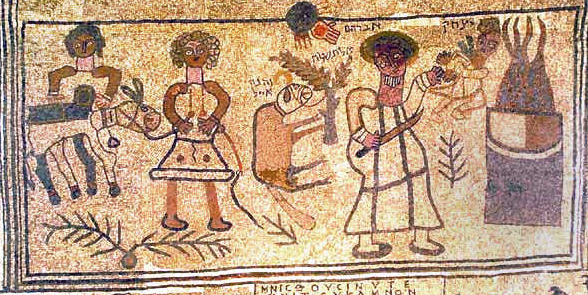
When, in ancient times, people read the account of the life of Abraham, it was common for them to ask, “When did Abraham finally make the grade? At which point in his life was Abraham approved and accepted by God?”
The Apostles and Prophets as the Foundation of the Church (Eph. 2:20)

This essay discusses a rhetorical device that has played an important role within postliberal writings: the idea that any appeal to the canons of logical necessity and/or conceptual consistency is in itself a defection to “another” foundation, that is, to a foundation set up in opposition to the role of Jesus Christ as the “church’s one foundation.”
If Your Eye Be Single

In Matt. 6:22, where you would expect to find the idiom, “good eye,” the adjective used in our saying is not καλός (kalos, “good,” “pleasant”) but ἁπλοῦς (haplous, “single,” “simple”).
Can Gentiles Be Saved?
Jesus’ broadminded approach resonates with contemporary sages who belonged to the School of Hillel. In their opinion, it is better to leave God-fearing Gentiles in their blessed state with only the necessity of the moral laws given to Noah.