
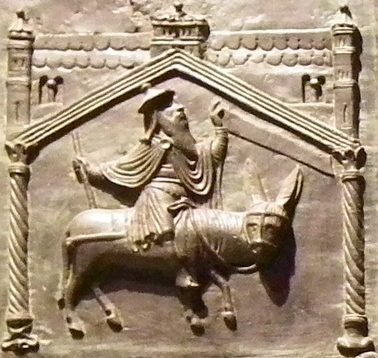
Revelation 2:12-16 is one of those occasions when it is necessary for the Christian reader to be familiar with first-century Jewish interpretation of an Old Testament account.

From Allegro to Zeitlin

In this article the author explains his view that the output of cheap, pseudo-scholarship has driven legitimate, serious scholarly information from the marketplace of ideas.
Were Women Segregated in the Ancient Synagogue?
Did women play a passive role in the synagogue congregations of antiquity? Were they separated from male members of the congregation during prayer and study, as is the case today? According to Professor Shmuel Safrai, the answer to both questions is a resounding “No.”
Paraphrastic Gospels
As Robert Lindsey realized in 1962, Mark reworked Luke’s Gospel in writing his own. Mark liked to substitute synonyms for nearly anything that Luke wrote. If, for instance, Luke used the singular of a noun, Mark substituted the plural form of the same noun in writing his Gospel. And vice versa: if Luke used the plural, Mark substituted the singular. In this article, Robert Lindsey surveys a unique substitution category found in Mark’s Gospel: the replacing of one verse of Scripture with another.
Gergesa: Site of the Demoniac’s Healing

The recent discovery of many of the ancient harbors that ringed the Sea of Galilee is an exciting chapter in Sea of Galilee research. One of these harbors is located at Kursi, ancient Gergesa. In this article, Mendel Nun contends that the demoniac’s healing and the miracle of the swine took place at Gergesa, not Gadara or Gerasa.
Stewards of God’s Keys
Jesus gave his disciple Peter the “keys of the kingdom of heaven” and promised that whatever Peter “bound” and “loosed” on earth would be “bound” and “loosed” in heaven. What scriptural allusions lurk beneath these expressions and what are their implications? How does the Jewish literary background of Matthew 16:19 help us better appreciate Jesus’ words?
The Power of Parables

Jesus was a master teacher. Therefore, it is significant that he relied heavily on parables. What is it about parables that makes them so moving and memorable?
Matthew 16:18: The Petros-petra Wordplay—Greek, Aramaic, or Hebrew?
The pinnacle of the Gospel story may be Jesus’ dramatic statement, “You are Petros and on this petra I will build my Church.” The saying seems to contain an obvious Greek wordplay, indicating that Jesus spoke in Greek. However, it is possible that “Petros…petra” is a Hebrew wordplay.