
I would like to congratulate Professor Safrai on his award, and add a personal note: I have known Professor Safrai since 1965 when he was one of my instructors at the Hebrew University. I have spent literally hundreds of hours with him. Not only is Professor Safrai one of the greatest scholars that the Hebrew University has ever produced, he is also a mensch. Kind, well-mannered, and above all, patient, he has been a model of right living to his many students.
The Transparent Agenda

As practitioners of Jesus’ teachings, our conduct certainly should be characterized by charity, but a helping hand with strings attached or expectations appended is not pleasant. This constitutes one of the mysterious aspects of the kingdom of heaven. It is The Transparent Agenda, a mandate to do good to all without prejudice and without expectations.
Don’t Throw Away That Piece of Bread!

The importance of sharing one’s bread with the poor has remained in the Jewish consciousness until today.
With All Due Respect…

The relationship between a sage and his disciple may be characterized both as that of a father to his son, and of a master to his servant. In effect, a disciple indentured himself to his teacher. Traveling with and attending to him, a disciple remained with his teacher twenty-four hours a day, three hundred sixty-five days a year. The etiquette governing the teacher-disciple relationship is a fascinating subject. In this article, Shmuel Safrai explores one aspect of that relationship: To what extent could an advanced disciple differ from the opinions of his teacher?
Parables of Ill Repute

In rabbinic parables God could be portrayed as behaving in a morally ambiguous manner: he might be a cruel slave owner or a heartless judge. In a few Lukan parables, Jesus also portrayed God as behaving scandalously. Often unsettling for modern readers, such portrayals added humorous elements to the plot and heightened the dramatic effect.
Design and Maintenance of First-century Ritual Immersion Baths
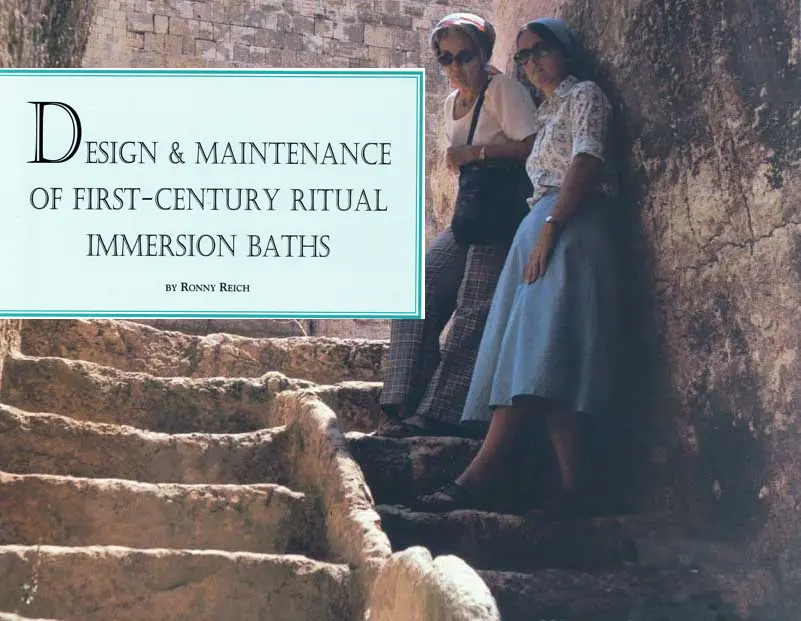
Archeologists and other scholars have not written prolifically about ancient mikvaot (or ritual immersion baths). Nevertheless, ritual immersion in the first century A.D. constitutes an important element of the overall historical, social and religious background of the New Testament. Here, Ronny Reich explains in non-technical language the intricacies of the design and maintenance of ancient mikvaot.
Deliver Us From Evil

Just as good poetry can convey multiple allusions, so “Deliver us from evil” can carry a variety of notions of protection from doing and experiencing evil.
The Synagogue the Centurion Built

Would a Roman officer have had the means to finance the construction of a synagogue in the lakeshore town of Capernaum?
Emulating the Ways of Sodom

As our disposable incomes have swelled and our pursuit of life’s finer things has gained momentum, has our concern for the destitute also swelled?
Were Women Segregated in the Ancient Synagogue?
Did women play a passive role in the synagogue congregations of antiquity? Were they separated from male members of the congregation during prayer and study, as is the case today? According to Professor Shmuel Safrai, the answer to both questions is a resounding “No.”