

God has a personal name: YHVH. Like Semitic names in general, it was intended to reflect something of the bearer’s character. YHVH is related to the root h-v-h, “to be”, and reflects God’s eternity and timelessness.
“And” or “But”—So What?
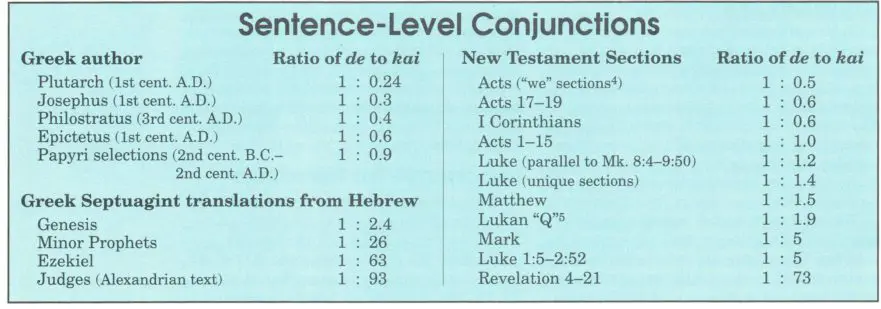
Writings that were originally composed in Greek tend to have a higher ratio of de to kai than writings that have been influenced by a Semitic language.
What Is the Priest Doing? Common Sense and Culture

Common sense is connected to cultural expectations. What is understandable in one culture may be opaque in another.
The Holy Spirit in the Hebrew New Testament

In this article, Dr. Ray Pritz, former head of the Bible Society in Israel, looks at another of the challenges faced by the Society’s translation committee in rendering the synoptic Gospels into modern Hebrew.
Who Is a Jew in the Gospels?

Most English translations consistently translate the Greek word Ἰουδαῖοι (Ioudaioi) as “Jews.” But this inflexible translation has often contributed to an anti-Semitic interpretation of the New Testament.
Matthew’s Aramaic Glue

Knowledge of the different ways of joining stories in Greek, Hebrew and Aramaic can help us understand the history and relationships of the Synoptic Gospels.
The New Testament in Modern Hebrew

In this series Dr. Ray Pritz, head of the Bible Society in Israel, describes the challenges faced by the Society’s translation committee in rendering the synoptic Gospels into modern Hebrew, and some of the solutions it found.
Sidebar: “Ears of Corn”?

Does the New Testament depict the disciples picking yellow sweet corn (maize) in firs-century Israel?
Gospel Postcard: Kefar Naḥum (Capernaum), the Village of Nahum

Jesus’ move from Nazareth to Capernaum was a tremendous change—from a little farm village hidden up in the hills, to a bustling lakeside fishing port.
What Kind of Blessing Is That?

In some cases a more informed understanding of the original setting of the Gospels can be communicated easily in a translation. A good translation will reflect that fuller, culturally appropriate understanding.