

What can the distribution of genitive absolute constructions in the Gospels of Matthew, Mark and Luke tell us about the origins of the Synoptic Gospels?
“And” or “In order to” Remarry?

Apparently, contrary to normal Greek usage, Greek’s kai (“and”) in the sense of “in order to” occurs in the Synoptic Gospels.
“And” or “But”—So What?
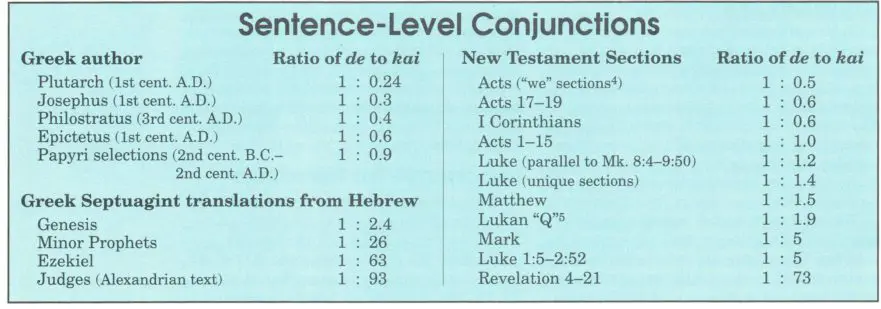
Writings that were originally composed in Greek tend to have a higher ratio of de to kai than writings that have been influenced by a Semitic language.
Sidebar: The Intricacies of Hebrew Gender

This article originally appeared in the JP magazine as a sidebar attached to “The Holy Spirit in the Hebrew New Testament” by Ray Pritz. Greek, like English, has three genders—masculine, feminine and neuter—while Hebrew has only masculine and feminine. There does not seem to be any logic as to whether a Hebrew noun is masculine …
The Holy Spirit in the Hebrew New Testament

In this article, Dr. Ray Pritz, former head of the Bible Society in Israel, looks at another of the challenges faced by the Society’s translation committee in rendering the synoptic Gospels into modern Hebrew.
Matthew’s Aramaic Glue

Knowledge of the different ways of joining stories in Greek, Hebrew and Aramaic can help us understand the history and relationships of the Synoptic Gospels.