
Mark’s placement of Jesus’ “no longer dared” comment is very awkward: first, because the comment comes in the middle of a lovefest between Jesus and a scribe; and second, because the comment immediately follows Jesus’ appreciation of the scribe’s wisdom: “You are not far from the Kingdom of God.”
Jesus’ Jewish Command to Love

Jesus’ command to “love your enemies” was revolutionary! No one before him dared to raise such a high standard for the life of faith.
The Qumran Targum of Job as a Window into Second Temple Judaism: A Response to Randall Buth’s “Where Is the Aramaic Bible at Qumran? Scripture Use in the Land of Israel”

How does one explain the sparseness of the Qumran targumic corpus?
More on the Absence of an Aramaic Bible at Qumran: A Response to Jack Poirier’s “The Qumran Targum of Job as a Window into Second Temple Judaism: A Response to Randall Buth”
I appreciate this opportunity to return to some issues concerning the Targum of Job that I raised in Where Is the Aramaic Bible at Qumran? Scripture Use in the Land of Israel and to evaluate Jack Poirier’s response entitled, The Qumran Targum of Job as a Window into Second Temple Judaism: A Response to Randall Buth.
Where Is the Aramaic Bible at Qumran? Scripture Use in the Land of Israel
The documents at Qumran allow us to reconstruct Scripture access in the Province of Judea in the first century. From the evidence, we must assume that the Qumran community and the other Jewish communities in the land had direct access to the Hebrew Bible, generally understood it, and were interested in teaching that related directly to the Hebrew text.
“Give unto Caesar”: Jesus, the Zealots and the Imago Dei

The retorts of Hillel and Jesus exemplify innovative developments in Jewish thought during the Second Temple period, developments that were established on the biblical notion that man was created in the image of God—Imago Dei (Gen. 1:27).
Were the Pharisees “Legalistic”?

If we define legalism as “works righteousness,” then we cannot apply it to the Pharisees, because the Pharisaic understanding of piety was not based upon this concept.
Parables of Ill Repute

In rabbinic parables God could be portrayed as behaving in a morally ambiguous manner: he might be a cruel slave owner or a heartless judge. In a few Lukan parables, Jesus also portrayed God as behaving scandalously. Often unsettling for modern readers, such portrayals added humorous elements to the plot and heightened the dramatic effect.
Us and Them: Loving Both

In ancient Roman society, the taking of revenge on an enemy was considered a commendable deed, but Jesus encouraged his followers to “Love your enemies.”
Design and Maintenance of First-century Ritual Immersion Baths
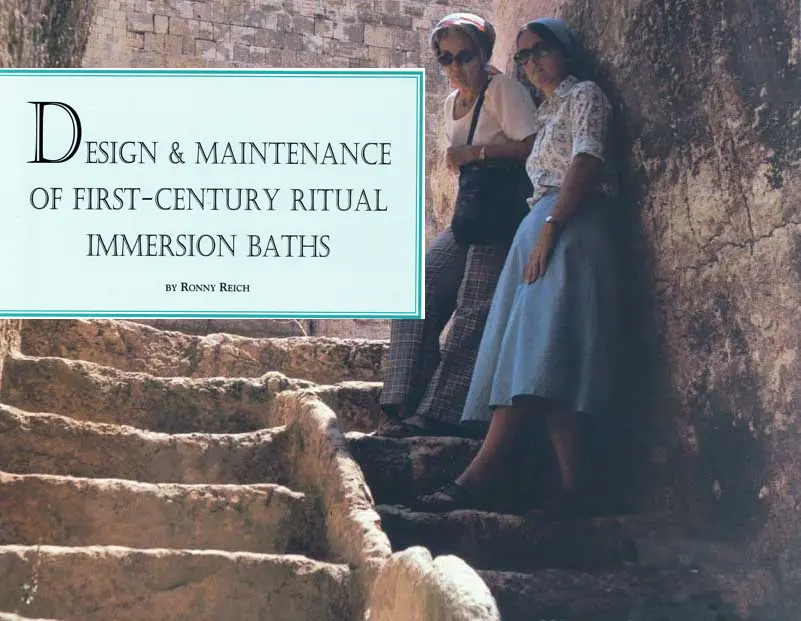
Archeologists and other scholars have not written prolifically about ancient mikvaot (or ritual immersion baths). Nevertheless, ritual immersion in the first century A.D. constitutes an important element of the overall historical, social and religious background of the New Testament. Here, Ronny Reich explains in non-technical language the intricacies of the design and maintenance of ancient mikvaot.