
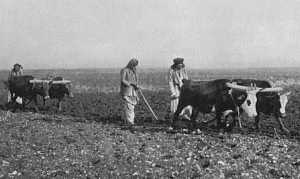
It appears that the original context for Jesus’ “Comfort for the Heavy-Laden” saying has been lost; however, passages in the apocrypha indicate that Jesus was speaking of Torah study and the rigors of first-century discipleship.
Selected Examples of Rewriting in Mark’s Account of Jesus’ Last Week

It has been noted that in instances where Mark’s editorial hand restructured his story, Luke has preserved a more primitive form of the account, a form that is independent of Mark’s influence. Gospel scholars need to properly evaluate Mark’s editorial style and acknowledge that frequently a theological agenda influenced his rewriting.
“Prophets and Kings”: The Evangelist Luke’s Curious Doublet

In a beautiful statement that probably referred to the Kingdom of Heaven, Jesus proclaimed to his disciples, according to Luke, that “many prophets and kings” desired to see and hear what they (his disciples) are seeing and hearing. Matthew preserves the same saying, but in Matthew’s account the doublet is, “prophets and righteous persons.” The wording of Jesus’ saying in these two accounts is so similar that it appears likely that their slight differences reflect literary, or editorial, changes rather than different versions of the saying uttered by Jesus on different occasions. If so, which of these gospel accounts preserves the more original form of Jesus’ saying? Did Jesus say “prophets and kings” or “prophets and righteous persons”?
The Season of Redemption

In the face of a national disaster, hope remained. Summer and its ripe figs—signs of future redemption—would come.
The “Desert” of Bethsaida

By analyzing the meaning of the word translated “desert,” the topography at the Feeding of the Five Thousand can be clarified.
Hendiadys in the Synoptic Gospels

Hebraisms are as ubiquitous in the Synoptic Gospels as cats in Jerusalem.
Unlocking the Synoptic Problem: Four Keys for Better Understanding Jesus
While translating the Gospel of Mark to modern Hebrew, pastor-scholar, the late Dr. Robert Lindsey was forced to conclusions that ran counter to his seminary training. If correct, his conclusions have the potential for revolutionizing New Testament scholarship. In this article, Lindsey condenses the results of a lifetime of research.
“And” or “But”—So What?
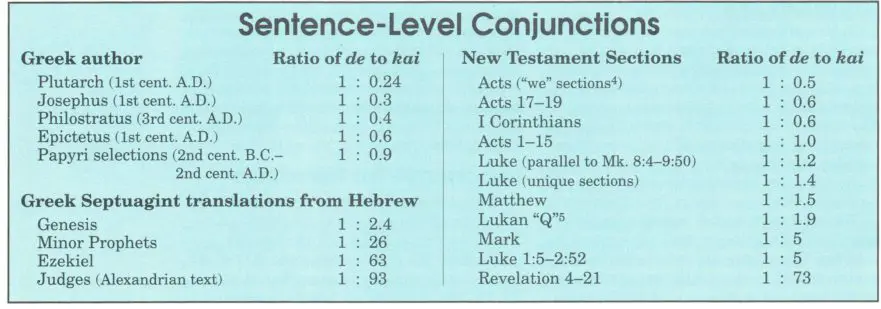
Writings that were originally composed in Greek tend to have a higher ratio of de to kai than writings that have been influenced by a Semitic language.
The Holy Spirit in the Hebrew New Testament

In this article, Dr. Ray Pritz, former head of the Bible Society in Israel, looks at another of the challenges faced by the Society’s translation committee in rendering the synoptic Gospels into modern Hebrew.
Matthew’s Aramaic Glue

Knowledge of the different ways of joining stories in Greek, Hebrew and Aramaic can help us understand the history and relationships of the Synoptic Gospels.