

Jerusalem Perspective presents a newly revised version of Robert Lindsey’s groundbreaking essay on the Synoptic Problem, which served as an introduction to his Hebrew Translation of the Gospel of Mark.
The Times of the Gentiles and the Redemption of Jerusalem
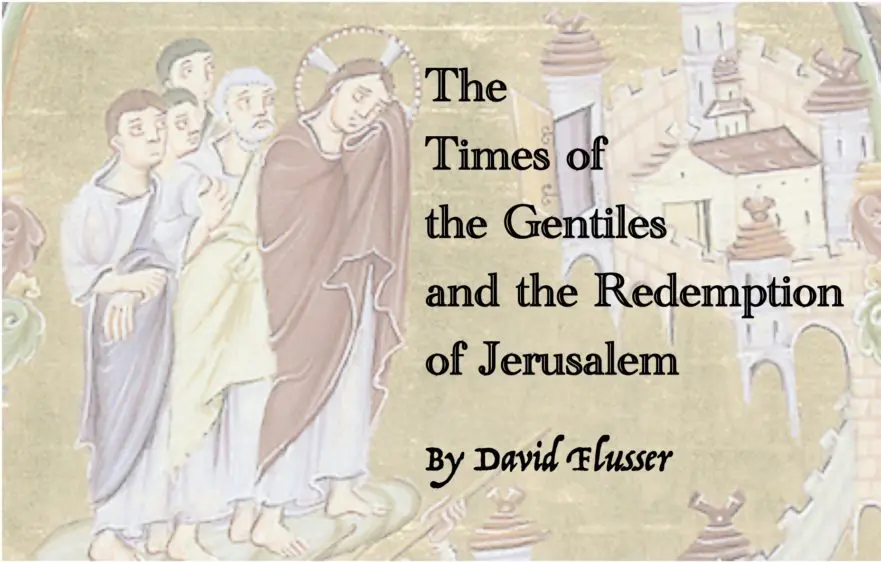
In this article David Flusser applies the methods of the Jerusalem School of Synoptic Research and the insights of Robert Lindsey’s solution to the Synoptic Problem to Jesus’ prophecy concerning the destruction and liberation of Jerusalem.
“It Is Said to the Elders”: On the Interpretation of the So-called Antitheses in the Sermon on the Mount

Jesus’ Sermon on the Mount deserves endless study, and the more one studies ancient Jewish sources, the clearer the meaning of these words of Jesus becomes.
Engaged: Clarifying A Few Words (over Mexican Dinner)

Ever since 1991 when I first received my back-issues of JP in the mail, I’ve remembered Bivin’s “To Destroy The Law” article from Issue #6. I had grown up with several teachings about Jesus’ fulfillment of the law of Moses, but this article clearly pointed out that if Jesus had communicated this in his mother-language and those words were translated into English we would probably have a completely different understanding of Matthew 5:17. It’s that pesky middle-language of Greek which so taints our understanding of Jesus’ message.
Hebraisms in the New Testament

The text of the New Testament contains many Semitic elements, some of which are Hebraisms. The Synoptic Gospels show evidence for the existence of wordplays and idioms that are typical of Hebrew.
Blessedness of the Twelve

Without a knowledge of the saying’s context, Jesus’ saying about eyes and ears and prophets and righteous men, seems quite prosaic. However, when it is understood that this saying deals with the Kingdom of Heaven, it becomes one of Jesus’ most exciting and dramatic statements.
Lord’s Prayer

David Bivin and Joshua Tilton envision how the Lord’s Prayer might have been formulated in its original language and explore the ancient Jewish context to which the Lord’s Prayer belongs.
Preparations for Eating the Passover Lamb

Careful analysis shows that a Hebraic source ultimately stands behind the Synoptic Gospels and that this source is best preserved in Luke. Luke’s version of the Preparations for Eating Passover Lamb preserves details—such as Jesus taking the initiative to send the two disciples, commanding the disciples to prepare the lamb, and using Hebraic idiom—that fit the cultural context of first-century Judaism.
Cataloging the Gospels’ Hebraisms: Part Six (Parallelism)

In this article, we will discuss the second type of parallelism: Antithetical Parallelism.
Cataloging the Gospels’ Hebraisms: Part Four (Parallelism)
Doubling, or repeating, is a characteristic feature of Hebrew. Hebrew loves to say things twice (or more!) by adding equivalents. Words, phrases, sentences, and even stories, are doubled (or tripled).