

Why do the wicked prosper? No one knows, but ancient Jewish thinkers reminded the faithful that appearances are not always what they seem.
“Shake the Dust from Your Feet”: What Did the Apostles’ Action Signify?
The standard interpretation of the apostles’ dust-shaking action proposes that Jesus turned the concept of the impurity of Gentile lands against the Jewish inhabitants of cities within the (ritually pure) land of Israel. This interpretation concludes that shaking the dust from their feet dramatically symbolized that Jesus’ apostles would henceforth regard the Jewish inhabitants of a city that had rejected their message as though they were cut off from Israel. It is time for this mistaken interpretation to finally be put to rest.
The Significance of Jesus’ Words “Not One Jot or One Tittle Will Pass from the Law” (Matt. 5:18)
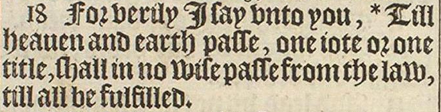
“Jot” and “tittle” are not everyday words in English. What do they mean and how should Jesus’ words in Matthew 5:18 be understood? Jerusalem Perspective‘s editor-in-chief, David Bivin, tackles these questions on behalf of a subscriber’s request for help.
Herod’s Tomb, Ehud Netzer and a Case of Mistaken Identity

The Herodium is a great place to bring people who are exploring the Holy Land for the first time. I always felt that the site spoke eloquently to visitors of both the brilliance and madness of Herod the Great.
Character Profiles: Gamaliel and Nicodemus

Gamaliel saved the lives of Jesus’ apostles, and also influenced Paul’s ethics, even after Paul’s conversion. Nicodemus belonged to the Hillelite anti-Zealot circles to which Jesus himself was close.
Covered in the Dust of Your Rabbi: An Urban Legend?

Some months ago, pastor-blogger Trevin Wax posted an article called “Urban Legends: The Preacher’s Edition.” There he lists several “urban legends” that he’s heard floating around lately in sermons. Like Internet rumors that people forward on ad infinitum, these preaching illustrations don’t have much grounding in fact.
Jesus’ Folded Napkin (John 20:7): Is it significant that Jesus’ burial napkin was found in the empty tomb folded?

The false theory that the folded “napkin” in Jesus’ tomb has deep spiritual significance is a good opportunity for us to sharpen our critical thinking skills.
What Did Jesus Mean by “Do Not Judge”?
Jesus’ teaching on judging is one of his most frequently misunderstood sayings, sounding as if he is saying, “Have no discernment. Just ignore sin!” Often we struggle to find a way to sort out sin without actually calling it that so that we do not judge. While Jesus’ ethical demands are high, we often give up trying to follow them if they do not make sense to us.
Parables of Ill Repute
In rabbinic parables God could be portrayed as behaving in a morally ambiguous manner: he might be a cruel slave owner or a heartless judge. In a few Lukan parables, Jesus also portrayed God as behaving scandalously. Often unsettling for modern readers, such portrayals added humorous elements to the plot and heightened the dramatic effect.
The New International Jesus
Inaccuracy in translating either through ignorance or because of an obscure manuscript reading is to be expected, but to skew wittingly due to academic bias or religious tendentiousness smirches the reputation of a venerable profession.