

As a consequence of my endeavor to produce a Modern Hebrew translation of the Gospel of Mark I began to develop a different picture of the interrelationship of the Synoptic Gospels than that which is espoused by most New Testament scholars.
Character Profile: Who Was John Mark?

Professor David Flusser on R. L. Lindsey’s “revolutionary step” in New Testament scholarship, showing that the Gospel of Mark, which made Jesus “less of a Jew,” was written latter than Luke.
Hebraisms in the New Testament
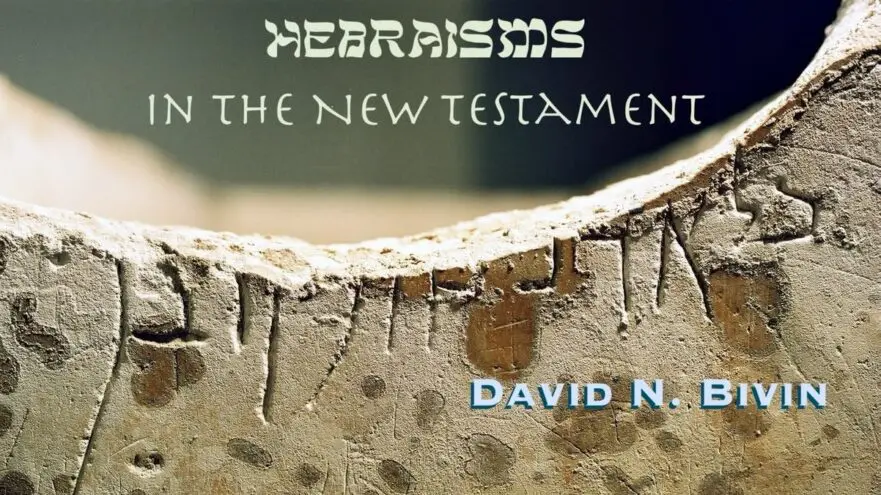
The text of the New Testament contains many Semitic elements, some of which are Hebraisms. The Synoptic Gospels show evidence for the existence of wordplays and idioms that are typical of Hebrew.
Lord’s Prayer

David Bivin and Joshua Tilton envision how the Lord’s Prayer might have been formulated in its original language and explore the ancient Jewish context to which the Lord’s Prayer belongs.
Introduction to The Life of Yeshua: A Suggested Reconstruction

Purpose and goals of the LOY Commentary.
Evidence of an Editor’s Hand in Two Instances of Mark’s Account of Jesus’ Last Week?
It has been noted that in instances where Mark’s editorial hand restructured his story, Luke has preserved a more primitive form of the account, a form that is independent of Mark’s influence. Gospel scholars need to properly evaluate Mark’s editorial style and acknowledge that frequently a theological agenda influenced his rewriting.
“They Didn’t Dare” (Matt 22:46; Mark 12:34; Luke 20:40): A Window on the Literary and Redactional Methods of the Synoptic Gospel Writers
Mark’s placement of Jesus’ “no longer dared” comment is very awkward: first, because the comment comes in the middle of a lovefest between Jesus and a scribe; and second, because the comment immediately follows Jesus’ appreciation of the scribe’s wisdom: “You are not far from the Kingdom of God.”
“Prophets and Kings”: The Evangelist Luke’s Curious Doublet

In a beautiful statement that probably referred to the Kingdom of Heaven, Jesus proclaimed to his disciples, according to Luke, that “many prophets and kings” desired to see and hear what they (his disciples) are seeing and hearing. Matthew preserves the same saying, but in Matthew’s account the doublet is, “prophets and righteous persons.” The wording of Jesus’ saying in these two accounts is so similar that it appears likely that their slight differences reflect literary, or editorial, changes rather than different versions of the saying uttered by Jesus on different occasions. If so, which of these gospel accounts preserves the more original form of Jesus’ saying? Did Jesus say “prophets and kings” or “prophets and righteous persons”?
Jesus, the Master Teacher: Part Four: “Binding and Loosing: Exercising Your Senses to Discern Good and Evil”
Friends of Jerusalem Perspective and those who have purchased access to this series from the JP Bookstore may listen to the audio in this post.
The Angel Who Has Delivered Me from All Harm
Dr. Horst Krüger, Jerusalem Perspective’s representative in Germany, has suggested to me that Genesis 48:16 may be part of the background to a phrase found in the Lord’s Prayer. I believe that Dr. Krüger has made an important discovery.