
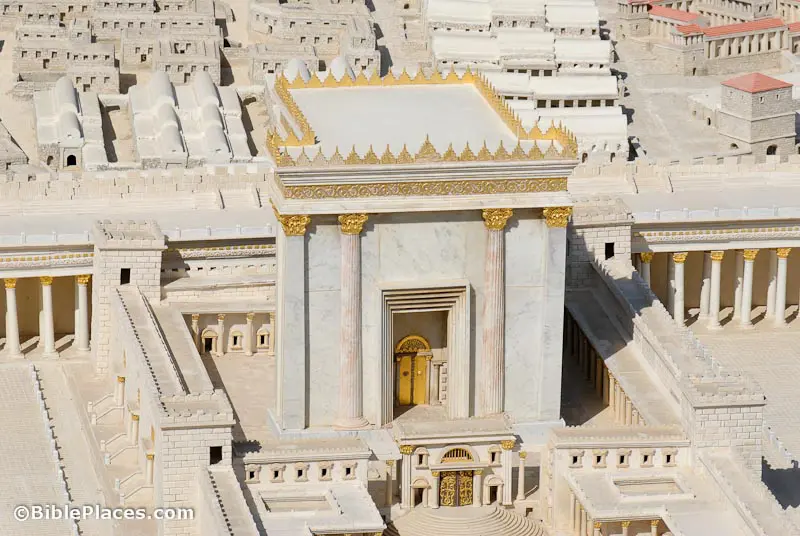
Why did the chief priests and Sadducees continue to oppose the early believers even after the crucifixion of Jesus? In this video Marc Turnage places the chief priests and Sadducees in their historical context and explains why the preaching of the apostles was unwelcome news to the Temple authorities in Jerusalem.
Tower Builder and King Going to War Similes

The Tower Builder and King Going to War similes explain why Jesus thought full-time discipleship was not suitable for everyone.
Engaged: Clarifying A Few Words (over Mexican Dinner)

Ever since 1991 when I first received my back-issues of JP in the mail, I’ve remembered Bivin’s “To Destroy The Law” article from Issue #6. I had grown up with several teachings about Jesus’ fulfillment of the law of Moses, but this article clearly pointed out that if Jesus had communicated this in his mother-language and those words were translated into English we would probably have a completely different understanding of Matthew 5:17. It’s that pesky middle-language of Greek which so taints our understanding of Jesus’ message.
On “Blood” in the Apostolic Decree (Acts 15:19-20)

Flusser and Safrai’s premise is that “blood” in this passage does not refer to the consumption of blood but rather to murder. They conclude that the apostolic decision prohibiting eating meat sacrificed to idols, fornication, and blood is equal to the rabbinic decree that under penalty of death a Jew may violate any of the commandments of the Torah with the exception of idolatry, adultery and murder.
Engaged: Eternally Dwelling In Hell?

Becker discusses a JP article where one verse of Mark has Jesus using an idiom which might be misunderstood by translators. Becker purports that the discovery should engage our readers on the topic of death after death.
Cataloging the Gospels’ Hebraisms: Part Six (Parallelism)

In this article, we will discuss the second type of parallelism: Antithetical Parallelism.
Cataloging the Gospels’ Hebraisms: Part Four (Parallelism)
Doubling, or repeating, is a characteristic feature of Hebrew. Hebrew loves to say things twice (or more!) by adding equivalents. Words, phrases, sentences, and even stories, are doubled (or tripled).
Cataloging the Gospels’ Hebraisms: Part Three (Impersonal “They”)
Awareness of even the simplest Hebrew grammatical structure can bring to life a vague, or difficult-to-understand, saying of Jesus. Since potential Hebrew idioms are so dense in the Greek texts of Matthew, Mark and Luke, one has to ask, Could these apparent Hebrew idioms be evidence that the synoptic Gospels are descendants of an ancient translation of a Hebrew “Life of Jesus,” the gospel that the church father Papias spoke of when he wrote: “Matthew…arranged the sayings [of Jesus] in the Hebrew language”?
Cataloging the Gospels’ Hebraisms: Part Two (Luke 9:51-56)
Relatively few of the suggested Semitisms underlying the Greek New Testament constitute clear-cut proof for a Hebrew undertext, but a high density of Hebraisms in a given passage increases the probability that it is “translation Greek.”
Jesus and the Enigmatic “Green Tree”
Jesus made bold messianic claims when he spoke. To thoroughly understand these claims, however, we must get into a time machine and travel back in time to a completely different culture, the Jewish culture of first-century Israel. We must acculturate ourselves to the way teachers and disciples in the time of Jesus communicated through allusions to Scripture.