

Jerusalem Perspective presents a newly revised version of Robert Lindsey’s groundbreaking essay on the Synoptic Problem, which served as an introduction to his Hebrew Translation of the Gospel of Mark.
“Verily” or “Amen”—What Did Jesus Say?
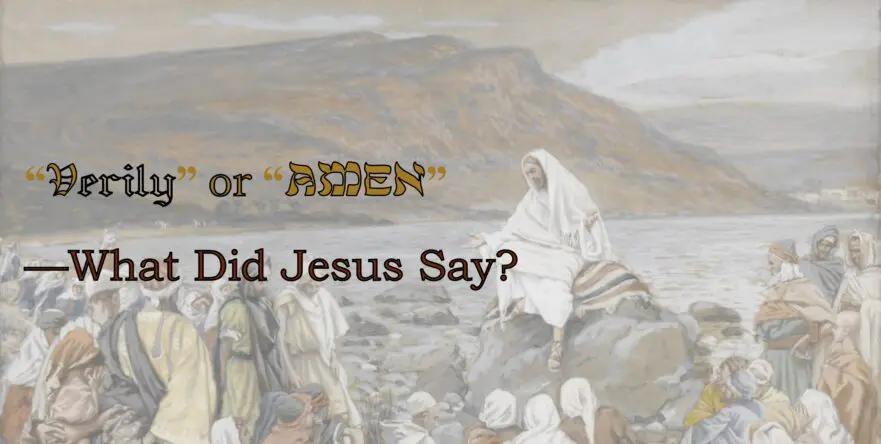
In translating the Greek texts of the Gospels into Hebrew, Dr. Lindsey found that many passages could be rendered literally with almost no change of word order. The result was a Hebrew version that often sheds fascinating light on the meaning of Jesus’ words, so much so that Lindsey came to believe the Greek sources Matthew, Mark and Luke used were rendered very literally from Hebrew originals. This Hebraic perspective sometimes explains Gospel passages that have long been considered difficult or ambiguous. In the following article, Lindsey presents one example of what has been considered a uniquely idiosyncratic expression of Jesus, but which a Hebraic perspective reveals to be a familiar phrase from the Scriptures.
Cataloging the Gospels’ Hebraisms: Part Six (Parallelism)

In this article, we will discuss the second type of parallelism: Antithetical Parallelism.
Cataloging the Gospels’ Hebraisms: Part Four (Parallelism)
Doubling, or repeating, is a characteristic feature of Hebrew. Hebrew loves to say things twice (or more!) by adding equivalents. Words, phrases, sentences, and even stories, are doubled (or tripled).
The “King James Only” Debate

Have you read a book called New Age Bible Versions by Gail Riplinger? She claims that the only reliable translation of the Bible is the King James Version.
Cataloging the Gospels’ Hebraisms: Part Three (Impersonal “They”)
Awareness of even the simplest Hebrew grammatical structure can bring to life a vague, or difficult-to-understand, saying of Jesus. Since potential Hebrew idioms are so dense in the Greek texts of Matthew, Mark and Luke, one has to ask, Could these apparent Hebrew idioms be evidence that the synoptic Gospels are descendants of an ancient translation of a Hebrew “Life of Jesus,” the gospel that the church father Papias spoke of when he wrote: “Matthew…arranged the sayings [of Jesus] in the Hebrew language”?
Jesus and the Enigmatic “Green Tree”
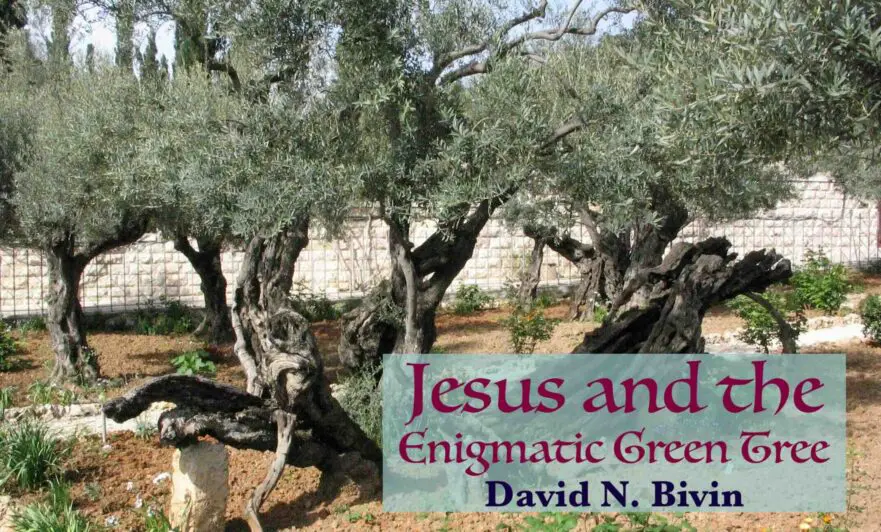
Jesus made bold messianic claims when he spoke. To thoroughly understand these claims, however, we must get into a time machine and travel back in time to a completely different culture, the Jewish culture of first-century Israel. We must acculturate ourselves to the way teachers and disciples in the time of Jesus communicated through allusions to Scripture.
Why Learn to Speak a Dead Language?
Why would anyone in his or her right mind want to speak a “dead” language, a language that no one speaks? The answer: Because only by speaking a language does one internalize it, and it was high time, Randall and I felt, having tasted fluency in Hebrew, that we should gain an active knowledge of Koine Greek.
Mark 7:19: Did Jesus Make “Unclean” Food “Clean”?
One should not be too quick to throw out large portions of the Torah because of a four-word parenthetical comment by Mark at the end of a long halachic discussion.
Written, Inspired and Profitable
The Bible provides minimal help for anyone trying to write a description of it for inclusion in a Statement of Faith. As a result, such descriptions typically claim more than the Bible discloses about itself.