
The date of Shavuot was the focus of one of the fiercest of many debates between the Pharisees and Sadducees.
The Parable of the Rich Man and Lazarus: Did the Rich Man End Up in Hell or Gehenna? (Luke 16:22)

Mechanically reconstructing to Hebrew Greek texts found in Matthew, Mark and Luke on the basis of Septuagintal equivalents can widely miss the mark.
Sidebar: Robert Lindsey According to Prof. Flusser

Here are some of Flusser’s remarks from his published works about Lindsey’s contribution to synoptic studies.
Book Review: Robert Lindsey’s A Comparative Greek Concordance of the Synoptic Gospels
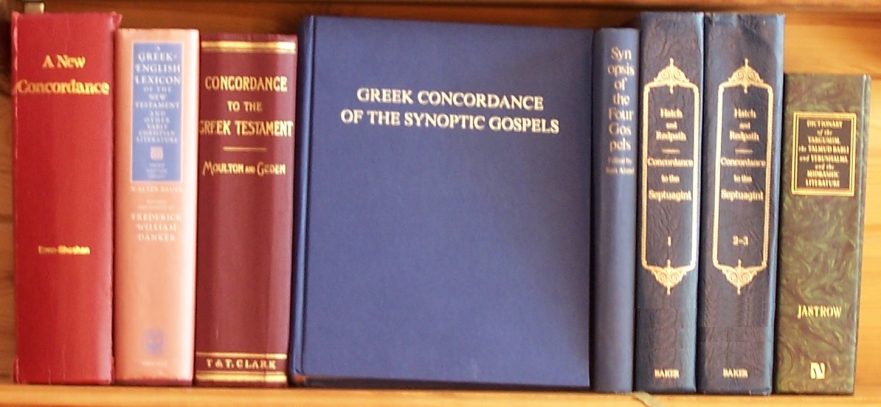
With the publication of the third and final volume of A Comparative Greek Concordance of the Synoptic Gospels, Dr. Robert Lindsey has given to the scholars who have been following his work, as well as to future scholarship, a necessary tool for the study of the synoptic Gospels.
Book Review: Robert L. Lindsey’s Jesus, Rabbi and Lord
There are many unique proposals in this book which deserve serious consideration.
Why does Jerusalem Perspective use the Greek name “Jesus” instead of “Y’shua” or “Yeshua”?

We use the spelling “Jesus” simply because that’s the way the name is written in English.
Does God Have a Gender?

Some people see theological significance in the fact that in Hebrew the gender of the third person of the Trinity is feminine.
Which Day Is the True Sabbath: Saturday or Sunday?
We must be careful to maintain a distinction between a day of meeting and a day of rest.
Book Review: Michael Sokoloff’s A Dictionary of Jewish Palestinian Aramaic of the Byzantine Period
Professor Sokoloff’s A Dictionary of Jewish Palestinian Aramaic of the Byzantine Period limits itself to the best and most reliable sources of JPA
Did Jerome see the Hebrew Gospel of Matthew?
Not only did Jerome (374-420 A.D.) claim to have seen a Hebrew gospel, he said he had translated it.
Sidebar: The Kingdom of Heaven

Both Jesus and the sages generally viewed the Kingdom of Heaven in a practical, everyday way: doing the will of God.

Book Review: Marvin Wilson’s Our Father Abraham: Jewish Roots of the Christian Faith

Wilson offers a number of helpful suggestions that will enable Christians to adopt “a Hebraic orientation toward life and the world.”
Book Review: Brad Young’s Jesus and His Jewish Parables
From the outset Young argues that the best way to understand what Jesus was teaching in his parables is to try to hear him as he spoke to his people. The author argues that this can best be done by analyzing the parables of Jesus together with those told by other rabbis of his day.
Book Review: David Flusser’s Personal Perspective on Brad Young’s Jesus and His Jewish Parables
Anyone who wants to be a good worker in the field of Jesus’ parables should begin by studying Brad Young’s Jesus and His Jewish Parables.
Scholarly Assumptions about the Historical Jesus

Many scholars today feel that it is impossible to know what the historical Jesus really said.
Who Was Jesus?
TIME magazine’s August 15, 1988 issue presented a sad picture of the current state of scholarly knowledge. After 200 years of “scientific” investigation into New Testament records of the life of Jesus, scholars are more divided than ever as to who Jesus was and who he thought he was. Even sadder, the Herculean efforts of generations of scholars have brought Jesus no nearer to the ordinary believer.
Gospel Translation

Hebrew words usually have many shades of meaning, and the Greek translator of the conjectured Hebrew “Life of Jesus” could convey only one sense of each Hebrew word’s meaning. When the standard Greek translation of a Hebrew word became fixed, Greek translators often employed this standard translation even when the Hebrew word it translated appeared with an obviously different meaning.