

During his recent tour of the Holy Land, Pope Francis shared his views on the language of Jesus with Israeli Prime Minister, Benjamin Netanyahu. Jerusalem School scholars weigh in on the debate.
LOY Excursus: Greek Transliterations of Hebrew, Aramaic and Hebrew/Aramaic Words in the Synoptic Gospels
One of the clues that the Synoptic Gospels descended from a Hebrew Life of Yeshua is the number of foreign words that were transliterated into Greek from either Hebrew or Aramaic (it is often impossible to distinguish Hebrew from Aramaic in Greek transliteration).
“Treasure in Heaven”: Examining an Ancient Idiom for Charity

The growing value placed on charity in the first century C.E. cannot be overstated. As a new sensitivity developed within Judaism that challenged the compensatory “blessings and curses” paradigm of the Hebrew Bible (cf. Deut. 28) as a basis to serve God, so there was a shifting emphasis towards altruistic love embodied in the Levitical commandment, “…and you shall love your neighbor as yourself (וְאָהַבְתָּ לְרֵעֲךָ כָּמוֹךָ אֲנִי יי; Lev. 19:18).”
1987 Interview with Dr. Robert Lindsey

In 1987 Robert Lindsey conducted an interview in which he discussed many aspects of his life and ministry. In the following clips Dr. Lindsey discusses the usefulness of knowing Hebrew for a proper understanding of Jesus’ message.
“Verily” or “Amen”—What Did Jesus Say?
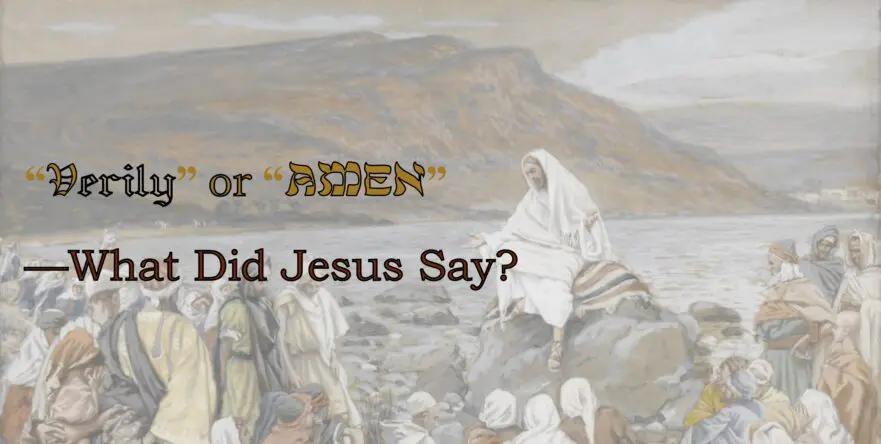
In translating the Greek texts of the Gospels into Hebrew, Dr. Lindsey found that many passages could be rendered literally with almost no change of word order. The result was a Hebrew version that often sheds fascinating light on the meaning of Jesus’ words, so much so that Lindsey came to believe the Greek sources Matthew, Mark and Luke used were rendered very literally from Hebrew originals. This Hebraic perspective sometimes explains Gospel passages that have long been considered difficult or ambiguous. In the following article, Lindsey presents one example of what has been considered a uniquely idiosyncratic expression of Jesus, but which a Hebraic perspective reveals to be a familiar phrase from the Scriptures.
Hebraisms in the New Testament

The text of the New Testament contains many Semitic elements, some of which are Hebraisms. The Synoptic Gospels show evidence for the existence of wordplays and idioms that are typical of Hebrew.
I happily stand corrected!
After reading my “Jehovah, A Christian Misunderstanding” article, a Jerusalem Perspective Member provided several impressive references, pointed out that the Christian reading “Jehovah” can be traced to Raymond Martin’s Pugeo Fidei (1270 A.D.), and may have originated much earlier, even as early as the ninth century!
Cataloging the Gospels’ Hebraisms: Part Six (Parallelism)

In this article, we will discuss the second type of parallelism: Antithetical Parallelism.
Cataloging the Gospels’ Hebraisms: Part Five (Parallelism)
Parallelism is a central feature of Hebrew poetry. It permeates the words of biblical poet and prophet. The frequency with which parallelism occurs in the utterances of Jesus is surprising, and leads inevitably to the conclusion that the Greek source (or, sources) used by the authors of Matthew, Mark and Luke derive(s) from a Greek translation (or, translations) of Hebrew documents.
Cataloging the Gospels’ Hebraisms: Part Four (Parallelism)
Doubling, or repeating, is a characteristic feature of Hebrew. Hebrew loves to say things twice (or more!) by adding equivalents. Words, phrases, sentences, and even stories, are doubled (or tripled).