

It seems clear that Lindsey’s observations have provided a decisive new clue to understanding the synoptic relationships and an equally important clue to the correct approach to the Gospel of Mark.
From Luke to Mark to Matthew: A Discussion of the Sources of Markan “Pick-ups” and the Use of a Basic Non-canonical Source by All the Synoptists

The first article I wrote on the interrelationships of Matthew, Mark and Luke to each other and to other canonical and non-canonical sources appeared in the journal Novum Testamentum. With further research, however, I refined my hypothesis.
An Interview with Dwight A. Pryor

January 2009 marked the 25th anniversary of The Center for Judaic-Christian Studies. In the following interview, the Center’s founder, Dwight Pryor, surveys his life’s journey, and reflects on the dangers inherent in the “Jewish Roots” movement. Dwight’s words are a clarion call to those who are part of this renewal, and a sobering warning to those who would abuse the fledgling movement.
A History of the Intersection of JP, JS, & Brian Becker
Fifteen years ago, I met David and Josa Bivin at a seminar in Tulsa, OK, made possible by HaKesher. As an introduction, I would like to share with you the cord that weaves my life with David’s family.
A Personal Tribute to Professor Shmuel Safrai, Recipient of the Israel Prize
I would like to congratulate Professor Safrai on his award, and add a personal note: I have known Professor Safrai since 1965 when he was one of my instructors at the Hebrew University. I have spent literally hundreds of hours with him. Not only is Professor Safrai one of the greatest scholars that the Hebrew University has ever produced, he is also a mensch. Kind, well-mannered, and above all, patient, he has been a model of right living to his many students.
A Milestone in Halvor Ronning’s Life: Cause for Reflection

Last night I attended the birthday party of one of my closest friend, Halvor Ronning. Gathered around him were children, grandchildren and friends. Having lived 65 years, Halvor had reached a milestone in his life. There was good reason to celebrate.
Why I Am a Member of the Jerusalem School

The appeal of the Jerusalem School of Synoptic Research lies in the potential of its research methodologies to make the words and claims of Jesus clearer.
A Body, Vultures and the Son of Man (Luke 17:37)

“Wheresoever the body is, thither will the eagles be gathered together” (Luke 17:37; KJV), is certainly one of the most enigmatic of Jesus’ sayings.
A New Solution to the Synoptic Problem

The many similarities among the Synoptic Gospels suggest a literary interdependence.
“And” or “But”—So What?
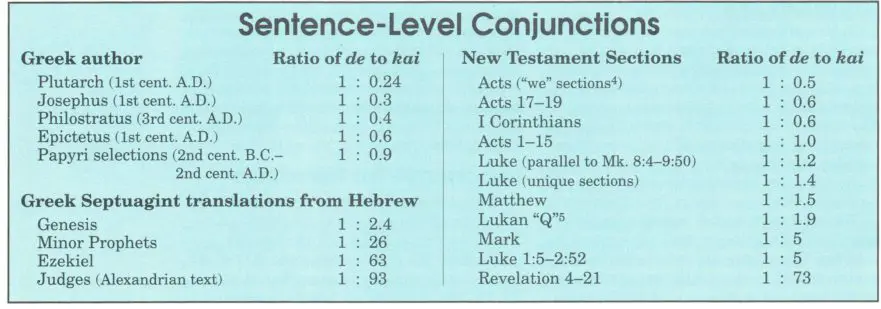
Writings that were originally composed in Greek tend to have a higher ratio of de to kai than writings that have been influenced by a Semitic language.