

Romans 8:28 has been read as a free-floating logion for years (at least in the American Bible culture), divorced from a context that would, if properly respected, lend it a much more limited meaning.
The Interpretive Key to the Four Horsemen of the Apocalypse
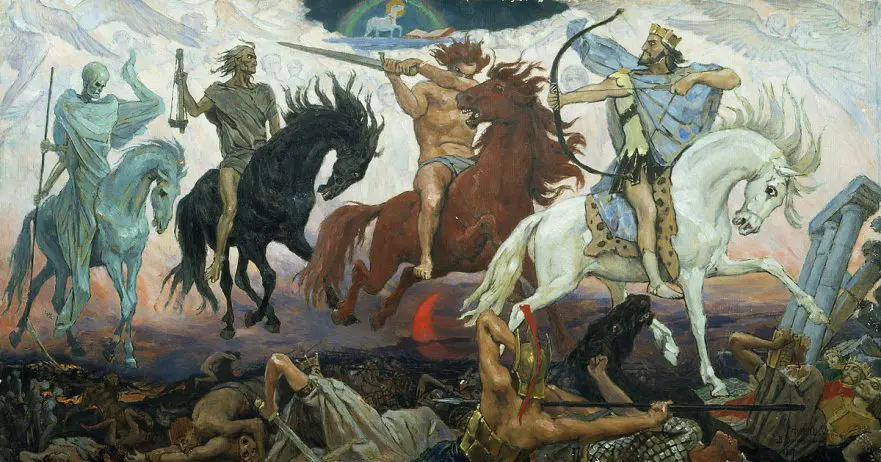
Modern readers of the Book of Revelation usually assume that the key to understanding the book lies in discovering a one-to-one correspondence between the figures it presents, and real-life figures. But the correct interpretation of the four horsemen appears only when we consider the four together as a unified symbol of widespread calamity.
The “Only Begotten” Son
As a small boy growing up in Alabama I had a deep love of God and a real hunger to know him better. By the age of eight I had read the entire Bible. But, like most people, I often struggled to understand what the Scriptures were saying. Many verses didn’t seem to make sense.
One God and Lord

The restoration of the Jewish homeland, Israel, and the reconnection of the Church to its Jewish roots are not unrelated phenomena. Many sectors of the Body of Messiah today are being stimulated and enriched by the “nourishing sap” of Israel’s faith, scriptures and scholarship. We are discovering that there is scarcely a single New Testament subject that cannot be amplified, deepened, or balanced by a Hebraic perspective. As disciples of Yeshua, we are deeply indebted to Israel.
Romans 11: The Olive Tree’s Root
Paul spoke about Israel as a “cultivated olive tree” whose rootage was in the Patriarchs, particularly Abraham. Some Bible commentators, however, interpreted the root of the olive tree as Christ or his messianic program.
Were the Pharisees “Legalistic”?

If we define legalism as “works righteousness,” then we cannot apply it to the Pharisees, because the Pharisaic understanding of piety was not based upon this concept.
Beyond an Inheritance

Could it be that the original integrity of Jesus’ message about the Kingdom of Heaven was later compromised by the presence of other expectations of a messianic-eschatological character that circulated promiscuously in early Christian communities?
Learning Is for Life

Sharing personal insights from his own spiritual journey and his study of the Scriptures, the late Dwight Pryor, founder of the Center for Judaic-Christian Studies, reflects on the life of Jesus for Christian readers of JP.
Walk after Me!
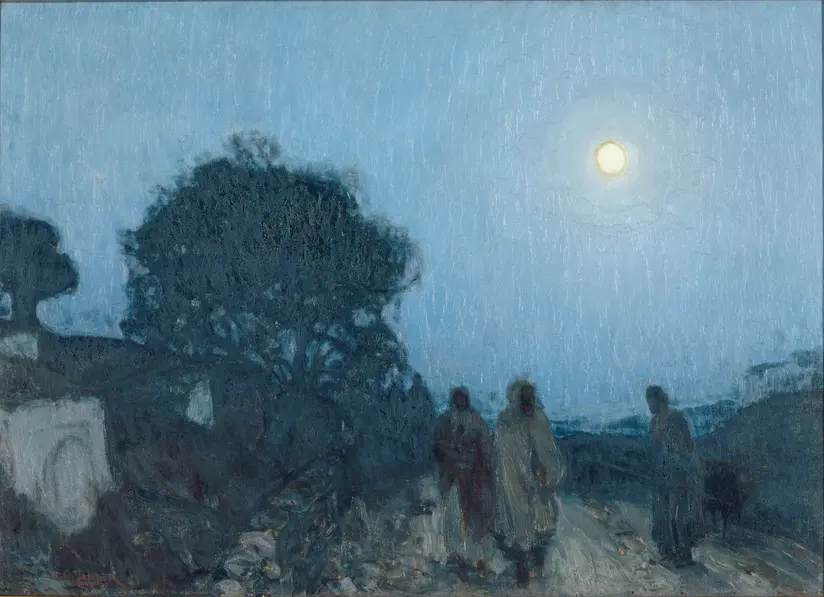
Sharing personal insights from his own spiritual journey and his study of the Scriptures, the late Dwight Pryor, founder of the Center for Judaic-Christian Studies, reflects on the life of Jesus for Christian readers of Jerusalem Perspective (JP).