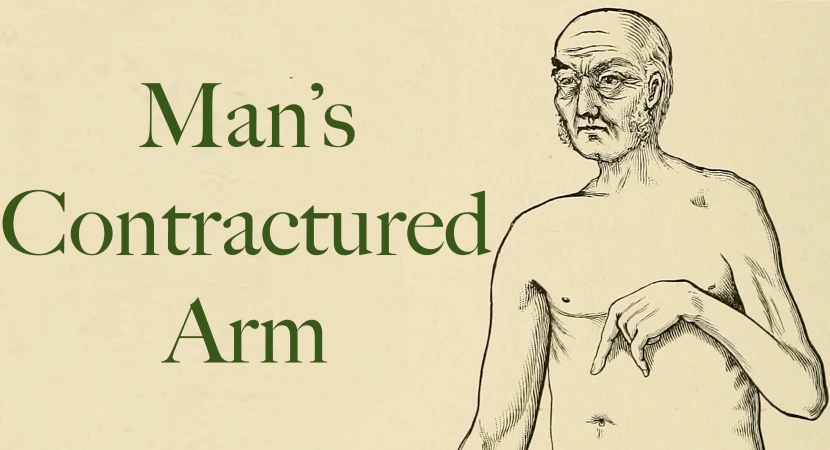
How to cite this article: Joshua N. Tilton, David N. Bivin, and Lauren Asperschlager, “Man’s Contractured Arm,” The Life of Yeshua: A Suggested Reconstruction (Jerusalem Perspective, 2025) [https://www.jerusalemperspective.com/30940/].
Matt. 12:9-14; Mark 3:1-6; Luke 6:6-11[1]
וַיְהִי בַּשַּׁבָּת וַיִּכָּנֵס לְבֵית הַכְּנֶסֶת וְהִנֵּה אָדָם יְמִינוֹ יְבֵשָׁה וַיִּשְׁאָלוּהוּ לֵאמֹר הֲיֵשׁ בַּשַּׁבָּת לְרַפְּאוֹת וַיּאֹמֶר לָאָדָם קוּם וַעֲמֹד בַּתָּוֶךְ וַיָּקָם וַיַּעֲמֹד וַיּאֹמֶר לָהֶם אֲנִי שׁוֹאֵל אֶתְכֶם הֲיֵשׁ בַּשַּׁבָּת לְקַיֵּם נֶפֶשׁ אוֹ לְאַבְּדָהּ מִי בָּכֶם אָדָם שֶׁיֵּשׁ לוֹ שֶׂה וְאִם יִפֹּל בַּשַּׁבָּת אֶל פַּחַת הֲלֹא יְקַיְּמֵהוּ עַל אַחַת כַּמָּה וְכַמָּה אָדָם שֶׁחָמוּר מִשֶּׂה וַיּאֹמֶר לָאָדָם שְׁלַח יָדְךָ וַיִּשְׁלַח יָדוֹ וְהִנֵּה שָׁבָה כִּבְשָׂרוֹ וַיְדַבֵּר אִישׁ אֶל רֵעֵהוּ לֵאמֹר מַה נַּעֲשֶׂה לְיֵשׁוּעַ
And it happened on the Sabbath that Yeshua entered a synagogue. A person was there whose right arm was contractured. They asked Yeshua, “Is there a duty on the Sabbath to heal?” But Yeshua said to the man, “Rise and stand in the center.” So he rose and stood. Then Yeshua said to them, “I will ask you a question. Is there a duty on the Sabbath to preserve life or to destroy it? Who among you has a sheep? If the sheep falls into a pit on the Sabbath, wouldn’t you preserve its life? Then how much more in the case of a human being!” To the man Yeshua said, “Stretch out your arm!” And he stretched it out. And behold! It returned from being contractured to being the way his flesh should be. And each discussed with his neighbor saying, “What can we do with Yeshua?”[2]
| Table of Contents |
|
3. Conjectured Stages of Transmission 5. Comment 8. Conclusion |
Reconstruction
To view the reconstructed text of Man’s Contractured Arm click on the link below:
Story Placement
In all three of the Synoptic Gospels Man’s Contractured Arm occurs as the sequel to Lord of Shabbat.[3] However, the strength of the connection between these two episodes differs among the three Gospels.
The weakest connection between the two episodes is in Luke, which states that the events described in Man’s Contractured Arm took place ἐν ἑτέρῳ σαββάτῳ (en heterō sabbatō, “on another Sabbath”; Luke 6:6). Luke’s phrase allows for, but does not imply, chronological sequence. What took place in Man’s Contractured Arm happened on “another” Sabbath than the events described in Lord of Shabbat. Man’s Contractured Arm could just as easily be a flashback to an earlier point in the chronology as it could be a jump forward in time. The two episodes are collated because the subject matter (Sabbath observance) is the same, not because one event happened before or after the other.
In Mark’s Gospel the connection between the two episodes is stronger. The two events are not clearly distinguished as having taken place on different Sabbaths. Rather, Mark informs his readers that Jesus “again” entered the synagogue (Mark 3:1). Unlike Luke’s “on another Sabbath,” Mark’s “again” does imply chronological sequence:[4] Jesus first debated Sabbath observance with the Pharisees in Lord of Shabbat, and later, in Man’s Contractured Arm, Jesus debated with them “again.” Mark’s wording allows for the possibility that after the encounter with the Pharisees in the barley field described in Lord of Shabbat Jesus made his way to the synagogue.
That Mark’s narrative could be understood in this way is proven by Matthew’s version of Man’s Contractured Arm, in which Jesus, departing “from there” (i.e., the barley field), comes to the synagogue (Matt. 12:9). Matthew’s version leaves no doubt that the two events took place one after the other. This progressive strengthening of the ties between Lord of Shabbat and Man’s Contractured Arm is a literary phenomenon that is consistent with Lindsey’s hypothesis that the transmission of the synoptic tradition went from Luke to Mark to Matthew.
The weak connection between the two episodes in Luke’s Gospel is likely to be the most historically accurate. The differing casts of characters suggest that the two episodes took place at different stages of Jesus’ career. In Lord of Shabbat the cast of characters includes the disciples, who are not merely present but central to the plot. It is their conduct that certain of the Pharisees questioned. It is clear, therefore, that Lord of Shabbat took place well into Jesus’ public career. By contrast, in Man’s Contractured Arm the disciples are not among the cast of characters.[5] The disciples are not even mentioned as bystanders or witnesses to the event. Their absence from the story suggests the events described in Man’s Contractured Arm took place before Jesus acquired a following of disciples.[6] Thus, the possibility that Man’s Contractured Arm is a chronological “flashback” is likely confirmed. The placement of Man’s Contractured Arm next to Lord of Shabbat is thematic, not chronological, and these pericopae may owe their collocation to the Anthologizer, who, according to Lindsey, rearranged the stories of Jesus according to subject matter.
On account of the disciples’ absence from this pericope we have placed Man’s Contractured Arm in the section of Jesus’ biography labeled “Yeshua, the Galilean Miracle-Worker,” which takes place before Jesus began calling disciples.
.

.
Click here to view the Map of the Conjectured Hebrew Life of Yeshua.
.
.
Conjectured Stages of Transmission

Most scholars assume that Mark’s version of Man’s Contractured Arm was the source for Luke’s[7] and Matthew’s.[8] However, we have already encountered some evidence—the tightening of the bonds between Lord of Shabbat and Man’s Contractured Arm that progresses from Luke to Mark to Matthew—that calls this assumption into question.
Further evidence for a Luke to Mark to Matthew sequence of transmission is found at the conclusion of the pericope. In Luke’s version the conclusion is low-key and credible. It accords well with other stories about charismatic wonder-workers in ancient Jewish sources, and it reverts well to Hebrew. In Luke’s version of Man’s Contractured Arm the baffled observers discuss “what they might do with Jesus” (Luke 6:11), since although they were uncomfortable with Jesus’ approach, Jesus had not actually done anything objectionable. Indeed, Jesus had not done anything at all—God had healed the man’s arm in apparent confirmation of Jesus’ opinion[9] —so there was nothing the spectators could do with Jesus except let him go on his way.
The situation is similar to a story in the Mishnah about the charismatic wonder-worker Ḥoni the Circle-Maker, who prayed for rain in an abrupt and forthright style.[10] Whereas the Pharisaic leader Shimon ben Shetaḥ personally objected to Ḥoni’s impetuous manner toward God, God’s answer to Ḥoni’s prayer demonstrated that “the butler is more regal than the king.” If God was willing to accept Ḥoni’s impetuous manner, then Shimon ben Shetaḥ would have to accept it too: צַרִיךְ אָתָּה לִנַדּוֹת אֲבַל מָה אֶעֱשֶׂה לָךְ (“You ought to be excommunicated, but what can I do with you?”; m. Taan. 3:8). Even the formulation of the Pharisees’ question resembles the discussion of the onlookers in Luke 6:11 concerning τί ἂν ποιήσαιεν τῷ Ἰησοῦ (“what they might do with Jesus”).
In Mark the response to the healing of the man’s arm is quite different. The Pharisees plot with the Herodians “how they might destroy” Jesus (Mark 3:6). Their reaction is wildly disproportionate to the situation, since Jesus did nothing in violation of the Sabbath. The conclusion in Matthew is substantially the same as Mark’s, except for a few stylistic improvements and the omission of the mysterious Herodians.
Some scholars have suggested that, for one reason or another,[11] the author of Luke toned down Mark’s conclusion to the story.[12] But secondary redaction in Greek does not result in a story that is more credible, more Jewish, and more Hebraic than the original. As Flusser observed, “Water does not flow uphill. It is simply impossible to believe that the Matthean-Markan account could be changed secondarily into the Lukan form.”[13]
Thus, Lindsey’s Luke-to-Mark-to-Matthew model finds powerful confirmation in Man’s Contractured Arm. This is not to say, however, that Luke’s version of the pericope has not undergone various stages of redaction. Indeed, there are several indications that for Man’s Contractured Arm the author of Luke relied not on the Anthology (Anth.), the translation-style Greek source he shared with Matthew, but on his more refined Greek source, the First Reconstruction (FR). Among these indicators are grammatical constructions (ἐγένετο + time marker + infinitive as main verb [L1-3]), vocabulary (σώζειν [L23]), and thematic motifs (scrutinizing Jesus [L8] with malicious intent [L12]; Jesus’ awareness of what others are thinking [L13]) typical of the First Reconstructor’s redactional style (see the Comment section below). Luke’s reliance on FR for Man’s Contractured Arm would also partially account for the relatively few Lukan-Matthean minor agreements against Mark in this pericope, since minor agreements in FR pericopae are only possible when the First Reconstructor transmitted Anth.’s wording to Luke at the same points where the author of Matthew preferred Anth.’s wording over Mark’s.[14]
The author of Mark based his version of Man’s Contractured Arm on Luke’s, but he pursued his usual method of paraphrasing and dramatizing. The most important change the author of Mark made to the pericope was to foreshadow, at such an early stage in his Gospel, the Passion narrative. This foreshadowing occurs in the rewritten conclusion of the story (Mark 3:6), in which the author of Mark describes the plot to destroy Jesus.
Matthew’s version of Man’s Contractured Arm stands out from the others in that it contains an analogy between healing on the Sabbath and assisting a sheep that has fallen into a pit on the Sabbath. Although this analogy is not present in the Lukan or Markan parallels to Man’s Contractured Arm, there are two parallels to this argument elsewhere in Luke. In Daughter of Avraham (Luke 13:10-17) the setting is similar: on a Sabbath Jesus encounters in the synagogue an infirm woman. Jesus argues that just as one may untie an ox or a donkey on the Sabbath to lead it to water, so the woman should be released from Satan’s power. Even more similar to Matthew’s analogy in Man’s Contractured Arm is the argument that Jesus makes in Man With Edema (Luke 14:1-6) that just as one would save his son or ox from drowning in a cistern on the Sabbath, so one should save the man with edema from succumbing to the excess fluids in his body, even on the Sabbath. On account of these similarities some scholars have supposed that the author of Matthew imported the analogy about the sheep in the pit from one of these stories into his version of Man’s Contractured Arm,[15] perhaps to compensate for his omission of Daughter of Avraham and Man With Edema.
Although positing a common source for the analogies in Matthew’s version of Man’s Contractured Arm and Luke’s Man With Edema may seem appealing, it must be noted that the analogy in Man With Edema is specifically tailored to the situation it addresses. The point of comparison is the threat to life from water. The son (and/or the ox) in the cistern is imperiled by an external threat, the danger of drowning, while the man with edema is imperiled by an internal threat: the fluids building up in his body could cause him to die suddenly.[16] The analogy in Daughter of Avraham is also tailored to its situation. The donkey and the ox have been tied up, while the woman has been bound by Satan. Below we will argue that the analogy about the sheep in the pit was likewise specifically tailored for the argument in Man’s Contractured Arm. Jesus appears to toy with the concept of קִיּוּם נֶפֶשׁ (qiyūm nefesh, “preserving a life”) and its vocabulary in his discussion of healing on the Sabbath. Since it is Hebrew concepts and terminology that give the argument and the pericope its unity, it is unlikely that the author of Matthew secondarily imported the analogy into Man’s Contractured Arm. Rather, we suspect that FR’s version of the pericope omitted the analogy, which explains its absence from the Lukan and Markan versions of the pericope, and that the author of Matthew “restored” the analogy to its proper place as he blended the versions of Man’s Contractured Arm he found in Mark and Anth.[17]
Crucial Issues
- From what condition did the man suffer?
- Is Matthew’s analogy about the sheep in the pit an original part of the story?
- Did Jesus break the Sabbath by healing the man’s hand/arm?
Comment
L1 καὶ ἐγένετο (GR). The structure of Luke’s opening to Man’s Contractured Arm (ἐγένετο + time marker) begins in a fairly Hebraic manner. The use in L3 of an infinitive as the main verb of the structure, on the other hand, is un-Hebraic. This structure with the infinitive never occurs in LXX,[18] but it does mimic normal Greek usage.[19] Moreover, ἐγένετο δὲ + time marker + infinitive also occurs in Lord of Shabbat (Luke 6:1) and Choosing the Twelve (Luke 6:12), the pericopae on either side of Man’s Contractured Arm. Since all three pericopae in which this construction occurs in Luke were probably based on FR, it is likely that the First Reconstructor was responsible for the presence of this hybrid Hebraic-Greek construction. The First Reconstructor probably adapted a Hebraic καὶ ἐγένετο/ἐγένετο δὲ + time marker + finite verb construction in Anth.’s version of Man’s Contractured Arm into a more acceptable ἐγένετο δὲ + time marker + infinitive construction. To reflect this likelihood we have adopted καὶ ἐγένετο (kai egeneto, “and it was”) for GR. The καί (kai, “and”) that opens the Markan and Matthean versions of Man’s Contractured Arm may reflect Anth.’s opening καί from a distance.
וַיְהִי (HR). On reconstructing γίνεσθαι (ginesthai, “to be”) with הָיָה (hāyāh, “be”), see Widow’s Son in Nain, Comment to L1.
L2 ἐν τῷ σαββάτῳ (GR). Although Luke’s time marker, ἐν ἑτέρῳ σαββάτῳ (en heterō sabbatō, “in another Sabbath”), can be easily reconstructed as בְּשַׁבָּת אַחֶרֶת (beshabāt ’aḥeret, “in another Sabbath”),[20] we suspect that it was the First Reconstructor who added ἑτέρῳ (heterō, “another”) to the narrative. According to Lindsey, it was the First Reconstructor who attempted to make a continuous narrative out of Anth.’s reorganized text, so it was probably the First Reconstructor who added ἑτέρῳ in L2 in order to give readers a sense of narrative progression. Had ἑτέρῳ been present in Anth., we think it is unlikely that the author of Matthew would have contradicted his source by making Man’s Contractured Arm take place on the same day as Lord of Shabbat. If the First Reconstructor inserted ἑτέρῳ, Anth. probably read ἐν τῷ σαββάτῳ (en tō sabbatō, “on the Sabbath”), which is the phrase we have adopted for GR.
בַּשַׁבָּת (HR). On reconstructing σάββατον (sabbaton, “Sabbath”) with שַׁבָּת (shabāt, “Sabbath”), see Teaching in Kefar Nahum, Comment to L21.
L3 μεταβὰς ἐκεῖθεν ἦλθεν (Matt. 12:9). By writing μεταβὰς ἐκεῖθεν ἦλθεν (metabas ekeithen ēlthen, “going down from there he came”) the author of Matthew tied Man’s Contractured Arm more closely to the events described in Lord of Shabbat than did the Gospels of Luke or Mark. For Matthew, these events definitely took place on the same day.[21] Such narrative tightening looks redactional, and this appearance is confirmed by the author of Matthew’s use in L3 of distinctly Matthean vocabulary (μεταβαίνειν [metabainein, “to depart”];[22] ἐκεῖθεν [ekeithen, “from there”][23] ).[24]
καὶ εἰσῆλθεν (GR). As we noted above in Comment to L1, Luke’s infinitive in L3 is probably a concession to Greek style introduced by the First Reconstructor. In Anth. there was probably a third-person aorist verb, just as we find in Mark 3:1. Mark’s πάλιν (palin, “again”), on the other hand, is a redactional addition[25] which strengthens the connection between Man’s Contractured Arm and the preceding narrative (Lord of Shabbat). Lindsey identified πάλιν as a Markan stereotype.[26]
וַיִּכָּנֵס (HR). On reconstructing εἰσέρχεσθαι (eiserchesthai, “to enter”) with נִכְנַס (nichnas, “enter”), see Shimon’s Mother-in-law, Comment to L5.
L4 εἰς τὴν συναγωγὴν αὐτῶν (Matt. 12:9). By attaching the possessive pronoun αὐτῶν (avtōn, “of them”) the author of Matthew may have intended to indicate that the synagogue Jesus entered was the synagogue of the Pharisees who questioned the behavior of the disciples in Lord of Shabbat.[27] However, the addition of possessive pronouns (“yours,” “their”) to Jewish religious institutions is typical of Matthean redaction[28] and implies a desire on the part of the evangelist and his audience to disassociate from Jews and Judaism.[29] So the author of Matthew’s addition of αὐτῶν served the dual purposes of creating narrative continuity and social distancing. The omission of the possessive pronoun in Luke and Mark evinces a more neutral attitude toward the synagogue and undoubtedly reflects the language of the pre-synoptic tradition. After all, the authors of Luke and Mark would have had no reason to omit the pronoun had it occurred in their respective sources.[30]
εἰς τὴν συναγωγὴν (GR). A textual variant in Mark raises some uncertainty regarding GR in L4. Some manuscripts (like Codex Vaticanus) omit a definite article before συναγωγήν (sūnagōgēn, “synagogue”), while others include it. Scholars differ whether scribes added the article to assimilate Mark’s text to Luke’s and Matthew’s[31] or whether copyists omitted the article either out of carelessness or to avoid having to determine which synagogue was meant.[32] The Lukan-Matthean agreement to include the definite article might seem to settle the issue with regard to GR, but the author of Matthew would probably have added τήν (tēn, “the”) to συναγωγήν (sūnagōgēn, “synagogue”) when he attached the possessive pronoun after it, so in this instance the Lukan-Matthean agreement is not as potent an argument as usual. The question, therefore, comes down to whether the author of Luke or the First Reconstructor would have added the definite article if it had been absent in Anth. We do not see any reason why they would, so we have accepted Luke’s wording in L4 for GR.
לְבֵית הַכְּנֶסֶת (HR). On reconstructing συναγωγή (sūnagōgē, “synagogue”) as בֵּית כְּנֶסֶת (bēt keneset, “house of assembly,” “synagogue”), see Teaching in Kefar Nahum, Comment to L36.
L5 καὶ διδάσκειν (Luke 6:6). We suspect that “and to teach” is a redactional insertion of the author of Luke or the First Reconstructor,[33] probably intended to enhance Jesus’ image as an authoritative and admired teacher. The alternative is to suppose that Anth. included a separate sentence such as καὶ ἐδίδαξεν αὐτούς (kai edidaxen avtous, “and he taught them”), which the First Reconstructor abbreviated as καὶ διδάσκειν (kai didaskein, “and to teach”), but since no trace of the teaching motif surfaces in the Markan or Matthean parallels, we think this is unlikely. We have therefore omitted anything corresponding to Luke’s wording in L5 from GR and HR.
L6 καὶ ἰδοὺ ἄνθρωπος (GR). Compared to the wording in Luke and Mark, Matthew’s wording in L6 is strikingly Hebraic. We suspect that Luke’s wording, which the author of Mark copied, was FR’s stylistically improved paraphrase of Anth.’s wording, which Matthew reproduces in L6. Both the author of Luke and the First Reconstructor had a tendency to avoid ἰδού (idou, “behold!”).[34]
וְהִנֵּה אָדָם (HR). On reconstructing ἰδού (idou, “behold!”) with הִנֵּה (hinēh, “behold!”), see Widow’s Son in Nain, Comment to L6.
In L6 ἄνθρωπος (anthrōpos, “person,” “human”) could be reconstructed either with אָדָם (’ādām, “person,” “human”) or with אִישׁ (’ish, “man,” “adult male”).[35] We have preferred אָדָם because it is the man’s humanity, not his gender, that is at issue in the story, and also because אָדָם (“human”) makes for a better contrast with “sheep” in Matthew’s analogy, which we believe he copied from Anth.
On reconstructing ἄνθρωπος (anthrōpos, “person,” “human”) with אָדָם (’ādām, “person,” “human”), see Lost Sheep and Lost Coin, Comment to L12.

L7 καὶ ἡ χεὶρ αὐτοῦ ἡ δεξιὰ ἦν ξηρά (GR). In L7 there is minimal verbal agreement between Luke, Mark and Matthew. Of the three, Mark’s wording is the most resistant to Hebrew retroversion,[36] and it appears to have been picked up from Luke’s wording in L15. There, Luke’s wording is probably redactional, since it reintroduces the man after the editorial explanations that the scribes and Pharisees were scrutinizing Jesus’ behavior in order to find grounds for an accusation against him and that Jesus was aware of their thoughts. Matthew’s wording also resists Hebrew retroversion,[37] but the agreement with Luke to use the adjective ξηρός (xēros, “dry”) against Mark’s participial form of ξηραίνειν (xērainein, “to dry up”) is important,[38] since such Lukan-Matthean agreements usually point to the wording of Anth. Indeed, Luke’s wording in L7 reverts quite easily to Hebrew and is, in our opinion, most likely to reflect Anth.’s wording (via FR). Matthew’s phrase χεῖρα ἔχων ξηράν (cheira echōn xēran, “having a dry hand”) is best explained as an attempt to blend the descriptions of the man in Anth. and Mark.[39]
יְמִינוֹ יְבֵשָׁה (HR). Our Hebrew reconstruction does not exactly replicate Luke’s Greek wording. On the other hand, Luke’s wording does resemble the way a Greek translator might render our Hebrew phrase. Hebrew possessed a noun, יָמִין (yāmin), for the right hand, but Greek (like English) did not have such a noun,[40] and so the LXX translators, when confronted by יָמִין + pronominal suffix, would sometimes resort to using the noun χείρ (cheir, “hand”) modified by the adjective δεξιός (dexios, “right”), as we can see in the following examples:
וַיִּשְׁלַח יִשְׂרָאֵל אֶת יְמִינוֹ
And Israel [i.e., Jacob—JNT and DNB] stretched out his right hand. (Gen. 48:14)
ἐκτείνας δὲ Ισραηλ τὴν χεῖρα τὴν δεξιὰν
But Israel, stretching out the right hand…. (Gen. 48:14)
יְמִינְךָ יי תִּרְעַץ אוֹיֵב
Your right hand [יְמִינְךָ], O Lord, shatters the enemy. (Exod. 15:6)
ἡ δεξιά σου χείρ, κύριε, ἔθραυσεν ἐχθρούς.
Your right hand [ἡ δεξιά σου χείρ], O Lord, shattered the enemy. (Exod. 15:6)
Thus, ἡ χεὶρ αὐτοῦ ἡ δεξιά (hē cheir avtou hē dexia, “the hand of him, the right one”), the phrase we encounter in Luke’s version of Man’s Contractured Arm, would be a reasonable translation of יְמִינוֹ (yeminō, “his right hand”).
Our Hebrew reconstruction also differs from Luke’s Greek in that it lacks a conjunction equivalent to καί (kai, “and”) and a “to be” verb equivalent to ἦν (ēn, “was being”). We suspect these words were supplied by the Greek translator of the Hebrew Life of Yeshua, just as they were in the following example:
וְהִנֵּה אִישׁ מַרְאֵהוּ כְּמַרְאֵה נְחֹשֶׁת וּפְתִיל פִּשְׁתִּים בְּיָדוֹ
And behold! A man! His appearance like the appearance of bronze, and a thread of linen in his hand! (Ezek. 40:3)
καὶ ἰδοὺ ἀνήρ, καὶ ἡ ὅρασις αὐτοῦ ἦν ὡσεὶ ὅρασις χαλκοῦ στίλβοντος, καὶ ἐν τῇ χειρὶ αὐτοῦ ἦν σπαρτίον οἰκοδόμων
And behold! A man, and [καὶ] his appearance was [ἦν] like the appearance of shining bronze, and in his hand was [ἦν] a builder’s line. (Ezek. 40:3)
In LXX ξηρός (xēros, “dry”) does not often occur as an adjective. More frequently we find substantival uses, viz. ἡ ξηρά (hē xēra, “the dry land”) and τὸ ξηρόν (to xēron, “the dry ground”).[41] When ξηρός is used adjectivally, it most often occurs as the translation of the adjective יָבֵשׁ (yāvēsh, “dry”).[42] Although Hebrew has alternative adjectives for “dry,” יָבֵשׁ appears to be the best option for HR. In 1 Kings we read of a man’s “hand” that becomes “dry,” where “dry” is expressed with the cognate verb יָבֵשׁ (yāvēsh, “be dry”):
וַיְהִי כִשְׁמֹעַ הַמֶּלֶךְ אֶת־דְּבַר אִישׁ הָאֱלֹהִים אֲשֶׁר קָרָא עַל־הַמִּזְבֵּחַ בְּבֵית אֵל וַיִּשְׁלַח יָרָבְעָם אֶת־יָדוֹ מֵעַל הַמִּזְבֵּחַ לֵאמֹר תִּפְשֻׂהוּ וַתִּיבַשׁ יָדוֹ אֲשֶׁר שָׁלַח עָלָיו וְלֹא יָכֹל לַהֲשִׁיבָהּ אֵלָיו
And when the king heard the word of the man of God which he proclaimed against the altar in Bethel, Jeroboam stretched out his hand from upon the altar saying, “Seize him!” And his hand, which he stretched out against him, dried up [וַתִּיבַשׁ], and he was not able to bring it back toward himself. (1 Kgs. 13:4)
Likewise, in rabbinic literature we learn of a priest whose arm became “dry”:
מעשה באחד שיבשה זרועו ולא הניחה לקיים מה שנא′ ברך ה′ חילו ופועל ידיו תרצה
An anecdote concerning one [i.e., a priest who was offering incense—JNT and DNB] whose arm dried up [שֶׁיָּבְשָׁה זְרוֹעוֹ], but he did not stop it [i.e., the incense offering] in order to fulfill what is said, Bless, O Lord, his strength, and accept the work of his hands [Deut. 33:11]. (y. Yom. 2:3 [12b])
These examples not only demonstrate that the adjective יָבֵשׁ (yāvēsh, “dry”) is the best option for HR, they also provide insight into what sort of condition a “dry” limb implies.[43] First, in both instances it was not merely the hand but the entire arm that was affected. Hence, Jeroboam was not able to retract his outstretched hand. Since in Greek and Hebrew “hand” can be used pars pro toto for the entire arm,[44] it is probably best to conclude that, like these other cases of “dry” limbs, the condition the man in the synagogue suffered affected his entire arm.[45] Second, we also learn from the examples of Jeroboam and the priest that the drying up of a limb results in immobility. While the context allows for the understanding that the priest’s arm merely went limp, “dry” seems to imply stiffness rather than laxity, and we know that King Jeroboam’s arm froze in place. Likewise, the man in the synagogue probably had an arm that was not merely useless but also inflexible. His arm was probably locked in place.[46] Third, the drying up of Jeroboam’s hand and the priest’s arm came on quite suddenly, each as they were carrying out other activities. King Jeroboam was in the act of making a gesture when his arm became inflexible. Similarly, the priest was in the act of offering incense when he suddenly lost the use of his arm. So in our pericope “dried” or “withered,” if taken to refer to a stunted limb that had never properly developed, probably does not give an accurate picture of the man’s condition.[47] As in the other two cases of a “dried” arm, the likeliest scenario is that the man in our pericope suddenly lost the use of what had been a healthy limb.
In the story of Jeroboam the sudden stiffening of his arm is a divine judgment, but in the second account the paralysis of the priest’s arm was probably due to natural causes. What those natural causes might have been can only be guessed at. Possibly some kind of neurological issue, such as a stroke, was at the root of the problem. King Jeroboam’s paralyzed arm was healed within moments, and we are not told what became of the poor priest who valiantly completed his service despite his sudden impediment. But if the paralysis did not abate, then over time the muscles in his arm would have atrophied. His shortened muscles would then cause the limb to curl at the joints (shoulder, elbow, wrists, and fingers), a condition referred to as “contracture.” Such contracture is not merely awkward and uncomfortable, it can cause muscle pain in the rest of the body, which the contracture has put out of alignment. In addition, the curled-in fingers can cause infection if the nails of the fingers that cannot be straightened continue to grow and begin to cut into the palm of the hand.
The man in the synagogue may have suffered from just such a condition. The story does not tell us how long the “dryness” in his arm had persisted. If it was a recent development, then contracture may not yet have set in. But if the “dryness” of his arm was prolonged, then contracture was almost inevitable. In which case, the contracture of his arm into an unnatural shape would likely have caused the man considerable, and possibly unrelenting, pain. Whether or not contracture had begun, the ability of the man to perform manual labor would have been extremely limited. So, unless he happened to be extremely wealthy, his resources would have been severely taxed. If his suffering had lasted for more than a brief period, he was likely teetering on the edge of destitution, if, indeed, he had not fallen into penury already. And since his “dry” arm was merely a symptom of an unknown condition, whatever had caused his arm to become immobile might strike again at any moment, this time with even more catastrophic results. Thus, it does not do justice to our pericope to downplay the seriousness of the condition from which the man in the synagogue suffered.[48] An appreciation for the precariousness of the man’s condition is essential for putting the issue of healing on the Sabbath into proper perspective.
L8 παρετηροῦντο δὲ αὐτὸν (Luke 6:7). The phrase “but they were scrutinizing him” in L8 introduces a note of tension into the narrative. Scrutiny in itself need not be interpreted as hostile,[49] although L12 informs us that this particular scrutiny was done with malicious intent. In any case, the motif of scrutiny and the use of the verb παρατηρεῖν (paratērein, “to scrutinize,” “to closely examine”) to express the same are strongly correlated with pericopae the author of Luke copied from FR, occurring not only in Man’s Contractured Arm (Luke 6:7) but also in Man With Edema (Luke 14:1) and Tribute to Caesar (Luke 20:20). Moreover, we never find this scrutiny motif in pericopae stemming from Anth. So it is likely that the scrutiny motif is a redactional theme the First Reconstructor introduced into certain pericopae, and that παρατηρεῖν should therefore be regarded as a marker of FR redaction.[50] Since we regard the scrutiny motif as a redactional element in Man’s Contractured Arm, we have excluded Luke’s wording, which Mark accepted with minimal adjustment, from GR.[51]
καὶ ἐπηρώτησαν αὐτὸν (GR). In contrast to the note of tension that the scrutiny motif brings into the pericope, Matthew’s description of bystanders asking for Jesus’ opinion regarding the permissibility of healing on the Sabbath is blandly neutral (absent the purpose clause in L12). Matthew’s wording in L8 also reverts smoothly into Hebrew. On the basis of these observations we believe that in L8 Matthew preserves Anth.’s wording, which had been erased in the Lukan and Markan versions of the pericope on account of FR’s redactional activity. We have therefore accepted Matthew’s wording in L8 for GR.[52]
וַיִּשְׁאָלוּהוּ (HR). On reconstructing ἐπερωτᾶν (eperōtan, “to ask”) with שָׁאַל (shā’al, “ask”), see Rich Man Declines the Kingdom of Heaven, Comment to L5-6.
L9 λέγοντες (GR). Only Luke’s version of Man’s Contractured Arm identifies Jesus’ antagonists as “the scribes and the Pharisees.” Later in the narrative (L45-47) Mark’s version will identify Jesus’ adversaries as the Pharisees and the Herodians (Mark 3:6), while Matthew’s parallel (L45) will refer to the Pharisees alone (Matt. 12:14). Several arguments could be adduced in favor of viewing Luke’s reference to the scribes and Pharisees as original. First, the Pharisees play a role in two other Sabbath controversies (Lord of Shabbat, Man with Edema), so their presence in Man’s Contractured Arm is unremarkable and even expected. Second, the response to Jesus at the end of Luke’s version of the pericope is a typically Pharisaic response. The Pharisees discuss what they might “do with Jesus,” just as the Pharisaic leader Shimon ben Shetaḥ asked of Ḥoni, “What can I do with you?” (see the Conjectured Stages of Transmission discussion above). Third, one might suppose that the Pharisees were more likely to be interested in halakhic issues than “ordinary” Jews, so it seems natural in Man’s Contractured Arm to find the Pharisees expressing curiosity about Jesus’ Sabbath observance. Fourth, Jesus’ analogy concerning the sheep fallen into a pit appears designed to elicit assent from an audience that follows Pharisaic-rabbinic halakhah. Whereas sectarians from Qumran would not have accepted the premise of Jesus’ argument, a Pharisaic-rabbinic audience probably would, so a reference to the Pharisees in Man’s Contractured Arm appears to agree with the strategy Jesus adopted to defend his position regarding healing on the Sabbath.
But despite these arguments, we are inclined to agree with Flusser’s view that the earliest pre-synoptic version of Man’s Contractured Arm did not identify any specific opponents; there was merely curiosity among the synagogue attendees regarding Jesus’ view of healing on the Sabbath.[53] Not only does the lack of synoptic agreement regarding the inquirers’ identity support this view, but the First Reconstructor had a tendency to portray the Pharisees in a bad light, as malicious observers who scrutinized Jesus’ every action and examined his every word in order to find fault with his deeds or to trap him in something he said (see above, Comment to L8, and see below, Comment to L12). Moreover, the arguments in favor of Luke’s identification are not as strong as they might seem. For instance, one might suppose that the First Reconstructor added the reference to the Pharisees precisely in order to make Man’s Contractured Arm more similar to other Sabbath controversy stories. Likewise, although it is true that the Pharisees were interested in matters of halakhah, such interest was not theirs exclusively. Sabbath observance was common among all first-century Jews, so it would not be unexpected for “ordinary” Jews to ask Jesus his opinion on whether or not healing on the Sabbath was permitted. And although Jesus’ argument presumes his audience’s agreement with the opinions of the Pharisees, this may simply reflect the fact that the Pharisees’ opinions tended to agree with those of the people at large. It was the Qumran sectarians whose practice was both extreme and aberrant. The practice of the Pharisees was both more moderate and more mainstream.
If Mark’s version of Man’s Contractured Arm is based on Luke’s, why did he omit the reference to the scribes and Pharisees in L9?[54] Perhaps because by doing so the author of Mark drew Lord of Shabbat and Man’s Contractured Arm more tightly together. By omitting the subject in L9 (“the scribes and the Pharisees”), the antecedent of “they were scrutinizing” in L8 becomes οἱ Φαρισαῖοι (hoi Pharisaioi, “the Pharisees”) mentioned in Mark 2:24.[55] Not only does Mark’s omission of Luke’s subjects in L9 cause the verb in L8 to link back to Lord of Shabbat, it erases the change in the cast of characters in Luke (“some of the Pharisees” in Lord of Shabbat; “the scribes and the Pharisees” in Man’s Contractured Arm), which, as we discussed in the Story Placement discussion above, is one indication that the two narratives did not originally belong together.
The author of Matthew, following Mark, did not find a reference in L9 to the scribes and Pharisees in either of his sources, so it is not surprising that he did not supply such a reference on his own. In any case, such an identification in Matthew would have been redundant because the questioners’ identity as “the Pharisees” had already been implied by the author of Matthew’s addition of the pronoun αὐτῶν (avtōn, “their”) in L4. Matthew’s Hebraic λέγοντες (legontes, “saying”) in L9 probably reflects the wording of Anth. Thus, we have accepted λέγοντες for GR.
לֵאמֹר (HR). On reconstructing λέγειν (legein, “to say”) with אָמַר (’āmar, “say”), see Widow’s Son in Nain, Comment to L15. We have reconstructed using the Biblical Hebrew form לֵאמֹר (lē’mor, “to say”) rather than the Mishnaic form לוֹמַר (lōmar, “to say”) because we prefer to reconstruct narrative (as opposed to direct speech) in a biblicizing style of Hebrew.[56]
L10 εἰ ἐν τῷ σαββάτῳ (Luke 6:7). As we discussed above in Comment to L8, the First Reconstructor replaced Anth.’s neutral questioning of Jesus’ opinion with malicious scrutiny of Jesus’ behavior. This tendentious adaptation required the First Reconstructor to change “Is it permissible on the Sabbath to heal?” in L10-11 to “…whether on the Sabbath he heals.” Luke reflects the First Reconstructor’s redaction, which the author of Mark accepted from Luke with minor modifications. In L10 these modifications include the omission of the preposition ἐν (en, “in”) and changing Luke’s singular τῷ σαββάτῳ (tō sabbatō, “[to] the Sabbath”) to the plural τοῖς σάββασιν (tois sabbasin, “[to] the Sabbaths”). The latter change was probably inspired by Luke’s use of τοῖς σάββασιν in Lord of Shabbat (Luke 6:2).[57]
εἰ ἔξεστιν ἐν τῷ σαββάτῳ (GR). Although we believe that in Anth.’s version of Man’s Contractured Arm a question about Sabbath observance was put to Jesus, we think it is likely that the author of Matthew continued his usual practice of blending the wording of his two sources, Mark and Anth., with the result that Matthew’s wording in L10 does not preserve Anth.’s precise wording. Matthew’s εἰ ἔξεστιν (ei exestin, “Is it permissible?”) probably came from Anth., but τοῖς σάββασιν probably comes from Mark,[58] whereas Anth. likely read ἐν τῷ σαββάτῳ (en tō sabbatō, “on the Sabbath”), which is more Hebraic.[59]
הֲיֵשׁ בַּשַּׁבָּת (HR). Although we often reconstruct εἰ (ei, “if”) with אִם (’im, “if”),[60] here we believe the interrogative -ה is a more appropriate reconstruction. Elsewhere we have reconstructed ἔξεστιν + infinitive with יֵשׁ + infinitive (Man With Edema, L10), and this seems the best reconstruction in L10 also, but examples of אִם יֵשׁ (’im yēsh, “if there is”) in direct questions are scarce in the Hebrew Scriptures, whereas הֲיֵשׁ (hayēsh, “Is there…?”) in direct questions is quite common. Moreover, the LXX translators tended to translate the interrogative -ה of הֲיֵשׁ as εἰ (ei, “if”), as we see in the following examples:
הֲיֵשׁ בֵּית אָבִיךְ מָקוֹם לָנוּ לָלִין
Is there [הֲיֵשׁ] in your father’s house a place for us to spend the night? (Gen. 24:23)
εἰ ἔστιν παρὰ τῷ πατρί σου τόπος ἡμῖν καταλῦσαι
If there is [εἰ ἔστιν] with your father a place for us to spend the night? (Gen. 24:23)
הֲיֵשׁ לָכֶם אָח
Is there [הֲיֵשׁ] to you a brother? (Gen. 43:7)
εἰ ἔστιν ὑμῖν ἀδελφός
If there is [εἰ ἔστιν] to you a brother? (Gen. 43:7)
הֲיֵשׁ אֱלוֹהַּ מִבַּלְעָדַי
Is there [הֲיֵשׁ] a god besides me? (Isa. 44:8)
εἰ ἔστιν θεὸς πλὴν ἐμοῦ
If there is [εἰ ἔστιν] a god besides me? (Isa. 44:8)[61]
In the examples cited above הֲיֵשׁ is followed by a noun (“Is there such-and-such a thing?”). In our reconstruction we have הֲיֵשׁ followed by an infinitive to express “Is there an obligation to do such-and-such a thing?” We find a similar usage in the following verse:
הֲיֵשׁ לְדַבֶּר לָךְ אֶל הַמֶּלֶךְ
Should we speak for you to the king? (2 Kgs. 4:13)
This example shows that הֲיֵשׁ + infinitive, as in our reconstruction, is not foreign to Hebrew.
On reconstructing ἔξεστιν + infinitive with יֵשׁ + infinitive, see Man With Edema, Comment to L10.
On reconstructing σάββατον (sabbaton, “Sabbath”) with שַׁבָּת (shabāt, “Sabbath”), see above, Comment to L2.
L11 θεραπεῦσαι (GR). All three evangelists agree to use the verb θεραπεύειν (therapevein, “to give medical treatment,” “to heal”) in L11. There is some textual uncertainty whether Luke used the future tense θεραπεύσει (therapevsei, “he will heal”) as in Codex Vaticanus, which serves as the base text for our reconstruction document, or θεραπεύει (therapevei, “he heals”), the reading adopted by Nestle-Aland. Likewise, whereas Codex Vaticanus has θεραπεύειν in Matthew, N‑A has θεραπεῦσαι (therapevsai, “to give medical treatment,” “to heal”). Mark uses the future tense and adds αὐτόν (avton, “him”), making the scrutiny more focused on whether Jesus will heal the man with the contractured arm. It is odd that Luke’s version lacks the direct object “him,” but the absence of the pronoun in Luke is supported by the lack of αὐτόν in Matthew’s parallel. Thus, the absence of αὐτόν in Luke may be the result of the First Reconstructor’s conservative redaction. Despite transforming Anth.’s question (“Is it allowed on the Sabbath to heal?”) into a conditional clause (“whether on the Sabbath he heals”), the First Reconstructor changed as few words as possible, even though this gave the clause a lack of focus. The αὐτόν in Mark should thus be regarded as a stylistic improvement. In any case, we regard Matthew’s interrogative as original (see above, Comment to L8) and have therefore accepted Matthew’s infinitive for GR.
לְרַפְּאוֹת (HR). On reconstructing θεραπεύειν (therapevein, “to give medical treatment,” “to heal”) with רִפֵּא (ripē’, “give medical treatment,” “heal”), see Sending the Twelve: Commissioning, Comment to L22-23. For HR we have adopted the Mishnaic Hebrew form of the infinitive, since this is the style of Hebrew we prefer when reconstructing direct speech.
The question of what may or may not be done for a sick or injured person on the Sabbath was still hotly debated in the first century. Some Jews adopted a stringent view on the matter, and others took a more lenient approach. The synagogue attendees in Man’s Contractured Arm wanted to know Jesus’ opinion on this matter in order to ascertain where he fell on the religious ideological spectrum. Jesus must have been puzzling to his contemporaries, since on some issues, such as monogamy and divorce, Jesus was far more stringent than the Pharisees, whereas on other issues, such as ritual purity, he seemed far more relaxed. Despite what may have appeared to some as halakhic eccentricity, there was an inner consistency to Jesus’ approach. Regarding interpersonal relationships Jesus prioritized love of one’s companion, which translated into strict rulings on issues of marriage and divorce. But regarding the human-divine relationship Jesus prioritized human welfare over divine prerogatives, which translated into relaxing the rigors of ritual purity and Sabbath observance for the sake of alleviating human suffering.
L12 ἵνα εὕρωσιν κατηγορεῖν αὐτοῦ (Luke 6:7). Although the verb κατηγορεῖν (katēgorein, “to accuse”) occurs more often in Luke (4xx) than in Mark (3xx) or Matthew (2xx), and although κατηγορεῖν occurs 9xx in Acts, all of which are in the second half, where Luke’s personal linguistic preferences are most evident,[62] we attribute Luke’s wording in L12 to FR rather than to Lukan redaction. Our reason is that clauses ascribing malicious motives to those who question or observe Jesus is a motif that occurs in two other FR pericopae. At the conclusion of Woes Against Scribes and Pharisees we read that the scribes and the Pharisees were laying in wait for Jesus θηρεῦσαί τι ἐκ τοῦ στόματος αὐτοῦ (thērevsai ti ek tou stomatos avtou, “to catch him in something from his mouth [i.e., in something objectionable Jesus might say]”; Luke 11:54). Likewise, in Tribute to Caesar the scribes and the chief priests scrutinized Jesus ἵνα ἐπιλάβωνται αὐτοῦ λόγου (hina epilabōntai avtou logou, “in order to catch him by his speech”; Luke 20:20). The First Reconstructor’s use of “Lukan” vocabulary is explained by the subject matter. The protagonists of both FR (Jesus) and Acts (Paul) are wrongly accused before the authorities.
Fitzmyer regarded Luke’s wording in L12 as a revision of Mark’s parallel, but explained Luke’s εὑρίσκειν + no object + infinitive construction (ἵνα εὕρωσιν κατηγορεῖν αὐτοῦ [hina hevrōsin katēgorein avtou, “in order that they might find ⟨grounds⟩ to accuse him”]) as an Aramaism.[63] But how the author of Luke could have produced an Aramiac construction if he was editing a Greek text is a mystery. Fitzmyer did not suggest, for instance, that the author of Luke worked from a source translated from Aramaic that paralleled Mark, or that occasionally the author of Luke’s mother tongue, Aramaic, colored his Greek. Not only is Fitzmyer’s Aramaic explanation mysterious, it turns out to be entirely unnecessary. Luke’s εὑρίσκειν + no object + infinitive construction is perfectly normal Koine Greek,[64] as we can see from comparable examples in the Discourses of Epictetus:
δὸς γοῦν ᾧ θέλεις ἡμῶν ἰδιώτην τινὰ τὸν προσδιαλεγόμενον· καὶ οὐχ εὑρίσκει χρήσασθαι αὐτῷ
At all events, give to any one of us you please some layman with whom to carry on an argument; he will not find [a way] to deal [εὑρίσκει χρήσασθαι] with him…. (Epictetus, Discourses 2:12 §2; Loeb [adapted])
πάλιν ἂν μὴ εὕρωμεν φαγεῖν ἐκ βαλανείου, οὐδέποθ’ ἡμῶν καταστέλλει τὴν ἐπιθυμίαν ὁ παιδαγωγός, ἀλλὰ δέρει τὸν μάγειρον
And again, if we when children don’t find [something] to eat [εὕρωμεν φαγεῖν] after our bath, our attendant never checks our appetite, but he cudgels the cook. (Epictetus, Discourses 3:19 §5; Loeb [adapted])
In contrast to Fitzmyer, we regard Mark’s wording in L12 as a streamlined paraphrase of the wording Luke had taken over from FR. To compensate for his omission of the scrutiny motif in L8, the author of Matthew accepted in L12 the purpose clause he read in Mark, even though it clashes with the innocent querying of Jesus’ opinion he took over from Anth. in L10-11. The result in Matthew is the bizarre portrayal of the Pharisees acting like the thought police, hoping to accuse Jesus because of the opinions he held rather than because of an action he might take. Such an unrealistic scenario shows that the desire to accuse Jesus originally belonged with the scrutiny of Jesus’ behavior, as we find it in Luke and Mark.[65]
L13 αὐτὸς δὲ ᾔδει τοὺς διαλογισμοὺς αὐτῶν (Luke 6:8). There are several reasons for regarding Luke’s notice in L13 about Jesus’ (supernatural?) awareness of his critics’ thoughts as redactional. First, Luke’s word order, with the subject (ἀυτός [avtos, “he”]) placed before the verb (ᾔδει [ēdei, “had known”]), is un-Hebraic. Second, sentences opening with αὐτὸς δέ are especially common in Lukan pericopae copied from FR.[66] Third, the noun διαλογισμός (dialogismos, “thought”) occurs with a higher frequency in Luke’s Gospel (6xx) compared to Mark (1x) and Matthew (1x).[67] Fourth, the majority of Luke’s instances of διαλογισμός occur in pericopae identified as stemming from FR (Bedridden Man [Luke 5:22]; Man’s Contractured Arm [Luke 6:8]; Greatness in the Kingdom of Heaven [Luke 9:46, 47]). Fifth, in Bedridden Man, Man’s Contractured Arm and Greatness in the Kingdom of Heaven διαλογισμός occurs in contexts describing Jesus’ uncanny perception of people’s thoughts: ἐπιγνοὺς δὲ ὁ Ἰησοῦς τοὺς διαλογισμοὺς αὐτῶν (epignous de ho Iēsous tous dialogismous avtōn, “But Jesus, knowing their thoughts…”; Luke 5:22), αὐτὸς δὲ ᾔδει τοὺς διαλογισμοὺς αὐτῶν (avtos de ēdei tous dialogismous avtōn, “but he knew their thoughts”; Luke 6:8), ὁ δὲ Ἰησοῦς εἰδὼς τὸν διαλογισμὸν τῆς καρδίας αὐτῶν (ho de Iēsous eidōs ton dialogismon tēs kardias avtōn, “But Jesus, knowing the thoughts of their hearts…”; Luke 9:47).[68] Thus, Jesus’ awareness of other people’s thoughts appears to be a redactional motif of the First Reconstructor. Attributing this motif as well as Luke’s use of διαλογισμός to FR in Man’s Contractured Arm is also supported by the complete absence of διαλογισμός in Acts.[69] Thus, διαλογισμός cannot be regarded as a Lukan word. It is a term the author of Luke took over from his source (FR).
It may seem surprising that the author of Mark omitted Luke’s notice about Jesus’ awareness of his critics’ thoughts, but this omission may be due to his preference for focusing on Jesus’ emotive response to his critics’ unwillingness to engage with his question (L36-39) rather than on Jesus’ supernatural awareness of their malign intentions even before the encounter began. The author of Matthew, working from Mark and Anth., had no knowledge of FR’s redactional motif in L13, so naturally it does not appear in Matthew’s version of Man’s Contractured Arm.
Since we attribute Luke’s wording in L13 to FR redaction, it has been excluded from GR and lacks an equivalent in HR.
L14-17 Matthew’s version of Man’s Contractured Arm lacks the description in L14-17 of Jesus’ summoning the afflicted man to center stage. The reason for this omission could be that the author of Matthew saw that this description was not present in Anth., and therefore he decided to skip over it when copying Mark. Or the description could have been present in Mark and Anth., but the author of Matthew skipped over it as non-essential. Such an omission would be consistent with the author of Matthew’s frequent economizing approach to his sources.[70] A decision is difficult, but we suspect that the economizing explanation is correct.
L14 καὶ εἶπεν τῷ ἀνθρώπῳ (GR). We believe Luke and Mark preserve Anth.’s wording, albeit in different ways. Luke’s use of the aorist εἶπεν (eipen, “he said”) is more Hebraic than Mark’s historical present λέγει (legei, “he says”). On the other hand, Mark’s use of the noun ἄνθρωπος (anthrōpos, “person,” “human”) looks more original, whereas Luke’s use of ἀνήρ (anēr, “man”) may be a stylistic improvement. The reason ἄνθρωπος looks more original is that this is the noun all three evangelists used in L6 to refer to the man with the contractured arm. Moreover, it appears the author of Luke had a slight redactional preference for ἀνήρ over ἄνθρωπος.[71] When the author of Luke changed τῷ ἀνθρώπῳ (tō anthrōpō, “the person”) to τῷ ἀνδρί (tō andri, “to the man”), he could have easily changed καὶ εἶπεν (kai eipen, “and he said”) to εἶπεν δέ (eipen de, “but he said”), a minor stylistic improvement. Thus, for GR we have adopted the most Hebraic wording attested in Luke and Mark: καὶ εἶπεν τῷ ἀνθρώπῳ (kai eipen tō anthrōpō, “and he said to the person”).
וַיּאֹמֶר לָאָדָם (HR). On reconstructing εἰπεῖν (eipein, “to say”) with אָמַר (’āmar, “say”), see Widow’s Son in Nain, Comment to L12.
On reconstructing ἄνθρωπος (anthrōpos, “person,” “human”) with אָדָם (’ādām, “person,” “human”), see above, Comment to L6.
L15 τῷ ξηρὰν ἔχοντι τὴν χεῖρα (Luke 6:8). Luke’s wording in L15 resists retroversion to Hebrew. The word order is un-Hebraic, and it is impossible to express the idea without supplying additional words in Hebrew. For instance, Delitzsch translated Luke’s τῷ ἀνδρὶ τῷ ξηρὰν ἔχοντι τὴν χεῖρα (tō andri tō xēran echonti tēn cheira, “to the | man | the one | dry | having | the | hand”) as אֶל הָאִישׁ אֲשֶׁר יָבְשָׁה יָדוֹ (’el hā’ish ’asher yāveshāh yādō, “to | the man | who | was dry | his hand”), a phrase we might have expected to be expressed in Greek as τῷ ἀνδρὶ οὗ ἐξηράνθη ἡ χεὶρ αὐτοῦ (tō andri hou exēranthē hē cheir avtou, “to the man of whom his hand dried up”). The author of Mark slightly rearranged Luke’s wording, but his Greek does not revert to Hebrew any more easily. Both Delitzsch and Lindsey, for instance, translated Mark’s τῷ ἀνθρώπῳ τῷ τὴν ξηρὰν χεῖρα ἔχοντι (tō anthrōpō tō tēn xēran cheira echonti, “to the | person | the one | the | dry | hand | having”) exactly as Delitzsch had translated Luke’s parallel.[72] The difficulty with which Luke’s Greek in L15 reverts to Hebrew suggests that it is redactional. We suspect the First Reconstructor added this description of the man because he found it necessary to reorient his readers to the situation in the narrative after his long insertions about the scrutiny of Jesus’ behavior (L8), the malicious intent of the scrutinizers (L12), and Jesus’ supernatural perception of the scrutinizers’ thoughts (L13). Since we regard the Lukan and Markan description of the man as redactional, we have excluded this description from GR and HR.
L16 ἔγειρε καὶ στῆθι εἰς τὸ μέσον (GR). In Luke, the wording of the command Jesus gives to the man to get up and stand in the middle reverts easily to Hebrew, and it does not bear the marks of Greek redaction. We have therefore accepted Luke’s wording in L16 for GR.
Apart from the omission of the second imperative (καὶ στῆθι [kai stēthi, “And stand!”]), Mark’s wording is identical to Luke’s. We can think of no particular reason why the author of Mark would have wanted to omit Luke’s second imperative, but in this pericope the author of Mark has eliminated several words and phrases found in the Lukan parallel (cf. L2, L9, L13, L17, L20).
קוּם וַעֲמֹד בַּתָּוֶךְ (HR). On reconstructing ἐγείρειν (egeirein, “to arise,” “to raise”) with קָם (qām, “arise”), see Widow’s Son in Nain, Comment to L15.
On reconstructing ἑστάναι (hestanai, “to stand”) with עָמַד (‘āmad, “stand”), see Widow’s Son in Nain, Comment to L14.
On reconstructing μέσος (mesos, “middle,” “among”) with תָּוֶךְ (tāvech, “middle,” “midst”), see “The Harvest Is Plentiful” and “A Flock Among Wolves,” Comment to L50. In the Hebrew Scriptures the phrase בַּתָּוֶךְ (batāvech, “in the middle”) occurs only 5xx (Gen. 15:10; Num. 35:5; Josh. 8:22; Judg. 15:4; Isa. 66:17). The LXX translators rendered these instances of בַּתָּוֶךְ in a variety of ways, but never as εἰς τὸ μέσον (eis to meson, “into the middle”). Nevertheless, we can think of no better option than בַּתָּוֶךְ for HR.
L17 καὶ ἐγερθεὶς ἔστη (GR). Although Luke’s wording in L17 reverts easily to Hebrew, we suspect that Luke’s use of the verb ἀναστῆναι (anastēnai, “to arise”) in L17, which contrasts with ἑστάναι (hestanai, “to stand”) in L16 (and cf. L28), comes from FR. The First Reconstructor probably chose a synonymous verb in L17 to avoid monotony. Elsewhere we have found ἀναστῆναι to be the product of FR redaction.[73] Therefore, we have adopted the phrase καὶ ἐγερθεὶς ἔστη (kai egertheis estē, “and rising, he stood”) for GR.
וַיָּקָם וַיַּעֲמֹד (HR). On reconstructing ἐγείρειν (egeirein, “to arise,” “to raise”) with קָם (qām, “arise”), and on reconstructing ἑστάναι (hestanai, “to stand”) with עָמַד (‘āmad, “stand”), see above, Comment to L16.
L18-19 εἶπεν δὲ πρὸς αὐτούς (GR). The Lukan-Matthean agreement to use the aorist verb εἶπεν (eipen, “he said”) against Mark’s historical present tense verb λέγει (legei, “he speaks”) is more Hebraic and likely reflects the wording of Anth. Both Luke and Matthew also agree to use the conjunction δέ (de, “but”). Luke’s εἶπεν δέ (eipen de, “but he said”) is more Hebraic than Matthew’s ὁ δὲ εἶπεν (ho de eipen, “but he said”),[74] so we have adopted Luke’s phrase for GR.
Because we suspect that either the First Reconstructor or the author of Luke added Jesus’ name in L18 for the sake of clarity, we have omitted Jesus’ name from GR.
Both Luke’s πρὸς αὐτούς (pros avtous, “to them”) and the αὐτοῖς (avtois, “to them”) in Mark and Matthew revert easily to Hebrew. We have preferred Luke’s wording for GR on the supposition that the author of Matthew copied αὐτοῖς from Mark, which was more succinct than the πρὸς αὐτούς he saw in Anth.
וַיּאֹמֶר לָהֶם (HR). On reconstructing εἰπεῖν (eipein, “to say”) with אָמַר (’āmar, “say”), see above, Comment to L14.
L20-23 Matthew’s version of Man’s Contractured Arm omits the question about whether it is permitted to do good or evil, to save or destroy on the Sabbath. Once again, as in L14-17, we must ask ourselves whether the author of Matthew skipped over this question, which he knew from Mark, because it was absent in Anth.,[75] or whether the author of Matthew omitted this question even though it was present in both of his sources. We believe the latter is correct: the author of Matthew skipped over the question in L20-23, versions of which he found in Mark and Anth., because he intended to paraphrase it in L31, where the question would be transformed into the concluding statement of Jesus’ argument.[76] There is a clear literary motive for the author of Matthew to have done this. In Mark—and probably also in Anth.—Jesus does not answer his own questions. He leaves it to his audience to draw their own conclusions from the healing they witnessed. The author of Matthew, who could sometimes be pedantic, wanted Jesus to give an explicit verbal answer to the question the synagogue-goers posed in L10-11. Since his sources did not provide an answer, the author of Matthew formulated an answer by paraphrasing the original question.
Our reasons for suspecting that (at least parts of) the question in L20-23 were present in Anth. are twofold. First, Luke’s “to save or destroy a soul” (L23) appears to reflect a Hebrew idiom, which is an improbable phenomenon if the author of Luke or the First Reconstructor composed the question in Greek. Second, the Hebrew behind the verb “to save” in L23 appears to have been the same as that which stands behind Matthew’s ἐγείρειν (egeirein, “to raise up [from a lying position],” “to elevate”) in Matt. 12:11 (see below, Comment to L28). Thus, there emerges a verbal and conceptual unity between L20-23 and L24-30. That the verbal and conceptual unity is no longer apparent in Greek and that this unity can only be recovered from the combined witness of the Synoptic Gospels suggest that both L20-23 and L24-30 have their origin in Anth., the source that best preserved the Hebrew substratum beneath the synoptic tradition.
L20 ἐπερωτῶ ὑμᾶς (GR). Responding to a question with a counter-question is typical both of Jesus’ style and of ancient Jewish discourse generally. Since there was no reason for the author of Luke or the First Reconstructor to have added ἐπερωτῶ ὑμᾶς (eperōtō hūmas, “I ask you”), and since this phrase reverts easily to Hebrew, we have accepted Luke’s wording in L20 for GR.
אֲנִי שׁוֹאֵל אֶתְכֶם (HR). On reconstructing ἐπερωτᾶν (eperōtan, “to ask”) with שָׁאַל (shā’al, “ask”), see above, Comment to L8. Below we cite an example of the phrase אֲנִי שׁוֹאֵל אֶתְכֶם (’ani shō’ēl ’etchem, “I ask you”), which occurs in a story concerning the period of the Bar Kochva revolt:
אָמַר לָהֶם: שָׁלשׁ שְׁאֵלוֹת אֲנִי שׁוֹאֵל אֶתְכֶם, אִם הֲשִׁיבוֹתֶם לִי, הֲרֵי מוּטָב
He [i.e., a Roman soldier—JNT and DNB] said to them [i.e., to two disciples of Rabbi Yehoshua—JNT and DNB], “I will ask you [אֲנִי שׁוֹאֵל אֶתְכֶם] three questions. If you can answer me, good!” (Gen. Rab. 82:8 [ed. Merkin, 3:250])
L21 εἰ ἔξεστιν τῷ σαββάτῳ (GR). In L21 Jesus repeats the opening of the question posed to him in L10. As in L10, we have accepted Luke’s more Hebraic τῷ σαββάτῳ (tō sabbatō, “in the Sabbath [sing.]”) instead of Mark’s τοῖς σάββασιν (tois sabbasin, “in the Sabbaths [plur.]”).
הֲיֵשׁ בַּשַּׁבָּת (HR). On reconstructing ἔξεστιν + infinitive with יֵשׁ + infinitive, see above, Comment to L10.
On reconstructing σάββατον (sabbaton, “Sabbath”) with שַׁבָּת (shabāt, “Sabbath”), see above, Comment to L2.
L22 ἀγαθοποιῆσαι ἢ κακοποιῆσαι (Luke 6:9). The issue of doing good or doing evil is not really germane to the controversy, which has to do with the prohibition against work on the Sabbath. The real issues are 1) whether healing/giving medical treatment should be regarded as a kind of work, and 2) if they are work, whether healing/giving medical treatment should override the prohibitions of the Sabbath. By the first century, Jewish halakhah was generally agreed that measures taken to preserve the life of a person at risk of dying do indeed override the prohibitions against working on the Sabbath. How great a risk to a person’s life and how much could be done for a person at risk, on the other hand, were still topics of debate, both among the various sects and within the sects themselves. Doing good versus doing evil, on the other hand, goes far beyond the scope of debate. No one, of course, advocated doing evil on the Sabbath or on any other day of the week. And struggling to determine what constituted doing good was what the controversy was all about. As the rabbinic maxim stated, אֵין טוֹב אֶלָּא תּוֹרָה (’ēn ṭōv ’elā’ tōrāh, “There is no good other than Torah”; m. Avot 6:3; b. Ber. 5a). Since the Torah prescribed the prohibition of work on the Sabbath, observing those prohibitions must constitute doing good, unless there is a good that ought to be done which is greater than Sabbath observance. Whether there was such a greater good and, if so, what that greater good might be and how to define it—not the issue of doing good versus doing evil—is what is at stake in Man’s Contractured Arm.[77]
While the overgeneralized terms (doing good versus doing evil) are extraneous to the original debate, they could quite easily have been introduced by a later editor who wished to adapt the pericope for a Gentile or mixed Jewish-Gentile audience for whom the issue of Sabbath observance may have been less familiar and was certainly (at least for the Gentile segment of the audience) less relevant. The First Reconstructor was just such an editor, and attributing Luke’s wording in L22 to FR is supported by the fact that while the verb ἀγαθοποιεῖν (agathopoiein, “to do good”) occurs 4xx in Luke (always in FR pericopae), it never occurs in Acts.[78] This pattern of ἀγαθοποιεῖν in Luke suggests that the author of Luke was willing to use ἀγαθοποιεῖν when he encountered it in his source(s), but was not inclined to use this verb on his own.
Scholars occasionally point out that the verb ἀγαθοποιεῖν (“to do good”) does not occur in Classical Greek.[79] It is perfectly at home, however, in Koine Greek, being found in LXX,[80] Hellenistic Jewish literature,[81] NT epistles,[82] and early Christian sources.[83] In 1 Pet. 3:17 and 3 John 11 “doing good” is contrasted with “doing evil” using the same verbs we find in Luke 6:9. The verb κακοποιεῖν (kakopoiein, “to do bad”) does not occur elsewhere in Luke. Nevertheless, it is safe to conclude that both ἀγαθοποιεῖν and κακοποιεῖν belong to the First Reconstructor’s universalistic ethical vocabulary.[84]
L23 ζῳογονεῖν ψυχὴν ἢ ἀπολέσαι (GR). Our reconstruction of Anth.’s wording in L23 is identical to Luke except in two respects. First, we have adopted a more Hebraic word order by placing the accusative object (ψυχήν [psūchēn, “a soul”]) after the verb instead of in Luke’s emphatic position. Second, in place of the verb σώζειν (sōzein, “to save”) we have adopted the verb ζῳογονεῖν (zōogonein, “to make alive,” “to preserve alive”). This second change is not strictly necessary and would not affect our Hebrew reconstruction. Nevertheless, in Preserving and Destroying (L9) we encountered an instance where the First Reconstructor changed Anth.’s ζῳογονεῖν to σώζειν,[85] a verb that belonged to the First Reconstructor’s redactional vocabulary,[86] so it is reasonable to hypothesize that σώζειν in Man’s Contractured Arm (L23) is another instance where the First Reconstructor replaced Anth.’s ζῳογονεῖν with one of his preferred, and theologically pregnant, terms.
Mark’s wording in L23 is nearly identical to Luke’s except that in place of Luke’s ἀπολέσαι (apolesai, “to destroy”) Mark has ἀποκτεῖναι (apokteinai, “to kill”). Luke’s verb appears to reflect a Hebrew idiom that contrasts preserving and destroying a soul, an example of which is found in this famous rabbinic saying:
נִיבְרָא אָדָם יָחִיד בָּעוֹלָם לְלַמֵּד שֶׁכָּל הַמְאַבֵּד נֶפֶשׁ אַחַת מַעֲלִין עָלָיו כְּיִלּוּ אִבֵּד עוֹלָם מָלֵא וְכָל הַמְקַיֵּים נֶפֶשׁ אַחַת מַעְלִין עָלָיו כְּיִלּוּ קִיֵּים עוֹלָם מָלֵא
…Adam was created unique in the world, in order to teach that everyone who destroys [הַמְאַבֵּד] one soul [נֶפֶשׁ], they account it to him as though he had destroyed [אִבֵּד] an entire world, but everyone who preserves [הַמְקַיֵּים] one soul [נֶפֶשׁ], they account it to him as though he had kept [קִיֵּים] the entire world alive. (m. Sanh. 4:5)[87]
Mark’s “kill” in L23 is less Hebraic than Luke’s “destroy” and probably represents an interpretive paraphrase of the Hebraic expression preserved in Luke. In part, the author of Mark’s decision to write “kill” in L23 must have been influenced by his intention to replace Luke’s description of the people’s asking “what they might do with Jesus” (L51) with the Pharisees’ plotting with the Herodians “how they might destroy him.” It is quite possible that the author of Mark composed his Gospel for audiences that were familiar with Luke. If so, Mark’s audience would have been expecting to hear the word “destroy” in Jesus’ question and therefore would have taken note of “kill” in Mark’s paraphrase. When Mark subsequently used “destroy” at the conclusion of the pericope, they would have heard the resonance with Jesus’ question and made the equation in their minds that “destroy” means “kill.” The result for Mark’s audience would have been a heightened sense of irony: because Jesus advocated saving lives on the Sabbath, his enemies sought to kill him.[88]
לְקַיֵּם נֶפֶשׁ אוֹ לְאַבְּדָהּ (HR).[89] On reconstructing ζῳογονεῖν (zōogonein, “to make alive,” “to preserve alive”) with קִיֵּם (qiyēm, “preserve alive,” “keep alive”), see Preserving and Destroying, Comment to L9.
On reconstructing ψυχή (psūchē, “soul,” “self,” “life”) with נֶפֶשׁ (nefesh, “soul,” “self,” “life”), see Demands of Discipleship, Comment to L18.
On reconstructing ἤ (ē, “or”) with אוֹ (’ō, “or”), see Yeshua’s Discourse on Worry, Comment to L47.
On reconstructing ἀπολλύειν (apollūein, “to destroy”) with אִבֵּד (’ibēd, “destroy”), see Days of the Son of Man, Comment to L21. We noted above the Hebrew idiom that contrasts “preserving a life” and “destroying a life” with the verbs קִיֵּם (qiyēm, “preserve alive,” “keep alive”) and אִבֵּד (’ibēd, “destroy”).
In our reconstruction we have attached a pronominal suffix to אִבֵּד. Although no equivalent, such as αὐτήν (avtēn, “it”), is present in GR, it was not uncommon for Greek translators of Hebrew texts to omit an equivalent to pronominal suffixes.[90]
Our reconstructed phrase לְקַיֵּם נֶפֶשׁ (leqayēm nefesh, “to preserve a soul [i.e., life]”) belongs to the conceptual framework of קִיּוּם נֶפֶשׁ (qiyūm nefesh, lit. “preservation of a soul [i.e., life]”), namely, all that which pertains to sustaining life (e.g., the provision of food and clothing as well as emergency life-saving measures). The concept of qiyūm nefesh is broad, as it can be applied to any situation pertaining to preserving anything alive.[91] The concept is also quite ancient, as the vocabulary of qiyūm nefesh is attested in Second Temple sources (DSS). And the concept of qiyūm nefesh was shared across different streams of ancient Judaism; the vocabulary of qiyūm nefesh occurs in sectarian writings from Qumran as well as in rabbinic literature.
The concept of קִיּוּם נֶפֶשׁ (qiyūm nefesh, “sustaining a life”) is not to be confused with the narrower and more specific concept of פִּיקוּחַ נֶפֶשׁ (piqūaḥ nefesh), rescuing a human life on the Sabbath. The term piqūaḥ nefesh is first encountered in discussions dating from the period after the destruction of the Second Temple. And unlike qiyūm nefesh, the term piqūaḥ nefesh is peculiar to rabbinic discourse. Piqūaḥ nefesh literally means “digging out of a soul,”[92] and refers to the concrete situation of digging a person out of the rubble of a collapsed building on the Sabbath. This unfortunate scenario became an important test case in rabbinic discussions of which situations override the prohibitions of the Sabbath, and piqūaḥ nefesh eventually became shorthand for any and all situations that met the rabbinic standard for superseding the Sabbath.
Despite the differences between the concepts of qiyūm nefesh (that which is necessary to sustain life in general) and piqūaḥ nefesh (rescuing a person from a life-threatening situation on the Sabbath), a connection nevertheless exists between them. Kister drew attention to the fact that at a certain place in a rabbinic midrash where the term piqūaḥ nefesh occurs, qiyūm nefesh occurs in a genizah fragment as a textual variant.[93]
|
Mechilta de-Rabbi Ishmael, Shabbata §1 |
|
|
Standard Text (ed. Lauterbach, 2:493) |
Genizah Fragment with Textual Variant[94] |
|
מנין לפיקוח נפש שידחה את השבת…קל וחומר לפיקוח נפש שידחה את השבת |
מנין לקיום נפש שידחה את השבת… קול וחומ′ לקיום נפש שידחה את השבת |
|
How do we know that piqūaḥ nefesh overrides the Sabbath? …thus on the principle of kal vahomer we know that piqūaḥ nefesh overrides the Sabbath. |
How do we know that the necessity of preserving a life [qiyūm nefesh] overrides the Sabbath? …thus on the principle of kal vahomer we know that the necessity of preserving a life [qiyūm nefesh] overrides the Sabbath. |
As we have seen, the two terms are not quite interchangeable, but the textual variant above demonstrates that the more general term qiyūm nefesh was used at times, even in rabbinic discourse, where the technical term piqūaḥ nefesh might be expected. This is probably because qiyūm nefesh represents everyday speech, whereas piqūaḥ nefesh represents rabbinic jargon that was mostly confined to the bet midrash. In Jesus’ time the term piqūaḥ nefesh may not even have been coined, and yet Jesus’ position on qiyūm nefesh vis-à-vis the Sabbath can usefully be compared to rabbinic discussions of piqūaḥ nefesh, since the debate regarding how to balance the demands of Sabbath observance with the duty to preserve human life, which began in the Second Temple period, continued into, and is reflected in, rabbinic sources.[95]
To demonstrate the usefulness of rabbinic discussions of piqūaḥ nefesh for understanding Jesus’ stance regarding qiyūm nefesh we may compare the following argument advanced by Rabbi Shimon ben Menasya with the question Jesus poses in Man’s Contractured Arm:
רבי שמעון בן מנסיא אומר ויהא פקוח נפש דוחה את השבת והדין נותן אם דוחה רציחה את העבודה שהיא דוחה את השבת פקוח נפש שהוא דוחה את העבודה לא כל שכן
Rabbi Shimon ben Menasya says, “And let piqūaḥ nefesh override the Sabbath. And the reason given: If [the punishment of] murder [which is execution—JNT and DNB] overrides the divine service, which itself overrides the Sabbath, then should not piqūaḥ nefesh, which overrides the divine service, all the more [override the Sabbath]?” (Mechilta de-Rabbi Ishmael, Nezikin §4 [ed. Lauterbach, 2:382])
Rabbi Shimon ben Menasya’s argument resembles Jesus’ stance on qiyūm nefesh vis-à-vis the Sabbath in some remarkable ways. In Lord of Shabbat Jesus defends the disciples’ action on the grounds that David’s hunger took precedence over the sanctity of the shewbread, and therefore the disciples’ hunger should take precedence over the restrictions of the Sabbath. Like Shimon ben Menasya, Jesus’ argument takes it for granted that qiyūm nefesh takes precedence over the divine service (represented by the shewbread), and since the divine service overrides the Sabbath, qiyūm nefesh must also override the Sabbath (qiyūm nefesh > divine service > Sabbath). Likewise, Rabbi Shimon ben Menasya’s contrasting the execution of murderers with piqūaḥ nefesh resembles the contrast Jesus makes between saving versus destroying a soul on the Sabbath. This resemblance suggests that Jesus’ question—whether it is permitted to save a life or to destroy it on the Sabbath—is not merely rhetorical or hyperbolic. It is likely that his question was tapping into an ongoing debate about the prioritizing of the commandment to abstain from work on the Sabbath versus other commandments and obligations.
On the other hand, it does not follow that Jesus’ stance on qiyūm nefesh vis-à-vis the Sabbath must be understood under the rabbinic rubric of piqūaḥ nefesh. The rabbinic sages agreed that piqūaḥ nefesh applied only to cases in which the life of a person was in doubt. If a person was expected to survive beyond the Sabbath without intervention, then the restrictions of the Sabbath were not to be lifted for a sick or injured person. In the case of the man with the contractured arm, the standard of piqūaḥ nefesh would dictate that nothing be done for the sufferer until after the Sabbath was over (cf. Luke 13:14). Clearly Jesus would not have been content with the rabbinic standard of piqūaḥ nefesh. How exactly Jesus balanced the competing demands of Sabbath observance and qiyūm nefesh will be examined as our inquiry continues.
L24-30 Many scholars suppose that the author of Matthew interpolated the analogy of the sheep in the pit into Man’s Contractured Arm from another pericope, perhaps from Man with Edema, which includes a similar example of a son or an ox fallen into a cistern. However, the analogy of the sheep in the pit appears specifically tailored to address the issue of qiyūm nefesh, which Jesus raises in his counter-question to the inquiry about healing on the Sabbath. This congruence and the ease with which Matthew’s analogy reverts to Hebrew suggest that the author of Matthew found L24-30 in his parallel non-Markan source (i.e., Anth.). We have therefore included Matthew’s analogy in GR and HR.
L24 τίς ἐξ ὑμῶν ἄνθρωπος (GR). The phrase τίς ἐξ ὑμῶν (tis ex hūmōn, “Who from you?”) occurs with Lukan-Matthean agreement in Yeshua’s Discourse on Worry, L22 (Matt. 6:27 ∥ Luke 12:25). We also find τίς ἐξ ὑμῶν in Luke 11:5 (Friend in Need, L2) and Luke 14:28 (Tower Builder and King Going to War, L1), where we traced this phrase back to Anth. Since τίς ἐξ ὑμῶν formulations are characteristic of Anth., the presence of τίς ἐξ ὑμῶν in L24 is probably not due to Matthean redaction. Nevertheless, the author of Matthew is probably responsible for the presence of the verb ἔσται (estai, “will be”), which parallels his insertion of ἐστιν into a τίς ἐξ ὑμῶν phrase in Fathers Give Good Gifts, L1 (Matt. 7:9). We have therefore excluded Matthew’s ἔσται from GR.
In Fathers Give Good Gifts, L1, we encounter another τίς ἐξ ὑμῶν ἄνθρωπος (tis ex hūmōn anthrōpos, “Who among you [is] a person…?”), which is similar to the τίς ἄνθρωπος ἐξ ὑμῶν (tis anthrōpos ex hūmōn, “What person among you…?”) we encounter in Lost Sheep and Lost Coin, L12. Thus, τίς ἐξ ὑμῶν + ἄνθρωπος is probably not Matthean but a reflection of Anth.
מִי בָּכֶם אָדָם (HR). On the reconstruction of τίς ἐξ ὑμῶν (tis ex hūmōn, “Who from you?”) as מִי בָּכֶם (mi bāchem, “Who in you?”), see Tower Builder and King Going to War, Comment to L1.
On reconstructing ἄνθρωπος (anthrōpos, “person,” “human”) with אָדָם (’ādām, “person,” “human”), see above, Comment to L6.
L25 ὃς ἔχων πρόβατον (GR). Our Greek reconstruction in L25 is quite close to Matthew’s wording. Because of the similar question τίς ἄνθρωπος ἐξ ὑμῶν ἔχων ἑκατὸν πρόβατα (tis anthrōpos ex hūmōn echōn hekaton probata, “What person among you having a hundred sheep…?”) in the Lost Sheep simile (L12-13; Luke 15:4), we suspect that Matthew’s future tense ἕξει (hexei, “will have”) replaced the participle ἔχων (echōn, “having”) in Anth. The future tense form would agree with Matthew’s redactional ἔσται (estai, “will be”) in L24.[96] We also suspect that Matthew’s reference to “one” sheep intentionally echoes the Lost Sheep simile (L15), which mentions “one” sheep that goes missing.[97] In the analogy of Man’s Contractured Arm the emphasis on “one” sheep is out of place, since the point of the analogy is not that the owner has only one sheep, but that no matter how many sheep he had, if any of them fell into a pit, he would take action to protect it.
On the basis of ancient Jewish parallels (cited below in Comment to L27) some scholars have suggested that Matthew’s source referred generically to a “domesticated animal” rather than to a sheep,[98] but if Anth. had referred only to a “domesticated animal,” there would have been no reason for the author of Matthew to create an allusion to the Lost Sheep simile. We have therefore retained the specific reference to a sheep in GR and HR.
שֶׁיֵּשׁ לוֹ שֶׂה (HR). On reconstructing ὅς (hos, “who,” “which”) with -שֶׁ (she-, “who,” “that”), see Hidden Treasure and Priceless Pearl, Comment to L5.
On reconstructing ἔχειν (echein, “to have”) with -יֵשׁ לְ (yēsh le–, “there is to”), see Tower Builder and King Going to War, Comment to L4.
On reconstructing πρόβατον (probaton, “sheep”) with שֶׂה (seh, “sheep”), see Lost Sheep and Lost Coin, Comment to L32.[99]
L26 καὶ ἐὰν ἐμπέσῃ (GR). We have accepted nearly all of Matthew’s wording in L26 for GR, since it easily reverts to Hebrew and there are parallels to Matthew’s exact phrasing in ancient Hebrew sources that deal with nearly identical scenarios (see below). The only difference between GR and Matthew in L26 is our omission of the demonstrative pronoun τοῦτο (touto, “this”). This demonstrative pronoun both clears up a slight ambiguity in the sentence—τοῦτο (“this [sheep]”]) makes explicit the subject of ἐμπέσῃ (“he/she/it might fall”)—and it places emphasis on the singularity of the “one” sheep, an emphasis which in L25 we attributed to Matthean redaction. Since τοῦτο can be explained as a grammatical improvement and since it is also consistent with the author of Matthew’s redactional interests, τοῦτο is best excluded from GR.
וְאִם יִפֹּל (HR). On reconstructing ἐάν (ean, “if”) with אִם (’im, “if”), see Sending the Twelve: Conduct in Town, Comment to L88.
In LXX the verb ἐμπίπτειν (empiptein, “to fall in”) nearly always occurs as the translation of נָפַל (nāfal, “fall”).[100] Although the LXX translators usually rendered נָפַל as πίπτειν,[101] ἐμπίπτειν is by no means so unusual a translation that we need have any doubt as to HR.
L27 ἐν τῷ σαββάτῳ εἰς βόθυνον (GR). As in L10, we suspect that the author of Matthew replaced Anth.’s ἐν τῷ σαββάτῳ (en tō sabbatō, “in the Sabbath”) with the plural τοῖς σάββασιν (tois sabbasin, “to the Sabbaths”). There the author of Matthew was influenced by the parallel in Mark. Here, where Matthew’s only source is Anth., the lingering influence of Mark’s wording in L10 continues to be felt. Aside from this minor adjustment, we have accepted Matthew’s wording in L27 for GR.
בַּשַּׁבָּת אֶל פַּחַת (HR). On reconstructing σάββατον (sabbaton, “Sabbath”) with שַׁבָּת (shabāt, “Sabbath”), see above, Comment to L2.
In LXX the noun βόθυνος (bothūnos, “hole,” “pit”) usually occurs as the translation of פַּחַת (paḥat, “pit”),[102] and we also find that the LXX translators nearly always rendered פַּחַת as βόθυνος.[103] Ancient Jewish sources frequently refer to the scenario of an animal fallen into a hole on the Sabbath. In rabbinic sources we typically find references to a בּוֹר (bōr, “cistern,” “pit”), but in a Qumran text we find בּוֹר (“cistern”) paired with פַּחַת (“pit”):
אל יילד איש בהמה ביום השבת ואם תפול אל בור ואל פחת אל יקימה בשבת
A man must not help a domesticated animal give birth on the Sabbath day. And if it falls into a cistern [בּוֹר] or into a pit [פַּחַת], he may not sustain it[s life][104] on the Sabbath. (CD XI, 13-14; corrected on the basis of 4Q271 5 I, 8-11)
בהמה שנפלה לתוך הבור עושין לה פרנסה במקומה בשביל שלא תמות
A domesticated animal that fell [on the Sabbath—JNT and DNB] into a cistern [הַבּוֹר]: they sustain it where it is, so that it will not die. (t. Shab. 14:3; Vienna MS)
בְּכוֹר שֶׁנָּפַל לַבּוֹר ר′ יְהוּדָה אוֹ′ יֵרֵד מוּמְחֶה וְיִרְאֶה אִם יֶשׁ בּוֹ מוּם יַעֲלֶה וְיִשְׁחוֹט וְאִם לָאו לֹא יִשְׁחוֹט
A firstborn animal that fell [on Passover, Shavuot, Sukkot or Rosh HaShanah, when regular activities are curtailed, but not quite as strictly as on the Sabbath—JNT and DNB] into a cistern [לַבּוֹר]: Rabbi Yehudah says, “An expert goes down and inspects. If there is a blemish in it [i.e., the animal—JNT and DNB], he pulls it up and slaughters it. But if not, he does not slaughter it.” (m. Betz. 3:4)
אותו ואת בנו שנפלו לבור ר′ ליעזר או′ מעלה את הראשון על מנת לשוחטו ושחטו והשיני עושה לו פרנסה במקומו בשביל שלא ימות
A domesticated animal and its young that fell [on Passover, Shavuot, Sukkot or Rosh HaShanah—JNT and DNB] into a cistern [לַבּוֹר]: Rabbi Liezer says, “One pulls up the first [only] in order to slaughter it, and he slaughters it. And the second he sustains it where it is in order that it not die.” (t. Betz. 3:2; Vienna MS)
Given the examples cited above, we believe either בּוֹר (“cistern”)[105] or פַּחַת (“pit”) would be a reasonable reconstruction of βόθυνος (bothūnos, “hole,” “pit”). However, in Man With Edema (L15) we used בּוֹר to reconstruct φρέαρ (frear, “well,” “cistern”). There בּוֹר is preferable because the analogy requires a reference to a hole filled with water (the son in the well is at risk of drowning in water, while the man with edema is at risk from the fluids accumulating in his body). In Man’s Contractured Arm the presence or absence of water in the hole is immaterial, and thus פַּחַת (“pit”) is a good fit. And while it is true that the Greek translator of the Hebrew Life of Yeshua could have rendered בּוֹר in two different ways in Man With Edema (φρέαρ) and Man’s Contractured Arm (βόθυνος), it is more likely that the difference in Greek vocabulary indicates that two different terms occurred in the underlying Hebrew text.
Common to all the examples cited above is reference to some kind of hole, whether a cistern (בּוֹר) or a pit (פַּחַת). Nevertheless, Lowe and Flusser reconstructed Matthew’s βόθυνος (bothūnos, “hole,” “pit”) as אַמַּת הַמָּיִם (’amat hamāyim, lit., “arm of the water,” i.e., “canal,” “sewer”)[106] on the basis of the following Talmudic text:[107]
אמר רב יהודה אמר רב בהמה שנפלה לאמת המים מביא כרים וכסתות ומניח תחתיה ואם עלתה עלתה
Rav Yehudah said in the name of Rav, “A domesticated animal that fell into a canal [לאמת המים], they bring cushions and coverings and set them under it, and if it comes up [from the canal], it comes up.” (b. Shab. 128b)
Lowe and Flusser reconstructed “pit” in Man’s Contractured Arm as “canal” because they believed the permissive opinion in b. Shab. 128b agrees with Jesus’ analogy in Matt. 12:11. However, אַמַּת הַמָּיִם (“canal,” “sewer”) is not a good equivalent of βόθυνος (“hole,” “pit”), and there cannot have been many canals in the land of Israel to make such an analogy relevant to Jesus’ audience. Rather, the opinion expressed in b. Shab. 128b reflects the Babylonian environment of its tradents, where canals and flowing ditches would have been more common. Moreover, not even the Babylonian opinion agrees with Lowe and Flusser’s interpretation of Jesus’ analogy. According to the Babylonian opinion, if an animal falls into a canal on the Sabbath, people could use items such as cushions as flotation devices to buoy the animal up, and if doing so allowed the animal to get itself out of the ditch, then so much the better. But even according to the Babylonian opinion, a person could not actively haul his beast up out of the canal. This conflicts with Lowe and Flusser’s understanding of Jesus’ opinion, which they reconstructed as הלא יאחוז אותו והוציאהו (“Will he not seize it [i.e., the sheep] and bring it out?”)—a scenario in which a person actively removes the animal from where it has fallen, thereby setting aside the normal prohibitions against working on the Sabbath. Thus, Lowe and Flusser’s reconstruction of βόθυνος (“hole,” “pit”) as אַמַּת הַמָּיִם (“canal,” “sewer”) cannot be sustained, and the relevance of the late Babylonian opinion expressed in b. Shab. 128b is called into question.
L28 οὐχὶ ἐγερεῖ αὐτό (GR). As Joosten and Kister noted, there is something odd about the author of Matthew’s choice of the verb ἐγείρειν (egeirein) to describe the action a person might take on behalf of his fallen sheep. Normally, ἐγείρειν should be used for the standing up of something that is in a lying position.[108] It is not the verb we should expect for the hauling up of a sheep out of a well.[109] The odd verb choice in Matt. 12:11 reminded Joosten and Kister of the Qumran text cited above concerning a domesticated animal fallen into a cistern or a pit:
אל יילד איש בהמה ביום השבת ואם תפול אל בור ואל פחת אל יקימה בשבת
A man must not help a domesticated animal give birth on the Sabbath day. And if it falls into a cistern or into a pit, he may not יקימה on the Sabbath. (CD XI, 13-14; corrected on the basis of 4Q271 5 I, 8-9)
Many scholars reading this text have assumed that יקימה is a hif‘il verb meaning “he will raise it,” but this verb could also be read as a pi‘el form meaning “he will sustain it” (i.e., “keep it alive”). In fact, the latter reading is preferable for two reasons. First, like ἐγείρειν (egeirein), the hif‘il הֵקִים more properly means “cause to stand (from a lying position)” than “lift out” or “bring out” from some place.[110] Second, in all the halakhic discussions regarding hauling someone or something out of the place they have fallen into on the Sabbath the verb for “haul out” is הֶעֱלָה (he‘elāh, “bring up,” “cause to go up”):
אל יעל איש בהמה אשר תפול א[ל ]המים ביום השבת ואם נפש אדם היא אשר תפול אל המים [ביום] השבת ישלח לו את בגדו להעלותו בו וכלי לא ישא [להעלותו ביום] השבת
A man must not pull up [יַעַל] a domesticated animal that falls into the water on the day of the Sabbath. But if it is a human being that falls into the water [on the day of] the Sabbath, he may cast him his clothing to pull him up [לְהַעֲלוֹתוֹ] with it, but he may not take up a utensil [to pull him up on the day of] the Sabbath. (4Q265 7 I, 6-9; DSS Study Edition)
וכל נפש אדם אשר תפול אל מקום מים ואל [בו]ר אל יעלה איש בסולם וחבל וכלי
And every human life that falls into a place of water or into a [cister]n, a man may not pull him up [יַעֲלֶה] with a ladder or a rope or a utensil. (CD XI, 16-17; corrected on the basis of 4Q271 5 I, 10-11)
נפל לבור ואין יכול לעלות עוקרין לו חוליה ויורדין ומעלין אותו משם ואין צריך ליטול רשות בית דין
If someone fell into a cistern and was not able to come up, they break loose a section of the entrenchment for him and go down and bring him up [וּמַעֲלִין] from there. And there is no need to obtain authority to do so from the Bet Din. (t. Shab. 15:12; Vienna MS)
בְּכוֹר שֶׁנָּפַל לַבּוֹר ר′ יְהוּדָה אוֹ′ יֵרֵד מוּמְחֶה וְיִרְאֶה אִם יֶשׁ בּוֹ מוּם יַעֲלֶה וְיִשְׁחוֹט וְאִם לָאו לֹא יִשְׁחוֹט
A firstborn animal that fell [on Passover, Shavuot, Sukkot or Rosh HaShanah, when regular activities are curtailed, but not quite as strictly as on the Sabbath—JNT and DNB] into a cistern: Rabbi Yehudah says, “An expert goes down and inspects. If there is a blemish in it [i.e., the animal—JNT and DNB], he pulls it up [יַעֲלֶה] and slaughters it. But if not, he does not slaughter it.” (m. Betz. 3:4)
אותו ואת בנו שנפלו לבור ר′ ליעזר או′ מעלה את הראשון על מנת לשוחטו ושחטו והשיני עושה לו פרנסה במקומו בשביל שלא ימות
A domesticated animal and its young that fell [on Passover, Shavuot, Sukkot or Rosh HaShanah—JNT and DNB] into a cistern: Rabbi Liezer says, “One pulls up [מַעֲלֶה] the first [only] in order to slaughter it, and he slaughters it. And the second he sustains it where it is in order that it not die.” (t. Betz. 3:2; Vienna MS)
The consistent use of הֶעֱלָה for the hauling out of a person or animal which has fallen into a hole in these examples is probably due to genre; halakhic discussion requires precise vocabulary in order to clearly formulate what is permitted and what is forbidden. It is therefore unlikely that ואם תפול אל בור ואל פחת אל יקימה בשבת in the Damascus Document (CD XI, 13-14; 4Q271 5 I, 8-9) means “and if it [i.e., a domesticated animal] falls into a cistern or a pit, he may not take it out on the Sabbath.” Rather, the Qumran text means “he may not sustain it” on the Sabbath. In other words, he may not do anything to keep the animal that has fallen into the hole alive until after the Sabbath is over. Thus, here we have a negative example of qiyūm nefesh: a prohibition against keeping an animal alive on account of Sabbath restrictions.
What Joosten and Kister have suggested is that just as some scholars have misread יקימה as a hif‘il instead of a pi‘el in the Damascus Document, so the Greek translator of the Hebrew version of Man’s Contractured Arm mistook a pi‘el verb from the ק‑ו‑מ root meaning “he will sustain it” for a hif‘il verb of the same root meaning “he will raise it,” and accordingly rendered it with ἐγείρειν (egeirein, “to cause to stand,” “to raise”).[111] Such a mistranslation is easy enough in any case, and it could have been easier still if the Greek translator was acquainted with an opinion like the one in b. Shab. 128b that on the Sabbath it is permitted to buoy up an animal stranded in the water.
If Joosten and Kister’s suggestion is correct, then Jesus’ question (“Would he not sustain it?”) would not elicit the appropriate (affirmative) response from the author of the Damascus Document. But Jesus’ question was not addressed to the sectarians but to a general audience, who probably would have answered affirmatively, as the following rabbinic ruling suggests:
בהמה שנפלה לתוך הבור עושין לה פרנסה במקומה בשביל שלא תמות
A domesticated animal that fell [on the Sabbath—JNT and DNB] into a cistern: they sustain it [עוֹשִׂין לָה פַּרְנָסָה] where it is, so that it will not die. (t. Shab. 14:3; Vienna MS)
The phrase לַעֲשׂוֹת פַּרְנָסָה (la‘asōt parnāsāh, “to make provision”) may include giving fodder to the stranded animal, but, as Kister has shown, it is functionally equivalent to לְקַיֵּם נֶפֶשׁ (leqayēm nefesh, “to preserve a soul alive,” i.e., “to sustain a life”), and in parallel traditions in the Jerusalem and Babylonian Talmuds the two phrases are even interchangeable.[112] Thus, the rabbinic ruling that allows for making provision for an animal stranded in a cistern on the Sabbath is in direct opposition to the strict sectarian ruling forbidding taking any action to preserve an animal in such a predicament.
If, as we believe, Joosten and Kister’s suggestion that ἐγείρειν (egeirein, “to cause to stand,” “to raise”) in Matt. 12:11 is a misreading of a pi‘el verb from the ק‑ו‑מ root meaning “he will sustain it” for a hif‘il verb of the same root meaning “he will raise it,” the coherence and integrity of the pericope becomes apparent. Jesus’ question focuses on the principle of qiyūm nefesh, the sustaining of life. He asks whether it is permitted to sustain life on the Sabbath and then gives an example in which his audience would agree that preserving life on the Sabbath is permitted. Then Jesus makes his clinching argument. If preserving the life of an animal in a pit is permitted on the Sabbath, then how much more the preservation of the life of the man with the contractured arm? The principle of piqūaḥ nefesh did not apply to animals,[113] and it applied only to humans if it was doubtful whether the sick or injured person would survive without intervention. But Jesus’ principle of qiyūm nefesh was rather more elastic. The animal stranded in the hole was not necessarily going to die if nothing was done until after the Sabbath was over. Nevertheless, it was permitted to ensure that it would live by giving it food and buoying it up so that it would not have to tread water. In other words, it was permitted to alleviate the animal’s suffering. Jesus applied the same standard to human beings. The man with the contractured arm would probably have lived until after the Sabbath was over, but he was suffering, and according to Jesus the duty to alleviate human suffering was sufficient grounds for healing on the Sabbath, especially if healing could be procured without any violation of the prohibitions of the Sabbath.
Nevertheless, Joosten and Kister’s solution does not easily accommodate Matthew’s description of the person “grasping” the sheep and raising it. We believe the author of Matthew was sensitive to the unusual use of ἐγείρειν in L28, and rather than changing it to a more apt verb like ἀνασπᾶν (anaspan, “to pull up”; cf. Luke 14:5), he added the detail of grasping the animal. In support of our supposition we note that the author of Matthew used the verb κρατεῖν (kratein, “to seize,” “to grasp”) in other places (Matt. 22:6; 26:57; 28:9) where it also appears to be redactional. The “grasping” of the sheep, which the author of Matthew added to the text, somewhat undermines the validity of Jesus’ argument, for while buoying up an animal by placing cushions under it may have been permitted, actively elevating the animal by one’s own strength was not. The damage which the “grasping” of the sheep does to Jesus’ otherwise valid argument shows this detail to be a foreign element, and we have accordingly excluded it from GR.
הֲלֹא יְקַיְּמֵהוּ (HR). On reconstructing οὐχί (ouchi, “Is/will not?”) with הֲלֹא (halo’, “Is/will not?”), see Tower Builder and King Going to War, Comment to L3.
As we explained above, we regard Matthew’s ἐγείρειν (egeirein, “to cause to stand,” “to raise”) in Man’s Contractured Arm as a mistranslation of קִיֵּם (qiyēm, “preserve alive”). Consequently, we cannot adduce support for our reconstruction from LXX. The examples we cited above of the sectarian and rabbinic rulings regarding the preservation of the life of an animal stranded in a pit on the Sabbath demonstate the reasonableness of our reconstruction.
L29 πόσῳ μᾶλλον (GR). From GR we have omitted Matthew’s οὖν (oun, “therefore”), a conjunction the author of Matthew frequently added,[114] and one that seems out of place here, since the inference that a person is different from a sheep cannot be drawn from the fact that someone would help a sheep that had fallen into a pit. On the other hand, we have added the adverb μᾶλλον (mallon, “more”) to Matthew’s πόσῳ (posō, “by how much”) because although Anth. certainly used the phrase πόσῳ μᾶλλον (posō mallon, “how much more”) at times (cf. the Lukan-Matthean agreement in Fathers Give Good Gifts, L15 [Matt. 7:11 ∥ Luke 11:13]), the author of Matthew had the habit of avoiding it either by deleting πόσῳ (Matt. 6:26; cf. Luke 12:24) or by replacing πόσῳ μᾶλλον with οὐ πολλῷ μᾶλλον (ou pollō mallon, “not much more?”; Matt. 6:30; cf. Luke 12:28). Thus here, too, we suspect the author of Matthew avoided Anth.’s πόσῳ μᾶλλον, this time by deleting the adverb.
עַל אַחַת כַּמָּה וְכַמָּה (HR). On reconstructing the phrase πόσῳ μᾶλλον (posō mallon, “how much more”) with עַל אַחַת כַּמָּה וְכַמָּה (‘al ’aḥat kamāh vechamāh, lit., “Concerning one, how many and how many?” an idiomatic phrase meaning “How much more?”), see Fathers Give Good Gifts, Comment to L15.
The idiomatic phrase עַל אַחַת כַּמָּה וְכַמָּה is used to make a kal vahomer argument (from lesser to greater). In the present case, the argument is that if the audience concedes that they would sustain the life of a sheep on the Sabbath by easing its discomfort, then they must also concede that they should sustain the life of the man by healing his contractured arm.
L30 διαφέρει ἄνθρωπος προβάτου (GR). Partly on linguistic grounds, Davies and Allison deemed Matt. 12:12 to be redactional,[115] since they regarded both οὖν (oun, “therefore”) and πρόβατον (probaton, “sheep”) as “Matthean favourites.” However, their linguistic analysis leaves us unconvinced. The author of Matthew only used the verb διαφέρειν (diaferein, “to differ from”) three times in his Gospel, and all three occur in a kal vahomer-like formula asking about the relative worth of animals compared to human beings (Matt. 6:26; 10:31; 12:12). Matthew’s other uses of διαφέρειν are supported by the Lukan parallels (Matt. 6:26 ∥ Luke 12:24; Matt. 10:31 ∥ Luke 12:7), and in one of those Lukan parallels (Luke 12:24) we find the phrase πόσῳ μᾶλλον + διαφέρειν, precisely the construction we believe stood behind Matthew’s wording in L29-30. Thus, the use of διαφέρειν in the sense of “to differ from” in a kal vahomer-like formula can hardly be considered Matthean. What we have in Matt. 12:12 is not pure Matthean composition but a lightly redacted reproduction of a sentence from Anth.
אָדָם שֶׁחָמוּר מִשֶּׂה (HR). There is considerable disparity between GR and HR in L29-30. We believe the reason for this disparity is that the underlying Hebrew text used an idiom that cannot be translated literally into Greek (or English). The question πόσῳ μᾶλλον διαφέρει ἄνθρωπος προβάτου (posō mallon diaferei anthrōpos probatou, “How much more does a person differ from a sheep?”) probably represents the Greek translator’s best attempt at rendering a sentence like עַל אַחַת כַּמָּה וְכַמָּה אָדָם שֶׁחָמוּר מִשֶּׂה (‘al ’aḥat kamāh vechamāh ’ādām sheḥāmūr miseh, “Then how much more in the case of a human being, who is more important than a sheep?”; lit., “Upon one how much and how much a man that is weightier than a sheep?”).[116]
On reconstructing ἄνθρωπος (anthrōpos, “person,” “human”) with אָדָם (’ādām, “person,” “human”), see above, Comment to L6.
On reconstructing διαφέρειν (diaferein, “to differ from”) with חָמוּר (ḥāmūr, “weighty,” “important,” “stringent”), see Yeshua’s Discourse on Worry, Comment to L20.
On reconstructing πρόβατον (probaton, “sheep”) with שֶׂה (seh, “sheep”), see above, Comment to L25.
What is the upshot of Jesus’ argument? And what would his audience have made of it? The first question is more easily answered. When Jesus is asked about the healing of the man with the “dry” arm, he equates healing with qiyūm nefesh (“I ask you, is it permitted to save a life…?”). Jesus then cites an example in which he knows his audience will agree that qiyūm nefesh is permitted on the Sabbath: the case of an animal that has fallen into a pit. For an animal in such a situation, life-sustaining measures, such as feeding it and buoying it up, were permitted according to Pharisaic halakhah, which likely reflected the popular opinion. It is not clear that the animal’s life would have been in danger if such comfort measures were not taken. (How realistic is it that the animal would starve to death before the Sabbath was over?) Nevertheless, it was permitted to keep the animal comfortable. Similarly, Jesus suggests that healing the man with the “dry” arm is a comfort measure that should likewise be permitted on the Sabbath.
But would any Pharisees among Jesus’ audience have been satisfied with his answer? It seems unlikely. The Pharisees could have pointed out that there was a major difference between what one is allowed to do for the animal in the pit and what the man with the “dry” arm requires. The Pharisees permitted life-sustaining comfort measures for an animal stranded in a pit that did not violate the restrictions on the Sabbath. They could feed the animal and buoy it up, but they could not haul it up out of the pit. By contrast, almost anything a person might do to heal the man with the “dry” arm would involve some kind of labor forbidden on the Sabbath. From the Pharisaic point of view, Jesus’ answer leaves the issue unresolved. He has made the case that qiyūm nefesh for humans as well as animals is permitted on the Sabbath, but he has not proven that actions normally forbidden on the Sabbath are permitted in the pursuit of qiyūm nefesh. His analogy does not prove that it was permitted to do for the man the equivalent of pulling the sheep out of the pit.
Nevertheless, we do not regard Jesus’ argument as a failure. His analogy has reframed the terms of the debate. The question is not “Is it permitted to heal on the Sabbath?” it is “Is there a duty on the Sabbath to preserve life?” To this question both Jesus and the Pharisees must answer “Yes.” The question then becomes, “What do we do if the duty to preserve life on the Sabbath is at odds with the Sabbath commandments that prohibit work?” And to this reframed issue Jesus provides a novel and seemingly impossible answer: Entrust the matter to God.
Without performing any action that constitutes work, Jesus instructed the man with the inflexible and apparently lifeless “dry” arm to stretch out his hand. And God, in his redeeming power, enabled the man to do just that! Jesus cut the Gordian Knot in a most challenging but highly characteristic manner that recalls his words to the disciples that if they had faith as small in quantity as a mustard seed’s bulk, they could do the impossible.[117] Jesus’ expectation that one can rely on a miracle to deliver one from a seemingly inescapable dilemma is also reminiscent of the attitude of the ḥasidim, who taught that one should not interrupt prayer even if a snake should wind itself around one’s ankle (m. Ber. 5:1) and that if Gentiles surround a city to demand the surrender of a wanted Jew, the inhabitants of that city are not to comply with the demands but rely on God to save them (y. Ter. 8:4 [47aa]; cf. Gen. Rab. 94:9).[118] As Shmuel Safrai noted, “tannaic halakhah does not formulate demands based on the presupposition that miracles will occur,”[119] but both Jesus and the ḥasidim were different in this regard. While the Pharisees may not have been willing to rely on miracles to resolve their halakhic difficulties, they could not dispute the miracle that God performed in confirmation of Jesus’ approach. Just as the Pharisaic leader Shimon ben Shetaḥ could not condone Ḥoni the Circle-Maker’s forceful style of prayer, but could also not do anything about it because when Ḥoni prayed God answered, so the synagogue attendees in Man’s Contractured Arm were unable to find fault with Jesus, even though they could not accept his approach to the thorny issue of healing on the Sabbath.
L31-32 ὥστε ἔξεστιν τοῖς σάββασιν καλῶς ποιεῖν (Matt. 12:12). The statement “So it is permitted to do well on the Sabbaths” is the author of Matthew’s paraphrase of Mark’s question in L21-23: ἔξεστιν τοῖς σάββασιν ἀγαθὸν ποιῆσαι ἢ κακοποιῆσαι (“Is it permitted on the Sabbaths to do good or to do evil?”; Mark 3:4).[120] Mark had inherited this question from Luke, who copied it from FR, but as we noted above, the question is redactional and obscures the issue at hand. The debate was not whether one should do the right thing or the wrong thing on the Sabbath—everyone agreed that one should do what is right. Rather, the debate was over what constitutes the right thing to do on the Sabbath: to abstain from work and let the man’s sufferings persist, or to heal him on the Sabbath. In Matthew the conclusion that one may do well on the Sabbath is even wider from the mark in that the inference that any and all good deeds are permitted on the Sabbath does not logically follow from the analogy of helping a sheep stranded in a pit. Matthew’s conclusion has the effect of totally nullifying the distinction between the Sabbath and other days of the week,[121] whereas Jesus simply prioritized the duty to alleviate human suffering over the sanctity of the Sabbath.
The evidence that in L31-32 the author of Matthew paraphrases Mark (L21-22) and is not reproducing Anth. is plentiful. The use of ὥστε (hōste, “so that”) is typically Matthean,[122] the un-Hebraic use of the plural τοῖς σαββάτοις (tois sabbatois, “on the Sabbaths”) agrees with Markan usage (L21) against the singular τῷ σαββάτῳ (tō sabbatō, “on the Sabbath”) of Anth. The adverbial phrase καλῶς ποιεῖν (kalōs poiein, “to do well”) is a stylistic improvement over Mark’s ἀγαθὸν ποιῆσαι (agathon poiēsai, “to do good”), and the use of καλῶς (kalōs, “well”) itself is atypical of Anth. The adverb καλῶς is relatively rare in all three Synoptic Gospels,[123] and there is only one instance of agreement among any of the evangelists to use it (Matt. 15:7 ∥ Mark 7:6).[124] It therefore seems unlikely that καλῶς ever occurred in Anth. and that the few instances of καλῶς in the Gospels originated with the evangelists themselves.[125]
Given the redactional nature of Matthew’s wording in L31-32, we have refrained from including an equivalent to Matthew’s statement in GR and HR.
L33-39 Jesus’ looking around at his audience when no answer to his question is forthcoming is briefly described in Luke (L34-35) and greatly expanded in Mark (L33-39), but has no parallel in Matthew’s account. The absence of this description in Matthew might be interpreted as an indication that it was not present in Anth., but since in Matthew Jesus closes with a statement (L31-32) rather than a question as in Luke and Mark, there is no reason for Jesus to expect an answer.[126] Thus, our determination whether or not to include any part of the description in L33-39 in GR and HR cannot place much weight on the absence of this description in Matthew.
L33 οἱ δὲ ἐσιώπων (Mark 3:4). Mark’s report that the scrutinizers gave no verbal response to Jesus’ questions is consistent with Luke’s account, in which it is implied that the scribes and the Pharisees had no answer. Nevertheless, Mark’s explicit statement that the scrutinizers remained silent is unlikely to be original. It is hard to see why the author of Luke or the First Reconstructor before him would have omitted the scrutinizers’ silence had it been recorded in Anth., and Mark’s wording (both the use of an imperfect verb[127] and the definite article + δέ + finite verb with unstated subject structure) is un-Hebraic. Moreover, the use of the verb σιωπᾶν (siōpan, “to be silent”) is typical of Markan redaction.[128] It seems that the author of Mark borrowed the detail of the scrutinizers’ silence from Man with Edema, L11 (Luke 14:4), where a similar statement—οἱ δὲ ἡσύχασαν (hoi de hēsūchasan, “but they were silent”)—occurs.
L34-35 καὶ περιβλεψάμενος πάντας αὐτοὺς (Luke 6:10). The detail that Jesus looked around at all of them who scrutinized his behavior is dramatic but difficult to reconstruct in Hebrew.[129] The verb περιβλέπειν (periblepein, “to look around”) is rare in LXX and does not consistently occur as the translation of any one Hebrew verb.[130] In the synoptic tradition περιβλέπειν is confined to Luke and Mark, and among these two evangelists the distribution is uneven. Luke has the verb only once (Luke 6:10), while in Mark it occurs 6xx (Mark 3:5, 34; 5:32; 9:8; 10:23; 11:11),[131] making περιβλέπειν a classic example of a Markan stereotype.[132] Odds are that περιβλέπειν never occurred in Anth., rather the description of Jesus’ looking around at his audience was added by the First Reconstructor,[133] who also added the details that Jesus was under scrutiny (L8) for the sake of finding grounds to accuse him (L12), but that Jesus was aware of their wicked intentions (L13). When these FR details are put together, the sense is that Jesus, looking around at his accusers, was able to penetrate their hearts and minds. The author of Mark correctly interpreted the import of these FR details in Luke and expanded thereon by describing Jesus’ wrath (L36) and sorrow (L37) at the imperceptiveness of the antagonists’ hearts (L38-39).
L36-39 μετ’ ὀργῆς συλλυπούμενος ἐπὶ τῇ πωρώσει τῆς καρδίας αὐτῶν (Mark 3:5). Mark’s highly dramatic description of Jesus’ emotional response to the silence of his adversaries resists retroversion to Hebrew and employs vocabulary that resurfaces as his narrative unfolds, all of which suggests that Mark’s wording in L36-39 is redactional.[134]
The phrase μετ’ ὀργῆς (met orgēs, “with wrath”) is rare in LXX and is mainly confined to books, or sections of books, originally composed in Greek (Esth. 16:24; 3 Macc. 6:23; Wis. 11:9).[135] We also find several instances of μετ’ ὀργῆς in the writings of Josephus (Ant. 2:55; 4:195; 8:335; 10:119; 20:203). Thus, μετ’ ὀργῆς appears to be more typical of Greek composition than of translation Greek.
The verb συλλυπεῖσθαι (sūllūpeisthai, “to sympathize”) is also rare in LXX, and scholars have noted the unusual sense with which the author of Mark uses this verb in Man’s Contractured Arm (“to be grieved” rather than “to sympathize”).[136] Be that as it may, the author of Mark had a tendency to redactionally use the verb λυπεῖσθαι (lūpeisthai, “to grieve”),[137] of which συλλυπεῖσθαι is a compound, so probability favors attributing Jesus’ sorrow in Mark 3:5 to Markan redaction too.
The phrase πώρωσις τῆς καρδίας (pōrōsis tēs kardias, “imperceptiveness of the heart”), which is unique to Mark’s Gospel, is echoed in Mark’s versions of Walking on Water (ἦν αὐτῶν ἡ καρδία πεπωρωμένη [ēn avtōn hē kardia pepōrōmenē, “their heart was imperceptive”; Mark 6:52]) and Warning About Leavened Bread (πεπωρωμένην ἔχετε τὴν καρδίαν ὑμῶν [pepōrōmenēn echete tēn kardian hūmōn, “Do you have an imperceptive heart?”; Mark 8:17]). Neither of these references to imperceptive hearts are found in the Lukan or Matthean parallels. It seems, therefore, that imperceptiveness of the heart is a Markan redactional motif. In Mark 6:52 and Mark 8:17 the imperceptiveness of the disciples’ hearts is linked to their incomprehension of Jesus’ words and deeds.[138] This link to incomprehension is significant because in Man’s Contractured Arm Mark’s “imperceptiveness of the heart” is roughly parallel to Luke’s reference in L48 to the Pharisees’ ἄνοια (anoia, “incomprehension”). By making πώρωσις τῆς καρδίας (“imperceptiveness of the heart”) equivalent to Luke’s ἄνοια (“incomprehension”) and by constantly linking “imperceptiveness of the heart” to “incomprehension” ever afterward, the author of Mark demonstrates that, unlike so many modern scholars and translators, he understood the term ἄνοια in Luke 6:11 correctly as meaning “incomprehension” and not “fury,” “wrath” or “anger.” Thus we find in his redactional expansion of Jesus’ response to his adversaries’ silence evidence of Markan dependence on Luke.[139]
Since we believe all of Mark’s wording in L36-39 to be redactional, we have excluded it from GR and omitted an equivalent in HR.
L40 εἶπεν τῷ ἀνθρώπῳ (GR). In L40 the authors of Mark and Matthew each display their respective redactional tendencies. The author of Mark did so by changing the aorist verb εἶπεν (eipen, “he said”) to the historical present tense λέγει (legei, “he says”). The author of Matthew, who accepted Mark’s historical present, introduced it with a narrative τότε (tote, “then”), so typical of Matthean redactional style.[140] It is also possible that the author of Luke or the First Reconstructor before him made a slight redactional change in L40 by writing αὐτῷ (avtō, “to him”) in place of τῷ ἀνθρώπῳ (tō anthrōpō, “to the person”). We saw above in L14 that the author of Luke avoided writing τῷ ἀνθρώπῳ, replacing it with τῷ ἀνδρί (tō andri, “to the man”), so a similar change in L40 would not be surprising. Thus, we have cautiously accepted Mark and Matthew’s τῷ ἀνθρώπῳ for GR.
וַיּאֹמֶר לָאָדָם (HR). On reconstructing εἰπεῖν (eipein, “to say”) with אָמַר (’āmar, “say”), see above, Comment to L14.
On reconstructing ἄνθρωπος (anthrōpos, “person,” “human”) with אָדָם (’ādām, “person,” “human”), see above, Comment to L6.
L41 ἔκτεινον τὴν χεῖρά σου (GR). In L41 there is considerable verbal agreement between the three synoptic versions. All three evangelists include the words ἔκτεινον τὴν χεῖρα (ekteinon tēn cheira, “stretch out the hand”), and Luke and Matthew agree against Mark to include the possessive pronoun σου (sou, “your”), although they place it in different locations. Although one might suppose that the addition of the possessive pronoun is a grammatical improvement, there was a tendency in Greek to omit possessive pronouns, so it may actually be Mark’s omission of the superfluous pronoun that is the improvement. The Lukan-Matthean agreement, therefore, is probably a reflection of the wording of Anth. For GR we have accepted Luke’s word order, which places the pronoun at the end of the phrase, because it is more Hebraic.
שְׁלַח יָדְךָ (HR). In LXX the verb ἐκτείνειν (ekteinein, “to stretch out,” “to extend”) usually occurs as the translation of either נָטָה (nāṭāh, “spread out”) or שָׁלַח (shālaḥ, “send”).[141] We also find that the LXX translators usually rendered נָטָה and שָׁלַח as ἐκτείνειν when these verbs were used for the stretching out of one’s hand.[142] Thus, either נָטָה or שָׁלַח is a feasible option for HR. We have preferred שָׁלַח because of the possibility that the healing of the man’s contractured arm alludes to the miraculous sign Moses was to show the children of Israel to convince them that God was acting on their behalf to redeem them from slavery.[143]

In his encounter with the burning bush Moses asks God what he should do in case the Hebrew slaves do not believe him when he tells them that the Lord had appeared to him. God then gives Moses two signs to convince the children of Israel that he is indeed acting to redeem them. First, he tells Moses to throw down the staff he is holding in his hand. When it hits the ground, it is transformed into a snake:
וַיֹּאמֶר יי אֶל־מֹשֶׁה שְׁלַח יָדְךָ וֶאֱחֹז בִּזְנָבוֹ וַיִּשְׁלַח יָדוֹ וַיַּחֲזֶק בּוֹ וַיְהִי לְמַטֶּה בְּכַפּוֹ
And the Lord said to Moses, “Stretch out your hand [שְׁלַח יָדְךָ; LXX: ἔκτεινον τὴν χεῖρα] and grasp it by its tail.” And he stretched out his hand, and he took hold of it, and it became a staff in his hand. (Exod. 4:4)
The second sign God gives Moses also involves his hand or his arm. God tells Moses to put his arm inside his cloak. When Moses withdraws it, his hand has become scale-diseased “like snow.” Then God tells Moses to return his arm inside his cloak:
וַיּוֹצִאָהּ מֵחֵיקוֹ וְהִנֵּה־שָׁבָה כִּבְשָׂרוֹ
And he brought it out from his cloak. And behold! It returned [שָׁבָה; LXX: ἀπεκατέστη] like his flesh [should be]. (Exod. 4:7)
We suspect that the imperative “Stretch out your hand!” in L41 and the miraculous restoration of the man’s arm in L43-44 were narrated in such a way as to allude to these two miraculous signs of deliverance. Jesus himself drew a parallel between his exorcisms and the signs of redemption Moses performed before Pharaoh and the magicians (Luke 11:20; cf. Exod. 8:15),[144] and here it seems Jesus’ Hebrew biographer drew a similar parallel between the healing of the man’s “dry” arm and the signs God gave Moses to convince the children of Israel that their redemption was near. The intention of such an allusion would have been to draw a parallel between Jesus and Moses. On the one hand, drawing such a parallel was apologetic, for it depicts Jesus as a champion of the Torah (like Moses), not its adversary. In other words, the parallelism conveys the message that Jesus’ stance on qiyum nefesh vis-à-vis the Sabbath does not abolish the Torah but establishes it. The parallelism between Jesus and Moses also shows that God endorses Jesus’ teaching on qiyum nefesh. Just as God gave Moses signs to confirm Moses’ message, so God produced the miraculous healing of the man’s contractured arm to confirm Jesus’ teaching. On the other hand, the parallelism between Jesus and Moses underscores the importance of faith. The purpose of Moses’ signs was to inspire Israel’s faith in their redeemer, that the Lord was indeed acting to deliver them from slavery in Egypt. Likewise, faith is crucial to understanding Man’s Contractured Arm. If we are correct that by the reference to a “dry hand” we are to understand that the man’s arm was not merely limp and useless but contractured into a painfully contorted position, then Jesus’ command is preposterous. By definition, a contractured arm cannot be stretched out! Nevertheless, the man demonstrated his faith in God by obeying Jesus’ impossible command.[145] And witnessing the miracle, the bystanders in the synagogue were likewise challenged to put their faith in the redeemer whom Jesus claimed was acting to deliver Israel from oppression, whether that deliverance was on the personal level (i.e., from infirmity), on the societal level (i.e., from oppression by the Roman Empire) or on the cosmic level (i.e., from the power of Satan). Jesus’ stance on qiyum nefesh was of a piece with that much larger message. For the high value Jesus placed on human life was a reflection of his understanding of God’s plan to redeem Israel, humankind, and all creation from the powers of evil that held them all captive. Thus, the effect of the parallelism between Jesus and Moses was circular. The miraculous healing of the man’s contractured arm both validated Jesus as God’s messenger (as the Exodus miracles validated Moses) and (like the signs given to Moses) it inspired faith in the God Jesus’ message was all about.
On reconstructing χείρ (cheir, “hand”) with יָד (yād, “hand”), see Not Everyone Can Be Yeshua’s Disciple, Comment to L35.
L42 καὶ ἐξέτεινεν τὴν χεῖρα (GR). Reconstructing Anth.’s wording in L42 is difficult because of the numerous possibilities that present themselves. Luke’s ὁ δὲ + verb construction is un-Hebraic and could, therefore, be attributed to the author of Luke or the First Reconstructor before him. But is ὁ δὲ ἐποίησεν (ho de epoiēsen, “but he did”) a paraphrase of something that existed in Anth., or was it simply supplied by the First Reconstructor or the author of Luke? The phrase καὶ ἐξέτεινεν (kai exeteinen, “and he stretched out”) found in Mark and Matthew is more Hebraic than Luke’s wording, but did the author of Mark copy this phrase from Anth., or was he simply paraphrasing what he read in Luke? Ultimately, we must remain uncertain, but the allusion we have already detected to the miracles described in Exodus 4 may strengthen the possibility that in L42 Mark (and Matthew) preserve traces of Anth. that have been obscured in Luke.
In Exodus, when Moses asks what he should do if the Israelites do not believe that God has sent him, God tells Moses to throw his staff to the ground, whereupon it is transformed into a snake. Then God tells Moses to do something preposterous:
שְׁלַח יָדְךָ וֶאֱחֹז בִּזְנָבוֹ וַיִּשְׁלַח יָדוֹ וַיַּחֲזֶק בּוֹ וַיְהִי לְמַטֶּה בְּכַפּוֹ
“Stretch out your hand [שְׁלַח יָדְךָ; LXX: ἔκτεινον τὴν χεῖρα] and grasp it by its tail.” And he stretched out his hand [וַיִּשְׁלַח יָדוֹ; LXX: ἐκτείνας…τὴν χεῖρα] and seized it, and it became a staff in his palm. (Exod. 4:4)
Here the fulfillment of the command (“and he stretched out his hand”) is expressed using the same vocabulary as the imperative (“Stretch out your hand!”). The same type of repetition is found in the narration of the second miraculous sign God gives to Moses (Exod. 4:6-7). If the Hebrew version of Man’s Contractured Arm intended to allude to this story, then Mark’s καὶ ἐξέτεινεν (“and he stretched out”) could reflect the wording of Anth., while Luke’s ὁ δὲ ἐποίησεν could represent FR’s avoidance of repetition, which Greek-speaking audiences found tedious. If so, the author of Mark likely abbreviated Anth.’s wording by dropping τὴν χεῖρα (tēn cheira, “the hand”), an omission inspired, perhaps, by FR’s paraphrase in Luke.
וַיִּשְׁלַח יָדוֹ (HR). On reconstructing ἐκτείνειν (ekteinein, “to stretch out,” “to extend”) with שָׁלַח (shālaḥ, “send”) and on reconstructing χείρ (cheir, “hand”) with יָד (yād, “hand”), see above, Comment to L41.
L43 καὶ ἰδοὺ ἀπεκατέστη (GR). Our Greek reconstruction in L43 is modeled upon the narration of the second miraculous sign given to Moses:
הָבֵא־נָא יָדְךָ בְּחֵיקֶךָ וַיָּבֵא יָדוֹ בְּחֵיקוֹ וַיּוֹצִאָהּ וְהִנֵּה יָדוֹ מְצֹרַעַת כַּשָּׁלֶג וַיֹּאמֶר הָשֵׁב יָדְךָ אֶל־חֵיקֶךָ וַיָּשֶׁב יָדוֹ אֶל־חֵיקוֹ וַיּוֹצִאָהּ מֵחֵיקוֹ וְהִנֵּה־שָׁבָה כִּבְשָׂרוֹ
“Now bring your hand into your cloak!” And he [i.e., Moses—JNT and DNB] brought his hand into his cloak. And he brought it out. And behold [וְהִנֵּה; LXX: καὶ ἐγενήθη]! It was scale-diseased like snow! And he [i.e., the Lord—JNT and DNB] said, “Return your hand into your cloak.” And he returned his hand to his cloak. And he brought it out from his cloak. And behold [וְהִנֵּה; LXX: καὶ πάλιν]! It returned [שָׁבָה; LXX: ἀπεκατέστη] [to being] like his flesh [should be]. (Exod. 4:6-7)
Thus, although all three evangelists agreed to write καὶ ἀπεκατεστάθη (kai apekatestathē, “and was restored”), we believe this wording reflects the influence FR exerted over all three Synoptic Gospels. Like the LXX translators of Exod. 4:6-7, who avoided translating וְהִנֵּה (vehinēh, “and behold!”) as καὶ ἰδού (kai idou, “and behold!”), we believe the First Reconstructor eliminated Hebraic Anth.’s ἰδού (idou, “behold!”) for stylistic reasons. And improving Anth.’s style was probably the reason the First Reconstructor changed Anth.’s active verb ἀπεκατέστη (apekatestē, “and he/she/it returned”) to the passive form ἀπεκατεστάθη (apekatestathē, “he/she/it was restored”).[146]
וְהִנֵּה שָׁבָה (HR). On reconstructing ἰδού (idou, “behold!”) with הִנֵּה (hinēh, “behold!”), see above, Comment to L6.
In LXX the verb ἀποκαθιστάναι (apokathistanai, “to restore,” “to reinstate,” “to reestablish”) usually occurs as the translation of the root שׁ‑ו‑ב.[147] The LXX translators usually rendered שָׁב (shāv, “return”) with other verbs, but as we saw above in the story of Moses’ arm being stricken with scale disease and then being miraculously healed (Exod. 4:6-7), the LXX translators did render שָׁב as ἀποκαθιστάναι. The verb שָׁב also occurs in two other accounts of miraculous healings. The first is in the story of Jeroboam’s paralyzed arm, which we have already discussed above in Comment to L7:
וַיַּעַן הַמֶּלֶךְ וַיֹּאמֶר אֶל־אִישׁ הָאֱלֹהִים חַל־נָא אֶת־פְּנֵי יי אֱלֹהֶיךָ וְהִתְפַּלֵּל בַּעֲדִי וְתָשֹׁב יָדִי אֵלָי וַיְחַל אִישׁ־הָאֱלֹהִים אֶת־פְּנֵי יי וַתָּשָׁב יַד־הַמֶּלֶךְ אֵלָיו וַתְּהִי כְּבָרִאשֹׁנָה
And [Jeroboam] the king answered and said to the man of God, “Now entreat the face of the Lord your God and pray on my behalf that my arm may return to me!” And the man of God entreated the face of the Lord, and the hand of the king returned [וַתָּשָׁב] to him, and it became as [it was] at first. (1 Kgs. 13:6)
While in this example the situation is similar to that in Man’s Contractured Arm—a paralyzed arm is healed—the sense of שָׁב is different. Jeroboam’s arm was frozen in an outstretched gesture, and he was unable to retract it toward his body until the prophet prayed for him. In another story, which is similar to the miraculous healing of Moses’ arm from scale disease, שָׁב is used in the sense of restoration:
וַיֵּרֶד וַיִּטְבֹּל בַּיַּרְדֵּן שֶׁבַע פְּעָמִים כִּדְבַר אִישׁ הָאֱלֹהִים וַיָּשָׁב בְּשָׂרוֹ כִּבְשַׂר נַעַר קָטֹן וַיִּטְהָר
And he [i.e., Naaman—JNT and DNB] went down and immersed in the Jordan seven times, according to the word of the man of God, and his flesh returned [וַיָּשָׁב] [to being] like the flesh of a small boy, and he was pure. (2 Kgs. 5:14)
These examples demonstrate that שָׁב is a good option for HR.
L44 ὡς σὰρξ αὐτοῦ (GR). There is a surprising divergence in L44 between the wording in Luke and Mark, ἡ χεὶρ αὐτοῦ (hē cheir avtou, “his hand”), and that which we find in Matthew, ὑγιὴς ὡς ἡ ἄλλη (hūgiēs hōs hē allē, “healthy like the other”). What might be the cause of this divergence? One explanation is that Luke and Mark reflect FR’s paraphrase of Anth.’s wording, whereas Matthew reflects direct knowledge of Anth.’s wording. One reason we think this explanation might be correct is Matthew’s use of ὡς (hōs, “like,” “as”), which reminds us of the use of -כְּ (ke–, “like,” “as”) in the miraculous healings of Moses’ arm—וְהִנֵּה־שָׁבָה כִּבְשָׂרוֹ (vehinēh shāvāh kivsārō, “And behold! It returned [to being] like his flesh [should be]”; Exod. 4:7)—and Naaman’s scale disease—וַיָּשָׁב בְּשָׂרוֹ כִּבְשַׂר נַעַר קָטֹן (vayāshov besārō kivsar na‘ar qāṭon, “and his flesh returned [to being] like the flesh of a small boy”; 2 Kgs. 5:14). The description of the healing of Jeroboam’s arm also uses a -כְּ (ke–, “like,” “as”) comparison, equivalent to Matthew’s ὡς: וַתְּהִי כְּבָרִאשֹׁנָה (vatehi kevāri’shonāh, “and it [i.e., Jeroboam’s arm] became like it was at first”; 1 Kgs. 13:6). These parallels suggest that at least Matthew’s ὡς reflects the wording of Anth.
Our suspicion is that both FR (as reflected in Luke and Mark) and Matthew attempted to paraphrase a difficult phrase in Anth. which they did not fully understand. We believe the Hebrew author of Man’s Contractured Arm intended to allude to the sign given to Moses, and so wrote, וְהִנֵּה־שָׁבָה כִּבְשָׂרוֹ (vehinēh shāvāh kivsārō, “And behold! It [i.e., the man’s arm] returned [to being] like his flesh [should be]”). The Greek translator of the Hebrew Life of Yeshua probably translated this phrase quite literally as καὶ ἰδοὺ ἀπεκατέστη ὡς σὰρξ αὐτοῦ (kai idou apekatestē hōs sarx avtou, “And behold! It [i.e., the man’s arm] returned [to being] like his flesh [should be]”), and this wording was retained in Anth. But because neither the First Reconstructor nor the author of Matthew recognized the allusion to the Exodus miracles, each redactor changed the wording so that it would make more sense to their readers. The First Reconstructor’s solution was simpler: he simply stated that the man’s arm was restored. Matthew’s solution was more convoluted: he attempted to retain some of Anth.’s wording while also giving a sense to it both he and his readers could understand: “and it [i.e., the man’s arm] was restored, healthy[148] like the other [arm].” Note that just as we suspect the First Reconstructor and the author of Matthew disliked Anth.’s phrase ὡς σὰρξ αὐτοῦ (hōs sarx avtou, “like his flesh”), the LXX translators refrained from rendering וְהִנֵּה־שָׁבָה כִּבְשָׂרוֹ (“And behold! It returned [to being] like his flesh [should be]”; Exod. 4:7) as καὶ ἰδοὺ ἀπεκατέστη ὡς σὰρξ αὐτοῦ (“And behold! It returned [to being] like his flesh [should be]”), preferring instead to write καὶ πάλιν ἀπεκατέστη εἰς τὴν χρόαν τῆς σαρκὸς αὐτοῦ (kai palin apekatestē eis tēn chroan tēs sarkos avtou, “and it again returned to the appearance of his flesh”).
כִּבְשָׂרוֹ (HR). On reconstructing ὡς (hōs, “like,” “as”) with -כְּ (ke–, “like,” “as”), see Sending the Twelve: “The Harvest Is Plentiful” and “A Flock Among Wolves,” Comment to L50.
In LXX the noun σάρξ (sarx, “flesh”) usually occurs as the translation of בָּשָׂר (bāsār, “flesh”).[149] We also find that the LXX translators usually rendered בָּשָׂר as σάρξ.[150]
The man’s arm had been “dry,” as stiff and lifeless as if it had been made of wood. Now, however, it had become like his flesh should be, flexible and strong by the power of God.
L45-51 All three synoptic versions of Man’s Contractured Arm conclude with the Pharisees’ response to the miraculous healing. Nevertheless, the conclusion in Luke’s version is far more credible than the concluding scene in Mark and Matthew. As Bundy noted,[151] in Luke the final scene, in which the Pharisees discuss what they might do with Jesus, is a fitting conclusion to the pericope, whereas in Mark and Matthew the closing scene, which describes a plot to murder Jesus, surpasses the scope of Man’s Contractured Arm, but serves as the culmination of an entire series of confrontations between Jesus and the Pharisees (Bedridden Man [Mark 2:1-12]; Call of Levi [Mark 2:13-17]; Question About Fasting [Mark 2:18-22]; Lord of Shabbat [Mark 2:23-28]; Man’s Contractured Arm [Mark 3:1-6]) that began in the previous chapter of Mark. Since Luke’s Gospel has the same series of confrontation stories, it is improbable that the author of Luke would have reworked Mark’s culmination of the series into a mere conclusion to the pericope. Conversely, however, it is understandable that the author of Mark would wish to make the conclusion to Luke’s pericope into the culmination of the series of confrontations. Moreover, there are indications of Markan dependence on Luke in the culminating scene in Mark 3:6.
Flusser argued that there is a complex literary relationship between the Pharisees’ plot to destroy Jesus in Mark (Mark 3:6) and the chief priests’ search for a means to kill Jesus in Luke (Luke 19:47-48; 22:2).[152] The Pharisees’ discussion of what they might do (τί ἂν ποιήσαιεν) with Jesus in Luke 6:11 reminded the author of Mark of the chief priests’ reaction in Luke to Jesus’ protest in the Temple, in which they sought to destroy him (ἐζήτουν αὐτὸν ἀπολέσαι; Luke 19:47) but were unable to find a way to do anything (τὸ τί ποιήσωσιν; Luke 19:48). The author of Mark was simultaneously reminded of Luke 22:2, where it is repeated that the chief priests sought the means to do away with Jesus (ἐζήτουν…τὸ πῶς ἀνέλωσιν αὐτόν). From Luke 22:2 the author of Mark picked up the phrase πῶς ἀνέλωσιν αὐτόν (pōs anelōsin avton, “how they might do away with him”), paraphrased it as ὅπως αὐτὸν ἀπολέσωσιν (hopōs avton apolesōsin, “how they might destroy him”), and brought it all the way forward into Mark 3:6 as a substitute for Luke’s τί ἂν ποιήσαιεν τῷ Ἰησοῦ (ti an poiēsaien tō Iēsou, “whatever they might do with Jesus”; Luke 6:11). By this means the author of Mark dramatically escalated the tension between Jesus and the Pharisees and foreshadowed the violent plot to do away with Jesus. When the author of Mark came to the chief priests’ reaction to Jesus’ protest in the Temple, he once again escalated the dramatic tension. Instead of writing that the chief priests and scribes sought to destroy him but could not find anything to do (Luke 19:47-48), the author of Mark wrote that the chief priests sought how they might destroy him (πῶς αὐτὸν ἀπολέσωσιν; Mark 11:18; cf. Luke 22:2) because they feared Jesus’ influence over the crowds, who were amazed at his teaching. Thus, the author of Mark omitted Luke’s report that the chief priests’ intentions were thwarted (καὶ οὐχ εὕρισκον τὸ τί ποιήσωσιν; Luke 19:48), just as he replaced the Pharisees’ discussion of what they might do with Jesus (τί ἂν ποιήσαιεν τῷ Ἰησοῦ; Luke 6:11) with a plot to destroy him (ὅπως αὐτὸν ἀπολέσωσιν; Mark 3:6). Finally, when the author of Mark came to Luke 22:2 he escalated the dramatic tension yet again. Whereas Luke wrote that the chief priests and scribes sought how they might do away with Jesus (τὸ πῶς ἀνέλωσιν αὐτόν; Luke 22:2), the author of Mark wrote that the chief priests and scribes sought how, arresting him in deceit, they might kill him (πῶς αὐτὸν ἐν δόλῳ κρατήσαντες ἀποκτείνωσιν; Mark 14:1).
|
Man’s Contractured Arm |
Yeshua’s Protest in the Temple |
Conspiracy Against Yeshua |
|
|
Luke |
αὐτοὶ δὲ ἐπλήσθησαν ἀνοίας καὶ διελάλουν πρὸς ἀλλήλους τί ἂν ποιήσαιεν τῷ Ἰησοῦ |
οἱ δὲ ἀρχιερεῖς καὶ οἱ γραμματεῖς ἐζήτουν αὐτὸν ἀπολέσαι καὶ οἱ πρῶτοι τοῦ λαοῦ, καὶ οὐχ εὕρισκον τὸ τί ποιήσωσιν, ὁ λαὸς γὰρ ἅπας ἐξεκρέματο αὐτοῦ ἀκούων |
καὶ ἐζήτουν οἱ ἀρχιερεῖς καὶ οἱ γραμματεῖς τὸ πῶς ἀνέλωσιν αὐτόν, ἐφοβοῦντο γὰρ τὸν λαόν |
|
But they were filled with incomprehension, and they were discussing with one another what they might do with Jesus. |
But the chief priests and the scribes and also the preeminent among the people were seeking to destroy him, but they did not find anything they could do, for all the people were hanging on his report. |
And the chief priests and the scribes were seeking how they might do away with him, for they feared the people. |
|
|
Mark |
καὶ ἐξελθόντες οἱ Φαρισαῖοι εὐθὺς μετὰ τῶν Ἡρῳδιανῶν συμβούλιον ἐδίδουν κατ’ αὐτοῦ ὅπως αὐτὸν ἀπολέσωσιν |
καὶ ἤκουσαν οἱ ἀρχιερεῖς καὶ οἱ γραμματεῖς καὶ ἐζήτουν πῶς αὐτὸν ἀπολέσωσιν· ἐφοβοῦντο γὰρ αὐτόν, πᾶς γὰρ ὁ ὄχλος ἐξεπλήσσετο ἐπὶ τῇ διδαχῇ αὐτοῦ |
καὶ ἐζήτουν οἱ ἀρχιερεῖς καὶ οἱ γραμματεῖς πῶς αὐτὸν ἐν δόλῳ κρατήσαντες ἀποκτείνωσιν |
|
And the Pharisees immediately going out with the Herodians were giving counsel against him, how they might destroy him. |
And the chief priests and the scribes heard, and they were seeking how they might destroy him. For they feared him, for all the crowd was amazed at his teaching. |
And the chief priests and the scribes were seeking how arresting him in deceit they might kill him. |
To suppose that the author of Luke consistently toned down the dramatic tension in these scenes beggars belief. It is much more probable that it was the author of Mark who, in his desire to foreshadow the passion narrative, built up the dramatic tension in Man’s Contractured Arm to a fevered pitch.
Although it is variations of the phrase “how they might destroy him” that are common to all three scenes in Mark, it is Luke’s phrase “what they might do” in Man’s Contractured Arm and Yeshua’s Protest in the Temple that explains how the three passages became associated with one another in the author of Mark’s mind. Since “what they might do” (Luke 6:11; 19:48) was the catalyst for Mark’s redactional activity in these verses, it is possible that another passage with similar wording also influenced Mark 3:6. In Acts we read that when Peter and John were arrested in the Temple for healing a lame man, the members of the Sanhedrin debated their options:
συνέβαλλον πρὸς ἀλλήλους λέγοντες· τί ποιήσωμεν τοῖς ἀνθρώποις τούτοις
…they conferred with one another saying, “What can we do with these people?” (Acts 4:15-16)
The wording of the question the members of the Sanhedrin ask (τί ποιήσωμεν τοῖς ἀνθρώποις τούτοις) is remarkably close to the Pharisees’ discussion about what they might do with Jesus in Luke 6:11 (τί ἂν ποιήσαιεν τῷ Ἰησοῦ), and the answer in both stories is the same. Just as there was nothing the Sanhedrin could do with Peter and John, because a public miracle proved their divine endorsement, so there was nothing the people in the synagogue could do with Jesus, because they could not deny the miracle with which God confirmed Jesus’ teaching. Since, according to Lindsey, the author of Mark knew Acts as well as the Gospel of Luke, it is possible that the author of Mark was reminded of this scene, and echoed συνέβαλλον πρὸς ἀλλήλους (sūneballon pros allēlous, “they conferred with one another”; Acts 4:15) when he wrote συμβούλιον ἐδίδουν κατ’ αὐτοῦ (sūmboulion edidoun kat avtou, “they were giving counsel against him”) in Mark 3:6.
In view of all this, we must regard Mark 3:6 as a largely redactional[153] attempt to foreshadow the passion[154] that is loosely based on Luke 6:11. How much of Luke 6:11 can be traced back to Anth., and how much must be attributed to Lukan or FR redaction, remains to be seen.
L45 καὶ ἐξελθόντες οἱ Φαρεισαῖοι (Mark 3:6). The author of Mark opens the pericope with Jesus’ entering the synagogue (L1-4) and concludes with the Pharisees’ exiting from the same (L45). The reference to the Pharisees is picked up from Luke in L9. In the concluding scene the author of Matthew followed Mark rather than Anth.[155]
L46 εὐθὺς (Mark 3:6). In L46 the author of Mark inserts one of his most common redactional terms, εὐθύς (evthūs, “immediately”), the quintessential Markan stereotype.
L47 μετὰ τῶν Ἡρῳδιανῶν (Mark 3:6). Apart from the two references to the “Herodians” in the Gospel of Mark (Mark 3:6; 12:13) and a single reference in the Gospel of Matthew (Matt. 22:16, dependent upon Mark 12:13), the Herodians are completely unknown in the historical record until later Christian authors attempt to identify them. Much scholarly effort has been exerted to discover more about the Herodians—Were they descendants of Herod the Great? Members of Antipas’ administration?[156] Partisans who favored Herodian rule?[157] Are they equivalent to the Essenes? or the Boethusians?[158] —than the bare references to them in Mark and Matthew. However, we regard these efforts as misguided. If Mark’s version of Man’s Contractured Arm is a redactional reworking of Luke’s, then Mark’s reference to the Herodians is not a historical recollection[159] but a Markan flourish,[160] and the key to their identity lies not in historical inquiry but in understanding the author of Mark’s editorial style.
In Luke there is a single passage in which the Pharisees are mentioned in conjunction with Herod (Antipas). In that passage (Luke 13:31-33) we read that certain Pharisees tell Jesus to depart because Herod wants to kill him. It appears the author of Mark did not understand this message of the Pharisees as a friendly warning but as a rejection of Jesus: “Go away! We don’t want you here! Herod considers you to be an outlaw.” Thus, for the author of Mark it was possible to imagine the Pharisees’ collaborating with Herod and his ilk.[161] And elsewhere the author of Mark has Jesus warn his disciples against “the leaven of the Pharisees and the leaven of Herod” (Mark 8:15). Since in Man’s Contractured Arm it was not credible to portray the Pharisees’ exiting the synagogue with Antipas himself, the author of Mark referred to “the Herodians” rather than to “Herod.”
But why insert Herodians into Man’s Contractured Arm at all? It may have been because in the author of Mark’s view the Pharisees and Herod Antipas had something in common other than their desire to destroy Jesus. According to Luke’s Gospel, Herod was perplexed by the reports he received of Jesus’ miracles (Luke 9:7), and he hoped to see Jesus perform a sign (Luke 23:8). According to Mark, the Pharisees also wished to see Jesus perform a sign (Mark 8:11), but neither the Pharisees nor Herod recognized the signs that were given them, nor who Jesus’ miracles proclaimed him to be. “Incomprehension” (ἄνοια; Luke 6:11) or “imperceptiveness of the heart” (πώρωσις τῆς καρδίας; Mark 3:5) are traits the Pharisees and Herod/the Herodians had in common, and it was a failing to which—in Mark—the disciples were also susceptible. It is against this failure to understand Jesus’ miracles and who, in Mark’s opinion, the miracles proclaimed him to be (Lord of the Sabbath, Son of God, Messiah, Son of Man) that Mark has Jesus warn his disciples by the enigmatic term “leaven of the Pharisees and leaven of Herod.”[162] So it is only fitting that the author of Mark should unite the Pharisees and the Herodians in opposition to Jesus on the first occasion in his Gospel where “imperceptiveness of the heart” is mentioned.
Some scholars have explained that the authors of Matthew and Luke omitted Mark’s reference to the Herodians in Man’s Contractured Arm because neither the evangelists nor their readers knew or cared who the Herodians were.[163] But while this explanation might hold true for Matthew, it is less credible with respect to Luke. The author of Luke displayed a particular interest in Herod Antipas (cf. Luke 13:31-33; 23:6-12; Acts 4:27),[164] so it would be strange for the author of Luke to omit a reference to the Herodians had it occurred in his sources.[165] We, of course, believe that the Herodians were not mentioned in Luke’s source (FR), but that the author of Mark introduced them into his reworking of Luke’s narrative.
L48 ἐπλήσθησαν ἀνοίας (Luke 6:11). Luke’s statement, ἐπλήσθησαν ἀνοίας (eplēsthēsan anoias, “they were filled with anoia”), is often misconstrued as meaning “they were filled with senseless wrath,”[166] “they were filled with blind fury,”[167] and the like. But “anger” is not what is meant by ἄνοια (anoia); it refers to lack of understanding due to ignorance or inability to comprehend.[168] To justify the translation “wrath” or “fury” scholars appeal to a distinction Plato made between two kinds of ἄνοια, namely μανία (mania, “madness”) and ἀμαθία (amathia, “ignorance”):[169]
νόσον μὲν δὴ ψυχῆς ἄνοιαν ξυγχωρητέον, δύο δ᾽ ἀνοίας γένη, τὸ μὲν μανίαν, τὸ δὲ ἀμαθίαν.
We must agree that ἄνοια is a disease of the soul; and of ἄνοια there are two kinds, the one of which is madness [μανίαν], the other ignorance [ἀμαθίαν]. (Plato, Timaeus 86B; Loeb [adapted])[170]
However, two points about Plato’s discussion of ἄνοια must be noted. First, it is highly dubious that the author of Luke was aware of Plato’s philosophical distinctions between the two kinds of ἄνοια, and even if he was aware of it, it is questionable whether he abided by Plato’s distinctions. Other Hellenistic authors did not.[171] Second, even according to Plato ἄνοια is not equated with anger or fury. When Plato referred to μανία (mania, “madness”), the meaning was “insanity” or “frenzied state,”[172] i.e., the inability to comprehend.
Had the author of Luke (or his source) wished to convey that the scribes and Pharisees were filled with fury, he could have done so clearly by writing ἐπλήσθησαν θυμοῦ (eplēsthēsan thūmou, “they were filled with wrath”), as we find in Nazarene Synagogue (Luke 4:28).[173] The difference in vocabulary in Luke 4:28 and Luke 6:11 is no less important than the difference in the reactions of the two audiences involved. In Nazarene Synagogue the attendees’ wrath leads to an attempt to hurl Jesus from a cliff, whereas in Man’s Contractured Arm the Pharisees’ incomprehension leads them to ask what they can do with Jesus. The milder reaction (ἄνοια) in Man’s Contractured Arm leads to milder consequences (a puzzled discussion).
Understanding ἄνοια in Luke 6:11 as “anger” or “fury” is the result of reading Luke’s version of Man’s Contractured Arm backwards through the lens of Mark’s plot to destroy Jesus (Mark 3:6). Proper perspective is gained when the order of dependence is understood to be from Luke to Mark.
Flusser regarded Luke’s statement that the Pharisees were filled with incomprehension as original and proposed reconstructing ἄνοια with אִוֶּלֶת (’ivelet, “foolishness,” “folly”).[174] However, ἄνοια is not the most common translation of אִוֶּלֶת in LXX,[175] and we do not find any examples of “being full of” or “filling up with” אִוֶּלֶת in MT, DSS or rabbinic sources.[176] Neither does אִוֶּלֶת (“foolishness”) have the connotation required in the context of Man’s Contractured Arm. The Pharisees were not rendered foolish; Luke 6:11 portrays them as being baffled how to proceed.
We think the statement about the Pharisees’ incomprehension is an addition of the First Reconstructor. The description of the Pharisees’ incomprehension is of a piece with the FR additions describing the Pharisees’ scrutiny of Jesus (L8) with the aim of finding grounds to accuse him (L12). Primarily, however, “they were filled with incomprehension” is an interpretation of the Pharisees’ discussion of what they might do with Jesus (L51). As it happens, this interpretation misses the mark. The people in Jesus’ audience were not confused by Jesus’ argument, they were confounded by the miracle. God had intervened and confirmed Jesus’ argument. “What can we do with Jesus?” was not a debate about what measures could be taken against Jesus, it was a concession. Despite their misgivings, there was nothing to be done because God had taken Jesus’ side.
L49-50 συμβούλιον ἐδίδουν κατ’ αὐτοῦ (Mark 3:6). Some scholars regard Mark’s unusual phrase, συμβούλιον ἐδίδουν (sūmboulion edidoun, “they were giving counsel”), as reflecting Latin influence.[177] Be that as it may, we believe the inspiration behind this unusual phrase may be the similar scene in Acts 4:15-16, where the members of the Sanhedrin conferred (συνέβαλλον [sūneballon]) with one another and asked, “What can we do with these men?”
συμβούλιον ἔλαβον κατ’ αὐτοῦ (Matt. 12:14). The author of Matthew improved upon Mark’s Greek by writing συμβούλιον ἔλαβον (sūmboulion elabon, “they took counsel”) in place of συμβούλιον ἐδίδουν (sūmboulion edidoun, “they were giving counsel”). The author of Matthew went on to repeat this redactional phrase in Matt. 22:15 and Matt. 27:1 and to write συμβούλιον λαβόντες (sūmboulion labontes, “taking counsel”) in Matt. 27:7 and Matt. 28:12. Thus, συμβούλιον + λαμβάνειν became a kind of “Matthean stereotype,” whereby conspiracy against Jesus became a recurring theme in Matthew’s Gospel.
καὶ διελάλησαν πρὸς ἀλλήλους λέγοντες (GR). In contrast to the sinister portrayal of Jesus’ enemies’ holding a council against him in Mark and Matthew, Luke merely depicts the scribes and Pharisees as having a discussion with one another. Although the verb διαλαλεῖν (dialalein, “to discuss”) never occurs in Mark or Matthew and occurs only twice in Luke,[178] it is difficult to regard this verb as especially Lukan, since it never appears in Acts. It is possible that the First Reconstructor wrote the compound verb διαλαλεῖν in place of the simple verb λαλεῖν (lalein, “to speak”), but since διαλαλεῖν does not occur in any other FR pericopae, this is hard to prove. In Teaching in Kefar Nahum (L61-62) we attributed the nearly synonymous συλλαλεῖν πρὸς ἀλλήλους (sūllalein pros allēlous, “to speak together”) to Anth., so it seems best to attribute Luke’s διαλαλεῖν πρὸς ἀλλήλους in Man’s Contractured Arm to Anth. too. At most, the use of the imperfect tense may be redactional. Thus, for GR we have reconstructed using the aorist form of the verb. In Teaching in Kefar Nahum (L61-62) συλλαλεῖν πρὸς ἀλλήλους is followed by the participle λέγοντες (legontes, “saying”), which gives the construction a Hebraic quality. Either the First Reconstructor or the author of Luke could have dropped λέγοντες in Man’s Contractured Arm. We have included the participle in GR.
וַיְדַבֵּר אִישׁ אֶל רֵעֵהוּ לֵאמֹר (HR). The verb διαλαλεῖν does not occur in LXX, but the simple verb λαλεῖν (lalein, “to speak”) is the usual equivalent of דִּבֵּר (dibēr, “speak”),[179] so reconstructing διαλαλεῖν with דִּבֵּר presents no difficulty.
On reconstructing πρὸς ἀλλήλους (pros allēlous, “to one another”) as אִישׁ אֶל רֵעֵהוּ (’ish ’el rē‘ēhū, “each to his neighbor”), see Teaching in Kefar Nahum, Comment to L61-62.
In MT it is more common for the verb associated with אִישׁ אֶל רֵעֵהוּ to be אָמַר (’āmar, “say”) than דִּבֵּר,[180] but an example of the latter combination does occur in Exod. 33:11,[181] so we have preferred a Hebrew reconstruction that is more reflective of GR.
On reconstructing λέγειν (legein, “to say”) with אָמַר (’āmar, “say”), see above, Comment to L9.
L51 ὅπως αὐτὸν ἀπολέσωσιν (Mark 3:6). Above in Comment to L45-51, we traced the origin of Mark’s ὅπως αὐτὸν ἀπολέσωσιν (hopōs avton apolesōsin, “how they might destroy him”) to the similar phrase τὸ πῶς ἀνέλωσιν αὐτόν (to pōs anelōsin avton, “how to do away with him”) in Luke 22:2.[182] The author of Mark’s preference for ἀπολλύειν (apollūein, “to destroy”) in L51 was probably dictated by Luke’s use of the same verb in L23. There, the author of Mark had replaced Luke’s ἀπολλύειν (“to destroy”) with ἀποκτείνειν (apokteinein, “to kill”). Here, the author of Mark’s intention in using ἀπολλύειν (“to destroy”) was to insinuate that the Pharisees, who were not willing to save a life on the Sabbath, were willing to destroy a life on the Sabbath by plotting to kill Jesus.
Nevertheless, Mark’s portrayal of the Pharisees is hardly realistic. Not only is it unlikely that the Pharisees would find common cause with Herod Antipas, the notion that the Pharisees would conspire to kill Jesus when God had confirmed Jesus’ opinion beggars belief. Jesus’ view of qiyum nefesh vis-à-vis the obligation to rest on the Sabbath was not beyond the bounds of the Judaism of his time, so it is hard to see how the Pharisees could take offense.
τί ποιήσωμεν τῷ Ἰησοῦ (GR). We suspect that the author of Luke or the First Reconstructor before him slightly altered Anth.’s wording by reporting the discussion in the third person (“what they might do”) instead of recording direct discourse (“What might we do?”).[183] This change allowed the editor to drop the participle λέγοντες (legontes, “saying”) in L50 and to write a slightly more polished Greek sentence in L51 (note the optative verb). For GR we have adopted simpler, more Hebraic wording in which the question is expressed in the first person plural.
מַה נַּעֲשֶׂה לְיֵשׁוּעַ (HR). On reconstructing τί (ti, “what?”) with מָה (māh, “what?”), see Yeshua’s Discourse on Worry, Comment to L5.
On reconstructing ποιεῖν (poiein, “to do”) with עָשָׂה (‘āsāh, “do”), see Rich Man Declines the Kingdom of Heaven, Comment to L8.
The phrase -מַה לַּעֲשׂוֹת לְ (mah la‘asōt le–) permits a range of meanings from “what to do to” and “what to do for” to “what to do with.” An example of “what to do to” would be:
יי לִי לֹא אִירָא מַה־יַּעֲשֶׂה לִי אָדָם
The Lord is for me, I will not be afraid. What can a human being do to me [מַה־יַּעֲשֶׂה לִי; LXX: τί ποιήσει μοι]? (Ps. 118:6)
Here there is the suggestion of violence (otherwise, why should the Psalmist be afraid?), which justifies rendering מַה יַּעֲשֶׂה לִי (mah ya‘aseh li) as “What will he do to me?”
An example of -מַה לַּעֲשׂוֹת לְ in the sense of “what to do for” might be:
וַיֹּאמֶר דָּוִד אֶל הַגִּבְעֹנִים מָה אֶעֱשֶׂה לָכֶם
And David said to the Gibeonites, “What can I do for you [מָה אֶעֱשֶׂה לָכֶם; LXX: τί ποιήσω ὑμῖν]?” (2 Sam. 21:3)
In the above example David has no intention of doing anything to the Gibeonites. Too much harm has been done already, and David is seeking to make amends. David wants to know what he can do for them to make things right. Other examples of this kind are found in 2 Kgs. 2:9; 4:2; Song 8:8.
But examples of -מַה לַּעֲשׂוֹת לְ in the sense of “what to do with” are quite common. They include:
וַיִּצְעַק מֹשֶׁה אֶל־יי לֵאמֹר מָה אֶעֱשֶׂה לָעָם הַזֶּה עוֹד מְעַט וּסְקָלֻנִי
And Moses cried to the Lord saying, “What can I do with this people [מָה אֶעֱשֶׂה לָעָם הַזֶּה; LXX: τί ποιήσω τῷ λαῷ τούτῳ]? A little more and they will stone me!” (Exod. 17:4)
In the above example Moses was in no position to do anything to the people who were threatening him. He was exasperated, and his question meant, “There is nothing I can do with this people!”[184] Further examples of -מַה לַּעֲשׂוֹת לְ in the sense of “what to do with” include:
וַיֶּעְתַּר מָנוֹחַ אֶל־יי וַיֹּאמַר בִּי אֲדוֹנָי אִישׁ הָאֱלֹהִים אֲשֶׁר שָׁלַחְתָּ יָבוֹא־נָא עוֹד אֵלֵינוּ וְיוֹרֵנוּ מַה־נַּעֲשֶׂה לַנַּעַר הַיּוּלָּד
And Manoah prayed to the Lord and said, “Please, my Lord, let the man of God whom you sent come again to us, so that he might teach us what we should do with the child [מַה־נַּעֲשֶׂה לַנַּעַר; LXX: τί ποιήσωμεν τῷ παιδαρίῳ] who will be born.” (Judg. 13:8)
Here Manoah has no intention of doing anything to his son that might harm him, he wants to know what he should do with his son so that he is reared in the way God wishes.
וַיִּשְׁלְחוּ וַיַּאַסְפוּ אֶת־כָּל־סַרְנֵי פְלִשְׁתִּים אֲלֵיהֶם וַיֹּאמְרוּ מַה־נַּעֲשֶׂה לַאֲרוֹן אֱלֹהֵי יִשְׂרָאֵל
And they sent, and they gathered all the lords of the Philistines to them, and they said, “What should we do with the ark [מַה־נַּעֲשֶׂה לַאֲרוֹן; LXX: τί ποιήσωμεν κιβωτῷ] of the God of Israel?” (1 Sam. 5:8; cf. 1 Sam. 6:2)
Here, too, the Philistines were not in a position to do anything to the ark, in the sense of doing it harm. The ark was harming them, and they wanted to get rid of it, but they did not know what to do with it, so like a hot potato they kept passing it from one city to another.
As we mentioned earlier, the audience’s response to Jesus in Man’s Contractured Arm is strikingly similar to the expression of exasperation Shimon ben Shetaḥ emits when God miraculously answers Ḥoni’s prayer:
שָׁלַח לוֹ שִׁמְעוֹן בֶּן שָׁטָח אָמַ′ לוֹ צַרִיךְ אָתָּה לִנַדּוֹת אֲבַל מָה אֶעֱשֶׂה לָךְ וְאַתָּה מִתְחַטֵּא לִפְנֵי הַמָּקוֹם כְּבֵן שֶׁהוּא מִתְחַטֵּא לְאָבִיו וְעוֹשֵׂה לוֹ רְצוֹנוֹ
Shimon ben Shetaḥ sent to him and said to him, “You need to be excommunicated! But what can I do with you [מָה אֶעֱשֶׂה לָךְ]? You are assertive before the Omnipresent One like a son who is assertive toward his father who does his bidding!” (m. Taan. 3:8)
Just as Moses was in no position to do anything to the Israelites, so Shimon ben Shetaḥ was in no position to do anything to Ḥoni the Circle-Maker. But the circumstances are different. Moses was in no position to do anything to the people because they were threatening him. But Shimon ben Shetaḥ was in no position to do anything to Ḥoni because God had answered Ḥoni’s prayer. Shimon ben Shetaḥ was at a disadvantage, and his exclamation “What can I do with you?” really meant, “There is nothing to be done with you!” Such an admission is probably what was intended in the Hebrew version of Man’s Contractured Arm. Even if they were slightly annoyed or taken aback by Jesus’ impudence, the synagogue attendees could not argue with the miracle. When the story was translated from Hebrew into Greek this nuance was lost, and so it appeared that the audience was discussing actual plans for what they might to with, or even to, Jesus. The author of Mark misconstrued Luke’s account by portraying a plot to destroy Jesus. The author of Matthew followed in Mark’s misguided wake.
On reconstructing Ἰησοῦς (Iēsous, “Jesus”) with יֵשׁוּעַ (yēshūa‘, “Jesus”), see Rich Man Declines the Kingdom of Heaven, Comment to L12.
Redaction Analysis
Man’s Contractured Arm has suffered from a relatively high degree of redactional interference, which has obscured the original intention of the pericope. Fortunately, the combined evidence of the three synoptic versions, comparison of the pericope with ancient Jewish sources, and the use of Hebrew reconstruction can enable us to recover a sense of the original form of the story.
Luke’s Version[185]
| Man’s Contractured Arm | |||
| Luke | Anthology | ||
| Total Words: |
114 | Total Words: |
108 |
| Total Words Iden- tical to Anth.: |
58 | Total Words Taken Over in Luke: |
58 |
| % Iden- tical to Anth.: |
50.88 | % of Anth. in Luke: |
53.70 |
| Click here for details. | |||
Luke’s version of Man’s Contractured Arm is based on the First Reconstruction. The First Reconstructor edited the pericope with three aims in mind. First, he wished to improve Anth.’s Greek style. Second, the First Reconstructor wished to make the pericope more accessible to the non-Jewish segment of his readership. Third, the First Reconstructor wished to portray antagonism between Jesus and the Pharisees.
The First Reconstructor’s improvements to the pericope’s style include adapting Anth.’s Hebraic καὶ ἐγένετο + time marker + finite verb structure in L1-3 into a more acceptable ἐγένετο δὲ + time marker + infinitive as main verb construction. Stylistic improvements also included writing “on another Sabbath” instead of Anth.’s “on the Sabbath” in L2 in order to create narrative continuity, changing (L6) or eliminating (L43) Anth.’s Hebraic καὶ ἰδού interjections, identifying the man in the story as “the one having a dry hand” in L15, referring to “the person” as “him” in L40, writing “and he did” in L42 to avoid monotonous repetition, writing “And his hand was restored” in L43-44 instead of the puzzling “and behold it returned like his flesh,” eliminating the superfluous but also highly Hebraic “saying” in L50, and changing “What can we do with Jesus?” to “…what they might do with Jesus” in L51. Such stylistic changes did little to affect the substance of the pericope.
More significant were the First Reconstructor’s changes that were aimed at making the pericope more relevant to the non-Jewish segment of his audience. This desire led the First Reconstructor to reformulate Jesus’ introductory question by referring to doing good or doing evil in L22 and writing “save a soul” instead of “preserve a soul alive” in L23. These changes had a universalizing effect—non-Jews as well as Jews could relate to the importance of doing good and saving souls, even if Gentile audiences could not relate to balancing Sabbath observance with other ethical demands—but they also dulled the finer points of Jesus’ argument. The same impulse led the First Reconstructor to completely eliminate Jesus’ analogy in L24-30 to what one would do in the case of a sheep that had fallen into a pit on the Sabbath, a situation that would not have had much meaning for Gentile audiences. Eliminating this analogy was made easier by the fact that the analogy had lost the link of qiyum nefesh (L23, L28) that connected it to Jesus’ question when the pericope was translated from Hebrew to Greek.
If the First Reconstructor had limited himself only to these changes, the finer points of Jesus’ halakhic reasoning would have been lost, but the overall message of the pericope would have been more or less the same. It was his introduction of antagonism between Jesus and the Pharisees that did the most to distort the original intention of the pericope. The First Reconstructor’s introduction of the scribes and Pharisees into the narrative and his portrayal of antagonism between them and Jesus may have been motivated by increasing tensions between the early believers and hardline Pharisees at the time when the First Reconstruction was made. In any case, instances of this motif are found in L8, where the First Reconstructor changed an innocent question into sinister scrutiny, a change that also involved replacing Anth.’s “to heal” in L11 with “he will heal,” the attribution of a malicious motive for the scrutiny in L12, Jesus’ supernatural awareness of his opponents’ thoughts in L13, Jesus indignantly “looking around at them” in L34-35, and the statement in L45-48 that Jesus’ opponents were filled with incomprehension. On the one hand, these changes cast the Pharisees in a negative light, and on the other hand, they emphasize Jesus’ superiority. Many of these anti-Pharisaic changes made their way directly into the Markan version of the pericope (L8, L12, L34-35) and paved the way for the author of Mark to rewrite the conclusion of the pericope that portrayed a Pharisaic plot to murder Jesus. Some of FR’s anti-Pharisee redaction penetrated all the way into Matthew’s version of the pericope (L12). The elimination of most of FR’s anti-Pharisee rhetoric in Matthew’s version has more to do with Matthean reliance on Anth. than any pro-Pharisee feeling on the part of the author of Matthew, as his willingness to accept the Markan conclusion to the story proves.
In addition to the First Reconstructor’s changes, the author of Luke probably made a few minor alterations of his own, such as changing “person” to “man” in L14, referring to Jesus’ teaching in L5, explicitly identifying Jesus as the speaker in L18, and using the imperfect tense in L49.
Mark’s Version[186]
| Man’s Contractured Arm | |||
| Mark | Anthology | ||
| Total Words: |
93 | Total Words: |
108 |
| Total Words Iden- tical to Anth.: |
30 | Total Words Taken Over in Mark: |
30 |
| % Iden- tical to Anth.: |
32.26 | % of Anth. in Mark: |
27.78 |
| Click here for details. | |||
In accordance with his usual approach to his sources, the author of Mark engaged in extensive redaction throughout the pericope. In some instances (L2, L5, L9, L13, L17, L20) the author of Mark omitted details that were present in Luke, but he more than compensated for such omissions by adding details such as the silence of Jesus’ critics (L33), Jesus’ wrath (L36) and his sorrow (L37), the exit of the Pharisees from the synagogue (L45), the immediacy with which they did so (L46), and their accompaniment by the Herodians (L47). Some of Mark’s changes were relatively minor: the insertion of “again” in L3, the omission of the definite article in L4, writing “having a dried hand” in L7 instead of “and his right hand was dry” (cf. L15), the use of the plural “on the Sabbaths” in place of Luke’s singular “on the Sabbath” (L10, L21), the addition of “him” in L11, the use of the historical present (L14, L18, L40), the use of αὐτοῖς instead of πρὸς αὐτούς in L19, writing ἀγαθὸν ποιῆσαι instead of ἀγαθοποιῆσαι in L22, writing “kill” instead of “destroy” in L23, referring to “imperceptiveness of the heart” (L38-39) instead of “incomprehension” (L48), and omitting the possessive pronoun in L41. The reworking of the conclusion of the pericope (L45-51), however, was more profound. There the author of Mark borrowed from Acts 4:15-16 (L49) and Luke 22:2 (L51) to foreshadow the passion by portraying the Pharisees’ plotting to destroy Jesus, just as the chief priests would later plot to murder him. The Markan changes are dramatic and effective, but ultimately false and misleading. The Pharisees played no role in Jesus’ execution, as even Mark’s Gospel attests. Nor would the Pharisees have plotted with Antipas’ administration to destroy Jesus because he differed with them slightly on how to prioritize the demands of Sabbath observance and the demand to preserve and protect human life.
Matthew’s Version[187]
| Man’s Contractured Arm | |||
| Matthew | Anthology | ||
| Total Words: |
90 | Total Words: |
108 |
| Total Words Iden- tical to Anth.: |
44 | Total Words Taken Over in Matt.: |
44 |
| % Iden- tical to Anth.: |
48.89 | % of Anth. in Matt.: |
40.74 |
| Click here for details. | |||
Matthew’s version of Man’s Contractured Arm is a blend of Mark’s highly redacted version with Anth.’s more pristine version of the account. The bizarre result is that Matthew’s version is at times the most reliable and at times the least reliable of all. Where Matthew’s version of Man’s Contractured Arm is most reliable is in L24-30, where the author of Matthew records the analogy Jesus drew between what should be done for the man with the “dry” arm and what the Pharisees would do for an animal that had fallen into a pit. Just as the Pharisees would take measures to comfort the stranded animal (providing it with food, buoying it up if it was in water), measures that fell under the category of qiyum nefesh, so measures falling under the category of qiyum nefesh should be extended to the man with the contractured arm. In these lines Matthew’s adherence to Anth. is not total—for example, the “one” sheep (L25) probably alludes to the Lost Sheep simile, the “grasping” of the sheep (L28) is probably a Matthean misunderstanding of what was meant by “raise” (i.e., “elevate”) a sheep—but Matthew is nonetheless generally reliable because in these lines Matthew is free of Markan influence. Where Matthew’s version of Man’s Contractured Arm is least reliable is where the author of Matthew redacted Mark, for example, by suggesting (L3-4) that Jesus went directly from the barley fields, where the Pharisees questioned his disciples’ behavior, to the synagogue, where the events of Man’s Contractured Arm take place, and by having Jesus declare (L31-32) that doing right is always permitted on the Sabbath.
Typical of Matthean redaction are μεταβαίνειν + ἐκεῖθεν in L3, συναγωή + αὐτῶν in L4, the insertion in L24 of εἶναι into a τίς ἐξ ὑμῶν formula, the addition of οὖν in L29, the use of ὥστε in L31, the use of narrative τότε in L40, and the combination of συμβούλιον + λαμβάνειν in L49.
A few Matthean agreements with Luke against Mark (L4, L7, L18, L41) were possible when the author of Matthew preferred Anth.’s wording to Mark’s and where in Luke FR refrained from altering the wording of Anth.
Results of This Research
1. From what condition did the man suffer? Some scholars maintain that it is impossible to diagnose the affliction from which the man in our pericope suffered because the description in the Gospels is too vague.[188] However, comparison of the description of the man’s condition with Hebrew narratives in which a person is said to have a “dry” hand or arm helps us narrow the possibilities. A “dry” hand or arm refers to a limb that had previously been whole, but which had become useless and, in at least one of the accounts, inflexible. In both accounts of a “dry” hand or arm the affliction affects not just the hand but the entire limb. Therefore, we should probably rule out a hand or an arm that was stunted in its growth, and we should probably assume that the man’s entire arm was useless and immobile. The muscles in an arm or a limb that cannot be used will atrophy. The shortening of the muscles pulls joints, causing the limb to curl in a condition known as “contracture.” Such contracture can only be prevented with difficulty through persistent therapy. It is not certain, but is altogether likely, that the man in our pericope suffered from contracture of the arm. What we cannot determine is the underlying cause of the contracture. Did the man suffer a stroke that caused partial paralysis? Or from some virus or injury? The pericope gives no details upon which to base speculation. The contracture itself was a chronic condition, but it may have been symptomatic of a life-threatening injury or illness.
Some scholars have suggested that the paralysis of the man’s hand or arm was psychosomatic and that Jesus was able to cure the man because his disease was all in his head, the man’s healing being an emotional reaction to Jesus’ charismatic personality.[189] This rationalistic and reductionistic approach to the miracle is unlikely to be correct. If we are correct in describing the man’s arm as contractured, then the healing produced a physical change to the man’s anatomy. His atrophied muscles were miraculously restored to health and vitality. Taking a step back from this story in order to take all of the healing accounts into view, the attempt to explain away all the healing miracles as psychological responses to Jesus’ personal charisma presents us with an unreal image of first-century Jewish society. In any average population the number of psychosomatic illnesses must be relatively rare. For the psychosomatic explanation to apply to Jesus’ healings generally, we must either suppose that Jesus was unusually adept at finding these rare cases or we must assume that first-century Jews were exceptionally prone to psychosomatic disorders. Neither of these possibilities are very likely. The psychosomatic explanation turns out to be just as incredible as the rationalists accuse the traditional explanation—that the healings were of a miraculous nature—of being. It is a weak attempt to avoid having to decide whether the healing accounts are historical or fictional. For those who are prepared to admit that divine intervention is possible, then the healing miracles may be taken at face value. For those who do not admit of such a possibility, then the healing stories must be regarded either as pious fictions or, less favorably, as deceptive fabrications.
2. Is Matthew’s analogy about the sheep in the pit an original part of the story? Many scholars regard Matthew’s analogy about the sheep in the pit as a doublet of Luke’s analogy in Man with Edema of a son or an ox in a cistern. There is debate as to which version is more original and whether or not Luke gives the analogy in its original context, but most scholars agree that the author of Matthew inserted the analogy into Man’s Contractured Arm from some other context. We do not regard the two analogies as doublets, and we do not think the author of Matthew interpolated the analogy about the sheep in the pit from a different context. The reason we do not regard the two analogies as doublets is that each analogy is specifically tailored to address the situation it confronts. When Jesus was asked about the healing of a man whose life was threatened by a build up of internal bodily fluids, he appealed to the example of a child (or an ox) that might drown in a cistern. A dangerous excess of fluid is what the man with edema and the child (or the ox) in the cistern had in common. How one responds in the one case clarifies how one should respond in the other. In Man’s Contractured Arm, by contrast, the issue is framed in terms of qiyum nefesh, preserving a life. Jesus cites a case in which qiyum nefesh applies to an animal on the Sabbath and then argues that if qiyum nefesh is extended to animals, it most certainly must be extended to human beings. The two analogies are not interchangeable without destroying Jesus’ argument, so each must belong to the context in which it appears. The question then becomes the mechanism whereby the author of Matthew, alone of the evangelists, and last in the chain of transmission, came to include the analogy about the sheep in the pit in the right place. Lindsey’s hypothesis solves that riddle by explaining that the author of Matthew not only relied on the Gospel of Mark, the latest Gospel in the chain of transmission but one, but also upon the Anthology, a pre-synoptic source from much earlier in the chain of transmission. The author of Matthew was able to place the analogy about the sheep in the pit in its proper context because that is where it appeared in Anth. It is only by taking into account the testimony of all three synoptic evangelists that we can arrive at a complete picture of Anth.’s version of the story.
3. Did Jesus break the Sabbath by healing the man’s hand/arm? Although some scholars have cited this healing as an example of Jesus’ breaking the Sabbath,[190] it must not only be noted that Jesus did not take any action that can be construed as labor, it must also be noted that none of the evangelists present Jesus as directly responsible for the miraculous cure. God intervened by healing the man’s arm. In the end, no one has to decide between honoring the Sabbath and preserving a life, and that seems to be the point. When someone is entirely devoted to honoring the commandments and to valuing human life, God opens up possibilities that do not otherwise exist. For the Pharisaic members of Jesus’ audience and for most modern readers Jesus does not give a satisfying answer. In Man’s Contractured Arm Jesus does not decide in favor of the Sabbath or in favor of healing. He affirms both and lets God sort it out in a way that benefits everyone. In place of an answer Jesus demands faith, and God responds to that faith by granting a miracle so that the man is healed without breaking the Sabbath. The practical and rational Pharisees did not like having to rely on miracles to solve halakhic problems; it not only robbed them of their authority to make legal decisions, it seemed an overfamiliar imposition on God’s dignity. Modern readers may dislike Jesus’ approach for different reasons. We want definitive “yes” or “no” answers to our moral issues and ethical quandaries. We do not like ambiguity or nuance that requires balancing opposing values and priorities. But Jesus’ call to faith challenges us to hold divine holiness and human frailty in tension. Righteousness cannot be allowed to run roughshod over human needs, but human weakness is no excuse for injustice. For those daring enough to follow Jesus’ example, God will provide a way to both obey the commandments and to love our fellow human beings, whomever they might be.

Conclusion
In Man’s Contractured Arm the synagogue attendees present Jesus with false alternatives, to honor the Sabbath or to heal the man who was suffering. By placing his trust in God, Jesus finds a way to do both.
 Click here to return to The Life of Yeshua: A Suggested Reconstruction main page.
_______________________________________________________
Click here to return to The Life of Yeshua: A Suggested Reconstruction main page.
_______________________________________________________
Notes
- For abbreviations and bibliographical references, see “Introduction to ‘The Life of Yeshua: A Suggested Reconstruction.’” ↩
- This translation is a dynamic rendition of our reconstruction of the conjectured Hebrew source that stands behind the Greek of the Synoptic Gospels. It is not a translation of the Greek text of a canonical source. ↩
- There is less agreement with regard to pericope order following Man’s Contractured Arm. In Luke’s Gospel Man’s Contractured Arm (Luke 6:6-11) is followed by Choosing the Twelve (Luke 6:12-16), Yeshua Attends to the Crowds (Luke 6:17-19), and the Sermon on the Plain. In Mark Yeshua Attends to the Crowds and Choosing the Twelve switch places and the lengthy sermon is omitted. Matthew includes Yeshua Attends to the Crowds and the Sermon on the Mount at an earlier point in the Gospel, but following Man’s Contractured Arm Matthew includes a second version of Yeshua Attends to the Crowds, showing that he knew both the Lukan (Yeshua Attends to the Crowds→Sermon on the Plain/Mount) and the Markan (Man’s Contractured Arm→Yeshua Attends to the Crowds) pericope orders. Because Yeshua Attends to the Crowds is a doublet in Matthew, the author of Matthew took the opportunity to turn the second version of Yeshua Attends to the Crowds, the one that follows Man’s Contractured Arm, into a fulfillment pronouncement. ↩
- Pace Bultmann, 12 n. 1. ↩
- See Bovon, 1:202. ↩
- In Luke the cast of characters differs also with respect to the antagonists. Lord of Shabbat only mentions “some of the Pharisees” as questioning the behavior of Jesus’ disciples (Luke 6:2), whereas in Man’s Contractured Arm it is “the scribes and the Pharisees” who scrutinize Jesus (Luke 6:7). The differences between these two sets of characters should not be glossed over. Why would the author of Luke want to create disunity between the two episodes by referring to different sets of antagonists? It is more likely that the differences in the cast of characters are a reflection of Luke’s source(s), which may not have preserved the original order of events. ↩
- See Taylor, 220; Fitzmyer, 1:605; Bovon, 1:201; Wolter, 1:254. ↩
- See Davies-Allison, 2:316. ↩
- Cf. Wolter, 1:257; Marcus, 1:253. ↩
- Flusser drew attention to the parallel between Man’s Contractured Arm and the confrontation between Shimon ben Shetaḥ and Ḥoni the Circle-Maker in David Flusser, “Foreword to Robert Lindsey’s A Hebrew Translation of the Gospel of Mark,” under the subheading “What they might do…”; idem, Jesus, 114 n. 10. And see Malcolm Lowe and David Flusser, “Evidence Corroborating a Modified Proto-Matthean Synoptic Theory,” New Testament Studies 29.1 (1983): 25-47, esp. 31. See also R. Steven Notley, “Anti-Jewish Tendencies in the Synoptic Gospels,” under the subheading “Jesus and the Pharisees.” ↩
- Marshall (236) suggested that the reason the author of Luke toned down Mark’s conclusion to Man’s Contractured Arm is that later in his Gospel he would portray amicable relations between Jesus and the Pharisees, which would hardly seem credible if the Pharisees were plotting to destroy Jesus. But are not friendly relations between Jesus and the Pharisees more credible, given all they had in common, than the Pharisees’ plotting with the Herodians to take Jesus’ life? ↩
- In addition to Marshall (236), see Fitzmyer, 1:611; Gundry, Matt., 228; Lutz Doering, “Sabbath Laws in the New Testament Gospels,” in The New Testament and Rabbinic Literature (ed. Reimund Bieringer, Florentio García Martinez, Didier Pollefeyt, and Peter J. Tomson; Leiden: Brill, 2010), 207-253, esp. 237 n. 137. ↩
- Flusser, “Foreword to Robert Lindsey’s A Hebrew Translation of the Gospel of Mark,” under the subheading “What they might do…” Cf. Tomson, If This Be, 155. ↩
- In other words, FR redaction transmitted to Luke, heavy Matthean reliance on Mark, and Matthean redaction are all factors that reduce the number of Lukan-Matthean minor agreements in a given pericope. ↩
- See Plummer, Mark, 100; Manson, Sayings, 277. Cf. Bultmann, 12; Davies-Allison, 2:316. ↩
- See further Man With Edema, under the “Story Placement” subheading. ↩
- Cf. David Flusser, “The Literary Relationship Between the Three Gospels,” in his Jewish Sources in Early Christianity: Studies and Essays (Tel Aviv: Sifriat Poalim, 1979 [in Hebrew]), 28-49, esp. 34-35; Lowe and Flusser, “Evidence Corroborating a Modified Proto-Matthean Synoptic Theory,” 30-33. ↩
- See Randall Buth and Brian Kvasnica, “Critical Notes on the VTS” (JS1, 259-317), 270. ↩
- Cf. Plummer, Luke, 168. ↩
- The phrase בְּשַׁבָּת אַחֶרֶת occurs, e.g., in t. Shab. 11:7; t. Men. 7:4; Semaḥot 5:6; y. Moed Kat. 2:1 [7b]. ↩
- See Swete, 50; McNeile, 170; Bundy, 182 §91; Schweizer, 280. ↩
- Cf. Allen, 129; Gundry, Matt., 225; Davies-Allison, 2:317. On μεταβαίνειν as a likely indicator of Matthean redaction, see Sending the Twelve: Conduct in Town, Comment to L135. ↩
- Cf. Gundry, Matt., 225. On ἐκεῖθεν as a Matthean redactional term, see Sending the Twelve: Conduct in Town, Comment to L135. ↩
- The phrase μεταβὰς ἐκεῖθεν (metabas ekeithen, “departing from there”) is also distinctly Matthean. See Davies-Allison, 2:317. In the synoptic tradition it is found only in Matt. 12:9 and Matt. 15:29. The author of Luke would have had no reason to avoid μεταβὰς ἐκεῖθεν had it occurred in his sources; he willingly used the phrase in the second half of Acts (Acts 18:7), where the author of Luke’s personal linguistic preferences come to the fore.
It is astonishing, given the redactional character of Matthew’s wording in L3, that Lowe and Flusser accepted Matthew’s wording in their reconstruction of the pre-synoptic version of Man’s Contractured Arm. See Lowe and Flusser, “Evidence Corroborating a Modified Proto-Matthean Synoptic Theory,” 32. But acceptance of such blatant Matthean redaction for their reconstruction is one of the glaring deficiencies of the Lowe-Flusser “Proto-Matthean” synoptic theory. We will encounter further examples of this deficiency as our investigation continues. ↩
- Cf. Taylor, 221; Guelich, 133. ↩
- See LOY Excursus: Catalog of Markan Stereotypes and Possible Markan Pick-ups. ↩
- Cf. A. B. Bruce, 183; Nolland, Matt., 486. Luz (2:187), however, disputed this. ↩
- On dissociative language with reference to Jewish religious institutions as typical of Matthean redaction, see Sending the Twelve: Commissioning, Comment to L6. ↩
- Cf. Gundry, Matt., 225; Luz, 2:187. ↩
- Nevertheless, the reconstruction of Man’s Contractured Arm Lowe and Flusser put forward includes Matthew’s anti-Jewish συναγωγὴν αὐτῶν (sūnagōgēn avtōn, “their synagogue”)! See Lowe and Flusser, “Evidence Corroborating a Modified Proto-Matthean Synoptic Theory,” 32. ↩
- So Taylor, 221; Collins, 205. ↩
- See Gundry, Mark, 1:153; Marcus, 1:247. ↩
- Cf. Bundy, 182 §91. ↩
- On the omission or replacement of ἰδού by the author of Luke (or the First Reconstructor before him), see Friend in Need, Comment to L6. ↩
- Lowe and Flusser (“Evidence Corroborating a Modified Proto-Matthean Synoptic Theory,” 32) opted for אִישׁ, as did Lindsey in his Hebrew translation of Mark (HTGM, 95). ↩
- Lindsey (HTGM, 95) translated Mark’s ἐξηραμμένην ἔχων τὴν χεῖρα (exērammenēn echōn tēn cheira, “having the hand being dried”) as אֲשֶׁר יָבְשָׁה יָדוֹ (’asher yāveshāh yādō, “whose hand had dried”), which isn’t very much like Mark’s Greek at all. Delitzsch’s translation, אֲשֶׁר יָדוֹ יְבֵשָׁה (’asher yādō yevēshāh, “whose hand was dry”) is, if anything, even further from Mark’s Greek. ↩
- Lowe and Flusser (“Evidence Corroborating a Modified Proto-Matthean Synoptic Theory,” 32) reconstructed Matthew’s χεῖρα ἔχων ξηράν (cheira echōn xēran, “a hand having dry”) as שהיתה לו יד יבשה (shehāytāh lō yād yevēshāh, “that was to him a dry hand”). Note, however, the difference in word order and the absence of a relative pronoun in Mark’s Greek. ↩
- Bovon (1:201 n. 5) described Mark’s passive participle as “more vivid” than the adjective used in Luke and Matthew. Much of Mark’s editorial activity was aimed at increasing the vividness and drama of the narratives he retold. ↩
- Cf. LHNS, 57 §70. ↩
- Nevertheless, Greek could use the adjective δεξιός as though it were a noun, and did so fairly often in LXX. See Muraoka, Lexicon, 143. LSJ (379), however, does not refer to a substantival usage of δεξιός, although it is attested in non-literary sources. See Moulton-Milligan, 141. ↩
- See Trommii, 2:84; Muraoka, Lexicon, 481. ↩
- See Trommii, 2:84; Hatch-Redpath, 2:957. ↩
- We concur with Taylor (223) and Meier (Marginal, 2:731 n. 17) that our pericope was not inspired or influenced by the story of Jeroboam’s immobilized arm. Nevertheless, comparison of the two stories is informative, enabling us to understand what is meant by a “dry hand” and also helping us to envision how our pericope may have looked in Hebrew. A. B. Bruce (183) supposed that Hebrew held the key to identifying the man’s ailment. ↩
- For this usage in Greek see LSJ, 1983-1984 (χείρ). In 1 Kgs. 13:4 (Jeroboam’s punishment) we have an excellent example in Hebrew of “hand” meaning “arm.” ↩
- Cf. Doering, “Sabbath Laws in the New Testament Gospels,” 227. Pace Loos, Miracles, 439. ↩
- Scholars who assume that the man in our pericope suffered from paralysis include Taylor (221), Marshall (235), Luz (2:187 n. 12), Bovon (1:203) and Wolter (1:255). However, paralysis does not necessarily imply stiffness, as we suppose was the case with Jeroboam, the priest, and the man in the synagogue. ↩
- Pace Fitzmyer, 1:610. ↩
- Thus the remark of Lowe and Flusser (“Evidence Corroborating a Modified Proto-Matthean Synoptic Theory,” 32) that “neither the man’s life nor indeed his general wellbeing depended upon his being healed immediately instead of a few hours later after the end of the sabbath” (emphasis ours) minimizes the man’s sufferings. Such airy dismissal of chronic pain exhibits an uncharacteristic lack of empathy. Likewise, Doering’s assessment (“Sabbath Laws in the New Testament Gospels,” 227) that the man’s condition was “a chronic disease, certainly not one threatening a person’s physical life” is too superficial. It pertains to the symptom, but does not address the underlying cause. ↩
- See Plummer, Mark, 99; Joseph Frankovic, “Is the Sage Worth His Salt?” Jerusalem Perspective 45 (1994): 12-13 [https://www.jerusalemperspective.com/2708/]. Plummer’s suggestion (Luke, 169) that παρατηρεῖν (paratērein, “to scrutinize,” “to closely examine”) implies that the Pharisees were “looking sideways out of the corner of [their] eyes” is fanciful, as is Marshall’s suggestion (234) that the Pharisees had brought the man into the synagogue for the purpose of observing how Jesus would respond. ↩
- Bovon (1:203) cited παρατηρεῖν as an indicator of Lukan redaction. On the use of παρατηρεῖν as a marker of FR redaction, see Man With Edema, Comment to L5. ↩
- Flusser (Jesus, 63) seems to have regarded the scrutiny, but not the identification of the scrutinizers, as an original part of the pericope. ↩
- Cf. LHNS, 57 §70. ↩
- Cf. Flusser, Jesus, 63. ↩
- Guelich (134) entertained the possibility that the author of Mark dropped the identification of the scrutinizers, which had been present in his source. ↩
- Cf. Guelich, 134; Gundry, Mark, 1:150; Meier, Marginal, 2:682. ↩
- Lowe and Flusser (“Evidence Corroborating a Modified Proto-Matthean Synoptic Theory,” 32) adopted an ecclectic style of Hebrew when they reconstructed Matthew’s καὶ ἐπηρώτησαν αὐτὸν λέγοντες (“and they asked him, saying”) as וישאלו אותו לומר (“and they asked him, saying”). ↩
- Cf. LHNS, 57 §70. ↩
- Cf. LHNS, 57 §70. ↩
- Nolland (Luke, 1:260) noted that the precise phrase ἐν τῷ σαββάτῳ does not occur elsewhere in Luke or Acts. We interpret this fact as evidence that ἐν τῷ σαββάτῳ is probably not redactional but taken over from Anth. via FR. ↩
- On reconstructing εἰ (ei, “if”) with אִם (’im, “if”), see Tower Builder and King Going to War, Comment to L4. ↩
- Additional examples in LXX of הֲיֵשׁ translated with εἰ ἔστιν occur in Exod. 17:7; Num. 13:20; 1 Kgdms. 9:11; 4 Kgdms. 4:13; Jer. 44[37]:17. ↩
- See Moulton-Geden, 540. ↩
- See Fitzmyer, 1:611. ↩
- See Wolter, 1:255. Cf. Nolland, Luke, 1:260; Bovon, 1:201. ↩
- Lowe and Flusser (“Evidence Corroborating a Modified Proto-Matthean Synoptic Theory,” 32) included the purpose clause in their reconstruction of “Proto-Matthew,” but they placed this clause within brackets, admitting (ibid., 43 n. 40) that “These words may be another M-revision.” But if this clause is Matthean redaction, how did it end up in Luke and Mark, both of which, in their view, were prior to Matthew? Elsewhere (Jesus, 63) Flusser was more definite in regarding the purpose clause in L12 as secondary. ↩
- On sentences opening with αὐτὸς δέ as an indication of FR redaction, see Possessed Man in Girgashite Territory, Comment to L128-130. ↩
- See Moulton-Geden, 204. ↩
- Jesus’ supernatural perception of people’s διαλογισμοί may be compared to Jesus’ perception of his opponents’ craftiness in Tribute to Caesar (κατανοήσας δὲ αὐτῶν τὴν πανουργίαν [katanoēsas de avtōn tēn panourgian, “but perceiving their craftiness”]; Luke 20:23), another FR pericope. ↩
- See Moulton-Geden, 204. ↩
- Matthew’s version of Man’s Contractured Arm, consisting of 90 words, is shorter than Mark’s (93 words) and Luke’s (114 words). Matthew’s version of Man’s Contractured Arm is also shorter than the conjectured length of the version in Anth. (108 words). For these tallies, see the tables in the Redaction Analysis section of this LOY segment. ↩
- On the author of Luke’s redactional preference for ἀνήρ, see Generations That Repented Long Ago, Comment to L10. ↩
- Were we to make an attempt, Luke’s Greek wording might best be expressed in Hebrew as לָאִישׁ אֲשֶׁר הָיְתָה לוֹ יָד יְבֵשָׁה (lā’ish ’asher hāytāh lō yād yevēshāh, “to the man who had a dry hand”). ↩
- On ἀναστῆναι (anastēnai, “to arise”) as an FR redactional term, see Bedridden Man, Comment to L69. ↩
- Nevertheless, Lowe and Flusser (“Evidence Corroborating a Modified Proto-Matthean Synoptic Theory,” 32) accepted Matthew’s ὁ δὲ εἶπεν in their reconstruction of the pre-synoptic source. ↩
- At one point Flusser believed that the question in L20-23 was the substitution Luke’s source made for the original question Matthew preserves in L24-30. Flusser’s reasoning is complex, so rather than attempt to summarize his position, we will simply provide an English translation of the argument he made in Flusser, “The Literary Relationship Between the Three Gospels,” 34-35:
It appears that the editor of the pericope, as it came down to us in Luke, was somewhat acquainted with the halakhah, and yet made an error, albeit a logical one. With regard to healing Jesus inquires, “I ask you whether it is permitted on the Sabbath to do good or to do evil, to rescue a life or to destroy it?” (Luke 6:9). But this question has no bearing on the actual issue, and it could only have raised unnecessary objections in this case. The pericope in no way concerns the issue of piquaḥ nephesh [i.e., the principle that the prohibitions of the Sabbath must be set aside in order to save someone whose life is in danger—JNT and DNB]…for the man with the withered hand was sick with a chronic illness. Whoever wrote the question Jesus asks in Luke 6:9 was aware of the halakhic issue of piquaḥ nephesh on the Sabbath and he inserted this question into the pericope, having omitted Jesus’ authentic—or at any rate reliable—opinion on this matter. This more reliable opinion is preserved in Matthew’s version of the story: “If there is someone among you who has one sheep, and if it fell into a cistern on the Sabbath, would he not seize and raise it? All the more so for a person than a sheep! Therefore, it is permissible to do good on the Sabbath” (Matt. 12:11-12). Such a case is discussed in the Gemara, and it is clear that it was obligatory to save an animal that fell into a well on the Sabbath (b. Shab. 128b). Jesus’ opinion regarding such a case is no different from the opinion of the sages, except that the conclusion, “Therefore it is permitted to do good on the Sabbath,” is not, of course, a valid inference from the case of an animal fallen into a well. Precisely this spurious addition caused the editor behind Luke’s version to both omit the original saying and to insert the issue of piquaḥ nephesh on the Sabbath. That is how the verse “Whether it is permitted to do good or to do evil, to rescue a life or to destroy it?” was formed. And so we see how this addition disrupted the entire framework of the story.
Thus, according to Flusser, it was the sentence ὥστε ἔξεστιν τοῖς σάββασιν καλῶς ποιεῖν (hōste exestin tois sabbasin kalōs poiein, “so that it is permitted on the Sabbaths to do well”; Matt. 12:12) in—to use Lindsey’s parlance—Anth. that caused the First Reconstructor to compose the question ἐπερωτῶ ὑμᾶς εἰ ἔξεστιν τῷ σαββάτῳ ἀγαθοποιῆσαι ἢ κακοποιῆσαι ψυχὴν σῶσαι ἢ ἀπολέσαι (eperōtō hūmas ei exestin tō sabbatō agathopoiēsai ē kakopoiēsai psūchēn sōsai ē apolesai, “I ask you whether it is permitted on the Sabbath to do good or to do evil, to save a life or to destroy?”; Luke 6:9) and to omit the analogy about the sheep in the pit.
But Flusser’s suggestion is implausible for two reasons. First, the second part of Luke’s question (“to save a life or to destroy”) appears to preserve a Hebrew idiom (see Comment to L23), which is unlikely to have been the result of the First Reconstructor’s redaction. Second, Matthew’s sentence, ὥστε ἔξεστιν τοῖς σάββασιν καλῶς ποιεῖν, bears all the hallmarks of Matthean redaction (viz., the use of ὥστε; the plural τοῖς σάββασιν picked up from Mark 3:4 [L21]; the use of καλῶς [see Comment to L31-32]). If, as it appears, the sentence “So it is permitted to do well on the Sabbaths” was composed by the author of Matthew, then it cannot have inspired the First Reconstructor to have composed the question in Luke 6:9. Rather, it appears that the author of Matthew paraphrased the question in Mark 3:4 (∥ Luke 6:9) (L20-23), converting it into a declaration in the process.
By the time Flusser co-wrote the article with Lowe he had reached the conclusion that ὥστε ἔξεστιν τοῖς σάββασιν καλῶς ποιεῖν was of Matthean origin (Lowe and Flusser, “Evidence Corroborating a Modified Proto-Matthean Synoptic Theory,” 32). Later, Flusser (Jesus, 63) was to recognize the Hebrew idiom in Luke 6:9 (“to save or destroy a life”) and to accept this part of the question (L20-21, L23) as original. ↩
- Cf. Taylor, 222; Davies-Allison, 2:321. ↩
- Pace Plummer (Luke, 169), who thought that these terms put “the matter in the true light. To refuse to do good is to do evil; and it could not be right to do evil on the Sabbath.” ↩
- See Moulton-Geden, 2. ↩
- Cf. Plummer, Mark, 100; Taylor, 222. ↩
- See Hatch-Redpath, 1:1-2. ↩
- Ep. Arist. §242. ↩
- 1 Pet. 2:15, 20; 3:6, 17; 3 John 11. ↩
- Cf., e.g., 2 Clem. 10:2; Ep. Diog. 5:16. ↩
- Another example of the First Reconstructor’s universalistic ethical vocabulary is καλοκἀγαθία (kalokagathia, “nobility and excellence”), which is in the background of Luke 8:15. See Four Soils Interpretation, Comment to L69. ↩
- See Preserving and Destroying, Comment to L9. ↩
- On the First Reconstructor’s redactional use of σώζειν, see Four Soils Interpretation, Comment to L34. ↩
- Flusser (Jesus, 63) entertained the possibility that in Man’s Contractured Arm Jesus alluded to this rabbinic midrash, but such a supposition is not necessary. ↩
- Cf. Meier, Marginal, 2:731 n. 16.
Creating irony was one of the author of Mark’s literary strategies. Examples of Markan irony include the demoniac’s attempt to exorcise Jesus (see Possessed Man in Girgashite Territory, Comment to L45), having the Pharisees demand a miraculous sign right after Jesus had miraculously fed the crowds (see Sign-Seeking Generation, under the “Story Placement” subheading), and having a Roman centurion at Jesus’ crucifixion confess that Jesus is the Son of God (Mark 15:39), the very confession the author of Mark had the high priest condemn as blasphemy (Mark 14:64). ↩
- Our reconstruction is identical to that which Menahem Kister proposed in his essay “Plucking on the Sabbath and Christian-Jewish Polemic,” Immanuel 24/25 (1990): 35-51, esp. 42. ↩
- On the tendency of the LXX translators to omit the equivalent to pronominal suffixes attached to infinitives, see Heaven and Earth Pass Away, Comment to L5. ↩
- Thus, in the following example the term qiyūm nefesh occurs in a discussion concerning the maintenance of a wife, which has nothing to do with the Sabbath:
↩אמרת קל וחומר ומה אם דברים שאינן קיום נפש אין אתה רשאי למנוע הימנה דברים שהם קיום נפש דין הוא שלא תהא רשאי למנוע הימנה
You make a kal vahomer argument. If things that are not life-sustaining [קִיּוּם נֶפֶשׁ] you are not allowed to withhold from her, then in the case of things that are life-sustaining [קִיּוּם נֶפֶשׁ] it is reasonable that you are not allowed to withhold them from her. (Mechilta de-Rabbi Yishmael, Nezikin §3 [ed. Lauterbach, 2:374])
- See Jastrow, 1169. ↩
- See Kister, “Plucking on the Sabbath and Christian-Jewish Polemic,” 42 n. 26. ↩
- Text according to Menahem I. Kahana, The Genizah Fragments of the Halakhic Midrashim Part I: Mekhilta d’Rabbi Ishma‘el, Mekhilta d’Rabbi Shim‘on ben Yohay, Sifre Numbers, Sifre Zuta Numbers, Sifre Deuteronomy, Mekhilta Deuteronomy (Jerusalem: Magnes, 2005), 151. (Pieter Lechner generously equipped JP with this valuable resource.) ↩
- Flusser (“The Literary Relationship Between the Three Gospels,” 34) claimed that לְהַצִּיל נֶפֶשׁ (lehatzil nefesh, “to rescue a soul”) was the earlier form of פִּיקוּחַ נֶפֶשׁ. Several examples of הִצִּיל נֶפֶשׁ do occur in the Hebrew Scriptures (Josh. 2:13; Isa. 44:20; 47:14; Jer. 20:13; Ezek. 3:19, 21; 14:20; 33:9; Ps. 22:21; 33:19; 56:14; 86:13; 120:2; Prov. 14:25; 23:14), and we note that Lindsey (HTGM, 95) translated ψυχὴν σῶσαι (psūchēn sōsai, “to save a soul”) in Mark 3:4 as לְהַצִּיל נֶפֶשׁ (lehatzil nefesh, “to rescue a soul”). Nevertheless, it is qiyūm nefesh that was the immediate precursor to piqūaḥ nefesh. ↩
- By contrast, Lowe and Flusser (“Evidence Corroborating a Modified Proto-Matthean Synoptic Theory,” 32) retained the future tense in their reconstructions (ὃς ἕξει πρόβατον ἕν ∥ אשר יהיה לו שה אחד). ↩
- See LHNS, 57 §70; Flusser, “The Literary Relationship Between the Three Gospels,” 35 n. 11; Gundry, Matt., 226. ↩
- See Flusser, “The Literary Relationship Between the Three Gospels,” 35 n. 11; Lowe and Flusser, “Evidence Corroborating a Modified Proto-Matthean Synoptic Theory,” 43 n. 42. ↩
- Lowe and Flusser (“Evidence Corroborating a Modified Proto-Matthean Synoptic Theory,” 32) reconstructed πρόβατον ἕν (probaton hen, “one sheep”) as שֶׂה אֶחָד (seh ’eḥād, “one sheep”), but then suggested (ibid., 43 n. 42) that the original was כִּבְשָׂה אַחַת (kivsāh ’aḥat, “one ewe lamb”; cf. 2 Sam. 12:3). However, we see no purpose for alluding to Nathan’s parable to David in Man’s Contractured Arm. ↩
- See Trommii, 1:511; Hatch-Redpath, 1:458. ↩
- See Dos Santos, 134. ↩
- See Trommii, 1:274; Hatch-Redpath, 1:224. ↩
- See Dos Santos, 166. ↩
- On reading יקימה as a pi‘el verb (“he will preserve it”) rather than as a hif‘il (“he will raise it”), see Jan Joosten and Menahem Kister, “The New Testament and Rabbinic Hebrew,” in The New Testament and Rabbinic Literature (ed. Reimund Bieringer, Florentio García Martinez, Didier Pollefeyt, and Peter J. Tomson; Leiden: Brill, 2010), 335-350, esp. 341-342. ↩
- Although the LXX translators never translated בּוֹר as βόθυνος, they did sometimes translate בּוֹר with the synonymous βόθρος (bothros, “hole,” “pit”). See Dos Santos, 23. ↩
- On the meaning of the phrase אַמַּת הַמָּיִם, see Jastrow, 75. ↩
- See Lowe and Flusser, “Evidence Corroborating a Modified Proto-Matthean Synoptic Theory,” 32. ↩
- For examples of ἐγείρειν in the sense of “to cause to stand,” see Matt. 8:25; Mark 1:31; 9:27; Acts 3:7; 10:26. ↩
- See Joosten and Kister, “The New Testament and Rabbinic Hebrew,” 340. ↩
- See BDB, 878-879. Cf. Lowe and Flusser’s (“Evidence Corroborating a Modified Proto-Matthean Synoptic Theory,” 32) rendering of καὶ ἐγερεῖ (“and he will raise [it]”) as והוציאהו (“and he brought it out”). ↩
- See Joosten and Kister, “The New Testament and Rabbinic Hebrew,” 341-345. ↩
- See Joosten and Kister, “The New Testament and Rabbinic Hebrew,” 342 n. 29. ↩
- Cf. Joosten and Kister, “The New Testament and Rabbinic Hebrew,” 344 n. 33. ↩
- Cf. Davies-Allison, 2:321. A survey of all the instances of οὖν in Matthew that occur in DT, TT, or Markan-Matthean contexts shows that Matthew frequently has οὖν where it is absent in the synoptic parallels. The following list shows all such cases:
Matt. 6:9 DT (cf. Luke 11:2)
Matt. 6:31 DT (cf. Luke 12:29)
Matt. 6:34 DT (cf. Luke 12:[–])
Matt. 7:12 DT (cf. Luke 6:31)
Matt. 7:24 DT (cf. Luke 6:47)
Matt. 10:26 DT (cf. Luke 12:2)
Matt. 10:31 DT (cf. Luke 12:7)
Matt. 12:26 TT (cf. Mark 3:26; Luke 11:18)
Matt. 14:15 TT (textually uncertain: present in Sinaiticus, omitted in N‑A) (cf. Mark 6:36; Luke 9:12)
Matt. 17:10 Mk-Mt (cf. Mark 9:11)
Matt. 19:7 Mk-Mt (cf. Mark 10:3)
Matt. 22:21 TT (cf. Mark 12:17; Luke 20:25)
Matt. 22:43 TT (cf. Mark 12:36; Luke 20:42)
Matt. 24:15 TT (cf. Mark 13:14; Luke 21:20)
Matt. 25:27 DT (cf. Luke 19:23)
Matt. 25:28 DT (cf. Luke 19:24)
Matt. 27:17 Mk-Mt (cf. Mark 15:9)
Key: TT = pericope has parallels in all three Synoptic Gospels; DT = Lukan-Matthean pericope; Mk-Mt = Markan-Matthean pericope; [–] = no corresponding word and/or verseWhile the author of Matthew may have copied some of these instances of οὖν from Anth., most are likely the product of Matthean redaction. Thus, for GR we have rejected instances of Matthew’s οὖν in Lord’s Prayer (L9), Houses on Rock and Sand (L21) and Yerushalayim Besieged (L1). ↩
- See Davies-Allison, 2:321. ↩
- Such a reconstruction is far more plausible than that which Lowe and Flusser (“Evidence Corroborating a Modified Proto-Matthean Synoptic Theory,” 32) proposed (כִּי כַּמָּה שׁוֹנֶה אָדָם מִשֶּׂה [ki kamāh shōneh ’ādām miseh, “Because how much different is a man from a sheep?”]), which has no parallel in ancient Hebrew sources. The phrase כַּמָּה שׁוֹנֶה (kamāh shōneh, “how much different”) closely resembles Matthew’s πόσῳ…διαφέρει (posō…diaferei, “how much…different”), but it does not reflect Hebrew idiom and is not attested in the Hebrew Scriptures, DSS, or rabbinic sources. In other words, Lowe and Flusser’s כִּי כַּמָּה שׁוֹנֶה אָדָם מִשֶּׂה is Hebrew translation, not Hebrew reconstruction. ↩
- See Faith Like a Mustard Seed. ↩
- See Shmuel Safrai, “Jesus and the Hasidim,” Jerusalem Perspective 42/43/44 (1994): 3-22 [https://www.jerusalemperspective.com/2685/], esp. 8-10 (under the subheading “Miracle Workers”). ↩
- Ibid. ↩
- See Taylor, 222; Davies-Allison, 2:321. ↩
- In Luke and Mark (and so presumably also in FR) the opposing pair “to do good or to do evil” is confined by the parameters of “to save a life or to destroy/kill.” In other words, in Luke and Mark Jesus’ question contemplates whether it is permitted to do good on the Sabbath by saving a life or to do evil on the Sabbath by destroying a life, not whether any and all good deeds are permitted on the Sabbath. By eliminating the parameters of saving versus destroying a life, the author of Matthew allows for all kinds of good deeds to be performed on the Sabbath. Since evil deeds are permitted neither on the Sabbath nor at other times, Matthew’s redaction effectively abolishes the distinction between the Sabbath and the other days of the week. ↩
- Cf. Davies-Allison, 2:321. On ὥστε + infinitive as typical of Matthean redaction, see Sending the Twelve: Commissioning, Comment to L21. Here the construction is different, but the principle is the same. ↩
- The adverb καλῶς occurs 2xx in Matthew (Matt. 12:12; 15:7), 5xx in Mark (Mark 7:6, 9, 37; 12:28, 32) and 4xx in Luke (Luke 6:26, 27, 48; 20:39). See Moulton-Geden, 521. ↩
- See Lindsey, GCSG, 2:34-35. ↩
- Cf. LHNC, 521. ↩
- See Gundry, Matt., 227. ↩
- On the author of Mark’s redactional preference for imperfect verbs, see LOY Excursus: Mark’s Editorial Style, under the subheading “Mark’s Freedom and Creativity.” ↩
- On σιωπᾶν as an indicator of Markan redaction, see Quieting a Storm, Comment to L43. ↩
- Delitzsch rendered Luke’s καὶ περιβλεψάμενος πάντας αὐτούς (kai periblepsamenos pantas avtous, “and looking around at all of them”) as וַיַּבֵּט סָבִיב אֶל כֻּלָּם (vayabēṭ sāviv ’el kulām, “and he looked surrounding to all of them”), while in Mark 3:5 he rendered καὶ περιβλεψάμενος αὐτούς as וַיִּפֶן וַיַּבֵּט אֲלֵיהֶם (vayifen vayabēṭ ’alēhem, “and he turned and he looked to them”). Delitzsch’s varying translations of περιβλέπειν attest to the difficulty of reverting this description to Hebrew. ↩
- See Hatch-Redpath, 2:1122. ↩
- See Moulton-Geden, 795. ↩
- See LHNC, 795. ↩
- Cf. David Flusser, Die rabbinischen Gleichnisse und der Gleichniserzähler Jesus (Bern: Peter Lang, 1981), 313 n. 3. ↩
- Cf. Pryke, 154. ↩
- The only instance of μετ’ ὀργῆς in LXX in a verse corresponding to MT is in Dan. 9:26, where μετ’ ὀργῆς is the equivalent of בַשֶּׁטֶף (vasheṭef, “in a flood”). ↩
- See Taylor, 223. ↩
- The author of Mark used the verb λυπεῖσθαι twice (Mark 10:22; 14:19). In neither case does λυπεῖσθαι occur in the Lukan parallel (Luke 18:23; 22:23). Matthew, on the other hand, reproduced both instances of Mark’s λυπεῖσθαι (Matt. 19:22; 26:22). See Lindsey, GCSG, 2:109-110. ↩
- Cf. Gundry, Mark, 1:154. The linkage between “imperceptiveness of the heart” and “incomprehension” is not unique to Mark’s Gospel. Cf. Eph. 4:18, where πώρωσις τῆς καρδίας is paired with ἄγνοια (agnoia, “ignorance”), a term similar in form and meaning to ἄνοια (anoia, “incomprehension”). ↩
- For further evidence of Markan dependence on Luke in connection with the phrase “imperceptiveness of the heart,” see the JP article, “What Is the Leaven of the Pharisees?” ↩
- On narrative τότε as the product of Matthean redaction, see Jesus and a Canaanite Woman, Comment to L22. ↩
- See Trommii, 1:492-493; Hatch-Redpath, 1:442. ↩
- See Dos Santos, 209. ↩
- Lowe and Flusser (“Evidence Corroborating a Modified Proto-Matthean Synoptic Theory,” 32) preferred to reconstruct ἐκτείνειν in Man’s Contractured Arm with פָּשַׁט (pāshaṭ, “stretch,” “straighten”), a reconstruction that reflects Mishnaic Hebrew usage. While we usually prefer to reconstruct direct speech in Mishaic Hebrew and narrative in biblicizing Hebrew, in Man’s Contractured Arm “stretch out” occurs both in dialogue (L41) and narration (L42), so we must choose one style or the other. In the present case a biblicizing style seems preferable. ↩
- See R. Steven Notley, “By the Finger of God,” Jerusalem Perspective 21 (1989): 6-7 [https://www.jerusalemperspective.com/514/]. ↩
- Cf. Nolland, Matt., 489. ↩
- Cf. Lindsey’s translation (HTGM, 95) of Mark’s καὶ ἀπεκατεστάθη (kai apekatestathē, “and it was restored”) as וְהִנֵּה שָׁבָה יָדוֹ (vehinēh shāvāh yādō, “and his hand returned”). ↩
- See Trommii, 1:163; Hatch-Redpath, 1:131. ↩
- The only other instance of the adjective ὑγιής (hūgiēs, “healthy”) in Matthew (Matt. 15:31) is also redactional. Cf. Davies-Allison, 2:322. There is Lukan-Matthean agreement against the only instance of ὐγιής in Mark (Mark 5:34; cf. Matt. 9:22; Luke 8:48). The author of Luke’s use of ὐγιής in Acts 4:10 suggests he would not have avoided this term if it had occurred in his source for Man’s Contractured Arm.
Lowe and Flusser (“Evidence Corroborating a Modified Proto-Matthean Synoptic Theory,” 32), who accepted Matthew’s wording in L44 for their reconstruction of the pre-synoptic source, rendered ὑγιὴς ὡς ἡ ἄλλη (hūgiēs hōs hē allē, “healthy like the other”) as לְאֵיתָנָהּ כַּשְּׁנִיָּה (le’ētānāh kasheniyāh, “to its normal condition, like the second”). Their reconstruction, which adopts Mishnaic Hebrew idiom, shows how difficult reverting Matthew’s Greek in L44 to Hebrew can be. Their reconstruction also disallows any allusion to Exod. 4:7. Since we prefer to reconstruct narrative in a biblicizing style of Hebrew, Lowe and Flusser’s suggestion is not a viable option for HR. ↩ - See Trommii, 2:413-414; Hatch-Redpath, 2:1259-1260. ↩
- See Dos Santos, 31. ↩
- See Bundy, 183 §91. ↩
- See Flusser, JOC, xxv n. 35. See also Notley, “Anti-Jewish Tendencies in the Synoptic Gospels,” n. 20. ↩
- Cf. Bultmann, 12; Pryke, 154. ↩
- Cf. Theissen, Miracles, 219; Collins, 210 n. 177; Doering, “Sabbath Laws in the New Testament Gospels,” 227. ↩
- Cf. Flusser, Jesus, 63-64. ↩
- So Collins, 210. ↩
- Cf. Plummer, Mark, 102. ↩
- So Harold W. Hoehner, Herod Antipas: A Contemporary of Jesus Christ (Grand Rapids: Zondervan, 1972), 331-342. ↩
- Pace Knox, 1:9. ↩
- Cf. Meier, Marginal, 2:730-731 n. 15. ↩
- Cf. Lindsey, HTGM, 82. ↩
- See “What Is the Leaven of the Pharisees?” under the subheading “Mark’s Version.” ↩
- See Knox, 1:9. ↩
- Above we suggested that Mark’s phrase συμβούλιον ἐδίδουν κατ’ αὐτοῦ (sūmboulion edidoun kat avtou, “they were giving counsel against him”; Mark 3:6) is indebted to the phrase συνέβαλλον πρὸς ἀλλήλους (sūneballon pros allēlous, “they conferred with one another”) in Acts 4:15. The reference to Herod Antipas in Acts 4:27 is not far removed from this verse. Might this reference have played a role in Mark’s insertion of the Herodians into Man’s Contractured Arm? ↩
- Cf. Hoehner, Herod Antipas, 335. ↩
- So Marshall, 236. ↩
- So Bovon, 1:204. Cf. Fitzmyer, 1:611; Nolland, Luke, 1:262. ↩
- See Flusser, JOC, xxvi n. 37; idem, Jesus, 64 n. 17; Notley, “Anti-Jewish Tendencies in the Synoptic Gospels,” under the subheading “Jesus and the Pharisees”; Wolter, 1:257. ↩
- See Creed, 86; Fitzmyer, 1:611. ↩
- Translation according to Plato: With an English Translation (trans. R. G. Bury et al.; 10 vols.; Loeb Classical Library; Cambridge, Mass.: Harvard University Press, 1914-1929 [1929]), 7:232-233. ↩
- See Wolter, 1:257. ↩
- Cf. LSJ, 1079. ↩
- See Wolter, 1:257. ↩
- See Flusser, JOC, xxvi n. 37. Cf. Lowe and Flusser, “Evidence Corroborating a Modified Proto-Matthean Synoptic Theory,” 32. ↩
- Of twenty-five instances of אִוֶּלֶת in MT (see Even-Shoshan, Concordance, 25), the LXX translators rendered only two as ἄνοια. See Dos Santos, 5. In LXX ἄνοια is rare and mostly occurs in books originally composed in Greek. However, on the two occasions where ἄνοια does occur as the translation of a Hebrew term (Prov. 14:8; 22:15), that term is אִוֶּלֶת. See Hatch-Redpath, 1:105. ↩
- Lowe and Flusser (“Evidence Corroborating a Modified Proto-Matthean Synoptic Theory,” 32) reconstructed Luke’s αὐτοὶ δὲ ἐπλήσθησαν ἀνοίας (avtoi de eplēsthēsan anoias, “But they were filled with incomprehension”) as וְהֵם נִתְמַלְּאוּ אִוֶּלֶת (vehēm nitmale’ū ’ivelet, “and they were full of foolishness”). ↩
- See Plummer, Mark, 102; Knox, 1:9 n. 2; Taylor, 224; Davies-Allison, 2:322 n. 75. ↩
- See Moulton-Geden, 203. Cf. Creed, 86. ↩
- On reconstructing λαλεῖν (lalein, “to speak”) with דִּבֵּר (dibēr, “speak”), see Widow’s Son in Nain, Comment to L17. ↩
- Perhaps that is why Lowe and Flusser (“Evidence Corroborating a Modified Proto-Matthean Synoptic Theory,” 32) reconstructed καὶ διελάλουν πρὸς ἀλλήλους (kai dielaloun pros allēlous, “and they were speaking with one another”) as וַיֹּאמֶר אִישׁ אֶל רֵעֵהוּ (vayo’mer ’ish ’el rē‘ēhū, “and each said to his neighbor”). ↩
- On the combination of דִּבֵּר (“speak”) followed by לֵאמֹר (lē’mor, “saying”), see Teaching in Kefar Nahum, Comment to L63. ↩
- Lindsey (HTGM, 81-82) argued that Mark’s text originally read ὁ πῶς instead of ὅπως on the grounds that ὅπως does not occur elsewhere in Mark’s Gospel and on the basis of the parallel in Luke 22:2 (καὶ ἐζήτουν οἱ ἀρχιερεῖς καὶ οἱ γραμματεῖς τὸ πῶς ἀνέλωσιν αὐτόν). However, there is no MSS support for such a reading, Matthew’s parallel reads ὅπως in agreement with Mark, and ὁ πῶς is not grammatically the same as τὸ πῶς. We therefore do not regard Lindsey’s textual amendment as necessary or correct. ↩
- Cf. Flusser, “Foreword to Robert Lindsey’s A Hebrew Translation of the Gospel of Mark,” under the subheading “What they might do…”; Lowe and Flusser, “Evidence Corroborating a Modified Proto-Matthean Synoptic Theory,” 31. ↩
- Perhaps the words מָה אֶעֱשֶׂה־לְּךָ אֶפְרַיִם מָה אֶעֱשֶׂה־לְּךָ יְהוּדָה (“What can I do with you, Ephraim? What can I do with you, Yehudah?”) in Hos. 6:4 should likewise be taken as an expression of exasperation meaning, “There is nothing I can do with you!” ↩
-
Man’s Contractured Arm
Luke’s Version
Anthology’s Wording (Reconstructed)
ἐγένετο δὲ ἐν ἑτέρῳ σαββάτῳ εἰσελθεῖν αὐτὸν εἰς τὴν συναγωγὴν καὶ διδάσκειν καὶ ἦν ἄνθρωπος ἐκεῖ καὶ ἡ χεὶρ αὐτοῦ ἡ δεξιὰ ἦν ξηρά παρετηροῦντο δὲ αὐτὸν οἱ γραμματεῖς καὶ οἱ Φαρεισαῖοι εἰ ἐν τῷ σαββάτῳ θεραπεύσει ἵνα εὕρωσιν κατηγορεῖν αὐτοῦ αὐτὸς δὲ ᾔδει τοὺς διαλογισμοὺς αὐτῶν εἶπεν δὲ τῷ ἀνδρὶ τῷ ξηρὰν ἔχοντι τὴν χεῖρα ἔγειρε καὶ στῆθι εἰς τὸ μέσον καὶ ἀναστὰς ἔστη εἶπεν δὲ Ἰησοῦς πρὸς αὐτούς ἐπερωτῶ ὑμᾶς εἰ ἔξεστιν τῷ σαββάτῳ ἀγαθοποιῆσαι ἢ κακοποιῆσαι ψυχὴν σῶσαι ἢ ἀπολέσαι καὶ περιβλεψάμενος πάντας αὐτοὺς εἶπεν αὐτῷ ἔκτεινον τὴν χεῖρά σου ὁ δὲ ἐποίησεν καὶ ἀπεκατεστάθη ἡ χεὶρ αὐτοῦ αὐτοὶ δὲ ἐπλήσθησαν ἀνοίας καὶ διελάλουν πρὸς ἀλλήλους τί ἂν ποιήσαιεν τῷ Ἰησοῦ
καὶ ἐγένετο ἐν τῷ σαββάτῳ καὶ εἰσῆλθεν εἰς τὴν συναγωγὴν καὶ ἰδοὺ ἄνθρωπος καὶ ἡ χεὶρ αὐτοῦ ἡ δεξιὰ ἦν ξηρά καὶ ἐπηρώτησαν αὐτὸν λέγοντες εἰ ἔξεστιν ἐν τῷ σαββάτῳ θεραπεῦσαι καὶ εἶπεν τῷ ἀνθρώπῳ ἔγειρε καὶ στῆθι εἰς τὸ μέσον καὶ ἐγερθεὶς ἔστη εἶπεν δὲ πρὸς αὐτούς ἐπερωτῶ ὑμᾶς εἰ ἔξεστιν τῷ σαββάτῳ ζῳογονεῖν ψυχὴν ἢ ἀπολέσαι τίς ἐξ ὑμῶν ἄνθρωπος ὃς ἔχων πρόβατον καὶ ἐὰν ἐμπέσῃ ἐν τῷ σαββάτῳ εἰς βόθυνον οὐχὶ ἐγερεῖ αὐτό πόσῳ μᾶλλον διαφέρει ἄνθρωπος προβάτου καὶ εἶπεν τῷ ἀνθρώπῳ ἔκτεινον τὴν χεῖρά σου καὶ ἐξέτεινεν τὴν χεῖρα καὶ ἰδοὺ ἀπεκατέστη ὡς σὰρξ αὐτοῦ καὶ διελάλησαν πρὸς ἀλλήλους λέγοντες τί ποιήσωμεν τῷ Ἰησοῦ
Total Words:
114
Total Words:
108
Total Words Identical to Anth.:
58
Total Words Taken Over in Luke:
58
Percentage Identical to Anth.:
50.88%
Percentage of Anth. Represented in Luke:
53.70%
↩
-
Man’s Contractured Arm
Mark’s Version
Anthology’s Wording (Reconstructed)
καὶ εἰσῆλθεν πάλιν εἰς συναγωγήν καὶ ἦν ἐκεῖ ἄνθρωπος ἐξηραμμένην ἔχων τὴν χεῖρα καὶ παρετήρουν αὐτὸν εἰ τοῖς σάββασιν θεραπεύσει αὐτόν ἵνα κατηγορήσωσιν αὐτοῦ καὶ λέγει τῷ ἀνθρώπῳ τῷ τὴν ξηρὰν χεῖρα ἔχοντι ἔγειρε εἰς τὸ μέσον καὶ λέγει αὐτοῖς ἔξεστιν τοῖς σάββασιν ἀγαθοποιῆσαι ἢ κακοποιῆσαι ψυχὴν σῶσαι ἢ ἀποκτεῖναι οἱ δὲ ἐσιώπων καὶ περιβλεψάμενος αὐτοὺς μετ’ ὀργῆς συλλυπούμενος ἐπὶ τῇ πωρώσει τῆς καρδίας αὐτῶν λέγει τῷ ἀνθρώπῳ ἔκτεινον τὴν χεῖρα καὶ ἐξέτεινεν καὶ ἀπεκατεστάθη ἡ χεὶρ αὐτοῦ καὶ ἐξελθόντες οἱ Φαρεισαῖοι εὐθὺς μετὰ τῶν Ἡρῳδιανῶν συμβούλιον ἐδίδουν κατ’ αὐτοῦ ὅπως αὐτὸν ἀπολέσωσιν
καὶ ἐγένετο ἐν τῷ σαββάτῳ καὶ εἰσῆλθεν εἰς τὴν συναγωγὴν καὶ ἰδοὺ ἄνθρωπος καὶ ἡ χεὶρ αὐτοῦ ἡ δεξιὰ ἦν ξηρά καὶ ἐπηρώτησαν αὐτὸν λέγοντες εἰ ἔξεστιν ἐν τῷ σαββάτῳ θεραπεῦσαι καὶ εἶπεν τῷ ἀνθρώπῳ ἔγειρε καὶ στῆθι εἰς τὸ μέσον καὶ ἐγερθεὶς ἔστη εἶπεν δὲ πρὸς αὐτούς ἐπερωτῶ ὑμᾶς εἰ ἔξεστιν τῷ σαββάτῳ ζῳογονεῖν ψυχὴν ἢ ἀπολέσαι τίς ἐξ ὑμῶν ἄνθρωπος ὃς ἔχων πρόβατον καὶ ἐὰν ἐμπέσῃ ἐν τῷ σαββάτῳ εἰς βόθυνον οὐχὶ ἐγερεῖ αὐτό πόσῳ μᾶλλον διαφέρει ἄνθρωπος προβάτου καὶ εἶπεν τῷ ἀνθρώπῳ ἔκτεινον τὴν χεῖρά σου καὶ ἐξέτεινεν τὴν χεῖρα καὶ ἰδοὺ ἀπεκατέστη ὡς σὰρξ αὐτοῦ καὶ διελάλησαν πρὸς ἀλλήλους λέγοντες τί ποιήσωμεν τῷ Ἰησοῦ
Total Words:
93
Total Words:
108
Total Words Identical to Anth.:
30
Total Words Taken Over in Mark:
30
Percentage Identical to Anth.:
32.26%
Percentage of Anth. Represented in Mark:
27.78%
↩
-
Man’s Contractured Arm
Matthew’s Version
Anthology’s Wording (Reconstructed)
καὶ μεταβὰς ἐκεῖθεν ἦλθεν εἰς τὴν συναγωγὴν αὐτῶν καὶ ἰδοὺ ἄνθρωπος χεῖρα ἔχων ξηράν καὶ ἐπηρώτησαν αὐτὸν λέγοντες εἰ ἔξεστιν τοῖς σάββασιν θεραπεῦσαι ἵνα κατηγορήσωσιν αὐτοῦ ὁ δὲ εἶπεν αὐτοῖς τίς ἔσται ἐξ ὑμῶν ἄνθρωπος ὃς ἕξει πρόβατον ἓν καὶ ἐὰν ἐμπέσῃ τοῦτο τοῖς σάββασιν εἰς βόθυνον οὐχὶ κρατήσει αὐτὸ καὶ ἐγερεῖ πόσῳ οὖν διαφέρει ἄνθρωπος προβάτου ὥστε ἔξεστιν τοῖς σαββάτοις καλῶς ποιεῖν τότε λέγει τῷ ἀνθρώπῳ ἔκτεινόν σου τὴν χεῖρα καὶ ἐξέτεινεν καὶ ἀπεκατεστάθη ὑγιὴς ὡς ἡ ἄλλη ἐξελθόντες δὲ οἱ Φαρεισαῖοι συμβούλιον ἔλαβον κατ’ αὐτοῦ ὅπως αὐτὸν ἀπολέσωσιν
καὶ ἐγένετο ἐν τῷ σαββάτῳ καὶ εἰσῆλθεν εἰς τὴν συναγωγὴν καὶ ἰδοὺ ἄνθρωπος καὶ ἡ χεὶρ αὐτοῦ ἡ δεξιὰ ἦν ξηρά καὶ ἐπηρώτησαν αὐτὸν λέγοντες εἰ ἔξεστιν ἐν τῷ σαββάτῳ θεραπεῦσαι καὶ εἶπεν τῷ ἀνθρώπῳ ἔγειρε καὶ στῆθι εἰς τὸ μέσον καὶ ἐγερθεὶς ἔστη εἶπεν δὲ πρὸς αὐτούς ἐπερωτῶ ὑμᾶς εἰ ἔξεστιν τῷ σαββάτῳ ζῳογονεῖν ψυχὴν ἢ ἀπολέσαι τίς ἐξ ὑμῶν ἄνθρωπος ὃς ἔχων πρόβατον καὶ ἐὰν ἐμπέσῃ ἐν τῷ σαββάτῳ εἰς βόθυνον οὐχὶ ἐγερεῖ αὐτό πόσῳ μᾶλλον διαφέρει ἄνθρωπος προβάτου καὶ εἶπεν τῷ ἀνθρώπῳ ἔκτεινον τὴν χεῖρά σου καὶ ἐξέτεινεν τὴν χεῖρα καὶ ἰδοὺ ἀπεκατέστη ὡς σὰρξ αὐτοῦ καὶ διελάλησαν πρὸς ἀλλήλους λέγοντες τί ποιήσωμεν τῷ Ἰησοῦ
Total Words:
90
Total Words:
108
Total Words Identical to Anth.:
44
Total Words Taken Over in Matt.:
44
Percentage Identical to Anth.:
48.89%
Percentage of Anth. Represented in Matt.:
40.74%
↩
- See Loos, Miracles, 439; Meier, Marginal, 2:681-682. Cf. Davies-Allison, 2:317; Gundry, Mark, 1:153. ↩
- Marshall (235) lightly touches upon this possibility. ↩
- Cf., e.g., Jeremias, Theology, 278. ↩