
How to cite this article:
Joshua N. Tilton and David N. Bivin, “Houses on Rock and Sand parable,” The Life of Yeshua: A Suggested Reconstruction (Jerusalem Perspective, 2024) [https://www.jerusalemperspective.com/27877/].
(Matt. 7:21, 24-27; Luke 6:46-49)[1]
Updated: 11 January 2026
וְלָמָה אַתֶּם קֹרְאִים לִי אֲדוֹנִי אֲדוֹנִי וְאֵינְכֶם עֹשִׂים מַה שֶּׁאֲנִי אֹמֵר כָּל הַשּׁוֹמֵעַ אֶת דְּבָרַי וְעֹשֶׂה אֹתָם לְמַה הוּא דּוֹמֶה לְאָדָם שֶׁבָּנָה בַּיִת עַל הַסֶּלַע וְיָרְדוּ הַגְּשָׁמִים וְהָלְכוּ הַנְּחָלִים וְנָשְׁבוּ הָרוּחוֹת בְּאוֹתוֹ הַבַּיִת וְלֹא נָפַל שֶׁהָיָה בָּנוּי עַל הַסֶּלַע וְכָל הַשּׁוֹמֵעַ אֶת דְּבָרַי וְאֵינוֹ עֹשֶׂה אֹתָם לְמַה הוּא דּוֹמֶה לְאָדָם שֶׁבָּנָה בַּיִת עַל הַחוֹל וְיָרְדוּ הַגְּשָׁמִים וְהָלְכוּ הַנְּחָלִים וְנָשְׁבוּ הָרוּחוֹת בְּאוֹתוֹ הַבַּיִת וְנָפַל וְהָיְתָה נְפִילָתוֹ גְדוֹלָה
“How ironic that you call out to me, ‘My lord! My lord!’ when you want something from me, but when what I say demands something from you, you don’t feel obliged to do it!
“To what shall I compare the one who hears my interpretation of the Torah and acts accordingly? I’ll compare him to someone who built a house on bedrock. The rains fell, the wadis streamed, and the winds blew against that house, but it did not fall because it was built on bedrock.
“And to what shall I compare the one who hears my interpretation of the Torah but does not act accordingly? I’ll compare him to someone who built a house on sand. The rains fell, the wadis streamed, and the winds blew against that house, and it fell with a mighty crash. He needn’t have bothered to build that house at all!”[2]
| Table of Contents |
|
3. Conjectured Stages of Transmission 5. Comment 8. Conclusion |
Reconstruction
To view the reconstructed text of the Houses on Rock and Sand parable click on the link below:
In addition to the reconstruction provided above, we note that Brad Young proposed a reconstruction of the Houses on Rock and Sand parable, which reads as follows:
לא כל שקורא לי אדון אדון יבוא למלכות שמים אלא מי שעושה רצון אבי שבשמים. כל ששומע [דברי] ועושה אותם למה הוא דומה? לפקח שבונה ביתו על הסלע. וירד גשם ובאו נהרות ונשבו הרוחות ופגעו בבית ולא נפל כי נוסד על הסלע. כל ששומע ואינו עושה אותם דומה לטפש שבנה ביתו על החול. וירד גשם ובאו נהרות ונשבו הרוחות ופגעו בבית ונפל ומפלתו גדולה.
Not everyone who calls to me, “Lord! Lord!” will enter the Kingdom of Heaven, but rather whoever does the will of my father who is in heaven. Everyone who hears [my words] and does them, to what is he like? To a prudent person who builds his house on the rock. And rain came down, and rivers came, and the winds blew and they struck the house, but it did not fall because it was founded on the rock. Everyone who hears and does not do them is like a foolish person who built his house on the sand. And rain came down, and rivers came, and the winds blew and they struck the house, and it fell and its fall was great.[3]
Story Placement
The Houses on Rock and Sand parable is the final unit of discourse both in Matthew’s Sermon on the Mount and in Luke’s Sermon on the Plain. In both Matthew and Luke the parable is preceded by a saying in which people who appeal to Jesus as “Lord! Lord!” are rebuffed. From this agreed-upon arrangement it is clear that the “Lord! Lord!” saying and the Houses on Rock and Sand parable were already present in the pre-synoptic homily that became the main source for Matthew’s Sermon on the Mount and (indirectly) for Luke’s Sermon on the Plain (see Conjectured Stages of Transmission below).[4] But whereas in Matthew this “Lord! Lord!” saying (Matt. 7:21) leads into an apocalyptic scene of the final judgment (Matt. 7:22-23), in Luke the “Lord! Lord!” saying (Luke 6:46) leads directly into the parable (Luke 6:47-49). We are therefore confronted with a crucial question regarding the placement of Houses on Rock and Sand. Did the author of Matthew insert the apocalyptic scene between the “Lord! Lord!” saying and the parable, or did the author of Luke omit it? A second question regarding the issue of story placement is whether the “Lord! Lord!” saying and the parable were originally included in Jesus’ homily on the Torah, or whether they were appended to the sermon by a pre-synoptic redactor.
The apocalyptic scene in Matt. 7:22-23 is not without a Lukan parallel (Closed Door), but Luke’s parallel (Luke 13:25-27) lies outside the Sermon on the Plain. Some scholars have supposed that the author of Luke removed his parallel to Matt. 7:22-23 from the Sermon on the Plain to a different point in his Gospel,[5] but this supposition is unlikely both on grounds internal to the Sermon on the Mount and on external considerations.
The internal tensions between Matt. 7:22-23 and the verses that surround it are one strong argument against its original placement in the homily behind the Sermon on the Mount and the Sermon on the Plain.[6] Neither the “Lord! Lord!” saying nor the Houses on Rock and Sand parable are inherently eschatological, as the Lukan parallels amply demonstrate.[7] Neither does the Sermon on the Mount as a whole concern eschatology. The scenario described in Matt. 7:22-23, on the other hand, depicts a scene that will take place at the final judgment. Thus the apocalyptic portrayal in Matt. 7:22-23 of the final judgment is in tension with its non-eschatological framing. Also in tension with its framing is the focus in Matt. 7:22-23 on acting in Jesus’ name, whereas the Houses on Rock and Sand parable is concerned with hearing and doing Jesus’ word (i.e., practicing his teaching). The unauthorized use of Jesus’ name to perform miracles is a poor example of hearing and doing (or not doing). Moreover, the audience addressed in Matt. 7:22-23 differs from the audience of the rest of the Sermon on the Mount, for whereas the sermon addresses a general audience, the apocalyptic scene in Matt. 7:22-23 pertains exclusively to Jesus’ followers. These followers are described as prophesying and performing exorcisms and other miraculous deeds, actions that only the twelve apostles—not regular disciples—were commissioned to perform at a later stage in Jesus’ career. Thus the apocalyptic scene is anachronistic in its presumption that Jesus’ followers could perform such wonders. All these internal tensions indicate that Matt. 7:22-23 is out of place in the context of the Sermon on the Mount.
While Matthew’s Gospel itself provides copious internal evidence that Matt. 7:22-23 is intrusive, external evidence from Luke’s Gospel adds a second powerful argument that the author of Matthew inserted it into its present location. Parallel to the Sermon on the Mount in Matthew’s Gospel is Luke’s Sermon on the Plain. Both sermons begin with the Beatitudes and conclude with Houses on Rock and Sand. The two sermons also share much of the same material between the Beatitudes and the parable, often in the same order. Nevertheless, Luke’s Sermon on the Plain is much shorter than Matthew’s Sermon on the Mount, and this is partly due to the fact that the author of Matthew added additional material from elsewhere in his sources to fill out the Sermon on the Mount in order to constitute it as the first of the five major discourses that punctuate his Gospel. For instance, the author of Matthew incorporated a version of the Lord’s Prayer into the Sermon on the Mount where it did not originally belong because it fills out the theme of prayer.[8]
By comparing Luke’s pericope order in the Sermon on the Plain to Matthew’s pericope order in the Sermon on the Mount it is possible to detect which material in the Sermon on the Mount the author of Matthew inserted from elsewhere in his sources. Toward the end of the two sermons and a bit beyond it the pericope order is as follows:
|
Sermon on the Mount |
Sermon on the Plain |
|
Narrow Gate |
|
|
Fruit of the Heart |
Fruit of the Heart |
|
Lord! Lord! |
Lord! Lord! |
|
Apocalyptic Judgment scene |
|
|
Houses on Rock and Sand parable |
Houses on Rock and Sand parable |
|
Sermon’s End |
Sermon’s End |
|
Man with Scale Disease |
|
|
Centurion’s Slave |
Centurion’s Slave |
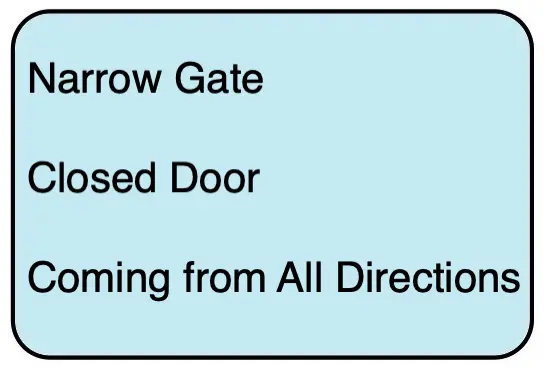
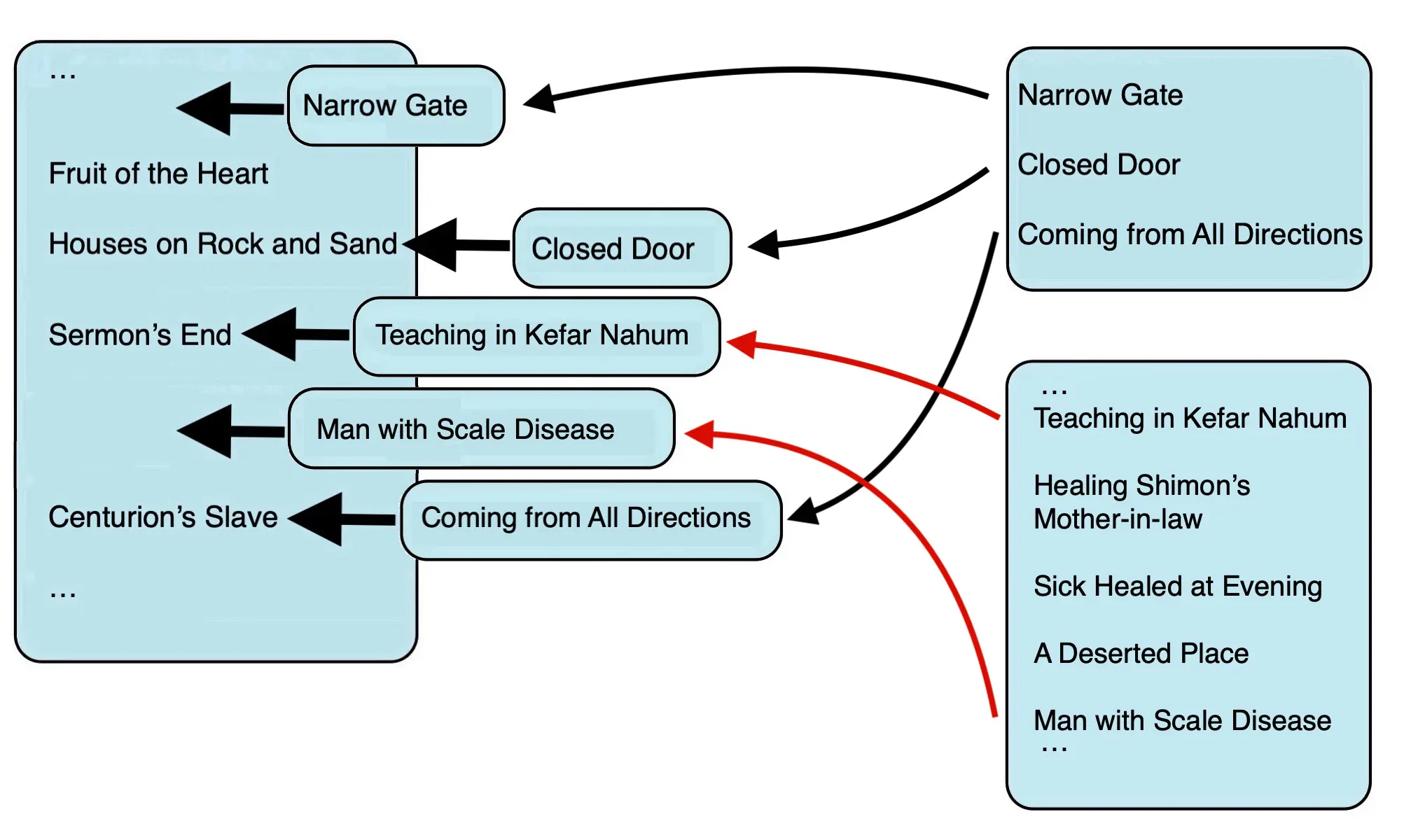
The absence in Luke’s Sermon on the Plain of Narrow Gate and the apocalyptic judgment scene strongly suggests that these two pericopae did not belong to the pre-synoptic homily that stands behind the Lukan and Matthean sermons.[9] But this impression is strengthened when we discover that Closed Door (Luke 13:25-27), Luke’s parallel to Matthew’s apocalyptic judgment scene, is sandwiched in Luke between Narrow Gate (Luke 13:22-24) and Coming From All Directions (Luke 13:28-30). Matthew’s version of Coming From All Directions (Matt. 8:11-12) is embedded in his version of Centurion’s Slave (Matt. 8:5b-13), where it is obviously intrusive. So we find that the author of Matthew wove a block of Anthology (Anth.) material, which is still intact in Luke 13:22-30, into the Sermon on the Mount. Narrow Gate he fit in before his version of Fruit of the Heart (which the author of Matthew redacted in order to polemicize against false prophets), Closed Door he injected between the introduction to Houses on Rock and Sand and the parable itself (in order to continue his polemic against false prophets), and Coming From All Directions he injected into his Centurion’s Slave (in order to polemicize against the unbelieving Jews). Despite spreading out his versions of these pericopae, instead of preserving them as a unit as the author of Luke had done, Matthew’s versions of these pericopae remain in the Lukan order.[10]
Lest it be doubted that the author of Matthew wove the unit preserved in Luke 13:22-30 into the Sermon on the Mount and the pericopae shortly thereafter, we have only to consider how the author of Matthew treated his Markan source in the same general area. Compare the pericope order in Mark and Matthew:
|
Mark |
Matthew |
|
Return to the Galil |
Return to the Galil |
|
Yeshua Calls His First Disciples |
Yeshua Calls His First Disciples |
|
Teaching in Kefar Nahum |
Sermon on the Mount |
|
Shimon’s Mother-in-law |
|
|
Healings and Exorcisms |
|
|
A Deserted Place |
|
|
Man with Scale Disease |
Man with Scale Disease |
|
Centurion’s Slave |
The author of Matthew had been following the Markan order until the Sermon on the Mount. This sermon, however, occupies the same place in Matthew’s Gospel as Teaching in Kefar Nahum occupies in Mark,[11] and the author of Matthew inserted the people’s reaction to Jesus’ teaching from Mark’s version of Teaching in Kefar Nahum (Mark 1:22) into the conclusion of the Sermon on the Mount.[12] Having skipped the story of an exorcism that took place while Jesus was teaching in a synagogue, the author of Matthew did not resume Mark’s order until after Mark’s version of A Deserted Place, in which Mark mentions Jesus’ teaching in synagogues and driving out demons.[13] The author of Matthew then recorded Man with Scale Disease in its Markan sequence, but then slipped in Centurion’s Slave, a Double Tradition (DT) pericope, which in Luke is the sequel to the Sermon on the Plain. Thus, just as the author of Matthew wove Mark’s pericope order into the Sermon on the Mount and the pericopae thereafter, so the author of Matthew wove the unit preserved in Luke 13:22-30 into the Sermon on the Mount and the pericopae thereafter.[14] In thus weaving together Markan and DT material in and around the Sermon on the Mount, the author of Matthew treated his two sources, Mark and Anth., alike.
Internal and external evidence conspire to prove that Matt. 7:22-23 is a Matthean interpolation of Closed Door into the context of the Sermon on the Mount.[15] A comparison of the content of Matt. 7:22-23 with Luke’s version of Closed Door only strengthens this conclusion. Matt. 7:22-23 is an apocalyptic preview of the final judgment, in which Jesus condemns certain Christians who, inter alia, prophesied in Jesus’ name. By contrast, in Luke’s Closed Door saying the scene is parabolic rather than apocalyptic, it is not the risen Christ but a householder who speaks, and it is not Christians who are condemned but an unspecified audience who are given a warning. Thus Matt. 7:22-23 has every appearance of having been redacted in order to advance the author of Matthew’s polemics against those whom he regarded as false Christian prophets,[16] a theme that occupies the final sections of Matthew’s Sermon on the Mount.
The Lukan form of the “Lord! Lord!” saying (Luke 6:46) poses the question, “Why do you call out to me, ‘Lord! Lord!’ but do not do what I say?” This question leads naturally and logically into the parable that compares a person who hears Jesus’ words and does them to a person who builds a house on rock.[17] The parable presupposes the Lukan form of the “Lord! Lord!” saying. It does not presuppose Matthew’s apocalyptic scene of judgment.
The question remains whether the “Lord! Lord!” saying and the Houses on Rock and Sand parable originally belonged to Jesus’ Torah homily or whether they became attached to the sermon at some later stage of transmission.[18] Doubt that these verses are native to the sermon arises from their emphasis on Jesus’ words, which is thought to be in tension with the focus on the Torah and the commandments in the original core of the sermon (see below, Comment to L24). However, the tension between the concluding pericope and the core of the sermon may be more perceived than real. Jesus did not emphasize his words at the expense of the Torah, rather he saw his words as establishing the Torah on its proper footing (Matt. 5:17).[19] Indeed, ancient Judaism did not sharply distinguish between the Torah and a sage’s teaching: the teachings of the sages were part of the living Torah, an understanding that eventually gave rise to the concept of Two Torahs, the Written Torah and the Oral Torah, neither of which was complete without the other.
Once this perceived obstacle is removed, it is easy to see how the Houses on Rock and Sand parable and its introduction connect with the rest of the sermon. The question “Why do you call to me, ‘Lord! Lord!’…?” refers back to the crowds who had come to Jesus for healing, “Lord!” being a common address used by those appealing to Jesus for help. It was these crowds that Jesus addressed in his sermon. “Do what I say” refers back to Jesus’ better interpretations of Scripture (“You have heard that it was said…. But I say to you….”) which are the heart of the sermon. And “my words,” as we have just explained, does not place Jesus’ teachings above the Hebrew Scriptures or in opposition to the Torah, rather Jesus regarded his “words” as the preferred interpretation of the Torah. Doing Jesus’ words caused the Torah’s true intentions to be realized in the life of the person who did them.
To view all of the pericopae we have included in the “Torah and the Kingdom of Heaven” complex, click here.
.

.
Click here to view the Map of the Conjectured Hebrew Life of Yeshua.
.
.
Conjectured Stages of Transmission
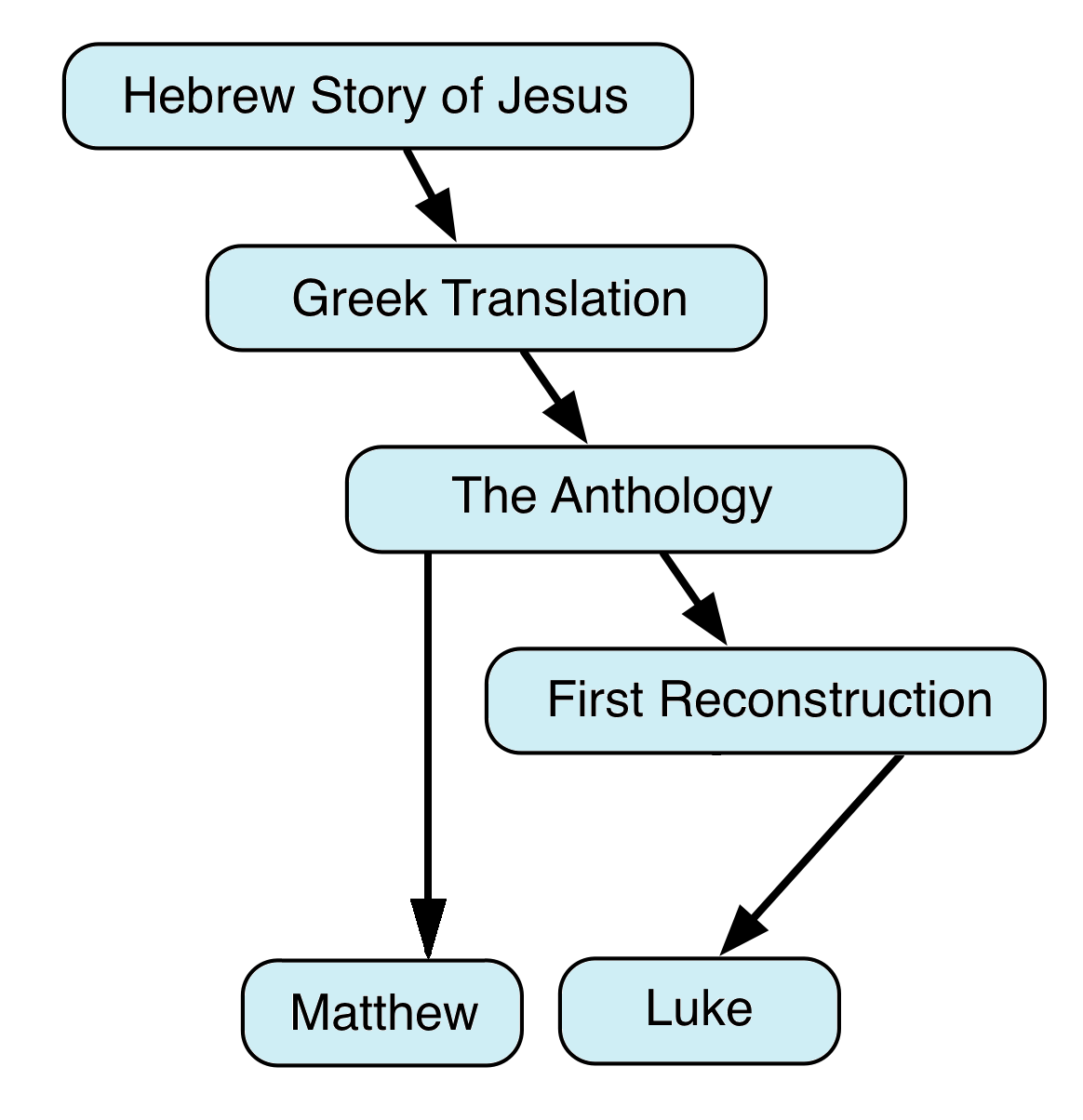
Most scholars trace the Lukan and Matthean versions of Houses on Rock and Sand and its introduction back to Q,[20] although the significant verbal disparity between the two versions of this pericope has led some scholars to suggest that the author of Matthew relied on a special source instead of, or in addition to, Q,[21] or to propose that the authors of Matthew and Luke relied on distinct recensions of Q.[22] Lindsey’s hypothesis is similar to the latter suggestion. According to Lindsey, Matthew’s source for DT pericopae was always the Anthology (Anth.), whereas in addition to Anth. the author of Luke had access to a stylistically improved Greek epitome of the Anthology, which Lindsey called the First Reconstruction (FR). When DT pericopae exhibit a high degree of verbal disparity, this is often due to Luke’s reliance on FR.[23] Thus to some extent the differences between the Lukan and Matthean versions of Houses on Rock and Sand are due to the authors of Luke and Matthew’s reliance on distinct but parallel sources. Nevertheless, considerable Matthean and, to a lesser extent, Lukan redaction also contributes significantly to the differences between the two synoptic versions of this pericope.
Pointing to FR as the source of Luke’s version of Houses on Rock and Sand are not only the verbal disagreements with Matthew’s version but also the context in which Luke’s version of Houses on Rock and Sand appears. The author of Luke tended not to switch back and forth between his two sources (Anth. and FR) from one pericope to the next, rather he typically stuck with one source for long stretches. Since we have determined that other pericopae belonging to Luke’s Sermon on the Plain derived from FR,[24] it is likely that Luke’s version of Houses on Rock and Sand derived from FR too.
Some scholars doubt that the introduction to the Houses on Rock and Sand parable, the “Lord! Lord!” saying, can be traced back to Jesus. In part, these doubts are founded on the assumption that addressing Jesus as “Lord” did not begin until after the resurrection.[25] It has therefore been proposed that the “Lord! Lord!” saying was created by later compilers of the Jesus tradition as an introduction to the parable.[26] However, we do not believe that the assumption that Jesus was not addressed as “Lord” prior to the resurrection is justified (see below, Comment to L2). And since the “Lord! Lord!” saying reverts easily to Hebrew and is consistent with Jesus’ rejection of personality cult, we see no reason why this saying could not have originated with Jesus.[27]
Crucial Issues
- How and when did addressing Jesus as “Lord” begin?
- What is the point of the parable?
- What does the storm/flood in the parable represent?
Comment
L1 οὐ πᾶς ὁ λέγων μοι (Matt. 7:21). Matthew’s opening phrase, οὐ πᾶς ὁ λέγων μοι (ou pas ho legōn moi, “not everyone who says to me”), is by no means difficult to reconstruct in Hebrew as לֹא כָּל הָאֹמֵר לִי (lo’ kol hā’omēr li, “not everyone who says to me”). Nevertheless, we think it is more likely that Luke’s interrogative phrase (“Why do you call me…?”) is more original[28] and that Matthew’s πᾶς ὁ + participle phrasing was formulated in imitation of the two comparative sentences (“Everyone who hears my words and does them…. Everyone who hears my words but does not do them….”) of the Houses on Rock and Sand parable.[29] The author of Matthew probably preferred “says” to “calls” in L1[30] because “says” agrees with the apocalyptic judgment scene in which “many will say to me…‘Lord! Lord!’” (L9-10).[31]
By transforming Jesus’ question into a negative declaration the author of Matthew offered a litmus test to enable his readers to distinguish between (those he regarded as) true and false Christians. According to the author of Matthew, true Christians will not merely profess Jesus to be Lord and do mighty works in his name, they will also do God’s will as revealed in the Law of Moses.[32] In formulating this test, however, the author of Matthew rendered Jesus’ saying cold and lifeless. As Manson put it, “There are few sadder words in the New Testament than Lk. 646: and all the pathos has gone in the version given by Mt.”[33]
The negative formulation of Matthew’s litmus test (“Not everyone who…but”) resembles a test for false prophets recommended in the Didache, an early Christian document that may have been produced by the same community for which the Gospel of Matthew was written:[34]
οὐ πᾶς δὲ ὁ λαλῶν ἐν πνεύματι προφήτης ἐστίν, ἀλλ’ ἐὰν ἔχῃ τοὺς τρόπους κυρίου. ἀπὸ οὖν τῶν τρόπων γνωσθήσεται ὁ ψευδοπροφήτης καὶ ὁ προφήτης
But not everyone who speaks in the spirit is a prophet, but [only] if he has the conduct of the Lord. Therefore, by his conduct you will know a false prophet and a [true] prophet. (Did. 11:8)
The similarity of Matthew’s litmus test to the one proposed in the Didache is important because, like the Didache, the author of Matthew is especially concerned about false prophets. Prophesying in Jesus’ name is the most prominent action that characterizes the false Christians described in Matt. 7:22-23.
τί δέ με καλεῖτε (GR). Luke’s wording in L1 would have been more Hebraic if the pronoun με (me, “me”) had followed the verb, and we might attribute the un-Hebraic order to the editorial work of the First Reconstructor, but such small concessions to Greek style were not beyond the abilities of the Greek translator of the Hebrew Life of Yeshua.
וְלָמָה אַתֶּם קֹרְאִים לִי (HR). On reconstructing τίς (tis, “Who?” “What?” “Why?”) with לָמָּה (lāmāh, “For what?” “Why?”), see Yeshua’s Discourse on Worry, Comment to L30.
On reconstructing καλεῖν (kalein, “to call”) with קָרָא (qārā’, “call”), see Call of Levi, Comment to 65.
Compare our reconstruction to the following question in Jeremiah:
הֲלוֹא מֵעַתָּה קָרָאתי לִי אָבִי
Have you not just now called to me [LXX: με ἐκάλεσας ⟨me ekalesas, “me you called”⟩], “My father!”…? (Jer. 3:4)
In Hebrew [no_word_wrap]-קָרָא לְ[/no_word_wrap] (qārā’ le–) can mean both “call to” someone and “address someone as.” In other words, our reconstruction of Jesus’ question could equally be translated “Why do you call out to me, ‘Lord! Lord!’?” or “Why do you address me as ‘Lord! Lord!’?” Probably the former sense predominates, since the repetition of “Lord!” suits the action of calling out to Jesus to attract his attention, whereas for the meaning “Why do you address me as ‘Lord’?” a single instance of “Lord!” would have sufficed. Indeed, it is probable that by his question Jesus was challenging his audience to think about what they were saying. They cried out to Jesus, “Lord! Lord!” hoping to catch his notice so that he would heal them or drive out their demons. But Jesus pointed out the contradiction of addressing him as “Lord!” in order to be served while showing little or no interest in his teachings. Lords, Jesus wryly observed, usually expect to be obeyed.
L2 κύριε κύριε (GR). There can be no doubt that the shout κύριε κύριε (kūrie kūrie, “Lord! Lord!”) occurred in Anth., since this is the only phrase the Lukan and Matthean introductions to the Houses on Rock and Sand parable have in common. We have therefore accepted it without hesitation for GR.
It is often stated that the doubling of “Lord! Lord!” is a mode of address “common in Judaism,”[35] and indeed we find examples of “Abraham! Abraham!” and “Samuel! Samuel!” etc. in the Hebrew Scriptures. Nevertheless, such doubling is hardly unique to Judaism or to Semitic languages, it is encountered in ancient Greek as well.[36] At best, we can say that the double address is consistent with the theory of an underlying Hebrew source, but since double vocatives were normal in Greek, the repeated address does not lend the hypothesis any particular support.
אֲדוֹנִי אֲדוֹנִי (HR). As we noted in the Conjectured Stages of Transmission discussion above, some scholars doubt that Jesus was ever addressed as “Lord” prior to his resurrection, since they regard this address as tantamount to a declaration of faith. However, this dogmatic assumption is not justified by the ancient sources. In rabbinic literature we find that אֲדוֹנִי (’adōni, “my Lord”), the Hebrew equivalent of κύριε,[37] was used as a term of respect when addressing persons of dignity such as priests (Gen. Rab. 71:4 [ed. Theodor-Albeck, 2:826-827]) and royalty (t. Sanh. 4:4; Gen. Rab. 61:7 [ed. Theodor-Albeck, 2:667-668]), and was also used to address professionals such as teachers (Kallah §21 [ed. Higger, 159-160]) and doctors (y. Ber. 5:2 [38b]). Although the sources we have cited are indeed later than the Second Temple period, there is no reason to suppose that use of אֲדוֹנִי as a polite address became more prevalent after the destruction of the Temple than it had been previously. If anything, the reverse may actually be the case, for in the period after the destruction רַבִּי (rabi, “my master”) became a formal title for ordained rabbinic sages,[38] and probably supplanted the use of אֲדוֹנִי when addressing rabbinic scholars (in much the same way as Dr. supplants Ms., Mrs. or Mr. when someone has earned their degree). So, at least in rabbinic circles, the use of אֲדוֹנִי would have become somewhat more restricted than it had been prior to the Temple’s destruction.
While some scholars have allowed that Jesus may have been addressed as “Lord” in his capacity as teacher,[39] we think it is more likely that Jesus was addressed as אֲדוֹנִי because of his reputation as a healer. Hebrew, it must be recalled, made no distinction between “healer” and “doctor,” the term for both was רוֹפֵא (rōfē’). The following rabbinic parable demonstrates that it was usual to address doctors as אֲדוֹנִי (“my Lord”):
לאחד שגנב נרתיקו של רופא עם כשהוא יוצא נפצע בנו חזר אצלו אמר לו אדוני הרופא רפא את בני אמר לו לך והחזר את הנרתק שכל מיני רפואות נתונין בו ואני מרפא את בנך
[It may be compared] to someone who stole a doctor’s medicine chest. When he [i.e., the thief] went out, his son was wounded. He [i.e., the thief] returned to him [i.e., the doctor]. He said to him, “My lord, the doctor [אֲדוֹנִי הָרוֹפֵא], heal my son!” He said to him, “Go and return my medicine chest, for all kinds of therapeutics are in it. Then I will heal your son.” (y. Ber. 5:2 [38b]; cf. y. Taan. 1:1 [1b])
Since rabbinic parables depicted quasi-realistic scenes and employed everyday speech to instruct popular audiences, and since the use of the address אֲדוֹנִי in the parable is merely an accidental detail, it need hardly be doubted that אֲדוֹנִי הָרוֹפֵא was the way Hebrew speakers ordinarily addressed doctors.
Scholars have long noted that in the Synoptic Gospels the people who address Jesus as “Lord” are typically individuals who come to him for healing (whether for themselves or for someone close to them).[40] According to Luke 8:2, some of those whom Jesus healed went on to become Jesus’ followers. It therefore does not seem unreasonable to hypothesize that the disciples’ use of “Lord” to address Jesus—the disciples being the only other group apart from those seeking healing who habitually addressed Jesus in this manner—originated among those of the disciples whose first interaction with Jesus was in his capacity as a healer (רוֹפֵא).
We have thus reconstructed a historically plausible context for Jesus’ question, “Why do you call to me, ‘Lord! Lord!’ but do not do what I say?”: Jesus was pointing out the irony of addressing him as אֲדוֹנִי while expecting to be served rather than preparing to obey. The question implies that Jesus viewed his healing activity as subservient to his teaching. Healing the sick and driving out demons was both a demonstration of and a way of attracting attention to his message about the Kingdom of Heaven. If our reconstruction is correct, then Jesus’ complaint in Houses on Rock and Sand is paralleled in Woes on Three Villages, where Jesus complained that despite the numerous miracles he had performed in Chorazin, Bethsaida and Capernaum the inhabitants of these villages had not repented (i.e., they had not adopted the ways of the Kingdom of Heaven which Jesus had been teaching them).
Sometimes we reconstruct the vocative κύριε (kūrie, “Lord!”) as אֲדוֹנֵנוּ (’adōnēnū, “our Lord”) rather than אֲדוֹנִי (“my Lord”), depending on whether the speakers represented others in addition to themselves or spoke as part of a group,[41] or whether the speakers spoke individually on their own behalf.[42] Here we think the speakers to whom Jesus refers probably petitioned him as individuals.
L3 καὶ οὐ ποιεῖτε ἃ λέγω (GR). In Luke 6:46 the connection between calling Jesus “Lord” and doing what he says is logical, since lords expect to be obeyed.[43] This logical connection is missing in Matt. 7:21, where there is no inherent connection between calling Jesus “Lord” and doing the will of the heavenly Father.[44] We think it is more likely that the coherent logic in Luke 6:46 is original and that the author of Matthew muddled Jesus’ argument through his redactional activity than that the author of Luke improved upon Jesus’ reasoning.[45] Our supposition is strengthened by the fact that in the Lukan and Matthean versions of the parable Jesus stresses the importance of doing his words (L23-26, L48-51), which agrees with Luke’s “do what I say” (L3) rather than Matthew’s “the ones who do the will of my Father in heaven” (L6-8).[46] In other words, the author of Matthew’s redactional activity was not sufficiently thorough to remove all traces of the original argument. This is hardly the first time we have detected a certain degree of sloppiness in the author of Matthew’s handling of his sources.[47]
Note that for GR we have adopted the plural form of the relative pronoun in agreement with N-A rather than the singular form found in Codex Vaticanus.
וְאֵינְכֶם עֹשִׂים מַה שֶּׁאֲנִי אֹמֵר (HR). On reconstructing ποιεῖν (poiein, “to do”) with עָשָׂה (‘āsāh, “do”), see Rich Man Declines the Kingdom of Heaven, Comment to L8.
On reconstructing λέγειν (legein, “to say”) with אָמַר (’āmar, “say”), see Widow’s Son in Nain, Comment to L15.
L4-5 εἰσελεύσεται εἰς τὴν βασιλείαν τῶν οὐρανῶν (Matt. 7:21). It is clear from the judgment scene that follows (Matt. 7:22-23) that the author of Matthew understood entering the Kingdom of Heaven as an eschatological event that is contingent upon the verdict issued at the final judgment.[48] This was not Jesus’ understanding of the Kingdom of Heaven. For Jesus, entering the Kingdom of Heaven was synonymous with becoming a full-time disciple.[49] The author of Matthew’s eschatological use of “enter the Kingdom of Heaven” provides further evidence that the apocalyptic preview of the final judgment in Matt. 7:22-23 is an interpolation. And since the majority of those who addressed Jesus as “Lord” in their appeals for healing had no intention of becoming full-time disciples, it was hardly necessary for Jesus to point out that not all those who called him “Lord” would enter the Kingdom of Heaven. Since according to Jesus’ definitions there was no inherent connection between calling him “Lord” and entering the Kingdom of Heaven, we conclude that Matthew’s version of the “Lord! Lord!” saying is secondary.
L6-8 ἀλλ᾿ ὁ ποιῶν τὸ θέλημα τοῦ πατρός μου τοῦ ἐν τοῖς οὐρανοῖς (Matt. 7:21). Just as calling Jesus “Lord” has no inherent connection to entering the Kingdom of Heaven, so there is a disconnect between doing God’s will and entering the Kingdom of Heaven. God’s will is revealed in the Torah, and according to Rich Man Declines the Kingdom of Heaven, anyone who kept the commandments would inherit eternal life. Entering the Kingdom of Heaven, on the other hand, was an altogether different matter. In order for the rich man to enter the Kingdom of Heaven it was necessary for him to divest himself of his wealth, leave his home and family behind, and become a full-time itinerant disciple. Doing God’s will by observing the commandments was, of course, a prerequisite for becoming a full-time disciple, yet it was a condition that was necessary but not sufficient. In other words, Matthew’s version of Jesus’ saying sets the bar for entry into the Kingdom of Heaven too low. Jesus held his disciples to a higher standard than the minimum the Torah requires.
Nevertheless, some scholars have been duped by Matthew’s use of the phrase “will of my Father who is in the heavens” into thinking that the Matthean form of Jesus’ saying is more Jewish than the Lukan form and must therefore be original.[50] And it is true that references to doing the will of the heavenly Father appear in rabbinic sources, most famously in the following saying:
יְהוּדָהּ בֶן תֵימָה אוֹמֵ′ הֱוֵוי עַז כַּנָּמֵר וְקַל כַּנֶּשֶׁר וְרָץ כַּצְּבִי וְגִיבּוֹר כַּאֲרִי לַעֲשׂוֹת רְצוֹן אָבִיךָ שֶׁבַּשָּׁמָיִם
Yehudah ben Temah says, “Be strong as a leopard, and swift as an eagle, and fleet as a gazelle, and courageous as a lion to do the will of your Father in heaven.” (m. Avot 5:20)
However, we suspect that the author of Matthew picked up the language of doing the will of the heavenly Father from the Two Sons parable (Matt. 21:28-31a), where Jesus asked his audience which of the two sons in the parable did the will of their father (Matt. 21:31a).[51] The author of Matthew used this language here to polemicize against fellow Gentile Christians who were not Torah observant. In any case, Matt. 7:21 is not the only instance of the author of Matthew’s redactional use of “will of my heavenly Father”; it also surfaces in Matthew’s version of Yeshua, His Mother and Brothers (Matt. 12:50).[52]
Also hinting that Matthew’s reference to the will of the heavenly Father is redactional and distinguishing it from normal Jewish usage is the exclusivity with which the author of Matthew has Jesus refer to “my Father” rather than “your Father” or “our Father.” Undoubtedly Jesus sometimes did refer to God as “my Father.” For instance, we believe “my Father” is genuine in Yeshua’s Thanksgiving Hymn (L4), but there Jesus is simply articulating his personal relationship to the heavenly Father, not denying to others a familial relationship with God. But denying a familial relationship to God appears to be the function of “my Father” in Matt. 7:21, since in the apocalyptic scene that follows Jesus will deny that he ever knew these false brethren (Matt. 7:23). When we observe that instances of Jesus’ references to “my Father” are far more plentiful in Matthew’s Gospel than in the Gospels of Mark or Luke,[53] little doubt remains that Matthew’s wording in L6-8 is redactional.[54]
L9-20 In the Story Placement section above we discussed our reasons for concluding that Matt. 7:22-23 is an interpolation. Here it is necessary to examine in greater detail how the author of Matthew redacted the Closed Door pericope in order to fit this saying between the introduction to Houses on Rock and Sand and the parable itself. Unlike Matt. 7:22-23, Luke’s version of Closed Door does not polemicize against “lawless” Christians, neither does it give a preview of the final judgment. Rather, in Luke’s version of Closed Door Jesus addresses his audience as though they had wandered inside one of his parables. He warns his listeners that “the householder” will rise and shut the door, and they will find themselves on the wrong side of it. The audience will knock on the door and plead with the householder to open it, but the householder will deny having known them. The audience will attempt to remind the householder of times they spent together, but he will reiterate that he does not know them and order them to depart.
Clearly the Lukan version of Closed Door is divorced from its original context. The identity of the audience Jesus addressed remains unknown, and the error they had committed—or were in danger of committing—to warrant such a warning can only be guessed. Nevertheless, compared to Matt. 7:22-23, the Lukan version of Closed Door shows signs of being more primitive.[55] First, unlike Matt. 7:22-23, Luke’s version of Closed Door does not assign to Jesus a decisive role in the final judgment.[56] Indeed, Luke’s version of Closed Door does not assign a role to Jesus at all. Since it is difficult to imagine the author of Luke stripping away such exalted functions from Jesus, let alone removing Jesus from the saying altogether, it is likely that Luke’s version represents the earlier form of the saying and that Matt. 7:22-23 is a secondary development.[57] Second, the identity of those who are excluded in Luke’s version of Closed Door is unknown.[58] In Matt. 7:22-23, on the other hand, the identity of those who are excluded is not difficult to ascertain. Since they performed miracles in Jesus’ name and expected Jesus to recognize them, it is clear that they are Christians of a particular variety that someone (in our view, the author of Matthew) found to be objectionable.[59] Once more, it is difficult to imagine the author of Luke obscuring the identity of the targets of Jesus’ criticism.[60] More likely, the author of Matthew gave greater precision to the identity of those who are excluded in order to render the saying more amenable to his polemical purposes.[61]
Moreover, there is some evidence that the author of Matthew knew a version of Closed Door similar to Luke’s. Scholars have noted that Matthew’s version presupposes a scene in which the “Lord” has already denied having known the petitioners, which is why they offer proofs that he should recognize them.[62] Whereas in Matthew the initial disavowal is missing, in Luke’s version the initial disavowal is present. Luke’s version of Closed Door describes a scenario in which a householder rises and shuts the door, whereupon those outside knock and beg for admittance. It is only when the householder feigns ignorance that the petitioners offer proofs of their acquaintance with him. The householder then reiterates his disavowal, their proofs notwithstanding, and dismisses them with the words of Ps. 6:9 (“depart from me, you workers of iniquity”). Since the shutting of the door, the knocking and the request for admittance did not fit the apocalyptic judgment scene the author of Matthew wished to describe, he omitted these elements from his version of Closed Door. But these omissions had the effect of making it appear that the judgment scene was already in progress. The verdict had already been issued when the petitioners mount their last-ditch defense. Luke’s version of Closed Door, which retains the opening scene presupposed by Matthew’s version, thereby shows itself to be more original than Matthew’s.
One reason the author of Matthew may have felt free to omit so many details in Closed Door is that he knew they would reoccur at the end of the Waiting Maidens parable (Matt. 25:10b-12).[63] Since the author of Matthew intended to include this parable later in his Gospel, there was no need for him to include them in his redacted version of Closed Door. The link the author of Matthew forged between Houses on Rock and Sand and Waiting Maidens by inserting his version of Closed Door into the introduction to Houses on Rock and Sand allowed for the motif of “sensible” and “foolish” actors to seep from Waiting Maidens back into Matthew’s version of Houses on Rock and Sand. Such seepage between redactionally linked pericopae is a common phenomenon in Matthew’s Gospel, which we refer to as “Matthean cross-pollination.”
L9 πολλοὶ ἐροῦσίν μοι ἐν ἐκείνῃ τῇ ἡμέρᾳ (Matt. 7:22). The phrase “many will say to me” in L9 explains why in L1 the author of Matthew preferred the verb λέγειν (legein, “to say”) to καλεῖν (kalein, “to call”), for in the apocalyptic judgment scene the people are not calling out to Jesus to attract his attention, they are explaining to him the reason why he ought to recognize them. Thus the change from καλεῖν to λέγειν in L1 helped the author of Matthew to assimilate his interpolated version of Closed Door into its new context in the Sermon on the Mount. Note that the future tense of the verb ἐροῦσίν (erousin, “they will say”) in L9 corresponds to the two instances of ἐρεῖν (erein, “to say [fut.]”) in Luke’s version of the Closed Door saying.
Davies and Allison pointed out that the “many” whom, according to Matthew, Jesus will deny at the final judgment correspond to the “many false prophets” who will arise to lead “many astray” according to the Matthean version of Jesus’ eschatological discourse (Matt. 24:11).[64] Perhaps the author of Matthew did want the readers of the eschatological discourse to recollect this apocalyptic scene from the Sermon on the Mount, but the source of πολλοί (polloi, “many”) in Matt. 7:22 is the Narrow Gate saying (Matt. 7:13), which in Anth., Matthew’s source, was the pericope that immediately preceded the Closed Door saying (see the Story Placement discussion above).[65] By picking up πολλοί from Narrow Gate the author of Matthew wished to imply that the “many” who will say to Jesus on the Last Day that they had performed mighty works in his name have taken the easy path that leads to destruction.
Simply by using the phrase “on that day” the author of Matthew was able to conjure up the apocalyptic scene of the final judgment.[66] Although the phrase ἐν ἐκείνῃ τῇ ἡμέρᾳ (en ekeinē tē hēmera, “on that day”) reverts readily to Hebrew as בַּיּוֹם הַהוּא (bayōm hahū’, “on that day”),[67] in Matthew this phrase only occurs twice (Matt. 7:22; 22:23). Both instances may be redactional, since both are unsupported by the synoptic parallels.[68]
L10 κύριε κύριε (Matt. 7:22). It is difficult to decide whether the doubling of κύριε κύριε in L10 is original or whether it is a Matthean attempt to assimilate the interpolation by repeating the double vocative from L2. Luke’s version of the Closed Door saying has only a single κύριε, but the Matthean ending to the Waiting Maidens parable, which is Matthew’s second version of Closed Door, also has κύριε κύριε (Matt. 25:11). Evidence from the ending of the Waiting Maidens parable is compromised, however, since any agreements between Matthew’s two versions of the Closed Door saying could be the result of Matthean cross-pollination. While it is possible that the author of Luke (or the First Reconstructor) dropped the second κύριε from Closed Door, this does not seem very likely. Not only does Luke’s Gospel retain double vocatives in Houses on Rock and Sand (κύριε κύριε in Luke 6:46) and Lament for Yerushalayim (Ἰερουσαλὴμ Ἰερουσαλήμ in Luke 13:34), where Matthew’s parallels confirm the double vocative (Matt. 7:21; 23:37), Luke’s Gospel also has a double vocative in Quieting a Storm, where it is lacking in the Matthean parallel (ἐπιστάτα ἐπιστάτα in Luke 8:24 [cf. Matt. 8:25]),[69] as well as in verses unique to Luke’s Gospel (Μάρθα Μάρθα in Luke 10:41; Σίμων Σίμων in Luke 22:31). The double vocative Σαοὺλ Σαούλ occurs three times in Acts (Acts 9:4; 22:7; 26:14), and if we were to expand the definition of double vocative to instances such as ἄνδρες ἀδελφοί, then Acts is full of double vocatives. So since the author of Luke was by no means averse to double vocatives and was not, so far as we can ascertain, in the habit of deleting them, the probability is that it was the author of Matthew who redactionally doubled κύριε κύριε in Matt. 7:22 and Matt. 25:11.[70]
L11-12 οὐ τῷ σῷ ὀνόματι ἐπροφητεύσαμεν (Matt. 7:22). The most prominent and characteristic action of the Christians the author of Matthew polemicizes against is that they prophesy in Jesus’ name. Thus the reference to prophesying in Jesus’ name continues the author of Matthew’s polemic in the Sermon on the Mount against false prophets.[71] This polemic is first made explicit in Matt. 7:15 (Wolves in Sheep’s Clothing), although it may have been already implicit in Matthew’s placement of Narrow Gate (Matt. 7:13-14) if, thereby, the author of Matthew intended to suggest that the “many” who take the “way of destruction” are none other than false prophets. The author of Matthew’s repetition of “many” in Matt. 7:22 suggests this was indeed his intention (see above, Comment to L9).
The question “Did we not prophesy in your name?” alludes to verses in Jeremiah in which God repudiates false prophets[72] :
καὶ εἶπεν κύριος πρός με Ψευδῆ οἱ προφῆται προφητεύουσιν ἐπὶ τῷ ὀνόματί μου, οὐκ ἀπέστειλα αὐτοὺς καὶ οὐκ ἐνετειλάμην αὐτοῖς καὶ οὐκ ἐλάλησα πρὸς αὐτούς
And the Lord said to me, “False are the prophets prophesying in my name! I did not send them, and I did not command them, and I did not speak to them.” (Jer. 14:14)
ὅτι οὐκ ἀπέστειλα αὐτούς, φησὶν κύριος, καὶ προφητεύουσιν τῷ ὀνόματί μου ἐπ̓ ἀδίκῳ πρὸς τὸ ἀπολέσαι ὑμᾶς καὶ ἀπολεῖσθε ὑμεῖς καὶ οἱ προφῆται ὑμῶν οἱ προφητεύοντες ὑμῖν ἐπ̓ ἀδίκῳ ψευδῆ
“For I did not send them,” says the Lord. “And they prophesy illegitimately in my name to destroy you. And you will be destroyed, you and your prophets who prophesy deception to you illegitimately.” (Jer. 34[27]:15)
There is nothing to suggest that Matthew’s allusions to these verses are based on anything other than LXX.[73]
Having picked up the motif of acting in the Lord’s name from these verses in Jeremiah, the author of Matthew applied it to all three activities the false Christians vainly cite as proof that Jesus should recognize them “on that day.” Not only did they prophesy in Jesus’ name, they drove out demons and did mighty works in his name as well.
Concern about false prophets is an especially Matthean motif. The term ψευδοπροφήτης (psevdoprophētēs, “false prophet”) occurs three times in Matthew’s Gospel (Matt. 7:15; 24:11, 24), compared to a single instance in Mark (Mark 13:22) and a single instance in Luke (Luke 6:26). But it is not merely the relative frequency of ψευδοπροφήτης in Matthew that is striking. In Luke false prophets are regarded as a phenomenon of the past, not a present concern. In Mark false prophets are a sign of the end times. But in Matthew false prophets are a present reality. Christians need not only be warned against them, they must be equipped with means of determining whether someone is a false prophet. To that end the author of Matthew reworked the version of Fruit of the Heart in the Sermon on the Mount. The threat false prophets pose to the community is a concern the Gospel of Matthew shares with the Didache, which, as we already noted (see above, Comment to L1), probably comes from the same milieu as Matthew’s Gospel. The Didache refers to visits from itinerant prophets as a common occurrence. And, like Matthew, the Didache recommends tests for distinguishing between true and false prophets (Did. 11:3-12). Thus the polemical slant the author of Matthew has given to the Closed Door saying addresses a live concern for the original readers of Matthew’s Gospel.
L13-14 καὶ τῷ σῷ ὀνόματι δαιμόνια ἐξεβάλομεν (Matt. 7:22). Scholars are probably right to identify the protest “Did we not cast out demons in your name?” as the reason for Matthew’s omission of the incident reported in Mark 9:38-40 (cf. Luke 9:49-50) of a non-disciple whom Jesus nevertheless permitted to continue driving out demons in his name.[74]
L15-16 καὶ τῷ σῷ ὀνόματι δυνάμεις πολλὰς ἐποιήσαμεν (Matt. 7:22). Doing sundry mighty works in Jesus’ name is generic and anti-climactic, but as we can see from Luke’s version of Closed Door, the author of Matthew inherited the tripartite structure of the protest from Anth.[75] The three activities in Luke’s version of Closed Door (eating, drinking, being taught) are mundane compared to those in Matt. 7:22-23. Prophesy, exorcism and miscellaneous miracles are deeds that characterize charismatic Christians, not the general Jewish audience of the Sermon on the Mount.
L17 καὶ τότε ὁμολογήσω αὐτοῖς ὅτι (Matt. 7:23). The adverb τότε (tote, “then”) is often a marker of Matthean redaction, but here it could be taken over from Anth.,[76] since τότε also appears in Luke’s version of Closed Door, albeit at the beginning of the excluded persons’ protest rather than at the beginning of the profession of ignorance.
We found the verb ὁμολογεῖν (homologein, “to confess”) to be redactional in Matt. 14:7,[77] and it is certainly redactional here too.[78] Its function in Matt. 7:23 is to echo Acknowledgement of the Son of Man, where Matthew and Luke agree to use this verb in a saying that describes what will happen at the final judgment (Matt. 10:32; Luke 12:8).[79] Acknowledgement of the Son of Man is not an apocalyptic preview of the final judgment, it is more of a promise of reassurance that whoever remains loyal to Jesus throughout their lifetime will be vouchsafed his recognition at the final judgment. Nevertheless, it is similar enough for the author of Matthew to have wished to allude to this saying.
In Matthew’s DT version of Acknowledgement of the Son of Man, Jesus does not play the role of judge but of advocate. Jesus promises that those who have acknowledged him he will acknowledge before his heavenly Father (Matt. 10:32). So, according to Matthew’s DT version of Acknowledgement of the Son of Man, it is the heavenly Father who renders the verdict, while Jesus merely speaks up on behalf of his followers. Jesus’ role as advocate in Matt. 10:32 lends credence to Betz’s contention that in Matt. 7:22-23 Jesus plays the role of advocate rather than judge.[80]
Jesus’ speaking for himself in the first person in Matt. 7:23 (“I will confess”) contrasts with Luke’s version of Closed Door, in which it is a householder, not the risen Jesus, who speaks.
L18 οὐδέποτε ἔγνων ὑμᾶς (Matt. 7:23). The adverb οὐδέποτε (oudepote, “never”) occurs with a higher frequency in Matthew (5xx) than in the Gospels of Mark (2xx) or Luke (2xx). There is no synoptic agreement on the use of this adverb,[81] but there is a complex relationship between the instances of οὐδέποτε in Mark and Matthew.[82] In Mark the first instance of οὐδέποτε occurs in the people’s reaction to the healing of the paralyzed man: οὕτως οὐδέποτε εἴδομεν (houtōs oudepote eidomen, “Such a thing as this we have never seen!”; Mark 2:12).[83] The author of Matthew did not accept this exclamation from Mark in his version of Bedridden Man, but in the first of his two versions of The Finger of God (Matt. 9:32-34)[84] the author of Matthew reported the people’s reaction to Jesus’ healing of the mute demoniac as οὐδέποτε ἐφάνη οὕτως ἐν τῷ Ἰσραήλ (oudepote efanē houtōs en tō Israēl, “Never has such a thing as this appeared in Israel!”; Matt. 9:33). Similarly, in Lord of Shabbat Mark has Jesus ask, οὐδέποτε ἀνέγνωτε τί ἐποίησεν Δαυὶδ κ.τ.λ. (oudepote anegnōte ti epoiēsen David, “Have you never read what David did…?”; Mark 2:25). Matthew 12:3 agrees with Luke 6:3 against Mark’s use of οὐδέποτε there, but in Yeshua’s Protest in the Temple the author of Matthew has Jesus quote Scripture to the chief priests and scribes saying, οὐδέποτε ἀνέγνωτε ὅτι κ.τ.λ. (oudepote anegnōte hoti, “Have you never read, ‘[Scripture quotation]’…?”; Matt. 21:16), where no such quotation is given in the Markan or Lukan parallels (cf. Mark 11:17; Luke 19:46). Likewise, in Wicked Tenants parable the author of Matthew has Jesus quote Scripture saying, οὐδέποτε ἀνέγνωτε ἐν ταῖς γραφαῖς κ.τ.λ. (oudepote anegnōte en tais grafais, “Have you never read in the Scriptures, ‘[Scripture quotation]’?”; Matt. 21:42), whereas Mark and Luke have Jesus cite the verse using different formulae (cf. Mark 12:10; Luke 20:17). All of these facts alert us to the likelihood that οὐδέποτε is often, if not always, a marker of Matthean redaction.[85] The use of οὐδέποτε in Matt. 7:23 only lends further confirmation to our conclusion that the author of Matthew heavily redacted the version of Closed Door he inserted between the introduction to Houses on Rock and Sand and the parable.
L19 ἀποχωρεῖτε ἀπ᾿ ἐμοῦ οἱ ἐργαζόμενοι τὴν ἀνομίαν (Matt. 7:23). Both Matthew and Luke use the words of Ps. 6:9 to dismiss those who are rejected, but Matthew’s quotation shows greater dependence on LXX than Luke’s.[86] Out of Luke’s six words, four are identical to LXX (ἀπόστητε ἀπ̓ ἐμοῦ πάντες = 66.67%), and four of LXX’s eight words are represented in Luke (50%). It is possible that the quotation in Luke represents a Greek translation independent of LXX or that it represents a fresh translation that was nevertheless influenced by a dim recollection of LXX’s wording. On the other hand, six of Matthew’s seven words are identical to LXX (ἀπ̓ ἐμοῦ οἱ ἐργαζόμενοι τὴν ἀνομίαν = 85.71%), and six of LXX’s eight words are represented in Matt. 7:23 (75%). It therefore appears that the author of Matthew attempted to bring his quotation into greater conformity with LXX. Matthew’s quotation differs from LXX in only two respects: 1) the author of Matthew preferred the verb ἀποχωρεῖν (apochōrein, “to depart”) to LXX’s ἀφιστάναι (afistanai, “to depart”), and 2) he dropped LXX’s πᾶς (pas, “all”). Otherwise, Matthew’s quotation is identical to LXX. If the author of Matthew wished to bring the quotation in line with LXX, then his preference for ἀποχωρεῖν is rather surprising, but the author of Matthew had a redactional preference for χωρεῖν (chōrein, “to progress,” “to have room for”)[87] and its compound ἀναχωρεῖν (anachōrein, “to withdraw”),[88] so his substitution of ἀφιστάναι with ἀποχωρεῖν is consistent with the author of Matthew’s redactional tendencies.[89] The author of Matthew’s redactional interest can also account for his omission of πᾶς.[90] The author of Matthew was not interested in having Jesus deny all the lawless, i.e., all unbelieving Gentiles, rather he was keen to shock his fellow Christian opponents by having Jesus deny lawless Christians.[91]
We see, then, that the author of Matthew’s motive for adapting the quotation of Ps. 6:9 was not primarily to conform its wording to LXX but to condemn ἀνομία (anomia, “lawlessness”) among Christians.[92] By ἀνομία the author of Matthew did not mean licentiousness or wickedness in a general sense, he meant non-observance of the Torah.[93] Apparently the author of Matthew belonged to a Gentile Christian sect that regarded the Torah as binding in some way even for non-Jewish believers. The apostle Paul fought vigorously against this Judaizing tendency among Gentiles, insisting that Gentiles are vindicated by faith apart from works of the Law (Rom. 3:28), but the very vehemence with which Paul argued against this tendency shows what great attraction it held for some Gentile believers. From the author of Matthew we catch a glimpse of the other side of the argument,[94] and if anything, it is even more harsh than Paul’s rhetoric. Paul claimed that if Gentiles allowed themselves to be circumcised (i.e., converted to Judaism), Christ’s death was in vain (Gal. 2:21) and these new Christian converts to Judaism would be obliged to keep the entire Torah (Gal. 5:3).[95] The author of Matthew, on the other hand, condemned the law-free Gentile believers to perdition. Jesus would refuse to recognize them at the final judgment despite all the good works they had done in his name.
A House on the Rock (L21-47)
L21 πᾶς οὖν ὅστις (Matt. 7:24). Matthew’s conjunction οὖν (oun, “therefore”) serves a dual function of drawing a logical inference from the preceding litmus test (Matt. 7:21) and apocalyptic judgment scene (Matt. 7:22-23)[96] and of signaling the conclusion of the entire Sermon on the Mount.[97] Since the conjunction serves the author of Matthew’s redactional purpose, and since οὖν does not fit with our reconstruction (“therefore” is not an answer to the question “Why do you call out to me, ‘Lord! Lord!’ but do not do what I say?”), we have omitted οὖν from GR.[98]
πᾶς ὁ (GR). We also think Matthew’s relative pronoun ὅστις, followed by a present-tense third-person verb in L23, is redactional, since in the openings to both parts of the parable in Luke and in the opening of the second part of the parable in Matthew we find ὁ + participle rather than ὅστις + verb. Perhaps the author of Matthew wrote ὅστις in L21 in anticipation of ὅστις in L31 and L56.
כָּל (HR). On reconstructing πᾶς (pas, “all,” “every”) with כָּל (kol, “all,” “every”), see Demands of Discipleship, Comment to L32.
L22 ἐρχόμενος πρός με (Luke 6:47). It is difficult to decide whether or not Luke’s wording in L22 ought to be included in GR and its equivalent in HR. It certainly cannot be excluded on the grounds of being difficult to revert to Hebrew, since it can be reconstructed easily as הַבָּא אֵלַי (habā’ ’ēlai, “the one who comes to me”).[99] And although Manson was correct in pointing out that “everyone who comes to me” is not strictly relevant to the parable, which solely concerns hearing and doing,[100] coming to Jesus is relevant to Jesus’ question “Why do you call out to me, ‘Lord! Lord!’ but do not do what I say?” since the people who called out to Jesus in this manner had probably come to him seeking healing.[101] The absence of “who comes to me” in the second part of Luke’s parable (L48) does not weigh against its having been present in his source either there or here, since it appears the author of Luke (or the First Reconstructor before him) abbreviated the opening of the second part of the parable.
It is mainly the absence of an equivalent to “who comes to me” in both parts of Matthew’s parable that casts doubt on Luke’s wording in L22. On the whole, Matthew’s version of the parable appears to reproduce Anth.’s wording fairly accurately, whereas Luke’s version, which he copied from FR, strays considerably from Anth. For this reason we have been swayed by Matthew’s omission of “who comes to me” to omit Luke’s wording in L22 from GR.[102]
Perhaps, as some scholars have suggested, the phrase “who comes to me” was added to refer back to the narrative introduction to the Sermon on the Plain, which refers to the crowds who came to hear Jesus (Luke 6:18).[103] This addition could have come from either the author of Luke or the First Reconstructor.
L23 ἀκούων (GR). We explained our preference for the participle ἀκούων (akouōn, “hearing”) above in Comment to L21.
הַשּׁוֹמֵעַ (HR). On reconstructing ἀκούειν (akouein, “to hear”) with שָׁמַע (shāma‘, “hear”), see Mysteries of the Kingdom of Heaven, Comment to L24-25.
L24 μου τοὺς λόγους (GR). Both Matthew and Luke refer to the hearing (and doing) of Jesus’ words. As scholars have noted, the reference to Jesus’ words matches Jesus’ question in Luke’s version of the introduction to the Houses on Rock and Sand parable, but not the Matthean version, which refers to doing the will of the heavenly Father rather than doing what Jesus says.[104] The Lukan-Matthean agreement to refer to Jesus’ words in L24 is strong evidence in favor of the originality of Luke’s wording in L3.
The placement of the possessive pronoun μου (mou, “my”) before “words” is un-Hebraic, but the Lukan-Matthean agreement to adopt this word order indicates that this un-Hebraic word order was already present in Anth.
Some scholars have regarded the emphasis in Houses on Rock and Sand on doing Jesus’ words as un-Jewish, being an expression of a later Christian ethic of prioritizing Jesus’ ethical teachings.[105] Others have supposed that Jesus placed his teachings over and above, or even in opposition to, the words of the Torah.[106] Flusser, on the other hand, suggested that Jesus originally referred to hearing and doing the words of the Torah and that, at a pre-synoptic stage of the transmission, “the words of the Law” or “the words of God” was changed to “my words.”[107] What all these opinions share in common is the feeling that Jesus’ emphasis on doing “my words” is somehow in tension with keeping the words of the Torah. However, as we discussed in the Conjectured Stages of Transmission section above, it is not necessary to drive a wedge between Jesus’ words and the words of the Torah. The rabbinic sages certainly did not draw a sharp distinction between their teachings and the words of Torah (cf., e.g., m. Avot 3:2, 3, 6),[108] and neither, it appears, did Jesus. According to Matt. 5:17, Jesus saw his teaching as giving the Torah its proper interpretation so that it might be observed to its fullest.[109] To do Jesus’ words, therefore, was to do Torah rightly, as God intended. Jesus did not consider his words to be in tension with the Mosaic law but to be in complete harmony with the Torah.
אֶת דְּבָרַי (HR). On reconstructing λόγος (logos, “word”) with דָּבָר (dāvār, “word”), see Widow’s Son in Nain, Comment to L24.
A good example of a rabbinic sage using “my words” to refer to a preferable interpretation of the Torah is found in the following Tosefta passage:
אמר רבי שמעון בן יוחאי ארבעה דברים היה רבי עקיבא דורש ודברי נראין מדבריו דרש רבי עקיבא ותרא שרה את בן הגר המצרית אשר ילדה לאברהם מצחק אין צחוק האמור כאן אלא עבודה זרה שנ′ וישב העם לאכול ושתו ויקומו לצחק מלמד שהיתה אמנו שרה רואה את ישמעאל שהיה בונה במסין וצד חגבים ומעלה ומקטיר לעבדה זרה…ואני אומר חס ושלום שיהי′ בביתו של אותו צדיק ההוא כך אפשר למי שנאמ′ עליו כי ידעתיו למען אשר יצוה וגומר יהא בביתו עבודה זרה וגילוי עריות ושפיכות דמים אלא אין צחוק האמור כאן אלא לענין ירושה שכשנולד אבינו יצחק לאברהם אבינו היו הכל שמחין ואומרין נולד בן לאברהם נולד בן לאברה′ נוחל את העולם ונוטל שני חלקים והיה ישמעאל מצחק בדעתו ואומר אל תהו שוטים אל תהו שוטים אני בכור ואני נוטל שני חלקין שמתשובת הדבר אתה למד כי לא יירש בן האמה וגומ′ ורואה אני את דברי מדברי רבי עקיבא
Rabbi Shimon ben Yohai said, “Rabbi Akiva interpreted four things, but my words [דְּבָרַי] are better than his words. Rabbi Akiva interpreted [as follows], ‘And Sarah saw the son that Hagar the Egyptian had borne to Abraham laughing [Gen. 21:9]—the laughing spoken of here is nothing other than idolatry, for it is said, The people sat to eat and drink and got up to laugh [Exod. 32:6]. This teaches that our mother Sarah was watching Ishmael, who was building altars, and hunting locusts, and making offerings, and burning incense for idolatrous worship.’ …But I say [וְאֲנִי אוֹמֵר], by no means would there be such things in the house of that righteous man! Is it possible for someone about whom it was said, For I have known him in order that he might command [his children] [Gen. 18:19] etc., that there would be idolatry and sexual transgression and bloodshed in his house? Rather, there is no other laughing spoken of here except the matter of inheritance, for when our father Isaac was born to Abraham, our father, everyone was rejoicing and saying, ‘A son is born to Abraham! A son is born to Abraham! He will inherit the world and take two portions.’ But Ishmael laughed in his knowledge and said, ‘Don’t be fools! Don’t be fools! I am the firstborn and I will take two portions.’ For from this answer you learn [why Sarah said,] The slave girl’s son will not inherit [Gen. 21:10] etc. And I prefer my words [אֶת דְּבָרַי] to the words of Rabbi Akiva [דִּבְרֵי רַבִּי עֲקִיבָא].” (t. Sot. 6:6; Vienna MS)
It is striking how similar Rabbi Shimon ben Yohai’s language is in this passage to Jesus’ vocabulary in the Sermon on the Mount. Like Rabbi Shimon, Jesus contrasted poor interpretations of the Torah with his own by saying, “But I say to you…” (the so-called antitheses in Matt. 5:22, 28, 32, 34, 39, 44). And like Rabbi Shimon, Jesus referred to his interpretation of the Torah as “my words.” No one would ever suggest that there was tension between Rabbi Shimon ben Yohai’s words and the words of the Torah. On the contrary, it is clear that Rabbi Shimon thought his words were more in harmony with the Torah’s intention than Rabbi Akiva’s. Likewise, it is unwarranted to detect tension between Jesus’ words and the words of the Torah. Jesus believed that his words were more in harmony with the Torah’s intention than the interpretations he criticized.
L25 τούτους (Matt. 7:24). Unlike Luke’s version of Houses on Rock and Sand, which refers merely to “my words,” Matthew’s version has Jesus refer to “these words of mine.” From a Hebrew perspective, “these words of mine” seems redundant, but τούτους (toutous, “these”) makes sense as a Matthean addition meant to include everything Jesus had said in the Sermon on the Mount.[110] It seems quite possible that the author of Matthew picked up “these” from Sermon’s End (L4), which refers to Jesus finishing “these words” (Matt. 7:28).[111]
L26 καὶ ποιῶν αὐτούς (GR). The agreement to use a participle in the two parts of Luke’s version of the parable and in the second part of Matthew’s version argues in favor of adopting a participle for GR instead of Matthew’s finite verb in L26.
וְעֹשֶׂה אֹתָם (HR). On reconstructing ποιεῖν (poiein, “to do”) with עָשָׂה (‘āsāh, “do”), see above, Comment to L3.
L27 ὑποδείξω ὑμῖν (Luke 6:47). We think the author of Luke—not the First Reconstructor—supplied the words ὑποδείξω ὑμῖν (hūpodeixō hūmin, “I will show you”) in L27, thereby transforming a question (“Everyone who hears my words and does them, what is he like?”) into a statement (“Everyone who hears my words and does them, I will show you what he is like”).[112] The reason for supposing that ὑποδείξω ὑμῖν is redactional is that without this phrase the question reads exactly like the introductions to so many rabbinic parables.[113] The reason for attributing ὑποδείξω ὑμῖν to the author of Luke rather than the First Reconstructor is that the formula ὑποδείξω ὑμῖν occurs not only in Luke (Luke 6:47; 12:5) but also in Acts (Acts 20:35; cf. Acts 9:16).
L28 τίνι ἐστὶν ὅμοιος (GR). As we noted in the previous Comment, the question “To what is he/she/it like?” is an exact parallel to the question לְמַה הוּא דּוֹמֶה (“To what is he/it like?”), which is found at the beginning of countless rabbinic parables, examples of which are cited below.
We found that the author of Matthew avoided the introductory questions to the Mustard Seed and Starter Dough parables (L4-6, L27-28) and one of the introductory questions to Like Children Complaining (L3). He may also have avoided introductory questions to the Hidden Treasure and Priceless Pearl parables (L1-2, L10). Thus omitting the introductory question to Houses on Rock and Sand would be consistent with the author of Matthew’s redactional habits.
לְמַה הוּא דּוֹמֶה (HR). On reconstructing τίς (tis, “Who?” “What?” “Why”) with מָה (māh, “What?”), see Yeshua’s Discourse on Worry, Comment to L5.
On reconstructing τίς + εἶναι + ὅμοιος with לְמַה + pronoun + דּוֹמֶה, see Mustard Seed and Starter Dough, Comment to L4.
As we noted above, there are rabbinic parables that begin by stating a scenario and asking, “What is he/she/it like?” The following are particularly useful examples, not only because they are parables that begin with this stereotypical formula, but the parables themselves have a message that is similar to the Houses on Rock and Sand parable:
הָיָה אוֹמֵ′ כָּל
שֶׁמַּעֲשָׂיושֶׁחָכְמָתוֹ מְרוּבָּה מִמַּעֲשָׂיו לְמָה הוּא דוֹמֶה לְאִילָן שֶׁנּוֹפוֹ מרובה וְשָׁרָשָׁיו מְעוּטִין וְהָרוּחַ בָּאת וְעוֹקְרַתּוּ וְהָופְכַתּוּ עַל פָּנָיו וְכָל שֶׁמַּעֲשָׁיו מְרוּבִּין מֵחָוכְמָתוֹ לְמָה הוּא דוֹמֶה לְאִילָן שֶׁנּוֹפוֹ מְמוּעָט וְשָׁרָשָׁיו מְרוּבִּים אֲפִלּוּ כָל הָרוּחוֹת בָּאוֹת עָלָיו אֵין מְזִיזוֹת אוֹתוֹ מִמְּקוֹמוֹHe [i.e., Rabbi Eleazar ben Azaryah—DNB and JNT] would say, “Everyone whose wisdom is more plentiful than his deeds, to what is he like [לְמָה הוּא דוֹמֶה]? To a tree whose canopy is abundant and whose roots are sparse. And the winds come and uproot it and topple it on its face. And everyone whose deeds are more plentiful than his wisdom, to what is he like? To a tree whose canopy is sparse and whose roots are abundant. Even if all the winds come against it, they do not move it from its place.” (m. Avot 3:17[18])
אלישע בן אבויה אומר אדם שיש בו מעשים טובים ולמד תורה הרבה למה הוא דומה לאדם שבונה אבנים תחילה ואחר כך לבנים. אפילו באים מים הרבה ועומדין בצידן אין מחין אותן ממקומן. ואדם שאין בו מעשים טובים ולמד תורה למה הוא דומה לאדם שבונה לבנים תחילה ואחר כך אבנים. אפילו באים מים קימעא מיד הופכין אותן:
הוא היה אומר אדם שיש בו מעשים טובים ולמד תורה הרבה למה הוא דומה לסיד שטוח על גבי אבנים אפילו יורדין עליו כמה גשמים אין מזיזות אותו ממקומו. אדם שאין בו מעשים טובים ולמד תורה הרבה דומה לסיד שניטוח על גבי לבנים אפילו יורדין עליו גשמים קימעא מיד נימוק והולך לו:
הוא היה אומר אדם שיש בו מעשים טובים ולמד תורה הרבה [למה הוא] דומה לכוס שיש לו פסיפס. ואדם שאין בו מעשים טובים ולמד תורה הרבה [למה הוא] דומה לכוס שאין לו פסיפס. שכיון שנתמלא הכוס נהפך על צידו ונשפך כל מה שבתוכו:
הוא היה אומר אדם שיש בו מעשים טובים ולמד תורה הרבה [למה הוא] דומה לסוס שיש לו כלונוס. ואדם שאין בו מעשים טובים ולמד תורה הרבה [למה הוא] דומה לסוס שאין לו כלונוס כיון שרוכב עליו זורקו בבת ראש
Elisha ben Avuyah says, “A person who has good deeds and who has done much Torah study, to what is he like [לְמַה הוּא דוֹמֶה]? To a person who builds first with stones and afterward with mud brick. Even if many waters come and stand at their sides, they cannot wash them from their place. But a man who has no good deeds but has studied Torah, to what is he like? To a man who builds first with mud bricks and afterward with stones. Even if a little water comes, it immediately topples them.”
He would say, “A person who has good deeds and has done much Torah study, to what is he like [לְמַה הוּא דוֹמֶה]? To plaster spread over stones. Even if a number of rains come down upon it, they cannot move it from its place. A man who has no good deeds but has done much Torah study is like plaster that is pressed against mud bricks. Even if only a few rains come down upon it, it is penetrated and comes off.”
He would say, “A person who has good deeds and has done much Torah study, [to what is he] like [לְמַה הוּא דוֹמֶה]? To a cup that has a heavy base. And a man who does not have good deeds but has done much Torah study, [to what is he] like? To a cup that has no heavy base. For as soon as it is filled, the cup is knocked over on its side and everything that is inside it is spilled.”
He would say, “A person who has good deeds and has done much Torah study, [to what is he] like [לְמַה הוּא דוֹמֶה]? To a horse that has a bridle. And a man who has no good deeds but who has done much Torah study, [to what is he] like? To a horse that has no bridle. As soon as he mounts it, it bucks him off.” (Avot de-Rabbi Natan, Version A, §24 [ed. Schechter, 77])
Similar to Jesus’ parable, these rabbinic parables compare a person who exhibits the positive quality they recommend to a scenario in which something survives an ordeal (a tree withstanding a storm, a house withstanding a flood, a plastered wall withstanding rain, a cup withstanding being knocked over, a man successfully mounting an unruly horse). Then, in the second half of the parable, a person lacking the positive quality is compared to something succumbing to the ordeal.
Unlike Jesus’ parable, which concerns hearing and doing (or not doing), the rabbinic parables concern wisdom versus deeds, or Torah study versus deeds. But since rabbinic instruction was delivered orally, the contrast between Jesus’ parable and the rabbinic parables should not be overemphasized. For Rabbi Eleazar ben Azaryah, a person’s wisdom was the accumulation of what he had heard from his masters, and for Elisha ben Avuyah, the study of Torah amounted to the oral instruction of the rabbinic sages. Likewise, the difference between wisdom/Torah study versus Jesus’ words should not be pressed too far. Just as the disciples of the sages regarded the teachings of the rabbis as Oral Torah, so Jesus regarded his words as part of the living Torah (see above, Comment to L24).
A more important distinction is between Jesus and Rabbi Eleazar ben Azaryah on the one hand, and Elisha ben Avuyah on the other. Whereas Jesus and Rabbi Eleazar ben Azaryah stressed the importance of practicing what was taught, Elisha ben Avuyah was concerned with the relative importance of study versus good deeds (i.e., acts of charity toward one’s fellow human beings). According to Flusser, this shift represents a later development when the significance of the debate over study versus practice was no longer fully appreciated.[114] Elsewhere Jesus emphasized the importance of hearing the word of God and doing it,[115] and when we refrain from driving a wedge between Jesus’ words and the words of the Torah, we find that Houses on Rock and Sand provides one further example of this emphasis.
In any case, these rabbinic parables provide excellent examples of setting up a scenario and asking, “What is he/she/it like?” which corresponds exactly with our reconstruction.
L29 ὅμοιός ἐστιν (GR). The Houses on Rock and Sand parable would be more rabbinic without the phrase “It is like…” in answer to the preceding question, since rabbinic parables always answer the question לְמַה הוּא דּוֹמֶה (“To what is he/it like?”) with -לְ + scenario, never -הוּא דּוֹמֶה לְ (“He/it is like…”). Nevertheless, the Lukan-Matthean agreement to include a comparative statement in L29 strongly suggests that Anth. had some such phrase as ὅμοιός ἐστιν (homoios estin, “he is like”) here,[116] and, indeed, we have found that ὅμοιός ἐστιν also occurred in other parables (cf., e.g., Hidden Treasure and Priceless Pearl, L3, L11; Mustard Seed and Starter Dough, L7, L29). As we explained in Mustard Seed and Starter Dough, Comment to L7, we believe the addition of ὅμοιός ἐστιν was a concession the Greek translator of the Hebrew Life of Yeshua allowed for his Greek readers. We have therefore adopted ὅμοιός ἐστιν for GR in L29 while omitting an equivalent in HR.
The author of Matthew likely changed ὅμοιός ἐστιν (“he is like”) to ὁμοιωθήσεται (homoiōthēsetai, “he will be likened”)[117] in order to suggest that the parable describes what the fates of those who do or do not do will be “on that day” (i.e., at the final judgment).[118] In any case, we have found the use of passive forms of the verb ὁμοιοῦν (homoioun, “to be like”) to be an indicator of Matthean redaction.[119]
L30 ἀνδρὶ φρονίμῳ (Matt. 7:24). We regard Matthew’s characterization of the two men in Houses on Rock and Sand as “sensible” and “foolish” to be redactional,[120] for, as we discussed above in Comment to L9-20, these characterizations appear to be the result of cross-pollination with the Waiting Maidens parable, in which the main characters are “sensible” and “foolish” maidens.[121]
The adjective φρόνιμος (fronimos, “sensible,” “prudent,” “sagacious”) occurs far more often in Matthew (7xx: Matt. 7:24; 10:16; 24:45; 25:2, 4, 8, 9) than in Mark (0xx) or Luke (2xx: Luke 12:42; 16:8),[122] but the four instances of φρόνιμος in the Waiting Maidens parable (Matt. 25:2, 4, 8, 9) may well have come from Anth., as did the instance in Matt. 24:45 (= Luke 12:42), so it is possible that only two instances of φρόνιμος in Matthew are redactional (or, if the saying in Matt. 10:16 came from Anth., only one). Thus it is difficult to characterize φρόνιμος as a distinctly Matthean term.[123]
ἀνθρώπῳ (GR). We also suspect that the author of Matthew’s characterization of the builders as “men,” using ἀνήρ (anēr, “man”), rather than as “persons,” using ἄνθρωπος (anthrōpos, “person”) as in Luke, is also redactional[124] and probably related to the cross-pollination with the Waiting Maidens parable, since “man” contrasts better with “maiden” than does “person.” In any case, the author of Luke displayed a redactional preference for ἀνήρ, so it is unlikely that he would have changed it to ἄνθρωπος if that is what he had found in his source.[125]
לְאָדָם (HR). On reconstructing ἄνθρωπος (anthrōpos, “person”) with אָדָם (’ādām, “person”), see Lost Sheep and Lost Coin, Comment to L12.
We encountered an example of לְאָדָם at the opening of a parable above in Comment to L28 in Elisha ben Avuyah’s comparison of a person who has both good deeds and Torah study to his credit to a person who first lays down a course of stones and then builds on top of it with mud brick.
L31 ὅστις ᾠκοδόμησεν (GR). It is difficult to decide whether Luke’s participle or Matthew’s aorist verb is more original, but since Luke and Matthew agree to use aorist verbs in the continuation of the parable, we have adopted Matthew’s wording in L31 for GR.
שֶׁבָּנָה (HR). On reconstructing ὅστις (hostis, “who,” “which”) with -שֶׁ (she-, “that,” “which,” “who,” “because”), see Lost Sheep and Lost Coin, Comment to L38.
On reconstructing οἰκοδομεῖν (oikodomein, “to build”) with בָּנָה (bānāh, “build”), see Tower Builder and King Going to War, Comment to L2.
L32 οἰκίαν (GR). Either “his house” (Matt.) or “a house” (Luke) could go back to Anth., but we have preferred Luke’s simpler οἰκίαν (oikian, “a house”) to Matthew’s more descriptive αὐτοῦ τὴν οἰκίαν (avtou tēn oikian, “his house”)[126] for the following reasons. First, whether or not the person building the house was building it for himself or someone else makes no difference to the point of the parable, so the detail that it was the builder’s own house he was building could have been added by the author of Matthew. Second, adding to the appearance that the builder’s ownership of the house is an addition is the un-Hebraic word order in which his ownership is expressed. It is true that we found the same un-Hebraic word order in L24, but there we had Lukan-Matthean agreement whereas here we do not. Third, we can see no reason why the author of Luke would have dropped the detail of the builder’s ownership if it had occurred in FR (or why the First Reconstructor would have dropped it if it had occurred in Anth.).[127] Finally, there seems in Matthew’s version of the parable to be a slight tendency toward allegorization. According to the author of Matthew, the parable describes what it will be like on the day of judgment for everyone who has heard the Sermon on the Mount and acted (or not) according to its precepts. By making the sensible man and the foolish man the builders of their own houses, the author of Matthew may have wished to emphasize that each person seals his or her fate by their response to the Sermon on the Mount.
בַּיִת (HR). On reconstructing οἰκία (oikia, “house”) with בַּיִת (bayit, “house”), see Shimon’s Mother-in-law, Comment to L7.
L33-35 ὃς ἔσκαψεν καὶ ἐβάθυνεν καὶ ἔθηκεν θεμέλιον (Luke 6:48). Luke’s ὅς (hos, “who”) in L33 may be in compensation for the omission of ὅστις (hostis, “who,” “whoever”) in L31. The description of the builder digging down deep and laying a foundation adds a new element to the story not present in Matthew’s version of the parable: the builder’s effort to build the house properly. In Matthew the two houses are built the same, the only difference between them is their locations. In Luke, however, the first builder puts in special effort that the second builder neglects.[128] The builder’s effort gives the parable a moralizing tone that was probably not original to the simple comparison of two houses built on locations where their fates were inevitable.[129] In Luke’s version of the parable the outcome is not inevitable, it depends on the builder’s effort.
Adding to the impression that the builder’s effort in Luke’s version of the parable is redactional is the vocabulary in which it is described.[130] The verb σκάπτειν (skaptein, “to dig”; L33) does not occur in the Gospels of Matthew or Mark, but it occurs 3xx in Luke’s Gospel (Luke 6:48; 13:8; 16:3).[131] Likewise, lexemes from the βαθ- root are more common in Luke’s writings than in the Gospels of Matthew and Mark. In the latter two Gospels there is a single instance of the noun βάθος (bathos, “depth”) in the Four Soils parable (L38; Matt. 13:5; Mark 4:5), but in Luke, in addition to the verb βαθύνειν (bathūnein, “to deepen”) in Luke 6:48, we also find the noun βάθος (“depth”) in Luke 5:4 and the adjective βαθύς (bathūs, “deep”) in Luke 24:1 and Acts 20:9. As for the phrase τιθέναι θεμέλιον (tithenai themelion, “to lay a foundation”), the only other place it occurs in the Synoptic Gospels is in Luke’s Tower Builder simile (Luke 14:29), where we attributed it to the work of the First Reconstructor.[132] From all this we suggest that καὶ ἔθηκεν θεμέλιον (kai ethēken themelion, “and he laid a foundation”) in L35 was the First Reconstructor’s contribution to the parable, while ὃς ἔσκαψεν καὶ ἐβάθυνεν (hos eskapsen kai ebathūnen, “who dug and deepened”) in L33-34 was added by the author of Luke.
Some scholars have noted the similarity of Luke’s description of the builder digging and deepening in order to lay a foundation to the following description in a rabbinic parable:[133]
משל למלך שהיה מבקש לבנות היה חופר ויורד ומבקש ליתן תמליום
A parable. [It may be compared] to a king who was seeking to build. He was digging and going down and seeking to lay a foundation…. (Yalkut Shim’oni 1:766 to Num. 23:9)
But while this rabbinic parallel proves that Luke’s description could be reconstructed in Hebrew, it does not prove that it is original to the Houses on Rock and Sand parable. In Yalkut Shim’oni the great effort of searching for a solid foundation on which to build is the point of the parable. Just as the king in the parable had to dig in many places before he found solid rock on which to build, so God had to search through many generations until he found Abraham with whom to make a lasting covenant. But while the search is integral to the rabbinic parable, it is not the point of Houses on Rock and Sand. The hearer has either to do or not do Jesus’ words. He does not have to search high and low for them before he can begin to obey.
A final clue that excavating down to bedrock in the Lukan version of the parable is secondary is sociological. The homes of most Jewish peasants did not have deep cellars such a Luke describes.[134] It therefore appears that in his description the author of Luke had in mind either a monumental public structure or the private dwelling of a wealthy elite.[135] Since many of Jesus’ parables describe scenarios from the everyday life of common folk—a widow losing a coin, a shepherd losing a sheep, a housewife baking bread, a man planting mustard or sowing seed or building an agricultural tower—it seems more likely that Houses on Rock and Sand originally described the kind of dwelling most of his listeners lived in. Had he wanted to describe the building of a mansion or a palace, Jesus would probably have made the actors kings or perhaps wealthy merchants rather than simply referring to them as “a person.”
L36 ἐπὶ τὴν πέτραν (GR). Since Luke and Matthew agree on the phrase ἐπὶ τὴν πέτραν (epi tēn petran, “on the rock”), there can be little doubt that this phrase occurred in Anth. The same phrase also occurs in Luke’s version of the Four Soils parable (L34).
עַל הַסֶּלַע (HR). On reconstructing ἐπί (epi, “upon”) with עַל (‘al, “upon”), see Widow’s Son in Nain, Comment to L11.
On reconstructing πέτρα (petra, “rock”) with סֶלַע (sela‘, “rock”), see Four Soils parable, Comment to L34. Another option for HR might be פִּטְרָה (piṭrāh, “rock”), a loanword from Greek, but since פִּטְרָה does not occur in tannaic sources, whereas סֶלַע occurs frequently in the Mishnah, where we even encounter several instances of the phrase עַל הַסֶּלַע (‘al hasela‘, “upon the rock”; m. Shev. 3:3; m. Ter. 8:11; m. Ned. 4:8; m. Zev. 13:3; m. Kel. 6:2), סֶלַע is probably the safest option for GR.

L37-38 πλημμύρης δὲ γενομένης (Luke 6:48). Whereas Matthew’s version of the parable describes a storm, Luke’s parable describes a flood. Since Luke’s description is formulated using the genitive absolute, it cannot easily be reverted to Hebrew. Matthew’s description, on the other hand, is easily reconstructed. It is likely, therefore, that Luke’s description of the flood is redactional.[136]
The description of a flood that inundates a well-built home seems to hint that Luke’s version of the parable was adapted for an audience of the urban elite. Theophilus, to whom the Gospel is dedicated, probably fit this profile.
καὶ κατέβη ἡ βροχὴ (GR). It is possible that it was Anth.’s description of the rain coming down that made the First Reconstructor think primarily in terms of a flood, since the noun Matthew uses, βροχή (brochē), not only meant “rain” but was also used to refer to the annual flooding of the Nile.[137]
וְיָרְדוּ הַגְּשָׁמִים (HR). On reconstructing καταβαίνειν (katabainein, “to go down,” “to descend”) with יָרַד (yārad, “go down,” “descend”), see Lesson of Lot’s Wife, Comment to L5.
The LXX translators usually rendered גֶּשֶׁם (geshem, “rain”) as ὑετός (hūetos, “rain”),[138] but since both of the two instances of βροχή in LXX represent גֶּשֶׁם (Ps. 67[68]:10; 104[105]:32), there is every reason for confidence in our choice for HR.
It is with a little less confidence that we have chosen to reconstruct the singular phrase καὶ κατέβη ἡ βροχή (kai katebē hē brochē, “and the rain [sing.] came down”) with the plural phrase וְיָרְדוּ הַגְּשָׁמִים (veyāredū hageshāmim, “and the rains [plur.] came down”). Our main reason for preferring the plural is that in Mishnaic Hebrew גֶּשֶׁם is almost always plural. But we also note that the other two items in Matthew’s description of the storm—rivers (L39) and winds (L41)—are plural. So perhaps in the Hebrew form of the parable “rain” was plural as well.
L39 καὶ ἦλθον οἱ ποταμοὶ (GR). Both Luke and Matthew mention a river (Luke) or rivers (Matt.), so we can be reasonably certain that a river (or rivers) was (or were) mentioned in Anth. Luke’s version of the parable graphically describes the river bursting upon the house, whereas Matthew’s version blandly describes rivers coming. Probably the First Reconstructor is responsible for the more vivid description in Luke.[139] Supporting this conclusion is the fact that Matthew’s description suits the climate and geography of the land of Israel.[140] The land of Israel has only one ever-flowing river, the Jordan, and since most of the Jewish population in the first century was not concentrated in the Jordan Valley, relatively few homes were built in the Jordan’s flood plain. On the other hand, flash floods in wadis are fairly common events that would have been familiar to people all over the Galilee and Judea.
וְהָלְכוּ הַנְּחָלִים (HR). In LXX the verb ἔρχεσθαι (erchesthai, “to come”) usually occurs as the translation of בָּא (bā’, “come”).[141] Nevertheless, there are several examples where ἔρχεσθαι occurs as the translation of הָלַךְ (hālach, “go,” “walk”).[142] The reason we prefer הָלַךְ for HR is that we do not find examples of בָּא used to describe the action of wadis, but הָלַךְ was used in this manner, as we see in the following example:
כָּל־הַנְּחָלִים הֹלְכִים אֶל הַיָּם וְהַיָּם אֵינֶנּוּ מָלֵא אֶל מְקוֹם שֶׁהַנְּחָלִים הֹלְכִים שָׁם הֵם שָׁבִים לָלָכֶת
All the wadis flow [הֹלְכִים] to the sea, but the sea is not full. To the place where the wadis flow [הֹלְכִים] there they flow [לָלָכֶת] again. (Eccl. 1:7)
In LXX the noun ποταμός (potamos, “river”) occurs more often as the translation of נָהָר (nāhār, “river,” “stream”) than of any other Hebrew term.[143] We also find that the LXX translators rendered נָהָר as ποταμός the vast majority of the time.[144] However, in the context of Houses on Rock and Sand נַחַל (naḥal, “wadi,” “ravine,” “stream”) seems preferable, for, as we noted, the land of Israel has only one river (the Jordan) but many wadis that flood during the rains but that at other times run dry. In LXX ποταμός does sometimes occur as the translation of נַחַל,[145] so our reconstruction is not unprecedented.
L40-41 καὶ ἔπνευσαν οἱ ἄνεμοι (GR). Although there is nothing in Luke’s version of Houses on Rock and Sand parallel to Matthew’s description of the blowing of the wind in L40-41, we think it is likely that Anth. did contain such a description. The verb πνεῖν (pnein, “to blow”) does not occur in Matthew’s Gospel outside this parable, so it is hardly characteristic of Matthean redaction. Neither is the noun ἄνεμος (anemos, “wind”) particularly Matthean. Apart from the two instances in Houses on Rock and Sand, only one other instance of ἄνεμος in Matthew (Matt. 14:30) is not supported by the Markan and/or Lukan parallel.[146] Since high winds often accompany heavy rains, and since Matthew’s wording reverts easily to Hebrew, we have accepted Matthew’s wording in L40-41 for GR.
וְנָשְׁבוּ הָרוּחוֹת (HR). The verb πνεῖν (pnein, “to blow”) is quite rare in LXX, occurring only 2xx in books corresponding to MT (Ps. 147:7; Isa. 40:24).[147] In Ps. 147:7 πνεῖν occurs as the translation of הִשִּׁיב (hishiv, “cause to blow”) from the root נ-שׁ-ב. Verbs from this root are rare in the Hebrew Scriptures, occurring only in Gen. 15:11; Isa. 40:7; Ps. 147:18. We know, however, that נָשַׁב (nāshav, “blow”) was in use in Mishnaic Hebrew. An excellent example is found in the following parable:
לעולם יהא אדם רך כקנה ולא יהא קשה כארז. מה קנה זה כל הרוחות באות ונושבת בו הולך ובא עמהם דממו הרוחות חוזר הקנה עומד במקומו…אבל ארז אינו עומד במקומו אלא כיון שנשבה רוח דרומית עוקרתו והופכתו על פניו
Let a person be ever flexible like a reed and not stiff like a cedar. What of the reed? All the winds [הָרוּחוֹת] come and blow against it [וְנוֹשְׁבֹת בּוֹ], but it comes and goes with them. The winds [הָרוּחוֹת] are quieted and the reed returns to an upright position in its place…. But the cedar does not remain in its place, rather, as soon as the south wind blows [נָשְׁבָה רוּחַ דְּרוֹמִית], it [i.e., the wind—DNB and JNT] uprooted it and toppled it over. (Avot de-Rabbi Natan, Version A, §41 [ed. Schechter, 131]; cf. b. Taan. 20a)
We have therefore adopted נָשַׁב for HR.
On reconstructing ἄνεμος (anemos, “wind”) with רוּחַ (rūaḥ, “wind,” “spirit”), see Yeshua’s Words about Yohanan the Immerser, Comment to L9.
L42 καὶ προσέπεσαν (Matt. 7:25). There are several reasons for being suspicious of Matthew’s wording in L42. First, the two parts of the parable in Matthew are perfectly symmetrical except for Matthew’s wording in L42 and L67, where the author of Matthew uses two different verbs for the action of the elements striking the house. It is as though the author of Matthew copied his source faithfully for the description of the storm except in L42 and L67, where, without his source to guide him, the author of Matthew supplied different words of his own.[148] Second, Matthew’s wording in L42 and L67 breaks the rhythm of the description of the storm. In L37-38 we find καί + aorist + definite subject. In L39 we encounter the same pattern, and it repeats again in L40-41. Given this rhythmic pattern, the subjectless verbs in L42 and L67 feel intrusive. Third, Matthew’s description of the storm reverts more easily to Hebrew without the verbs in L42 and L67. As we saw in the comment above, wind blowing against an object was expressed with נָשַׁב plus the preposition -בְּ. An additional example occurs in Isaiah:
יָבֵשׁ חָצִיר נָבֵל צִיץ כִּי רוּחַ יי נָשְׁבָה בּוֹ
The grass dries up and the flower withers, for the spirit/wind of the Lord blows against it. (Isa. 40:7)
If the Hebrew text of Jesus’ parable had read, וְנָשְׁבוּ הָרוּחוֹת בְּאוֹתוֹ הַבַּיִת (venāshevū hārūḥōt be’ōtō habayit, “and the winds blew against that house”), we can easily imagine the Greek translator of the Hebrew Life of Yeshua, whose technique tended toward the woodenly literal, translating this phrase as καὶ ἔπνευσαν οἱ ἄνεμοι τῇ οἰκίᾳ ἐκείνῃ (kai epnevsan hoi anemoi tē oikia ekeinē, “and the winds blew to that house”). The author of Matthew would probably have found such a translation to be odd, and so we can imagine him inserting the phrase καὶ προσέπεσαν (kai prosepesan, “and they fell against”) at L42 for clarification. Finally, the choice of the verb προσπίπτειν (prospiptein, “to fall against”) in L42 may have been a deliberate wordplay (in Greek!) on the verb πίπτειν (piptein, “to fall”) in L44.[149] Thus for all these reasons we have omitted καὶ προσέπεσαν from GR.
L43 τῇ οἰκίᾳ ἐκείνῃ (GR). Since both Luke and Matthew agree to use the phrase τῇ οἰκίᾳ ἐκείνῃ (tē oikia ekeinē, “to that house”) in L43, we can be reasonably certain this phrase occurred in Anth.
בְּאוֹתוֹ הַבַּיִת (HR). On reconstructing the demonstrative ἐκεῖνος (ekeinos, “that”) with אֶת + third-person pronominal suffix, see Calamities in Yerushalayim, Comment to L14. This grammatical construction is typical of Mishnaic rather than Biblical Hebrew.
On reconstructing οἰκία (oikia, “house”) with בַּיִת (bayit, “house”), see above, Comment to L32.
L44-45 καὶ οὐκ ἴσχυσεν σαλεῦσαι αὐτὴν (Luke 6:48). Once more we find that Luke’s version of the parable is more vivid and dramatic than Matthew’s parallel (see above, Comment to L39). Whereas Matthew blandly denies that the house fell, Luke emphatically states that the flood was not even able to make the house shake. The more descriptive language in Luke, which subtly shifts the focus away from the house and onto the flood, is probably a Greek literary improvement.[150] That this is so is confirmed by the distinctively FR vocabulary the denial in L44-45 employs. We have found the use of the verb ἰσχύειν (ischūein, “to be strong”) in the sense of “to be able” to be a marker of the First Reconstructor’s redactional activity.[151] The verb σαλεύειν (salevein, “to shake”) occurs in pericopae the author of Luke copied from FR, too, both Houses on Rock and Sand (L45) and Son of Man’s Coming (L23), but since the Lukan-Matthean agreement to use the verb σαλεύειν in Yeshua’s Words about Yohanan the Immerser, L9 (Matt. 11:7 ∥ Luke 7:24) proves that this verb could occur in Anth., it is unlikely that σαλεύειν can be classified as an especially FR term.
L44 καὶ οὐκ ἔπεσεν (GR). Matthew’s statement that the house on the rock did not fall is more to the point, since it focuses on the fate of the house, not the inability of the flood to move it, and, although somewhat bland in comparison to Luke’s wording, allows for better symmetry with the fate of the house on the sand (L69). Matthew’s wording in L44 also reverts easily to Hebrew. All these reasons recommend adopting καὶ οὐκ ἔπεσεν (kai ouk epesen, “and it did not fall”) for GR.
וְלֹא נָפַל (HR). On reconstructing πίπτειν (piptein, “to fall”) with נָפַל (nāfal, “fall”), see Return of the Twelve, Comment to L17.
The collapse of buildings was an all too common occurrence in the time of Jesus, often with deadly results. The toppling of the tower in Siloam mentioned in Calamities in Yerushalayim (Luke 13:4-5) is but one vivid example. The framing in rabbinic circles of the debate over when it is permissible to override the restrictions of the Sabbath in order to help a person in distress in terms of piquaḥ nefesh (lit., “uncovering a soul”) refers to the digging out of victims from the rubble of collapsed buildings on the Sabbath. Houses that were not liable to collapse were therefore highly valued. Jesus drew an analogy between the high value his contemporaries placed on securely built homes and buildings and the high value he placed on obedience to his teaching.
L46 διὰ τὸ καλῶς οἰκοδομῆσθαι αὐτήν (Luke 6:48). The explanation that the flood could not shake the house “because it was well built” is related to the Lukan expansion in L33-34 detailing the excavation necessary to lay the house’s foundation on bedrock.[152] Like the description of the builder’s efforts, the statement that the house was well built has a moralizing tone. Since we attributed the moralizing expansion in L33-34 to the author of Luke rather than the First Reconstructor, we attribute the statement in L46 to him also.
In support of this conclusion we note that διὰ τό + infinitive constructions occur 4xx in Luke (Luke 2:4; 9:7; 11:8; 23:8) and 3xx in Acts (Acts 4:2; 12:20; 18:2) but only 1x in Matthew (Matt. 24:12) and never in Mark. While not all διὰ τό + infinitive constructions in Luke necessarily came from the author of Luke’s pen,[153] it is clear that the author of Luke was capable of using this construction when it served his purposes. The adverb καλῶς (kalōs, “well”) points in the same direction. This adverb occurs 2xx in Matthew (Matt. 12:12; Matt. 15:7), 5xx in Mark (Mark 7:6, 9, 37; 12:28, 32) and 4xx in Luke (Luke 6:26, 27, 48; 20:39),[154] but there is only one instance of synoptic agreement to use καλῶς (Matt. 15:7 ∥ Mark 7:6). It may be doubted, therefore, whether καλῶς ever occurred in Anth.[155] Moreover, καλῶς occurs 3xx in Acts (Acts 10:33; 25:10; 28:25), and since two of these instances occur in the second half of Acts, where the author of Luke’s personal writing style comes to the fore, we know that the author of Luke was quite willing to use this adverb when it suited him. Thus in L46, which on other grounds we suspected of being of Lukan origin, we find Lukan vocabulary to confirm our suspicion.[156]
As Manson noted, Luke’s statement that the house had been well built misses the point of the parable.[157] In Houses on Rock and Sand Jesus carefully constructed a comparison in which there is only a single variable that determines different outcomes. The constant is hearing. The variable is whether or not the hearing is put into action. The outcome is left unstated because it is to be inferred from the parable. In the parable the construction of houses is the constant. Just as we may presume that everyone could hear Jesus’ words equally well, so we must presume that the houses were equally well built.[158] The foundation of the houses is the only variable. Putting Jesus’ words into action corresponds to rock.[159] Failure to put Jesus’ words into action corresponds to sand. From the fates of the two houses listeners could draw their own conclusions regarding what acting or not acting upon Jesus’ teachings would mean for them. The inference is clear. Positive action in response to Jesus’ teaching would mean that their listening to Jesus had been worthwhile. Inaction would mean that listening to Jesus had been futile. The parable is not about salvation or the day of judgment but something far more mundane. It was up to Jesus’ audience to determine whether or not listening to Jesus’ teaching had been a waste of time.
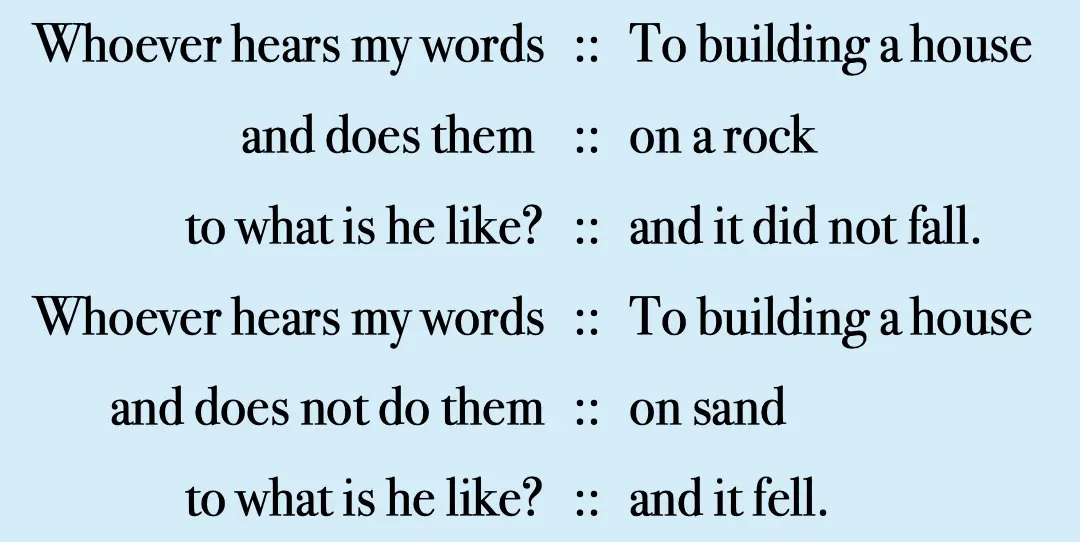
L46-47 τεθεμελίωτο γὰρ ἐπὶ τὴν πέτραν (GR). Whereas Luke’s explanation muddles the point of the parable, Matthew’s explanation hits the nail on the head, reiterating the single variable that distinguishes the two scenarios and that determines the outcome: where the house was located. Moreover, Matthew’s Greek reverts easily to Hebrew. There can be no doubt that Matthew’s wording in L46-47 should be accepted for GR.
We suspect that it was the use of θεμελιοῦν (themelioun, “to lay the foundation of”) in Anth. that inspired the First Reconstructor to add references to a θεμέλιος (themelios, “foundation”) in L35 and L61.
שֶׁהָיָה בָּנוּי עַל הַסֶּלַע (HR). In LXX the verb θεμελιοῦν usually occurs as the translation of the verbal root י-ס-ד in its various stems.[160] Likewise, the LXX translators rendered most verbs from the י-ס-ד root as θεμελιοῦν.[161] Thus the participle מְיוּסָּד (meyūsād, “founded”) would be a reasonable option for HR. The following examples would lend support to such a reconstruction:
וּמְיֻסָּד אֲבָנִים יְקָרוֹת אֲבָנִים גְּדֹלוֹת אַבְנֵי עֶשֶׂר אַמּוֹת וְאַבְנֵי שְׁמֹנֶה אַמּוֹת
And it was founded [וּמְיֻסָּד] on precious stones, stones of great size, ten or eight cubits. (1 Kgs. 7:10)
τὴν τεθεμελιωμένην ἐν τιμίοις λίθοις μεγάλοις, λίθοις δεκαπήχεσιν καὶ τοῖς ὀκταπήχεσιν
…founded [τεθεμελιωμένην] with large valuable stones, stones of ten cubits and eight cubits. (3 Kgdms. 7:47)
שׁוֹקָיו עַמּוּדֵי שֵׁשׁ מְיֻסָּדִים עַל אַדְנֵי־פָז
His thighs are pillars of alabaster founded [מְיֻסָּדִים] on bases of gold…. (Song 5:15)
κνῆμαι αὐτοῦ στῦλοι μαρμάρινοι τεθεμελιωμένοι ἐπὶ βάσεις χρυσᾶς
His legs are marble pillars founded [τεθεμελιωμένοι] on golden bases…. (Song 5:15)
Nevertheless, we think that reconstructing τεθεμελίωτο (tethemeliōto, “it had been founded”) with the passive participle בָּנוּי (bānūy, “was built”) from בָּנָה (bānāh, “build”) is more to the point. We do find one example where the LXX translators rendered בָּנָה with θεμελιοῦν:
וַיְהִי…בַּשָּׁנָה הָרְבִיעִית בְּחֹדֶשׁ זִו הוּא הַחֹדֶשׁ הַשֵּׁנִי לִמְלֹךְ שְׁלֹמֹה עַל־יִשְׂרָאֵל וַיִּבֶן הַבַּיִת לַיי
And it was…in the fourth year in the month of Ziv (which is the second month) of Solomon’s reign over Israel and he built the house of the Lord. (1 Kgs. 6:1)
καὶ ἐγενήθη ἐν…τῷ ἔτει τῷ τετάρτῳ ἐν μηνὶ τῷ δευτέρῳ βασιλεύοντος τοῦ βασιλέως Σαλωμων ἐπὶ Ισραηλ καὶ…ἐθεμελίωσεν τὸν οἶκον κυρίου
And it was in…the fourth year in the second month of Solomon’s reign over Israel and…he founded the house of the Lord…. (3 Kgdms. 6:1)
Given this example, our reconstruction is not without precedent. Reconstructing with בָּנוּי not only drives home the point of the parable, it also represents idiomatic Mishnaic Hebrew, as the following examples demonstrate:
וְכֵן בֵּית הַבַּד שֶׁהוּא בָנוּיִ בַסֶּלַע וְגִינַּה אַחֵר עַל גַּבָּיו
And likewise, an olive press that is built [בָנוּיִ] into the bedrock, and another’s garden is planted above it…. (m. Bab. Metz. 10:4)
בית הבנוי בחומה ר′ יהודה או′ כאילו הוא מבחוץ ר′ שמעון או′ כאלו הוא מבפנים
A house that is built [הַבָּנוּי] in the wall [of a city]: Rabbi Yehudah says, “It is as though it were outside [the city].” Rabbi Shimon says, “It is as though it were inside.” (t. Maas. Shen. 2:15)
בית שהיה בנוי על ארבע קורות אין מטמאין בנגעים
A house that was built [בָּנוּי] on four beams is not made impure by scale disease…. (t. Neg. 6:4)
On reconstructing ἐπί with עַל, and on reconstructing πέτρα (petra, “rock”) with סֶלַע (sela‘, “rock”), see above, Comment to L36.
A House on the Sand (L48-73)
L48 καὶ πᾶς ὁ ἀκούων (GR). The second half of the parable begins just like the first, the only exception being the addition of καί (kai, “and”) to join the two parts together. That the two parts of the parable should mirror one another is important.[162] It allows for a single variable to determine the outcome, showing what a high value Jesus placed on doing what he taught.
Luke’s δέ (de, “but”) looks like a stylistic improvement over Matthew’s καί. This improvement was probably the work of the First Reconstructor, as was the omission of πᾶς (pas, “everyone”).[163] The First Reconstructor’s approach in the second half of the parable was to abbreviate by cutting out whatever repetitive features he felt were not essential.[164]
וְכָל הַשּׁוֹמֵעַ (HR). On reconstructing πᾶς (pas, “all,” “every”) with כָּל (kol, “all,” “every”), see above, Comment to L21.
On reconstructing ἀκούειν (akouein, “to hear”) with שָׁמַע (shāma’, “hear”), see above, Comment to L23.
L49 μου τοὺς λόγους (GR). The First Reconstructor’s economizing approach to the second half of the parable accounts for the omission of “my words” in L49, but the presence of “my words” in the first half of Luke’s version of the parable and in both parts of Matthew’s version strongly favors the inclusion of μου τοὺς λόγους (mou tous logous, “my words”) in GR.[165]
אֶת דְּבָרַי (HR). On reconstructing λόγος (logos, “word”) with דָּבָר (dāvār, “word”), see above, Comment to L24.
L50 τούτους (Matt. 7:26). On our reasons for considering τούτους (toutous, “these”) in L50 to be redactional, see above, Comment to L25.
L51 καὶ μὴ ποιῶν αὐτοὺς (GR). Matthew and Luke are in fairly close agreement in L51, differing only on the tense of the participle and the inclusion of αὐτούς (avtous, “them”). Whoever was responsible for omitting “my words” in L49 would also have deleted αὐτούς. We think the one responsible was the First Reconstructor, whom Lindsey described as an epitomizer of Anth.
וְאֵינוֹ עֹשֶׂה אֹתָם (HR). On reconstructing ποιεῖν (poiein, “to do”) with עָשָׂה (‘āsāh, “do”), see above, Comment to L3.
L53 τίνι ἐστὶν ὅμοιος (GR). Although neither Luke nor Matthew has a phrase corresponding to “to what is he like” in the second half of the parable, we think it may have been present in Anth. The author of Matthew would have omitted this question for the same reason he omitted it in the first half of the parable (see above, Comment to L28). The First Reconstructor could have omitted it in keeping with his economizing approach to the second half of the parable.
Our conclusion that τίνι ἐστὶν ὅμοιος (tini estin homoios, “to what is he like”) was original in L28, our belief that the two parts of the parable originally mirrored one another almost exactly, and the fact that the parable is more Hebraic if this phrase is included are the reasons why we have adopted this phrase for GR in L53.
לְמַה הוּא דּוֹמֶה (HR). On reconstructing τίνι ἐστὶν ὅμοιος as לְמַה הוּא דּוֹמֶה, see above, Comment to L28.
L54 ὅμοιός ἐστιν (GR). As in L29, we prefer Luke’s ὅμοιός ἐστιν (homoios estin, “he is like”) to Matthew’s ὁμοιωθήσεται (homoiōthēsetai, “he will be likened”) for GR.
— (HR). As we explained above in Comment to L29, we think the Greek translator of the Hebrew Life of Yeshua supplied ὅμοιός ἐστιν in L29 and L54 for the sake of his Greek readers, even though there was nothing corresponding to this phrase in the Hebrew text. We therefore have no equivalent to ὅμοιός ἐστιν in HR.
L55 ἀνδρὶ μωρῷ (Matt. 7:26). As we discussed above in Comment to L30, we believe the author of Matthew’s characterization of the builder in the second half of the parable as a “man” rather than a “person” and as “foolish” is redactional,[166] the result of cross-pollination with the Waiting Maidens parable.[167]
Although among the Synoptic Gospels the adjective μωρός is exclusive to the Gospel of Matthew, it is not clear to us that all instances of μωρός in Matthew are redactional. The instance in Matt. 5:22 (Murder) and the instances in Matt. 25:2, 3, 8 (Waiting Maidens) could stem from Anth., in which case only the instances in Matt. 7:26 (Houses on Rock and Sand) and Matt. 23:17 (Woes Against Scribes and Pharisees) are likely to be Matthean additions.
ἀνθρώπῳ (GR). As in L30, we believe the builder in the second half of the parable was simply referred to as a “person.”
לְאָדָם (HR). On reconstructing ἄνθρωπος (anthrōpos, “person”) with אָדָם (’ādām, “person”), see above, Comment to L30.
L56 ὅστις ᾠκοδόμησεν (GR). As in L31, we prefer Matthew’s ὅστις + aorist to Luke’s participle for GR.
שֶׁבָּנָה (HR). On reconstructing ὅστις (hostis, “who,” “which”) with -שֶׁ (she-, “that,” “which,” “who,” “because”), and on reconstructing οἰκοδομεῖν (oikodomein, “to build”) with בָּנָה (bānāh, “build”), see above, Comment to L31.
L57 οἰκίαν (GR). On our reasons for preferring Luke’s “a house” to Matthew’s “his house” for GR, see above, Comment to L32.
בַּיִת (HR). On reconstructing οἰκία (oikia, “house”) with בַּיִת (bayit, “house”), see above, Comment to L32.
L60 ἐπὶ τὴν ἄμμον (GR). Matthew’s ἐπὶ τὴν ἄμμον (epi tēn ammon, “upon the sand”) makes a more fitting antithetical parallel to ἐπὶ τὴν πέτραν (epi tēn petran, “upon the rock”) than Luke’s ἐπὶ τὴν γῆν χωρὶς θεμελίου (epi tēn gēn chōris themeliou, “upon the ground without a foundation”).[168] The use of the preposition χωρίς (chōris, “without”) is suspect because of the total lack of Lukan-Matthean agreement to use this term in either DT or TT pericopae.[169] Moreover, the First Reconstructor was probably responsible for adding the idea of a θεμέλιος (themelios, “foundation”) to the parable (see above, Comment to L33-35). Was the First Reconstructor baffled by the preposterous notion of building on sand? We cannot say. In any case, Matthew’s wording in L60 is to be preferred for HR.[170]
עַל הַחוֹל (HR). On reconstructing ἐπί (epi, “upon”) with עַל (‘al, “upon”), see above, Comment to L36.
In LXX the noun ἄμμος (ammos, “sand”) usually occurs as the translation of חוֹל (ḥōl, “sand”),[171] and the LXX translators usually rendered חוֹל as ἄμμος.[172] Since no obvious alternative has presented itself, we see no reason not to adopt חוֹל for HR.
L62 ᾗ (Luke 6:49). Again in L62 we encounter the First Reconstructor’s economizing approach to the second half of the parable. Whereas in the first half we read, “but when the flood happened [the river burst upon that house],” here we have merely “against which [the river burst].”
L62-63 καὶ κατέβη ἡ βροχὴ (GR). As in the first half of the parable, we believe Matthew’s description of the rainstorm reflects the wording of Anth.
וְיָרְדוּ הַגְּשָׁמִים (HR). On reconstructing καταβαίνειν (katabainein, “to go down,” “to descend”) with יָרַד (yārad, “go down,” “descend”), see above, Comment to L37-38.
On reconstructing βροχή (brochē, “rain”) with גֶּשֶׁם (geshem, “rain”), see above, Comment to L37-38.
L64 καὶ ἦλθον οἱ ποταμοὶ (GR). As in the first half of the parable, both Luke and Matthew mention “a river” or “rivers.” Luke’s more succinct description of a single river in flood bursting upon the house probably comes from FR. Matthew’s more bland description of rivers coming probably comes from Anth.
וְהָלְכוּ הַנְּחָלִים (HR). On reconstructing ἔρχεσθαι (erchesthai, “to come”) with הָלַךְ (hālach, “go,” “walk”), and on reconstructing ποταμός (potamos, “river”) with נָהָר (nāhār, “river,” “stream”), see above, Comment to L39.
L65-66 καὶ ἔπνευσαν οἱ ἄνεμοι (GR). As in the first half of the parable, we believe Matthew’s description of the blowing winds comes from Anth.
וְנָשְׁבוּ הָרוּחוֹת (HR). On reconstructing πνεῖν (pnein, “to blow”) with נָשַׁב (nāshav, “blow”), see above, Comment to L40-41.
On reconstructing ἄνεμος (anemos, “wind”) with רוּחַ (rūaḥ, “wind,” “spirit”), see above, Comment to L40-41.
L67 καὶ προσέκοψαν (Matt. 7:27). As in L42 in the first half of the parable, we suspect the author of Matthew added a phrase—this time, “and they beat upon”—in L67 because “and the winds blew to that house” in Anth. sounded strange to him. In L42 the author of Matthew inserted the verb προσπίπτειν (prospiptein, “to fall against”) in order to make a Greek wordplay on the verb πίπτειν (piptein, “to fall”) in L44. But in L67 the author of Matthew sacrificed the wordplay (and the parallelism of the two parts of the parable) in order to use the verb προσκόπτειν (proskoptein, “to beat upon”), an intensification of the storm[173] that anticipates the catastrophic result for the house and its builder.[174] That the author of Matthew should have intensified the severity of the storm that beat upon the house on the sand is problematic because it is essential to the parable that both houses be exposed to the same degree of inclement weather. The quality of the construction (corresponding to hearing Jesus’ words) and the severity of the storm must remain constant so that the outcome depends entirely on the location on which the house is built (corresponding to acting or not acting in accordance with Jesus’ words). Only in this way can the parable effectively make its point. The fact that Matthew’s wording in L67 undermines the point of the parable provides additional evidence that it is redactional.
L68 τῇ οἰκίᾳ ἐκείνῃ (GR). Matthew’s reference to “that house” in L68 parallels the Lukan-Matthean reference to “that house” in the first part of the parable (L43). The First Reconstructor’s abbreviations in the second half of the parable, especially in L62, allowed him to postpone referring to “that house” until L72.
בְּאוֹתוֹ הַבַּיִת (HR). On reconstructing the demonstrative pronoun ἐκεῖνος (ekeinos, “that”) with אֶת + third-person pronominal suffix, see above, Comment to L43.
On reconstructing οἰκία (oikia, “house”) with בַּיִת (bayit, “house”), see above, Comment to L32.
L69 καὶ εὐθὺς συνέπεσεν (Luke 6:49). Luke’s wording in L69 is more dramatic than Matthew’s[175] and employs more sophisticated vocabulary. These are strong indications that Luke’s wording in L69 is redactional.[176] Whether the author of Luke copied καὶ εὐθὺς συνέπεσεν (kai evthūs sūnepesen, “and immediately it fell together”) from FR (as we suppose)[177] or whether he wrote these words himself,[178] the author of Luke’s willingness to use the adverb εὐθύς (evthūs, “immediately”) in L69 is significant. It undercuts the theory that the author of Luke avoided εὐθύς when it occurred in his sources. The reason Luke lacks εὐθύς in parallel to Mark’s many instances of this adverb is not that the author of Luke rejected εὐθύς from Mark but that the author of Mark added εὐθύς when copying Luke!
καὶ ἔπεσεν (GR). Matthew’s plain language, which forms an exact antithetical parallelism with L44 and which reverts so easily to Hebrew, surely reproduces the wording of Anth.
וְנָפַל (HR). On reconstructing πίπτειν (piptein, “to fall”) with נָפַל (nāfal, “fall”), see above, Comment to L44.
L70 καὶ ἐγένετο (GR). Both Matthew’s καὶ ἦν (kai ēn, “and was being”) and Luke’s καὶ ἐγένετο (kai egeneto, “and it was”) revert easily to Hebrew as וְהָיְתָה (vehāyetāh, “and it was”), but since Luke’s phrase is slightly more Hebraic and since the author of Matthew tended to avoid καὶ ἐγένετο, we think it is likely that the author of Matthew slightly improved Anth.’s Greek, whereas Luke, via FR, preserves Anth.’s wording. We have therefore accepted καὶ ἐγένετο for GR.
וְהָיְתָה (HR). On reconstructing γίνεσθαι (ginesthai, “to be”) with הָיָה (hāyāh, “be”), see Widow’s Son in Nain, Comment to L1.
L71 ἡ πτῶσις (GR). As scholars have noted, the choice of the noun ῥῆγμα (hrēgma, “breakage,” “wreckage”) in Luke 6:49 appears to be a wordplay based on the verb προσρηγνύναι (prosrēgnūnai, “to burst upon”), which occurs in L39 and L64 of Luke’s version of the parable.[179] As such, it is probably redactional[180] and stems from the First Reconstructor. We have therefore accepted Matthew’s wording in L71 for GR.
נְפִילָתוֹ (HR). In LXX the noun πτῶσις (ptōsis, “falling”) is not particularly common, though it occurs as the translation of several different nouns. The most common of these is מַפֶּלֶת (mapelet, “fall”),[181] a term that is almost exclusively found in Ezekiel and which did not survive into Mishnaic Hebrew. Once (Isa. 17:1) πτῶσις occurs as the translation of מַפָּלָה (mapālāh, “ruin”), but this noun does not appear to have been very common in Mishnaic Hebrew either. For this reason we have adopted the good Mishnaic Hebrew noun נְפִילָה (nefilāh, “fall,” “falling”) for HR. The following are examples of נְפִילָה in rabbinic sources:
אֶחָד הַשּׁוֹר וְאֶחָד כָּל הַבְּהֵמָה לִנְפִילַת הַבּוֹר
A bull is the same as every domesticated animal with respect to falling [לִנְפִילַת] into a cistern…. (m. Bab. Kam. 5:7)
לא ימות ונפל למשכב בשעת נפילתו נותן לו ואין נותן לו בשעת עמידתו
He does not die, but falls on his bed [Exod. 21:18]: At the time of his falling [נְפִילָתוֹ] he gives [compensatory payment] to him and he does not give [it] to him at the time of his rising. (Mechilta de-Rabbi Shimon ben Yohai 21:18 [ed. Epstein-Melamed, 174])
L72 αὐτῆς (GR). The phrase τῆς οἰκίας ἐκείνης (tēs oikias ekeinēs, “of that house”) in Luke 6:49 is delayed from L68, where it is paralleled in the first half of Luke’s version of the parable and in both halves of Matthew’s version. Matthew’s possessive pronoun αὐτῆς (avtēs, “of it”) in L72 probably reflects the wording of Anth.
(HR). The pronominal suffix attached to נְפִילָה in L71 (HR) corresponds to αὐτῆς in L72 (GR).
L73 μεγάλη (GR). The Lukan-Matthean agreement to use the adjective μέγας (megas, “big”) in L73 ensures that this was the adjective that appeared in Anth.
גְדוֹלָה (HR). On reconstructing μέγας (megas, “big”) with גָּדוֹל (gādōl, “big”), see Widow’s Son in Nain, Comment to L22.
Whereas the conclusion of the first half of the parable (L46-47) emphasized the reason for the house’s survival (its having been built on rock, which corresponds to doing Jesus’ words), the conclusion of the second half of the parable (L70-73) emphasizes the house’s destruction, which corresponds to the unstated consequence of hearing Jesus’ words and not doing them. This subtle maneuver drives home even more forcefully the point of Houses on Rock and Sand. Just as building the house on sand had been a waste of the builder’s time and resources, so listening to Jesus’ teachings and failing to act on them would be a waste of time and effort both for the listener and for Jesus, the teacher.
Redaction Analysis
The two versions of Houses on Rock and Sand in Luke and Matthew are mutually complimentary in terms of reconstructing the pre-synoptic sources. Luke’s version, stemming from FR, has been subjected to Greek stylistic improvements that resulted in an abbreviated, less repetitive, and slightly less logical version of the parable. Matthew’s version of the parable proper stems from Anth., but the author of Matthew’s polemical framing of the parable has substantially recast the message of the parable.
Luke’s Version[182]
| Houses on Rock and Sand | |||
| Luke | Anthology | ||
| Total Words: |
94 | Total Words: |
101 |
| Total Words Identical to Anth.: |
45 | Total Words Taken Over in Luke: |
45 |
| % Identical to Anth.: |
47.87 | % of Anth. in Luke: |
44.55 |
| Click here for details. | |||
Luke’s version of Houses on Rock and Sand was subjected to two stages of redactional activity, that of the First Reconstructor and the author of Luke’s own redactional activity. In the discussions above we have attempted to distinguish between these two stages of redaction, and therefore propose that FR’s version of Houses on Rock and Sand looked like this:
τί δέ με καλεῖτε κύριε κύριε καὶ οὐ ποιεῖτε ἃ λέγω πᾶς ὁ ἀκούων μου τῶν λόγων καὶ ποιῶν αὐτούς τίνι ἐστὶν ὅμοιος ὅμοιός ἐστιν ἀνθρώπῳ οἰκοδομοῦντι οἰκίαν καὶ ἔθηκεν θεμέλιον ἐπὶ τὴν πέτραν πλημμύρης δὲ γενομένης προσέρηξεν ὁ ποταμὸς τῇ οἰκίᾳ ἐκείνῃ καὶ οὐκ ἴσχυσεν σαλεῦσαι αὐτὴν τεθεμελίωτο γὰρ ἐπὶ τὴν πέτραν ὁ δὲ ἀκούσας καὶ μὴ ποιήσας ὅμοιός ἐστιν ἀνθρώπῳ οἰκοδομήσαντι οἰκίαν ἐπὶ τὴν γῆν χωρὶς θεμελίου ᾗ προσέρηξεν ὁ ποταμός καὶ εὐθὺς συνέπεσεν καὶ ἐγένετο τὸ ῥῆγμα τῆς οἰκίας ἐκείνης μέγα
Why do you call me “Lord! Lord!” but you do not do what I say? Everyone who hears my words and does them, to what is he like? He is like a person building a house, and he laid the foundation on the rock. When the flood came the river burst against that house, but it was not able to shake it, for it was founded on the rock. But the one who hears and does not do is like a person building a house on the ground without a foundation, against which the river burst and immediately it collapsed. And the wreck of that house was great.
The First Reconstructor’s redactional activity included changing “who built” to “building” (L31), adding “and he laid a foundation” (L35), changing the storm consisting of rain, runoff and wind (L37-41) into a flood (L37-39), changing “it [i.e., the house] did not fall” (L44) to “it [i.e., the river] was not able to shake it” (L44-45), changing “and everyone who hears” to “but the one who hears,” which involved a switch from present to aorist participles (L48), omitting “my words” (L49), changing a present participle to an aorist (L51), dropping the introductory question (L53), changing “who built” to “building” (L56), changing “sand” to “ground” (L60), adding “without a foundation” (L61), changing the storm (L62-68) into a flood (L62-64), changing “it fell” to “and immediately it collapsed” (L69), changing “its fall” to “the wreckage of that house” (L71-72), and changing the form of the adjective in L73 to agree with “wreckage” instead of “fall.” These changes were mainly stylistic in nature and not intended to change the message of the parable. An economizing tendency is detected in the first half of the parable in the description of a flood instead of a storm, and all throughout the second half of the parable. The First Reconstructor also tended to enliven the parable with descriptions such as the river “bursting upon” the house but “not being able even to shake it” or “suddenly it collapsed.” Despite this economizing tendency, the First Reconstructor also added clarification wherever he deemed it necessary, especially in the statements “he laid a foundation” and “without a foundation,” which seem to have been inspired by Anth.’s statement that the first house had been founded upon the rock.
To this already redacted version of Houses on Rock and Sand the author of Luke made additional changes, such as transforming the first introductory question (L28) into a statement (L27-28), the insertion of “whoever comes to me” (22), adding a description of the first builder’s effort to excavate the spot on which he built the house (L33-34), and explaining that the reason the first house did not fall was that it had been well built (L46). These last two changes have a moralizing tendency and the unfortunate effects of making the parable somewhat lopsided and of muddling the correspondence of the parable to the real-life situation it was meant to clarify.
Matthew’s Version[183]
| Houses on Rock and Sand | |||
| Matthew | Anthology | ||
| Total Words: |
162 | Total Words: |
101 |
| Total Words Identical to Anth.: |
75 | Total Words Taken Over in Matt.: |
75 |
| % Identical to Anth.: |
46.30 | % of Anth. in Matt.: |
74.26 |
| Click here for details. | |||
Despite having Anth. as his source, Matthew’s version of Houses on Rock and Sand is surprisingly distant from Anth.’s wording. The author of Matthew recast Jesus’ opening question “Why do you call me ‘Lord! Lord!’…?” (L1-3) into a rule that could serve as a litmus test to distinguish true (i.e., Matthean) from false (i.e., non-Matthean) Gentile Christians (L1-8). He then injected between the introduction to Houses on Rock and Sand and the parable itself an apocalyptic scene of the final judgment (L9-20), which is a highly redacted version of Closed Door. In this apocalyptic scene Jesus dismisses the false (i.e., non-Matthean) Gentile believers because they are “lawless” (i.e., they do not keep the specifically Jewish commandments of the Torah).
In the parable proper, the author of Matthew adhered more closely to Anth., but left his mark nonetheless. He used future passives (L29 and L54) to suggest that the fates of the houses represent what it will be like for true and false Christians on the judgment day, thereby allegorizing Houses on Rock and Sand, albeit to a lesser extent than his allegorization of Darnel Among the Wheat and Bad Fish Among the Good. The allegorizing tendency may also explain why the author of Matthew described the house each builder constructed as “his house,” since the ownership linked the man’s fate to the fate of his house, which represented the verdict to be rendered “on that day.”
The author of Matthew changed the protagonists in the parable from nondescript “persons” into “sensible” and “foolish” men. This he did under the influence of the Waiting Maidens parable, another parable he allegorized by the insertion of a redacted version of Closed Door.
Other changes the author of Matthew made to the parable had nothing to do with his polemical aims but were simply intended to relate the parable to the Sermon on the Mount as a whole. For this reason he added “therefore” in L21 to signal that the parable was the concluding statement in the sermon, and he had Jesus refer to “these words of mine” (L24-25, L49-50) instead of “my words” in order to make the parable apply to the entire Sermon on the Mount.
The author of Matthew added the detail that the elements “fell upon” (L42) or “beat upon” (L67) the house, probably because the winds blowing “to the house” sounded strange to him.
Characteristically, the author of Matthew avoided the introductory questions to the comparisons (L28, L53), and he changed καὶ ἐγένετο in L70 to καὶ ἦν.
Such extensive redactional activity means that while Matthew’s version of the parable is invaluable for recovering the wording of the pre-synoptic sources, Luke’s version is indispensable for understanding the parable’s original intention.
Results of This Research
1. How and when did addressing Jesus as “Lord” begin? Some scholars have dogmatically insisted that Jesus was never addressed as “Lord” prior to the resurrection because they regard calling Jesus “Lord” as tantamount to a profession of faith in Jesus’ divinity. We question whether the confession “Jesus is Lord” was ever a profession of Jesus’ divinity. More likely, it was a political statement, asserting the Lordship of Jesus over believers in the face of Caesar’s competing claim to be Lord of everyone in the Roman Empire. However, the beginnings of referring to Jesus as “Lord” were probably non-political and far less grandiose. Addressing persons of higher rank as אֲדוֹנִי (’adōni, “My lord”) was a routine sign of respect among Hebrew speakers. Among the classes of people who were addressed as “Adoni” were doctors. Since Jesus was a well-known healer, it is possible that addressing Jesus as “Adoni” first began as a way of appealing to Jesus for help.
2. What is the point of the parable? The point of the parable is quite simple. It is not enough to hear what Jesus taught, what Jesus taught must be done for the hearing to be of any value. Hearing and not doing is useless. The teaching was a futile exercise and the hearing was a waste of time.
3. What does the storm/flood in the parable represent? It is unlikely that Jesus intended the storm in his parable to represent anything. It is the two scenarios as a whole, not their individual parts, that are intended to convey the answer to the questions “What is a person like who hears my words and acts on them?” and “What is a person like who hears my words but does not act on them?” The first person is like the scenario in which someone built a house that could weather a storm. That person had done something useful and worthwhile, which is also true of everyone who listens to Jesus’ words and does them. The second person is like the scenario in which someone built a house that could not weather a storm. That person had done something useless and futile, which is also true of everyone who listens to Jesus’ words but fails to do them.
While it is true that there are certain correspondences between the scenarios and the real-life situations (hearing :: building a house; doing :: on rock; not doing :: on sand), the parable must not be allegorized.[184] The rain does not represent daily troubles, the rivers do not represent temptations, the wind does not represent the final judgment, or the like.
In Luke’s version of the parable, however, a mild form of allegorization has already begun to creep in. The author of Luke emphasized the first builder’s effort to construct a house that was well built. It was because of his diligent effort that the house survived the flood. Here the simple matter of hearing and doing versus hearing and not doing has been complicated by the extraneous issues of both hearing and doing well. Whereas Jesus’ parable did not take into account half measures, Luke’s adaptations seem to reflect the lived experience of the Church, in which failures, setbacks and disappointment in trying to live up to Jesus’ high moral standard were well-known phenomena. Even so, it is unlikely that the author of Luke intended the flood to represent anything outside the world of the parable. The flood was simply the mechanism for proving which house was well built and which house was not.
Matthew’s version of the parable has been more fully allegorized, not so much by changing the wording of the parable but by framing it in the context of the final judgment, which is when (in his mind) the false Gentile Christians will be exposed as frauds. For the author of Matthew the storm probably does correspond to the final judgment. The collapsed house in the parable is what the false believers will be like “on that day.”[185]
Conclusion
Too much and, simultaneously, too little has been made of Jesus’ claims in Houses on Rock and Sand. Jesus did not arrogate titles of divinity to himself only to claim that flattering him with such titles will not ensure salvation. Jesus did not claim that obeying the precepts of the Sermon on the Mount will deliver Christians on the Judgment Day. Jesus did wryly observe that those who called out to him, “My Lord!” in the hope of being healed ought to think about what they are saying. If Jesus truly is their Lord, then they will not only seek his miraculous powers, they will follow his teachings. Jesus did not claim that only by following his teachings could a person be saved from condemnation at the final judgment, but he did claim that his interpretations brought the Torah’s true intentions to light, and Jesus, in agreement with the rest of Judaism, regarded the Torah as the source of life both in this world and in the world to come. Jesus certainly did claim that doing what he taught was the only point of listening to him. He certainly would have been repulsed by the thought that simply believing in Jesus as one’s personal savior was the point of the Gospel. “What’s the point of believing in me,” Jesus would ask, “if you don’t do what I say?”
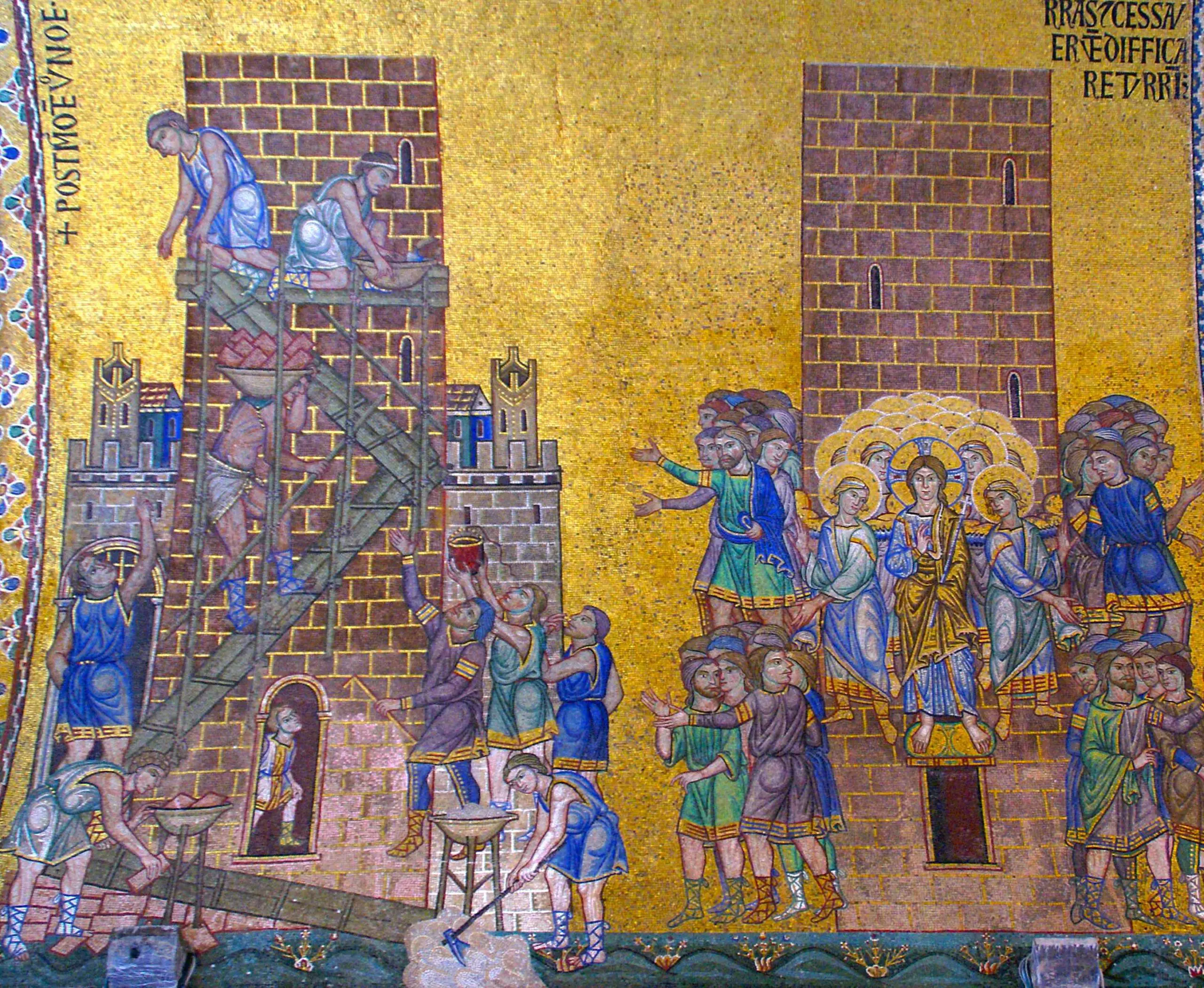
 Click here to return to The Life of Yeshua: A Suggested Reconstruction main page.
_______________________________________________________
Click here to return to The Life of Yeshua: A Suggested Reconstruction main page.
_______________________________________________________
Notes
- For abbreviations and bibliographical references, see “Introduction to ‘The Life of Yeshua: A Suggested Reconstruction.’” ↩
- This translation is a dynamic rendition of our reconstruction of the conjectured Hebrew source that stands behind the Greek of the Synoptic Gospels. It is not a translation of the Greek text of a canonical source. ↩
- See Young, JHJP, 255. While the Hebrew reconstruction is Young’s, the translation of his reconstruction is our own. A few critical remarks on Young’s reconstruction are in order. First, we find the lack of a pronominal suffix attached to אדון to be infelicitous. Either אדוני or אדוננו would seem preferable to אדון. Second, we would have thought את was necessary before רצון אבי שבשמים. Even better would be את רצונו שלאבי שבשמים. We also wonder why את was not attached to דברי or ביתו. Third, we do not see how Young can omit דברי yet include אותם. There is no antecedent for אותם without דברי. Fourth, Young’s reconstruction with לפקח and not לאיש פקח or לאדם פקח is surprising, as is his reconstruction of לטפש rather than לאיש טפש or לאדם טפש. Fifth, we are surprised that Young wrote ופגעו בבית and not ופגעו בבית ההוא or ופגעו באותו הבית. Sixth, we are at a loss to comprehend the variation between בונה in the first part of the parable and בנה in the second part. In his defense, we note that Young referred to his reconstruction as “tentative” (JHJP, 254). ↩
- Cf. Creed, 98; Davies-Allison, 1:712; Bovon, 1:254. ↩
- See Allen, 72; Bultmann, 116; Jeremias, Parables, 96; David Flusser, “Two Anti-Jewish Montages in Matthew” (JOC, 552-560), esp. 554-555; idem, Die rabbinischen Gleichnisse und der Gleichniserzähler Jesus (Bern: Peter Lang, 1981), 98-99. ↩
- Cf. Catchpole, 40. ↩
- Cf. Kloppenborg, 185-186; Betz, 545. See also C. H. Dodd, “The ‘Primitive Catechism’ and the Sayings of Jesus,” in his More New Testament Studies (Manchester: Manchester University Press, 1968), 11-29, esp. 18. ↩
- See Lord’s Prayer, under the “Story Placement” subheading. ↩
- See the introduction to the “Torah and the Kingdom of Heaven” complex. ↩
- Cf. Vincent Taylor, “The Original Order of Q,” in New Testament Essays: Studies in Memory of Thomas Walter Manson (ed. A. J. B. Higgins; Manchester: Manchester University Press, 1959), 246-269, esp. 253; Christopher M. Tuckett, Q and the History of Early Christianity: Studies on Q (Peabody, Mass.: Hendrickson, 1996), 189-194; Fleddermann, 676, 694-695. ↩
- See Luz, 1:389. ↩
- See Sermon’s End, Comment to L5-7. ↩
- See Teaching in Kefar Nahum, under the “Story Placement” subheading. ↩
- We found that the author of Matthew acted analogously in his version of the eschatological discourse. Although based on the version he found in Mark, the author of Matthew wove a block of Anth.’s Son of Man sayings into it, which in Luke was preserved as a unit outside Luke’s eschatological discourse. See the introduction to the “Destruction and Redemption” complex. ↩
- On the author of Matthew’s use of interpolation as redactional method, see Sermon’s End, Comment to L5-7. ↩
- Cf. Manson, Sayings, 176; Bundy, 123 §49; Beare, 68 §42; Fitzmyer, 1:644; Kloppenborg, 185; Young, JHJP, 252; Catchpole, 40, 98; Vermes, Authentic, 319. ↩
- Cf. Manson, Sayings, 60; Bundy, 196 §104; Fitzmyer, 1:643; Gundry, Matt., 130; Kloppenborg, 185; Davies-Allison, 1:712 n. 29; Catchpole, 98; Bovon, 1:253. ↩
- Flusser (Die rabbinischen Gleichnisse und der Gleichniserzähler Jesus, 100) suggested that Houses on Rock and Sand originally belonged to a discourse in which Jesus opposed the incipient cult of personality that idolized Jesus’ charismatic persona but that disregarded Jesus’ teachings. Parts of this discourse were later attached to Jesus’ sermon on the Torah. ↩
- For this understanding of Matt. 5:17, see Heaven And Earth Pass Away, Comment to L6. ↩
- See Creed, 98; Bundy, 123 §49; Davies-Allison, 1:712; Luz, 1:375. ↩
- See Manson, Teaching, 121. ↩
- See Taylor, “The Original Order of Q,” 253; Beare, Earliest, 69 §43; idem, Matt., 199; Betz, 559. ↩
- See LOY Excursus: Criteria for Distinguishing Type 1 from Type 2 Double Tradition Pericopae, under the subheading “Causes of Verbal Disparity in DT Pericopae.” ↩
- See Sermon’s End, under “Conjectured Stages of Transmission.” ↩
- Cf., e.g., McNeile, 96; Beare, 68 §42; Fitzmyer, 1:644. ↩
- See Catchpole, 98. ↩
- Cf. Schweizer, 188. ↩
- Cf. Manson, Sayings, 176; Bultmann, 116; Bundy, 123 §49; Gundry, Matt., 130; Catchpole, 97; Bovon, 1:253. ↩
- Pace Harnack (70), Flusser (Die rabbinischen Gleichnisse und der Gleichniserzähler Jesus, 99) and Young (JHJP, 252), who thought that Matthew’s wording in L1 was more original. ↩
- Somewhat idiosyncratically, Marshall (274) and Nolland (Luke, 1:309), despite preferring Luke’s interrogative form of the saying, thought that Matthew’s use of the verb λέγειν (legein, “to say”) was original. Their preference is due to reliance on Black’s opinion (276) that “Matthew’s expression recalls the use of Semitic אמר in the meaning ‘to designate, name,’” whereas “Luke…gives the more idiomatic Greek phrase.” It should be noted, however, that קָרָא (qārā’, “call”), the Hebrew equivalent of Luke’s καλεῖν (kalein, “call”), can also be used in the sense of “designate” or “name.” ↩
- It is also possible that the author of Matthew’s choice of ὁ λέγων (ho legōn, “the one saying”) was influenced by Anth.’s use of ἃ λέγω (ha legō, “the things I say”) in L3. ↩
- We accept Flusser’s view that the author of Matthew belonged to a Law-keeping Gentile sect that rejected the notion that Gentiles could be saved apart from the Law. For this reason the author of Matthew polemicized against the “lawless” Christians (Matt. 7:23) who followed Jesus but who did not keep the Torah’s commandments. ↩
- Manson, Sayings, 60. ↩
- On the ties between the Didache and the Gospel of Matthew, see Huub van de Sandt, “The Didache and its Relevance for Understanding the Gospel of Matthew.” ↩
- Cf. Marshall, 274; Bovon, 1:253 n. 57. Both scholars rest their opinion on Strack-Billerbeck, 1:943; 2:258. ↩
- See Betz, 542 n. 198; Luz, 1:379 n. 48; Muraoka, Syntax, 193. Examples of double vocatives occur, for instance, in the Classical Greek playwright Aeschylus (5th cent. B.C.E.), where we read:
Ζεῦ Ζεῦ, θεωρὸς τῶνδε πραγμάτων γενοῦ
O Zeus, O Zeus [Ζεῦ Ζεῦ], look upon our cause! (Libation Bearers [Choephoroe] §246; Loeb)
παῖ παῖ, θύρας ἄκουσον ἑρκείασ κτύπον
Porter! Porter! [παῖ παῖ] Hear the knocking at the door! (Libation Bearers [Choephoroe] §653; Loeb)
In the Hellenistic Jewish novella Joseph and Aseneth (1st-2nd cent. C.E.?) we read:
καὶ ἐκάλεσεν αὐτὴν ὁ ἄνθρωπος ἐκ δευτέρου καὶ εἶπεν Ἀσενέθ Ἀσενέθ
And the man called her a second time and said, “Aseneth! Aseneth! [Ἀσενέθ Ἀσενέθ].” (Joseph and Aseneth 14:6)
Likewise, in the thirteenth book of the Sibylline Oracles (ca. 265 C.E.) we read:
↩ὦ Λύκιοι, Λύκιοι, λύκος ἔρχεται αἷμα λιχμῆσαι
O Lycians! Lycians! [Λύκιοι, Λύκιοι] A wolf comes to lick blood! (Sib. Or. 13:139)
- On reconstructing κύριος (kūrios, “lord,” “master”) with אָדוֹן (’ādōn, “lord,” “master”), see Widow’s Son in Nain, Comment to L10. ↩
- See David N. Bivin, “Was Jesus a Rabbi?” ↩
- Cf. Bultmann, 116 n. 2; Schweizer, 188; Gundry, Matt., 131; Kloppenborg, 186; Betz, 545, 636 n. 3. ↩
- See Dalman, 327; Strecker, 166; Davies-Allison, 1:712; Flusser, Jesus, 32. ↩
- Cf., e.g., Lord’s Prayer, L5; Return of the Twelve, L9; Quieting a Storm, L34. ↩
- Cf., e.g., Not Everyone Can Be Yeshua’s Disciple, L19, L30. ↩
- Cf. T. Abraham [A] 9:4 (ed. Stone, 20): Τάδε λέγει Ἁβραὰμ ὁ οἰκέτης σου ὅτι Κύριε, κύριε… (“Thus says Abraham, your slave, ‘Lord! Lord!…’”). ↩
- Cf. Bovon, 1:253. ↩
- Pace Flusser, Die rabbinischen Gleichnisse und der Gleichniserzähler Jesus, 115 n. 104. ↩
- Cf. Marshall, 275. ↩
- For additional instances of the author of Matthew’s sloppy redaction, see Woes on Three Villages, Comment to L24. ↩
- Cf. Hagner, 1:186; Nolland, Matt., 340. ↩
- See LOY Excursus: The Kingdom of Heaven in the Life of Yeshua, under the subheading “The Kingdom of Heaven in the Teachings of Jesus: Jesus’ Band of Itinerating Disciples.” ↩
- Cf. Harnack, 70; Bundy, 123 §50; Vermes, Authentic, 319. ↩
- See the introduction to the “Torah and the Kingdom of Heaven” complex, where we suggest that the author of Matthew knew that in Anth. Houses on Rock and Sand and the Two Sons parable were connected. ↩
- See Yeshua, His Mother and Brothers, Comment to L49-50. ↩
- The table below shows all the instances in the Gospels of Matthew, Mark and Luke where Jesus refers to God as “my Father” and the synoptic parallels (if any):
Matt. 7:21 DT (cf. Luke 6:46)
Matt. 10:32 DT (cf. Luke 12:8)
Matt. 10:33 DT (cf. Luke 12:9)
Matt. 11:27 DT = Luke 10:22
Matt. 12:50 TT (cf. Mark 3:35; Luke 8:21)
Matt. 15:13 U
Matt. 16:17 U
Matt. 18:10 U
Matt. 18:19 U
Matt. 18:35 U
Matt. 20:23 Mk-Mt (cf. Mark 10:40)
Matt. 25:34 U
Matt. 26:29 TT (cf. Mark 14:25; Luke 22:18)
Matt. 26:39 TT (cf. Mark 14:36; Luke 22:42)
Matt. 26:42 TT (cf. Mark 14:39; Luke 22:[–])
Matt. 26:53 TT (cf. Mark 14:47; Luke 22:51)
Luke 2:49 U
Luke 10:22 DT = Matt. 11:27
Luke 22:29 DT (cf. Matt. 19:28)
Luke 24:49 U
Key: TT = pericope has parallels in all three Synoptic Gospels; DT = Lukan-Matthean pericope; Mk-Mt = Markan-Matthean pericope; U = verse unique to a particular Gospel; [–] = no corresponding verseThe author of Luke’s willingness to have Jesus refer to God as “my Father” 4xx in his Gospel suggests that the author of Luke probably did not avoid such references when they occurred in his sources. The reason for the prevalence of Jesus’ references to God as “my Father” in the Gospel of Matthew is most likely due to Matthean redaction. ↩
- Cf. Schweizer, 177; Strecker, 165; Nolland, Luke, 1:309; Catchpole, 97. ↩
- Cf. Manson, Sayings, 121. ↩
- See Knox, 2:32. ↩
- Cf. Bultmann, 117. ↩
- Some scholars assert that those who are excluded in Luke’s version of Closed Door are the Jews (cf., e.g., Bultmann, 117; Strecker, 165), but such an identification is merely speculative. ↩
- Cf. Fredriksen, From Jesus, 39, 190. ↩
- Pace Strecker, 165. See Betz, 546, for criticism of Strecker’s view. ↩
- Cf. A. B. Bruce, 134; Bultmann, 117; Manson, Sayings, 176; Knox, 2:32; Luz, 1:376. ↩
- See Betz, 542-543, 549. ↩
- Cf. Creed, 185; Knox, 2:79-80. Sometimes the conclusion of the Waiting Maidens parable is regarded as a doublet of the Closed Door pericope, which we believe is not far from the truth. We think Jesus repeated some of the language that appears in Closed Door at the end of the Waiting Maidens parable because this parable was intended to illustrate the point Jesus was making in Closed Door and associated sayings. ↩
- See Davies-Allison, 1:714. ↩
- Cf. Fleddermann, 683. ↩
- Cf. Betz, 542. ↩
- See Lesson of Lot’s Wife, Comment to L1. ↩
- Luke’s parallel to Matt. 7:22 (Luke 13:25) lacks ἐν ἐκείνῃ τῇ ἡμέρᾳ. Likewise, the Lukan and Markan parallels to Matt. 22:23 (Luke 20:27; Mark 12:18) lack ἐν ἐκείνῃ τῇ ἡμέρᾳ. ↩
- See Quieting a Storm, Comment to L34. ↩
- Cf. Gundry, Matt., 131; Kloppenborg, 225 n. 219. ↩
- Betz (541) denied that the rejected petitioners in Matt. 7:22-23 are to be identified with the false prophets of Matt. 7:15, maintaining that those in Matt. 7:22-23 are rather “the ones who have been deluded by the false prophets.” But Betz’s distinction can hardly be maintained when the main activity of the rejected petitioners was false prophesy. However, we do concede that equating the rejected petitioners with the false prophets may be misleading. The rejected petitioners are a broader group of false Christians that includes, but is not limited to, false prophets. ↩
- See Schweizer, 178; Gundry, Matt., 132; Davies-Allison, 1:693, 715; Luz, 1:375-376. ↩
- Cf. Gundry, Use, 135. ↩
- See Gundry, Matt., 132; Davies-Allison, 1:717. ↩
- Cf. Gundry, Matt., 132; Davies-Allison, 1:714. ↩
- Pace Gundry, Matt., 132. ↩
- See Yohanan the Immerser’s Execution, L48. ↩
- Cf. Kilpatrick, 24; Nolland, Luke, 2:734. ↩
- See Gundry, Matt., 132; Nolland, Matt., 341. ↩
- See Betz, 542-544, 549, 551, 554-556. ↩
- See Lindsey, GCSG, 3:42-43. ↩
- See Lindsey, LHNC, 725. ↩
- There is a Lukan-Matthean agreement against Mark’s use of οὐδέποτε in Bedridden Man. Cf. Matt. 9:8; Luke 5:26. ↩
- Matthew’s Gospel has two versions of The Finger of God. The first (Matt. 9:32-34) is a truncated version where Jesus’ response to the Pharisees’ accusation is omitted. The second (Matt. 12:22-32) is a complete version that includes Jesus’ response to the accusation. ↩
- Cf. Kilpatrick, 24; Gundry, Matt., 132; Davies-Allison, 1:717 n. 40; Fleddermann, 684. ↩
- Kilpatrick (24) suggested that in the source behind Matt. 7:23 and Luke 13:27 the quotation originally ran ἀποχωρεῖτε ἀπ᾿ ἐμοῦ ἐργάται ἀδικίας (“depart from me, workers of unrighteousness”) and that the authors of Matthew and Luke each took independent measures to bring the quotation more in line with LXX. Cf. Luz, 1:376. But as we shall see, this suggestion does not fully take into account the author of Matthew’s redactional tendencies. ↩
- The verb χωρεῖν occurs 4xx in Matthew (Matt. 15:17; 19:11, 12 [2xx]), compared to a single instance in Mark (Mark 2:2) and zero instances in Luke. The first instance of χωρεῖν occurs in a Markan-Matthean pericope, where the presumption is that the author of Matthew redacted Mark. The remaining instances occur in a pericope unique to Matthew, Eunuchs for the Kingdom, which has every appearance of being a Matthean composition. ↩
- On ἀναχωρεῖν as a marker of Matthean redaction, see Jesus and a Canaanite Woman, Comment to L1. ↩
- Cf. Fleddermann, 685. ↩
- Ibid. ↩
- Gundry offered two reasons why the author of Matthew omitted “all” from the quotation of Ps. 6:9, neither of which are convincing. The first suggestion was that the author of Matthew translated from a Hebrew text of Ps. 6:9 in which כָּל was missing (Gundry, Use, 76). But it is hardly credible that the author of Matthew would have achieved 85.71% verbal identity with LXX’s translation of Ps. 6:9 if he had been translating directly from Hebrew, neither are there any textual witnesses to support Gundry’s theory. Gundry’s second suggestion was that the author of Matthew omitted πάντες from the quotation because he had already written πᾶς in Matt. 7:21 (Gundry, Matt., 132). But it is difficult to see why having written πᾶς a few verses earlier should have prevented him from quoting the Psalm accurately. ↩
- On ἀνομία as a Matthean redactional term, see Darnel Among the Wheat, Comment to L60. ↩
- According to Matt. 28:20, Jesus commissioned the disciples to teach all the Gentiles to do everything he had commanded them. Thus, even the Torah precepts discussed in the Sermon on the Mount and elsewhere in Matthew’s Gospel were to be binding upon non-Jewish believers. ↩
- Cf. Manson, Sayings, 176-177. ↩
- Does Paul’s insistence that circumcised believers were obliged to keep the entire Torah suggest that the Judaizing Gentile believers thought that certain parts of the Torah were “fulfilled” through Jesus’ coming and were therefore no longer incumbent upon Christians? Cf. Gal. 6:13, where Paul states that even those who are circumcised do not obey the (entire) Torah. ↩
- See Gundry, Matt., 132. ↩
- See A. B. Bruce, 135; McNeile, 98; Betz, 560. ↩
- Cf. Strecker, 169; Luz, 1:385. ↩
- Cf. our reconstruction in Demands of Discipleship, L8. ↩
- See Manson, Sayings, 61. ↩
- Thus we do not agree with Bovon (1:254), who regarded ἐρχόμενος πρός με in Luke 6:47 as “a theologically significant addition.” ↩
- We are unconvinced by Gundry’s suggestion that the author of Matthew omitted “who comes to me” because for him ὁ ἐρχόμενος was “a sacrosanct title for the Messiah” (Gundry, Matt., 133; Davies-Allison, 1:720). It is clear that ὁ ἐρχόμενος in Luke 6:47 is non-titular, so the author of Matthew did not need to omit it in order to avoid confusion. Moreover, the author of Matthew did not, in fact, use the title ὁ ἐρχόμενος any more frequently than the other synoptic evangelists. The table below shows all of the instances of ὁ ἐρχόμενος in Matthew and the parallels in the Gospels of Mark and Luke (if any):
Matt. 11:3 DT = Luke 7:19 Yohanan the Immerser’s Question
Matt. 21:9 TT = Mark 11:9; Luke 19:38 Yeshua Enters Yerushalayim
Matt. 23:39 DT = Luke 13:35
Thus we see that the author of Matthew inherited every instance of the title ὁ ἐρχόμενος from his sources. Note, too, that the latter two instances of ὁ ἐρχόμενος are not strictly messianic titles but quotations of Ps. 118:26. At most we can say that the author of Matthew adapted John the Baptist’s words in Yohanan the Immerser’s Eschatological Discourse (Matt. 3:11) in order to anticipate the title ὁ ἐρχόμενος in Yohanan the Immerser’s Question (Matt. 11:3). See Yohanan the Immerser’s Eschatological Discourse, Comment to L11. A single adaptation for the sake of literary continuity does not a sacrosanct title make. Cf. Snodgrass, 693 n. 6. ↩
- Cf. Fitzmyer, 1:644; Strecker, 169; Luz, 1:385; Nolland, Luke, 1:309; Wolter, 1:289. ↩
- Cf. Bundy, 124 §50. ↩
- See Bundy, 124 §50. ↩
- Cf. Hagner, 1:190-191; Bovon, 1:254, 255; Luz, 1:386. ↩
- See Flusser, Die rabbinischen Gleichnisse und der Gleichniserzähler Jesus, 99-100. Snodgrass (694 n. 22) claimed that Flusser’s suggestion had no justification, but that does not do justice to Flusser’s argument. Flusser noted that toward the conclusion of the eschatological discourse we find a saying in which Jesus claims that “my words will never pass away” (Matt. 24:35; Mark 13:31; Luke 21:33). It was Flusser’s opinion (and ours also) that this is not an authentic saying of Jesus but a reworking of Jesus’ claim that “It is easier for heaven and earth to pass away than for a yod or a qotz from the Torah to be deleted” (≈ Matt. 5:18; see our reconstruction of Heaven and Earth Pass Away). Flusser argued that since toward the end of the eschatological discourse we find a saying about Jesus’ words that originally referred to the Torah, the saying about Jesus’ words at the end of the Sermon on the Mount/Sermon on the Plain might originally have referred to the Torah. Flusser’s justification, therefore, was analogy. Nevertheless, we concur with Luz (1:385 n. 6), who concluded that Flusser’s opinion owed more to his desire for Jesus to agree with the rabbinic worldview than to his philological analysis. According to Young (JHJP, 278 n. 82), Flusser modified his opinion by suggesting that originally Jesus referred neither to his own words nor to the words of the Law/words of God. Rather, in the original saying the object of hearing and doing was unstated, as it is in Luke 6:49. According to Flusser’s revised opinion, “my words” in L24 was supplied by a pre-synoptic redactor, and the author of Matthew supplied “my words” in L49. ↩
- Cf. Smith, 155-156. ↩
- Cf. Snodgrass, 334-335. ↩
- See McNeile, 98; Bundy, 124 §50; Schweizer, 190; Flusser, Die rabbinischen Gleichnisse und der Gleichniserzähler Jesus, 99; Beare, Matt., 199; Gundry, Matt., 134; Davies-Allison, 1:720; Strecker, 169; Young, JHJP, 253, 278 n. 82; Betz, 561, 638; Luz, 1:385, 386; Nolland, Luke, 1:309. ↩
- Cf. Luz, 1:385 n. 2. ↩
- Cf. Harnack, 72; Nolland, Luke, 1:309; Betz, 638; Luz, 1:385. ↩
- Cf. Young, JHJP, 253; Nolland, Luke, 1:309. Pace Gundry, Matt., 134. ↩
- See Flusser, Die rabbinischen Gleichnisse und der Gleichniserzähler Jesus, 101-102. ↩
- See Four Soils interpretation, Yeshua, His Mother and Brothers, and A Woman’s Misplaced Blessing. ↩
- Cf. Davies-Allison, 1:720; Luz, 1:386. ↩
- Cf. Strecker, 169; Luz, 1:385. ↩
- Cf. Schweizer, 190-191; Gundry, Matt., 134; Davies-Allison, 1:720; Snodgrass, 331. ↩
- On the author of Matthew’s redactional use of passive forms of the verb ὁμοιοῦν (homoioun, “to be like”), see Darnel Among the Wheat, Comment to L2. ↩
- Cf. Harnack, 73-74; Manson, Sayings, 61; Bundy, 196 §106; Marshall, 275; Davies-Allison, 1:721; Strecker, 169; Luz, 1:385. See also Georg Bertram, “φρήν κτλ.,” TDNT, 9:220-235, esp. 234. Pace Flusser, Die rabbinischen Gleichnisse und der Gleichniserzähler Jesus, 98; Young, JHJP, 253; Snodgrass, 330. ↩
- Cf. Gundry, Matt., 134; Catchpole, 95. ↩
- The table below shows all the instances of φρόνιμος in the Gospels of Matthew, Mark and Luke and the synoptic parallels (if any):
↩Matt. 7:24 DT (cf. Luke 6:48)
Matt. 10:16 U
Matt. 24:45 DT = Luke 12:42
Matt. 25:2 U
Matt. 25:4 U
Matt. 25:8 U
Matt. 25:9 U
Luke 12:42 DT = Matt. 24:45
Luke 16:8 [φρονιμώτερος] U
Key: DT = Lukan-Matthean pericope; U = verse unique to a particular Gospel - Pace Harnack, 73-74. ↩
- Cf. Davies-Allison, 1:720. ↩
- On the author of Luke’s redactional preference for ἀνήρ, see Generations That Repented Long Ago, Comment to L10. ↩
- Flusser (Die rabbinischen Gleichnisse und der Gleichniserzähler Jesus, 98) preferred Luke’s “a house” to Matthew’s “his house.” ↩
- Harnack (72) thought Matthew’s αὐτοῦ τὴν οἰκίαν was original because Luke’s οἰκίαν is better Greek, but his assertion is not self-evident. In any case, Matthew’s αὐτοῦ τὴν οἰκίαν certainly is not Hebraic. ↩
- Cf. Harnack, 73; Manson, Sayings, 61; Catchpole, 95; Wolter, 1:290. ↩
- Cf. Harnack, 73; Creed, 99; Manson, Sayings, 61; Knox, 2:32; Fitzmyer, 1:644; Davies-Allison, 1:721; Young, JHJP, 253; Luz, 1:385. Pace Gundry, Matt., 134. ↩
- Cf. Harnack, 72; Davies-Allison, 1:721. ↩
- Note, however, that each of the three instances of σκάπτειν in Luke occurs in parables. ↩
- See Tower Builder and King Going to War, Comment to L5-6. ↩
- See Gundry, Matt., 134; Davies-Allison, 1:721 n. 47. ↩
- According to Safrai (“Home and Family,” Safrai-Stern, 2:728-792, esp. 733-743), most private first-century Jewish dwellings had floors of packed earth. If a house had a dirt floor, then there can be no question of a stone cellar. It does seem as though the author of Luke is describing a more luxurious building than what is envisioned in Matthew’s version of the parable. ↩
- Cf. Knox, 2:32; Jeremias, Parables, 27 n. 9; Fitzmyer, 1:644; Nolland, Luke, 1:310; Hagner, 1:190. ↩
- Cf. Young, JHJP, 253; Bovon, 1:255. On genitives absolute in the Gospel of Luke as indicative of redactional activity, see LOY Excursus: The Genitive Absolute in the Synoptic Gospels, under the subheading “The Genitive Absolute in Luke.” ↩
- See LSJ, 331. ↩
- See Dos Santos, 39. ↩
- Cf. Fitzmyer, 1:644. ↩
- Cf. Cadbury, Making, 244; Hagner, 1:191; Bovon, 1:255; Snodgrass, 330; Wolter, 1:290. ↩
- See Hatch-Redpath, 1:548-553. ↩
- In LXX ἔρχεσθαι occurs as the translation of הָלַךְ in Gen. 18:22; 22:3; 32:7; 50:18; Exod. 2:8; 3:16; 8:21; Num. 22:16, 37; Deut. 16:7 [Vaticanus]; 17:3; Josh. 9:4, 6; Judg. 2:6 [Vaticanus]; 18:19; 3 Kgdms. 1:49 [Vaticanus]; 10:13; 1 Chr. 19:5; 2 Chr. 8:3; 10:1; 2 Esd. 8:31; Ps. 79[80]:3; Prov. 1:11; Song 2:13; 7:12. ↩
- See Hatch-Redpath, 2:1196-1197. ↩
- See Dos Santos, 129. ↩
- In LXX ποταμός occurs as the translation of נַחַל in 2 Chr. 20:16; 32:4; Prov. 18:4; Ezek. 47:6, 7, 9 (2xx), 12. The LXX translators more often rendered נַחַל as χείμαρρος (cheimarros, “stream”) or φάραγξ (faranx, “ravine,” “gully”). See Dos Santos, 131. ↩
- See Lindsey, GCSG, 1:38. ↩
- See Hatch-Redpath, 2:1151. ↩
- That in supplying his own words in L42 and L67 the author of Matthew ruined the parable’s symmetry may be put down to the sloppiness that can often be detected in Matthean redaction. On the author of Matthew’s redactional sloppiness, see Woes on Three Villages, Comment to L24. ↩
- Cf. Gundry, Matt., 135; Davies-Allison, 1:722. ↩
- Cf. Davies-Allison, 1:722. Pace Catchpole, 95. ↩
- On ἰσχύειν as indicative of the First Reconstructor’s redactional activity, see Tower Builder and King Going to War similes, Comment to L6. Cf. Plummer (Luke, 193) and Luz (1:385), who regard ἰσχύειν as Lukan. ↩
- Cf. Metzger, 142. ↩
- We accepted a διὰ τό + infinitive from Luke in Friend in Need, L17 (Luke 11:8). ↩
- See Moulton-Geden, 521. ↩
- Cf. LHNC, 521. ↩
- Cf. Young, JHJP, 254; Luz, 1:385. ↩
- See Manson, Sayings, 61. ↩
- However, the comedy group Monty Python imagined the hilarious confusion resulting from not being able to properly hear Jesus delivering the Sermon on the Mount in this clip from the movie Life of Brian (1979): ↩
- Pace Davies-Allison, 1:721. ↩
- See Hatch-Redpath, 1:629-630. ↩
- See Dos Santos, 82. ↩
- Pace Davies-Allison, 1:722. ↩
- Pace Davies-Allison, 1:732. ↩
- Cf. Manson, Sayings, 61. ↩
- Pace Flusser, Die rabbinischen Gleichnisse und der Gleichniserzähler Jesus, 99; Davies-Allison, 1:732; Young, JHJP, 278 n. 82. ↩
- Cf. Harnack, 73; Davies-Allison, 1:732. ↩
- Cf. Gundry, Matt., 135. ↩
- Pace Gundry, Matt., 135. ↩
- The table below shows every instance of χωρίς in the Gospels of Matthew, Mark and Luke and the synoptic parallels (if any):
↩Matt. 13:34 Mk-Mt = Mark 4:34
Matt. 14:21 TT (cf. Mark 6:44; Luke 9:14)
Matt. 15:38 Mk-Mt (cf. Mark 8:9)
Mark 4:34 Mk-Mt = Matt. 13:34
Luke 6:49 DT (cf. Matt. 7:26)
Key: TT = pericope has parallels in all three Synoptic Gospels; DT = Lukan-Matthean pericope; Mk-Mt = Markan-Matthean pericope - Cf. A. B. Bruce (509) and Davies-Allison (1:723), who likewise regarded “without a foundation” as redactional. ↩
- See Hatch-Redpath, 1:66. ↩
- See Dos Santos, 60. ↩
- See Betz, 567 n. 79. ↩
- Cf. Gundry, Matt., 136. ↩
- See Bovon, 1:255. ↩
- Cf. Harnack, 73; Marshall, 275; Young, JHJP, 254; Davies-Allison, 1:723; Bovon, 1:255. ↩
- Cf. Marshall, 275, who thought that εὐθύς in Luke 6:49 was “pre-Lucan.” ↩
- So Bovon (1:255). ↩
- See Plummer, Luke, 193; A. B. Bruce, 509; Marshall, 275; Bovon, 1:255. ↩
- See Harnack, 73. ↩
- See Hatch-Redpath, 2:1239. ↩
-
Houses on Rock and Sand
Luke’s Version
Anthology’s Wording (Reconstructed)
τί δέ με καλεῖτε κύριε κύριε καὶ οὐ ποιεῖτε ἃ λέγω
πᾶς ὁ ἐρχόμενος πρός με καὶ ἀκούων μου τῶν λόγων καὶ ποιῶν αὐτούς ὑποδείξω ὑμῖν τίνι ἐστὶν ὅμοιος ὅμοιός ἐστιν ἀνθρώπῳ οἰκοδομοῦντι οἰκίαν ὃς ἔσκαψεν καὶ ἐβάθυνεν καὶ ἔθηκεν θεμέλιον ἐπὶ τὴν πέτραν πλημμύρης δὲ γενομένης προσέρηξεν ὁ ποταμὸς τῇ οἰκίᾳ ἐκείνῃ καὶ οὐκ ἴσχυσεν σαλεῦσαι αὐτὴν διὰ τὸ καλῶς οἰκοδομῆσθαι αὐτήν
ὁ δὲ ἀκούσας καὶ μὴ ποιήσας ὅμοιός ἐστιν ἀνθρώπῳ οἰκοδομήσαντι οἰκίαν ἐπὶ τὴν γῆν χωρὶς θεμελίου ᾗ προσέρηξεν ὁ ποταμός καὶ εὐθὺς συνέπεσεν καὶ ἐγένετο τὸ ῥῆγμα τῆς οἰκίας ἐκείνης μέγα
τί δέ με καλεῖτε κύριε κύριε καὶ οὐ ποιεῖτε ἃ λέγω
πᾶς ὁ ἀκούων μου τοὺς λόγους καὶ ποιῶν αὐτούς τίνι ἐστὶν ὅμοιος ὅμοιός ἐστιν ἀνθρώπῳ ὅστις ᾠκοδόμησεν οἰκίαν ἐπὶ τὴν πέτραν καὶ κατέβη ἡ βροχὴ καὶ ἦλθον οἱ ποταμοὶ καὶ ἔπνευσαν οἱ ἄνεμοι τῇ οἰκίᾳ ἐκείνῃ καὶ οὐκ ἔπεσεν τεθεμελίωτο γὰρ ἐπὶ τὴν πέτραν
καὶ πᾶς ὁ ἀκούων μου τοὺς λόγους καὶ μὴ ποιῶν αὐτοὺς τίνι ἐστὶν ὅμοιος ὅμοιός ἐστιν ἀνθρώπῳ ὅστις ᾠκοδόμησεν οἰκίαν ἐπὶ τὴν ἄμμον καὶ κατέβη ἡ βροχὴ καὶ ἦλθον οἱ ποταμοὶ καὶ ἔπνευσαν οἱ ἄνεμοι τῇ οἰκίᾳ ἐκείνῃ καὶ ἔπεσεν καὶ ἐγένετο ἡ πτῶσις αὐτῆς μεγάλη
Total Words:
94
Total Words:
101
Total Words Identical to Anth.:
45
Total Words Taken Over in Luke:
45
Percentage Identical to Anth.:
47.87%
Percentage of Anth. Represented in Luke:
44.55%
↩
-
Houses on Rock and Sand
Matthew’s Version
Anthology’s Wording (Reconstructed)
οὐ πᾶς ὁ λέγων μοι κύριε κύριε εἰσελεύσεται εἰς τὴν βασιλείαν τῶν οὐρανῶν ἀλλ᾿ ὁ ποιῶν τὸ θέλημα τοῦ πατρός μου τοῦ ἐν τοῖς οὐρανοῖς
πολλοὶ ἐροῦσίν μοι ἐν ἐκείνῃ τῇ ἡμέρᾳ κύριε κύριε οὐ τῷ σῷ ὀνόματι ἐπροφητεύσαμεν καὶ τῷ σῷ ὀνόματι δαιμόνια ἐξεβάλομεν καὶ τῷ σῷ ὀνόματι δυνάμεις πολλὰς ἐποιήσαμεν καὶ τότε ὁμολογήσω αὐτοῖς ὅτι οὐδέποτε ἔγνων ὑμᾶς ἀποχωρεῖτε ἀπ᾿ ἐμοῦ οἱ ἐργαζόμενοι τὴν ἀνομίαν
πᾶς οὖν ὅστις ἀκούει μου τοὺς λόγους τούτους καὶ ποιεῖ αὐτούς ὁμοιωθήσεται ἀνδρὶ φρονίμῳ ὅστις ᾠκοδόμησεν αὐτοῦ τὴν οἰκίαν ἐπὶ τὴν πέτραν καὶ κατέβη ἡ βροχὴ καὶ ἦλθαν οἱ ποταμοὶ καὶ ἔπνευσαν οἱ ἄνεμοι καὶ προσέπεσαν τῇ οἰκίᾳ ἐκείνῃ καὶ οὐκ ἔπεσεν τεθεμελίωτο γὰρ ἐπὶ τὴν πέτραν
καὶ πᾶς ὁ ἀκούων μου τοὺς λόγους τούτους καὶ μὴ ποιῶν αὐτοὺς ὁμοιωθήσεται ἀνδρὶ μωρῷ ὅστις ᾠκοδόμησεν αὐτοῦ τὴν οἰκίαν ἐπὶ τὴν ἄμμον καὶ κατέβη ἡ βροχὴ καὶ ἦλθον οἱ ποταμοὶ καὶ ἔπνευσαν οἱ ἄνεμοι καὶ προσέκοψαν τῇ οἰκείᾳ ἐκείνῃ καὶ ἔπεσεν καὶ ἦν ἡ πτῶσις αὐτῆς μεγάλη
τί δέ με καλεῖτε κύριε κύριε καὶ οὐ ποιεῖτε ἃ λέγω
πᾶς ὁ ἀκούων μου τοὺς λόγους καὶ ποιῶν αὐτούς τίνι ἐστὶν ὅμοιος ὅμοιός ἐστιν ἀνθρώπῳ ὅστις ᾠκοδόμησεν οἰκίαν ἐπὶ τὴν πέτραν καὶ κατέβη ἡ βροχὴ καὶ ἦλθον οἱ ποταμοὶ καὶ ἔπνευσαν οἱ ἄνεμοι τῇ οἰκίᾳ ἐκείνῃ καὶ οὐκ ἔπεσεν τεθεμελίωτο γὰρ ἐπὶ τὴν πέτραν
καὶ πᾶς ὁ ἀκούων μου τοὺς λόγους καὶ μὴ ποιῶν αὐτοὺς τίνι ἐστὶν ὅμοιος ὅμοιός ἐστιν ἀνθρώπῳ ὅστις ᾠκοδόμησεν οἰκίαν ἐπὶ τὴν ἄμμον καὶ κατέβη ἡ βροχὴ καὶ ἦλθον οἱ ποταμοὶ καὶ ἔπνευσαν οἱ ἄνεμοι τῇ οἰκίᾳ ἐκείνῃ καὶ ἔπεσεν καὶ ἐγένετο ἡ πτῶσις αὐτῆς μεγάλη
Total Words:
162
Total Words:
101
Total Words Identical to Anth.:
75
Total Words Taken Over in Matt.:
75
Percentage Identical to Anth.:
46.30%
Percentage of Anth. Represented in Matt.:
74.26%
↩
- Cf. A. B. Bruce, 136; Strecker, 170; Snodgrass, 335. Unfortunately, after stating that “The parable is not to be allegorized,” that is just what Snodgrass went on to do, claiming that “most modern commentators rightly conclude that the reference is to the final judgment.” Snodgrass has been misled by the author of Matthew’s redactional activity, as have Nolland (Luke, 1:310), Hagner (1:189-190) and Luz (1:386). ↩
- Cf. Schweizer, 190-191; Gundry, Matt., 132. ↩