
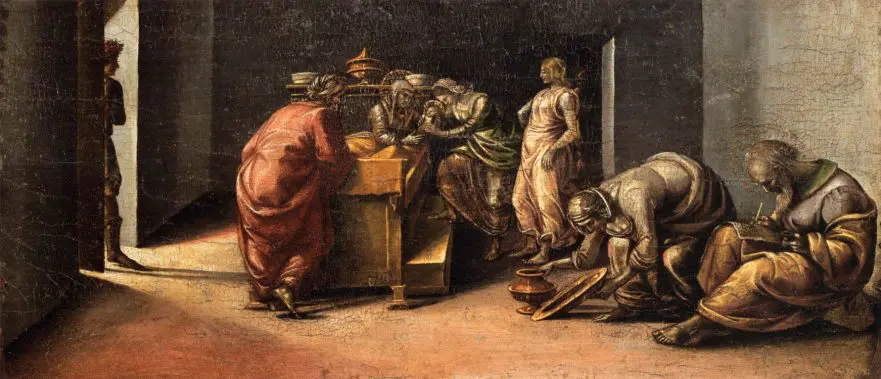
The naming of a child at his circumcision ceremony, as presented in Luke 1, is also mentioned in Luke 2:21 regarding the naming of Jesus. In fact, naming a child during the circumcision ceremony is still accepted Jewish practice. The naming rite includes a prayer for the child’s well-being.
The Lord’s Prayer 10: A Hebrew Reconstruction

As a summary of Dr. Bradford Young’s series on the rabbinic background to the Lord’s Prayer, we present his English transliteration of the conjectured Hebrew original and its English translation.
Zechariah’s Prestigious Task
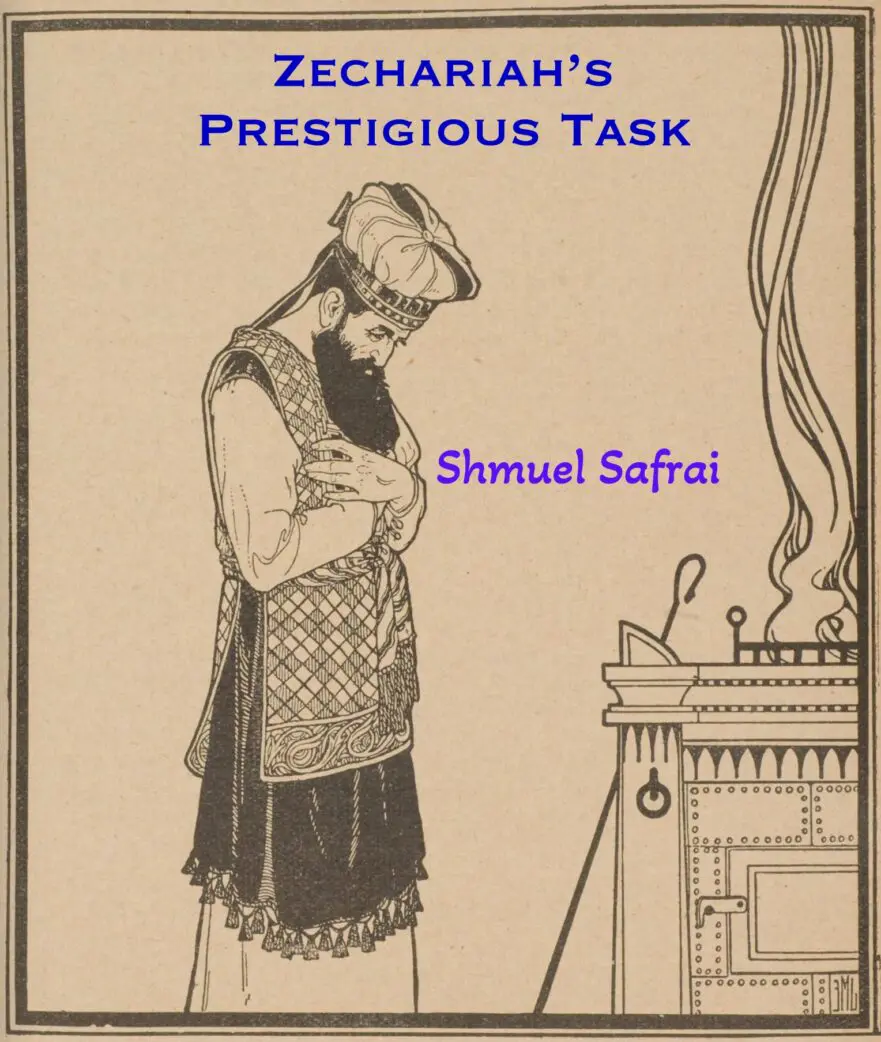
It was not unknown for a priest to see a vision or hear a heavenly voice in the sanctuary at the time of the incense offering. Josephus relates that while the high priest and ruler John Hyrcanus was offering incense in the sanctuary, he heard a voice proclaiming that his sons had just defeated the Syrian king Antiochus (Antiq. 13:282).
The Lord’s Prayer 9: “Lead Us Not Into Temptation”
It is difficult to grasp the full impact of the Lord’s Prayer without an appreciation of its Jewish background. Today’s Christians have quite a different understanding of prayer, Scripture and faith than a Jewish teacher like Jesus. One easily can miss the great depth of Jesus’ message.
The Lord’s Prayer 8: “Forgive Us Our Debts”
Forgiveness is one of the main emphases in Jesus’ teaching. It is no wonder, then, that forgiveness is part of the short prayer that Jesus taught his disciples.
The Lord’s Prayer 7: “Give Us This Day Our Daily Bread”
The deceptively simple petition from Matthew 6:11, “Give us this day our daily bread,” has been a matter of controversy for centuries. The unusual Greek word epiousion, which is translated “daily,” is the root of the controversy. Some scholars have suggested that the original phrase contained the similar-sounding Greek word epeimi, (the next), and so meant “bread for the next day.” Nevertheless, the Latin translation of the New Testament understood the word as meaning bread needed for sustenance.
The Lord’s Prayer 6: “Thy Will Be Done”
We noted in a previous article that “Thy will be done” parallels “Thy Kingdom come.” Both phrases mean, “May you continue establishing your Kingship.” Jesus does not instruct his disciples to pray “if it is your will.” It is within God’s purpose that all men should repent and become a part of God’s reign. “May your will be accomplished” is a strong affirmative appeal.
The Lord’s Prayer 5: “Thy Kingdom Come” (Part 2)
Like Jesus, the rabbis made frequent reference to “the Kingdom of Heaven.” A familiarity with the way “Kingdom of Heaven” is used in rabbinic literature is essential for understanding its use in the Gospels.
The Lord’s Prayer 4: “Thy Kingdom Come” (Part 1)
Probably no other aspect of Jesus’ teaching has been so greatly misunderstood as the Kingdom of Heaven. Certainly, few themes are more essential for understanding Jesus.
The Lord’s Prayer 1: Introduction
Too often, the importance of the Jewish background of the prayer and of the language that Jesus used has been overlooked or minimized.