How to cite this article: David N. Bivin and Joshua N. Tilton, “Yeshua’s Testing,” The Life of Yeshua: A Suggested Reconstruction (Jerusalem Perspective, 2021) [https://www.jerusalemperspective.com/20454/].
Matt. 4:1-11; Mark 1:12-13; Luke 4:1-13
(Huck 8; Aland 20; Crook 23)[1]
Updated: 17 December 2025
וְיֵשׁוּעַ מָלֵא רוּחַ קֹדֶשׁ שָׁב מִן הַיַּרְדֵּן וַיִּתְהַלֵּךְ בָּרוּחַ בַּמִּדְבָּר אַרְבָּעִים יוֹם וַיִּתְנַסֶּה בַּשָּׂטָן וְלֹא אָכַל מְאוּמָה בַּיָּמִים הָהֵם וַיְכֻלּוּ וַיִּרְעַב וַיִּקְרַב הַשָּׂטָן וַיֹּאמֶר לוֹ אִם בֵּן אַתָּה לֵאלֹהִים אֱמֹר לָאֶבֶן הַזּוֹ וְתִּהְיֶה לְלֶחֶם וַיַּעַן יֵשׁוּעַ וַיֹּאמֶר כָּתוּב כִּי לֹא עַל הַלֶּחֶם לְבַדּוֹ יִחְיֶה הָאָדָם וַיַּעֲלֵהוּ אֶל הַר גָּבֹהַּ מְאֹד וַיּוֹרֵהוּ אֶת כָּל מַמְלְכוֹת הָאָרֶץ וְאֶת כֹּל כְּבוֹדָן וַיֹּאמֶר לוֹ אֶת כֻּלָּם לְךָ אֶתֵּן אִם תִּתְנַפֵּל לְפָנַי וַיַּעַן יֵשׁוּעַ וַיֹּאמֶר לוֹ כָּתוּב אֶת יי אֱלֹהֶיךָ תִּירָא וְאוֹתוֹ לְבַדּוֹ תַעֲבֹד וַיֹּלֶךְ אוֹתוֹ יְרוּשָׁלַיִם וַיַּעֲמִדֵהוּ עַל כְּנַף הַמִּקְדָּשׁ וַיֹּאמֶר לוֹ אִם בֵּן אַתָּה לֵאלֹהִים הַפֵּל אֶת עַצְמְךָ [מִזֶּה] לְמַטָּה שֶׁכָּתוּב כִּי מַלְאָכָיו יְצַוֶּה לָּךְ וְעַל כַּפַּיִם יִשָּׂאוּנְךָ פֶּן תִּגֹּף בָּאֶבֶן רַגְלֶךָ וַיַּעַן וַיֹּאמֶר לוֹ יֵשׁוּעַ נֶאֱמַר לֹא תְנַסּוּ אֶת יי אֱלֹהֵיכֶם וַיְכַל הַשָּׂטָן כֹּל נִסָּיוֹן וַיָּסַר מִמֶּנּוּ [וְהִנֵּה מַלְאָכִים קָרְבוּ וַיְשָׁרְתוּ אוֹתוֹ]
Having been filled with the Holy Spirit, Yeshua turned from the Yarden, and in the Spirit he walked in the desert for forty days. He was tempted by Satan, and he did not eat anything in all that time. When those days were over he was famished.
Then Satan approached Yeshua and said, “If you really are God’s son, command this hunk of rock to become bread.” But Yeshua replied, “It is written, People do not live on bread alone [Deut. 8:3].”
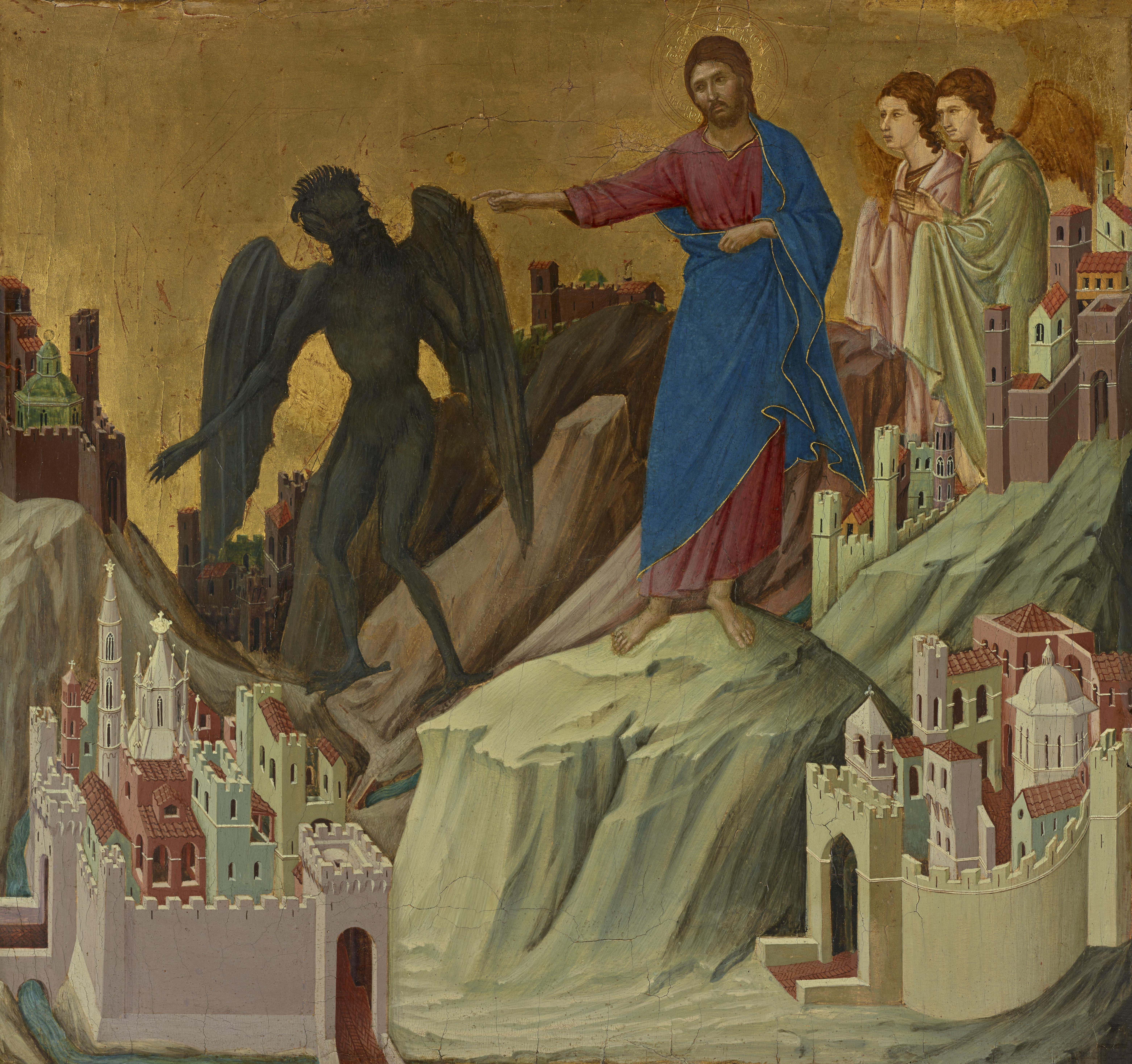
So Satan took Yeshua up a very high mountain and showed him all the kingdoms of the earth and all their glory. Then Satan said to Yeshua, “All of them I will give you if you will worship me.” But Yeshua replied, “It is written, Fear the LORD your God, and worship him alone [Deut. 6:13; 10:20].”
So Satan led Yeshua into Yerushalayim, set him on a wing of the Temple, and said to him, “If you really are God’s son, throw yourself down from this spot, since it is written, For he will command his angels concerning you so that they will lift you up in their arms, lest you strike your foot against a stone [Ps. 91:11, 12].” But Yeshua replied, “Scripture says, You must not test the LORD your God [Deut. 6:16].”
When Satan had concluded every temptation he left Yeshua alone [but angels came to Yeshua and served him].[2]
| Table of Contents |
|
3. Conjectured Stages of Transmission 5. Comment 8. Conclusion |
Reconstruction
To view the reconstructed text of Yeshua’s Testing click on the link below:
Story Placement
All three Synoptic Gospels record that Jesus faced a period of trial subsequent to his immersion by John the Baptist. Not only is there a chronological sequence from immersion to trial, there is also a thematic connection.[3] At his baptism a heavenly voice acknowledged Jesus as the Son of God. The trials Jesus faced following his baptism put Jesus’ sonship to the test.
There may be an even deeper connection between Yeshua’s Immersion and Yeshua’s Testing, one that has previously gone unnoticed by most New Testament scholars. At his baptism the heavenly voice not only proclaimed that Jesus was God’s Son, it described him as a specific kind of son, a beloved son, an appellation that likely alludes to Gen. 22:2, in which Isaac is referred to as Abraham’s beloved son.[4] Having identified Jesus as God’s Isaac, as it were, Jesus is then described as enduring a series of trials that resemble the trials that, according to Jewish tradition, Abraham and Isaac endured on their way to the place of sacrifice.[5]

Jesus’ trials resemble those of Abraham and Isaac in several respects. First, although according to Gen. 22:1 God tested Abraham, in post-biblical Jewish sources both Abraham and Isaac were tempted by Satan.[6] Thus Jesus was tempted by the same malevolent being who had once tempted the patriarchs Abraham and Isaac. Second, on their way to the sacrifice Satan attempted to undermine Abraham’s loyalty to God and Isaac’s obedience to his father.[7] It is precisely Jesus’ loyalty and obedience to his heavenly Father that Satan put to the test. Third, according to some retellings of the trials of Abraham and Isaac, Satan quoted Scripture to dissuade them from their purpose, but the patriarchs successfully resisted Satan with Scripture quotations of their own.[8] Jesus, too, resisted Satan’s temptations with Scripture quotations. Fourth, just as Abraham and Isaac journeyed from their home (presumably in Beersheva on the edge of the desert) to their destination on Mount Moriah, so Jesus, in the course of his temptations, was led (according to the Lukan sequence) from the wilderness to the Temple, which was built on the site of Isaac’s sacrifice (2 Chr. 3:1).
We believe the similarities between the trial of Abraham and Isaac and Jesus’ temptation are too great to be merely coincidental. It is more likely that the story of Jesus’ temptation intentionally echoed ancient traditions surrounding the trial of Abraham and especially Isaac, the beloved son. Satan tested the obedience of both beloved sons (Abraham’s beloved son Isaac and God’s beloved son Jesus) in order to derail God’s redemptive mission. In both cases Satan was unsuccessful, and the beloved sons proved their willingness to give themselves up for the sake of Israel.
.

.
Click here to view the Map of the Conjectured Hebrew Life of Yeshua.
.
.
Conjectured Stages of Transmission

The Lukan and Matthean versions of Yeshua’s Testing are clearly derived from a common source,[9] for despite a few important differences (e.g., the order of the temptations, the location of the temptation to accept worldly dominion), they have sufficiently high verbal identity as to classify Yeshua’s Testing as a Type 1 Double Tradition (DT) pericope.[10] The overall ease with which Luke’s version of Yeshua’s Testing reverts to Hebrew likewise suggests that both the Lukan and Matthean versions of Yeshua’s Testing relied directly on the Anthology (Anth.), the only source the authors of Luke and Matthew shared in common. The differences between the Lukan and Matthean versions of Yeshua’s Testing that do exist are probably not due to the author of Luke’s reliance on his second source, the First Reconstruction (FR); the differences should rather be attributed to Lukan and Matthean redaction.
Mark’s version of Yeshua’s Testing is so dissimilar to Luke’s that even scholars who concurred with Lindsey’s theory that the author of Mark was familiar with the Gospel of Luke have concluded that Mark’s version represents an entirely different strain of tradition from that represented by Luke and Matthew.[11] Scholars who adhere to the Two-source theory generally maintain that Mark’s version of Yeshua’s Testing was not influenced by the “Q” version.[12] We believe that while the author of Mark was fully aware of Luke’s version of Yeshua’s Testing, he completely rewrote the pericope according to his own tastes and purposes.
While enjoying much in common with Luke’s version of Yeshua’s Testing, Matthew’s version also contains points of similarity with Mark’s version (e.g., “into the desert” vs. Luke’s “in the desert” in L10), which suggests that when the author of Matthew incorporated this pericope into his Gospel he combined Anth.’s wording with Mark’s.[13] Such a procedure was typical of the author of Matthew’s redactional style.
Some scholars have suggested that the three temptations of the Lukan and Matthean versions of Yeshua’s Testing did not originate from a single source.[14] These scholars point out that whereas in two temptations (changing stone to bread and jumping from the pinnacle) the devil opens his challenge with “If you are the Son of God” and continues with an imperative (“command,” “throw yourself”), the remaining temptation (seizing worldly dominion) contains neither of these elements. Instead the devil attempts to strike a bargain with Jesus, granting Jesus a global empire in exchange for worship. According to these scholars, it was the author of the pre-synoptic source common to Luke and Matthew who first brought the two “Son of God” temptations and the temptation to seize worldly dominion together into a single literary unit.[15] On the other hand, Flusser argued that while it was too incongruous for the devil to say to Jesus, “If you are the Son of God, worship me, and I will give you all these kingdoms,” the content of the three temptations is the same—to reject human frailty by usurping divine prerogatives.[16] Moreover, Donaldson has pointed out that although Satan does not address Jesus as the Son of God in the temptation to seize worldly dominion, the Son of God concept, far from being absent, is actually integral to the scene.[17] According to Psalm 2, the anointed king who is hailed as God’s Son is destined to possess the entire earth and rule over the Gentiles. Thus, while the temptation to seize worldly dominion is structured differently from the other two temptations, thematically all three are strongly united. Moreover, the temptation to seize worldly dominion is just as easy to reconstruct in Hebrew as the other two temptations (see Comment section below), which indicates that it originated from the same linguistic milieu as the other two temptations. Rather than regarding the formal differences between the temptation to seize worldly dominion and the other two temptations as indications of separate sources that have been artificially patched together, we believe the differences are the result of literary craftsmanship. By placing two explicit “Son of God” temptations on either side of the temptation to seize worldly dominion, the author of Yeshua’s Testing wished to signal to his readers that this temptation, too, focused on Jesus’ status as Son of God.
The final issue regarding the transmission of Yeshua’s Testing we wish to consider in this section is the scholarly contention that Yeshua’s Testing could not have originated in a Jewish, Hebrew-speaking milieu, but must have been formulated in the Greek-speaking church, probably among Gentile believers. Some scholars have defended the Greek origin of the temptation narrative on the grounds that the Son of God concept could only have existed in a Hellenistic context.[18] Other scholars have maintained that the conformity of the biblical quotations to LXX[19] and the presence of un-Semitic Greek in Yeshua’s Testing[20] prove that this pericope must have originated in a Greek-speaking context. Yet each of these arguments against supposing that Yeshua’s Testing could have originated in a first-century Jewish context are inconclusive.
In the first place, the designation “son of God” was not foreign to late Second Temple-period Judaism. The term “son of God” could convey one of several connotations:[21]
-
- God referred to Israel collectively as “my son” (Hos. 11:1), and by extension individual Israelites were considered “sons of God” (Deut. 14:1).
- Particularly righteous individuals who distinguished themselves by their piety earned for themselves the designation “son of God” (Sir. 4:10). This usage appears to have been particularly important among the Hasidim of the first century C.E.[22]
- The designation of the Messiah as God’s Son is as ancient as Psalm 2, in which the LORD proclaims to his anointed king, “You are my son, today I have begotten you” (Ps. 2:7). This Psalm, and consequently the designation “son of God,” could be applied to any figure understood to fulfill a messianic function (e.g., an eschatological king, an end-time prophet, a messianic high priest).
- Angels or other heavenly beings could also be referred to as “sons of God” (Gen. 6:2; Ps. 82:6).
A combination of the second and third senses mentioned above adequately accounts for the term “Son of God” in Yeshua’s Testing, and therefore cannot disqualify its possible origin in a Jewish, Hebrew-speaking milieu.
As for the conformity of the Scripture quotations in Yeshua’s Testing to LXX, we should begin by stating that there is no reason why a Greek translator of a Hebrew source, such as the one we believe ultimately stands behind the Synoptic Gospels, could not have utilized LXX when he encountered Scripture quotations.[23] He was, after all, making a translation for Greek speakers for whom LXX would undoubtedly have been familiar. We believe that the Greek translator of the Hebrew Life of Yeshua generally did follow LXX, except in cases where the verse as quoted in the Hebrew Life of Yeshua was substantially different from LXX. And, in fact, not all the Scripture quotations in Yeshua’s Testing do conform to LXX, and the departures from LXX may indicate that behind Yeshua’s Testing there stood a Hebrew source acquainted with a pre-Masoretic version of Deut. 6:13 (or Deut. 10:20) (see below, Comment to L61 and Comment to L62). Thus, to our minds, conformity to LXX in Scripture quotations is no argument against positing a Hebrew source behind the synoptic versions of Yeshua’s Testing, while the few instances of disagreement with LXX may provide evidence of an underlying Hebrew Ur-text.
Finally, the un-Semitic Greek in Yeshua’s Testing that is usually cited as evidence that this pericope could only have originated in a Greek-speaking context is the absolute use of “the Spirit” (i.e., without a qualifier such as “Holy” or “of God”; Matt. 4:1 [L11]; Mark 1:12 [L5]; Luke 4:1 [L9]) and the phrase εἰ υἱὸς εἶ τοῦ θεοῦ (ei huios ei tou theou, lit., “if son you are of the God”; Matt. 4:3 ∥ Luke 4:3 [L26]; Matt. 4:6 ∥ Luke 4:9 [L69]). Regarding the absolute use of “the Spirit,” Dalman claimed that “In Jewish literature it is so unheard of to speak of ‘the Spirit’ (הָרוּחַ), when the Spirit of God is meant, that the single word ‘spirit’ would much rather be taken to mean a demon or the wind.”[24] But the examples of the absolute use of “the Spirit” in Scripture (e.g., Num. 11:25, 26; Ezek. 1:12, 20; 11:24; 43:5; Hos. 9:7) and in post-biblical Jewish sources[25] prove that Dalman’s argument is overblown.[26] Especially in a context where the Spirit has already been identified as the Holy Spirit (Luke 4:1 [L5]) or the Spirit of God (Matt. 3:16 [Yeshua’s Immersion, L30]), an absolute usage of “the Spirit” can hardly be styled as un-Hebraic. As for εἰ υἱὸς εἶ τοῦ θεοῦ (“if you are the son of God”; L26, L69), Kloppenborg maintained that this phrase “is hardly possible in a semitic language!”[27] but his confident assertion is difficult to comprehend given the fact that a nearly identical construction, υἱοί ἐστε κυρίου τοῦ θεοῦ ὑμῶν (lit., “sons you are of [the] Lord the God of you”), occurs in Deut. 14:1 as the translation of בָּנִים אַתֶּם לַיי אֱלֹהֵיכֶם (lit., “sons you [are] to the LORD your God”). If these are the strongest examples of un-Semitic Greek in Yeshua’s Testing that scholars can produce, then we are underwhelmed by the evidence that Yeshua’s Testing is a thoroughly Greek composition.[28]
Crucial Issues
- Was Jesus tempted or tested?
- Was Yeshua’s Testing modeled on Israel’s trials in the desert or on the trials of Abraham and Isaac?
- What was the original order of the trials (or temptations)?
- Was Jesus’ temptation (or testing) a visionary experience or was Jesus transported from place to place?
- Where was the “pinnacle of the Temple”?
Comment
L1 καὶ εὐθὺς (Mark 1:12). The author of Mark opened Yeshua’s Testing with his stereotypical adverbial phrase “and immediately.” Since the use of εὐθύς (evthūs, “immediately”) is typical of Markan redaction, we have omitted this phrase from GR.[29]
L2 τότε (Matt. 4:1). The author of Matthew opened his version of Yeshua’s Testing with the adverb τότε (tote, “then”). Since the use of τότε, especially in narrative, is typical of Matthean redaction, we have not included τότε in GR.[30]
L3 Ἰησοῦς δὲ (Luke 4:1). The authors of Luke and Matthew agreed against Mark to make Jesus the subject of the opening sentence of Yeshua’s Testing. Such specific Lukan-Matthean agreement is a good indication that both authors were reflecting the wording of their common source, Anth.[31] The lack of a definite article before Jesus’ name is atypical for Luke, but consistent with the hypothesis that the author of Luke copied Yeshua’s Testing from a Hebraic-Greek source.[32] We have accordingly accepted Luke’s wording in L3 for GR.
וְיֵשׁוּעַ (HR). On reconstructing Ἰησοῦς (Iēsous, “Jesus”) with יֵשׁוּעַ (yēshūa‘, “Jesus”), see Rich Man Declines the Kingdom of Heaven, Comment to L12.
L4-5 πλήρης πνεύματος ἁγίου (Luke 4:1). Although Luke’s description of Jesus as “full of the Holy Spirit” is often regarded as redactional,[33] the phrase πλήρης πνεύματος ἁγίου (plērēs pnevmatos hagiou, “full of Holy Spirit”) poses no difficulty from the standpoint of Hebrew reconstruction (see below). While it is true that descriptions of individuals as “full of the Holy Spirit” also occur in Acts (Acts 6:3, 5; 7:55; 11:24), but not elsewhere in the Synoptic Gospels, this fact does not prove that the author of Luke added this description of Jesus to Yeshua’s Testing. It could just as easily be the case that Luke’s descriptions of other individuals as being filled with the Holy Spirit in Acts were modeled on the description he had found in Anth.’s version of Yeshua’s Testing. Since we believe that the author of Luke adhered rather closely to Anth.’s wording in the opening of Yeshua’s Testing, we have accepted his description of Jesus’ being full of the Holy Spirit for GR in L4-5.
מָלֵא רוּחַ קֹדֶשׁ (HR). In LXX the adjective πλήρης (plērēs, “full”) usually occurs as the translation of the adjective מָלֵא (mālē’, “full”), and less often as the translation of the verb מָלֵא (mālē’, “be full”).[34] Likewise we find that the LXX translators rendered most instances of the adjectival מָלֵא with πλήρης, while they occasionally rendered verbal forms of מָלֵא with πλήρης.[35]
On reconstructing πνεῦμα ἅγιον (pnevma hagion, “holy spirit”) as רוּחַ קֹדֶשׁ (rūaḥ qodesh, “spirit of holiness”), see Yeshua’s Thanksgiving Hymn, Comment to L2.
An example of being “full” of the divine Spirit occurs in the Book of Micah:
וְאוּלָם אָנֹכִי מָלֵאתִי כֹחַ אֶת־רוּחַ יי וּמִשְׁפָּט וּגְבוּרָה לְהַגִּיד לְיַעֲקֹב פִּשְׁעוֹ וּלְיִשְׂרָאֵל חַטָּאתוֹ
But I am filled with power, with the Spirit of the LORD and justice and might to declare to Jacob his transgression and to Israel his sin. (Mic. 3:8)
Since Luke’s Greek lacks definite articles accompanying πνεῦμα (“spirit”) and ἅγιον (“holy”), we have decided against including the definite article in HR. Examples of “Holy Spirit” without the definite article or a pronominal suffix are found in DSS, for example:
ואז יברר אל באמתו כול מעשי גבר וזקק לו מבני איש להתם כול רוח עולה מתכמי בשרו ולטהרו ברוח קודש מכול עלילות רשעה
And then God will purify with his truth all the works of man and refine for himself from the sons of man to put to an end every spirit of iniquity from within the depths of his flesh and to purify him with the Holy Spirit [בְּרוּחַ קוֹדֶשׁ] from all deeds of wickedness. (1QS IV, 20-21)
בהיות אלה בישראל ככול התכונים האלה ליסוד רוח קודש לאמת עולם לכפר על אשמת פשע
When these exist in Israel according to all these precepts for a foundation of the Holy Spirit [רוּחַ קוֹדֶשׁ] and for eternal truth to atone for the guilt of transgression…. (1QS IX, 3-4)
יחונכה ברוח קודש וחס[ד — ]
May he be gracious to you by the Holy Spirit [בְּרוּחַ קוֹדֶשׁ] and mer[cy –]. (1QSb [1Q28b] II, 24)
Compare the description of Jesus’ being full of the Holy Spirit with the following description of Joshua at the time when he assumed leadership over Israel following Moses’ death:
וִיהוֹשֻׁעַ בִּן נוּן מָלֵא רוּחַ חָכְמָה כִּי סָמַךְ מֹשֶׁה אֶת יָדָיו עָלָיו
And Joshua son on Nun was full of the spirit of wisdom, for Moses had laid his hands on him…. (Deut. 34:9)
καὶ Ἰησοῦς υἱὸς Ναυη ἐνεπλήσθη πνεύματος συνέσεως ἐπέθηκεν γὰρ Μωυσῆς τὰς χεῖρας αὐτοῦ ἐπ᾿ αὐτόν
And Joshua son of Nun was full of the spirit of understanding, for Moses had put his hands on him…. (Deut. 34:9)
L5 τὸ πνεῦμα (Mark 1:12). The author of Mark dropped Luke’s adjective ἅγιος (hagios, “holy”), just as he had done in Yeshua’s Immersion, L30 (Mark 1:10). Why the author of Mark would have preferred to speak of “the Spirit” rather than “the Holy Spirit” is a mystery.
L6-7 ὑπέστρεψεν ἀπὸ τοῦ Ἰορδάνου (GR). Since our reconstruction of Anth.’s account of Jesus’ baptism included a description of Jesus’ arrival at the Jordan (see Yeshua’s Immersion, L1-8), it seems only natural to accept Luke’s description of Jesus’ departure from the Jordan for GR.
שָׁב מִן הַיַּרְדֵּן (HR). On reconstructing ὑποστρέφειν (hūpostrefein, “to return”) with שָׁב (shāv, “return”), see Return of the Twelve, Comment to L1.
On reconstructing Ἰορδάνης (Iordanēs, “Jordan”) with יַרְדֵּן (yardēn, “Jordan”), see A Voice Crying, Comment to L32-33.
Bovon noted that in Yeshua’s Testing Jesus returns on the path John the Baptist had taken from the desert to the Jordan (Luke 3:2-3).[36]
L8 αὐτὸν ἐκβάλλει (Mark 1:12). Both the Lukan-Matthean agreement to use verbs for “being led” against Mark’s use of the verb ἐκβάλλειν (ekballein, “to throw out,” “to remove”) and the un-Hebraic present tense form of Mark’s verb support our view that Mark’s wording in L8 is alien to Anth. The phrase αὐτὸν ἐκβάλλει (avton ekballei, “it [i.e., the Spirit] throws him out”) is the first instance of the historical present, so typical of Markan redaction,[37] in Mark’s Gospel.[38]

Why did the author of Mark choose to describe the Spirit’s sending of Jesus into the wilderness as an expulsion? Some scholars have suggested that the author of Mark crafted his version of Yeshua’s Testing as a reversal of the expulsion from Eden.[39] In the story of Eve and Adam’s fall, the first human couple enjoyed the bliss of paradise until they were tempted (by Satan, according to later tradition) to disobey God. When they succumbed to temptation, God “threw out” (ἐξέβαλεν [exebalen]) Adam and Eve into the wilds outside the garden, where henceforth they and their descendants would have to contend with nature in order to scrape together a living (Gen. 3:24). The LXX verb for the expulsion of Adam and Eve from paradise is an aorist form of ἐκβάλλειν, the same verb the author of Mark chose to describe Jesus’ expulsion into the desert (Mark 1:12 [L8]).[40] In contrast to the fall of Adam and Eve, which ends with expulsion, the author of Mark opened Jesus’ temptation with expulsion into the inhospitable desert, where he is then tempted by Satan. But because he did not yield to temptation, Jesus was able to exist in harmony with the created order. The wild beasts, representing the “natural” world, and the angels, representing the “supernatural” world, relate to Jesus as they would have related to all human beings had the fall not taken place. Throughout the rest of Mark’s Gospel Jesus’ reconciliation to the created order is taken for granted—demons are subject to Jesus, and the wind and waves are at his command—and so Jesus returns from the desert haunts of wild animals and spirits to the centers of human activity where reconciliation, restoration and redemption have yet to be achieved.[41]
The desire to present Jesus as a universal savior[42] rather than as an exemplary Israelite, as in the Lukan and Anth. versions of Yeshua’s Testing, may help explain why the author of Mark not merely condensed but entirely reformulated the temptation narrative. But it is also possible that it was the Lukan genealogy of Jesus, which appears between the baptism and temptation narratives in Luke (and perhaps did likewise in Anth.), that contributed to the author of Mark’s decision to present Jesus’ temptation as reversing the fall of Adam and Eve. Luke’s (and possibly Anth.’s) genealogy traces Jesus’ lineage back to “Adam, the son of God” (Luke 3:38). The linking of the Son of God concept to Adam, which the author of Mark saw in Luke (and perhaps Anth.), may have been the genesis of his reimagining of Jesus’ post-baptismal experience as a return to Eden after successfully resisting the devil.
If the author of Mark was acquainted with the Pauline epistles, as Lindsey believed,[43] then he would not have needed to invent the concept of Jesus as a second Adam,[44] he merely would have needed to recognize that the linking of the Son of God concept to Adam in the Lukan genealogy afforded him an opportunity to think about the temptation narrative in a new way.
καὶ ἤγετο (GR). The Lukan-Matthean agreement to use forms of the verb ἄγειν (agein, “to lead”)—Matthew has the compound form ἀνάγειν (anagein, “to lead up”) in the passive voice and the aorist tense, while Luke has the simple form ἄγειν in the passive voice and the imperfect tense—virtually guarantees that some form of ἄγειν occurred in Anth.[45] Although it is possible that Matthew preserves Anth.’s form of the verb, a few considerations incline us toward the view that Luke’s wording in L8 is the more accurate reflection of Anth. First, the author of Luke used the compound verb ἀνάγειν frequently in his writings,[46] so it is hard to understand why he would have rejected this verb if he had found it in Anth.[47] Second, whereas Matthew’s verb ἀνάγειν is a better equivalent for הֶעֱלָה (he‘elāh, “bring up”; see below, Comment to L38), God’s leading of Israel in the desert, to which we believe the opening of Yeshua’s Testing alludes, was typically expressed with הוֹלִיךְ (hōlich, “lead”; see below), for which Luke’s ἄγειν is a better fit. Third, the author of Matthew appears not to have followed Anth. very closely in the opening of his version of Yeshua’s Testing. Instead, he borrowed from both Mark and Anth. and crafted an introduction of his own. The author of Luke, on the other hand, appears to have adhered quite closely to the wording of Anth.’s introduction to the temptations of Jesus. Fourth, it is just possible that the author of Matthew’s choice of ἀνάγειν (“to lead up”) was intended to echo Moses’ ascent to Mount Sinai, for as we will see below in Comment to L17-19, the author of Matthew edited Yeshua’s Testing so as to draw a comparison between Jesus and Moses.[48]
וַיִּתְהַלֵּךְ (HR). In some respects it would be easier to reconstruct “and he was being led” with וַיוּבָא (vayūvā’, “and he was brought”), since in LXX there is a stronger correlation between ἄγειν (agein, “to lead”) and הֵבִיא (hēvi’, “bring”) than between ἄγειν and הוֹלִיךְ (hōlich, “lead”),[49] and while הֵבִיא has a corresponding passive in the hof‘al stem,[50] the root [no_word_wrap]ה-ל-כ[/no_word_wrap] in the hof‘al stem never occurs. And yet a passive form is indicated by the Greek of Luke and Matthew’s versions of Yeshua’s Testing. Unlike Mark’s version of Yeshua’s Testing, which narrates Jesus’ arrival in the active voice (“And immediately the Spirit threw him out into the desert”), the Lukan and Matthean versions adopt the passive voice: “Then Jesus was led up into the desert by the Spirit” (Matt.); “And he was being led by the Spirit in the desert” (Luke).
On the other hand, the leading of God’s people in the desert was typically expressed as הוֹלִיךְ בַּמִּדְבָּר (hōlich bamidbār, “lead in the desert”),[51] and, most significantly, this is the case in the verse upon which the introduction to Jesus’ temptations was modeled:
וְזָכַרְתָּ אֶת כָּל הַדֶּרֶךְ אֲשֶׁר הֹלִיכֲךָ יי אֱלֹהֶיךָ זֶה אַרְבָּעִים שָׁנָה בַּמִּדְבָּר לְמַעַן עַנֹּתְךָ לְנַסֹּתְךָ לָדַעַת אֶת אֲשֶׁר בִּלְבָבְךָ הֲתִשְׁמֹר מִצְוֹתָו אִם לֹא
And remember the whole way which the LORD your God led you [הֹלִיכֲךָ] these forty years in the desert in order to humble you and to test you to know what is in your heart, whether you will keep his commandments or not. (Deut. 8:2)
καὶ μνησθήσῃ πᾶσαν τὴν ὁδόν, ἣν ἤγαγέν σε κύριος ὁ θεός σου ἐν τῇ ἐρήμῳ, ὅπως ἂν κακώσῃ σε καὶ ἐκπειράσῃ σε καὶ διαγνωσθῇ τὰ ἐν τῇ καρδίᾳ σου, εἰ φυλάξῃ τὰς ἐντολὰς αὐτοῦ ἢ οὔ
And remember all the way which the Lord your God led you [ἤγαγέν σε] in the desert so that he might trouble you and try you out and so that he might thereby know what is in your heart, if you will keep his commands or not. (Deut. 8:2)
The evidence that the introduction to Jesus’ temptations was modeled on this verse is strong.[52] First, there is the common vocabulary: “led you/was being led,” “forty years/forty days” (in MT but not LXX), “in the desert,” “test/tempt.” Second, the scenarios in which the common vocabulary occurs are similar: God led Israel in the wilderness for forty years to test them, and Jesus was led in the desert for forty days and was tested. Third, in the first encounter with Satan Jesus quotes from the very next verse (see below, Comment to L34-35):
וַיְעַנְּךָ וַיַּרְעִבֶךָ וַיַּאֲכִלְךָ אֶת הַמָּן אֲשֶׁר לֹא יָדַעְתָּ וְלֹא יָדְעוּן אֲבֹתֶיךָ לְמַעַן הוֹדִעֲךָ כִּי לֹא עַל הַלֶּחֶם לְבַדּוֹ יִחְיֶה הָאָדָם כִּי עַל־כָּל־מוֹצָא פִי־יי יִחְיֶה הָאָדָם
So he humbled you and made you hunger, and he fed you the manna which you had not known and your fathers had not known, in order to make you know that it is not on bread alone that a person lives, for on everything that comes out of the LORD’s mouth a person lives. (Deut. 8:3)
Since Deut. 8:2 has exerted so much influence on Yeshua’s Testing, we prefer to reconstruct ἄγειν in L8 with some form of the root [no_word_wrap]ה-ל-כ[/no_word_wrap]. But what form ought that to be? Since [no_word_wrap]ה-ל-כ[/no_word_wrap] cannot occur in the passive hof‘al stem, is there some other form of [no_word_wrap]ה-ל-כ[/no_word_wrap] that a Greek translator might have rendered with a passive verb?
The most promising option is the hitpa‘el stem, which often conveys a reflexive or passive sense. It is conceivable that a Greek translator might have rendered וַיִּתְהַלֵּךְ בָּרוּחַ (vayithalēch bārūaḥ, “and he walked in the Spirit”) in the passive voice, namely καὶ ἤγετο ἐν τῷ πνεύματι (kai ēgeto en tō pnevmati, “and he was being led in the Spirit”). Reconstructing with הִתְהַלֵּךְ (hithalēch, “walk”) retains the link to Deut. 8:2, since the verb derives from the same root, but it also elevates Jesus’ status: he is not merely led, he walks in the Spirit, just as other righteous individuals had walked (הִתְהַלֵּךְ) with God (cf., e.g., Gen. 5:24 [Enoch]; 6:9 [Noah]; 17:1 [Abraham]; 48:15 [Abraham and Isaac]). If הִתְהַלֵּךְ is the verb that occurred in the Hebrew Life of Yeshua, the Greek translator might have been motivated to translate this verb in the passive voice because the very next verb, which probably also occurred in the hitpa‘el stem (see below, Comment to L15), definitely had a passive sense.
Does dependence on Deut. 8:2 in the opening scene of Yeshua’s Testing challenge our thesis that the temptation of Jesus mirrors the trials of Abraham and Isaac? Not necessarily. Temptation narratives are quite rare in Scripture, and it is clear that the way the trials of Abraham and Isaac were portrayed in post-biblical Jewish literature was influenced by the story of Job’s trials. We have also seen that the author of Mark reframed the temptation of Jesus to resemble the temptations of Adam and Eve. Under such circumstances it is not surprising that we should detect elements in Yeshua’s Testing that echo the trials of Israel in the wilderness being combined with elements that echo the trials of Abraham and Isaac.

L9 ἐν τῷ πνεύματι (GR). We have accepted Luke’s phrase “in the Spirit” rather than Matthew’s phrase “by the Spirit” (L11) for GR because Luke’s phrase is attested in LXX whereas Matthew’s is not.
בָּרוּחַ (HR). On reconstructing πνεῦμα (pnevma, “spirit,” “wind”) with רוּחַ (rūaḥ, “spirit,” “wind”), see Return of the Twelve, Comment to L25. As we noted above in the Conjectured Stages of Transmission section, the absence of a qualifier such as “of God” or “holy” to modify “spirit” can hardly be regarded as un-Hebraic.
In prophetic books we encounter examples of persons and things who go places or are sent “in (or, ‘by’) the Spirit of God/the LORD,” for instance:
וְרוּחַ נְשָׂאַתְנִי וַתְּבִיאֵנִי כַשְׂדִּימָה אֶל־הַגּוֹלָה בַּמַּרְאֶה בְּרוּחַ אֱלֹהִים
And the Spirit lifted me and brought me to Chaldea, to the exiles, in a vision in the Spirit of God [בְּרוּחַ אֱלֹהִים]. (Ezek. 11:24)
הָיְתָה עָלַי יַד יי וַיּוֹצִאֵנִי בְרוּחַ יי וַיְנִיחֵנִי בְּתוֹךְ הַבִּקְעָה
And the LORD’s hand was upon me, and he took me out in the Spirit of the LORD [בְרוּחַ יי] and set me in the midst of the valley. (Ezek. 37:1)
וְלִבָּם שָׂמוּ שָׁמִיר מִשְּׁמוֹעַ אֶת־הַתּוֹרָה וְאֶת הַדְּבָרִים אֲשֶׁר שָׁלַח יי צְבָאוֹת בְּרוּחוֹ בְּיַד הַנְּבִיאִים הָרִאשֹׁנִים
And their heart they made hard against hearing the Torah and the words that the LORD of Hosts sent by his Spirit [בְּרוּחוֹ] through his early prophets. (Zech. 7:12)
In light of these examples, the phrase “in the Spirit” raises the question of whether the subsequent temptations were a visionary experience.[53] On the other hand, there are cases in which בְּ- + הִתְהַלֵּךְ means “walk with,” for instance:
בְּכֹל אֲשֶׁר הִתְהַלַּכְתִּי בְּכָל בְּנֵי יִשְׂרָאֵל הֲדָבָר דִּבַּרְתִּי אֶת־אַחַד שִׁבְטֵי יִשְׂרָאֵל אֲשֶׁר צִוִּיתִי לִרְעוֹת אֶת־עַמִּי אֶת־יִשְׂרָאֵל לֵאמֹר לָמָּה לֹא־בְנִיתֶם לִי בֵּית אֲרָזִים
In all the places I have gone with all the people of Israel [הִתְהַלַּכְתִּי בְּכָל בְּנֵי יִשְׂרָאֵל], did I ever speak a word with any of the Israelite tribes whom I commanded to shepherd my people Israel saying, “Why have you not built me a house of cedar?” (2 Sam. 7:7)
L10 εἰς τὴν ἔρημον (Mark 1:12). Having written that the Spirit threw Jesus out, the author of Mark had to write εἰς τὴν ἔρημον (eis tēn erēmon, “into the desert”) to indicate where Jesus had ended up. This has the jarring effect of having the Spirit cast Jesus out into the desert despite the fact that according to Mark 1:4 the desert was the center of John the Baptist’s activity. The author of Matthew copied εἰς τὴν ἔρημον from Mark and shares the same difficulties. Luke’s account is more attuned to geographical realities. John had left the desert in order to proclaim his immersion of repentance in the region around the Jordan (Luke 3:3), and therefore Jesus was able to turn back from the Jordan and wander in the desert (Luke 4:1).
ἐν τῇ ἐρήμῳ (GR). We have accepted Luke’s “in the desert” for GR since this phrase occurs in Deut. 8:2, which is the verse upon which the opening of Yeshua’s Testing was probably based (see above, Comment to L8).
בַּמִּדְבָּר (HR). On reconstructing ἔρημος (erēmos, “desert”) with מִדְבָּר (midbār, “desert”), see Yeshua’s Words about Yohanan the Immerser, Comment to L8. Jesus’ walking with the Spirit in the desert parallels God’s leading of Israel בַּמִּדְבָּר (bamidbār, “in the desert”; Deut. 8:2).
L11 ὑπὸ τοῦ πνεύματος (Matt. 4:1). Compared to Luke’s καὶ ἤγετο ἐν τῷ πνεύματι (“and he was being led in the Spirit”), Matthew’s ἀνήχθη…ὑπὸ τοῦ πνεύματος (“he was led up…by the Spirit”) is stylistically better Greek and more difficult to reconstruct in Hebrew. The author of Matthew probably changed the wording in order to make his description of Jesus’ being led by the Spirit resemble the description of Jesus’ being tempted by the devil:
| Greek Text | Grammatical Construction | English Translation |
| ἀνήχθη…ὑπὸ τοῦ πνεύματος | passive aorist + ὑπό + genitive | …he was led up…by the Spirit… |
| πειρασθῆναι ὑπὸ τοῦ διαβόλου | passive infinitive + ὑπό + genitive | …to be tempted by the devil. |
L12 καὶ ἦν (Mark 1:13). Mark’s version of Yeshua’s Testing has two instances of καὶ ἦν + prepositional phrase: καὶ ἦν ἐν τῇ ἐρήμῳ (“and he was being in the desert”; L12-13) and καὶ ἦν μετὰ τῶν θηρίων (“and he was being with the wild animals”; L113). Since neither phrase is supported in Luke or Matthew, it is unlikely that καὶ ἦν in L12 is a reflection of Anth.
L13 ἐν τῇ ἐρήμῳ (Mark 1:13). Mark’s “in the desert” echoes Luke’s wording from L10.
L14 ἡμέρας τεσσεράκοντα (GR). It is very difficult to decide whose word order to accept in L14. Mark’s τεσσεράκοντα ἡμέρας (tesserakonta hēmeras, “forty days”) is consistent with Hebrew word order, which places the cardinal number before the unit.[54] On the other hand, Luke’s order, ἡμέρας τεσσεράκοντα (hēmeras tesserakonta, “days forty”), finds support in Matthew’s version of Yeshua’s Testing (L18). Lukan-Matthean agreements against Mark are usually reliable evidence of Anth.’s wording, but in the present instance it is conceivable that two authors might independently change the Hebraic word order of their source to achieve better Greek style. The author of Mark, by contrast, was prone to inverting the word order of his source,[55] and so could have acquired the Hebraic word order by chance.
Tipping our decision in favor of Luke’s word order is the fact that we have encountered the un-Hebraic unit→number order elsewhere in Anth. As we discovered in Mustard Seed and Starter Dough, Comment to L34, the LXX translators exhibited a tendency to reverse their vorlage’s number→unit order to unit→number, and it appears that the Greek translation of the Hebrew Life of Yeshua occasionally did the same.
אַרְבָּעִים יוֹם (HR). A survey of all the instances of the cardinal τεσσαράκοντα (tessarakonta, “forty”; var. τεσσεράκοντα [tesserakonta, “forty”]) in the first five books of LXX reveals that, with but a single exception, τεσσαράκοντα always occurs as the translation of אַרְבָּעִים (’arbā‘im, “forty”).[56] Even without this LXX evidence our reconstruction would be the same, since there is no other viable option for HR.
On reconstructing ἡμέρα (hēmera, “day”) with יוֹם (yōm, “day”), see Choosing the Twelve, Comment to L1.
The LXX translators always rendered the phrase אַרְבָּעִים יוֹם as τεσσαράκοντα ἡμέρας.[57]
The forty days Jesus spent walking about in the desert parallels the forty years of Israel’s desert wanderings.[58] It is significant that Deut. 8:2, the verse upon which the description of Jesus’ sojourn in the desert was modeled, mentions the forty-year duration only in the Hebrew text, whereas the LXX omits the reference to forty years.[59] This point of commonality with the Hebrew text of Deut. 8:2 over against LXX supports Lindsey’s hypothesis that a Hebrew source ultimately stands behind the Greek texts of the Synoptic Gospels, since it suggests that the pericope was composed in a Hebrew-speaking, rather than a Greek-speaking, milieu.
τεσσεράκοντα ἡμέρας (Mark 1:13). In Mark’s version of Yeshua’s Testing, which was rewritten so as to cast Jesus as a second Adam who reverses the alienation of human beings from the natural and supernatural worlds that resulted from the fall, the forty-day duration of Jesus’ desert sojourn has lost its significance. The forty days are simply a relic from the older Anth. and Luke versions which were the raw materials for Mark’s Gospel.
L15 πειραζόμενος (GR). Whereas Luke and Mark have the passive participle πειραζόμενος (peirazomenos, “being tested,” “being tempted”), Matthew has the passive infinitive πειρασθῆναι (peirasthēnai, “to be tested,” “to be tempted”). We believe that Luke and Mark preserve the wording of Anth., whereas it was the author of Matthew who, by changing the participle to an infinitive, transformed the sentence into a statement of purpose (“Then Jesus was led up into the desert by the Holy Spirit in order to be tempted by the devil”; Matt. 4:1).
וַיִּתְנַסֶּה (HR). Whenever πειράζειν (peirazein, “to test,” “to tempt”) occurs in LXX as the translation of a Hebrew term, that term is always נִסָּה (nisāh, “test,” “attempt”).[60] Likewise, the LXX translators rendered most instances of נִסָּה with πειράζειν.[61] Thus there is strong support for adopting the [no_word_wrap]נ-ס-ה[/no_word_wrap] root for HR. However, there are no passive forms of [no_word_wrap]נ-ס-ה[/no_word_wrap] in the Hebrew Scriptures, which probably explains why Delitzsch rendered Luke’s πειραζόμενος ὑπὸ τοῦ διαβόλου (“being tempted by the devil”) as וַיְנַסֵּהוּ הַשָּׂטָן (“and the Satan tempted him”; Luke 4:2) in the active voice.[62] However, in Mishnaic Hebrew the root [no_word_wrap]נ-ס-ה[/no_word_wrap] does occur in the passive hitpa‘el (or nitpa‘el) stem,[63] for example:
עֲשָׂרָה נִיסְיוֹנוֹת נִיתְנַסָּה אַבְרָהָם אָבִינוּ וְעָמַד בְּכּוּלָּם
[By] ten trials was our father Abraham tested [נִיתְנַסָּה] and he stood firm in them all. (m. Avot 5:3)
כיון שנתנסה אברהם ניסיון עשירי אמר לו הישבע לי שלא תנסיני עוד
When Abraham had been tested [נִתְנַסָּה] [by] the tenth trial he [i.e., Abraham—DNB and JNT] said to him [i.e., God—DNB and JNT], “Swear to me that you will not test me more.” (Gen. Rab. 56:11 [ed. Theodor-Albeck, 2:609-610])
ויהי אחר הדברים וגו′…ד″א אבא נתנסה זקיני נתנסה ואני איני נתנסה, אמ′ לו הקב″ה חייך אני מנסך יותר מהם
And it happened after these things [Gen. 39:7]. …Another interpretation [taking דברים (“things”) in the sense of “words”—DNB and JNT]: [Joseph had been saying—DNB and JNT], “My father [i.e., Jacob—DNB and JNT] was tested [נִתְנַסָּה], my grandfather [i.e., Isaac—DNB and JNT] was tested [נִתְנַסָּה], but I have not been tested [נִתְנַסֶּה].” The Holy One, blessed is he, said to him, “By your life, I will test you more than them!” (Gen. Rab. 87:4 [ed. Theodor-Albeck, 3:1064])
Since it is easy to reconstruct πειραζόμενος (“he was being tested”) with a passive verb in the hitpa‘el (or nitpa‘el) stem, we see no reason to switch to the active voice for HR.
L16 ὑπὸ τοῦ διαβόλου (GR). The Lukan-Matthean agreement to write ὑπὸ τοῦ διαβόλου (hūpo tou diabolou, “by the devil”) opposite Mark’s ὑπὸ τοῦ σατανᾶ (hūpo tou satana, “by the Satan”) is a strong indication that διάβολος (diabolos, “devil”) rather than σατανᾶς (satanas, “Satan”) appeared in the text of Anth.[64] This conclusion is strengthened by the fact that neither the author of Luke nor the author of Matthew were averse to accepting σατανᾶς elsewhere in their Gospels,[65] so there is no reason for both authors to have rejected σατανᾶς in Yeshua’s Testing if it had occurred in Anth. Moreover, the author of Mark never utilized the term διάβολος in his Gospel, but opposite διάβολος in Luke’s version of the Four Soils interpretation (L30) we again find that the author of Mark wrote σατανᾶς (Mark 4:15 [cf. Luke 8:12; Matt. 13:19]).
Neither σατανᾶς nor διάβολος is more Hebraic than the other. The loanword σατανᾶς probably entered Greek via Aramaic (סָטָנָא [sāṭānā’, “satan,” “accuser”]),[66] and it was not until after Christianity began to spread throughout the Greek-speaking world that the loanword σατανᾶς gained circulation beyond the Jewish community. But while the term σατανᾶς may have been peculiar to Jewish Greek, the substantival use of διάβολος as a title or name for Satan is also a Jewish usage. Outside Jewish circles διάβολος was simply an adjective meaning “slanderous” or “backbiting.”[67] The use of either term with reference to a malevolent supernatural being would have sounded strange to any Greek speaker unacquainted with Jewish concepts. Conversely, anyone familiar with LXX would be acquainted with διάβολος as a translation of שָׂטָן (sāṭān, “adversary,” “Satan”),[68] so it would be entirely natural for the Greek translator of the Hebrew Life of Yeshua to have used διάβολος in Yeshua’s Testing.
בַּשָּׂטָן (HR). We do not find examples of πειράζειν + ὑπό in LXX, and, in general, passive verbs + ὑπό are un-Hebraic. Nevertheless, they do sometimes occur. In Biblical Hebrew “test with” or “test by” is expressed as -נִסָּה בְּ (cf., e.g., Judg. 2:22; 3:1, 4; 1 Kgs. 10:1; Eccl. 2:1; 7:23; 2 Chr. 9:1). The LXX translators rendered -נִסָּה בְּ in these verses with πειράζειν + ἐν. We have therefore reconstructed “by” in L16 with the preposition -בְּ.[69]
On reconstructing διάβολος (diabolos, “devil”) with שָׂטָן (sāṭān, “adversary,” “Satan”), see Four Soils interpretation, Comment to L30.
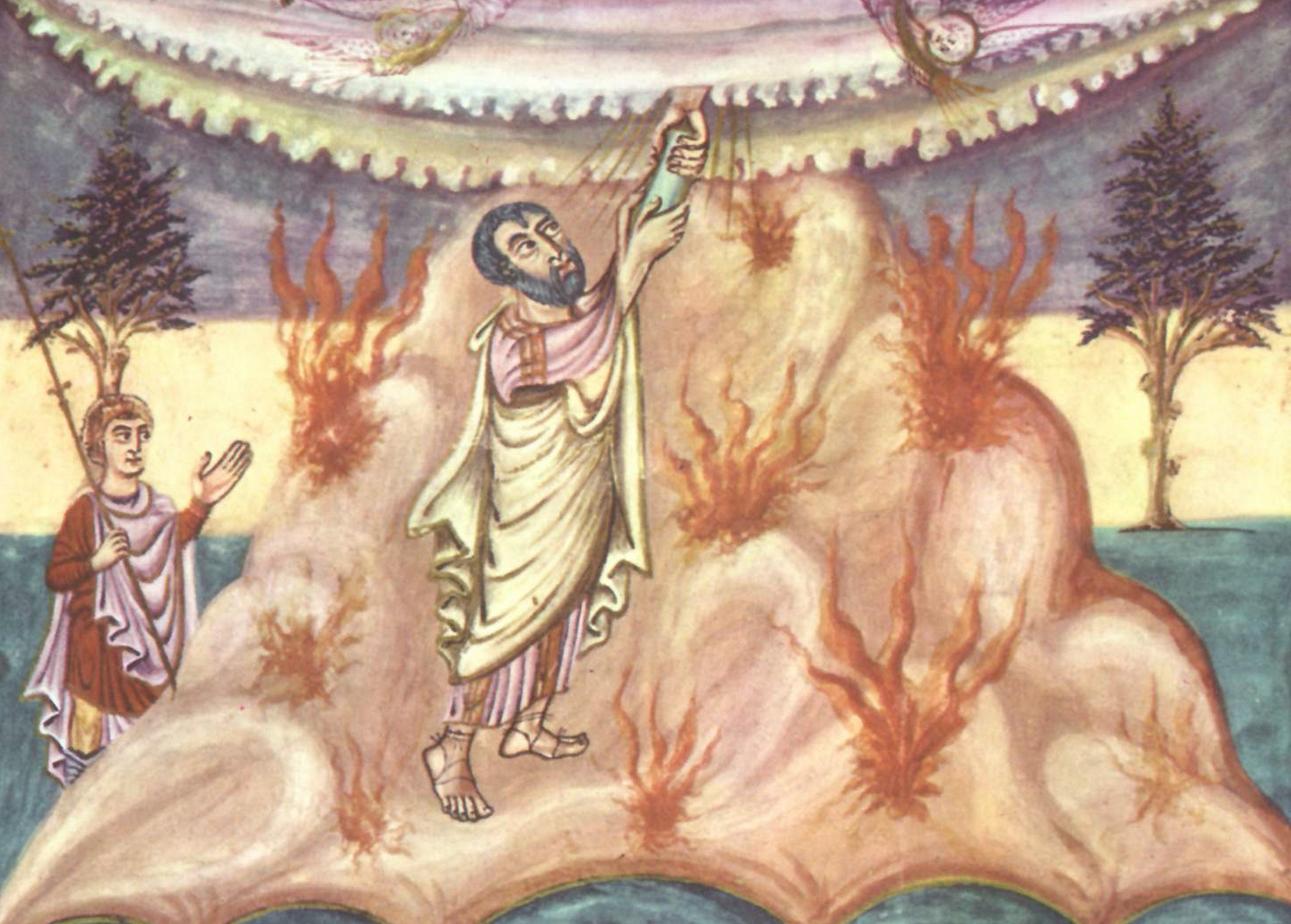
L17-19 καὶ νηστεύσας ἡμέρας τεσσεράκοντα καὶ νύκτας τεσσεράκοντα (Matt. 4:2). By describing Jesus as fasting for forty days and forty nights, Matt. 4:2 draws an unmistakable comparison between Jesus and Moses,[70] who went without food or drink for forty days and nights on Mount Sinai in order to receive the tablets of the covenant.[71] By contrast, Luke’s version of Yeshua’s Testing lacks a Mosaic motif, a fact that makes the Moses typology in Matthew’s version immediately suspicious. Increasing our suspicions is the fact that Moses typology is a central organizing theme of Matthew’s Gospel. The Gospel of Matthew opens with the story of how Jesus, like Moses, escaped murder by a wicked king while still an infant (Matt. 2:1-23). In the chapter following that, in which the temptation narrative appears, the author of Matthew depicts Jesus delivering a “new Torah” in the form of the Sermon on the Mount in imitation of Moses’ reception of the Torah on Mount Sinai. And just as the five books of the Torah were attributed to Moses, so the author of Matthew organized Jesus’ teaching materials into five major discourses (Matt. 5:1-7:28; 10:5-11:1; 13:1-53; 18:1-19:1; 24:4-26:1).[72] Moreover, the Mosaic motif does not sit comfortably in a pericope already replete with allusions to the trials of Abraham and Isaac on Mount Moriah and the trials of Israel in the desert. After all, Moses was not tested or tempted during his forty days and nights of fasting,[73] and, as Allison noted,[74] if the forty days of Jesus’ desert sojourn were intended to parallel Israel’s forty years in the desert, then “and forty nights” interferes with the parallelism, for years are not divisible in a manner comparable to day and night. All the indications suggest that it was the author of Matthew who added the Mosaic motif to Yeshua’s Testing.[75] We have therefore adopted Luke’s description of Jesus’ physical trial by hunger for GR.
L17 καὶ οὐκ ἔφαγεν οὐδὲν (GR). Unlike Matthew’s description of a forty-day and forty-night fast, there is nothing in Luke’s parallel description to suggest a Moses typology. Instead, the fact that Jesus endured a long period of time without food echoes Deut. 8:2-3, according to which God made the people of Israel experience hunger in the desert so as to test their hearts.
וְלֹא אָכַל מְאוּמָה (HR). On reconstructing ἐσθίειν (esthiein, “to eat”) with אָכַל (’āchal, “eat”), see Yeshua’s Discourse on Worry, Comment to L5.
The use of οὐδείς (oudeis, “not one,” “nobody,” “nothing”) as the translation of מְאוּמָה (me’ūmāh, “anything,” “something”) represents a sizable proportion of the total number of instances of οὐδείς in LXX.[76] We also find that the LXX translators rendered most instances of מְאוּמָה with οὐδείς, οὐθείς (outheis, “not one,” “nobody,” “nothing”) or μηδείς (mēdeis, “not one,” “nobody,” “nothing”).[77] In MH מְאוּמָה was replaced by כְּלוּם (kelūm, “anything,” “something”),[78] but since we prefer to adopt a biblicizing style when reconstructing narrative, we have opted for מְאוּמָה in HR L17.
The phrase לֹא אָכַל מְאוּמָה (lo’ ’āchal me’ūmāh, “he did not eat anything”) does not occur in MT, although we do encounter אַל יִטְעֲמוּ מְאוּמָה (’al yiṭ‘amū me’ūmāh, “do not let them taste anything”) in Jonah 3:7, which the LXX translators rendered μὴ γευσάσθωσαν μηδὲν (mē gevsasthōsan mēden, “do not let them taste anything”). We do encounter the phrase לֹא אָכַל מְאוּמָה in a very late rabbinic source:
אִלּוּ אַחֵר אוֹמֵר ’אֶת הַכֹּל עָשָׂה יָפֶה בְעִתּוֹ‘ הָיוּ אוֹמְרִים: זֶה לֹא אָכַל מְאוּמָה מִיָּמָיו וְהוּא אוֹמֵר ’אֶת הַכֹּל עָשָׂה יָפֶה בְעִתּוֹ‘
If another [than King Solomon—DNB and JNT] had said, Everything he has made beautiful in its time [Eccl. 3:11], they would have said, “This fellow has not eaten anything [לֹא אָכַל מְאוּמָה] [good] in all his days, yet he says, Everything he has made beautiful in its time!” (Deut. Rab. 1:5 [ed. Merkin, 11:12])
L18 ἐν ταῖς ἡμέραις ἐκείναις (GR). Luke’s “in those days” lacks the secondary Moses typology of Matthew’s “forty days and forty nights,” and his wording reverts easily to Hebrew. We have therefore accepted Luke’s wording for GR.
בַּיָּמִים הָהֵם (HR). On reconstructing the phrase ἐν ταῖς ἡμέραις ἐκείναις (en tais hēmerais ekeinais, “in those days”) with בַּיָּמִים הָהֵם (bayāmim hāhēm, “in those days”), see Yeshua’s Immersion, Comment to L2.
L19 καὶ νύκτας τεσσεράκοντα (Matt. 4:2). As we noted above in Comment to L17-19, the author of Matthew introduced the phrase “and forty nights” in order to create a comparison between Jesus’ fasting and Moses’ fasting. Here we merely note that there is one other instance of the author of Matthew adding “x days and x nights” to a pericope in order to generate a parallelism between Jesus and a biblical figure.[79] That other instance, almost certainly redactional, occurs in Generations that Repented Long Ago, where, as opposed to Luke’s statement καθὼς γὰρ ἐγένετο Ἰωνᾶς τοῖς Νινευίταις σημεῖον (“For as Jonah was a sign to the Ninevites”; Luke 11:30), the author of Matthew wrote, ὥσπερ γὰρ ἦν Ἰωνᾶς ἐν τῇ κοιλίᾳ τοῦ κήτους τρεῖς ἡμέρας καὶ τρεῖς νύκτας (“For as Jonah was in the belly of the sea monster three days and three nights”; Matt. 12:40).
L20 ὕστερον (Matt. 4:2). The adverb ὕστερον (hūsteron, “afterward”) is relatively rare in LXX, occurring 15xx and only about half of which correspond to a Hebrew word (always some form of the [no_word_wrap]א-ח-ר[/no_word_wrap] root) in MT.[80] Matthew’s use of ὕστερον in L20 does not revert easily to Hebrew, and we are struck by the fact that ὕστερον occurs disproportionately in Matthew’s Gospel.[81] Also, by making Jesus’ period of trial commence only after the forty days (unlike Luke and Mark),[82] the parallelism between Israel’s forty-year trial and Jesus’ forty-day trial is weakened. All the indications suggest that ὕστερον in Matt. 4:2 is redactional.[83]
καὶ συντελεσθεῖσαι (GR). In L20 the author of Luke has a genitive absolute construction: καὶ συντελεσθεισῶν αὐτῶν (kai sūntelestheisōn avtōn, “and when they were finished”). Genitives absolute are un-Hebraic, and we suspect that many of the instances of the genitive absolute in the Synoptic Gospels are redactional.[84] On the other hand, the verb συντελεῖν (sūntelein, “to finish”) is rare in the Lukan corpus, occurring twice in Luke (Luke 4:2, 13)—both in Yeshua’s Testing—and once in Acts (Acts 21:27). Therefore, we should be cautious about ascribing the verb itself to Lukan redaction.[85] Perhaps the author of Luke encountered a καί + participle + aorist construction in Anth. and decided to improve the Greek style of Anth.’s wording by changing the participle to a genitive and adding the pronoun αὐτῶν (avtōn, “of them”), thereby achieving a genitive absolute construction. In LXX καί + participle + aorist constructions often occur as the translation of two vav-consecutives,[86] and we note that Matt. 4:2 (καὶ νηστεύσας…ἐπείνασε [“and fasting…he hungered”]) attests this construction. Perhaps the author of Matthew, despite changing Anth.’s wording, retained Anth.’s καί + participle + aorist structure.
וַיְכֻלּוּ (HR). The verb συντελεῖν occurs more often in LXX as the translation of כִּלָּה (kilāh, “finish,” “complete”) than of any other Hebrew verb.[87] We also find that the LXX translators rendered כִּלָּה more often with συντελεῖν than with any other Greek verb.[88] Since in L20 συντελεῖν occurs as a passive participle, we have reconstructed with [no_word_wrap]כ-ל-ה[/no_word_wrap] in the passive pu‘al stem.
L21 ἐπείνασεν (GR). Since Luke and Matthew agreed to write ἐπείνασεν (epeinasen, “he hungered”), there can be no doubt as to the wording of Anth. in L21.
וַיִּרְעַב (HR). Most instances of the verb πεινᾶν (peinan, “to hunger”) in LXX occur as the translation of verbal or adjectival forms of the root [no_word_wrap]ר-ע-ב[/no_word_wrap].[89] In addition, we find that the LXX translators rendered nearly all instances of the verb רָעֵב (rā‘ēv, “hunger”) as πεινᾶν.[90] These facts demonstrate that רָעֵב is the most natural option for HR in L21.
The mention of Jesus’ hunger alludes to Deut. 8:3, in which God states that he caused Israel to hunger during their forty years in the desert in order to test them and to show them that a person does not live on bread alone.[91] The verb for “cause to hunger” in Deut. 8:3 is a hif‘il form of the root [no_word_wrap]ר-ע-ב[/no_word_wrap]. In LXX, however, the verb corresponding to הִרְעִיב (hir‘iv, “cause to hunger”) in Deut. 8:3 is not πεινᾶν (peinan, “to hunger”) but λιμαγχονεῖν (limanchonein, “to be weak with hunger”). Thus we have a second example of allusions to Deut. 8:2-3 in the opening scene of Yeshua’s Testing reflecting the Hebrew text rather than the Septuagint (the first was the forty days corresponding to Israel’s forty years in the desert, which is mentioned in the Hebrew but not the Greek text of Deut. 8:2 [see above, Comment to L14]).

First Temptation
L22 καὶ προσελθὼν (GR). Some scholars are inclined to regard Matthew’s καὶ προσελθών (kai proselthōn, “and coming toward”) as redactional[92] because προσέρχεσθαι (proserchesthai, “to come toward”) occurs with disproportionately high frequency in Matthew as compared to Luke and Mark. However, the ease with which Matthew’s wording in L22 reverts to Hebrew[93] mitigates the disproportionality of προσέρχεσθαι in the present case. Doubtless many of the instances of προσέρχεσθαι in Matthew are redactional, but clearly there are also cases where προσέρχεσθαι occurred in Anth.,[94] so it is unwise to attribute every single instance of προσέρχεσθαι in Matthew to Matthean redaction. In the present case the ease of Hebrew retroversion suggests that the author of Matthew copied καὶ προσελθών from Anth.
וַיִּקְרַב (HR). On reconstructing προσέρχεσθαι (proserchesthai, “to come toward”) with קָרַב (qārav, “approach”), see Widow’s Son in Nain, Comment to L13.
L23 ὁ διάβολος (GR). In L23 the author of Matthew refers to the devil as “the tempter.” Since we have not discovered a single example of the devil being referred to as הַמְּנַסֶּה (hamenaseh, “the tempter”) in a Hebrew source, it is likely that ὁ πειράζων (ho peirazōn, “the tempter”) is a substitution for something else.[95] That something else was probably ὁ διάβολος (ho diabolos, “the devil”), which Luke has in L25.[96] Whereas Luke’s version of Yeshua’s Testing consistently refers to Satan as ὁ διάβολος, Matthew’s version has a variety of terms: “the devil” (L16; L64; L87 [L39]; L111), “the tempter” (L23) and “Satan” (L102 [L58]). Moreover, in the Four Soils interpretation (L23) the author of Matthew wrote “the evil one” (Matt. 13:19) opposite “the devil” (Luke 8:12) and “Satan” (Mark 4:15). So it appears that the author of Matthew was fond of using a variety of terms for the devil. This observation leads us to conclude that in L23 Matthew preserves Anth.’s word order, whereas Luke in L25 preserves Anth.’s vocabulary.
הַשָּׂטָן (HR). On reconstructing διάβολος (diabolos, “devil”) with שָׂטָן (sāṭān, “Satan”), see above, Comment to L16.
L24 εἶπεν αὐτῷ (GR). Luke and Matthew agree on εἶπεν (eipen, “he said”) and αὐτῷ (avtō, “to him”). Luke’s δέ (de, “but”) takes the place of the καί (kai, “and”) that probably occurred in Anth. (L22).[97]
L25 ὁ διάβολος (Luke 4:3). As we discussed above in Comment to L23, it appears that the author of Luke, having dropped καὶ προσελθών (“and coming toward”), shifted Anth.’s ὁ διάβολος (“the devil”) to a new position following εἶπεν αὐτῷ (“he said to him”).
L26 εἰ υἱὸς εἶ τοῦ θεοῦ (GR). There can be no doubt as to Anth.’s wording in L26, since the authors of Luke and Matthew agree exactly.[98] Kloppenborg claimed that the phrase εἰ υἱὸς εἶ τοῦ θεοῦ (ei huios ei tou theou, lit., “if son you are of the God”) “is hardly possible in a semitic language,”[99] but Lindsey pointed out that this Greek phrase reverts easily to Hebrew as אִם בֵּן אַתָּה לֵאלֹהִים (’im bēn ’atāh lē’lohim, lit., “if son you [are] to God”).[100] Not only does Lindsey’s Hebrew reconstruction line up remarkably well with the Lukan and Matthean Greek phrase, but a very close grammatical parallel is found in Deuteronomy:
בָּנִים אַתֶּם לַיי אֱלֹהֵיכֶם
Sons you are to the LORD your God. (Deut. 14:1)
υἱοί ἐστε κυρίου τοῦ θεοῦ ὑμῶν
Sons you are of the Lord your God. (Deut. 14:1)
Far from being impossible in a Semitic language, Deut. 14:1 provides us with strong evidence that εἰ υἱὸς εἶ τοῦ θεοῦ (“if you are Son of God”) could reflect the wording of a Hebrew source.
אִם בֵּן אַתָּה לֵאלֹהִים (HR). On reconstructing εἰ (ei, “if”) with אִם (’im, “if”), see Tower Builder and King Going to War, Comment to L4.
Scholars often repeat that in the temptation narrative the devil was not questioning whether Jesus was the Son of God, but challenging Jesus to take various actions since he was the Son of God.[101] While εἰ might be used in the sense of “since,” in Hebrew אִם always means “if.” Therefore, if Yeshua’s Testing was originally composed in Hebrew and our reconstruction with אִם is correct, then we must conclude that Satan was testing and challenging Jesus’ status as God’s beloved Son, not merely accepting this status as a matter of course. Had Satan succeeded in tempting Jesus to disobey God, he would have undermined Jesus’ status as the beloved Son. Like Isaac’s apprehension that by flinching under the knife he might invalidate Abraham’s sacrifice, Jesus’ ability to become a redeeming sacrifice God could accept was at stake during his trial with Satan.[102]
On reconstructing υἱός (huios, “son”) with בֵּן (bēn, “son”), see Fathers Give Good Gifts, Comment to L3. On reconstructing θεός (theos, “god”) with אֱלֹהִים (’elohim, “God”), see Four Soils interpretation, Comment to L21.
The testing of Jesus’ status as God’s Son is one of the strongest thematic links uniting Yeshua’s Immersion and Yeshua’s Testing.
L27 εἰπὲ τῷ λίθῳ τούτῳ (GR). Luke and Matthew are very close in wording in L27. Nevertheless, three points of difference combine to suggest that the author of Luke faithfully copied the wording of Anth. in L27, whereas the author of Matthew introduced minor Greek stylistic improvements. These differences are:
- Matthew has the conjunction ἵνα (hina, “so that”) after the imperative εἰπέ (eipe, “Say!”), whereas Luke has ἵνα in L28 preceding γένηται (genētai, “it might become”).
- Matthew’s version refers to “these rocks” in the plural, whereas Luke’s version refers to “this rock” in the singular.
- Matthew’s version has “these rocks” in the nominative case, whereas Luke has “to this rock” in the dative case.
In each of these respects Luke’s wording reverts to Hebrew more easily than Matthew’s.
- Presuming that ἵνα represents a Hebrew word and not merely the sense of the devil’s suggestion, that Hebrew equivalent belongs where Luke’s version indicates it should be.
- The Hebrew term for bread, לֶחֶם (leḥem), did not usually occur in the plural, especially not in Mishnaic Hebrew, the style of Hebrew in which we prefer to reconstruct direct speech. While it would be possible to reconstruct Matthew’s ἄρτοι (artoi, “breads”; L28) as כִּכְּרוֹת לֶחֶם (kikrōt leḥem, “loaves of bread”; see Friend in Need, Comment to L5), Luke’s singular “bread” is simpler to reconstruct. If it is preferable to reconstruct “bread” in the singular, then “this rock” is also preferable for GR and HR.
- Presuming that εἰπέ (“Say!”) represents אֱמֹר (’emor, “Say!”), the Hebrew imperative demands the preposition
It is possible that the author of Matthew changed “this rock” to “these rocks” because he recalled John the Baptist’s statement that ἐκ τῶν λίθων τούτων (ek tōn lithōn toutōn, “from these rocks”; Matt. 3:9; Luke 3:8) God is able to raise up sons for Abraham (Yohanan the Immerser Demands Repentance, L15-16), since this statement affords the only analogy in the Gospels for transforming rocks into some other substance.[103]
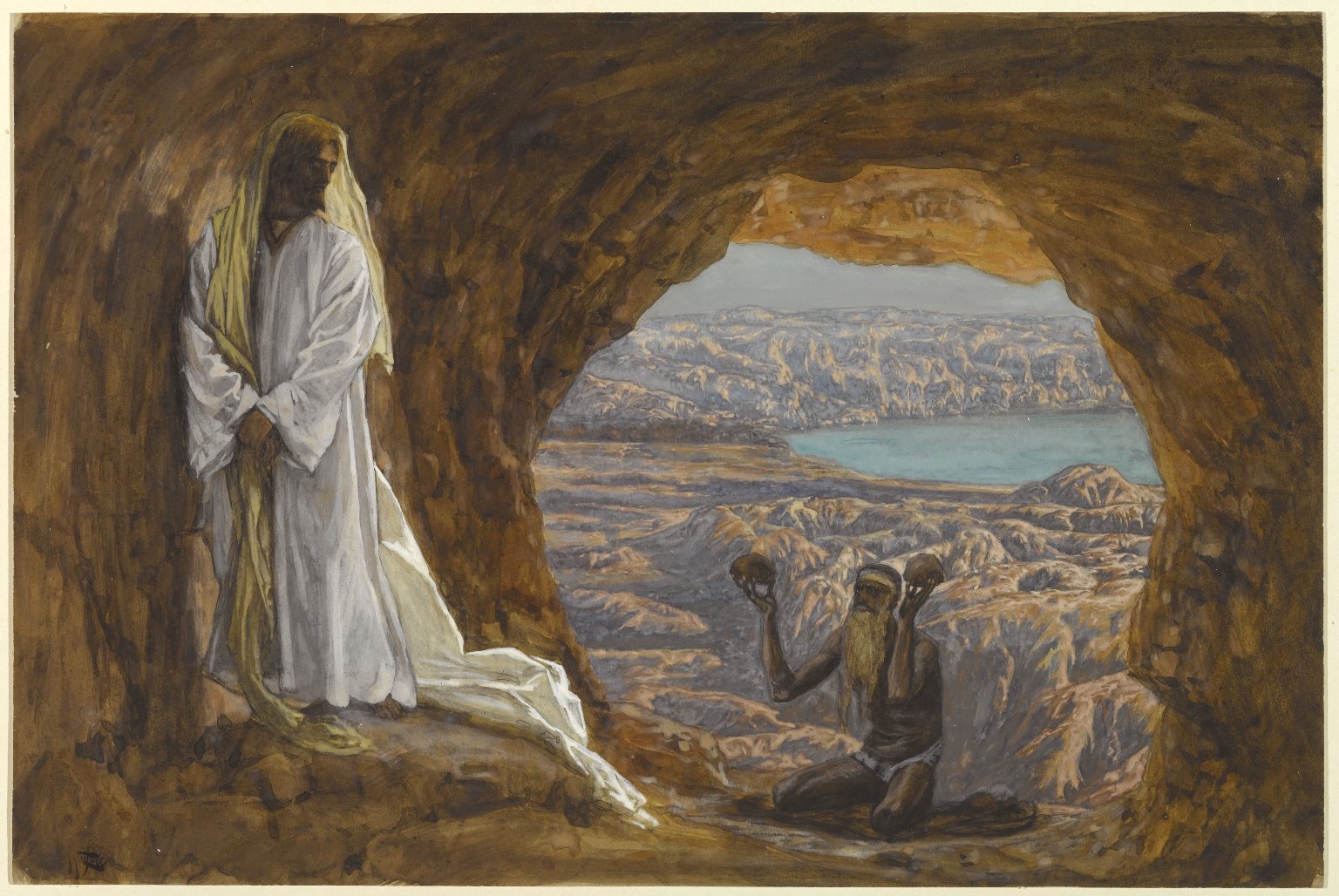
אֱמֹר לָאֶבֶן הַזּוֹ (HR). The LXX translators usually rendered the imperative אֱמֹר (’emor, “Say!”) as εἰπόν (eipon, “Say!”)[104] rather than εἰπέ (eipe, “Say!”).[105] In any case, LXX provides solid evidence that אֱמֹר should be reconstructed with an imperatival form of εἰπεῖν (eipein, “to say”).[106]
On reconstructing λίθος (lithos, “rock,” “stone”) with אֶבֶן (’even, “rock,” “stone”), see Fathers Give Good Gifts, Comment to L5.
We have reconstructed the demonstrative adjective οὗτος (houtos, “this”) with the MH demonstrative זוֹ (zō, “this”) rather than the BH זֹאת (zo’t, “this”) because we prefer to reconstruct direct speech in a Mishnaic style of Hebrew.
L28 ἵνα γένηται ἄρτος (GR). As we noted in the previous Comment, since Luke’s placement of ἵνα is more Hebraic than Matthew’s,[107] and Luke’s singular “bread” more readily reverts to Hebrew than Matthew’s plural form, we have accepted Luke’s wording in L28 for GR.
וְתִּהְיֶה לְלֶחֶם (HR). A grammatical parallel to “Say to this rock that it might become bread” is found in Deuteronomy:
וְעַתָּה כִּתְבוּ לָכֶם אֶת הַשִּׁירָה הַזֹּאת וְלַמְּדָהּ אֶת בְּנֵי יִשְׂרָאֵל שִׂימָהּ בְּפִיהֶם לְמַעַן תִּהְיֶה לִּי הַשִּׁירָה הַזֹּאת לְעֵד בִּבְנֵי יִשְׂרָאֵל
And now write [כִּתְבוּ] for yourselves this song and teach it to the children of Israel; put it in their mouths so that [לְמַעַן] this song will be [תִּהְיֶה] a witness [לְעֵד] for me against the children of Israel. (Deut. 31:19)
καὶ νῦν γράψατε τὰ ῥήματα τῆς ᾠδῆς ταύτης καὶ διδάξετε αὐτὴν τοὺς υἱοὺς Ισραηλ καὶ ἐμβαλεῖτε αὐτὴν εἰς τὸ στόμα αὐτῶν, ἵνα γένηταί μοι ἡ ᾠδὴ αὕτη εἰς μαρτύριον ἐν υἱοῖς Ισραηλ
And now write [γράψατε] the words of this song and teach it to the children of Israel and put it into their mouth so that [ἵνα] this song might become [γένηταί] a witness [εἰς μαρτύριον] to me among the children of Israel. (Deut. 31:19)
In both the devil’s suggestion and in Deut. 31:19 we find the structure imperative + ἵνα γένηται + noun: εἰπὲ…ἵνα γένηται ἄρτος (“Say…so that it might become bread”); γράψατε…ἵνα γένηταί…εἰς μαρτύριον (“Write…so that it might become…into a witness”; Deut. 31:19). On the basis of this parallel we have reconstructed ἵνα γένηται ἄρτος (“so that it might become bread”) as וְתִּהְיֶה לְלֶחֶם (vetihyeh leleḥem, “and it will be for bread”).
Instead of לְמַעַן (lema‘an, “for the sake of,” “in order that”), which became obsolete in MH,[108] we have reconstructed ἵνα (hina, “so that”) with [no_word_wrap]-וְ[/no_word_wrap] (ve–, “and”) followed by an imperfect. In LXX ἵνα + subjunctive frequently represents [no_word_wrap]-וְ[/no_word_wrap] + imperfect in the underlying Hebrew text.[109] Another option for reconstructing ἵνα + subjunctive is [no_word_wrap]-שֶׁ[/no_word_wrap] (she-, “that,” “because”) followed by an imperfect. The relative pronoun [no_word_wrap]-שֶׁ[/no_word_wrap] was often used in the sense of “so that” or “in order that,”[110] and there are two examples in which ἵνα + subjunctive occurs in LXX as the translation of [no_word_wrap]-שֶׁ[/no_word_wrap] + imperfect (Eccl. 3:14; 5:14).
On reconstructing ἄρτος (artos, “bread”) with לֶחֶם (leḥem, “bread”), see Sending the Twelve: Conduct on the Road, Comment to L68.
It is tempting to insert לְךָ (lechā, “for you”) before לְלֶחֶם (leleḥem, “for bread”) in HR, not only because of the grammatical parallel with Deut. 31:19, but also because of the words הִנְנִי מַמְטִיר לָכֶם לֶחֶם מִן־הַשָּׁמָיִם (hinni mamṭir lāchem leḥem min hashāmāyim, “Behold, I am raining down for you bread from heaven”; Exod. 16:4) when God told Moses about his intention to give the Israelites manna, to which Satan’s suggestion seems somehow to be related. But nothing in the Greek text of Luke or Matthew has anything corresponding to לְךָ (“for you”), so we have thought it best not to include לְךָ in HR.
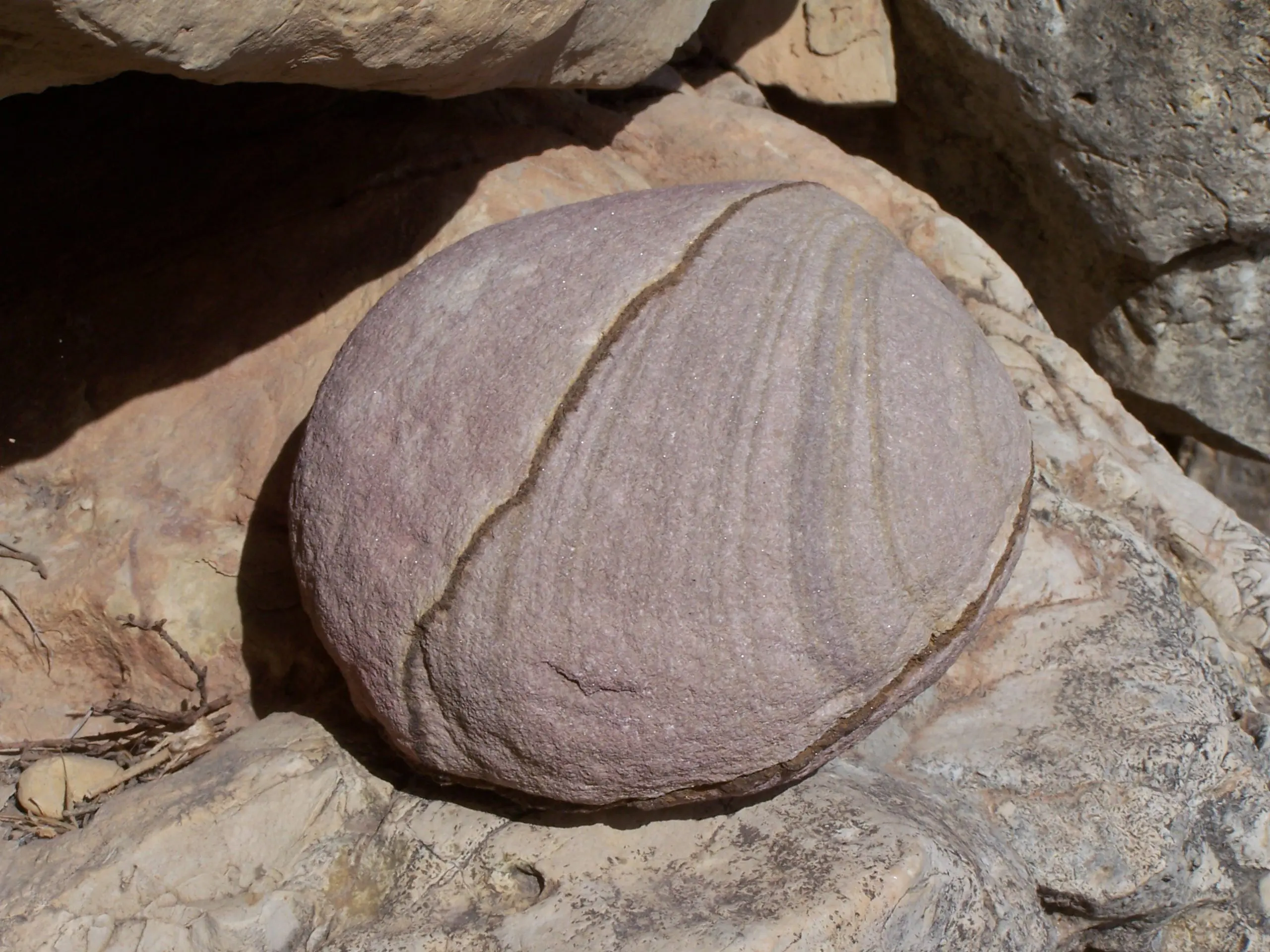
Satan’s suggestion that Jesus should order a rock to become bread is quite strange. Robinson demurred that if Israel’s trials in the desert are the background of this temptation, we might have expected Satan to suggest that Jesus order a rock to produce water to drink.[111] But Deut. 8:2-3, upon which the opening scene of Yeshua’s Testing was modeled, mentions hunger, not thirst, so the water-from-the-rock motif is not really suitable for the devil’s suggestion.[112] Swapping a rock for bread is mentioned in a saying of Jesus (Matt. 7:9; Fathers Give Good Gifts, L5), and Thompson documented a widespread curse, “May your bread turn to stones!” pronounced by beggars if refused assistance,[113] so it may be that Satan’s suggestion simply reflects a folk tradition associating bread with stones.[114] Numerous commentators have noted that rocks in the desert do somewhat resemble loaves of bread, perhaps especially so to a hungry person in a desolate place.[115]
Wherever the imagery of changing a rock into bread may have come from, what Jesus said about human fathers giving their children rocks when they had requested bread is probably key to understanding the intention behind Satan’s suggestion. According to Jesus, no normal human father would be so cruel or callous as to give his hungry child a rock to eat. In Yeshua’s Testing Satan appears to suggest that at best God is a heartless, wicked father because all he has provided for Jesus, his supposedly beloved Son, to eat is rocks. Or perhaps God is no kind of father at all, and the voice Jesus heard at his baptism was nothing more than a flight of enthusiastic fancy drummed up by religious fervor or the figment of a deranged mind.
L29 καὶ ἀποκριθεὶς (GR). As the preface to Jesus’ other two responses to Satan, Luke has καὶ ἀποκριθεὶς αὐτῷ εἶπεν Ἰησοῦς (kai apokritheis avtō eipen Iēsous, “and answering to him Jesus said”; Luke 4:8 [L56-57]) or καὶ ἀποκριθεὶς εἶπεν αὐτῷ ὁ Ἰησοῦς (kai apokritheis eipen avtō ho Iēsous, “and answering Jesus said to him”; Luke 4:12 [L81-83]). This leads us to believe that in L29 Anth. probably read καὶ ἀποκριθείς (kai apokritheis, “and answering”) instead of Matthew’s ὁ δὲ ἀποκριθείς (ho de apokritheis, “but he answering”) or Luke’s καὶ ἀπεκρίθη (kai apekrithē, “and he answered”). The authors of Luke and Matthew may have altered Anth.’s wording for the sake of variation or for stylistic concerns.
וַיַּעַן (HR). On reconstructing ἀποκρίνειν (apokrinein, “to answer”) with עָנָה (‘ānāh, “answer”), see Call of Levi, Comment to L56.
L30 πρὸς αὐτὸν (Luke 4:4). As we can observe from the previous Comment, Luke lacks the prepositional phrase πρὸς αὐτόν (pros avton, “to him”) in the other two prefaces to Jesus’ replies to Satan. Instead of πρὸς αὐτόν we find αὐτῷ (avtō, “to him”), but we doubt whether πρὸς αὐτόν is Luke’s replacement for αὐτῷ in L30 because the prepositional phrase is out of place from the standpoint of Hebrew word order, and Matt. 4:4 lacks anything corresponding to “to him” in the preface to Jesus’ reply to Satan. While we could add αὐτῷ to GR in L32 following εἶπεν, the prepositional phrase is not necessary for GR or HR to make sense, so we have thought it best to omit it from GR altogether.
L31 ὁ Ἰησοῦς (GR). Jesus’ name is omitted in Matt. 4:4, but it appears in each of the prefaces to Jesus’ replies to Satan in Luke’s version, and so probably also in Anth. We considered dropping the definite article ὁ (ho, “the”) before Jesus’ name from GR, since Hebrew does not attach definite articles to personal names, and personal names often appear without a definite article in Anth. Preventing us from doing so here is Matthew’s ὁ in L29, which may hint that Anth. did have the definite article before Jesus’ name in L31. Luke and Matthew also appear to agree to write ὁ Ἰησοῦς (ho Iēsous, “the Jesus”) in the prefaces to Jesus’ replies to Satan in L57 and L83 (although in L57 there are some uncertainties regarding the correct text of Luke), further strengthening the likelihood that the definite article should be preserved in GR.
יֵשׁוּעַ (HR). On reconstructing Ἰησοῦς (Iēsous, “Jesus”) with יֵשׁוּעַ (yēshūa‘, “Jesus”), see above, Comment to L3.
L32 εἶπεν (GR). Since εἶπεν (eipen, “he said”) occurs in the prefaces to Jesus’ other two replies to Satan in Luke’s version of Yeshua’s Testing (L56, L82), we have accepted Matthew’s εἶπεν for GR.
L33 γέγραπται (GR). Since γέγραπται (gegraptai, “it has been written”) occurs in Luke and Matthew, we can be certain that it also occurred in Anth.
כָּתוּב (HR). On reconstructing γέγραπται (gegraptai, “it has been written”) with כָּתוּב (kātūv, “[it is] written”), see Yeshua’s Words about Yohanan the Immerser, Comment to L22.
L34-35 ὅτι οὐκ ἐπ᾿ ἄρτῳ μόνῳ ζήσεται ὁ ἄνθρωπος (GR). The only difference between Matthew and Luke in L34-35 is the presence or absence of ὅτι (hoti, “that”) at the beginning of the quotation. It is possible that the author of Matthew omitted the ὅτι under the mistaken impression that it was a recitative ὅτι (i.e., a ὅτι that introduces quotations).[116] In fact, the ὅτι is part of the quotation of Deut. 8:3, and we have therefore accepted Luke’s ὅτι in GR. In all other respects the biblical quotation in Luke and Matthew reproduces the LXX version of Deut. 8:3 exactly. That the Greek translator of the Hebrew Life of Yeshua should have utilized LXX is hardly surprising. Using LXX for biblical quotations when LXX agreed with his biblical text lightened the Greek translator’s workload, and the readers of the Greek translation of the Hebrew Life of Yeshua were probably well acquainted with LXX.
כִּי לֹא עַל הַלֶּחֶם לְבַדּוֹ יִחְיֶה הָאָדָם (HR). Since LXX (and hence Luke and Matthew) adheres closely to the wording of MT, there can be very little uncertainty as to our Hebrew reconstruction. It is gratifying to observe, however, that even if L34-35 had not been a Scripture quotation, our reconstruction would have been very much the same, as the following notes indicate.
On reconstructing ὅτι (hoti, “that,” “because”) with כִּי (ki, “that,” “because”), see Yeshua’s Thanksgiving Hymn, Comment to L6.
On reconstructing ἐπί (epi, “upon”) with עַל (‘al, “upon”), see Widow’s Son in Nain, Comment to L11.
On reconstructing ἄρτος (artos, “bread”) with לֶחֶם (leḥem, “bread”), see above, Comment to L28.
In LXX the adjective μόνος (monos, “alone,” “only”) usually occurs as the translation of לְבַד (levad, “alone,” “only”).[117] Likewise, the LXX translators more often rendered לְבַד with μόνος than with any other term.[118]
In LXX the verb ζῆν (zēn, “to live”) nearly always occurs as the translation of a verbal or adjectival form of the root [no_word_wrap]ח-י-ה[/no_word_wrap].[119] Likewise, the LXX translators rendered most instances of the verb חָיָה (ḥāyāh, “live”) as ζῆν.[120]
On reconstructing ἄνθρωπος (anthrōpos, “person,” “human”) with אָדָם (’ādām, “person,” “human”), see Lost Sheep and Lost Coin, Comment to L12.
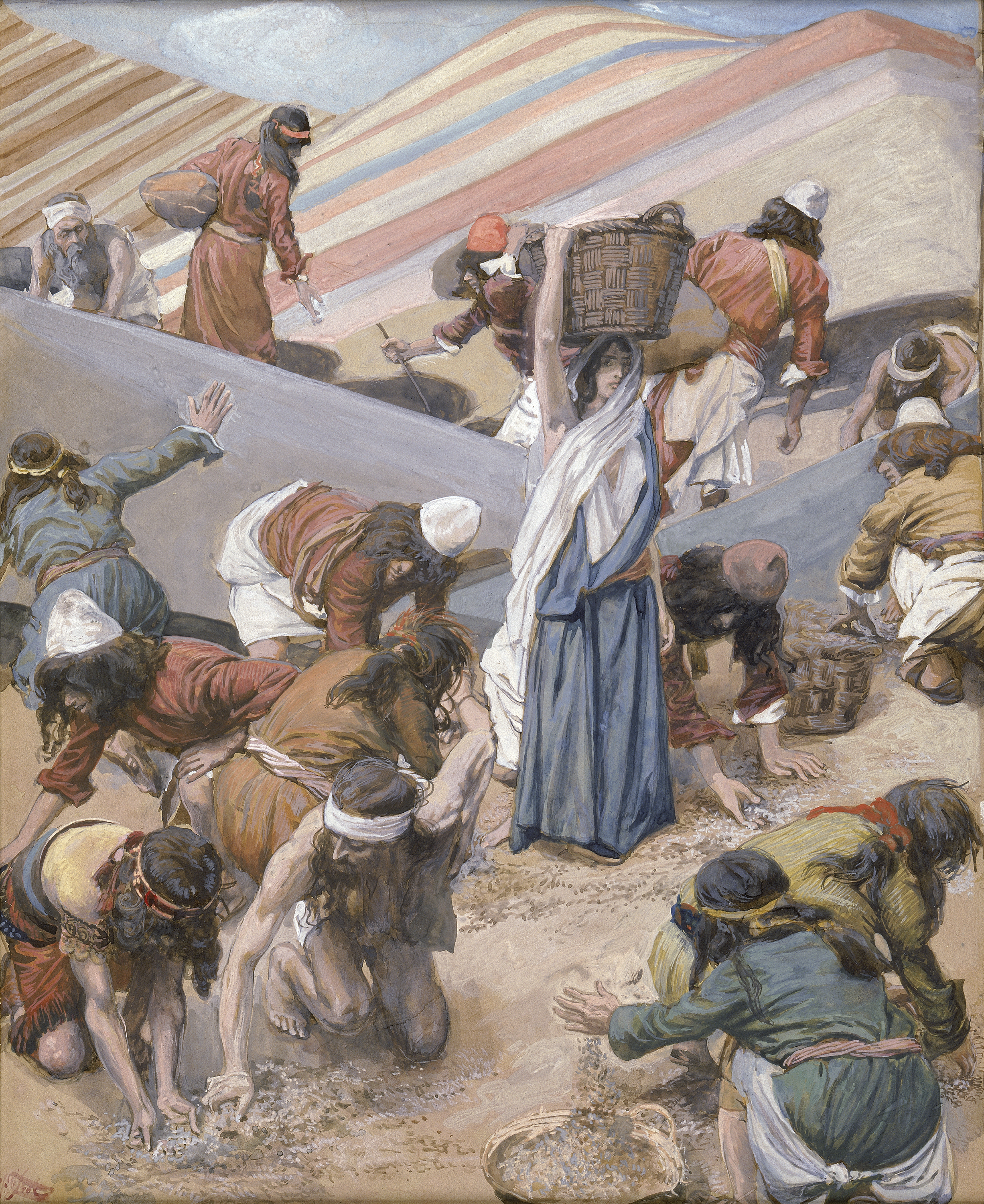
The humility of Jesus’ response to Satan’s suggestion is both striking and instructive. Whereas Satan suggested that if Jesus was truly God’s Son, he deserved special treatment, Jesus’ response shows that his understanding of divine sonship meant that he stood in complete solidarity with Israel. Jesus would be a beloved Son by being a faithful Israelite. His status as God’s beloved Son did not mean that Jesus could take advantage of special privileges that separated him from the rest of his people. Divine sonship did not grant Jesus a free pass from hardship or an exemption from obedience. The logic of Jesus’ refusal of Satan’s suggestion is based on the conviction that since God caused Israel to hunger during its desert sojourn, it was only to be expected that Jesus, too, should experience hunger in the desert. And since Israel had to wait upon God to provide them with manna, Jesus ought likewise to wait for God to provide for him. Of course, Jesus was also wise enough to know that Satan’s advice was unreliable. Satan did not have Jesus’ best interests at heart. Jesus knew that Satan was there to tempt him. But with his answer Jesus turned the tables on Satan, robbing him of his initiative and potency. By quoting Deut. 8:3, Jesus implied that while Satan may have believed that he was tempting Jesus, Jesus was aware that he was in the desert for God to test him. God willed Jesus’ hunger in order to test him, and Jesus intended to accept that hunger and wait patiently for God to provide for him. That God would provide for him Jesus was assured, because God had long ago provided Israel with manna in the desert. The hunger Israel experienced and God’s provision of manna were means by which God tested Israel’s obedience (cf. Exod. 16:4). And as Deut. 8:16 affirms, God tested Israel in these ways for its own good. Jesus intended to pass God’s test, so he gave no heed to Satan’s temptation.
L36-37 ἀλλ᾿ ἐπὶ παντὶ ῥήματι ἐκπορευομένῳ διὰ στόματος θεοῦ (Matt. 4:4). Matthew’s version of Yeshua’s Testing continues the quotation of Deut. 8:3 to include the positive statement that human beings live by the word of God. It is likely that it was the author of Matthew who extended the quotation,[121] since it seems improbable that the author of Luke would have shortened the quotation had it appeared in his source. Trimming away a reference to the word of God would be particularly out of character for the author of Luke, in whose Gospel the “word of God” is an especially important concept (ῥῆμα θεοῦ: Luke 3:2; λόγος τοῦ θεοῦ: Luke 5:1; 8:11, 21; 11:28).
Scholars debate whether the version of the extended quotation as recorded in Codex Vaticanus or Codex Bezae is more original. In Codex Vaticanus the extended quotation agrees almost exactly with LXX,[122] whereas in Codex Bezae LXX’s wording is altered slightly for the sake of abbreviation.[123]

Second Temptation
At this point in our reconstruction we are confronted with the problem of whether to accept Luke’s or Matthew’s order of the temptations. Many recent scholars prefer Matthew’s order, citing several different reasons:
- According to Matthew’s order, the two temptations in which Jesus is addressed as “Son of God” are adjacent, which is deemed to be original.[124]
- According to Matthew’s order, each temptation takes place at a higher elevation, beginning below sea-level in the desert, ascending to the pinnacle of the Temple, and then cresting the world’s tallest mountain.[125]
- According to Matthew’s order, the scope of each temptation widens, from one man alone in the desert, to the Jewish people on the Temple Mount, to the whole world in the final temptation.
But these seemingly formidable arguments in favor of Matthew’s order of the temptations are hardly decisive. As we discussed above in the Conjectured Stages of Transmission section, Jesus’ divine sonship is central to all three temptations, so it is by no means obvious that Matthew’s order, in which the two temptations in which Satan addresses Jesus as “Son of God” are adjacent, is original. Luke’s order, in which the temptations containing the explicit Son of God address stand at either side of the temptation in which the Son of God concept is implicit, could also be original.
As for the rise in elevation in each successive temptation according to Matthew’s order, it may be that the author of Matthew did understand the ordering this way. But it is by no means obvious that Luke’s order cannot be understood in the same manner. Whereas for the author of Matthew the high mountain occupies some unknown location, perhaps beyond the borders of the physical universe, there are good reasons to suppose that Matthew’s source understood the high mountain to be none other than the Temple Mount. After all, the idea that the Son of God ought to have worldwide dominion derives from Psalm 2, and according to that Psalm the Messiah will reign from Mount Zion. Thus Luke’s order of the temptations may equally represent a continuous rise in elevation (desert→Temple Mount→pinnacle of the Temple), even if the author of Luke was unaware of the altitudinal progression contained within his source.
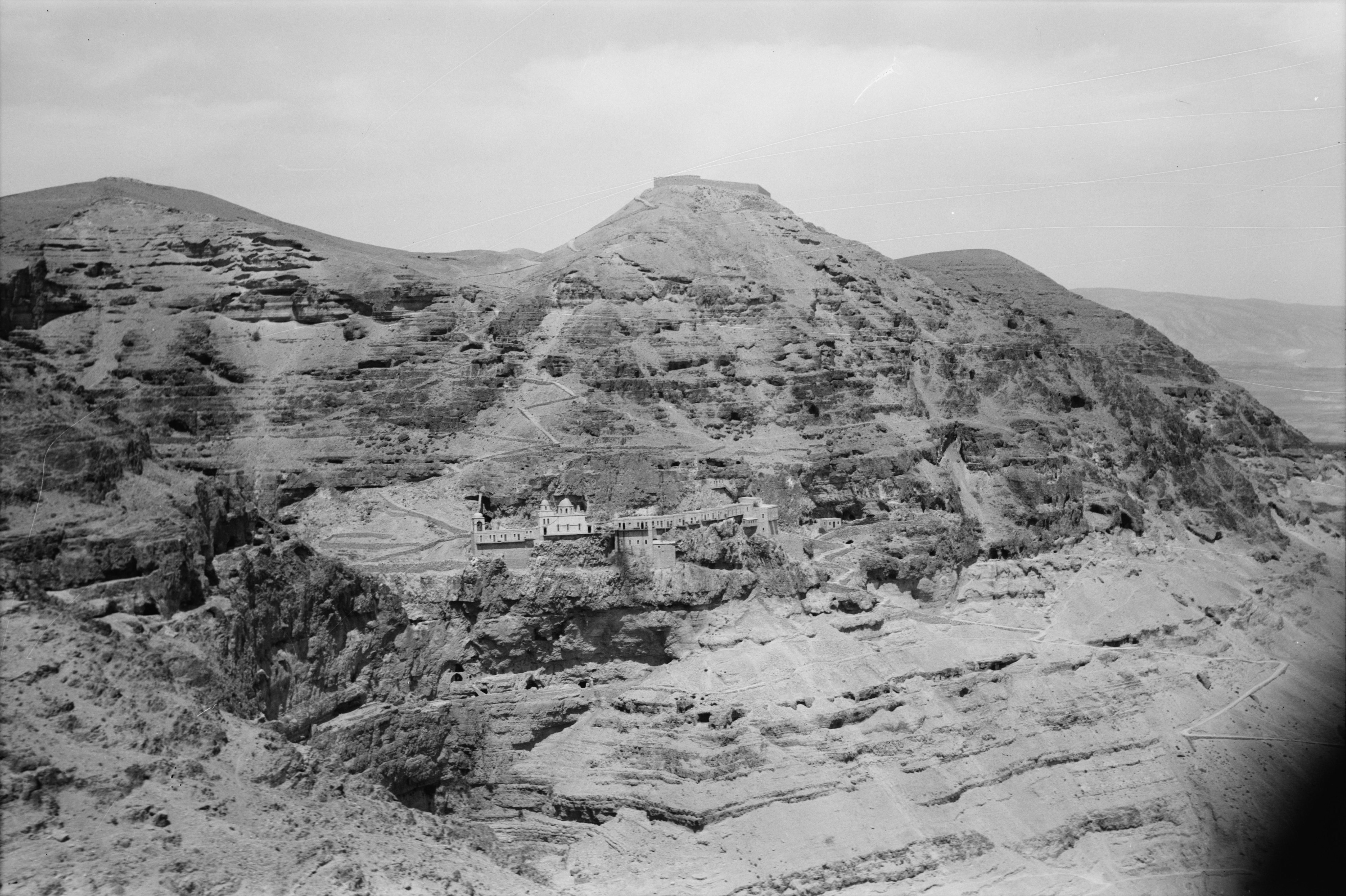
The widening of the scope of temptations according to Matthew’s order is also open to question. Each of the temptations are presented as a private conversation between Jesus and the devil. There is no suggestion that there would have been a worldwide audience to witness Jesus’ act of worshipping Satan. Only the temptation in the Temple potentially envisions spectators.
The contention that it is only when the devil demands worship from Jesus that his true identity is revealed has no basis in the text. Readers are aware from the beginning that the tempter is none other than Satan, and there is no reason to suppose that Jesus was not aware of Satan’s identity from the outset.
That Matthew’s order concludes with what strikes readers as a better literary climax could be the result of the author of Matthew’s literary reworking of his source.[126] In fact, it appears that the author of Matthew went to a great deal of trouble to build tension within the temptation narrative. Black has shown that the distribution of historical presents (i.e., the narration of past events with present tense verbs) within Matthew’s version of Yeshua’s Testing (0xx in the first temptation, 2xx in the second, 3xx in the third) has the effect of heightening the dramatic effect of Matthew’s temptation account.[127] These historical presents were almost certainly added by the author of Matthew.[128] Likewise, Jesus’ dismissal of the devil in the final temptation (according to Matthew’s order) with the words “Go away, Satan!” are most likely a Matthean addition. These signs of Matthean redaction in Yeshua’s Testing, which are designed to build up the dramatic tension within the narrative, may have been necessary because the author of Matthew was responsible for the order in which the temptations occur. Moreover, we wonder aloud, along with other skeptics of the originality of Matthew’s order of the temptations, why the author of Luke, who was not insensitive to good literary style, would destroy a narrative that leads up to a crescendo if that is what he had found in his source.[129]
The argument that in Matthew’s order of the temptations the quotations from Deuteronomy appear in reverse canonical order ignores the fact that “worship the LORD your God and serve him only” occurs in two places in Deuteronomy, a fact that inherently undermines any argument based on the order of the verses. Only if one arbitrarily decides that Deut. 6:13 is the origin of the quotation, and not Deut. 10:20, does the reverse order argument work in favor of Matthew. If we arbitrarily decide that Deut. 10:20 is the verse Jesus quoted, then the argument concerning the reverse canonical order of Jesus’ Deuteronomy quotations favors Luke. Reverse canonical order is, in any case, a bizarre organizing principle of which more scholars ought to be skeptical.
Finally, while it may be true that the author of Luke was particularly interested in Jerusalem and the Temple, and therefore having the temptation narrative conclude in the Temple is consistent with Luke’s preferences, it is also the case that having the temptation narrative conclude on a mountain is consistent with the author of Matthew’s redactional interests.[130] The author of Matthew presents Jesus’ first and most important discourse as having been delivered on a mountain (the Sermon on the Mount), and the author of Matthew concludes his Gospel with Jesus on a mountain victoriously claiming that all authority in heaven and earth has been given to him by God (Matt. 28:16-20). Having the temptation narrative end with Satan offering a cheap imitation of what Jesus eventually receives from God could easily be ascribed to the author of Matthew’s editorial activity.

In our view none of the arguments scholars have advanced in favor of Matthew’s or Luke’s order of the temptations are conclusive. Internal evidence alone cannot settle the question. There may, however, be an external clue that could tip the balance in favor of Luke’s order. As we have seen, there are points of contact between Jesus’ temptation and Jewish traditions concerning the trials of Abraham and (especially) Isaac. The obedience of Isaac, the beloved son of Abraham, was tested, and, according to Jewish tradition, Satan tried to tempt Isaac to resist being offered on the altar. Likewise, in the temptation narrative Satan attempts to undermine the father-son relationship between God and Jesus by tempting Jesus into disobedience. Isaac’s temptation culminated on Mount Moriah on the site where, according to Jewish tradition, the altar in the Temple was eventually built. We think it is more than a coincidence that, according to Luke’s ordering, Jesus’ temptation culminated in the Temple.[131] An Isaac-style temptation following the declaration at Jesus’ baptism that he was to be an Issac-style son suggests that Luke’s order reflects an early Jewish-Christian tradition. The author of Luke may not even have been fully aware of this tradition’s significance. Certainly the author of Luke did nothing to amplify the Isaac theme to make it clearer to an audience unfamiliar with Jewish traditions concerning the trials of Abraham and Isaac.
A definitive answer as to whether the Matthean or Lukan order of the temptations is original is, of course, impossible. However, the resemblance between Yeshua’s Testing and Jewish traditions about the trials of Abraham and Isaac makes the Lukan order seem all the more plausible and attractive. In the absence of convincing arguments that Matthew’s order is original, we have accepted Luke’s order for our reconstruction.[132]
L38 καὶ ἀναγαγὼν αὐτὸν (GR). The disproportionate frequency with which the verb παραλαμβάνειν (paralambanein, “to take aside”) occurs in Matthew’s Gospel (16xx) as compared with Mark (6xx) and Luke (6xx) cautions us against accepting Matthew’s verb in L38 for GR.[133] The author of Luke’s willingness to use παραλαμβάνειν 6xx in Acts[134] —and all of these in 2 Acts, where the author of Luke’s personal style is most likely to be evident—also warns us that the author of Luke would probably not have rejected παραλαμβάνειν had it occurred in his source. Moreover, the historical present tense in which the author of Matthew used παραλαμβάνειν is un-Hebraic and therefore likely to be redactional.[135] Likewise, the use of the adverb πάλιν (palin, “again”) looks like a Matthean addition intended to help make this temptation scene (the third in Matthew’s order) the climax of the pericope. For all these reasons we have accepted Luke’s wording for GR.
וַיַּעֲלֵהוּ (HR). In LXX ἀνάγειν (anagein, “to lead up”) almost always occurs as the translation of הֶעֱלָה (he‘elāh, “bring up”).[136] We also find that the LXX translators more frequently rendered הֶעֱלָה with ἀνάγειν than with any other Greek verb.[137] On reconstructing καί + participle + aorist, such as we find in Luke 4:5 (καὶ ἀναγαγὼν…ἔδειξεν; L38, L41), with two vav-consecutives, see above, Comment to L20.
L39 ὁ διάβολος (Matt. 4:8). Having concluded that Matthew’s wording in L38 is redactional, we must question whether the author of Matthew’s redactional activity extended to L39, which refers directly to the devil. Reaching a decision is more difficult here, since ὁ διάβολος (ho diabolos, “the devil”) can easily be reconstructed as הַשָּׂטָן (hasāṭān, “the satan”) (see above, Comment to L16). On the other hand, Luke’s omission of ὁ διάβολος here and in L64 suggests that ὁ διάβολος did not occur in Anth. at these two locations. Furthermore, the Hebrew reconstruction does not require הַשָּׂטָן in order for the narrative to make sense. Hebrew narrative can sometimes be laconic, and it would be understood from the context that it was Satan who led Jesus, not Jesus who led Satan. For these reasons we have decided to omit ὁ διάβολος from GR and הַשָּׂטָן from HR in L39.
L40 εἰς ὄρος ὑψηλὸν λίαν (GR). Although some scholars regard the reference to the high mountain as a Matthean addition to the temptation narrative,[138] we have reasons for thinking that “to a very high mountain” may be original. First, as Donaldson pointed out, the other two temptations take place in a specific location (desert, Temple), so it is reasonable to expect that a location would have been specified in this temptation, too.[139] Second, the story of the binding of Isaac (Gen. 22), which we believe influenced Yeshua’s Testing, mentions a mountainous region:
קַח נָא אֶת בִּנְךָ…אֶת יִצְחָק וְלֶךְ לְךָ אֶל אֶרֶץ הַמֹּרִיָּה וְהַעֲלֵהוּ שָׁם לְעֹלָה עַל אַחַד הֶהָרִים אֲשֶׁר אֹמַר אֵלֶיךָ
Take now your son…Isaac and go to the land of Moriah and offer him up there as an offering on one of the mountains [עַל אַחַד הֶהָרִים] that I will tell you. (Gen. 22:2)
This verse informs us that the journey to the place of Isaac’s sacrifice led through a mountainous region, and if Jesus’ itinerary with Satan was parallel to that of Isaac’s, then a mountainous setting for Jesus’ middle temptation is entirely fitting.
A Second Temple-period retelling of the binding of Isaac story further specifies that the mountains were “high”:
קח את בנכה את ישחק…והעלהו לי לעולה על אחד ההרים[ הגבוה]ים [אשר אומר] לכׄה
Take your son Isaac…and offer him to me as an offering on one of the[ hig]h mountains [עַל אַחַד הֶהָרִים (הַגְּבוֹהִ)ים] [that I will tell] you. (4QPseudo-Jubileesa [4Q225] 2 I, 11-13)
The text of 4QPseudo-Jubileesa is fragmentary, and therefore the reading “high mountains” is not certain, but it has support from Jubilees 18:2, which likewise refers to the “high country.”[140]
There are two other possible verbal links between Gen. 22:2 and the setting of the middle temptation. The command “and offer him up” is וְהַעֲלֵהוּ (veha‘alēhū; Gen. 22:2) and is formed from the same root and belongs to the same stem (hif‘il) as the verb וַיַּעֲלֵהוּ (vaya‘alēhū, “and he brought him up”) that we used for HR in L38. It could be that the author of the Hebrew Life of Yeshua intentionally echoed Gen. 22:2 when he described Satan taking Jesus up to the mountain.
The second potential verbal link to the binding of Isaac story is the verb for “he showed him” all the kingdoms of the earth. The most likely candidates for reconstructing ἔδειξεν αὐτῷ (edeixen avtō, “he showed him”) are וַיּוֹרֵהוּ (vayōrēhū, “and he showed him”) from the root [no_word_wrap]י-ר-ה[/no_word_wrap] and וַיַּרְאֵהוּ (vayar’ēhū, “and he showed him”) from the root [no_word_wrap]ר-א-ה[/no_word_wrap] (see below, Comment to L41). Either verb could be seen as playing off the toponym מֹרִיָּה (moriyāh, “Moriah”), as the following rabbinic discussion about the meaning of this name illustrates:
ולך לך אל ארץ המורייה ר′ חייא רבה ור′ ינאי חד אמר למקום שהורייה יוצאה לעולם וחרנה אמר למקום שיראה יוצאה לעולם…אמר ר′ יהושע בן לוי שמשם הקב″ה מורה על אומות העולם ומורידם לגיהינם…רבי יודן בן פלייא אמר למקום שהיה מראה לך, ר′ פנחס אמר לאתר מרותא דעלמא….
Go to the land of Moriah [Gen. 22:2]. Rabbi Hiyya the elder and Rabbi Yannai [explained these words—DNB and JNT]. One said, “To the place whence instruction [הוֹרָיָיה] goes out to the world,” and the other said, “To the place where fear [יִרְאָה] [of the LORD—DNB and JNT] goes out to the world.” …Rabbi Yehoshua ben Levi said, “From there the Holy One, blessed be he, decides [מוֹרֶה] concerning the peoples of the world and sends them down to gehenna.” …Rabbi Yudan ben Palya said, “To the place that was shown [מָרְאֶה] to you.” Rabbi Pinhas said, “To the place of worldwide dominion [מָרְוְתָא].” (Gen. Rab. 55:7 [ed. Theodor-Albeck, 1:590-592])
These rabbinic speculations regarding the significance of the name Moriah show that whether ἔδειξεν αὐτῷ (“he showed him”) should be reconstructed as וַיּוֹרֵהוּ (“and he showed him”) or וַיַּרְאֵהוּ (“and he showed him”), we may be dealing with a wordplay based on the name of Moriah. Such a wordplay in the context of Yeshua’s Testing would make sense because, as the rabbinic derivations prove, Moriah was regarded as the focal point of the entire world. Moriah, the Temple Mount, was the place from which instruction went forth to all the world and the place where the fate of all the peoples of the world would be decided. It was the place from which worldwide dominion was exercised.
From the Jewish point of view, Mount Moriah was not only the political center of the universe, it was also the cultic center of the universe. The Temple was believed to be built on Mount Moriah at the very place where Issac was to be sacrificed. Thus there could be no more appropriate place for Satan’s offer of political supremacy in exchange for worship than on the mountain that, according to the ancient Jewish worldview, was the place where worship was focused and from which political authority emanated.
The influence of Psalm 2 on this temptation also lends credence to Matthew’s mountain setting.[141] Psalm 2 is one of the foundational texts for the Son of God concept, which is so central to the entire temptation narrative. According to this psalm, God grants the anointed king of Israel worldwide dominion after declaring to him, “You are my son” (Ps. 2:7). In Yeshua’s Testing Satan attempts to preempt God’s investiture of Jesus as his messiah by insinuating himself as Jesus’ “divine” patron. Instead of allowing Jesus to become God’s anointed redeemer who would liberate Israel and bring justice and equity to the nations, Satan preferred to make Jesus his own protégé by setting Jesus up as a despotic oppressor of all humankind. In Psalm 2 the LORD declares, “I have set my king on Zion, my holy mountain [הַר קָדְשִׁי (har qodshi)]” (Ps. 2:6). Since Mount Zion is the place from which the Son of God would exercise his dominion over the earth, Satan’s offer would seem more credible if it were made at the foot of this holy mountain.[142]

Worship is also an important theme in Psalm 2. “Serve the LORD in fear,” the psalmist advises (Ps. 2:11), in words that are strongly reminiscent of the Scripture quotation with which Jesus rejected Satan’s offer, “Fear the LORD and serve him” (Deut. 6:13; 10:20). As in the first trial, in which the key to resistance was embedded in the temptation scene itself (i.e., Jesus’ forty days of hunger was intended to teach the same lesson as Israel’s forty years in the desert, namely that a person does not live by bread alone), so too in this trial the correct response for successfully overcoming the temptation was baked into the scenario (i.e., true messiahship is predicated upon exclusive loyalty to God).
Thus it appears that in this temptation the Mount Moriah motif from the binding of Isaac story and the Mount Zion motif from Psalm 2 converge. Such a convergence is entirely natural since Mount Moriah and Mount Zion are one and the same.
Whether Matthew’s adverb λίαν (lian, “exceedingly”; var. λείαν [leian]) comes from Anth. or is a Matthean addition is difficult to decide. In the Synoptic Gospels λίαν is relatively rare, and the evangelists never agree to use it parallel to one another.[143] Since no Synoptic Gospel writer ever used λίαν more than 4xx, however, their lack of agreement on the use of this adverb may not be terribly significant. Convincing us to accept Matthew’s λίαν for GR is Ezekiel’s depiction of Jerusalem as being situated on “a very high mountain (הַר גָּבֹהַּ מְאֹד [har gāvoah me’od])” (Ezek. 40:2).
We can only guess at the reasons why the author of Luke chose to omit the reference to the mountain in the middle temptation. It is possible that the author of Luke did not realize that the mountain inhabited a physical space within the universe.[144] He may have supposed that visiting a mountain from which all the kingdoms of the earth could be viewed was only possible in a vision, in which case the author of Luke may have taken the reference to the mountain as a metaphor that could be dispensed with.[145]
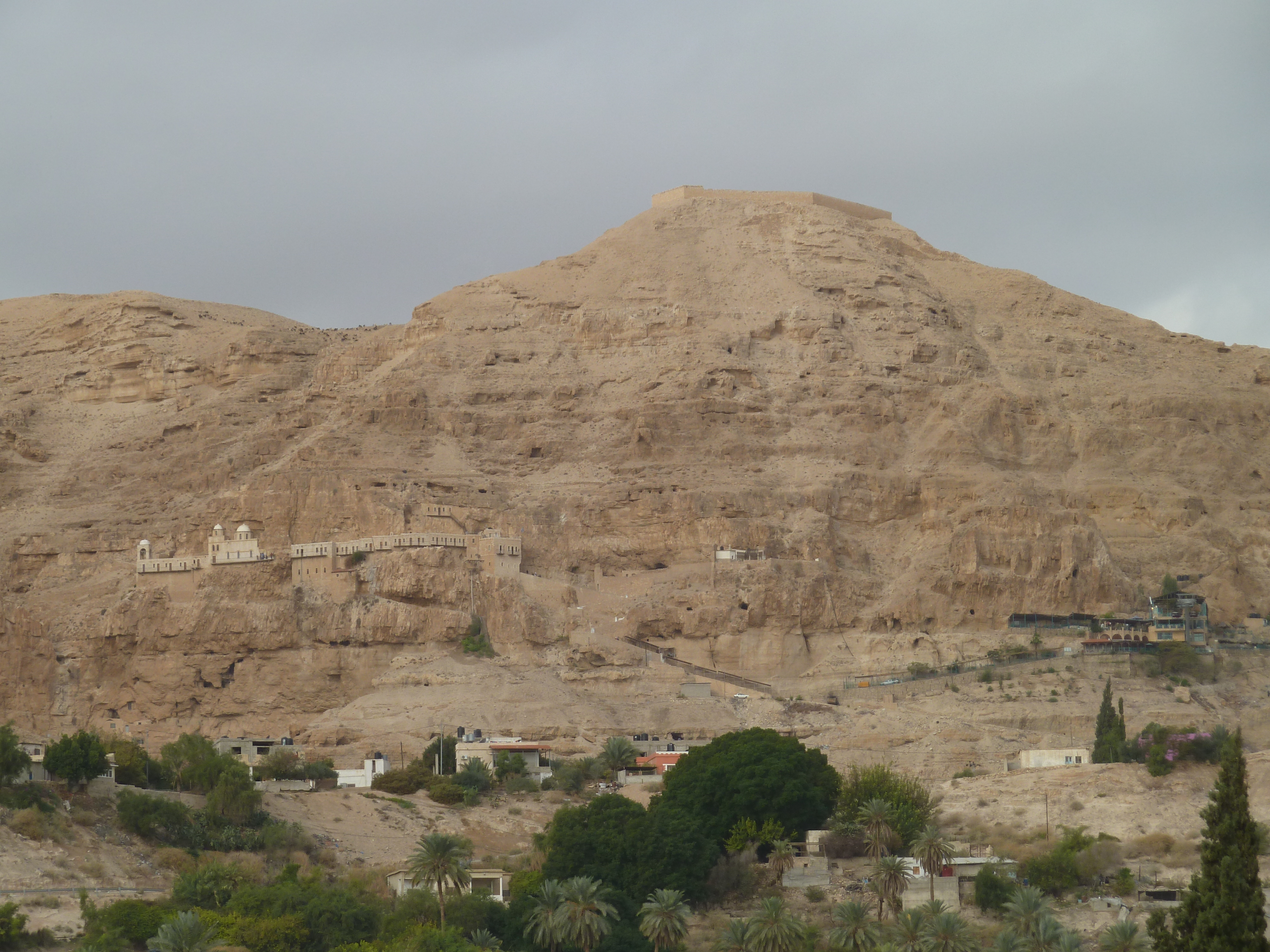
אֶל הַר גָּבֹהַּ מְאֹד (HR). Like the preposition εἰς (eis, “into,” “to”), אֶל (’el, “unto,” “to”) need not imply that Satan took Jesus to the summit of the mountain. If the mountain is correctly identified as Mount Moriah and Mount Zion, and if we accept Luke’s order of the temptations, in which Jesus enters Jerusalem only at the beginning of the final temptation, then it may be preferable to suppose that Satan took Jesus to the foot of the mountain, outside the city walls.
On reconstructing ὄρος (oros, “mountain”) with הַר (har, “mountain,” “hill”), see Lost Sheep and Lost Coin, Comment to L18.
A great many instances of the adjective ὑψηλός (hūpsēlos, “high”) in LXX occur as substantives equivalent to the Hebrew noun בָּמָה (bāmāh, “high place [of worship]”). The adjective ὑψηλός also frequently occurs in the phrase ἐν βραχίονι ὑψηλῷ (en brachioni hūpsēlō, “with a raised arm”) as the translation of בִּזְרוֹעַ נְטוּיָה (bizrōa‘ neṭūyāh, “with an outstretched arm”), but since these are unsuitable reconstructions for the present context, we must consider other alternatives. Frequently in LXX ὑψηλός serves as the translation of רָם (rām, “high,” “exalted”) and in this capacity is found in combination with ὄρος (“mountain”):
אַבֵּד תְּאַבְּדוּן אֶת־כָּל־הַמְּקֹמוֹת אֲשֶׁר עָבְדוּ־שָׁם הַגּוֹיִם אֲשֶׁר אַתֶּם יֹרְשִׁים אֹתָם אֶת־אֱלֹהֵיהֶם עַל־הֶהָרִים הָרָמִים וְעַל־הַגְּבָעוֹת וְתַחַת כָּל־עֵץ רַעֲנָן
You must surely destroy all the places where the Gentiles whom you are dispossessing served their gods, on the lofty mountains [עַל הֶהָרִים הָרָמִים] and on the hills and under every green tree. (Deut. 12:2)
ἀπωλείᾳ ἀπολεῖτε πάντας τοὺς τόπους, ἐν οἷς ἐλάτρευσαν ἐκεῖ τοῖς θεοῖς αὐτῶν οὓς ὑμεῖς κληρονομεῖτε αὐτούς, ἐπὶ τῶν ὀρέων τῶν ὑψηλῶν καὶ ἐπὶ τῶν θινῶν καὶ ὑποκάτω δένδρου δασέος
With destruction you will destroy all the places in which those whom you are dispossessing served their gods, on the high mountains [τῶν ὀρέων τῶν ὑψηλῶν] and on the hills and under a leafy tree. (Deut. 12:2)
Even more frequently, however, ὑψηλός served as the translation of גָּבֹהַּ (gāvoah, “high”),[146] and we also find that the LXX translators almost always rendered גָּבֹהַּ as ὑψηλός.[147] Moreover, the phrase ὄρος ὑψηλόν (oros hūpsēlon, “high mountain”) occurs several times in LXX as the translation of הַר גָּבֹהַּ (har gāvoah, “high mountain”),[148] which makes our selection for HR all the more plausible.
The adverb λίαν (lian, “exceedingly”; var. λείαν [leian]) is not very common in LXX, but when it does occur it mainly does so as the translation of מְאֹד (me’od, “very”).[149]
L41 ἔδειξεν αὐτῷ (GR). Luke and Matthew agree in L41 to use the verb δεικνύειν (deiknūein, “to show”) + αὐτῷ (avtō, “to him”), but whereas Matthew puts the verb in the present tense, Luke’s verb is in the aorist tense. Since the historical present is un-Hebraic and indicative of Matthean redaction, we have accepted Luke’s wording for GR.
וַיּוֹרֵהוּ (HR). In LXX the verb δεικνύειν (“to show”) serves as the translation of several verbs, but none so often as verbs formed from the [no_word_wrap]ר-א-ה[/no_word_wrap] root, especially in the hif‘il stem, viz. הֶרְאָה (her’āh, “show”).[150] So, too, we find that the LXX translators rendered most instances of הֶרְאָה with δεικνύειν.[151] On the other hand, δεικνύειν also served as the translation of הוֹרָה (hōrāh, “show,” “teach”), for example:
וַיּוֹרֵהוּ יי עֵץ וַיַּשְׁלֵךְ אֶל הַמַּיִם וַיִּמְתְּקוּ הַמָּיִם
And the LORD showed him [וַיּוֹרֵהוּ] a tree, and he threw it into the water, and the water was sweet. (Exod. 15:25)
καὶ ἔδειξεν αὐτῷ κύριος ξύλον, καὶ ἐνέβαλεν αὐτὸ εἰς τὸ ὕδωρ, καὶ ἐγλυκάνθη τὸ ὕδωρ
And the Lord showed him [καὶ ἔδειξεν αὐτῷ] a tree, and he threw it into the water, and the water was sweetened. (Exod. 15:25)
בִּלְעֲדֵי אֶחֱזֶה אַתָּה הֹרֵנִי
What I do not see, show me! (Job 34:32)
ἄνευ ἐμαυτοῦ ὄψομαι, σὺ δεῖξόν μοι
Without myself I will see; show me! (Job 34:32)
Although וַיַּרְאֵהוּ (vayar’ēhū, “and he showed him”) is a completely acceptable option for HR, we have preferred וַיּוֹרֵהוּ (vayōrēhū, “and he showed him”) because if there is a play on the name מֹרִיָּה (moriyāh, “Moriah”) in Yeshua’s Testing, that play comes through most clearly by reconstructing with וַיּוֹרֵהוּ.
L42 πάσας τὰς βασιλείας (GR). Since there is perfect agreement between Luke and Matthew in L42, there can be no doubt regarding the wording of Anth.
אֶת כָּל מַמְלְכוֹת (HR). On reconstructing πᾶς (pas, “all,” “every”) with כָּל (kol, “all,” “every”), see Demands of Discipleship, Comment to L32.
Elsewhere we have reconstructed the noun βασιλεία (basileia, “kingdom”) with מַלְכוּת (malchūt, “reign,” “kingdom”),[152] but in the present instance “all the kingdoms of the world” probably reflects the fixed phrase כָּל מַמְלְכוֹת הָאָרֶץ (kol mamlechōt hā’āretz, “all the kingdoms of the earth”; see below, Comment to L43). We have accordingly adopted מַמְלָכָה (mamlāchāh, “kingdom”) as the reconstruction of βασιλεία in L42. In LXX βασιλεία occurs frequently as the translation of מַמְלָכָה,[153] and the LXX translators rendered most instances of מַמְלָכָה with βασιλεία.[154]
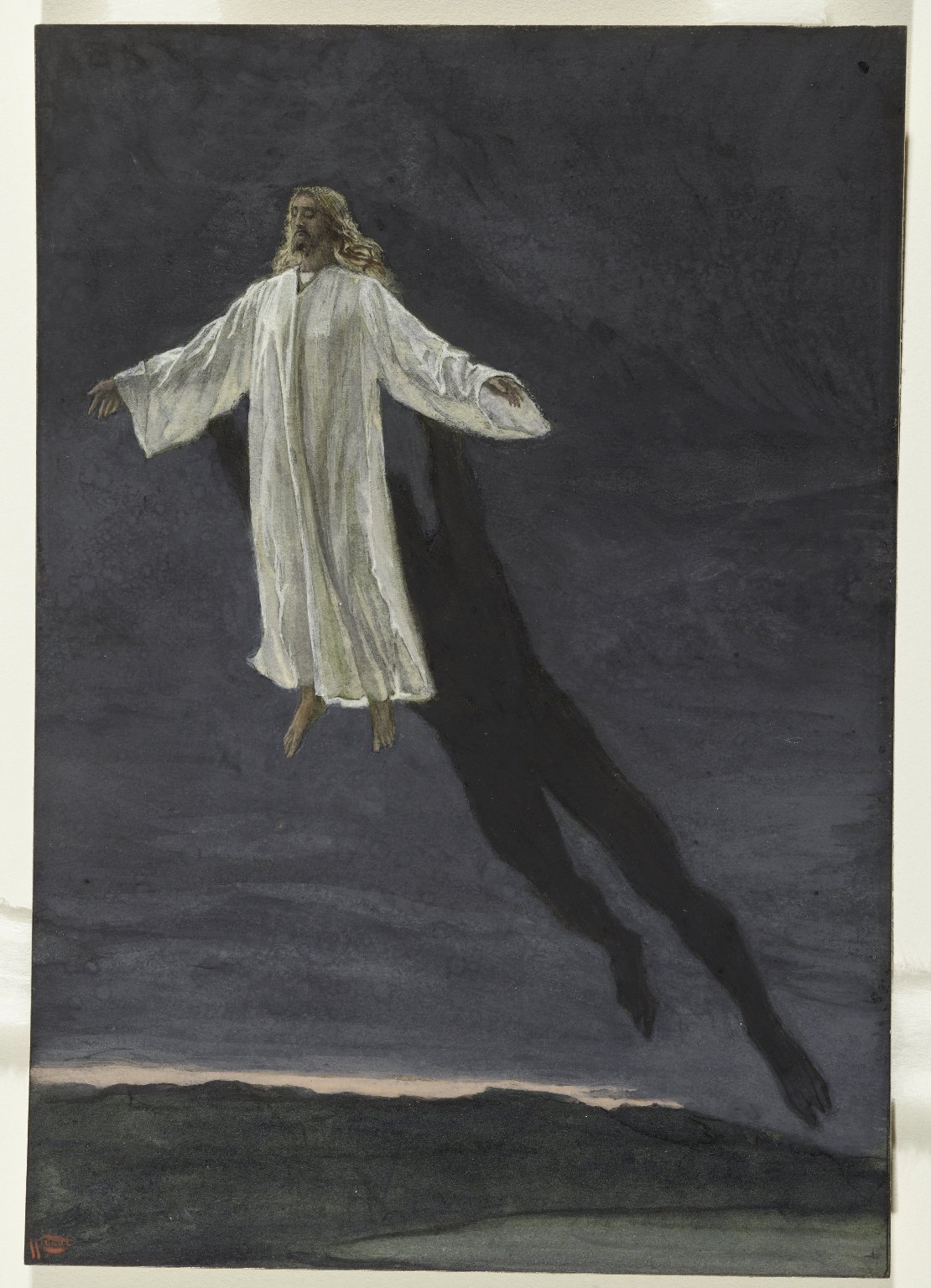
L43 τῆς οἰκουμένης (GR). Matthew and Luke use different words to describe “the world.” Matthew has the noun κόσμος (kosmos, “world”), while Luke has the noun οἰκουμένη (oikoumenē, “inhabited world”). Whereas some scholars attribute οἰκουμένη in L43 to Lukan redaction,[155] we think it is more likely that Luke preserves Anth.’s wording and that it was the author of Matthew who changed the noun to κόσμος. As we stated in the previous Comment, we believe “all the kingdoms of the world” represents the Hebrew phrase כָּל מַמְלְכוֹת הָאָרֶץ (“all the kingdoms of the earth”), but κόσμος points rather to a reconstruction with עוֹלָם (‘ōlām, “world”; see Yeshua’s Discourse on Worry, Comment to L51). In LXX κόσμος never occurs as the translation of אֶרֶץ (’eretz, “land,” “earth”),[156] nor do we encounter phrases such as מַמְלְכוֹת הָעוֹלָם (mamlechōt hā‘ōlām, “the kingdoms of the world”) or מַלְכֻיּוֹת הָעוֹלָם (malchuyōt hā‘ōlām, “the kingdoms of the world”) in ancient Hebrew sources. The phrase מַמְלְכוֹת הָאָרֶץ (mamlechōt hā’āretz, “the kingdoms of the earth”), on the other hand, is well attested, and while αἱ βασιλεῖαι τῆς γῆς (hai basileiai tēs gēs, “the kingdoms of the earth”) was a more common translation of this phrase in LXX,[157] there are two instances where the LXX translators rendered מַמְלְכוֹת הָאָרֶץ as [αἱ] βασιλεῖαι τῆς οἰκουμένης (“[the] kingdoms of the inhabited world”) or [ἡ] βασιλεία τῆς οἰκουμένης (“[the] kingdom of the inhabited world”) (Isa. 23:17; 37:16).
Thus Luke’s wording in L43 reverts to Hebrew more easily than Matthew’s, which has led us to accept τῆς οἰκουμένης for GR.
הָאָרֶץ (HR). In LXX οἰκουμένη (oikoumenē, “inhabited world”) occurs most often as the translation of תֵּבֵל (tēvēl, “world”),[158] but there are plenty of examples in which οἰκουμένη serves as the translation of אֶרֶץ (’eretz, “land,” “earth”).[159] Most importantly, however, οἰκουμένη appears in the phrase [αἱ] βασιλεῖαι τῆς οἰκουμένης (“[the] kingdoms of the inhabited world”) or [ἡ] βασιλεία τῆς οἰκουμένης (“[the] kingdom of the inhabited world”), which twice occurred in LXX as the translation of מַמְלְכוֹת הָאָרֶץ (“the kingdoms of the earth”; Isa. 23:17; 37:16), as we have already noted.[160]
L44 καὶ τὴν δόξαν αὐτῶν (GR). Whereas Matthew’s version of Yeshua’s Testing describes how Jesus saw the kingdoms “and their glory,” in Luke’s version the exact same phrase, καὶ τὴν δόξαν αὐτῶν (kai tēn doxan avtōn, “and their glory”), appears in direct speech when the devil offers to give Jesus “all their glory” (L50). We believe Matthew’s placement of “and their glory” reflects Anth.’s order.[161] The author of Luke may have created the devil’s speech, in which the devil explains his right to dispose of the kingdoms of the earth as he pleases, for the sake of his Gentile readers who may not have been fully acquainted with the Jewish concept of the devil. Jesus, who was well aware of Jewish ideas pertaining to Satan, would not have required this speech from the devil. In any case, the un-Hebraic word order exhibited in L49-53 suggests that this part of the devil’s speech was composed in Greek. Moreover, there appears to be an increasing complexity in each of the devil’s proposals, from a simple suggestion (“Turn this rock into bread”) to a bargain (“I’ll give you all this if you bow down to me”) to a reasoned argument (“Fling yourself from the Temple’s pinnacle, for according to Scripture it says,” etc.). The devil’s speech in Luke’s version of the temptation narrative mars this developing complexity by extending the dialogue in the middle trial.
וְאֶת כֹּל כְּבוֹדָן (HR). On reconstructing δόξα (doxa, “glory”) with כָּבוֹד (kāvōd, “glory”), see Yeshua’s Discourse on Worry, Comment to L36.
Compare our reconstruction, וְאֶת כֹּל כְּבוֹדָן (ve’et kol kevōdān, “and all their glory”), to the following biblical verse:
אֲדֹנָי מַעֲלֶה עֲלֵיהֶם אֶת־מֵי הַנָּהָר הָעֲצוּמִים וְהָרַבִּים אֶת־מֶלֶךְ אַשּׁוּר וְאֶת כָּל כְּבוֹדוֹ
The Lord is bringing upon them the mighty and copious waters of the river, [namely] the king of Assyria and all his glory [וְאֶת כָּל כְּבוֹדוֹ]. (Isa. 8:7)
ἀνάγει κύριος ἐφ᾿ ὑμᾶς τὸ ὕδωρ τοῦ ποταμοῦ τὸ ἰσχυρὸν καὶ τὸ πολύ, τὸν βασιλέα τῶν Ἀσσυρίων καὶ τὴν δόξαν αὐτοῦ
The Lord is bringing upon you the mighty and copious water of the river, [namely] the king of the Assyrians and his glory [καὶ τὴν δόξαν αὐτοῦ]. (Isa. 8:7)
This verse implies that the “glory” of a king or a kingdom might be equivalent to his (or its) military might. Such an understanding would suit the context of Yeshua’s Testing.
L45 ἐν στιγμῇ χρόνου (Luke 4:5). The noun στιγμή (stigmē, “moment”) does not occur elsewhere in NT. In LXX στιγμή is extremely rare, occurring only in 2 Macc. 9:11 and Isa. 29:5, where it serves as the equivalent of פֶּתַע (peta‘, “instant”). We concur with those scholars who regard the phrase ἐν στιγμῇ χρόνου (en stigmē chronou, “in a moment of time”) as the author of Luke’s replacement for a specific location for this temptation.[162] Rather than picturing a place from which all the kingdoms of the earth could be viewed, the author of Luke preferred to depict a visionary experience in which the devil caused Jesus to see all that the world had to offer in a single instant. Since we regard “in a moment of time” to be a Lukan addition, we have omitted this phrase from GR and HR.
L46 καὶ εἶπεν αὐτῷ (GR). Matthew and Luke agree completely in L46, so there can be no doubt here regarding GR.
L47 ὁ διάβολος (Luke 4:6). It is difficult to decide whether the author of Luke added ὁ διάβολος (“the devil”) to L47 for the sake of clarity or whether Matthew’s omission of the same is due to the fact that he had already mentioned “the devil” in L39. As we noted in Comment to L39, Hebrew narrative often fails to explicitly identify the speaker when his or her identity can be discerned from the context, so it would not be surprising if Anth. lacked ὁ διάβολος here in L47. Since our Greek reconstruction does not include ὁ διάβολος following εἶπεν αὐτῷ (“he said to him”) in L25 or in L68, we have not felt it necessary to include ὁ διάβολος in L47 either.
L48 πάντα ταῦτά σοι δώσω (GR). Reconstructing Anth.’s wording in L48 has been complicated by Matthew’s un-Hebraic word order. Luke’s pairing of the pronoun (σοι [soi, “to you”]) with the verb (δώσω [dōsō, “I will give”]) in L48 and his pairing of the demonstrative pronoun (ταύτην [tavtēn, “this”) with ἅπας (hapas, “all”) in L49 is more Hebraic than Matthew’s jumbled ταῦτά σοι πάντα δώσω (lit., “these to you all I will give”).
Nevertheless, there are also reasons against uncritically accepting Luke’s wording in L48 and L49. As we noted above in Comment to L44, the author of Luke probably added the devil’s explanation about his right to grant Jesus the worldwide dominion he offered. Luke’s editorial activity probably extended into the opening portion that is paralleled in Matthew. This impression is confirmed by Luke’s use of ἅπας (“all”) in L49, a term that occurs with disproportionate high frequency in Luke compared to Mark and Matthew and is therefore indicative of Lukan redaction.[163] Moreover, Wolter noted that in the section likely to have been written by the author of Luke (L50-53) each of the pronouns are placed in an emphatic position: ἐμοί (“to me”; L51), ᾧ (“to whom”; L52), σύ (“you”; L53).[164] This observation makes Luke’s emphatic position of σοί (“to you”) in L48 suspicious. It is probable that the author of Luke moved σοὶ δώσω (“to you I will give”) to the opening of the sentence in conformity with the emphatic style of the sentence.
How then are we to proceed if the authors of Luke and Matthew both altered Anth.’s wording? The following clues have led us to our decision. First, Luke and Matthew agree to place the personal pronoun (σοί [soi, “to you”]) ahead of the verb (δώσω [dōsō, “I will give”]). Therefore, there is a good chance that σοὶ δώσω reflects the word order of Anth. Second, the phrase ταῦτα πάντα (in that order) is contrary to Hebrew word order,[165] but it occurs 7xx in Matthew (Matt. 4:9; 6:33; 13:34, 51, 56; 23:36; 24:2). Each time it occurs in Matthew it does so without the agreement of the Lukan and/or Markan parallels (if any).[166] Thus it appears that the order ταῦτα→πάντα is a redactional trait of the author of Matthew, and therefore the Lukan-Matthean agreement to place a demonstrative pronoun (ταῦτά [“these”; Matt., L48] / ταύτην [“this”; Luke, L49]) before πᾶς (pas, “all”; Matt., L48) or ἅπας (hapas, “all”; Luke, L49) could simply be a coincidence, the result of two independent Greek editors producing Greek word order. In view of these considerations we have adopted for GR the most Hebraic wording that assumes the least amount of redaction on the part of the author of Matthew, namely πάντα ταῦτά σοι δώσω (panta tavta soi dōsō, lit., “All these to you I will give”), while taking into account the known redactional tendencies of the authors of Matthew (preference for the order ταῦτα πάντα) and Luke (placing pronouns in positions of emphasis and substituting ἅπας for πᾶς).אֶת כֻּלָּם לְךָ אֶתֵּן (HR). On reconstructing διδόναι (didonai, “to give”) with נָתַן (nātan, “give”), see Widow’s Son in Nain, Comment to L18.
Compare our reconstruction to the following promise:
כִּי אֶת כָּל הָאָרֶץ אֲשֶׁר אַתָּה רֹאֶה לְךָ אֶתְּנֶנָּה וּלְזַרְעֲךָ עַד עוֹלָם
…for all the land that you see, to you I will give it, and to your offspring forever. (Gen. 13:15)
ὅτι πᾶσαν τὴν γῆν, ἣν σὺ ὁρᾷς, σοὶ δώσω αὐτὴν καὶ τῷ σπέρματί σου ἕως τοῦ αἰῶνος
…for all the land which you see, to you I will give it, and to your offspring forever. (Gen. 13:15)
As in our reconstruction, this promise exhibits the order direct object marker→כָּל→object→לְךָ→imperfect of נָתַן.
L49-53 We have already stated reasons for supposing that the devil’s explanation in L49-53 is largely the product of Lukan redaction.[167] These include the un-Hebraic emphatic positioning of the pronouns, the likelihood that the explanation is for the benefit of Gentile readers not well acquainted with the Jewish concept of the devil, and the way the explanation destroys the developing complexity from one temptation to the next (according to Luke’s order).[168]
Rudman’s suggestion that the way the devil’s explanation is phrased reflects the author of Luke’s personal knowledge of Aramaic seems unlikely.[169] That the words the author of Luke attributed to the devil reflect standard formulae used in the ancient world for expressing proprietorship, however, is not improbable.[170] Rudman probably is correct in his assessment that the devil’s claims express the author of Luke’s view that the devil held sway over the world empires.
L54 ἐὰν προσκυνήσῃς ἐνώπιον ἐμοῦ (GR). Luke and Matthew agree on the words ἐὰν προσκυνήσῃς (ean proskūnēsēs, “if you pay homage”), which must therefore be traced back to Anth. Matthew’s version, however, includes the participle πεσών (pesōn, “falling”), which is absent in Luke’s parallel. Instead of Matthew’s μοι (moi, “to me”), Luke’s version reads ἐνώπιον ἐμοῦ (enōpion emou, “before me”). In both cases of disagreement we have preferred Luke’s wording for GR.
Regarding πεσών (“falling”), we note that the combination of πίπτειν + προσκυνεῖν occurs 3xx in Matthew (Matt. 2:11; 4:9; 18:26), but never in the Gospels of Luke or Mark.[171] On the other hand, the author of Luke used this combination in Acts 10:25, so we have no reason to think that he would have avoided it had it occurred in Anth. It is possible that Matthew’s πεσὼν προσκυνήσῃς (“falling you might pay homage”) was intended to echo the state-sponsored idolatry in the story of Nebuchadnezzar’s image in the Book of Daniel, where the combination of πίπτειν + προσκυνεῖν occurs repeatedly (Dan. 3:5, 6, 10, 11, 15).
Regarding Luke’s ἐνώπιον ἐμοῦ (“before me”), it is true that the preposition ἐνώπιον is unique to Luke among the Synoptic Gospels,[172] but this datum is offset by the fact that “the use of ἐνώπιον is a Hebraism for the simple dative,”[173] and it seems improbable that the author of Luke would add Hebraisms to his Gospel.[174] The more credible explanation is that the Hebraisms in Luke reflect the author of Luke’s use of a Hebraic-Greek source. We note, moreover, that the author of Luke’s use of ἐνώπιον drops off dramatically in 2 Acts (3xx: Acts 19:9, 19; 27:35), where his personal writing style is most clearly expressed, as compared to his Gospel (22xx)[175] and 1 Acts (10xx).[176]
אִם תִּתְנַפֵּל לְפָנַי (HR). On reconstructing ἐάν (ean, “if”) with אִם (’im, “if”), see Sending the Twelve: Conduct in Town, Comment to L88.
We admit that our decision to reconstruct προσκυνεῖν (proskūnein, “to pay homage,” “to prostrate oneself”) with הִתְנַפֵּל (hitnapēl, “prostrate oneself”) is a bit ironic given our rejection of Matthew’s πεσών (“falling”) in GR, since the basic meaning of the [no_word_wrap]נ-פ-ל[/no_word_wrap] root is “to fall.” However, falling and prostration are nearly synonymous, and reconstructing προσκυνεῖν with הִתְנַפֵּל allows for a verbal link between this temptation and the next, in which Satan’s suggestion that Jesus should throw himself from the pinnacle of the Temple can also be reconstructed with a verb from the [no_word_wrap]נ-פ-ל[/no_word_wrap] root (see below, Comment to L70). Examples of הִתְנַפֵּל in the sense of “prostrate oneself” occur in Deut. 9:18, 25 (2xx); Ezra 10:1. In most of these instances הִתְנַפֵּל is followed by the preposition לִפְנֵי (lifnē, “before”). The verb הִתְנַפֵּל continued to be used in this sense in Mishnaic Hebrew, as we see from the following example:
מעשה בר′ טרפון שהיה אוכל קציעות מפרדס שלו, בא עריס שלו ומצאו, הכהו מכה רבה, ולא אמר לו שאני ר′ טרפון, עד שעמד אותו אריס והכירו, כיון שהכירו קרע בגדיו ותלש בשערו, והיה צועק ובוכה, ומתנפל לפני רגליו, אמר לו אדוני מורי מחול לי
An anecdote concerning Rabbi Tarfon, who was eating figs in his garden. His tenant came and found him and beat him severely, but he did not say to him, “I am Rabbi Tarfon!” until that tenant stopped and recognized him. As soon as he recognized him he tore his clothes and pulled out his hair and was crying and weeping. And prostrating himself before his feet [וּמִתְנַפֵּל לִפְנֵי רַגְלָיו], he said to him, “My Lord, my teacher, forgive me!” (Kallah §21 [ed. Higger, 159-160])
Another perfectly justifiable option for reconstructing προσκυνεῖν is, of course, הִשְׁתַּחֲוָה (hishtaḥavāh, “prostrate oneself”). In LXX the vast majority of instances of προσκυνεῖν occur as the translation of הִשְׁתַּחֲוָה.[177] Likewise, the LXX translators almost always rendered הִשְׁתַּחֲוָה with προσκυνεῖν.[178]
On reconstructing ἐνώπιον (enōpion, “in front of”) with לִפְנֵי (lifnē, “in front of,” “in the presence of,” “before”), see Lost Sheep and Lost Coin, Comment to L58.
Theissen made an acute observation regarding Satan’s proposal of granting Jesus worldwide dominion in exchange for worship: the devil’s intention was to gain Jesus’ submission, but he tempted Jesus with the exact opposite of submission—power.[179] The experience of this temptation may be expressed in Jesus’ saying “What will it profit a person if he gains the whole world but loses his soul?” (Matt. 16:26; Mark 8:36; Luke 9:25).[180]
According to Flusser, Satan’s attempt to bargain with Jesus marks a turning point in the history of evil.[181] In ancient Jewish sources Satan attempts to make the righteous stumble, but never until the temptation of Jesus is he portrayed as attempting to recruit the righteous to come over to the dark side. Subsequent to the composition of the Gospels, and probably under the influence of the temptation narrative, stories about deals with the devil began to emerge.[182]
L55 ἔσται σοῦ πᾶσα (Luke 4:7). The long explanation the author of Luke attributed to the devil in L49-53 necessitated the addition in L55 of “it will all be yours.”
L56 τότε λέγει αὐτῷ (Matt. 4:10). Matthew’s historical present and its τότε (“then”) in L56 are undoubtedly redactional.[183] In what is the final temptation according to Matthew’s order the τότε is delayed from the opening position it enjoys in Matt. 4:1 (L2) and Matt. 4:5 (L63) and instead serves to introduce Jesus’ final response to the devil. This postponement of τότε in Matthew’s final temptation is another technique the author of Matthew employed to create a sense of mounting drama and increasing tension within his version of the temptation narrative.[184]
L56-57 καὶ ἀποκριθεὶς ὁ Ἰησοῦς εἶπεν αὐτῷ (GR). For reconstructing the introduction to Jesus’ response to the devil’s offer we have adopted Luke’s wording as it appears in critical editions of the New Testament, which is the more probable reading and more Hebraic than the word order that appears in Codex Vaticanus. On accepting the definite article preceding Jesus’ name, see above, Comment to L31.
וַיַּעַן יֵשׁוּעַ וַיֹּאמֶר לוֹ (HR). On reconstructing ἀποκρίνειν (apokrinein, “to answer”) with עָנָה (‘ānāh, “answer”), see above, Comment to L29. On reconstructing Ἰησοῦς (Iēsous, “Jesus”) with יֵשׁוּעַ (yēshūa‘, “Jesus”), see above, Comment to L3.
On reconstructing καὶ ἀποκριθείς + speaker + εἶπεν with וַיַּעַן + speaker + וַיֹּאמֶר, see Call of Levi, Comment to L58.
L58 ὕπαγε σατανᾶ (Matt. 4:10). It is likely that the command “Depart, Satan!” attributed to Jesus in Matthew’s version of the temptation narrative is a secondary accretion introduced by the author of Matthew.[185] This command only makes sense if we accept Matthew’s order of the temptations, which we do not (see the discussion under the subheading Second Temptation). But there are additional reasons for questioning the originality of the command ὕπαγε σατανᾶ (hūpage satana, “Depart, Satan!”) in L58. First, it seems improbable that having translated שָׂטָן (sāṭān, “Satan”) as διάβολος (diabolos, “devil”) earlier in the temptation narrative (L16, L23) the Greek translator would have changed course and translated שָׂטָן as σατανᾶς (satanas, “Satan”) in L58. More likely the author of Matthew, regarding “Satan” as the personal name of the devil, added “Depart, Satan!” to L58 as a dramatic flourish. Second, Mark 8:33 depicts Jesus as rebuking Peter with the words ὕπαγε ὀπίσω μου σατανᾶ (hūpage opisō mou satana, “Depart from behind me, Satan!”), words the author of Matthew accepted in his parallel (Matt. 16:23). It seems likely that the author of Matthew echoed this memorable rebuke in the temptation narrative. Third, we have already observed that the author of Matthew enjoyed using a variety of names and titles when referring to the devil (see above, Comment to L23). The switch from διάβολος to σατανᾶς appears to be another example of this phenomenon.
L59 γέγραπται (GR). Luke and Matthew agree in L59 to have Jesus introduce his Scripture quotation with the formula γέγραπται (gegraptai, “it has been written”). Matthew’s addition of γάρ (gar, “for”) eases the transition from the command “Depart, Satan!” to the Scripture quotation, and is therefore probably secondary.[186]
כָּתוּב (HR). On reconstructing γέγραπται (gegraptai, “it has been written”) with כָּתוּב (kātūv, “[it is] written”), see above, Comment to L33.
L60-62 Both the quotation Jesus selected to rebuff Satan’s offer and the form in which the quotation appears in Matthew and Luke are problematic. As we will see, these two difficulties are intimately related.
In the first place, why didn’t Jesus choose Deut. 13:5 for his Scripture quotation? This verse, which contains the same key vocabulary as the verse Jesus did choose, occurs in a passage that deals with enticement to idolatry, and therefore seems more appropriate for the occasion. According to MT and LXX, this verse reads:
אַחֲרֵי יי אֱלֹהֵיכֶם תֵּלֵכוּ וְאֹתוֹ תִירָאוּ וְאֶת־מִצְוֹתָיו תִּשְׁמֹרוּ וּבְקֹלוֹ תִשְׁמָעוּ וְאֹתוֹ תַעֲבֹדוּ וּבוֹ תִדְבָּקוּן
After the LORD your God you must walk, and him you must fear, and his commandments you must keep, and to his voice you must listen, and him you must serve, and to him you must cling. (Deut. 13:5)
ὀπίσω κυρίου τοῦ θεοῦ ὑμῶν πορεύεσθε καὶ αὐτὸν φοβηθήσεσθε καὶ τὰς ἐντολὰς αὐτοῦ φυλάξεσθε καὶ τῆς φωνῆς αὐτοῦ ἀκούσεσθε καὶ αὐτῷ προστεθήσεσθε
After the Lord your God you must go, and him you must fear, and his commandments you must keep, and his voice you must hear, and to him you must be joined. (Deut. 13:5)[187]
Making this verse even more attractive is the prior statement that God permits Israel to be enticed into committing idolatry because “the LORD your God is testing you to know whether you love the LORD your God with all your hearts and with all your souls” (Deut. 13:4). Recall that in the first temptation Jesus quoted a verse from a context in which God tested Israel in the desert with hunger in order to know what was in Israel’s heart, so it would have made sense for Jesus to have quoted a verse that appears in a context that explains that God tests Israel with idolatry to know what is in their heart. Given these strong reasons for selecting Deut. 13:5, there must have been an even more compelling reason for Jesus to have selected the passage that appears twice in Deuteronomy, which according to Matthew and Luke states:
κύριον τὸν θεόν σου προσκυνήσεις καὶ αὐτῷ μόνῳ λατρεύσεις
The Lord your God you must pay homage to, and to him alone you must render service. (Matt. 4:10 ∥ Luke 4:8)
As Flusser noted, the crucial word in this quotation, the reason for which it must have been selected in preference to Deut. 13:5 or any other biblical verse, is the word μόνῳ (monō, “alone”).[188] It is this word, which highlights the exclusivity of the covenant relationship between God and Israel, that makes Deut. 6:13 ∥ 10:20 exactly suited for Jesus’ purpose. The problem is, it is precisely the word “alone” that is missing from the verse in biblical manuscripts!
According to MT, the passage Jesus quoted reads:
אֶת יי אֱלֹהֶיךָ תִּירָא [וְ]אֹתוֹ תַעֲבֹד [וּבוֹ תִדְבָּק] וּבִשְׁמוֹ תִּשָּׁבֵעַ
The LORD your God you must fear, [and] him you must serve, [and to him you must cling], and in his name you must swear. (Deut. 6:13; 10:20)[189]
And apart from Codex Alexandrinus,[190] which clearly has been adapted to reflect the wording of Jesus’ quotation in the temptation narrative, LXX agrees with MT:
κύριον τὸν θεόν σου φοβηθήσῃ καὶ αὐτῷ λατρεύσεις καὶ πρὸς αὐτὸν κολληθήσῃ καὶ τῷ ὀνόματι αὐτοῦ ὀμῇ
The Lord your God you must fear, and to him you must render service, and to him you must be joined, and in his name you must swear. (Deut. 6:13; 10:20)
Now, there are two points of difference between Jesus’ quotation and the way the verse is worded in MT and LXX: in the Gospel quotation we find the verb “pay homage” instead of “fear” (as in the biblical MSS), and the crucial word “alone” in Jesus’ quotation is missing in MT and LXX. Yet there are some LXX MSS that do include the word μόνῳ (“alone”) but have the verb “fear” instead of “pay homage” (as in the Gospel quotation).[191] These non-conforming MSS that include μόνῳ suggest that “alone” occurred in some versions of Deut. 6:13 and Deut. 10:20 prior to and independent of the temptation narrative.[192]
Some scholars have drawn the facile conclusion that the presence of μόνῳ (“alone”) in Jesus’ Deuteronomy quotation proves that the temptation narrative was composed in Greek by an author acquainted with this minority LXX reading. But Flusser has shown that the reading “alone” in Deut. 6:13 and Deut. 10:20 did not originate in Greek but in Hebrew, specifically in the liturgy of the Temple in Jerusalem. According to rabbinic sources, the priests, including the high priest, and other worshippers in the Temple were accustomed to reciting a blessing for the divine service that concluded with the words שֶׁאוֹתְךָ לְבַדֶּךָ בְּיִרְאָה נַעֲבוֹד (she’ōtechā levadechā beyir’āh na‘avōd, “for you alone we will serve in fear”; y. Sot. 7:6 [33b]; cf. m. Tam. 5:1).[193] This blessing is modeled on Deut. 6:13 and Deut. 10:20, but unlike MT’s version of these verses, the blessing recited in the Temple includes the crucial word “alone.”
Flusser discovered support for the existence of this blessing in the late Second Temple period in the writings of Josephus (Ant. 3:91) and in Pseudo-Philo’s Biblical Antiquities (L.A.B. 23:14), where echoes of this blessing are preserved.[194] Subsequent to the destruction of the Temple, this blessing was incorporated into the eighteen benedictions of the Amidah as it was recited in the land of Israel.[195]Since the blessing for the divine service was well known to Hebrew speakers in the Second Temple period, and since the blessing itself was a paraphrase of Deut. 6:13 and Deut. 10:20, Jesus easily could have (mis)quoted the verse by including the word “alone.” Flusser conjectured that the word “alone” crept from the blessing into Hebrew MSS of Deut. 6:13 and Deut. 10:20,[196] and it was from such interpolated MSS that some LXX copies came to insert μόνῳ in these verses.[197] So it is even possible that Jesus knew a non-Masoretic Hebrew text in which the word “alone” did appear in Deut. 6:13 and Deut. 10:20. In any case, the presence of the word μόνῳ (“alone”) in Jesus’ Scripture quotation hardly proves that this quotation was based on LXX. On the contrary, the form of Jesus’ quotation points to a Hebrew background and a Jewish milieu focused on the exclusivity of the worship that was conducted in the Temple.
So we see that Jesus selected the passage that occurs in Deut. 6:13 and Deut. 10:20 because of the role it played in the liturgy of the Temple. In that liturgy a blessing based on these verses celebrated the exclusivity of the divine service that was conducted there.[198] The form of Jesus’ quotation reflects the Temple liturgy and the ideology of exclusive worship of the one God which the blessing articulates. No more fitting passage, especially in the peculiar form in which Jesus cited it, could have been found as a repudiation of Satan’s deal—a deal Satan may well have proffered at the foot of Mount Zion, the mountain of the LORD’s Temple.
L60 אֶת יי אֱלֹהֶיךָ (HR). Since Luke and Matthew agree on the wording of L60, there is no need for discussion of GR; both authors copied Anth.’s wording exactly.
In LXX the noun κύριος (kūrios, “lord”) typically occurs as the representation of the Tetragrammaton, God’s personal name.[199] Likewise, the LXX translators habitually represented the Tetragrammaton as κύριος.[200] On reconstructing θεός (theos, “god”) with אֱלֹהִים (’elohim, “God”), see above, Comment to L26. Since L60 belongs to the quotation of a passage that occurs in Deut. 6:13 and Deut. 10:20, there can be no doubt as to HR.
Our reconstruction raises the question of whether Jesus would have pronounced the divine name while reciting this biblical verse. While it appears that Jesus generally avoided uttering the divine name, preferring to use circumlocutions such as “Heaven,” and while it was customary for first-century Jews to pronounce the word אֲדֹנָי (’adonāy, “my lord”) in place of the Tetragrammaton when reading or reciting Scripture,[201] uttering the divine name was believed to be an effective means of exorcising evil spirits and warding off Satan.[202] This belief was based upon, or at least informed by, the scene in Zechariah’s vision where Satan is dismissed with the words “The LORD rebuke you, Satan” (Zech. 3:2; cf. Jude 9). In a face-to-face confrontation with Satan Jesus’ use of the divine name may have been deemed warranted. On the other hand, Satan does not take flight when Jesus quotes the verse that contains the divine name, so unless we are to suppose that in the temptation narrative Satan was impervious to the invocation of the Tetragrammaton, perhaps it is safest to conclude that Jesus did not use the divine name as a defense against the onslaught of the devil.
L61 προσκυνήσεις (GR). Since the authors of Luke and Matthew agreed to write προσκυνήσεις (proskūnēseis, “you will pay homage”) in L61, there can be no doubt that this was the verb they found in Anth. However, this poses a problem for us because, apart from Codex Alexandrinus, which was clearly adapted to agree with the form of the quotation as it occurs in the temptation narrative, LXX reads φοβηθήσῃ (fobēthēsē, “you will fear”) in Deut. 6:13 and Deut. 10:20 in agreement with MT, which reads תִּירָא (tirā’, “you will fear”). Unlike μόνῳ (monō, “alone”) in L62, which can be explained from Hebrew sources (see above, Comment to L60-62), there is no evidence to support a hypothesis that “you will pay homage” reflects a variant Hebrew text that read תִּשְׁתַּחֲוֶה (tishtaḥaveh, “you will bow down”). Neither is it convincing to suggest that προσκυνεῖν (proskūnein, “to pay homage”) is simply an alternate translation of יָרֵא (yārē’, “fear”) independent of LXX. There is really no semantic overlap between προσκυνεῖν (“to pay homage”) and יָרֵא (“fear”), nor do we ever find that προσκυνεῖν was used as an equivalent for יָרֵא in LXX.[203]
Thus we are left with two explanations for προσκυνήσεις (“you will pay homage”) in L61:
- The Greek translator of the Hebrew Life of Yeshua wrote προσκυνήσεις (“you will pay homage”) despite the fact that his vorlage read תִּירָא (“you will fear”) because doing so tied the biblical quotation directly to the wording of the devil’s bargain.
- The Greek translator of the Hebrew Life of Yeshua rendered תִּירָא (“you will fear”) as φοβηθήσῃ (“you will fear”), but the Anthologizer (i.e., the creator of Anth.) changed φοβηθήσῃ to προσκυνήσεις (“you will pay homage”) for the same reason as in the previous explanation.
Neither alternative is particularly attractive, since according to Lindsey’s hypothesis the style of the Greek translation of the Hebrew Life of Yeshua was highly literal, while the Anthologizer’s approach was not to tamper with the wording of the Greek translation, but only to reorganize its contents. It is impossible to decide between the two alternatives with any degree of certainty, but fortunately for our purposes we do not need to, since our Greek reconstruction does not attempt to go back any further than Anth.[204]
תִּירָא (HR). As we discussed above, we have adopted תִּירָא (“you will fear”) for HR because there is no indication that there ever was a Hebrew text of Deut. 6:13 or Deut. 10:20 that read otherwise. The change from “you will fear” to “you will pay homage” must have taken place at the Greek stage of transmission.[205]
L62 וְאוֹתוֹ לְבַדּוֹ תַעֲבֹד (HR). Since Luke and Matthew agree on the wording in L62, there is no need for comment on GR. As we have already discussed (Comment to L60-62), there is support in ancient Jewish (especially Hebrew) sources for the form in which Jesus quoted the passage repeated in Deut. 6:13 and Deut. 10:20.
On reconstructing μόνος (monos, “alone,” “only”) with לְבַד (levad, “alone,” “only”), see above, Comment to L34-35. Our confidence in the selection of לְבַד for HR is greatly increased by the blessing for the divine service that contains this term, which we discussed in Comment to L60-62.
Nearly all instances of λατρεύειν (latrevein, “to serve,” “to worship”) in LXX occur as the translation of עָבַד (‘āvad, “serve,” “worship”).[206] The LXX translators more frequently rendered עָבַד as δουλεύειν (doulevein, “to serve”), but λατρεύειν is their second most common translation of עָבַד.[207] In the present instance our reconstruction is not in doubt because it is a quotation of Deut. 6:13 and Deut. 10:20.
Some scholars have attempted to construe this temptation as a repudiation of militant Jewish nationalist (i.e., zealot) ideology. But as Kloppenborg pointed out, the passage Jesus selected—and especially the form in which he quoted it—is strikingly similar to Josephus’ description of the radical “Fourth Philosophy,” whose followers recognized God alone as their ruler and master (Ant. 18:23).[208] We do not regard this similarity as signaling Jesus’ agreement with radical militant Jewish nationalism, but it does suggest that zeal ideology was not the butt of the temptation narrative’s criticism. It seems rather that the temptation narrative polemicizes against Roman imperialism[209] without, of course, endorsing a violent extremism.
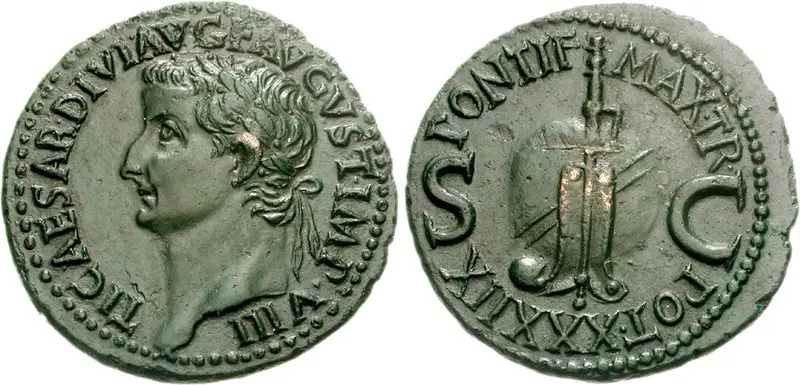
Roman imperialist propaganda triumphantly proclaimed that Caesar reigned over the entire world.[210] If this boast is regarded in the light of Satan’s offer of worldwide dominion to Jesus, then the implication is that previously Satan had bestowed this dominion on the emperor of Rome,[211] undoubtedly on the same terms as he now offered it to Jesus. In other words, the Roman emperor had embraced Satan as his patron and imitated his manner of exercising authority. In this way the temptation narrative exposed Roman imperialist rule for what it truly was, a brutal and ruthless regime based on violence and exploitation that crushed the powerless many for the enrichment of the powerful few.
Jesus’ refusal of Satan’s offer implies a total rejection of the coercive control with which Caesar maintained his empire. Redemption would not (and can never) be achieved by imposing one’s will on another. By committing himself exclusively to God, Jesus declared his faith in the one who redeemed Israel from slavery in Egypt and who would liberate all humankind from the reign of sin and death. Healing creation through acts of forgiveness, mercy and peacemaking in obedience to God’s commandments would be the means by which the Kingdom of Heaven would increase.
Once again Jesus’ humble definition of divine sonship is striking. Although Caesar, too, claimed to be the son of a god, Jesus did not view his divine sonship as justifying imperialist ambitions. Rather than exercising power over others, Jesus’ divine sonship was expressed through obedience to and the worship of the one true God.

Third Temptation
L63 ἤγαγεν δὲ αὐτὸν (GR). Matthew’s wording in L63 is nearly identical to that in L38, and we regard it as redactional for the same reasons we cited in Comment to L38. We have therefore accepted Luke’s wording for GR.
וַיֹּלֶךְ אוֹתוֹ (HR). In L8 we reconstructed a passive form of ἄγειν (agein, “to lead”) with the root [no_word_wrap]ה-ל-כ[/no_word_wrap], and here we have followed suit, using the active hif‘il stem. Compare our reconstruction to the following examples in which ἄγειν serves as the equivalent of הוֹלִיךְ (hōlich, “lead”):
וָאוֹלֵךְ אֶתְכֶם אַרְבָּעִים שָׁנָה בַּמִּדְבָּר
And I led [וָאוֹלֵךְ] you forty years in the desert. (Deut. 29:4)
καὶ ἤγαγεν ὑμᾶς τεσσαράκοντα ἔτη ἐν τῇ ἐρήμῳ
And he led [ἤγαγεν] you forty years in the desert. (Deut. 29:4)
וַיֹּלֶךְ אוֹתָם אֶל מֶלֶךְ בָּבֶל רִבְלָתָה
…and he led [וַיֹּלֶךְ] them to the king of Babylon in Rivlah. (Jer. 52:26)
καὶ ἤγαγεν αὐτοὺς πρὸς βασιλέα Βαβυλῶνος εἰς Δεβλαθα
…and he led [ἤγαγεν] them to the king of Babylon in Deblatha. (Jer. 52:26)
וַיּוֹלִיכֻהוּ יְרוּשָׁלִַם וַיָּמָת וַיִּקָּבֵר בְּקִבְרוֹת אֲבֹתָיו
…and they led him [וַיּוֹלִיכֻהוּ] to Jerusalem. And he died and was buried in the tombs of his fathers. (2 Chr. 35:24)
καὶ ἤγαγον αὐτὸν εἰς Ιερουσαλημ· καὶ ἀπέθανεν καὶ ἐτάφη μετὰ τῶν πατέρων αὐτοῦ
…and they led [ἤγαγον] him to Jerusalem. And he died and was buried with his fathers. (2 Chr. 35:24)
L64 ὁ διάβολος (Matt. 4:5). As we discussed above in Comment to L39, since reiterating that it was the devil who instigated the temptations is not necessary in Greek or Hebrew, it seems likely that it was the author of Matthew who added ὁ διάβολος (ho diabolos, “the devil”) in L39 and L64 for the sake of clarity, and we have therefore not included ὁ διάβολος at either point in GR. It is possible, however, that the author of Luke eliminated ὁ διάβολος for the sake of brevity. The inclusion or exclusion of ὁ διάβολος in these lines does not affect the meaning of the overall narrative.
L65 εἰς Ἰερουσαλὴμ (GR). Matthew’s reference to “the holy city” could be reconstructed as עִיר הַקֹּדֶשׁ (‘ir haqodesh, “the city of holiness”), a designation that occurs in the Hebrew Scriptures.[212] However, Matthew’s un-Hebraic word order (def. article→adjective→noun) combined with the fact that the only other instance of the term “holy city” occurs in Matt. 27:53, a passage likely penned by the author of Matthew, does not inspire confidence.[213] We have therefore preferred Luke’s “to Jerusalem” for GR.
The form in which Luke records Jerusalem’s name is significant. Whereas the authors of Mark and Matthew preferred to use the Hellenized spelling Ἱεροσόλυμα (Hierosolūma),[214] the author of Luke displayed a marked preference for the Hebraic spelling Ἰερουσαλήμ (Ierousalēm) in his Gospel.[215] While scholars have advanced various theories to account for the distribution of the Hellenized and Hebraic forms of “Jerusalem” in Luke and Acts,[216] we believe the most probable explanation for the author of Luke’s preference for the Hebraic spelling of Jerusalem in his Gospel is that he accepted the Hebraic spelling from his sources (Anth. and FR).[217]
יְרוּשָׁלַיִם (HR). In LXX the phrase εἰς Ἰερουσαλήμ (eis Ierousalēm, “into Jerusalem”) sometimes occurs as the translation of אֶל יְרוּשָׁלִַם (’el yerūshālaim, “to Jerusalem”)[218] or לִירוּשָׁלִַם (lirūshālaim, “to Jerusalem”),[219] but in the vast majority of cases εἰς Ἰερουσαλήμ simply represents יְרוּשָׁלִַם (yerūshālaim, “Jerusalem”) without any accompanying preposition.[220] In Biblical Hebrew a preposition meaning “to” in phrases such as “lead to Jerusalem,” “bring to Jerusalem,” “come to Jerusalem,” “send to Jerusalem,” etc., was optional and in most cases omitted. Since we are reconstructing the narration in Yeshua’s Testing in a biblicizing style, we have decided to omit a preposition corresponding to εἰς (eis, “into”) in HR.
The spelling Ἰερουσαλήμ is a transliteration of יְרוּשָׁלֵם (yerūshālēm), an alternate (and probably older)[221] pronunciation of the name יְרוּשָׁלַיִם (yerūshālayim, “Jerusalem”).[222] However, the pronunciation yerūshālayim was current in the first century C.E., being reflected in the spelling with a yod before the final mem (i.e., יְרוּשָׁלַיִם) in a few instances in the biblical text.[223] In DSS the spelling ירושלים is common (cf., e.g., 1QM I, 3; III, 11; VII, 4; XII, 13, 17). Since it is likely that the author of the Hebrew Life of Yeshua would have used the pronunciation current in his time, we have reconstructed Ἰερουσαλήμ as יְרוּשָׁלַיִם.
L66 καὶ ἔστησεν αὐτὸν (GR). Luke and Matthew agree in L66 except with respect to the pronoun αὐτόν (avton, “him”). Since it is unlikely that a change in subject was intended (i.e., the devil took→Jesus stood), Matthew’s inclusion of the pronoun probably reflects the wording of Anth.[224] By dropping the pronoun the author of Luke avoided what Harnack described as “Semitic repetition,”[225] since αὐτόν already occurs in L63.
וַיַּעֲמִדֵהוּ (HR). Reconstructing καὶ ἔστησεν αὐτόν (kai estēsen avton, “and he set him”) as וַיָּקֶם אוֹתוֹ (vayāqem ’ōtō, “and he established him”; cf. Exod. 40:18) or וַיַּצֵּג אוֹתוֹ (vayatzēg ’ōtō, “and he set him”; cf. Judg. 8:27) or וַיָּשֶׂם אוֹתוֹ (vayāsem ’ōtō, “and he set him”; cf. Gen. 28:18) or וַיַּצֵּב אוֹתוֹ (vayatzēv ’ōtō, “and he set him”; cf. Gen. 35:14) are all possible, but these phrases typically refer to inanimate objects. When stationing a person at a particular location is involved the verb employed is typically הֶעֱמִיד (he‘emid, “cause to stand”; cf. Gen. 47:7; Lev. 14:11; Num. 3:6; 5:16, 18, 30; 8:13). Reconstructing with הֶעֱמִיד also forms a nice contrast with הִפִּיל (hipil, “cause to fall”) in L70 and accords well with a rabbinic tradition that the Messiah will stand (עָמַד [‘āmad]) on the roof of the Temple (on which, see below, Comment to L67).
In LXX the verb ἑστάναι (hestanai, “to stand”) occurs as the translation of several different Hebrew roots, with [no_word_wrap]ק-ו-מ[/no_word_wrap] and [no_word_wrap]ע-מ-ד[/no_word_wrap] being the most common.[226] We also find that the LXX translators rendered הֶעֱמִיד more often with ἑστάναι than with any other Greek verb.[227]

L67 עַל כְּנַף הַמִּקְדָּשׁ (HR). Since Luke and Matthew are in complete agreement in L67, GR requires no comment. How we ought to reconstruct ἐπὶ τὸ πτερύγιον τοῦ ἱεροῦ (epi to pterūgion tou hierou, “on the winglet of the Temple”), on the other hand, is a vexed issue.[228] In Greek it was not common to use πτερύγιον (pterūgion, “winglet”) or πτέρυξ (pterūx, “wing”) as architectural terms,[229] but neither was “wing” an architectural term in Hebrew.[230]
Jeremias suggested that τὸ πτερύγιον τοῦ ἱεροῦ (“the winglet of the Temple”) could be a mistranslation of the phrase הָאֲגוֹף שֶׁל הַר הַבַּיִת (hā’agōf shel har habayit, “the doorframe of the Temple Mount”; y. Pes. 7:12 [56a] [pointing according to Jeremias]), noting that אַגָּף (’agāf, “doorframe”; var. אִגּוּף [’igūf]) and אֲגַף (’agaf, “wing”) are homonyms.[231] But Jeremias’ suggestion is not entirely satisfactory. The doorframe of the Temple Mount is only mentioned in a single passage in the Jerusalem Talmud, which states:
ר′ בא בשם רב יהודה לא קידשו תחת האגוף שבירושלם. ר′ ירמיה בשם רב שמואל בר רב יצחק כדי שיהו מצורעין מגינין תחתיהן בחמה מפני החמה ובגשמים מפני הגשמים ודכוותה לא קידשו תחת האגוף של הר הבית כדי שיהו זבין מגינין תחתיהן בחמה מפני החמה ובגשמים מפני הגשמים. מצורע אין לו איכן להגן זב יש לו איכן להגן זב יש לו איכן להגן בכל ירושלם
Rabbi Ba said in the name of Rabbi Yehudah, “They did not consecrate beneath doorframes in [the wall of] Jerusalem [האגוף שבירושלם]. Rabbi Yirmeyah said in the name of Rabbi Shmuel son of Rabbi Yitzhak, “So that people with scale disease could shelter under them in the heat from the sun and in rain from the rain. And did they similarly not sanctify beneath doorframes of the Temple Mount [האגוף של הר הבית] so that people with an abnormal genital discharge could shelter under them in the heat from the sun and in the rain from the rain? [They did not, because] a person with scale disease has nowhere to shelter [in Jerusalem]. [But] a person with an abnormal genital discharge has somewhere to shelter in all parts of Jerusalem [and therefore does not need to shelter in the doorframe of the Temple Mount—DNB and JNT].” (y. Pes. 7:12 [56a])
It is clear from this discussion that the אִגּוּף (“doorframe”), whether of Jerusalem or of the Temple Mount, refers to an area within which a person can take shelter. It refers to the inside of an area protected by a frame or an arch. This becomes clearer when we examine the mishnah that the Jerusalem Talmud is discussing:
This mishnaic ruling provides a definition for the biblical prohibition against taking the Passover lamb outside the house in which it is eaten. The interior of the doorframe marks the boundary between inside and outside. Since the אַגָּף (var. אֶגֶף [’egef]) is defined as the place where the door abuts the frame,[232] it is by no means clear that אִגּוּף or אַגָּף can ever refer to a structure upon which a person could stand, which is of course what the description in the temptation narrative requires.[233] To salvage his proposal, Jeremias noted that in the Babylonian Talmud’s parallel we read of gates instead of doorframes, and therefore he equated the two, but we question whether he was justified in doing so. The Babylonian Talmud states:מִן הַאֶגֶף וְלִפְנִים כְּלִיפִנִים מִן הָאֶגֶף וְלַחוּץ כְּלַחוּץ
From the doorframe [of a structure] and inward [is regarded] as inside [the structure]. From the doorframe and outward [is regarded] as outside [the structure]. (m. Pes. 7:12)
אמר רבי שמואל בר רב יצחק מפני מה לא נתקדשו שערי ירושלים מפני שמצורעין מגינין תחתיהן בחמה מפני החמה ובגשמים מפני הגשמים ואמר רבי שמואל בר רב יצחק מפני מה לא נתקדשה שער נקנור מפני שמצורעין עומדין שם ומכניסין בהונות ידם
Rabbi Shmuel son of Rabbi Yitzhak said, “Why were the gates of Jerusalem not consecrated? Because people with scale disease sheltered beneath them in heat from the sun and in rain from the rain.” And Rabbi Shmuel son of Rav Yitzhak also said, “Why was the Gate of Nicanor not consecrated? Because people purified from scale disease stood there and inserted their thumbs [into the inner courtyard].” (b. Pes. 85b)
This passage from the Babylonian Talmud does not equate gates with doorframes. Rather, the doorframe is the part of the gate beneath which people took shelter, and therefore the Babylonian Talmud could use the more general term “gate.” However, we cannot deduce from this passage that אַגָּף (“doorframe”) means “gate.”
The traditional English translation “on the pinnacle of the Temple” echoes the wording of the Latin Vulgate, which in Matt. 4:5 reads supra pinnaculum templi (“on the winglet of the Temple”).[234] Pinnaculum, the diminutive form of pinna (“feather,” “wing”), corresponds exactly to πτερύγιον (“winglet”). In Luke 4:9 the Latin Vulgate has the regular form pinna (supra pinnam templi).[235] Curiously, the Vulgate (especially in Luke 4:9), despite translating literally, makes far better sense than the Greek text of Matt. 4:5 ∥ Luke 4:9, since in Latin pinna was used as an architectural term meaning “parapet.”[236] It is also curious that there are traditions that connect the “pinnacle of the Temple” with the cornerstone of Ps. 118:22, since the Hebrew term for “cornerstone,” פִּנָּה (pināh), sounds like the Latin term pinna (“parapet”).[237] But we do not know what to make of these connections. Is the similarity of the terms פִּנָּה and pinna and the conflation of the location of Jesus’ temptation in the Temple with the stone the builders rejected mere coincidence, or is there some kind of interface between Hebrew and Latin?
Interplay between these two languages seems within the realm of possibility for three reasons: 1) Herod’s renovation and expansion of the Temple complex reflects Roman temple architecture,[238] and therefore a Latin term for a particular structure within the Temple complex might be carried over into Hebrew.[239] 2) The continuous Roman presence garrisoned in the Tower of Antonia,[240] which stood at the northwest corner of the Temple Mount, may have afforded an opportunity for Latin and Hebrew to intermingle.[241] For example, we could imagine that Roman soldiers referred to a parapet on or near the Tower of Antonia as a (or “the”) pinna, and some Hebrew speakers mistook the Latin term pinna for the Hebrew term פִּנָּה (“corner”), while other Hebrew speakers translated the Latin term literally as כָּנָף (kānāf, “wing”). Alternatively, we could imagine Hebrew speakers referring to פִּנַּת הַמִּקְדָּשׁ (pinat hamiqdāsh, “the corner of the Temple”) when discussing the Tower of Antonia,[242] and Roman soldiers mistaking the Hebrew term פִּנָּה (“corner”) for the Latin term pinna (“parapet”). 3) At least one other architectural structure on the Temple Mount bore a Latin name: a gate on the western side of the Temple Mount was called קִיפּוֹנוֹס (qipōnōs; m. Mid. 1:3), apparently the Hebrew form of Coponius, the name of the first Roman prefect of Judea.[243]
Locating the temptation on the Tower of Antonia is attractive for two reasons. First, in the previous temptation scene Satan essentially declared himself to be the angelic prince of the Roman Empire, so it would be entirely appropriate for Satan to take Jesus to the place from which the Romans exercised their control over the Temple. Second, as Josephus pointed out, the Tower of Antonia dominated the entire Temple Mount (J.W. 5:245), so it would be a suitable location for a jumping-off point.
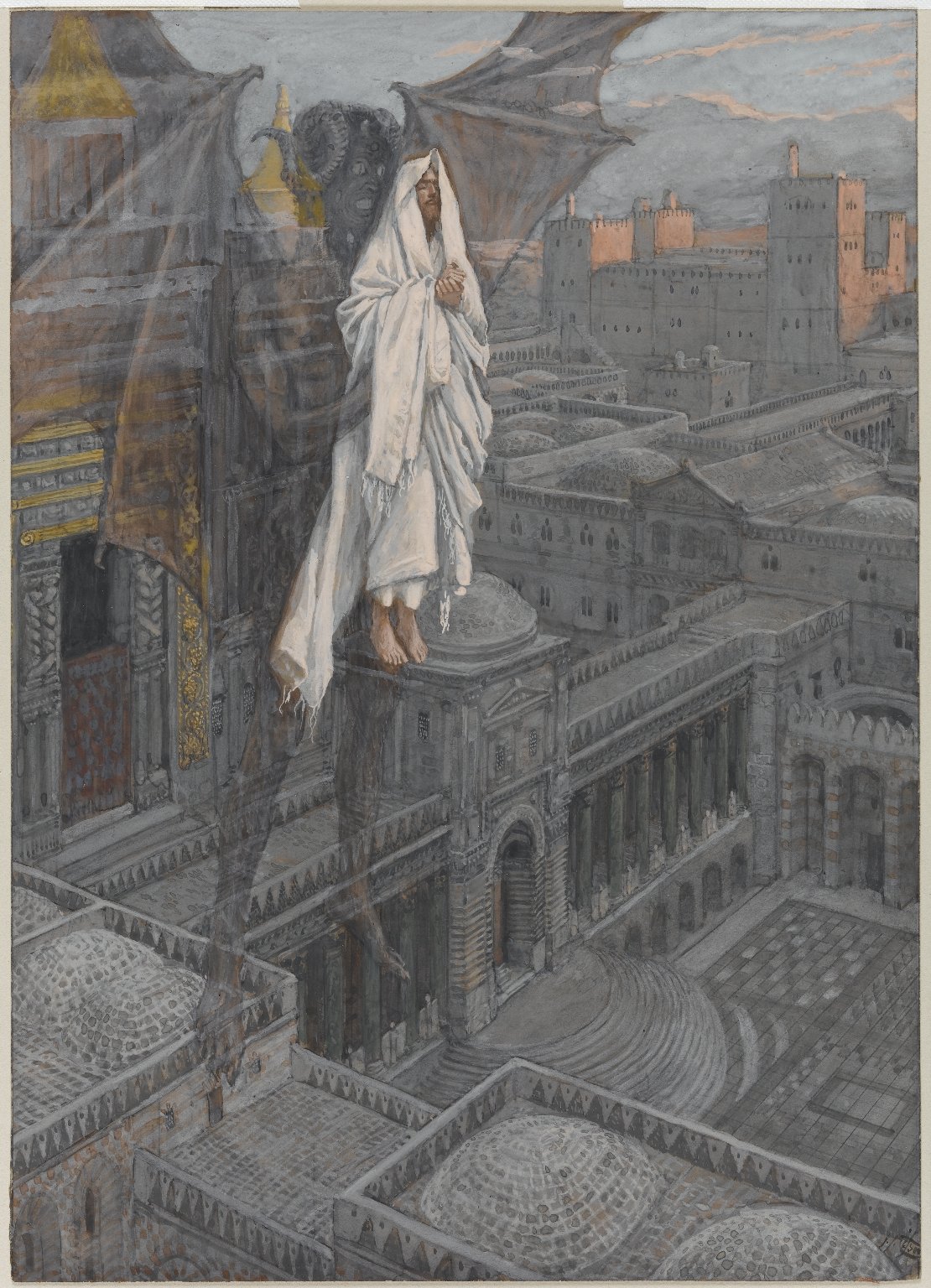
The logic behind Satan’s suggestion to jump from the pinnacle of the Temple and be caught by angels must have been that by doing so Jesus would reveal himself to be the Messiah.[244] No other interpretation can explain why the Temple was specifically chosen as the place for this temptation. Were it not for the symbolic significance of the act being performed in the Temple, any tall building or high precipice would have served the devil’s purpose just as well.[245] Without the messianic rationale, Satan had no cause for taking Jesus to the Temple in Jerusalem.[246]
But if Satan was tempting Jesus to reveal his messianic status in a flamboyant and self-aggrandizing manner, then no better place for a jumping-off point could be found than the Tower of Antonia. A leap from the southeastern corner of the Temple Mount down into the Kidron Valley would not communicate anything in particular to onlookers,[247] even supposing there were people in the valley below to witness it.[248] Nor would jumping away from the Temple from the southwestern corner of the Temple Mount into the city below convey a deep and intimate connection between the Messiah and the Temple. But leaping from the Tower of Antonia, where the vestments of the high priest were held hostage by the Romans, and then being set safely down by the angels in the Temple courts would have deep symbolic significance for the witnesses. It would demonstrate Jesus’ invincibility: nothing, not even the imposing Roman fortress that dominated the Temple, could harm Jesus, and therefore nothing, not even the full might of the Roman Empire, could withstand him. If being a military savior was how Satan wished Jesus to conceive of his role as Messiah, then leaping from the Tower of Antonia would certainly have expressed that conception in unmistakable terms.[249] All of this brings us back to the problem of reconstructing ἐπὶ τὸ πτερύγιον τοῦ ἱεροῦ in Hebrew. A reconstruction such as עַל פִּנַּת הַמִּקְדָּשׁ (‘al pinat hamiqdāsh, “on the corner of the Temple”)[250] would certainly be more natural than עַל כְּנַף הַמִּקְדָּשׁ (‘al kenaf hamiqdāsh, “on the wing of the Temple”) because in Hebrew the Temple was known to have corners[251] but was never said to have wings. But reconstructing with עַל כְּנַף הַמִּקְדָּשׁ has more explanatory power. If some part of the Temple’s architecture—perhaps the parapet of the Tower of Antonia—was called by the Latin name pinna templi (“parapet [lit., ‘wing’] of the Temple”), this name could have entered Hebrew as כְּנַף הַמִּקְדָּשׁ (kenaf hamiqdāsh, “wing of the Temple”), which the Greek translator of the Hebrew Life of Yeshua might understandably have rendered as τὸ πτερύγιον τοῦ ἱεροῦ (“the winglet of the Temple”).[252] In this way the perplexing Greek phrase could be explained as a literal translation via Hebrew of a Latin term. In any case, we can offer no better alternative.
L68 καὶ εἶπεν αὐτῷ (GR). We have preferred Luke’s aorist εἶπεν (eipen, “he said”) over Matthew’s historical present λέγει (legei, “he says”) for GR.[253]
L69 אִם בֵּן אַתָּה לֵאלֹהִים (HR). Since Luke and Matthew agree at all points in L69, there is no need for comment on GR. On reconstructing εἰ υἱὸς εἶ τοῦ θεοῦ (“if you are a son of God”) with אִם בֵּן אַתָּה לֵאלֹהִים (“if you are a son to God”), see above, Comment to L26.
L70 הַפֵּל אֶת עַצְמְךָ (HR). GR requires no discussion since Luke and Matthew agree on the wording of Satan’s command, βάλε σεαυτόν (bale seavton, “Throw yourself!”).
There are two main ways of expressing “throw oneself” in MH: 1) הִשְׁלִיךְ (hishlich, “throw”) + עֶצֶם (‘etzem, “bone,” “self”) + pronominal suffix, e.g., הִשְׁלִיךְ עַצְמוֹ (hishlich ‘atzmō, “he threw himself”);[254] or 2) הִפִּיל (hipil, “throw”) + עֶצֶם + pronominal suffix, e.g., הִפִּיל עַצְמוֹ (hipil ‘atzmō, “he threw himself”).[255] We have preferred the latter for HR, both because in LXX βάλλειν (ballein, “to throw”) more often occurs as the translation of הִפִּיל (“throw”) than of הִשְׁלִיךְ (“throw”)[256] and because reconstructing with the [no_word_wrap]נ-פ-ל[/no_word_wrap] root creates a pleasing verbal connection between this temptation and the previous temptation in which Satan suggested that Jesus “prostrate himself” (הִתְנַפֵּל) before him (see above, Comment to L54).The use of עֶצֶם + pronominal suffix as a reflexive pronoun is characteristic of MH, but is not found in earlier sources.[257]
L71 [ἐντεῦθεν] (GR). It is difficult to decide whether the author of Luke added the adverb ἐντεῦθεν (entevthen, “from here”) to the devil’s challenge for greater specificity or whether the author of Matthew omitted ἐντεῦθεν for the sake of brevity. While it is true that the only two instances of ἐντεῦθεν in the Synoptic Gospels occur in Luke (Luke 4:9; 13:31), we must also consider that ἐντεῦθεν never occurs in Acts, so the presence of ἐντεῦθεν in Luke 4:9 is hardly indicative of Lukan style. Since Luke’s wording is easily reconstructed in Hebrew (see below), we have accepted his wording provisionally within brackets.
[מִזֶּה] (HR). In LXX most instances of ἐντεῦθεν (“from here”) occur as the translation of מִזֶּה (mizeh, “from this,” “from here”).[258] Another option for reconstructing ἐντεῦθεν is מִכָּאן (mikā’n, “from here”).
L72 לְמַטָּה (HR). Since Luke and Matthew agree to use the adverb κάτω (katō, “down”), GR requires no discussion. In LXX κάτω occurs as the translation of מִתַּחַת (mitaḥat, “from below”)[259] and מַטָּה (maṭāh, “down”), often prefixed with -לְ (le–, “to”).[260] Since לְמַטָּה (lemaṭāh, “downward”) exactly suits our purpose, we have adopted it for HR.
L73-80 (GR). Since Luke and Matthew agree on the introductory formula to the biblical quotation and, for the most part, on the wording of Ps. 91:11-12, no further comment for GR in these lines will be necessary except in the few places (L76, L77) where they differ.
L73 שֶׁכָּתוּב (HR). On reconstructing γέγραπται (gegraptai, “it has been written”) with כָּתוּב (kātūv, “[it is] written”), see above, Comment to L33.
Compare our reconstruction to the following example:
יודע צדיק נפש בהמתו, זה הקב″ה, שכתוב בתורתו שור או שה אותו ואת בנו לא תשחטו ביום אחד
A righteous person knows the life of his livestock [Prov. 12:10]. This [refers to] the Holy One, blessed be he, for it is written [שֶׁכָּתוּב] in his Torah, A cow or ewe—you may not slaughter it and its offspring in one day [Lev. 22:28]. (Lev. Rab. 27:11 [ed. Margulies, 2:644])
As in our reconstruction, the above rabbinic example justifies a proposition with a biblical quotation introduced by the formula שֶׁכָּתוּב (shekātūv, “for it is written”).
Scholars sometimes remark how surprising it is that Satan dared to quote Scripture, although in rabbinic retellings of the trial of Abraham and Isaac Satan quotes Scripture in an attempt to steer them off course. Even more surprising, although this is rarely commented upon, is the text Satan quotes. Reciting Psalm 91 (or in LXX, Psalm 90) was believed to be an effective means for driving away demons (cf. 11QapocrPs [11Q11]), yet in the temptation narrative Satan casually demonstrates that the words of Psalm 91 are not harmful to him at all.[261]
It is possible that by having Satan quote from Psalm 91 the temptation narrative polemicizes against the use of Scripture as a magical incantation. The temptation narrative seems to suggest that rather than wearing Scripture verses as an amulet or reciting them as a form of apotropaic prayer, it is the doing of Scripture, obeying its teachings, that is an effective protection from the power of Satan. Such a view is entirely consistent with Jesus’ own prioritization of doing Scripture over hearing (or studying) it. The apotropaic (i.e., warding off danger) effects of keeping the commandments is attested in Second Temple sources and in rabbinic literature.[262] One very clear example is found in the Damascus Document:
וביום אשר {יקום} <יקים> האיש על נפשו לשוב אל תורת משה יסור מלאך המשטמה מאחריו אם יקים את דבריו
And on the day when a man resolves in his soul to return to the Torah of Moses, the angel of Mastemah [i.e., Satan—DNB and JNT] will turn aside from behind him if he keeps his word. (CD-A XVI, 4-5)[263]
A passage in the Epistle of James is similar:
ὑποτάγητε οὖν τῷ θεῷ, ἀντίστητε δὲ τῷ διαβόλῳ, καὶ φεύξεται ἀφ᾿ ὑμῶν· ἐγγίσατε τῷ θεῷ καὶ ἐγγιεῖ ὑμῖν.
Submit yourselves, therefore, to God. Resist the devil, and he will flee from you. Come near to God, and he will come near to you. (Jas. 4:7-8)
L74-75 כִּי מַלְאָכָיו יְצַוֶּה לָּךְ (HR). On reconstructing ὅτι (hoti, “that,” “for,” “because”) with כִּי (ki, “that,” “for”), see above, Comment to L34-35.
On reconstructing ἄγγελος (angelos, “messenger,” “angel”) with מַלְאָךְ (mal’āch, “messenger,” “angel”), see Lost Sheep and Lost Coin, Comment to L58.
The overwhelming majority of instances of ἐντέλεσθαι (entelesthai, “to command”) in LXX occur as the translation of צִוָּה (tzivāh, “command”).[264] Likewise, the LXX translators rendered most instances of צִוָּה with ἐντέλεσθαι.[265] Since in L74-75 the quotation of Ps. 91:11 (LXX: 90:11) conforms exactly to the wording of LXX, which itself agrees closely with MT, we can be fully confident in our reconstruction.
L76 τοῦ διαφυλάξαι σε (Luke 4:10). In L76 Luke has the words “to guard you,” which are a continuation of the quotation from Ps. 91:11 (LXX: Ps. 90:11). These words are missing in Matthew’s parallel, and since it is unlikely that the author of Matthew would have wanted to shorten the Scripture quotation, it seems likely that the author of Luke extended it,[266] perhaps for the sake of his non-Jewish Greek readers who may not have been fully acquainted with the verse. We have therefore omitted τοῦ διαφυλάξαι σε (tou diafūlaxai se, “to guard you”) from GR and HR.
L77 καὶ (GR). The devil’s quotation of Ps. 91:11 (LXX: Ps. 90:11) omits the words τοῦ διαφυλάξαι σε ἐν πάσαις ταῖς ὁδοῖς σου (“to guard you in all your paths”) only to pick up again at Ps. 91:12 (LXX: Ps. 90:12). Some scholars suggest that the devil intentionally omitted these words because the precipitous drop from the pinnacle of the Temple was hardly in Jesus’ path.[267] Including this phrase would have undermined the usefulness of this passage for the devil’s temptation.
Skipping over phrases in order to bend biblical quotations to his purpose is also attributed to Satan in the account of the trial of Abraham and Isaac given in the Talmud. The following table shows how Satan selectively quoted from the fourth chapter of Job to dissuade Abraham from offering his son Isaac on Mount Moriah:
| b. Sanh. 89b | Job 4:1-12 |
| …Satan preceded him [i.e., Abraham—DNB and JNT] on the way. He [i.e., Satan—DNB and JNT] said to him, “If he tests you in a matter, will you be weary?… [Job 4:2]. Behold, you have instructed many, and weak hands you have strengthened. Your words have steadied the stumbling… [Job 4:3-4]. But now it has come to you, and you are weary!… [Job 4:5].” He [i.e., Abraham—DNB and JNT] said to him, “As for me, in my integrity I will walk [Ps. 26:1].” He [i.e., Satan—DNB and JNT] said to him, “Is not your fear [of God—DNB and JNT] your folly?… [Job 4:6].” He [i.e., Abraham—DNB and JNT] said to him, “Recall, if you will, who is the innocent person who has perished? [Job 4:7].” When he [i.e., Satan—DNB and JNT] saw that he would not listen to him, he said to him, “But a report has been leaked to me [Job 4:12]—this is what I heard from behind the partition: the lamb for the offering and not Isaac for the offering.” He [i.e., Abraham—DNB and JNT] said to him, “This is the punishment of a liar, that even if he speaks the truth, no one listens to him.” | 4:1 And Eliphaz the Temanite answered and said, 4:2 “If he tests you in a matter, will you be weary? But who can refrain from words? 4:3 Behold, you have instructed many, and weak hands you have strengthened. 4:4 Your words have steadied the stumbling, and you have strengthened weak knees. 4:5 But now it has come to you, and you are weary! It touches you, and you are dismayed. 4:6 Is not your fear your confidence? And is not your hope the integrity of your ways? 4:7 Recall, if you will, who is the innocent person who has perished? Or where were the upright cut off? 4:8 As I have seen, those who plow iniquity and those who sow trouble will harvest it. 4:9 From a breath of God they are destroyed, and from a wind of his nostrils they are annihilated. 4:10 The roar of a lion and the voice of a lion [sounds], but the teeth of lion cubs are broken. 4:11 The lion is destroyed from lack of prey, and the offspring of a lioness are scattered. 4:12 But a report has been leaked to me, and my ear received a whisper of it.” |
In order to bridge the gap in the quotation, καί (kai, “and”; Matt.) or καὶ ὅτι (kai hoti, “and that”; Luke) was added.[268] Whether the author of Luke added the ὅτι or whether the author of Matthew omitted it is of little consequence, but since it is difficult to find an appropriate Hebrew equivalent for ὅτι, we suspect that the author of Luke added it.[269] We have accordingly omitted ὅτι from GR.
L78-80 וְעַל כַּפַּיִם יִשָּׂאוּנְךָ פֶּן תִּגֹּף בָּאֶבֶן רַגְלֶךָ (HR). Since the quotation of Ps. 91:12 (LXX: 90:12) in the Lukan and Matthean versions of Yeshua’s Testing conforms to LXX, GR is not in doubt. Neither are we in doubt regarding HR, since LXX adhered closely to the Hebrew text. The only deviation in HR from Ps. 91:12 as it appears in MT is the addition of the coordinating conjunction -וְ (ve–, “and”) at the opening of the verse, which stands in for Satan’s omission of the second half of Ps. 91:11.

Most examples of χείρ (cheir, “hand”) in LXX occur as the translation of יָד (yād, “hand”), but there are plenty of examples where χείρ serves as the translation of כַּף (kaf, “palm”),[270] including in Ps. 91:12 (LXX: 90:12), the verse quoted in L78-80. Most instances of כַּף were translated χείρ in LXX.[271]
On reconstructing αἴρειν (airein, “to lift”) with נָשָׂא (nāsā’, “lift”), see Yohanan the Immerser’s Execution, Comment to L84.
On μήποτε (mēpote, “lest,” “perhaps”) as the LXX equivalent of פֶּן (pen, “lest,” “perhaps”), see Tower Builder and King Going to War, Comment to L5-6.
In LXX the verb προσκόπτειν (proskoptein, “to hit against”) is relatively rare and occurs with equal frequency as the translation of נִכְשַׁל (nichshal, “stumble”) and the root [no_word_wrap]נ-ג-פ[/no_word_wrap].[272] Fortunately, we cannot be in doubt as to HR since the Hebrew text of Ps. 91:12 (LXX: 90:12) has the verb נָגַף (nāgaf, “hit”).
On reconstructing λίθος (lithos, “rock”) with אֶבֶן (’even, “rock”), see above, Comment to L27.
On reconstructing πούς (pous, “foot”) with רֶגֶל (regel, “foot”), see Sending the Twelve: Conduct in Town, Comment to L112.
L81-82 καὶ ἀποκριθεὶς εἶπεν αὐτῷ (GR). Since Luke’s introduction to Jesus’ reply closely resembles the introductions to Jesus’ replies in GR for L29-32 and L56-57, we have accepted Luke’s wording for GR in L81-82.[273] That the use of the verb φάναι (fanai, “to say”) in Matthew is an indicator of Matthean redaction makes it all the more likely that Matthew’s more succinct wording in L82 is secondary.[274]
וַיַּעַן וַיֹּאמֶר לוֹ (HR). On reconstructing ἀποκρίνειν (apokrinein, “to answer”) with עָנָה (‘ānāh, “answer”), see above, Comment to L29.
L83 ὁ Ἰησοῦς (GR). Following Jesus’ name in L83 Luke’s version of Yeshua’s Testing has ὅτι (hoti, “that”). This ὅτι and the one in L77 (also probably a Lukan addition) are the only two examples of recitative ὅτι in Yeshua’s Testing (the instances of ὅτι in L34 and L74 are part of the LXX quotation, while the instance in L51 [L96] is not recitative). Probably the author of Luke did not realize that he was deviating from Anth.’s style when he inserted ὅτι into L83.
יֵשׁוּעַ (HR). On reconstructing Ἰησοῦς (Iēsous, “Jesus”) with יֵשׁוּעַ (yēshūa‘, “Jesus”), see above, Comment to L3.
L84 εἴρηται (GR). The πάλιν (palin, “again”) in Matt. 4:7 looks like another attempt on the part of the author of Matthew to create a more overt sense of sequence within the temptation narrative, which contributes to the increasing dramatic tension in Matthew’s version of Yeshua’s Testing. Note that the author of Matthew also introduced πάλιν in L38 [L86]. Since πάλιν in L84 appears to be a Matthean addition, we have omitted it from GR.
It is difficult to decide whether by writing γέγραπται (gegraptai, “it has been written”) the author of Matthew imposed uniformity[275] or whether by writing εἴρηται (eirētai, “it has been said”) the author of Luke introduced variation[276] with respect to the Scripture quotation formulae in Yeshua’s Testing (cf. L33, L59 [L103], L73). Fitzmyer noted that Luke’s formula in L84 “has no counterpart in the Qumran introductory formulae,”[277] but he failed to mention that it is an exact counterpart to the most common formula in rabbinic literature for introducing Scripture quotations, namely נֶאֱמַר (ne’emar, “it was said”). Since the author of Luke did not use εἴρηται anywhere else in his Gospel or in Acts to introduce a Scripture quotation, the formula he used in L84 cannot justly be described as Lukan, and since Luke’s wording reverts so easily to Hebrew, we have accepted εἴρηται for GR.[278] Whether Matthew’s formula or Luke’s is accepted makes no discernible difference for the overall sense of the pericope.
L85 οὐκ ἐκπειράσεις κύριον τὸν θεόν σου (GR). Matthew and Luke’s wording in L85 is identical, and therefore there can be no doubt as to the reconstruction of Anth.
לֹא תְנַסּוּ אֶת יי אֱלֹהֵיכֶם (HR). The quotation of Deut. 6:16 in Yeshua’s Testing agrees exactly with LXX, and this precise agreement can hardly be coincidental. In LXX the compound verb ἐκπειράζειν (ekpeirazein, “to test”) is relatively rare, occurring only 5xx (Deut. 6:16 [2xx]; 8:2, 16; Ps. 77:18), always as the translation of נִסָּה (nisāh, “test”). Since the Lukan-Matthean agreement to use ἐκπειράζειν in L85 strongly suggests that this is the verb that occurred in Anth., it is quite clear that the Greek translator of the Hebrew Life of Yeshua copied the LXX translation of Deut. 6:16, for elsewhere in this pericope the Greek translator rendered the [no_word_wrap]נ-ס-ה[/no_word_wrap] root with the simple form πειράζειν (peirazein, “to test”; L15). However, the Greek translator’s use of LXX here creates difficulty for us because the LXX translation of Deut. 6:16 differs from MT with respect to number: whereas the Hebrew text uses the second person plural (תְנַסּוּ [tenasū, “you will test”], אֱלֹהֵיכֶם [’elohēchem, “your God”]), LXX uses the second person singular (ἐκπειράσεις [ekpeiraseis, “you will test”], τὸν θεόν σου [ton theon sou, “your God”]). Torrey suggested that the tradition behind the Lukan and Matthean temptation narrative knew a “better Heb. text” that “had the singular number, לֹא תְנַסֶּה and אֱלֹהֶיךָ, as is shown not only by the LXX, but also by the Heb. context on both sides of the verse.”[279] However, there are no textual witnesses to corroborate Torrey’s suggestion,[280] and Torrey was mistaken that the verses surrounding Deut. 6:16 have the second person singular. In fact, throughout the sixth chapter of Deuteronomy the number fluctuates between singular and plural:
| Second Person Singular | Second Person Plural | First Person Plural |
| Deut. 6:1 (also LXX) | ||
| Deut. 6:2 | ||
| Deut. 6:3 | ||
| Deut. 6:4 | ||
| Deut. 6:5 | ||
| Deut. 6:6 | ||
| Deut. 6:7 | ||
| Deut. 6:8 | ||
| Deut. 6:9 | ||
| Deut. 6:10 | ||
| Deut. 6:11 | ||
| Deut. 6:12 | ||
| Deut. 6:13 | ||
| Deut. 6:14 (also LXX) | ||
| Deut. 6:15 | ||
| Deut. 6:16 (sing. LXX) | ||
| Deut. 6:17 (sing. LXX) | ||
| Deut. 6:18 | ||
| Deut. 6:19 | ||
| Deut. 6:20 | ||
| Deut. 6:21 | ||
| Deut. 6:22 | ||
| Deut. 6:23 | ||
| Deut. 6:24 | ||
| Deut. 6:25 |
It appears that rather than reflecting a text at variance with MT, the LXX translators simply attempted to reduce the fluctuation between second person plural and second person singular by changing the plurals to singulars in Deut. 6:16 and 6:17.[281] Moreover, there is no reason why Jesus could not have quoted a verse worded in the second person plural to justify his refusal of Satan’s proposal. The Greek translator of the Hebrew Life of Yeshua probably saw no reason to change the wording of the LXX translation of Deut. 6:16, especially since the change in number has so little bearing on the meaning or applicability of the verse. Postulating a non-Masoretic Hebrew text behind the Deuteronomy quotation in Matt. 4:7 and Luke 4:12, therefore, seems gratuitous, and we have followed MT for HR.
On reconstructing κύριος (kūrios, “lord”) with the Tetragrammaton, see above, Comment to L60.
On reconstructing θεός (theos, “god”) with אֱלֹהִים (’elohim, “God”), see above, Comment to L26.
By quoting Deut. 6:16 Jesus implied that following through on Satan’s proposal would have been tantamount to testing God. Lachs compared Jesus’ refusal to take up Satan’s suggestion to the following statement of Rabbi Yannai:[282]
לעולם אל יעמוד אדם במקום סכנה לומר שעושין לו נס שמא אין עושין לו נס ואם עושין לו נס מנכין לו מזכיותיו
A person should never stand in a place of danger saying that a miracle would be done for him, lest a miracle is not done for him. And even if a miracle is done for him, it is taken away from his merits. (b. Shab. 32a)
This saying of Rabbi Yannai is cited in the Talmud to explain his habit of checking a bridge’s soundness before crossing over it, an action that is mentioned along with Rabbi Zera’s refusal to walk among palm trees on a windy day. The reasoning behind both their precautions is that it is better not to tempt fate. But this attitude does not comport well with the behavior of the Hasidim, with whom Jesus had so much in common. For instance, there was a belief among the sages that a venomous snake might drink from an uncovered vessel left unattended overnight, and that the snake would leave behind some of its deadly poison in the vessel, which would then make people sick who drank from it. But the Hasidim disregarded the rabbinic inhibitions regarding drinking from vessels that had been left uncovered overnight.[283] The Hasidim believed that it is not the bite of a serpent that kills, but sin that kills (b. Ber. 34a), and therefore Hanina ben Dosa, a first-century Hasid, fearlessly approached a venomous snake to destroy it.[284] The Hasidim believed in bold action and even relied on miracles to deliver them.[285] Jesus’ prohibition against his apostles’ bearing staves on their mission as defensive weapons probably reflects the same attitude.[286] Jesus wanted his disciples to have complete trust in God’s providential care when they were actively carrying out their mission to proclaim and enact the Kingdom of Heaven. What distinguished Satan’s proposal from the kind of fearless action Jesus did endorse was that a self-aggrandizing display of power for power’s sake would not (and indeed could not) have been in the service of the Kingdom of Heaven.
On another level, Satan’s proposal that Jesus should act upon his divine sonship by quite literally casting himself upon God’s care may have been a psychological attempt to undermine Jesus’ confidence that he could trust God with his very life. If we are correct in detecting the influence of Jewish traditions concerning the trials of Abraham and Isaac in Yeshua’s Testing, then we should not fail to notice that it was upon Mount Moriah that Isaac demonstrated his complete submission to his father, even to the point of death. Now, on the Temple Mount at the site of the binding of Isaac, Satan asks whether Jesus really trusts his heavenly Father with his life. Satan insinuates that by jumping from the pinnacle of the Temple Jesus could demonstrate his complete trust in God. Seeing through this trickery, Jesus knew that throwing himself from the pinnacle of the Temple was no leap of faith, but a reckless testing of God.
L86-106 Having accepted the Lukan order of the temptations for GR and HR, we have already dealt with the contents of L86-106 in our Comments to L38-L62. Therefore, it is to those Comments that we refer readers for our discussion of what is the final temptation according to Matthew’s order.
L107 καὶ συντελέσας ὁ διάβολος πάντα πειρασμὸν (GR). As we discussed above in Comment to L20, in all of Luke’s Gospel the only two instances of the verb συντελεῖν (sūntelein, “to finish”) are both found in Yeshua’s Testing. And since the author of Luke used this verb only once in Acts (Acts 21:27), it is difficult to describe the use of συντελεῖν as typical of Lukan redaction. Although some scholars ascribe the concluding statement “and finishing every temptation” to Lukan authorship,[287] Luke’s wording reverts quite easily to Hebrew (see below), which is a good reason for supposing that the author of Luke copied this statement from Anth. Perhaps the only change the author of Luke made to Anth.’s wording was to shift the position of ὁ διάβολος (“the devil”) to L109 from the more Hebraic position following the participle in L107. It is possible, however, that the Greek translation of the Hebrew Life of Yeshua departed slightly from Hebrew word order, and that the author of Luke made no changes to Anth. in L107-109.
וַיְכַל הַשָּׂטָן כֹּל נִסָּיוֹן (HR). On reconstructing συντελεῖν (sūntelein, “to finish”) with כִּלָה (kilāh, “finish”), see above, Comment to L20. On reconstructing πειρασμός (peirasmos, “testing,” “temptation”) with נִסָּיוֹן (nisāyōn, “testing,” “temptation”), see Lord’s Prayer, Comment to L22-23.
Compare our reconstructions in L107-109 to the following examples:
וַיְכַל מֹשֶׁה אֶת הַמְּלָאכָה
And Moses finished the work. (Exod. 40:33)
καὶ συνετέλεσεν Μωυσῆς πάντα τὰ ἔργα
And Moses finished all the work. (Exod. 40:33)
וַיְכַל חִירָם לַעֲשׂוֹת אֶת כָּל הַמְּלָאכָה
And Hiram finished doing all the work…. (1 Kgs. 7:40)
καὶ συνετέλεσεν Χιραμ ποιῶν πάντα τὰ ἔργα
And Hiram finished doing all the work…. (3 Kgdms. 7:26)
In the two examples cited above the Greek text has the aorist form συνετέλεσεν (sūnetelesen, “he finished”) instead of the participial form συντελέσας (sūntelesas, “finishing”) found in Luke 4:13. However, as we discussed above in Comment to L20, the construction καί + participle + aorist, such as we find in Luke 4:13 (καὶ συντελέσας…ἀπέστη), is a common translation of two vav-consecutive verbs, so reverting Luke’s Greek to Hebrew poses no difficulty.
L110 ἀπέστη ἀπ᾿ αὐτοῦ (GR). There are two main reasons why we have adopted Luke’s wording in L110 for GR. First, Matthew’s phrase τότε ἀφίησιν αὐτόν (tote afiēsin avton, “then he leaves him”) is an exact replica of the phrase used to describe John the Baptist’s acquiescence to Jesus’ insistence that John should baptize him (Matt. 3:15). In Yeshua’s Immersion Comment to L12-22 we concluded that Matt. 3:14-15 was composed by the author of Matthew. The fact that we encounter in Yeshua’s Testing (L110) a phrase that is identical to one that appeared in a Matthean composition certainly cautions against assuming that Matthew’s wording in L110 was copied from Anth. Moreover, Matthew’s narrative τότε and his use of the historical present are simultaneously un-Hebraic and hallmarks of Matthean redaction. Second, Luke’s wording in L110 not only reverts easily to Hebrew, it has parallels in ancient Hebrew sources for the departure of malevolent spirits (see below).
וַיָּסַר מִמֶּנּוּ (HR). On reconstructing the verb ἀφιστάναι (afistanai, “to withdraw,” “to depart”) with סָר (sār, “turn aside”), see Four Soils interpretation, Comment to L48. Examples of ἀφιστάναι ἀπό occurring in LXX as the translation of סָר מִן are abundant.[288]
In the story of how David’s playing brought King Saul relief from the affliction of an evil spirit, we read the following statement:
וְסָרָה מֵעָלָיו רוּחַ הָרָעָה
…and the evil spirit turned aside from him. (1 Sam. 16:23)
καὶ ἀφίστατο ἀπ᾿ αὐτοῦ τὸ πνεῦμα τὸ πονηρόν
…and the evil spirit withdrew from him. (1 Kgdms. 16:23)
This usage of סָר (“turn aside”) for the departure of an evil spirit reminds us of the passage from the Damascus Document we cited above in Comment to L73, according to which the angel Mastemah (i.e., Satan) departs (יָסוּר) from a person who returns to the Torah by joining the Essene sect (CD-A XVI, 4-5). Given these parallels, we believe סָר is a solid choice for HR.
As we noted in Comment to L73, the devil’s departure from a person who is resolute in his or her obedience is a theme that is attested in a wide variety of sources. In addition to the Damascus Document and the Epistle of James, this theme finds expression in a variety of ancient sources, for instance:
Ταῦτα καὶ ὑμεῖς, τέκνα μου, ποιεῖτε, καὶ πᾶν πνεῦμα τοῦ βελίαρ φεύξεται ἀφ᾽ ὑμῶν καὶ πᾶσα πρᾶξις πονηρῶν ἀνθρώπων οὐ κυριεύσει ὑμῶν καὶ πᾶν ἄγριον θηρίον καταδουλώσετε ἔχοντες μεθ᾽ ὑμῶν τὸν θεὸν τοῦ οὐρανοῦ καὶ τῆς γῆς συμπορευόμενον τοῖς ἀνθρώποις ἐν ἁπλότητι καρδίας.
Do these things [i.e., love God and neighbor—DNB and JNT] too, my children, and every spirit of Beliar will flee from you [καὶ πᾶν πνεῦμα τοῦ βελίαρ φεύξεται ἀφ᾽ ὑμῶν], and no evil work of human beings will master you, and every wild animal will serve you, since you have with you the God of heaven and earth while going about with human beings in simplicity of heart. (T. Issachar 7:7 [ed. Charles, 115])
Φυλάξατε οὖν, τέκνα μου, τὴν ἐντολὴν τοῦ Κυρίου καὶ τὸν νόμον αὐτοῦ τηρήσατε ἀπόσητε ἀπό τοῦ θυμοῦ, καὶ μισήσατε τὸ ψεῦδος, ἵνα Κύριος κατοικήσει ἐν ὑμῖν καὶ φεύξεται ἀφ᾽ ὑμῶν ὁ Βελίαρ.
Therefore, my children, guard the commandment of the Lord and keep his law. Turn from anger and hate falsehood, so that the Lord might dwell in you and Beliar may flee from you [καὶ φεύξεται ἀφ᾽ ὑμῶν ὁ Βελίαρ]. (T. Dan 5:1 [ed. Charles, 136])
Ἐὰν οὖν καὶ ὑμεῖς ἐργάσησθε τὸ καλόν, εὐλογήσουσιν ὑμᾶς οἱ ἄνθρωποι καὶ οἱ ἄγγελοι…καὶ ὁ διάβολος φεύξεται ἀφ᾽ ὑμῶν, καὶ τὰ θηρία φοβηθήσονται ὑμᾶς, καὶ ὁ Κύριος ἀγαπήσει ὑμᾶς….
Therefore, if you also do what is good, human beings and angels will bless you…and the devil will flee from you [καὶ ὁ διάβολος φεύξεται ἀφ᾽ ὑμῶν], and the wild animals will be afraid of you, and the Lord will love you…. (T. Naphtali 8:4 [ed. Charles, 156])
The Testaments of the Twelve Patriarchs are Christian works in their present form, but they drew from Jewish traditions and sources. Flusser believed the author of Mark knew of a source similar to the Testament of Naphtali, and that this was what inspired him to describe the wild animals with Jesus and the angels serving him following the temptation by Satan.[289] Also Christian is the Shepherd of Hermas, which encourages taking a resolute stance against the devil with the following words:
ὁ διάβολος μόνον φόβον ἔχει, ὁ δὲ φόβος αὐτοῦ τόνον οὐκ ἔχει μὴ φοβήθητε οὖν αὐτόν, καὶ φεύξεται ἀφ᾽ ὑμῶν
The devil can only cause fear, but fear of him has no force. Therefore do not fear him and he will flee from you [καὶ φεύξεται ἀφ᾽ ὑμῶν]. (Hermas, 12 Mand. 4:7; Loeb [adapted])[290]
We find a demythologized version of this idea in the following rabbinic text:
אמר ר′ יוחנן אין אתה גורר אחר הרעה, ואין הרעה גוררת אחריך ואינה דרה אצלך
If you do not follow after wickedness, wickedness will not follow after you and it will not reside with you. (Midrash Tanhuma, Tazria §11 [ed. Buber, 2:39])
L111 ὁ διάβολος (Matt. 4:11). The author of Matthew copied the words ὁ διάβολος (“the devil”) from Anth., but because he paraphrased Anth.’s wording, they appear in L111 instead of in their original position, which was probably in L107.
L112 ἄχρι καιροῦ (Luke 4:13). We have omitted Luke’s phrase ἄχρι καιροῦ (achri kairou, “for a time”) from GR, both because it is un-Hebraic[291] and because it seems to be an editorial comment meant to attenuate Anth.’s assertion that the devil had completed “every temptation.”[292]

L113 καὶ ἦν μετὰ τῶν θηρίων (Mark 1:13). In one sense it is hardly surprising that the author of Mark mentioned wild animals in his version of the temptation narrative, since the desert was the natural habitat of wild (as opposed to domesticated) animals, as well as the haunt of demons.[293] What is surprising about the wild animals in Mark’s account is that whereas wild animals were typically portrayed as being threatening to, or at least afraid of, human beings, in Mark’s version of the temptation narrative Jesus abides with the wild animals in tranquility.[294] With his description of Jesus’ peaceful cohabitation with the wild animals in the desert, we believe the author of Mark wished to signal that, having resisted Satan, Jesus became reconciled to the natural world, thereby reversing the estrangement between human beings and nature that came about as a result of Adam and Eve’s succumbing to temptation (see above, Comment to L8).
Flusser believed that the author of Matthew’s omission of the wild animals was simply a careless oversight,[295] but we harbor doubts as to this explanation, for, as we will see below, Matthew’s wording in L114-115, which describes the service of the angels, reverts easily to Hebrew. In fact, Matthew’s wording in L114-115 reverts to Hebrew more easily than Mark’s parallel wording in these lines. Since it is difficult to suppose that by editing the text of Mark in Greek the author of Matthew accidentally produced wording that reverts more easily to Hebrew than Mark’s, we think it likely that Anth. contained a description of the angels’ ministering to Jesus following the temptation. Whereas the author of Mark paraphrased Anth.’s wording in L114-115, the author of Matthew copied Anth.’s wording verbatim. In this way Matthew’s wording in L114-115 succeeded in becoming more Hebraic than Mark’s. If this is the correct explanation, then it is likely that the author of Matthew omitted Jesus’ coexistence with the wild animals because this depiction was absent from Anth. In other words, Matthew’s omission of the wild animals was not a mistake, but a conscious decision to prefer Anth.’s conclusion of the temptation narrative over Mark’s.

In addition to the ease with which Matthew’s wording in L114-115 reverts to Hebrew, there is another consideration which inclines us to regard the service of the angels as an authentic part of Yeshua’s Testing. In the trial of Abraham and Isaac it is an angel that finally stays Abraham’s hand (Gen. 22:11-12). In later retellings of the trial of Abraham and Isaac it is not only one angel but many who are present to witness the binding of Isaac. The presence of angelic witnesses is already mentioned in 4QPseudo-Jubileesa (4Q225 2 II, 5), and thus was current in the first century. In the retelling of the trial of Abraham and Isaac in rabbinic tradition, the angels are specified as מַלְאֲכֵי שָׁרֵת (mal’achē shārēt, “ministering angels”; Gen. Rab. 56:5 [ed. Theodor-Albeck, 2:600]), a title that is consistent with the service the angels rendered to Jesus following his recapitulation of Isaac’s trial.
But why would the author of Luke have omitted the final statement about the angels’ service to Jesus, supposing it did occur in his source? We can only offer conjectures. We know, for example, that the author of Luke sometimes eliminated καὶ ἰδού (kai idou, “and behold”) constructions when they occurred in his source,[296] so perhaps that was reason enough for him to eliminate the statement about the angels. Perhaps the author of Luke felt that concluding Yeshua’s Testing with the devil’s departure “for a time,” with its sense of foreboding, made for a more effective conclusion to the temptation narrative than the optimistic depiction of the ministry of the angels serving Jesus. Or perhaps the author of Luke avoided mentioning the angels because Jesus had only just refused to accept their assistance in the final temptation scenario. In any case, it seems easier to find reasonable explanations for why the author of Luke would have omitted the reference to the angels than it is to account for how, apart from Anth., Matthew’s wording in L114-115 became more Hebraic than Mark’s. Nevertheless, because of the modicum of doubt Luke’s omission of the angels produces, we have placed GR and HR in L114-115 within brackets.
L114 [καὶ ἰδοὺ ἄγγελοι προσῆλθον (GR). The Lukan-Matthean agreements to write ἰδού (idou, “behold”) in TT where ἰδού is absent in Mark strongly suggest that eliminating the Hebraic interjection ἰδού was typical of Markan redaction.[297] Moreover, Mark’s καί + subject + verb word order is un-Hebraic, since Hebrew places the verb ahead of the subject. Matthew’s καὶ ἰδού + noun + aorist construction, on the other hand, reverts quite naturally to Hebrew as וְהִנֵּה + subject + perfect verb. While not as common as וְהִנֵּה + subject + participle constructions in vav-consecutive contexts (on which, see Yeshua’s Immersion, Comment to L40), examples of וְהִנֵּה + subject + perfect verb do occur.[298] The following example is particularly similar to Matthew’s description of the angels’ approach:
וְהִנֵּה נָבִיא אֶחָד נִגַּשׁ אֶל אַחְאָב מֶלֶךְ יִשְׂרָאֵל וַיֹּאמֶר
And behold! A certain prophet approached Ahab, king of Israel, and said…. (1 Kgs. 20:13)
καὶ ἰδοὺ προφήτης εἷς προσῆλθεν τῷ βασιλεῖ Ισραηλ καὶ εἶπεν
And behold! A certain prophet came toward the king of Israel and said…. (3 Kgdms. 21:13)
וְהִנֵּה מַלְאָכִים קָרְבוּ] (HR). On reconstructing ἰδού (idou, “behold”) with הִנֵּה (hinēh, “behold”), see Widow’s Son in Nain, Comment to L6. On reconstructing ἄγγελος (angelos, “angel”) with מַלְאָךְ (mal’āch, “angel”), see Lost Sheep and Lost Coin, Comment to L58. On reconstructing προσέρχεσθαι (proserchesthai, “to come toward”) with קָרַב (qārav, “approach”), see above, Comment to L22, although as the example we cited in the previous paragraph shows, נִגַּשׁ (nigash, “approach”) is an equally valid option for HR.
L115 καὶ διηκόνουν αὐτῷ] (GR). Having adopted Matthew’s wording for GR in L114, we are bound to accept his wording in L115, which is identical to Mark’s except for the inclusion of καί (kai, “and”) at the line’s opening. Since the coordinating conjunction would correspond to the -וְ (ve–, “and”) of a vav-consecutive in an underlying Hebrew text, Matthew’s inclusion of καί is more Hebraic than Mark’s omission of the same.
[וַיְשָׁרְתוּ אוֹתוֹ (HR). The fact that the verb διακονεῖν (diakonein, “to serve”) never occurs in LXX, combined with the fact that in Matt. 4:11 and Mark 1:13 διακονεῖν occurs in the imperfect tense, might seem to suggest that this verb did not occur in Anth. However, the verb διακονεῖν occurs 6xx in Matthew (Matt. 4:11; 8:15; 20:28 [2xx]; 25:44; 27:55), 5xx in Mark (Mark 1:13, 31; 10:45 [2xx]; 15:41) and 8xx in Luke (Luke 4:39; 8:3; 10:40; 12:37; 17:8; 22:26, 27 [2xx]), so it does not seem likely that all instances of διακονεῖν in the Synoptic Gospels are redactional. Moreover, every time the verb διακονεῖν appears in narration in the Synoptic Gospels (as opposed to direct speech) it occurs in the imperfect tense (Matt. 4:11; 8:15; Mark 1:13, 31; 15:41; Luke 4:39; 8:3), the only exception being Matt. 27:55, where it is a participle. There are no examples of διακονεῖν in the aorist tense in narration. It seems, therefore, that for the author of the source (or sources) behind the Synoptic Gospels—in our view, the Greek translator of the Hebrew Life of Yeshua—it simply felt more natural to put διακονεῖν in the imperfect rather than the aorist tense.
Reconstructing διακονεῖν (“to serve”) with שֵׁרֵת (shērēt, “serve”) makes sense not only because of the semantic equivalence between these two verbs, but, as we have seen, in ancient Jewish sources the root [no_word_wrap]שׁ-ר-ת[/no_word_wrap] was used especially for angels.
In MH שֵׁרֵת became less common as the verb שִׁמֵּשׁ (shimēsh, “serve”) came to take its place, but שֵׁרֵת remained current, as we see from the following example:
ר′ אלעזר הקפר אומר מנין אתה אומר שהראה הקב″ה ליעקב אבינו בית המקדש בנוי וקרבנות מוקרבים וכהנים משרתים ושכינה מסתלקת שנאמר ויחלום והנה סולם מוצב ארצה וראשו מגיע השמימה והנה מלאכי אלהים עולים ויורדים בו
Rabbi Eleazar ha-Kappar[299] says, “On what basis can you say that the Holy One, blessed be he, showed to our father Jacob the Temple as built with sacrifices being offered and priests serving [מְשַׁרְתִים] and the Divine Presence visible? From that which is said, And he dreamed. And behold! A ladder was standing on the earth, and its top reached to heaven. And behold! Angels of God were going up and down on it [Gen. 28:12].” (Sifre Num. §119 [ed. Horovitz, 143])
Redaction Analysis
Each of the three synoptic evangelists adapted Yeshua’s Testing according to his own purpose. The least invasive evangelist was the author of Luke, who by and large followed the wording of Anth. The author of Matthew preferred Anth.’s version of Yeshua’s Testing to Mark’s and therefore mainly agrees with Luke’s version, however the changes introduced by the author of Matthew are pervasive. Mark’s version of Yeshua’s Testing represents the most radical departure from Anth. The author of Mark only gave a brief notice about the fact of the temptation, but he put a new interpretation on the temptation’s significance by hinting that Jesus reversed the consequences of the fall of the first man and the first woman.
Luke’s Version[300]
| Yeshua’s Testing | |||
| Luke | Anthology | ||
| Total Words: |
202 | Total Words: |
178 [186] |
| Total Words Identical to Anth.: |
165 [166] | Total Words Taken Over in Luke: |
165 [166] |
| % Identical to Anth.: |
81.68 [82.18] | % of Anth. in Luke: |
92.70 [89.25] |
| Click here for details. | |||
The changes the author of Luke made to Anth.’s version of Yeshua’s Testing were mainly stylistic in nature. The three most important changes he made were to omit the mountain setting of the middle temptation (L40), preferring to describe a visionary experience (L45), to give the devil an extended speech explaining his right to confer worldly dominion upon Jesus, which entailed extensive rewriting in L49-55, and his omission of the ministry of the angels following Satan’s departure (L114-115). By making this final omission and by adding the sinister words “for a time,” the author of Luke concluded the temptation narrative with a dark sense of foreboding of even more difficult trials to come. In Luke’s Gospel this foreshadowing is realized in the events of the passion narrative.
The other changes the author of Luke made were mainly stylistic improvements of Anth.’s Greek, including the use of a genitive absolute construction (L20), slight changes of word order (L23-25, L48-49), the specification of the speaker in L47, the omission of a redundant pronoun (L66) and the insertion of ὅτι (L77, L83). In L22 the author of Luke omitted the devil’s approach, and in L29-32 he rephrased the introduction to Jesus’ response to the devil. These changes might also be considered stylistic improvements. Likewise, his inclusion of a little more of Ps. 91:11 in L76 was probably an aid to the readers of Luke’s Gospel.
Mark’s Version[301]
| Yeshua’s Testing | |||
| Mark | Anthology | ||
| Total Words: |
30 | Total Words: |
178 [186] |
| Total Words Identical to Anth.: |
8 [12] | Total Words Taken Over in Mark: |
8 [12] |
| % Identical to Anth.: |
26.67 [40.00] | % of Anth. in Mark: |
4.50 [6.45] |
| Click here for details. | |||
The author of Mark drastically revised Yeshua’s Testing by excising the three temptation scenes and merely recording the fact of Jesus’ temptation “by Satan” (rather than “the devil” as in Luke and Matthew, and therefore undoubtedly Anth.). The author of Mark also put a new interpretation on the meaning of Jesus’ temptation by stating that the Spirit “threw Jesus out” into the desert (L8) and describing Jesus’ communion with the wild animals (L113). By placing these two events on either side of Jesus’ encounter with Satan, Jesus enacts the reversal of the fall of Adam and Eve, who began in harmony with nature but who gave in to temptation and were therefore expelled from paradise. The author of Mark’s inspiration for this reinterpretation of the temptation narrative may have been Luke’s genealogy, which appears just prior to Yeshua’s Testing in Luke’s Gospel. In the Lukan genealogy there are two sons of God—Jesus and Adam (Luke 3:38). The new interpretation the author of Mark placed on the temptation narrative may be the product of his deep theological reflection on the meaning of Luke’s genealogy in relation to the baptism and temptation narratives.
In one respect Mark’s version of Yeshua’s Testing is closer to Anth.’s than Luke’s: the author of Mark retained the description of the ministering angels who came to Jesus after the temptation was over. The author of Mark may have preserved this detail precisely because Luke’s version omitted it, since the author of Mark seems to have reveled in the differences between his main sources, Luke and Anth. In any case, preserving the reference to the angels did no damage to the new interpretation the author of Mark put on the temptation narrative. According to some Jewish traditions, Adam and Eve were waited upon by the angels while they were still in Eden.
Matthew’s Version[302]
| Yeshua’s Testing | |||
| Matthew | Anthology | ||
| Total Words: |
183 | Total Words: |
178 [186] |
| Total Words Identical to Anth.: |
117 [124] | Total Words Taken Over in Matt.: |
117 [124] |
| % Identical to Anth.: |
63.93 [67.76] | % of Anth. in Matt.: |
65.73 [66.67] |
| Click here for details. | |||
The author of Matthew mainly followed Anth.’s version of Yeshua’s Testing, but not without a great deal of editorial activity.[303] The author of Matthew’s personal style is reflected in his use of varying terms for the devil (“devil” in L16, L64, L87 [L39], L111; “tempter” in L23; “Satan” in L102 [L58]), his description of Jerusalem as “the holy city” (L65), his introduction of his favorite adverb τότε (“then”; L2, L63, L101 [L56], L110) and his use of the historical present tense (L63, L68, L86 [L38], L88 [L41], L101 [L56], L110) in the narrative. The author of Matthew’s reliance on τότε and the historical present was neither automatic nor haphazard; he used them strategically to create a stronger sense of narrative progression and increasing dramatic tension. His use of πάλιν (“again”; L84, L86 [L38]) and his addition of “Depart, Satan!” (L102 [L58]) served the same dramatic purpose.
The reason the author of Matthew felt the need to create this sense of progression and mounting tension within the narrative is probably that the progression of the temptations in Matthew’s version is artificial. Luke’s version of Yeshua’s Testing probably preserves the original order of the temptations, which culminated in the Temple (i.e., on Mount Moriah). For the author of Matthew the worldwide perspective of the (originally) middle temptation made for a more impressive conclusion to the narrative, and therefore he altered the order, taking care as he did so to use grammar and vocabulary to reinforce the structural changes he had made to his source (Anth.).
Another important change the author of Matthew made to Yeshua’s Testing was to portray Jesus as a second Moses. This he did by describing Jesus’ “going up” into the desert (L8) and fasting for forty days and forty nights (L19), just as Moses did when he ascended Mount Sinai to receive the Torah.
Other changes the author of Matthew made to Yeshua’s Testing were less consequential stylistic changes: altering word order (L27-28, L93 [L48]), changing “stone” to “stones” (L27) and “bread” to “[loaves of] bread” (L28), writing δέ (“but”) instead of καί (“and”) in L29, making minor omissions (L34, L71, L81), specifying the subject of a verb (L64, L87 [L39]), or using synonymous words or phrases (L8, L11, L17, L82, L84, L86 [L38], L90 [L43], L110-111). Other minor alterations of Anth.’s wording include the extended quotation of Deut. 8:3 with which Jesus turned down the devil’s first suggestion (L36-37) and the omission of the statement about the devil’s having finished “every temptation” (L107-108).
Despite the author of Matthew’s redactional activity, there are places where it is likely he preserved Anth.’s wording more faithfully than Luke. These include the descriptions of the devil’s approach (L22), the preservation of εἶπεν (“he said”; L32), the mountain setting of the temptation to seize world dominion (L40), the correct placement of “and their glory” (L44), and the description of the ministering angels (L114-115) which the author of Luke omitted.
The author of Matthew does not seem to have made much use of Mark’s version of Yeshua’s Testing. In the little bit of Yeshua’s Testing Mark retains, Matthew still managed to agree with Luke against Mark’s use of καὶ εὐθύς (“and immediately”; L1) and to agree with Luke to use a form of ἄγειν (“to lead”) in L8. The only place where the author of Matthew appears to have agreed with Mark against Anth. is in L10, where the two evangelists wrote εἰς τὴν ἔρημον (“into the desert”) instead of Anth.’s ἐν τῇ ἐρήμῳ (“in the desert”). In the description of the angels’ ministrations, which is common to Mark and Matthew, Matthew’s version is more Hebraic than Mark’s, indicating that he copied the description from Anth.
Results of This Research
1. Was Jesus tempted or tested? The Greek verb πειράζειν (peirazein), like the Hebrew verb נִסָּה (nisāh), can mean either “to test” the quality or condition of someone or something or “to tempt” a person to do evil. In Yeshua’s Testing both senses are active. Satan wished to entice Jesus to do evil, but God led Jesus by the Spirit into the desert in order to prove the quality of his beloved Son by testing him.[304] Jesus successfully resisted the devil’s temptations by bearing in mind that in a sense it was God who was on trial. If Satan had succeeded in tempting Jesus to betray his heavenly Father, it would be God’s redemptive purposes that would be frustrated and God who would be embarrassed for having proclaimed a disappointing sinner to be his beloved Son. Jesus’ love for his heavenly Father was what shielded him from temptation and also what defined his divine sonship. Neither power nor privilege were Jesus’ right to enjoy, neither adoration nor abject submission were Jesus’ right to demand by virtue of his status as the Son of God. For Jesus, being the Son of God meant having an intimate relationship with his heavenly Father based on obedience to the Torah like any true Israelite.
2. Was Yeshua’s Testing modeled on Israel’s trials in the desert or on the trials of Abraham and Isaac? Flusser criticized a typological mode of interpreting the temptation narrative according to which Jesus experienced the same temptations Israel had faced in the desert, but whereas Israel failed the test, Jesus succeeded.[305] Flusser’s word of caution needs to be taken seriously, especially since the typological approach is so congenial to the triumphalist strain within Christian theology that has so distorted the New Testament portrait of Jesus and poisoned Jewish-Christian relations. Moreover, upon closer scrutiny the typological approach to Jesus’ temptation quickly breaks down: Israel was not tempted to perform miracles or offered worldwide dominion during its sojourn in the desert.[306]
That being said, we believe that the account of Jesus’ temptation was based on preexisting models.[307] The narrative framing of Yeshua’s Testing was certainly designed to remind readers of Israel’s trials in the desert, and Jesus’ quotations from the Book of Deuteronomy point in the same direction. Nor can the similarities between Yeshua’s Testing and Jewish traditions about the trial of Abraham and Isaac be ignored. Rather than regarding these two models as mutually exclusive, we believe they operated simultaneously within the temptation narrative. Satan modeled the temptations on the trials of Abraham and Isaac by emphasizing Jesus’ unique status as God’s Son and by taking Jesus on an itinerary parallel to that which Abraham and Isaac followed. Jesus, on the other hand, responded to the temptations by quoting verses from Deuteronomy, thereby emphasizing his status as an ordinary and faithful Israelite who had fully absorbed the lessons of Israel’s trials in the desert. Whereas Satan wished to suggest that Jesus’ divine sonship meant that he could bypass being a true and faithful Israelite, Jesus insisted that it was his faithfulness as a true Israelite that made him God’s beloved Son.
3. What was the original order of the trials (or temptations)? Being convinced that Yeshua’s Testing was partially based on the trial of Abraham and Isaac, we believe that Luke’s order of the temptations, which culminates on the Temple Mount—the same mountain upon which Abraham was to offer Isaac—is more likely to be original that Matthew’s order. The redactional efforts the author of Matthew exerted to create a sense of progression and mounting tension within the temptation narrative also strengthen our suspicion that the Matthean order of the temptations is secondary.
4. Was Jesus’ temptation (or testing) a visionary experience or was Jesus physically transported from place to place? This is a question that is simply not entertained by the narrator of Yeshua’s Testing. Modern scholars who are uncomfortable with the “mythological” elements in the temptation narrative (the devil, the angels, Jesus’ instantaneous translation from one place to another) often prefer to interpret the temptations as a visionary experience.[308] Rabbinic sources, on the other hand, regard the transportation of human beings from one place to another by an evil spirit as a realistic possibility (m. Eruv. 4:1; Sifre Num. Zuta on Num. 15:32 [ed. Horovitz, 287]). It is possible, however, that the author of Luke was a forerunner of the rationalistic approach to the temptation narrative. His avoidance of the mountain setting for the middle temptation, preferring instead to describe how the devil showed Jesus all the kingdoms of the world “in a moment of time,” casts this temptation in terms of a visionary experience. In any case, drawing too sharp a distinction between “real” and “visionary” experiences can be misleading. As Professor Dumbledore told Harry Potter when Harry asked him whether their conversation was real or just going on inside his head, “Of course it is happening inside your head, Harry, but why on earth should that mean that it is not real?”[309]
5. Where was the “pinnacle of the Temple”? It is now impossible to determine the location of the “pinnacle of the Temple” with any degree of certainty. The narrative’s logic suggests some point from which Jesus could leap into the Temple courts. The association of the “pinnacle of the Temple” with the cornerstone of Psalm 118 in ancient Christian sources may point to a Hebrew-Latin interplay, since the architectural term pinna (“rampart”) would have sounded to Hebrew speakers like פִּנָה (pināh, “corner,” “cornerstone”). However, if pinna were translated into Hebrew literally, it might have been rendered as כָּנָף (kānāf, “wing”), which could then have entered Greek as πτερύγιον (pterūgion, “winglet”). If a Hebrew-Latin interplay did take place, this might suggest that the “pinnacle of the Temple” was in some way connected to the Tower of Antonia at the northwest corner of the Temple Mount, for the Tower of Antonia was occupied by Roman soldiers and therefore the likeliest spot for an architectural structure on the Temple Mount to receive a Latin name. A leap from the Tower of Antonia would also make sense within the context of the temptation narrative. In some ancient Jewish and Christian sources Satan was regarded as the spiritual power that animated the Roman Empire, so Satan would have been more at home in the Tower of Antonia than at any other spot on the Temple Mount. Moreover, Jesus’ leap from the Tower of Antonia, only to be set safely down in the Temple courts by the angels, would have deep symbolic significance: Jesus was impervious to the might of Rome, and therefore Jesus would be able to lead Israel to victory in a war against Rome. Jesus rejected Satan’s temptation to manifest his messianic status through military might. According to Jesus’ view, the redemption of Israel would not be accomplished by the sword but by the power of the Spirit, which is unleashed through acts of mercy, forgiveness, peacemaking and love of one’s enemies.
Conclusion
In Yeshua’s Testing Satan pressured Jesus to take advantage of his divine sonship by eluding suffering, amassing power and making himself the focus of a cult of personality. In each instance Jesus quoted Scripture to the effect that divine sonship is defined not by privilege or the exercise of power but by humble obedience to the Torah’s commandments.
 Click here to return to The Life of Yeshua: A Suggested Reconstruction main page.
_______________________________________________________
Click here to return to The Life of Yeshua: A Suggested Reconstruction main page.
_______________________________________________________
Notes
- For abbreviations and bibliographical references, see “Introduction to ‘The Life of Yeshua: A Suggested Reconstruction.’” ↩
- This translation is a dynamic rendition of our reconstruction of the conjectured Hebrew source that stands behind the Greek of the Synoptic Gospels. It is not a translation of the Greek text of a canonical source. ↩
- Pace Bultmann (251 n. 5), who denied that there was an inner connection between the baptism and temptation narratives. ↩
- On the allusion to Gen. 22:2 in the words of the heavenly voice at Jesus’ baptism, see Yeshua’s Immersion, Comment to L43. ↩
- See David N. Bivin, “Abraham’s Temptation, Forerunner of Jesus’ Temptation.” ↩
- The earliest sources to refer to Satan’s involvement in the binding of Isaac are Jubilees and a fragmentary work discovered in Qumran called 4QPseudo-Jubileesa (4QpsJuba [4Q225]). According to Jub. 17:6, it was Prince Mastemah (i.e., Satan) who challenged God to command Abraham to offer Isaac as a sacrifice, and according to Jub. 18:9-12, Prince Mastemah was present when Abraham lifted the knife to slaughter Isaac, on account of which Mastemah was put to shame. 4QPseudo-Jubileesa, too, states that Mastemah was the instigator behind the binding of Isaac (4QpsJuba 2 I, 9-10), and it is as Mastemah and his cohort of angels were present with Abraham and Isaac on the summit of Mount Moriah that we gain our first inkling that it was not only Abraham but also Isaac who was on trial:
ומלאכי המ[שטמה — ] שמחים ואומרים עכשו יאבד ו[בכול זה ינסה שר המשטמה אם] ימצא כחש ואם לא ימצא נאמן א[ברהם לאלוהים….]
…and the angels of Ma[stemah — ] rejoicing and saying, “Now he [i.e., Isaac—DNB and JNT] will be destroyed!” And[ in all this Prince Mastemah was testing whether] he [i.e., Isaac—DNB and JNT] would be found weak and whether A[braham] would not be found faithful [to his God….] (4QpsJuba 2 II, 6-8)
The text is fragmentary and Isaac is not explicitly mentioned in this passage, but since it was Isaac who was about to be slaughtered, it makes sense that the exclamation “Now he will be destroyed!” referred to Isaac. Likewise, “whether he will be found weak” could refer to Abraham. On the other hand, according to later Jewish traditions, Isaac requests his father to bind him because although in spirit he was willing to submit to the sacrifice, he feared that the flesh was weak and that he might flinch at the crucial moment and thereby inadvertently invalidate the offering. Thus the weakness referred to here may be Isaac’s, in which case we have in 4QPseudo-Jubileesa the earliest evidence of a trial of Isaac’s resolve as well as Abraham’s. See Geza Vermes, “New Light on the Sacrifice of Isaac from Qumran,” in his Jesus in his Jewish Context (Minneapolis: Fortress, 2003), 109-113, 181-184. ↩
- In the following retellings of the binding of Isaac Satan tests Isaac’s obedience to his father:
אמר ר′ אבין הלוי ברבי עם שהן הולכין בא השטן מימינו של יצחק, ואמר אי עלוב בנה של עלובה, כמה תעניות נתענה אמך עד שתבא, והזקן נשתטה בזקנותו והרי הוא הולך לשחוט אותך, חזר יצחק ואמר לאביו ראה מה זה אומר לי, א″ל הוא בא ליצף אותך, אבל הקב″ה אל יצף לנו, שנאמר אלהים יראה לו שה לעולה
Rabbi Abin ha-Levi said in the name of Rabbi, “While they were walking, Satan came from the right side of Isaac and said, ‘Woe to the unfortunate one, son of an unfortunate mother! How many fasts did your mother fast until you came? And this old man is confused in his old age and he is going to slaughter you!’ Isaac returned and said to his father, ‘Look what this fellow is saying to me!’ He said to him, ‘He came to discourage you, but the Holy One, blessed is he, will look after us, as it is said, God will provide himself the lamb for the offering [Gen. 22:8].’” (Tanhuma, Vayera §48 [ed. Buber, 1:114]; cf. Pesikta Rabbati 40:6 [ed. Friedmann, 170b])
בא שטן ועמד לפניו ונדמה לו לזקן א″ל להיכן אתה הולך א″ל להתפלל א″ל והעצים והאש ומאכלת למה א″ל שמא אשהה יום ויומים לאפות ולאכול א″ל אדם שכמותך יאבד בנו שניתן לו בזקנתו ותאבד נשנה ויתחייב בדין א″ל הקב″ה אמר לי בא ועמד אצל יצחק נדמה לו כנער א″ל להיכן אתה הולך א″ל ללמוד מוסר ובינה א″ל בחייך או לאחר מיתתך לשחטך הוא הולך א″ל אע″פ כן. בא אצל שרה א″ל בעלך היכן הוא א″ל במלאכתו, ובנך היכן הוא א″ל עמו א″ל לא כך היית אומרת שאינך עוזבת אותו שיצא מפתח החיצונה א″ל לא למלאכה הלכו אלא להתפלל א″ל לא תראי אותו אמרה הקב″ה יעשה רצונו מבני
…Satan came and stood before him [i.e., Abraham—DNB and JNT] and appeared to him as an old man. He said to him, “Where are you going?” He said to him, “To pray.” He said to him, “Why, then, the wood and the fire and the knife?” He said to him, “Perhaps I will meditate a day or two. [So the fire and the knife are] to bake and to eat.” He said to him, “A man like yourself would destroy his son, who was given to him in his old age! And you would destroy a life and become subject to judgment?” He said to him, “The Holy One, blessed is he, has spoken to me.” Satan came and stood by Isaac and appeared to him as a youth. He said to him, “Where are you going?” He said to him, “To learn good conduct and understanding.” He said to him, “During your lifetime or after your death? He is going to slaughter you.” He said to him, “Nevertheless, so be it.” Satan came to Sarah. He said to her, “Your husband, where is he?” She said to him, “At his work.” “And your son, where is he?” She said to him, “With him.” He said to her, “Have you not been saying that you never leave him, yet he has gone out from the outer opening?” She said to him, “They have not gone out to work, but to pray.” He said to her, “You will not see him [again].” She said, “The Holy One, blessed is he, will do his will with my son.” (Yalkut Shim‘oni 1 §98)
Satan also tests Isaac’s obedience to Abraham, according to Gen. Rab. 56:5, which we will quote in the next footnote. ↩
- The earliest retelling of the binding of Isaac in which Satan quotes Scripture is found in Genesis Rabbah:
ויאמר יצחק אל אברהם וגו′ בא לו סמאל אצל אבינו אברהם, אמר לו מה סבה אובדת לבך, בן שנתן לך לק′ שנה את הולך לשחטו, אמר לו על מנת כן, אמר לו ואם מנסה הוא לך יותר מיכן את יכול לעמוד הנסה דבר אליך תלאה, אמר ליה ויתר על כן, אמר לו למחר אומר לך שופך דם אתה ואתה חייב, אמר לו על מנת כן, כיון שראה שלא הועיל ממנו כלום בא לו אצל יצחק, אמר לו מה ברא שעלובתא, הולך הוא לשוחטך, אמר לו על מנת כן, אמר לו אם כן כל אותן הפרגזיות שעשת אמך לישמעאל סניה דביתה ירותה, כד לא תיעול מילה תיעול פלגה הה″ד ויאמר יצחק אל אברהם אביו ויאמר אבי למה אביו אבי כדי שיתמלא עליו רחמים
And Isaac said to Abraham [Gen. 22:7], etc. Samael [i.e., Satan—DNB and JNT] came to our father Abraham. He said to him, “What, grandpa! Have you lost your heart? A son that he gave to you at a hundred years of age you are going to slaughter?” He said to him, “Nevertheless.” He said to him, “If he tests you even more, are you able to withstand it? If he tests you in a matter, will you be weary? [Job 4:2].” He said to him, “[I can withstand] even more than this.” He said to him, “Tomorrow he will say to you, ‘You are a shedder of blood and are guilty.’” He said to him, “Nevertheless.” When he saw that he did not succeed with him at all he went to Isaac. He said to him, “What, son of an unfortunate woman! He is going to slaughter you.” He said to him, “Nevertheless.” He said to him, “If so, all those fine tunics your mother made will be for Ishmael, the despised one of her house.” If a word is not wholly effective, it may yet avail in part; hence it is written, And Isaac spoke to Abraham his father and said, “My father” [Gen. 22:7]. Why “his father,” “my father”? It was in order that he might be filled with compassion. (Gen. Rab. 56:5 [ed. Theodor-Albeck, 2:598-599])
In another retelling of the binding of Isaac Satan quotes Scripture and Abraham counters with Scripture quotations of his own:
קדמו שטן לדרך אמר לו הנסה דבר אליך תלאה הנה יסרת רבים וידים רפות תחזק כושל יקימון מליך כי עתה תבא אליך ותלא אמר לו אני בתומי אלך אמר לו הלא יראתך כסלתך אמר לו זכר נא מי הוא נקי אבד כיון דחזא דלא קא שמיע ליה אמר ליה ואלי דבר יגונב כך שמעתי מאחורי הפרגוד השה לעולה ואין יצחק לעולה אמר לו כך עונשו של בדאי שאפילו אמר אמת אין שומעין לו
…Satan preceded him [i.e., Abraham—DNB and JNT] on the way. He [i.e., Satan—DNB and JNT] said to him, “If he tests you in a matter, will you be weary? [Job 4:2]. Behold, you have instructed many, and weak hands you have strengthened, your words have steadied the stumbling [Job 4:3-4]. But now it has come to you and you are weary! [Job 4:5].” He [i.e., Abraham—DNB and JNT] said to him, “As for me, in my integrity I will walk” [Ps. 26:1]. He [i.e., Satan—DNB and JNT] said to him, “Is not your fear [of God—DNB and JNT] your folly?” [Job 4:6]. He [i.e., Abraham—DNB and JNT] said to him, “Recall, if you will, who is the innocent person who has perished?” [Job 4:7]. When he [i.e., Satan—DNB and JNT] saw that he would not listen to him, he said to him, “But a report has been leaked to me [Job 4:12]—this is what I heard from behind the partition: the lamb for the offering and not Isaac for the offering.” He [i.e., Abraham—DNB and JNT] said to him, “This is the punishment of a liar, that even if he speaks the truth, no one listens to him.” (b. Sanh. 89b)
Some scholars have noted the similarity between Abraham’s parrying of verses with Satan in b. Sanh. 89b and Jesus’ scriptural responses to the devil in the temptation narrative (cf., e.g., Davies-Allison, 1:352), but few have gone so far as to suggest that Jesus’ temptation was modeled on ancient Jewish traditions about the testing of Abraham and especially Isaac, the beloved son. But see Marcus, 1:170. ↩
- Most scholars, usually working from the perspective of the Two-source Hypothesis, attribute the Lukan and Matthean versions of Yeshua’s Testing to “Q.” See Harnack, 41-48; Bultmann, 254-257; Marshall, 166; Fitzmyer, 1:507; Davies-Allison, 1:350-351; Kloppenborg, 246-262; Catchpole, 12-16; Bovon, 1:139. See also Christopher M. Tuckett, “The Temptation Narrative in Q,” in The Four Gospels 1992: Festschrift Frans Neirynck (3 vols.; ed. Christopher Tuckett and Frans van Segbroeck; Leuven: Leuven University Press, 1992), 1:479-507, esp. 479-483. ↩
- Yeshua’s Testing can be treated as a DT pericope, despite the fact that Mark contains a temptation narrative, because Mark’s version lacks so much of what is found in the versions of Yeshua’s Testing in Luke and Matthew. On the classification of Lukan-Matthean DT pericopae into two types based on verbal identity, see LOY Excursus: Criteria for Distinguishing Type 1 from Type 2 Double Tradition Pericopae. ↩
- See David Flusser, “Die Versuchung Jesu und ihr jüdischer Hintergrund,” Judaica: Beiträge zum Verstehen des Judentums 45 (1989): 110-128, esp. 114, 116. To read an English translation of this article, click here. ↩
- See Streeter, 187-188; Bundy, 61-62 §8; Taylor, 163; Dale C. Allison, “Behind the Temptations of Jesus: Q 4:1-13 and Mark 1:12-13,” in Authenticating the Activities of Jesus (ed. Bruce Chilton and Craig A. Evans; Leiden: Brill, 1999), 195-213, esp. 195. ↩
- Cf. McNeile, 37; Bultmann, 254; Luz, 1:148. ↩
- See Bultmann, 255-256; Jeremias, Theology, 71; Schweizer, 58-59. ↩
- Theissen maintained that the two “Son of God” temptations could be derived from Mark, arguing that the temptation to turn stones into bread could have been derived from the reference to the desert in Mark 1:12, that the temptation to leap from the pinnacle of the Temple could have been derived from the reference to angels in Mark 1:13, and that only the temptation to seize worldly dominion is totally independent of Mark. However, supposing that the two “Son of God” temptations could have been spun from Mark’s version of Yeshua’s Testing requires quite a stretch of the imagination. See Gerd Theissen, The Gospels in Context: Social and Political History in the Synoptic Tradition (trans. Linda M. Maloney; Fortress: Minneapolis, 1991), 206-207. ↩
- See Flusser, “Die Versuchung Jesu und ihr jüdischer Hintergrund,” 114. Cf. Luz, 1:149 n. 15. Also, the inclusion of two conditionals within the same sentence (“if you are the Son of God” and “if you will prostrate yourself before me”) is awkward. This awkwardness may itself be sufficient to explain why “if you are the Son of God” was not included in this temptation. ↩
- See Terence L. Donaldson, Jesus on the Mountain: A Study in Matthean Theology (Sheffield: JSOT Press, 1985), 94-95. ↩
- See Luz, 1:148-149. ↩
- See Wolter, 1:185. ↩
- See Kloppenborg, 256. ↩
- On the uses of the term “son of God” in Second Temple Judaism, see Adela Yarbro Collins, “Mark and His Readers: The Son of God among Jews,” Harvard Theological Review 92.4 (1999): 393-408; Serge Ruzer, “Son of God as Son of David: Luke’s Attempt to Biblicize a Problematic Notion,” Babel und Bibel 3 (2006): 321-352. ↩
- According to rabbinic sources, a heavenly voice referred to Hanina ben Dosa, a first-century C.E. Hasid, as “my son” (b. Taan. 24b; cf. b. Ber. 17b; b. Hul. 86a). See further Shmuel Safrai, “Jesus and the Hasidim,” under the subheading “Father-Son Relationship”; Flusser, Jesus, 113-115. ↩
- See Flusser, “Die Versuchung Jesu und ihr jüdischer Hintergrund,” 111. Cf. Charles Cutler Torrey, Documents of the Primitive Church (New York: Harper & Brothers, 1941), 56. ↩
- See Dalman, 203. Cf. Bultmann, 251; Taylor, 160. ↩
- Examples of the absolute use of “the Spirit” in reference to the Spirit of God or the Holy Spirit are found in 1QS IV, 6 (אלה סודי רוח לבני אמת [“these are the foundations of (the) Spirit for the sons of truth”]); 1QHa V, 25 (ברוח אשר נתתה בי [“by the Spirit you have placed within me”]); VIII, 19; XX, 11-12; XXI bottom, 14; 11QMelch [11Q13] II, 18 (משיח הרו[ח] [“the anointed of the Spirit”]). ↩
- See Hermann Kleinknecht, Werner Bieder, Erik Sjöberg, and Eduard Schweizer, “πνεῦμα, πνευματικός, κ.τ.λ.,” TDNT, 6:332-455, esp. 400 n. 430; Guelich, 32; Marcus, 1:159. ↩
- See Kloppenborg, 256 n. 33. ↩
- It is somewhat puzzling to find that, according to Martin’s analysis, Matthew’s version of Yeshua’s Testing is classified as an original Greek composition, whereas Luke’s version is classified as translation Greek, this despite the fact that 57% of Matthew’s wording of Yeshua’s Testing is identical to Luke’s version. See Raymond A. Martin, Syntax Criticism of the Synoptic Gospels (Lewiston, N.Y.: Edwin Mellen, 1987), 91. For Matthew’s verbal agreement with Luke’s version of Yeshua’s Testing, see LOY Excursus: Criteria for Distinguishing Type 1 from Type 2 Double Tradition Pericopae. We would agree, however, that the level of Matthean redaction in Yeshua’s Testing is not negligible (see our discussion in the Redaction Analysis section above), and that whenever the author of Matthew departed from the wording of Anth., the tendency would naturally be away from translation-style Greek. ↩
- On the redactional use of εὐθύς in the Gospel of Mark, see the discussion in Robert L. Lindsey, “Introduction to A Hebrew Translation of the Gospel of Mark,” under the subheading “The Markan Stereotypes.” See also the entry for Mark 1:10 in LOY Excursus: Catalog of Markan Stereotypes and Possible Markan Pick-ups and Yeshua’s Immersion, Comment to L24. ↩
- On τότε as an indicator of Matthean redaction, see Jesus and a Canaanite Woman, Comment to L22. ↩
- Cf. Gundry, Matt., 54. ↩
- Cf. Marshall, 168; Bovon, 1:140. ↩
- See Harnack, 44; Creed, 62; Bovon, 1:140. ↩
- See Hatch-Redpath, 2:1147. ↩
- See Dos Santos, 112. ↩
- See Bovon, 1:140. ↩
- On the historical present as an indicator of Markan redaction, see LOY Excursus: Mark’s Editorial Style, under the subheading “Mark’s Freedom and Creativity.” Cf. Taylor, 163. ↩
- See Plummer, Mark, 59. ↩
- See Lightfoot, 2:387; Jeremias, Theology, 69-70; Schweizer, 58; Guelich, 39; Marcus, 1:168. See also Allison, “Behind the Temptations of Jesus: Q 4:1-13 and Mark 1:12-13,” 196-199. Plummer (Mark, 59-60), on the other hand, rejected the notion that Mark’s temptation narrative was related to the Genesis account of the expulsion from Eden. ↩
- See Allison, “Behind the Temptations of Jesus: Q 4:1-13 and Mark 1:12-13,” 197. ↩
- See Richard Bauckham, “Jesus and the Wild Animals (Mark 1:13): A Christological Image for an Ecological Age,” in Jesus of Nazareth: Lord and Christ: Essays on the Historical Jesus and New Testament Christology (ed. Joel B. Green and Max Turner; Grand Rapids: Eerdmans, 1994), 3-21, esp. 8. ↩
- This same desire to present Jesus as a universal savior may account for the author of Mark’s preference for understanding Jesus as the Son of Man rather than as the Son of God or the Son of David (i.e., the Messiah). On the author of Mark’s preference for understanding Jesus in terms of the Son of Man, see Paula Fredriksen, From Jesus to Christ: The Origins of the New Testament Images of Jesus (New Haven: Yale University Press, 1988), 44-52. ↩
- On the author of Mark’s acquaintance with the Pauline epistles, see Lindsey, “Introduction to A Hebrew Translation of the Gospel of Mark,” under the subheading “Sources of the Markan Pick-ups”; idem, “Measuring the Disparity Between Matthew, Mark and Luke,” under the subheading “Further Proof of Mark’s Dependence on Luke”; idem, “My Search for the Synoptic Problem’s Solution (1959-1969),” under the subheading “Markan Pick-ups.” And see Allison’s comment that “one wonders, given the other intriguing connections between Mark and Paul, whether Mark 1:12-13 was composed under Paul’s influence” (“Behind the Temptations of Jesus: Q 4:1-13 and Mark 1:12-13,” 199). ↩
- The apostle Paul presented Jesus as a second Adam in Rom. 5:12-21 and 1 Cor. 15:21-22. On the Adamic theme in Paul’s writings, see Menahem Kister, “Romans 5:12-21 against the Background of Torah-Theology and Hebrew Usage,” Harvard Theological Review 100.4 (2007): 391-424; idem, “‘In Adam’: 1 Cor 15:21-22; 12:27 in their Jewish Setting,” in Flores Florentino: Dead Sea Scrolls and Other Early Jewish Studies in Honour of Florentino García Martínez (ed. Anthony Hilhorst, Émile Puech, and Eibert Tigchelaar; Leiden: Brill, 2007), 685-690; idem, “‘First Adam’ and ‘Second Adam’ in 1 Cor 15:45-49 in the Light of Midrashic Exegesis and Hebrew Usage,” in The New Testament and Rabbinic Literature (ed. Reimund Bieringer, Florentino García Martínez, Didier Pollefeyt, and Peter J. Tomson; Leiden: Brill, 2010), 351-365. ↩
- Cf. Gundry, 54. ↩
- The verb ἀνάγειν occurs 3xx in Luke’s Gospel (Luke 2:22; 4:5; 8:22) and 17xx in Acts (Acts 7:41; 9:39; 12:4; 13:13; 16:11, 34; 18:21; 20:3, 13; 21:1, 2; 27:2, 4, 12, 21; 28:10, 11), with most of those occurring in 2 Acts, i.e., the part of Acts most likely to reflect the author of Luke’s personal writing style. ↩
- Pace Harnack, 45. ↩
- See Gundry, Matt., 54. ↩
- In LXX ἄγειν serves as the translation of several verbs, but הֵבִיא is the most common (approximately 70xx). There are 15 instances in LXX where ἄγειν occurs as the translation of הוֹלִיךְ: Lev. 26:13; Deut. 8:2, 15; 29:4; 4 Kgdms. 6:19 [Alexandrinus]; 2 Chr. 33:11; 35:24; Isa. 42:16; 48:21; 63:12, 13; Jer. 52:26; Ezek. 40:24; 43:1; 47:6. See Hatch-Redpath, 1:9-10. ↩
- Examples of [no_word_wrap]ב-ו-א[/no_word_wrap] in the hof‘al stem include: Gen. 33:11; 43:18; Exod. 27:7; Lev. 6:23; 10:18; 11:32; 13:2, 9; 14:2; 16:27; 2 Kgs. 12:5, 17; Jer. 10:9; 27:22; Ezek. 40:4. ↩
- Examples of the leading of God’s people in the desert expressed with הוֹלִיךְ בַּמִּדְבָּר include:
הַמּוֹלִיכֲךָ בַּמִּדְבָּר הַגָּדֹל וְהַנּוֹרָא
…the one [i.e., the LORD—DNB and JNT] who led you in the great and terrible desert. (Deut. 8:15)
וָאוֹלֵךְ אֶתְכֶם אַרְבָּעִים שָׁנָה בַּמִּדְבָּר
And I led you forty years in the desert. (Deut. 29:4)
אַיֵּה יי הַמַּעֲלֶה אֹתָנוּ מֵאֶרֶץ מִצְרָיִם הַמּוֹלִיךְ אֹתָנוּ בַּמִּדְבָּר
Where is the LORD who brought us up from the land of Egypt, who led us in the desert? (Jer. 2:6)
וְאָנֹכִי הֶעֱלֵיתִי אֶתְכֶם מֵאֶרֶץ מִצְרָיִם וָאוֹלֵךְ אֶתְכֶם בַּמִּדְבָּר אַרְבָּעִים שָׁנָה
But I brought you up from the land of Egypt and I led you in the desert forty years…. (Amos 2:10)
לְמוֹלִיךְ עַמּוֹ בַּמִּדְבָּר כִּי לְעוֹלָם חַסְדּוֹ
To the one who led his people in the desert. For his mercy endures forever. (Ps. 136:16)
By contrast, examples of הֵבִיא בַּמִּדְבָּר (hēvi’ bamidbār, “bring in the desert”) are non-existent, and the only example of הֵבִיא אֶל מִדְבָּר (hēvi’ ’el midbār, “bring to a desert”) in MT is found in Ezek. 20:35. ↩
- See Nolland, Luke, 178. Cf. Wolter, 1:187-188. ↩
- Hagner (1:63) opined that the temptations ought to be regarded as visionary to the exclusion of any physical transportation beyond the desert. Cf. France, Matt., 131; Witherington, 90. We are not convinced that such a sharp distinction needs to be drawn between visionary and physical experiences. For instance, Jesus could have perceived the devil speaking to him in the Temple, while to an onlooker Jesus may have appeared to be alone. Since the story does not take such distinctions into consideration, it is impossible to reach an answer unless we impose our own a priori assumptions onto the text. ↩
- See Segal, 194 §394. ↩
- On the inversion of word order as a typical feature of Markan redaction, see LOY Excursus: Mark’s Editorial Style, under the subheading “Mark’s Freedom and Creativity.” ↩
- In LXX τεσσαράκοντα occurs as the translation of אַרְבָּעִים in Gen. 5:13; 7:4 (2xx), 12 (2xx), 17; 8:6; 18:28, 29 (2xx); 25:20; 26:34; 32:16; 47:28; 50:3; Exod. 16:35; 24:18 (2xx); 26:19, 21; 34:28; Lev. 25:8; Num. 1:21, 31, 37, 41; 2:11, 15, 19, 28; 13:25; 14:33, 34 (2xx); 26:7, 27[18], 45[41], 50; 32:13; 35:6, 7; Deut. 2:7; 8:4; 9:9 (2xx), 11 (2xx), 18 (2xx), 25 (2xx); 10:10 (2xx); 25:3; 29:4. This accounts for every occurrence of τεσσαράκοντα in the Pentateuch except for one in Gen. 7:17, which has no Hebrew equivalent. ↩
- The phrase τεσσαράκοντα ἡμέρας occurs as the translation of אַרְבָּעִים יוֹם in Gen. 7:4, 12, 17; 8:6; 50:3; Exod. 24:18; 34:28; Num. 13:25; 14:34; Deut. 9:9, 11, 18; 10:10; 3 Kgdms. 19:8; Ezek. 4:6. ↩
- The forty years of Israel’s desert wanderings corresponded to the forty days during which the Israelite spies surveyed the land of Canaan (Num. 14:34). Similarly, the prophet Ezekiel lay on his side for forty days, which symbolized forty years of Israel’s punishment (Ezek. 4:6). Thus there is no obstacle to regarding the forty days of Jesus’ desert sojourn as corresponding to the forty years during which God led Israel in the desert. Cf. Nolland, Matt., 163 n. 33. ↩
- See Fitzmyer, 1:514. ↩
- See Hatch-Redpath, 2:1115-1116. ↩
- See Dos Santos, 133. ↩
- Cf. Delitzsch’s translation of Mark’s πειραζόμενος ὑπὸ τοῦ σατανᾶ (“being tempted by the Satan”) as וְהַשָּׂטָן נִסָּהוּ (“and the Satan tempted him”; Mark 1:13). Lindsey, too, rendered Mark’s πειραζόμενος ὑπὸ τοῦ σατανᾶ in the active voice as וַיְנַסֵּהוּ שָׁם הַשָּׂטָן (“and the Satan tempted him there”; HTGM, 87). ↩
- The earliest attestation of [no_word_wrap]נ-ס-ה[/no_word_wrap] in the hitpa‘el stem occurs in a tiny fragment associated with 4Q222, which reads [–] ת תתנסו[–] (“…t you will be tempted [or, ‘tested’]…”). ↩
- Cf. Gundry, Matt., 54. ↩
- The noun σατανᾶς occurs 4xx in Matthew (Matt. 4:10; 12:26 [2xx]; 16:23). In Luke σατανᾶς occurs 5xx (Luke 10:18; 11:18; 13:16; 22:3, 31). ↩
- See Moulton-Milligan, 570; Return of the Twelve, Comment to L14. ↩
- See LSJ, 390; Werner Foerster, “διάβολος,” TDNT, 2:72-73. ↩
- See Hatch-Redpath, 1:299. ↩
- Had we been reconstructing the narrative in Mishnaic-style Hebrew, we might have adopted נִתְנַסָּה + עַל יְדֵי, which occurs in the following rabbinic source:
↩בא וראה מה בין הראשונים לאחרונים, שהראשונים היו מתנסים ע″י הקב″ה, שנאמר והאלהים נסה את אברהם, וכן באנשי דור המדבר, שנאמר למען אנסנו הילך בתורתי אם לא, וכן הוא אומר למען ענותך [ולמען] נסותך וגו′, אבל האחרונים נתנסו על ידי האומות, שנאמר ואלה הגוים אשר הניח ה′ לנסות בם את ישראל
Come and see the difference between the early and the later [generations]! For the early [generations] were tested by the Holy One, blessed is he [הָיוּ מִתְנַסִּים ע″י הקב″ה], as it is said, And God tested Abraham [Gen. 22:1], and likewise of the people of the generation of the wilderness it is said, so that I may test them, whether they will walk according to my Torah or not [Exod. 16:4], and it also says, in order to humble you and in order to test you [Deut. 8:16]. But the later [generations] were tested by the Gentiles [נִתְנַסּוּ עַל יְדֵי הָאוּמּוֹת], as it is said, and these are the Gentiles whom the LORD left to test Israel with them [Judg. 3:1]. (Midrash Tanhuma, Vayera §43 [ed. Buber, 1:110]) - Pace Birger Gerhardsson, The Testing of God’s Son (Matt 4:1-11 & Par): An Analysis of an Early Christian Midrash (Lund: Gleerup, 1966), 43. ↩
- See Allen, Matt., 30; McNeile, 38; Gundry, Matt., 54; Davies-Allison, 1:358; Nolland, Matt., 163. References to Moses’ forty-day and forty-night fast on Mount Sinai occur in Exod. 24:18; 34:28; Deut. 9:9, 11, 18; 10:10. These account for all of the instances of “forty days and forty nights” in Scripture apart from the story of Noah (Gen. 7:4, 12) and the story of Elijah’s journey to Mount Horeb, in which an angel gives the prophet food that sustains him for “forty days and forty nights” (1 Kgs. 19:8). Mention of Moses’ fasting for forty days and nights also appears in the writings of Philo (Somn., 1:36) and Josephus (Ant. 3:99). ↩
- For a detailed investigation of Mosaic typology in the Gospel of Matthew, see Dale C. Allison, Jr., The New Moses: A Matthean Typology (Minneapolis: Fortress, 1993). ↩
- See Bovon, 1:142. ↩
- Allison, The New Moses: A Matthean Typology, 167. ↩
- See Allison, The New Moses: A Matthean Typology, 166-169. ↩
- See Hatch-Redpath, 2:1028-1029. ↩
- Of the 32 instances of מְאוּמָה in MT, 10 were rendered οὐδείς in LXX (Gen. 39:6, 9; 40:15; Deut. 13:18; Judg. 14:6; 1 Kgdms. 12:4; 20:26; Eccl. 5:13, 14; 9:5), 9 were rendered οὐθείς—a variant form of οὐδείς—(Gen. 30:31; 39:23; 1 Kgdms. 12:5; 20:39; 25:7, 21; 29:3; 3 Kgdms. 18:43; 2 Chr. 9:20) and 3 were rendered μηδείς (Gen. 22:12; Jonah 3:7; Eccl. 7:14). ↩
- See Jastrow, 640; Segal, 210 §437. ↩
- See Gundry, Matt., 55; Allison, The New Moses: A Matthean Typology, 167; Nolland, Matt., 163 n. 34. ↩
- See Hatch-Redpath, 2:1418. ↩
- The adverb ὕστερον does not occur at all in Mark, except in the spurious conclusion (Mark 16:14), and occurs only once in Luke (Luke 20:32). In Matthew, by contrast, ὕστερον occurs 7xx (Matt. 4:2; 21:29, 32, 37; 22:27; 25:11; 26:60). The sole occurrence in agreement with Luke (Matt. 22:27 ∥ Luke 20:32; cf. Mark 12:22) demonstrates that ὕστερον did occur, at least this once, in Anth. ↩
- See Fitzmyer, 1:514; Davies-Allison, 1:355. ↩
- See Davies-Allison, 1:359. ↩
- On gen. abs. as an indicator of Lukan redaction, see LOY Excursus: The Genitive Absolute in the Synoptic Gospels, under the subheading “Analysis of Luke’s Use of the Genitive Absolute.” Marshall (170) attributed the genitive absolute in Luke 4:2 to Lukan redaction. ↩
- See LHNS, 14 §8. ↩
- On καί + participle + aorist in LXX as the translation equivalent of vav-consecutive + vav-consecutive, see Return of the Twelve, Comment to L1. ↩
- See Hatch-Redpath, 2:1319-1320. ↩
- See Dos Santos, 91. ↩
- See Hatch-Redpath, 1:1115. ↩
- See Dos Santos, 194. ↩
- Nolland, Luke, 1:179. ↩
- See Harnack, 45; McNeile, 38; Davies-Allison, 1:359; Bovon, 1:142. ↩
- As we noted above in Comment to L20, the καί + participle + aorist construction, such as we find in Matt. 4:3 (καὶ προσελθὼν…εἶπεν), was often used in LXX to translate two vav-consecutives, and προσέρχεσθαι (“to come toward”) reverts easily to קָרַב (“approach”). ↩
- The Lukan-Matthean agreements against Mark to use προσέρχεσθαι in Matt. 8:25 ∥ Luke 8:24 (cf. Mark 4:38), Matt. 9:20 ∥ Luke 8:44 (cf. Mark 5:27), Matt. 22:23 ∥ Luke 20:27 (cf. Mark 12:18) and Matt. 27:58 ∥ Luke 23:52 (cf. Mark 15:43) virtually guarantee that προσέρχεσθαι occurred in Anth. ↩
- Pace Harnack, 45. Marshall (17) pointed out that the devil is referred to in Greek as ὁ πειράζων (“the tempter”) in 1 Thess. 3:5. Perhaps for a new Gentile congregation, such as the one Paul founded in Thessalonica, the term “the tempter” was more meaningful than the Jewish-Greek term ὁ διάβολος. ↩
- See Marshall, 17; Davies-Allison, 1:360; Bovon, 1:142. ↩
- Cf. Bovon, 1:142. ↩
- Cf. Davies-Allison, 1:361. ↩
- See Kloppenborg, 256 n. 33. ↩
- See LHNS, 15 §8. ↩
- See Fitzmyer, 1:515; Gundry, Matt., 54; Davies-Allison, 1:361; Hagner, 1:65; Luz, 1:151 n. 32; Edwards, 127. ↩
- Recall that in the words of the heavenly voice that spoke at Jesus’ baptism, בְּךָ רָצְתָה נַפְשִׁי (bechā rātzetāh nafshi, “my soul delights in you”) could also mean “my soul accepts you (i.e., as an offering).” See Yeshua’s Immersion, Comment to L44. ↩
- Cf. Gundry, Matt., 55; Nolland, Matt., 164. ↩
- In LXX εἰπόν occurs as the translation of אֱמֹר in Gen. 45:17; Exod. 6:6; 7:19; 8:1, 12; 16:9; Lev. 21:1; 22:3; Num. 14:28; 25:12; Deut. 1:42; 5:30; 1 Kgdms. 9:27; 3 Kgdms. 12:23; 18:44; 4 Kgdms. 4:13; 8:10; 2 Chr. 11:3; Esth. 5:14; Ps. 34[35]:3; Prov. 7:4; Hag. 2:2, 21; Zech. 7:5; Jer. 18:11; Ezek. 6:11; 11:16, 17; 12:10, 11, 23, 28; 13:11; 14:6; 17:9, 12 (2xx); 20:30; 21:14; 22:24; 24:21; 28:2; 31:2; 33:10, 11, 12, 25; 36:22; 39:17. Occasionally the LXX translators rendered אֱמֹר as λέγε (lege, “Say!”; 3 Kgdms. 18:8, 14; Ezek. 11:5). ↩
- In fact, the imperative εἰπέ occurs only in Jer. 36[29]:25 [= לֵאמֹר], so presuming that εἰπέ reflects אֱמֹר in the Hebrew Life of Yeshua, we have in L27 a definitely non-Septuagintal translation of אֱמֹר. ↩
- On reconstructing εἰπεῖν with אָמַר, see Widow’s Son in Nain, Comment to L12. ↩
- Cf. LHNS, 15 §8. It is true that ἵνα + subjunctive constructions are never particularly Hebraic. Nevertheless, given the three instances of Lukan-Matthean agreement to use this construction in DT pericopae (Luke 4:3 ∥ Matt. 4:3; Luke 6:31 ∥ Matt. 7:12; Luke 7:6 ∥ Matt. 8:8) and the one instance of Lukan-Matthean agreement against Mark to use this construction in a TT pericope (Luke 17:2 ≈ Matt. 18:6 [cf. Mark 9:42]), we know that ἵνα + subjunctive occurred at least occasionally in Anth., and this is hardly surprising since ἵνα + subjunctive also occurs in LXX as the translation of various Hebrew constructions. ↩
- See Segal, 141 §200. ↩
- In LXX ἵνα + subjunctive occurs as the translation of [no_word_wrap]-וְ[/no_word_wrap] + imperfect in Gen. 24:14, 49, 56; 27:4, 41; 30:25, 26; 42:2; 43:8; 47:19; 49:1; Exod. 3:18; 6:11; 9:13; 10:3; 17:2; 23:12; Num. 11:13; Deut. 31:28; Judg. 19:22; Ps. 38[39]:14; 77[78]:7; Prov. 3:10, 22; 31:7; Job 13:13; 14:6; 32:20; 36:2; Isa. 5:19; 37:20; 41:26; 49:20; 51:23; Lam. 1:19. ↩
- See Segal, 227 §482. ↩
- See John A. T. Robinson, “The Temptations,” in his Twelve New Testament Studies (London: SCM Press, 1962), 53-60, esp. 55. ↩
- On the other hand, Flusser (“Die Versuchung Jesu und ihr jüdischer Hintergrund,” 125 n. 17) compared the devil’s advice (“Say to this rock that it might become bread”) to God’s command to Moses in the story that takes place at Merivah (“Take the staff and assemble the congregation, you and your brother Aaron, and you will speak to the rock [וְדִבַּרְתֶּם אֶל הַסֶּלַע] before their eyes, and it will give its water”; Num. 20:8). So perhaps there are echoes of the water-from-the-rock story in the first temptation after all. ↩
- See Stith Thompson, Motif-Index of Folk-Literature (6 vols.; rev. ed.; Bloomington, Ind.: Indiana University Press, 1955-1958), M411.2; cf. D471.1. ↩
- Wolter (1:189) noted the following coupling of bread and stones in the writings of Epictetus:
ὡς ἡ κατάλληλος πόα τῷ προβάτῳ φανεῖσα προθυμίαν αὐτῷ κινεῖ πρὸς τὸ φαγεῖν, ἂν δὲ λίθον ἢ ἄρτον παραθῇς, οὐ κινηθήσεται, οὕτως εἰσί τινες ἡμῖν φυσικαὶ προθυμίαι καὶ πρὸς τὸ λέγειν, ὅταν ὁ ἀκουσόμενος φανῇ τις, ὅταν αὐτὸς ἐρεθίσῃ.
Just as suitable grass when shown to the sheep arouses in it an eagerness to eat, whereas if you set before it a stone or a loaf of bread, it will not be moved to eat, so we have certain moments of natural eagerness for speech also, when the suitable hearer appears, and when he himself stimulates us. (Epictetus, Discourses 2:24 §16; Loeb)
This parallel to the devil’s suggestion in Yeshua’s Testing is not particularly apt, however, because the sheep refuses both the bread and the stone. Neither is suitable sheep fodder, and neither is substituted for the other. ↩
- Cf., e.g., Gustaf Dalman, Sacred Sites and Ways: Studies in the Topography of the Gospels (trans. Paul P. Levertoff; New York: Macmillan, 1935), 96; Davies-Allison, 1:681-682; Nolland, Matt., 164, 327. ↩
- Cf. Davies-Allison, 1:363. ↩
- See Hatch-Redpath, 2:933-934. ↩
- See Dos Santos, 97. ↩
- See Hatch-Redpath, 1:594-597. ↩
- See Dos Santos, 62. ↩
- See Harnack, 45; Marshall, 171; Fitzmyer, 1:515; Davies-Allison, 1:363; Tuckett, “The Temptation Narrative in Q,” 494; Hagner, 1:65; Bovon, 1:142. ↩
- According to Vaticanus’ reading, the only difference between Matthew’s extended quotation and LXX is Matthew’s omission of τῷ before ἐκπορευομένῳ. ↩
- See Gundry, Use, 66-67. ↩
- For the view that the placement of the two temptations with explicit Son of God references side-by-side argues in favor of the originality of Matthew’s order, see Schweizer, 57-58; LHNS, 15 §8; Gundry, 56. ↩
- For the view that the steady rise in altitude in Matthew’s order of the temptations is an argument in favor of its originality, see Davies-Allison, 1:352; Nolland, Matt., 166. ↩
- See Allen, Matt., 33. ↩
- See Stephanie L. Black, “The Historic Present in Matthew: Beyond Speech Margins,” in Discourse Analysis and the New Testament: Approaches and Results (ed. Stanley E. Porter and Jeffrey T. Reed; Sheffield: Sheffield Academic Press, 1999), 120-139, esp. 129-135. ↩
- The un-Hebraic quality of the historical present and the total lack of agreement between Luke and Matthew to use the historical present are two strong indications that the historical present in Matthew is redactional. For a list of all the instances of the historical present in Matthew, see LOY Excursus: Mark’s Editorial Style, under the subheading “Mark’s Freedom and Creativity.” ↩
- See H. B. Streeter, “On the Original Order of Q,” in Studies in the Synoptic Problem (ed. William Sanday; Oxford: Clarendon, 1911), 140-164, esp. 152-153; Manson, Sayings, 42-43; Donaldson, Jesus on the Mountain, 89. ↩
- See Donaldson, Jesus on the Mountain, 90. Cf. Nolland, Matt., 161 n. 21. ↩
- Some scholars have noted that, according to Luke’s order of the temptations, Jesus follows a realistic geographical itinerary to Jerusalem. Cf., e.g., McNeile, 37; Dalman, Sacred Sites and Ways, 96-97; Donaldson, Jesus on the Mountain, 89. The significance of Luke’s geographical realism has too often been ignored or dismissed. ↩
- Other scholars who favor the originality of Luke’s order of the temptations include Daube (406), Young (JJT, 33 n. 2) and Keener (142). See also Petros Vassiliadis, “The Original Order of Q: Some Residual Cases,” in Logia Les Paroles de Jésus—The Sayings of Jesus: Mémorial Joseph Coppens (ed. Joël Delobel; Leuven: Leuven University Press, 1982), 379-387, esp. 384. ↩
- The following table displays all of the examples of παραλαμβάνειν in Matthew, Mark and Luke and the parallels (if any) in the other two Synoptic Gospels:
Matt. 1:20 U
Matt. 1:24 U
Matt. 2:13 U
Matt. 2:14 U
Matt. 2:20 U
Matt. 2:21 U
Matt. 4:5 DT (cf. Luke 4:9)
Matt. 4:8 DT (cf. Luke 4:5)
Matt. 12:45 DT = Luke 11:26
Matt. 17:1 TT = Mark 9:2 ∥ Luke 9:28
Matt. 18:16 U
Matt. 20:17 TT = Mark 10:32 ∥ Luke 18:31
Matt. 24:40 DT = Luke 17:34
Matt. 24:41 DT = Luke 17:35
Matt. 26:37 TT = Mark 14:33 (cf. Luke 22:[–])
Matt. 27:27 Mk-Mt (cf. Mark 15:16)
Mark 4:36 TT (cf. Matt. 8:23; Luke 8:22)
Mark 5:40 TT (cf. Matt. 9:25; Luke 8:53)
Mark 7:4 Mk-Mt (cf. Matt. 15:[–])
Mark 9:2 TT = Matt. 17:1 ∥ Luke 9:28
Mark 10:32 TT = Matt. 20:17 ∥ Luke 18:31
Mark 14:33 TT = Matt. 26:37 (cf. Luke 22:[–])
Luke 9:10 TT (cf. Matt. 14:13; Mark 6:32)
Luke 9:28 TT = Matt. 17:1 ∥ Mark 9:2
Luke 11:26 DT = Matt. 12:45
Luke 17:34 DT = Matt. 24:40
Luke 17:35 DT = Matt. 24:41
Luke 18:31 TT = Matt. 20:17 ∥ Mark 10:32
Key: TT = pericope has parallels in all three Synoptic Gospels; DT = Lukan-Matthean pericope; Mk-Mt = Markan-Matthean pericope; U = verse unique to a particular Gospel; [–] = no corresponding verseFrom the table above we can observe that the author of Matthew usually accepted παραλαμβάνειν when it occurred in his source(s) (Matt. 12:45; 17:1; 20:17; 24:40, 41; 26:37), except on a few occasions when he abbreviated Mark (Matt. 9:25 [cf. Mark 5:40]; 15:[–] [cf. Mark 7:4]) or when he preferred Anth.’s wording over Mark’s (Matt. 8:23 [cf. Mark 4:36]). The high frequency of παραλαμβάνειν in verses unique to Matthew (Matt. 1:20, 24; 2:13, 14, 20, 21; 18:16) strongly suggests that when παραλαμβάνειν is unsupported in the parallels (Matt. 4:5, 8; 27:27) it was added by the author of Matthew, especially since we see that the authors of Mark and Luke had no aversion to the verb παραλαμβάνειν. ↩
- In Acts παραλαμβάνειν occurs in Acts 15:39; 16:33; 21:24, 26, 32; 23:18. ↩
- Cf. Hagner, 1:66. ↩
- See Hatch-Redpath, 1:75. ↩
- See Dos Santos, 155. ↩
- See Davies-Allison, 1:369; Nolland, Matt., 166. ↩
- See Donaldson, Jesus on the Mountain, 88. ↩
- See James C. VanderKam and Józef T. Milik, “4QPseudo-Jubileesa,” in Discoveries in the Judean Desert XIII: Qumran Cave 4 VIII: Parabiblical Texts, Part 1 (ed. Harold Attridge et al.; Oxford: Clarendon, 1994), 141-155, esp. 149. ↩
- See Donaldson, Jesus on the Mountain, 94-95. ↩
- Buchanan (1:165) also suggested that the mountain to which Matthew’s version of the temptation narrative refers may be none other than Mount Zion. ↩
- See Lindsey, GCSG, 2:104-105. ↩
- For an example of what we mean by a mountain that exists outside the physical universe, recall The Silver Chair in the Chronicles of Narnia by C. S. Lewis. In that story two children (Jill and Eustace) visit a mountain in Aslan’s country that exists outside our world and also outside Narnia. See “Aslan’s Country” in Paul F. Ford, Companion to Narnia (San Francisco: HarperSanFrancisco, 1980), 57-59. ↩
- Cf. Donaldson, Jesus on the Mountain, 88. ↩
- See Hatch-Redpath, 2:1419-1420. ↩
- See Dos Santos, 32. ↩
- In LXX ὄρος ὑψηλόν serves as the translation of הַר גָּבֹהַּ in Gen. 7:19; Ps. 103[104]:18; Isa. 30:25; 40:9; 57:7; Jer. 3:6; Ezek. 17:22; 40:2. ↩
- See Hatch-Redpath, 2:876. ↩
- See Hatch-Redpath, 1:286. ↩
- See Dos Santos, 188. ↩
- See the entry for βασιλεία in the LOY Excursus: Greek-Hebrew Equivalents in the LOY Reconstructions. For our justification, see Not Everyone Can Be Yeshua’s Disciple, Comment to L39. ↩
- See Hatch-Redpath, 1:192-194. In LXX πᾶσα βασιλεία (pasa basileia, “every kingdom”) and πᾶσα ἡ βασιλεία (pasa hē basileia, “all the kingdom”) occur as the translation of כָּל מַמְלָכָה (kol mamlāchāh, “every kingdom”) and כָּל הַמַּמְלָכָה (kol hamamlāchāh, “all the kingdom”) in Deut. 3:21; 28:25; Josh. 11:10; 1 Kgdms. 10:18; 3 Kgdms. 10:20; 4 Kgdms. 19:15, 19; 1 Chr. 29:30; 2 Chr. 9:19; 17:10; 20:6, 29; 36:23; 2 Esd. 1:2; Ps. 134[135]:11; Isa. 23:17; 37:16, 20; Jer. 15:4; 24:9; 32[25]:26; 41[34]:17. ↩
- See Dos Santos, 114. ↩
- See Harnack, 46; Marshall, 171; Bovon, 1:143. ↩
- See Hatch-Redpath, 2:780-781. ↩
- The LXX translators rendered מַמְלְכוֹת הָאָרֶץ as [αἱ] βασιλεῖαι τῆς γῆς or [ἡ] βασιλεία τῆς γῆς in Deut. 28:25; 4 Kgdms. 19:15, 19; 2 Chr. 36:23; 2 Esd. 1:2; Ps. 67[68]:33; Is. 37:20; Jer. 15:4; 24:9; 41[34]:17. Cf. 1 Chr. 29:30; 2 Chr. 12:8; 17:10; 20:29, where the LXX translators rendered מַמְלְכוֹת הָאֲרָצוֹת (“the kingdoms of the lands”) as [αἱ] βασιλεῖαι τῆς γῆς (“[the] kingdoms of the earth”) or ἡ βασιλεία τῆς γῆς (“the kingdom of the earth”). ↩
- In LXX οἰκουμένη serves as the translation of תֵּבֵל in 2 Kgdms. 22:16; Ps. 9:9; 17[18]:16; 18[19]:5; 23[24]:1; 32[33]:8; 49[50]:12; 76[77]:19; 88[89]:12; 89[90]:2; 92[93]:1; 95[96]:10, 13; 96[97]:4; 97[98]:7, 9; Prov. 8:31; Isa. 13:11; 14:17; 24:4; 27:6; 34:1; Jer. 10:12; 28[51]:15; Lam. 4:12. ↩
- In LXX οἰκουμένη appears as the translation of אֶרֶץ in Ps. 71[72]:8; Isa. 10:23; 13:5, 9; 14:26; 23:17; 24:1; 37:16, 18. ↩
- According to Jastrow (59), οἰκουμένη entered Hebrew as אִיקוּמֵינֵי (’iqūmēnē) and variant spellings. One such example occurs in the following rabbinic statement:
וַיִּמַח אֶת כָּל הַיְקוּם מהו היקום…ר′ בון אמ′ אוקימיני
And he wiped out all the yeqūm [Gen. 7:23]. What is the yeqūm? …Rabbi Bun said, “It is the inhabited world [אוקימיני].” (Eccl. Rab. 6:3 [ed. Hirshman, 336])
This example does not give us confidence that אִיקוּמֵינֵי had become an established term in Hebrew by the first century C.E. ↩
- Cf. Fitzmyer, 1:516. ↩
- See Harnack, 47; Marshall, 171; Bovon, 1:142. ↩
- The adjective ἅπας occurs 11xx in Luke (Luke 3:21; 4:6, 40; 5:26; 8:37; 9:15; 19:37, 48; 20:6; 21:15; 23:1), 3xx in Matthew (Matt. 6:32; 24:39; 28:11) and 4xx in Mark (Mark 1:27; 8:25; 11:32; [16:15]). Note, moreover, that Luke and Matthew never agree on the use of ἅπας. See Lindsey, GCSG, 1:51-52. ↩
- See Wolter, 1:190. Cf. Harnack, 47; Fitzmyer, 1:516. ↩
- However, there are instances of ταῦτα πάντα (“these all”) in LXX. In LXX the phrase ταῦτα πάντα occurs as the translation of כָּל אֵלֶּה (“all these”) in Lev. 20:23; Zech. 8:17; Isa. 45:7; Jer. 3:7; Ezek. 16:30. Likewise, the LXX translators rendered כָּל זֹאת (“all this”) as ταῦτα πάντα in Deut. 32:27; 2 Chr. 21:18; Ps. 43[44]:18. Cf. Job 1:22, where ἐν τούτοις πᾶσιν is the translation of בְּכָל־זֹאת, and Isa. 9:11, 20, where ἐπὶ τούτοις πᾶσιν is the translation of בְּכָל־זֹאת. ↩
- The table below shows all of the instances of ταῦτα πάντα in Matthew and the parallels (if any) in Mark and Luke:
↩Matt. 4:9 DT (cf. Luke 4:6)
Matt. 6:33 DT (cf. Luke 12:31)
Matt. 13:34 Mk-Mt (cf. Mark 4:33)
Matt. 13:51 U
Matt. 13:56 TT (cf. Mark 6:3; Luke 4:22)
Matt. 23:36 DT (cf. Luke 11:51)
Matt. 24:2 TT (cf. Mark 13:2; Luke 21:6)
- Hagner (1:62), on the other hand, argued that the author of Matthew “deleted” the devil’s explanation “because he regarded it as objectionable.” ↩
- Other scholars who regard the devil’s explanation as a Lukan addition include Harnack (47), Fitzmyer (1:516), Gundry (Matt., 58) and Bovon (1:143). ↩
- See Dominic Rudman, “Authority and Right of Disposal in Luke 4.6,” New Testament Studies 50 (2004): 77-86. ↩
- See Fitzmyer, 1:516; Menahem Kister, “Words and Formulae in the Gospels in the Light of Hebrew and Aramaic Sources,” in The Sermon on the Mount and its Jewish Setting (ed. Hans-Jürgen Becker and Serge Ruzer; Paris: Gabalda, 2005), 117-147, esp. 138-139. ↩
- Harnack (47), Gundry (Matt., 58) and Davies-Allison (1:372) similarly attribute πεσών (“falling”) to Matthean redaction. ↩
- As noted by Harnack (47). ↩
- As stated by Marshall (172). ↩
- Pace Davies-Allison, 1:372. ↩
- The 22 instances of ἐνώπιον in Luke occur in Luke 1:15, 17, 19, 75, 76; 4:7; 5:18, 25; 8:47; 12:6, 9 (2xx); 13:26; 14:10; 15:10, 18, 21; 16:15 (2xx); 23:14; 24:11, 43. ↩
- The ten instances of ἐνώπιον in 1 Acts occur in Acts 2:25; 4:10, 19; 6:5, 6; 7:46; 9:15; 10:30, 31, 33. ↩
- See Hatch-Redpath, 2:1217-1218. ↩
- See Dos Santos, 206. ↩
- See Theissen, The Gospels in Context, 207. ↩
- Cf. Robinson, “The Temptations,” 57. ↩
- See Flusser, “Die Versuchung Jesu und ihr jüdischer Hintergrund,” 115-116. ↩
- For stories about deals with the devil in Christian literature, see Michael E. Stone, “The Legend of the Cheirograph of Adam,” in Literature on Adam and Eve: Collected Essays (ed. Gary Anderson, Michael Stone, and Johannes Tromp; Leiden: Brill, 2000), 149-166; idem, Adam’s Contract with Satan: The Legend of the Cheirograph of Adam (Bloomington, Ind.: Indiana University Press, 2002). On deals with the devil in folk literature, see Thompson, Motif-Index of Folk-Literature, M210. ↩
- Cf. Davies-Allison, 1:372. On the historical present as an indicator of Matthean redaction, see the discussion under the subheading Second Temptation. On narrative τότε as an indicator of Matthean redaction, see above, Comment to L2. ↩
- See Black, “The Historic Present in Matthew: Beyond Speech Margins,” 133. ↩
- Cf. Harnack, 44; Davies-Allison, 1:372. ↩
- Cf. Davies-Allison, 1:373. ↩
- In DSS we find an alternate form of this verse that is even closer to the wording of Jesus’ quotation:
↩אחרי יי אלוהיכמה תלכון ואותו תעבודון ואותו תיראו ובקולו תשמעון ובו תדבקון
After the LORD your God you must walk, and him you must serve, and him you must fear, and to his voice you must listen, and to him you must cling. (11QTa [11Q19] LIV, 13-15; cf. 1QDeuta 9 I, 2)
- See Flusser, “Die Versuchung Jesu und ihr jüdischer Hintergrund,” 111; idem, “‘But Who Can Detect Their Errors?’ (Ps 19:3): On Some Biblical Readings in the Second Temple Period” (JSTP2, 162-171, esp. 166-167). Catchpole (14) opined that the crucial word in Jesus’ quotation is “pay homage,” the same verb that occurs in the terms of the deal Satan offered to Jesus. But whereas “pay homage” assimilates the quotation to the wording of Satan’s offer, it is the exclusivity of the covenantal relationship, expressed in the word “alone,” that makes the quotation an appropriate rejection of the devil’s bargain. ↩
- The two differences between Deut. 6:13 and Deut. 10:20 are the coordinating conjunction -וְ (ve–, “and”), which is attached to אֹתוֹ (’otō, “him”) in Deut. 6:13 but missing in Deut. 10:20, and the phrase וּבוֹ תִדְבָּק (ūvō tidbāq, “to him you must cling”), which is absent in Deut. 6:13 but present in Deut. 10:20. Neither of these differences help us to identify which of these two verses Jesus intended to quote, since LXX has καί (kai, “and”), corresponding to -וְ, in both verses. In the part of the quotation that Jesus leaves out LXX also has καὶ πρὸς αὐτὸν κολληθήσῃ (kai pros avton kollēthēsē, “and to him you must be joined”), corresponding to וּבוֹ תִדְבָּק, in both verses, so even if Jesus had extended the quotation, we could not be sure which verse he was quoting. It may be that in the Hebrew vorlage known to the LXX translators the two verses were identical. ↩
- In Codex Alexandrinus Deut. 6:13 ∥ 10:20 read κύριον τὸν θεόν σου προσκυνήσεις καὶ αὐτῷ μόνῳ λατρεύσεις, exactly as the quotation is cited in the temptation narrative. ↩
- For a summary of the textual evidence for Deut. 6:13, see Gundry, Use, 68. Note, however, that Gundry is mistaken with regard to 𝔓963. This fragmentary papyrus dating from the first half of the second century C.E. preserves Deut. 6:13 as follows:
…θν σου φοβηθη-
…και αυτω μονω λα-
…προς αυτ-
…God of you you will fea[r]…
…and to him alone [you will] re[nder service]…
…to hi[m]….
Thus 𝔓963 does not support Codex Alexandrinus or the Gospels in reading προσκυνήσεις (“you must pay homage”) instead of “you must fear.” See Tuckett, “The Temptation Narrative in Q,” 484 n. 23. ↩
- See Krister Stendahl, The School of St. Matthew and its Use of the Old Testament (Philadelphia: Fortress, 1968), 89; Flusser, “Die Versuchung Jesu und ihr jüdischer Hintergrund,” 111; idem, “‘But Who Can Detect Their Errors?’ (Ps 19:3)” (JSTP2, 167); Tuckett, “The Temptation Narrative in Q,” 484. ↩
- See Flusser, “Die Versuchung Jesu und ihr jüdischer Hintergrund,” 112; idem, “‘But Who Can Detect Their Errors?’ (Ps 19:3)” (JSTP2, 167). ↩
- See Flusser, “Die Versuchung Jesu und ihr jüdischer Hintergrund,” 112; idem, “‘But Who Can Detect Their Errors?’ (Ps 19:3)” (JSTP2, 168). Josephus paraphrased the first of the Ten Commandments in the following manner:
Neither version of the Ten Commandments (Exod. 20:1-17; Deut. 5:6-21) stipulates that God “alone” must be worshipped, so it is plausible that Josephus’ paraphrase of the first commandment was influenced by the blessing based on Deut. 6:13 and Deut. 10:20 that was recited in the Temple. Josephus was a priest who served in the Temple prior to its destruction. According to Pseudo-Philo’s Biblical Antiquities (L.A.B.), the people of Israel respond to Joshua’s departure speech saying:Διδάσκει μὲν οὖν ἡμᾶς ὁ πρῶτος λόγος, ὅτι θεός ἐστιν εἷς καὶ τοῦτον δεῖ σέβεσθαι μόνον
The first word teaches us that God is one and that he alone must be worshipped. (Ant. 3:91; Loeb [adapted])
Dominus est Deus noster et ipsi soli serviemus
The Lord is our God and him only we will serve. (L.A.B. 23:14)
The verse that L.A.B. paraphrases (Josh. 24:24) does not say anything about serving God “alone,” so it is again plausible that the author of Biblical Antiquities was influenced by the Temple blessing. Although L.A.B. only survives in Latin translation, it was composed in Hebrew. ↩
- The Palestinian version of the Amidah is attested in genizah MSS, on which see Jacob Mann, “Genizah Fragments of the Palestinian Order of Service,” Hebrew Union College Annual 2 (1925): 269-338, esp. 310. The benediction concluding with שֶׁאוֹתְךָ לְבַדֶּךָ בְּיִרְאָה נַעֲבוֹד (“for you alone we will serve in fear”) is also attested in rabbinic sources originating from the land of Israel (Yalkut Shim‘oni 2 §80; Midrash Tehillim 29:2 [ed. Buber, 232]). ↩
- Unfortunately, neither Deut. 6:13 nor Deut. 10:20 has survived in biblical MSS discovered among DSS. ↩
- See Flusser, “Die Versuchung Jesu und ihr jüdischer Hintergrund,” 113; idem, “‘But Who Can Detect Their Errors?’ (Ps 19:3)” (JSTP2, 169). ↩
- The exclusivity of the divine service that was conducted in the Temple in Jerusalem was two-fold. On the one hand, the worship was directed exclusively to the God of Israel. On the other hand, at least according to the dominant Jewish view, the Temple in Jerusalem was the only valid location for cultic worship. Josephus articulated the ideology of one place of worship for the one true God as follows:
We have but one temple for the one God…common to all as God is common to all. (Apion 2:193; Loeb; cf. Ant. 4:200-201)
See Flusser, “Die Versuchung Jesu und ihr jüdischer Hintergrund,” 112; idem, “‘But Who Can Detect Their Errors?’ (Ps 19:3)” (JSTP2, 169). ↩
- In LXX the noun κύριος more frequently occurs as the equivalent of the Tetragrammaton than of a noun such as אָדוֹן (’ādōn) or בַּעַל (ba‘al), meaning “master” or “lord.” See Hatch-Redpath, 2:800-839. ↩
- See Dos Santos, 78. ↩
- See David N. Bivin, “Jesus and the Oral Torah: The Unutterable Name of God.” Dalman (182-183) argued that Jesus would have said הַשֵּׁם (hashēm, “the Name”) in place of the Tetragrammaton when he quoted Hebrew Scripture. ↩
- See Ludwig Blau, “Tetragrammaton,” JE, 12:118-120. ↩
- See Hatch-Redpath, 2:1217-1218; Dos Santos, 85. ↩
- See our Introduction to “The Life of Yeshua: A Suggested Reconstruction,” under the subheading “Arrangement of the Reconstruction.” ↩
- See Flusser, “Die Versuchung Jesu und ihr jüdischer Hintergrund,” 124 n. 4; idem, “‘But Who Can Detect Their Errors?’ (Ps 19:3)” (JSTP2, 167 n. 18). ↩
- See Hatch-Redpath, 2:863. ↩
- See Dos Santos, 147. ↩
- See Kloppenborg, 256. Cf. Tuckett, “The Temptation Narrative in Q,” 492. ↩
- Pace France, Matt., 135 n. 36. For scholars who have noted the anti-imperialist critique embedded in the temptation narrative, see Lightfoot, 2:86; Luz, 1:153 n. 43; Bovon, 1:144. Whereas some scholars have portrayed the temptation narrative as a polemic against the imperial cult, it seems more likely that the polemical thrust is against Roman imperialism as such. See, for instance, Theissen, The Gospels in Context, 206-221; N. H. Taylor, “The Temptation of Jesus on the Mountain: A Palestinian Christian Polemic Against Agrippa I,” Journal for the Study of the New Testament 83 (2001): 27-49. ↩
- On ancient imperialist propaganda that proclaimed Rome’s worldwide domination, see P. A. Brunt, “Roman Imperial Illusions,” in his Roman Imperial Themes (Oxford: Clarendon, 1990), 433-480. ↩
- The belief that Satan was the true power behind the Roman Empire is attested in ancient Jewish sources as well as in the Revelation of John. On the identification of Satan in ancient Jewish and early Christian sources as the angelic prince who stood behind the power of Rome, see Joshua N. Tilton, “Like Lightning from Heaven (Luke 10:18): Jesus’ Apocalyptic Vision of the Fall of Satan,” and the sources cited there. ↩
- The term עִיר הַקֹּדֶשׁ occurs in Isa. 48:2; 52:1; Neh. 11:1, 18. The LXX translators rendered עִיר הַקֹּדֶשׁ as [ἡ] πόλις ἡ ἁγία ([hē] polis hē hagia, “[the] city the holy”). Note the Hebraic word order of the LXX translation. We also encounter the term עִיר הַקֹּדֶשׁ in CD-B XX, 22, but “the holy city” is not a common designation for Jerusalem in DSS or rabbinic sources. ↩
- Cf. Harnack, 46; Marshall, 172; Davies-Allison, 1:365; Bovon, 1:144. ↩
- The Hellenized spelling Ἱεροσόλυμα incorporates the adjective ἱερός (hieros, “holy”) into Jerusalem’s name. On the pseudo-etymology of the Hellenistic spelling Ἱεροσόλυμα, see Thackeray, 168; James A. Montgomery, “Paronomasias on the Name Jerusalem,” Journal of Biblical Literature 49:3 (1930): 227-282. The spelling Ἱεροσόλυμα does not occur in LXX books corresponding to MT, although it does occur in books such as Tobit and 1 Maccabees, which were translated from Hebrew or Aramaic originals. ↩
- The author of Matthew used the Hellenistic spelling Ἱεροσόλυμα 11xx (Matt. 2:1, 3; 3:5; 4:25; 5:35; 15:1; 16:21; 20:17, 18; 21:1, 10), but only adopted the Hebraic Ἰερουσαλήμ twice—both in Matt. 23:37, which is parallel to and in agreement with Luke 13:34, demonstrating that the Hebraic spelling occurred in Anth. The author of Mark used the Hellenistic spelling 10xx (Mark 3:8, 22; 7:1; 10:32, 33; 11:1, 11, 15, 27; 15:41), but entirely avoided the Hebraic spelling. The author of Luke, on the other hand, occasionally used the Hellenized spelling (Luke 2:22; 13:22; 19:28; 23:7)—and note that in Luke 13:22 and Luke 19:28 Codex Bezae has the Hebraic form Ἰερουσαλήμ—but adopted the Hebraic spelling at least 27xx (Luke 2:25, 38, 41, 43, 45; 4:9; 5:17; 6:17; 9:31, 51, 53; 10:30; 13:4, 33, 34 [2xx]; 17:11; 18:31; 19:11; 21:20, 24; 23:28; 24:13, 18, 33, 47, 52). ↩
- See Dennis D. Sylva, “Ierosalēm and Hierosoluma in Luke-Acts,” Zeitschrift für die neutestamentliche Wissenschaft und die Kunde der älteren Kirche 74.3-4 (1983): 207-221; J. M. Ross, “The Spelling of Jerusalem in Acts,” New Testament Studies 38.3 (1992): 474-476. ↩
- Although the apostle Paul occasionally used the Hellenistic spelling Ἱεροσόλυμα (Gal. 1:17, 18; 2:1), the Hebraic spelling Ἰερουσαλήμ occurs with greater frequency in his writings (Rom. 15:19, 25, 26, 31; 1 Cor. 16:3; Gal. 4:25, 26). Thus we can assume that the Hebraic spelling would have been familiar to Luke’s audience, which makes Luke’s willingness to accept Ἰερουσαλήμ from his Hebraic-Greek sources (Anth. and FR) easier to understand. ↩
- In LXX εἰς Ἰερουσαλήμ serves as the translation of אֶל יְרוּשָׁלִַם in 1 Chr. 15:3; 2 Chr. 5:2; 12:5; 23:2; 2 Esd. 3:1; 7:7, 9; 12:11; Zech. 14:17. ↩
- In LXX εἰς Ἰερουσαλήμ serves as the translation of לִירוּשָׁלִַם in 1 Chr. 21:15; 2 Chr. 11:14; 19:1; 30:3, 11; 32:23; 34:7; 2 Esd. 1:3, 11; 2:1; 3:8; 4:12, 23; 7:13, 14; 8:30; 17:6; 22:27; 23:7. ↩
- In LXX εἰς Ἰερουσαλήμ serves as the translation of יְרוּשָׁלִַם (without an accompanying preposition) in Judg. 1:7; 1 Kgdms. 17:54; 2 Kgdms. 5:6; 8:7; 10:14; 12:31; 14:23; 15:8, 29, 37; 16:15; 17:20; 19:26, 35; 20:3, 22; 24:8, 16; 3 Kgdms. 3:15; 12:18, 21, 28; 4 Kgdms. 14:13; 16:5; 18:17; 23:20, 30; 24:10; 25:8; 1 Chr. 11:14; 18:7; 19:15; 20:3; 21:4; 2 Chr. 1:13; 2:15; 10:18; 11:1, 16; 14:14; 15:10; 20:27, 28; 25:23; 30:13; 33:13: 35:24; 2 Esd. 3:8; 7:8; 8:31, 32; 10:7, 9; 22:28; 23:15; Jer. 34[27]:3; 42[35]:11; Dan. 1:1. ↩
- On יְרוּשָׁלֵם as the more ancient pronunciation, see George Adam Smith, “The Name Jerusalem and its History,” in his Jerusalem: The Topography, Economics, and History from Earliest Times to A.D. 70 (2 vols.; London: Hodder and Stoughton, 1907-1908), 1:250-265, esp. 252. ↩
- In Philo’s works the transliterated spelling Ἰερουσαλήμ occurs only once (Somn. 2:250), and in that context Philo took care to explain that Jerusalem is called Ἰερουσαλήμ “by the Hebrews” (ὑπὸ Ἑβραίων). The transliterated spelling Ἰερουσαλήμ never occurs in the writings of Josephus, although the form Ἰερουσαλήμη (Ierousalēmē) occurs once (Apion 1:179), in a quotation from the works of Clearchus of Soli (ca. 300 B.C.E.). In that quotation Clearchus comments on the awkwardness of the foreign name. Note that although the name is spelled with the rough breathing mark (Ἱερουσαλήμην) in the Loeb edition of Josephus, the smooth breathing is closer to the Hebrew pronunciation, with which Clearchus seems to have been familiar. See Smith, “The Name Jerusalem and its History,” 260. On Clearchus and the quotation in Josephus, see Stern, 1:47-52. ↩
- The spelling יְרוּשָׁלַיִם (with a yod before the final mem) occurs in Jer. 26:18; Esth. 2:6; 1 Chr. 3:5; 2 Chr. 25:1; 32:9. See Kutscher, 81 §118, 94 §153; Hurvitz, 127-129. ↩
- Cf. Davies-Allison, 1:365. ↩
- See Harnack, 46. ↩
- See Hatch-Redpath, 1:689-692. ↩
- See Dos Santos, 156. ↩
- On the term πτερύγιον τοῦ ἱεροῦ and its identification in early Christian sources, see See Yaron Z. Eliav, God’s Mountain: The Temple Mount in Time, Place, and Memory (Baltimore: Johns Hopkins University Press, 2005), 63-76. ↩
- The only example LSJ (1547) gives for πτερύγιον as an architectural term is Luke 4:9, and for πτέρυξ as a point of a building LSJ (1547) cites only the Onomasticon of Julius Pollux (second cent. C.E.), whose work was dedicated to collecting obscure and antiquated terms. We do encounter τὸ πτερύγιον τοῦ ἱεροῦ (“the winglet of the Temple”) in Hegesippus’ account of the martyrdom of James, the brother of Jesus, which was preserved in the writings of Eusebius (Hist. Eccl. 2:23 §11). In the same context we find the synonymous phrase τὸ πτερύγιον τοῦ ναοῦ (to pterūgion tou naou, “the winglet of the Temple”; Hist. Eccl. 2:23 §12) in a statement that clearly echoes the temptation narrative:
Hegesippus (Hist. Eccl. 2:23 §12, 14) Temptation Narrative ἔστησαν οὖν οἱ προειρημένοι γραμματεῖς καὶ Φαρισαῖοι τὸν Ἰάκωβον ἐπὶ τὸ πτερύγιον τοῦ ναοῦ…. τότε πάλιν οἱ αὐτοὶ γραμματεῖς καὶ Φαρισαῖοι πρὸς ἀλλήλους ἔλεγον…καταβάλωμεν αὐτὸν ἵνα φοβηθέντες μὴ πιστεύσωσιν αὐτῷ καὶ ἔστησεν αὐτὸν ἐπὶ τὸ πτερύγιον τοῦ ἱεροῦ καὶ εἶπεν αὐτῷ…βάλε σεαυτὸν κάτω Therefore, the aforementioned scribes and Pharisees made James stand on the winglet of the Temple…. Then again those very scribes and Pharisees said to one another, “…let us throw him down so that they will be afraid and not believe in him.” And he made him stand on the winglet of the Temple, and he said to him, “…throw yourself down.” Hegesippus’ account of James’ martyrdom contradicts the much more credible account given by Josephus, according to whom James was put to death by the high priest, not the Pharisees. Hegesippus’ reference to the “winglet of the Temple” serves no other purpose than to portray the Jews as imitators of the devil, so there is no reason to doubt that Hegesippus (or his source) took the phrase directly from the Gospels.
Eusebius also quotes Clement of Alexandria’s lost work Hypotyposes, which makes reference to James the Just ὁ κατὰ τοῦ πτερυγίου βληθείς (“who was thrown from the winglet”; Hist. Eccl. 2:1 §5), but Clement may have been acquainted with Hegesippus or his source.
The Testament of Solomon, a Christian work of uncertain date (first half of the first millennium C.E.) that tells the story of how King Solomon constructed the Temple with the assistance of enslaved demons, identifies τὸ πτερύγιον τοῦ ναοῦ (“the winglet of the Temple”; T. Sol. 22:8) with ἡ ἄκρα τῆς εἰσόδον τοῦ ναοῦ (“the top of the entrance of the Temple”; T. Sol. 23:3), but it is highly unlikely that the Testament of Solomon preserves any historical recollection of the Temple layout. Rather, the vivid description of the winglet of the Temple, one of the few memorable locations within the Temple described in NT, inspired later Christian writers to set important events at this famous spot. ↩
- The only possible instance in which כָּנָף (kānāf, “wing”) might be used as an architectural term is in a highly obscure and problematic reference in Dan. 9:27, where we read וְעַל כְּנַף שִׁקּוּצִים מְשֹׁמֵם (“and on the wing of abominations a desolator”). The LXX translators rendered this phrase as καὶ ἐπὶ τὸ ἱερὸν βδέλυγμα τῶν ἐρημώσεων (“and on the Temple an abomination of desolations”), which has caused some scholars to draw a connection between this passage in Daniel and the temptation narrative. See, for instance, James A. Montgomery, A Critical and Exegetical Commentary on the Book of Daniel (Edinburgh: T&T Clark, 1927), 386-388. But this passage is so problematic that it is doubtful whether it can shed any light on the temptation narrative. ↩
- See Joachim Jeremias, “Die „Zinne“ des Tempels (Mt. 4,5; Lk. 4,9),” Zeitschrift des Deutschen Palästina 59.3/4 (1936): 195-208, esp. 205-208; for an English translation of Jeremias’ article, click here. ↩
- See Jastrow, 13. ↩
- That אַגָּף refers to the interior of a doorway, beneath which a person could shelter and through which a person may enter, but not on top of which a person could stand, is borne out by additional examples of this term in rabbinic literature. For instance:
הַנּוֹדֵר מִן הַבַּיִת אָסוּר מִן הָאָגָף וְלִפְנִים
The one who vows [to exclude himself] from a house: he is forbidden [beginning] from the doorframe and inward. (m. Ned. 7:5)
גמל שטוען פשתן ועובר ברשות הרבים ונכנס בפשתנו לתוך החנות ודלקה בנירו של חנוני והדליק את הבירה מן האגוף ולחוץ חנוני חייב
If there was a camel that was carrying flax and passing through the public domain and it inserted some flax into a shop and it caught fire from a lamp belonging to the shopkeeper and it caught the building on fire, [if the lamp was anywhere] from the doorframe outward the shopkeeper is liable. (t. Bab. Kam. 6:8; Vienna MS)
None of these examples support the meaning “lintel” or “gate projection” that Jeremias argued for. ↩מצא בין פצים לפצים מן האגף ולחוץ שלו מן האגף ולפנים של בעל הבית
If a person found something between doorposts, from the doorframe and outward it is his, from the doorframe and inward it belongs to the owner of the house. (t. Bab. Metz. 2:13; Vienna MS)
- Text according to Robert Weber and Roger Gryson, eds., Biblia Sacra Iuxta Vulgatam Versionem (Biblia Sacra Vulgata) (5th ed.; Stuttgart: Deutsche Bibelgesellschaft, 2007), 1530. Nestle’s Vulgate text reads super pinnaculum templi. See Eberhard Nestle, Novum Testamentum Latine: textum Vaticanum cum apparatu critico ex editionibus et libris manu scriptis collecto imprimendum (Stuttgart: Württembergische Bibelanstalt, 1906), 7. ↩
- Text according to Weber and Gryson, eds., Biblia Sacra Vulgata, 1612. Nestle’s Vulgate text reads super pinnam templi. See Nestle, Novum Testamentum Latine, 151. ↩
- This usage of pinna as an architectural term meaning “parapet” was current in the first century C.E. Cf., e.g., Varro, On the Latin Language 5:142. For additional references to classical authors, see the Oxford Latin Dictionary (Oxford: Clarendon, 1968), 1381. ↩
- We find the “pinnacle of the Temple” associated with the cornerstone of Ps. 118:22 in the Itinerary from Bordeaux to Jerusalem (333 C.E):
Ibi est angulus turris excelsissimae, ubi dominus ascendit…. Ibi est et lapis angularis magnus, de quo dictum est: Lapidem, quem reprobauerunt aedificantes, hie factus est ad capud anguli. Et sub pinna ipsius sunt cubicula plurima, ubi Salomon palatium habebat.
Here is also the corner [angulus] of an exceeding high tower [turris], where our Lord ascended…. There is a great corner-stone [lapis angularis], of which it was said, ‘The stone [Lapidem] which the builders rejected is become the head of the corner [capud anguli].’ Under the pinnacle [pinna] of the tower are many rooms, and here was Solomon’s palace. (trans. Stewart [PPTS 1887, 20-21])
Similarly, we find the pinnacle of the Temple and the cornerstone of Ps. 118:22 identified in the writings of the fourth-century C.E. author Prudentius:
Excidio templi veteris stat pinna superstes; structus enim lapide ex illo manet angulus usque in seclum secli, quem sprerunt aedificantes; nunc caput est templi lapidum conpago novorum.
A pinnacle [pinna] stands surviving the destruction of the old temple; for the corner [angulus] built with that stone [lapide] which the builders rejected remains for all time, and now it is the head of [caput] the temple and the joint which holds the new stones together. (Tituli Historiarum [Dittochaeon] §31)
Text and translation according to H. J. Thomson, Prudentius (Loeb; 2 vols.; Cambridge, Mass.: Harvard University Press, 1949-1953), 2:360-361.
The association of the Temple’s pinnacle (pinna) with a corner (angulus), stone (lapideus), or cornerstone (lapis angularis) cannot be explained on the basis of the similarity of the Latin terms. The Testament of Solomon, referred to in a previous footnote, also identifies the cornerstone of Ps. 118:22 with the pinnacle of the Temple:
καὶ ἦν Ἱερουσαλὴμ ᾠκοδομωμένη καὶ ὁ ναὸς συνεπληροῦτο. καὶ ἦν λίθος ἀκρογωνιαῖος μέγας ὃν ἐβουλόμην θεῖναι εἰς κεφαλὴν γωνίας τῆς πληρώσεως τοῦ ναοῦ τοῦ θεοῦ. καὶ πάντες οἱ τεχνῖται καὶ πάντες οἱ δαίμονες οἱ συνυπουργοῦντες ἦλθον ἐπὶ τὸ αὐτὸ ἀγαγεῖν τὸν λίθον καὶ θεῖναι εἰς τὸ πτερύγιον τοῦ ναοῦ καὶ οὐκ ἴσχυσαν σαλεῦσαι αὐτόν….
And Jerusalem was built, and the Temple was being completed. And there was a large cornerstone [λίθος ἀκρογωνιαῖος] that I wanted to place as the head cornerstone [κεφαλὴν γωνίας] for the completion of the Temple of God. So all the craftsmen and all the demons that were assisting came to it to bring up the stone and place it as the pinnacle of the Temple [εἰς τὸ πτερύγιον τοῦ ναοῦ], but they were not able to lift it. (T. Sol. 22:7 [ed. McCown, 66])
Text according to Chester Charlton McCown, The Testament of Solomon (Leipzig: J. C. Heinrich, 1922).
Just as Latin alone could not explain the association of the pinnacle of the Temple with the cornerstone of Ps. 118:22, so we find that the association of these two ideas cannot be explained on the basis of the similarity of the terms in Greek.
The association of the pinnacle of the Temple with the cornerstone of Ps. 118:22 also occurs in the Coptic Second Apocalypse of James, where we read:
They were there, and they found him [i.e., James—DNB and JNT] standing by the pinnacle of the temple [ⲡⲓⲧⲛⳉ ⲛⲧⲉ ⲡⲉⲣⲡⲉ], next to the mighty cornerstone [ⲡⲓⲱⲛⲉ ⲉⲧⲭⲟⲟⲣ ⲛⲕⲟⲟⳉ]. They determined to throw him down from the height. (2 Apocalypse James 61, 20-24)
Translation according to Wolf-Peter Funk, “The Second Revelation of James,” in The Nag Hammadi Scriptures (ed. Marvin Meyer; San Francisco: HarperSanFranscisco, 2007), 340-341.
If the Second Apocalypse of James originates from the second century C.E., as some scholars contend, then it is the earliest witness to the association of the pinnacle of the Temple with the cornerstone of Ps. 118:22. Nevertheless, there is no verbal similarity between the Coptic terms for “pinnacle” and “cornerstone” that would explain the association of these two items.
Could a Latin-Hebrew interface explain the association of the pinnacle of the Temple with the cornerstone of Ps. 118:22?
↩ - On the Hellenistic-Roman design of Herod’s Temple, see Dan Bahat, “The Herodian Temple,” in The Cambridge History of Judaism: The Early Roman Period (Cambridge: Cambridge University Press, 1999), 38-58, esp. 39; Lee I. Levine, Jerusalem: Portrait of the City in the Second Temple Period (538 B.C.E.-70 C.E.) (Philadelphia: Jewish Publication Society, 2002), 232-235. ↩
- It is possible that the place name or architectural term “Gabbatha,” said to be the Hebrew equivalent of Λιθόστρωτος (Lithostrōtos, “stone pavement”; John 19:13), is actually a loanword from Latin, gabata (“platter,” “dish”). See Randall Buth and Chad Pierce, “Hebraisti in Ancient Texts: Does Ἑβραϊστί Ever Mean ‘Aramaic’?” (JS2, 66-109, esp. 104-107). If so, this might provide an analogy for the architectural term pinna entering Hebrew as פִּנָּה (pināh). ↩
- Josephus referred to the fortification at the northwest corner of the Temple Mount as τὸ ἀνάστημα τῆς Ἀντωνίας (to anastēma tēs Antōnias, “the tall building of Antony”; J. W. 5:240), while Tacitus referred to it as turris Antonia (“tower of Antony”; Hist. 5:11 §3). See Stern, 2:57. ↩
- On the Tower of Antonia as one of the most likely locations for the use of Latin in Second Temple-period Jerusalem, see Levine, Jerusalem: Portrait of the City in the Second Temple Period (538 B.C.E.-70 C.E.), 270. ↩
- When describing the location of the Tower of Antonia, Josephus stated:
Ἡ δ᾿ Ἀντωνία κατὰ γωνίαν μὲν δύο στοῶν ἔκειτο τοῦ πρώτου ἱεροῦ, τῆς τε πρὸς ἑσπέραν καὶ τῆς πρὸς ἄρκτον
The tower of Antonia lay at the corner [γωνίαν] where two porticoes, the western and the northern, of the first court of the temple meet…. (J.W. 5:238; Loeb [adapted])
The term Josephus used for corner, γωνία (gōnia), usually occurs in LXX as the translation of פִּנָּה (“corner”). See Hatch-Redpath, 1:238. Likewise we find that the LXX translators rendered most instances of פִּנָּה as γωνία. See Dos Santos, 169. ↩
- On the Qiponos gate, see Levine, Jerusalem: Portrait of the City in the Second Temple Period (538 B.C.E.-70 C.E.), 230 n. 49; R. Steven Notley, Jerusalem: City of the Great King (Jerusalem: Carta, 2015), 84. On loan translations from Latin in Second Temple Hebrew, see Kutscher, 100-101 §163. ↩
- There are scholars who object to a messianic background to this temptation on the grounds that no crowds are mentioned in the Temple courts below. Cf., e.g., Davies-Allison, 1:367; Kloppenborg, 255-256; Nolland, Luke, 181; Hagner, 1:66, 67; France, Matt., 127, 133. But this objection is not insurmountable. There would hardly have been a time when the Temple courts were empty. Witnesses to the spectacular event Satan proposed can be presumed. Cf. Tuckett, “The Temptation Narrative in Q,” 500; Luz, 1:152 n. 40.
Other scholars demur that there are no ancient Jewish sources that interpret Psalm 91 messianically and there are no ancient Jewish sources to support the theory that being borne up by angels within the Temple was considered to be a messianic sign. C.f., e.g., Davies-Allison, 1:367; Tuckett, “The Temptation Narrative in Q,” 498. Yet it cannot be ignored that there is a strong connection between the Messiah and the Temple (see Young, JJT, 31-32). Solomon, the first son of David to be anointed king, built the Temple, and the messianic Son of David was expected to follow in Solomon’s footsteps by either building the Temple, or restoring the Temple, or liberating the Temple from foreign control. Thus Zerubbabel and Joshua the high priest were anointed for the rebuilding of the Temple (Zech. 4:1-14), Herod’s refurbishing of the Temple was in large part motivated to legitimate his status as “King of the Jews,” and Bar Kochva’s messianic claims were predicated upon his liberating the site of the Temple from Roman occupation.
Josephus described how messianic pretenders revealed their messianic status in the Temple (or promised to do so). Thus the first-century C.E. false prophet known as “the Egyptian” proposed to force an entrance into Jerusalem from the Mount of Olives and vanquish the Roman garrison (in the Tower of Antonia?) in order to liberate the Temple (J.W. 2:261-262). During the revolt against Rome, Menahem, son of Judah the Galilean, attempted to assert his messianic status by wearing royal (i.e., messianic) robes in the Temple (J.W. 2:441-448). And in the immediate aftermath of the Temple’s destruction, Simon ben Giora, a leader of the Jewish rebels, attempted to escape the Romans by rising up from the ruins dressed in royal (i.e., messianic) garb in order to terrify them (J.W. 7:29).
While jumping into the Temple courts is not attested as a messianic sign in ancient Jewish sources, the Messiah is depicted as flying up onto the Temple Mount in 4 Ezra 13:7, 35. Rabbinic tradition, too, associates the Messiah with the Temple. One tradition in particular depicts the Messiah as announcing the redemption of Israel from the roof of the Temple:
שנו רבותינו בשעה שמלך המשיח נגלה בא ועומד על הגג של בית המקדש. והוא משמיע להם לישראל ואומר להם ענוים הגיע זמן גאולתכם ואם אין אתם מאמינים ראו באורי שזרח עלכם. שנאמר קומי אורי כי בא אורך וכבוד ה′ עליך זרח.
Our rabbis taught: When the anointed king [i.e., the Messiah—DNB and JNT] is revealed, he comes and stands on the roof of the Temple. And he proclaims to Israel and says to them, “You meek ones, the time of your redemption is come! And if you do not believe, see my light that shines upon you.” As it is said, Arise, shine, for your light has come, and the glory of the LORD shines upon you [Isa. 60:1]. (Pesikta Rabbati 36:2 [ed. Friedmann, 162a-b]; cf. Yalkut Shim‘oni §499)
Although Pesikta Rabbati is a late rabbinic collection, the tradition preserved within it could be quite ancient. One reason for suspecting that this is the case is that in this tradition the Temple is presumed to be still standing. The Messiah does not have to rebuild the Temple before proclaiming redemption to Israel. It is possible, therefore, that the core of this tradition originated during the Second Temple period.
The Hebrew term for “roof” in the above-cited tradition is גָּג (gāg), a term the LXX translators usually rendered as δῶμα (dōma, “housetop,” “roof”). See Dos Santos, 34. The roof of the Temple is also mentioned elsewhere in rabbinic sources. Cf., e.g., Sifre Num. Zuta, Naso (on Num. 5:2 [ed. Horovitz, 229]). The Hebrew noun גָּג cannot explain the Greek term πτερύγιον (“winglet”) in Yeshua’s Testing. ↩
- Cf. Plummer (Luke 113), who lamented, “It is difficult to see what point there is in mentioning the temple, if presumptuously seeking peril was the only element in the temptation. The precipices of the wilderness would have served for that.” ↩
- See Gundry, Matt., 56. ↩
- The southeastern corner of the Temple Mount is the traditional site of the pinnacle of the Temple. It is also favored by some modern scholars. See, for example, Dan Bahat, “Jesus and the Herodian Temple Mount,” in Jesus and Archaeology (ed. James H. Charlesworth; Grand Rapids: Eerdmans, 2006), 300-308, esp. 308. Other scholars adopting this view include Edwards, 130. ↩
- See Davies-Allison, 1:367. ↩
- Jumping from the roof of the Temple proper might actually send the wrong message: that Jesus had no regard for the Torah’s purity laws. As Bahat (“Jesus and the Herodian Temple Mount,” 308) noted, only priests were allowed access to the Temple roof. But see Pesikta Rabbati 36:2, cited in a previous footnote. ↩
- Cf. Delitzsch’s rendering of ἐπὶ τὸ πτερύγιον τοῦ ἱεροῦ as עַל פִּנַּת גַּג בֵּית הַמִּקְדָּשׁ (“on the corner [or, ‘capstone’?] of the roof of the Temple”), which was also adopted by MHNT. Bahat (“Jesus and the Herodian Temple Mount,” 308 n. 49) expressed his perplexity at Delitzsch’s rendering, which is really more an attempt to make sense in Hebrew of the incomprehensible Greek than a true translation. The same can be said of the equivalent to ἐπὶ τὸ πτερύγιον τοῦ ἱεροῦ in the Hebrew version of Matthew quoted in Shem Tov’s Even Bohan, viz., על מקום היותר גבוה שבכל המקדש (“upon the highest place in all the Temple” [ed. Howard, 12]). The only value this medieval Hebrew version of Matt. 4:5 has is to provide an excellent argument against the theory that Shem Tov preserved the original Hebrew Gospel of Matthew upon which the canonical Greek Gospel of Matthew was based. No competent Greek translator would have rendered the unambiguous phrase על מקום היותר גבוה שבכל המקדש (“upon the highest place in all the Temple”) with the incomprehensible ἐπὶ τὸ πτερύγιον τοῦ ἱεροῦ (“on the winglet of the Temple”). For further refutation of the hypothesis that Shem Tov’s Hebrew version of Matthew is none other than the lost Hebrew Gospel of Matthew, see the JP FAQ “Has a Hebrew Gospel Been Found?” under the Comments section. ↩
- The Mishnah refers to various corners in the Temple’s architecture:
↩בִּשְׁלֹשָׁה מְקוֹמוֹת הַכֹּהֲנִים שׁוֹמְרִיִן בְּבֵית הַמִּקְדָּשׁ…וְהַלְוִים בְּעֶשְׂרִים וְאַחַד מָקוֹם חֲמִשָּׁה עַל חֲמִשָּׁה מִשַּׁעֲרֵי הַר הַבָּיִת אַרְבָּע עַל אַרְבַּע פִּינּוֹתָיו מִתּוֹכוֹ חֲמִשַּׁה עַל חֲמִשָּׁה מִשַׁעֲרֵי הָעֲזָרָה אַרְבָּעָה בְאַרְבַּעָה פִינּוֹתֶיהָ מִבַּחוּץ….
In three places the priests keep watch in the Temple…and the Levites in twenty-one places: five on the five gates of the Temple Mount, four on its four corners [stationed] from within, five on the five gates of the court, four in its four corners [stationed] from without…. (m. Mid. 1:1)
- In LXX most instances of πτερύγιον (pterūgion, “wing”) occur as the translation of כָּנָף (kānāf, “wing”). See Hatch-Redpath, 2:1238. Most instances of כָּנָף were rendered with the related term πτέρυξ (pterūx, “wing”), but πτερύγιον is nevertheless the second most common translation of כָּנָף. See Dos Santos, 93. ↩
- Cf. Davies-Allison, 1:366. ↩
- MHNT opted for הַשְׁלֵךְ עַצְמְךָ (hashlēch ‘atzmechā, “throw yourself”) in Matt. 4:6 and Luke 4:9. Examples in rabbinic sources include:
יצחק קיים מה שכתוב בתורה והשליך עצמו לפני אביו כשה זבוח
Isaac established what is written in the Torah in that he threw himself [וְהִשְׁלִיךְ עַצְמוֹ] before his father like a sacrificial lamb. (Lev. Rab. 2:10 [ed. Margulies, 1:50])
בתו של המן נשקפה מן החלון לראות בצליבא, וכיון שראתה מרדכי רוכב ואביה מכריז לפניו כָּכָה יֵעָשֶׂה לָאִישׁ אֲשֶׁר הַמֶּלֶךְ חָפֵץ בִּיקָרוֹ השליכה עצמה לארץ ומתה
Haman’s daughter looked down from her window to see the crucifixion, but as soon as she saw Mordecai riding [the horse—DNB and JNT] and her father proclaiming before him, This is what will be done for the man whom the king wishes to honor! [Esth. 6:11], she threw herself [הִשְׁלִיכָה עַצְמָהּ] to the ground and died. (Esth. Rab. 10:5 [ed. Tabory-Atzmon, 176])
אספסיינוס שחיק עצמות מילא שלש ספינות אנשים ונשים מגדולי ירושלים להעמידן לקלון ברומי,כיון שירדו לים אמרו לא דיינו שהכעסנו אלהינו בבית מקדשו, אלא אף בחוצה לארץ אנו הולכים להכעיסו…תאמרו אם משליכים עצמינו לים יש לנו חלק לעה″ב
Vespasian—may his bones rot!—filled three ships with prominent men and women of Jerusalem to set them up for a brothel in Rome. When they came down to the sea they [i.e., the men] said, “Is it not enough for us that we angered our God in his Temple, that we are also going to anger him outside the land [of Israel]? …If we threw ourselves [מַשְׁלִיכִים עַצְמֵינוּ] into the sea, would you [women] agree that we have a portion in the world to come?” (Lam. Rab. 1:16 §45 [ed. Buber, 81-82])
↩מיד השליכו עצמן לכבשן האש, לקדש שמו של הקב″ה
…immediately they threw themselves [הִשְׁלִיכוּ עַצְמָן] into the fiery furnace in order to sanctify the name of the Holy One, blessed be he. (Midrash Tehillim 28:2 [ed. Buber, 229])
- The following are rabbinic examples of “throw oneself” using הִפִּיל:
האומר אם מת הוא לא תקברוהו מנכסיו אין שומעין לו לאו כל הימנו שיעשיר את בניו ויפיל עצמו על הציבור
The person who says, “If he dies [i.e., ‘If I die’], do not bury him [i.e., ‘me’] [with money] from his [i.e., ‘my’] estate” is not listened to, for it is not within his rights to enrich his heirs while throwing himself [וְיַפִּיל עַצְמוֹ] upon the public. (b. Ket. 48a)
נוח לו לאדם שיפיל עצמו לתוך כבשן האש ואל ילבין פני חבירו ברבים
It is better for a person that he throws himself [שֶׁיַּפִּיל עַצְמוֹ] into a fiery furnace than to embarrass his fellow in public. (b. Sot. 10b; cf. b. Bab. Metz. 59a)
מפני מה אמרו בין כך ובין כך ישתעבד שלא יהא כל אחד ואחד הולך ומפיל עצמו לגייסות ומפקיע עצמו מיד רבו
Why do they say that in either case he goes back to slavery? So that everyone does not go and throw himself [וּמַפִּיל עַצְמוֹ] to invading troops and so release himself from his master. (b. Git. 37b)
מעשה באשה אחת שהיו לה שלשה בנים והלכו שנים למלחמה, והלכה ולקחה השלישי שהיה יונק ושחטה אותו ובשלתו בקדירה. וכשבאו שני בניה מן המלחמה, והרגישו שהיו אוכלים אחיהם הקטן, עלו לגג והפילו את עצמם ומתו
An anecdote concerning a certain woman who had three sons and two of them went to war, and she went and took the third, who was an infant, and she slaughtered him and boiled him in a pot. And when the other two sons returned from the battle and they perceived that they were eating their little brother, they went up to the roof and threw themselves [וְהִפִּילוּ אֶת עַצְמָם] [down] and died. (Midrash Zuta Echah, Version B [ed. Buber, 75])
↩ויקח את המאכלת לשחוט. א″ל אבא לא תודיע את אמי כשהיא עומדת על הבור או כשהיא עומדת על הגג שמא תפיל את עצמה ותמות
And he [i.e., Abraham—DNB and JNT] took the knife to slaughter [Gen. 22:10]. He [i.e., Isaac—DNB and JNT] said to him, “Father, do not tell my mother when she is standing next to a cistern or when she is standing on the roof, lest she throw herself [תַּפִּיל אֶת עַצְמָהּ] [down] and die.” (Tanhuma, Vayera §23 [ed. Warsaw, 30b-31a])
- In LXX βάλλειν (ballein, “to throw”) only occurs as the translation of הִפִּיל 14xx (1 Kgdms. 14:42; 1 Chr. 25:8; 26:13, 14; 2 Esd. 20:35; 21:1; Esth. 3:7; 9:24 [Sinaiticus]; Ps. 21[22]:19; Prov. 1:14; Jonah 1:7 [2xx]; Ezek. 47:22; 48:29) and of הִשְׁלִיךְ 4xx (2 Kgdms. 20:22; Ps. 147:6[17]; Mic. 2:5; Isa. 19:8). ↩
- On the reflexive use of עֶצֶם + pronominal suffix in MH, see Segal, 207-208 §429-431; Kutscher, 124 §205. ↩
- See Hatch-Redpath, 1:479. ↩
- In LXX κάτω serves as the translation of מִתַּחַת in Exod. 20:4; Deut. 4:39; 5:8; Josh. 2:11; 3 Kgdms. 8:23. ↩
- In LXX κάτω occurs as the translation of מַטָּה in Deut. 28:43 (2xx); 4 Kgdms. 19:30 (לְמָטָּה); 1 Chr. 27:23 (לְמָטָּה); 2 Chr. 32:30 (לְמַטָּה). ↩
- See Wolter, 1:193. ↩
- On the antidemonic effects of Torah observance in the rabbinic sources, see Gideon Bohak, “Jewish Exorcism Before and After the Destruction of the Second Temple,” in Was 70 CE a Watershed in Jewish History? On Jews and Judaism before and after the Destruction of the Second Temple (ed. Daniel R. Schwartz et al.; Leiden: Brill, 2011), 277-300, esp. 296-297. ↩
- On this passage, see Menahem Kister, “Demons, Theology and Abraham’s Covenant (CD 16:4-6 and Related Texts),” in The Dead Sea Scrolls at Fifty (ed. Robert A. Kugler and Eileen M. Schuller; Atlanta, Ga.: Scholars Press, 1999), 167-181. ↩
- See Hatch-Redpath, 1:477-479. ↩
- See Dos Santos, 175. ↩
- See Gundry, Matt., 57. ↩
- See Plummer, Luke, 113; Gundry, Matt., 57; Davies-Allison, 1:366. ↩
- See Davies-Allison, 1:366; Nolland, Luke, 1:181. ↩
- Cf. Wolter, 1:192. ↩
- See Hatch-Redpath, 2:1457-1467. ↩
- See Dos Santos, 94. ↩
- See Hatch-Redpath, 1:1217. ↩
- Cf. Davies-Allison, 1:368. ↩
- On the author of Matthew’s redactional use of the verb φάναι (fanai, “to say”), see Darnel Among the Wheat, Comment to L19. ↩
- Cf. Gundry, Matt., 57; Davies-Allison, 1:368. ↩
- Cf. Harnack, 46; Marshall, 173. ↩
- See Fitzmyer, 1:517. ↩
- Nolland (Luke, 1:181) commented that it is as if the devil’s use of γέγραπται (“it has been written”) to introduce the quotation from the Psalms had “contaminated” this formula, and therefore Jesus switched to εἴρηται (“it has been said”). ↩
- See Charles Cutler Torrey, Documents of the Primitive Church (New York: Harper & Brothers, 1941), 56. ↩
- But it should be noted that the text of Deut. 6:16 has not been preserved among DSS. ↩
- It should be mentioned, however, that the second verb in 6:16, “as you tested him at Massah,” is plural in both MT and LXX, and that the last word in 6:17, “he commanded you,” is singular in both MT and LXX. Even within the same verses, the change from singular to plural (or vice versa) seems to happen often in Deut. 6 (cf. 6:2 [LXX]; 6:3 [MT and LXX]; 6:18 [LXX]; 6:20 [MT and LXX]). ↩
- See Lachs, 51. Cf. Davies-Allison, 1:369. ↩
- Cf. m. Ter. 8:4. See further, Shmuel Safrai, “Teaching of Pietists in Mishnaic Literature,” Journal of Jewish Studies 16 (1965): 15-33, esp. 30-31; idem, “Jesus and the Hasidim,” under the subheading “Miracle Workers.” ↩
- See David Flusser, “‘It Is Not A Serpent That Kills’” (JOC, 543-551). ↩
- See Safrai, “Jesus and the Hasidim,” under the subheading “Miracle Workers.” ↩
- See our discussion in Sending the Twelve: Conduct on the Road, Comment to L66. ↩
- Cf., e.g., Harnack, 47; Gundry, Matt., 58; Davies-Allison, 1:373; Nolland, Luke, 182. ↩
- Examples of ἀφιστάναι ἀπό as the translation of סָר מִן occur in Lev. 13:58; Num. 12:10; Deut. 4:9; Judg. 16:17, 20; 1 Kgdms. 16:14, 23; 28:15, 16; 2 Kgdms. 7:15; 22:23; 4 Kgdms. 3:3; 10:29; 13:2, 6, 11; 14:24; 15:9, 18, 24, 28; 17:22; Ps. 6:9; Job 21:14. ↩
- See Flusser (“Die Versuchung Jesu und ihr jüdischer Hintergrund,” 120-121), who makes much of what he called the “triad” consisting of the devil, wild animals and angels in the passage from T. Naphtali. See also David Flusser and Shmuel Safrai, “Who Sanctified the Beloved in the Womb,” Immanuel 11 (1980): 46-55, esp. 49 n. 9. Cf. Plummer, Mark, 60. For reservations, see Bauckham (“Jesus and the Wild Animals [Mark 1:13]: A Christological Image for an Ecological Age,” 13), who wrote: “…it is unlikely that there is a direct literary relationship between the Testaments of the Twelve and Mark 1:13, since in the Testaments of the Twelve the relationships of the wicked and the righteous to other beings are not limited to their relationships to the devil, the wild animals, and angels, but also include their relationships to God and to other humans.” ↩
- Text and translation according to Kirsopp Lake, ed. and trans., The Apostolic Fathers (2 vols.; Loeb; Cambridge, Mass.: Harvard University Press, 1912-1913), 2:133. ↩
- The phrase ἄχρι καιροῦ never occurs in LXX and is not found elsewhere in the Synoptic Gospels. It does, however, occur in Acts 13:11. ↩
- Cf. Harnack, 47. ↩
- See Bauckham, “Jesus and the Wild Animals (Mark 1:13): A Christological Image for an Ecological Age,” 6, 8-10. On the desert as the haunt of demons, cf. Luke 8:29; 11:24. ↩
- According to Jeremias (Theology, 69), εἶναι μετά (einai meta, “to be with”) in Mark connotes “close community.” Cf. Bauckham, “Jesus and the Wild Animals (Mark 1:13): A Christological Image for an Ecological Age,” 5. ↩
- See Flusser, “Die Versuchung Jesu und ihr jüdischer Hintergrund,” 116. ↩
- On the author of Luke’s occasional deletion of ἰδού, see Friend in Need, Comment to L6. ↩
- Lukan-Matthean agreements to write ἰδού where this term is absent in Mark are found in Matt. 8:2 ∥ Luke 5:12 (cf. Mark 1:40); Matt. 9:2 ∥ Luke 5:18 (cf. Mark 2:3); Matt. 9:18 ∥ Luke 8:41 (cf. Mark 5:22); Matt. 17:3 ∥ Luke 9:30 (cf. Mark 9:4); Matt. 24:23 ∥ Luke 17:23 (cf. Mark 13:21); Matt. 26:47 ∥ Luke 22:47 (cf. Mark 14:43). ↩
- Examples of וְהִנֵּה + subject + perfect verb in vav-consecutive contexts are found in Exod. 16:10; Deut. 13:15; 17:4; 19:18; 2 Sam. 13:36; 1 Kgs. 20:13; Dan. 10:10. ↩
- Rabbi Eleazar ha-Kappar was a late second-century C.E. sage. See Shmuel Safrai, “Eleazar (Eliezer) ha-Kappar,” Encyclopaedia Judaica (ed. F. Skolnik and M. Birnbaum; 22 vols; 2d ed.; Detroit: Macmillan Reference USA; Jerusalem: Keter Publishing Ltd., 2007), 6:309. ↩
-
Yeshua’s Testing Luke’s Version Anthology’s Wording (Reconstructed) Ἰησοῦς δὲ πλήρης πνεύματος ἁγίου ὑπέστρεψεν ἀπὸ τοῦ Ἰορδάνου καὶ ἤγετο ἐν τῷ πνεύματι ἐν τῇ ἐρήμῳ ἡμέρας τεσσεράκοντα πειραζόμενος ὑπὸ τοῦ διαβόλου καὶ οὐκ ἔφαγεν οὐδὲν ἐν ταῖς ἡμέραις ἐκείναις καὶ συντελεσθεισῶν αὐτῶν ἐπείνασεν εἶπεν δὲ αὐτῷ ὁ διάβολος εἰ υἱὸς εἶ τοῦ θεοῦ εἰπὲ τῷ λίθῳ τούτῳ ἵνα γένηται ἄρτος καὶ ἀπεκρίθη πρὸς αὐτὸν ὁ Ἰησοῦς γέγραπται ὅτι οὐκ ἐπ᾿ ἄρτῳ μόνῳ ζήσεται ὁ ἄνθρωπος καὶ ἀναγαγὼν αὐτὸν ἔδειξεν αὐτῷ πάσας τὰς βασιλείας τῆς οἰκουμένης ἐν στιγμῇ χρόνου καὶ εἶπεν αὐτῷ ὁ διάβολος σοὶ δώσω τὴν ἐξουσίαν ταύτην ἅπασαν καὶ τὴν δόξαν αὐτῶν ὅτι ἐμοὶ παραδέδοται καὶ ᾧ ἂν θέλω δίδωμι αὐτήν σὺ οὖν ἐὰν προσκυνήσῃς ἐνώπιον ἐμοῦ ἔσται σοῦ πᾶσα καὶ ἀποκριθεὶς αὐτῷ εἶπεν Ἰησοῦς γέγραπται κύριον τὸν θεόν σου προσκυνήσεις καὶ αὐτῷ μόνῳ λατρεύσεις ἤγαγεν δὲ αὐτὸν εἰς Ἰερουσαλὴμ καὶ ἔστησεν ἐπὶ τὸ πτερύγιον τοῦ ἱεροῦ καὶ εἶπεν αὐτῷ εἰ υἱὸς εἶ τοῦ θεοῦ βάλε σεαυτὸν ἐντεῦθεν κάτω γέγραπται γὰρ ὅτι τοῖς ἀγγέλοις αὐτοῦ ἐντελεῖται περὶ σοῦ τοῦ διαφυλάξαι σε καὶ ὅτι ἐπὶ χειρῶν ἀροῦσί σε μήποτε προσκόψῃς πρὸς λίθον τὸν πόδα σου καὶ ἀποκριθεὶς εἶπεν αὐτῷ ὁ Ἰησοῦς ὅτι εἴρηται οὐκ ἐκπειράσεις κύριον τὸν θεόν σου καὶ συντελέσας πάντα πειρασμὸν ὁ διάβολος ἀπέστη ἀπ᾿ αὐτοῦ ἄχρι καιροῦ Ἰησοῦς δὲ πλήρης πνεύματος ἁγίου ὑπέστρεψεν ἀπὸ τοῦ Ἰορδάνου καὶ ἤγετο ἐν τῷ πνεύματι ἐν τῇ ἐρήμῳ ἡμέρας τεσσεράκοντα πειραζόμενος ὑπὸ τοῦ διαβόλου καὶ οὐκ ἔφαγεν οὐδὲν ἐν ταῖς ἡμέραις ἐκείναις καὶ συντελεσθεῖσαι ἐπείνασεν καὶ προσελθὼν ὁ διάβολος εἶπεν αὐτῷ εἰ υἱὸς εἶ τοῦ θεοῦ εἰπὲ τῷ λίθῳ τούτῳ ἵνα γένηται ἄρτος καὶ ἀποκριθεὶς ὁ Ἰησοῦς εἶπεν γέγραπται ὅτι οὐκ ἐπ᾿ ἄρτῳ μόνῳ ζήσεται ὁ ἄνθρωπος καὶ ἀναγαγὼν αὐτὸν εἰς ὄρος ὑψηλὸν λίαν ἔδειξεν αὐτῷ πάσας τὰς βασιλείας τῆς οἰκουμένης καὶ τὴν δόξαν αὐτῶν καὶ εἶπεν αὐτῷ πάντα ταῦτά σοι δώσω ἐὰν προσκυνήσῃς ἐνώπιον ἐμοῦ καὶ ἀποκριθεὶς ὁ Ἰησοῦς εἶπεν αὐτῷ γέγραπται κύριον τὸν θεόν σου προσκυνήσεις καὶ αὐτῷ μόνῳ λατρεύσεις ἤγαγεν δὲ αὐτὸν εἰς Ἰερουσαλὴμ καὶ ἔστησεν αὐτὸν ἐπὶ τὸ πτερύγιον τοῦ ἱεροῦ καὶ εἶπεν αὐτῷ εἰ υἱὸς εἶ τοῦ θεοῦ βάλε σεαυτὸν [ἐντεῦθεν] κάτω γέγραπται γὰρ ὅτι τοῖς ἀγγέλοις αὐτοῦ ἐντελεῖται περὶ σοῦ καὶ ἐπὶ χειρῶν ἀροῦσίν σε μήποτε προσκόψῃς πρὸς λίθον τὸν πόδα σου καὶ ἀποκριθεὶς εἶπεν αὐτῷ ὁ Ἰησοῦς εἴρηται οὐκ ἐκπειράσεις κύριον τὸν θεόν σου καὶ συντελέσας ὁ διάβολος πάντα πειρασμὸν ἀπέστη ἀπ᾿ αὐτοῦ [καὶ ἰδοὺ ἄγγελοι προσῆλθον καὶ διηκόνουν αὐτῷ] Total Words: 202 Total Words: 178 [186] Total Words Identical to Anth.: 165 [166] Total Words Taken Over in Luke: 165 [166] Percentage Identical to Anth.: 81.68 [82.18]% Percentage of Anth. Represented in Luke: 92.70 [89.25]% ↩
-
Yeshua’s Testing Mark’s Version Anthology’s Wording (Reconstructed) καὶ εὐθὺς τὸ πνεῦμα αὐτὸν ἐκβάλλει εἰς τὴν ἔρημον καὶ ἦν ἐν τῇ ἐρήμῳ τεσσεράκοντα ἡμέρας πειραζόμενος ὑπὸ τοῦ σατανᾶ καὶ ἦν μετὰ τῶν θηρίων καὶ οἱ ἄγγελοι διηκόνουν αὐτῷ Ἰησοῦς δὲ πλήρης πνεύματος ἁγίου ὑπέστρεψεν ἀπὸ τοῦ Ἰορδάνου καὶ ἤγετο ἐν τῷ πνεύματι ἐν τῇ ἐρήμῳ ἡμέρας τεσσεράκοντα πειραζόμενος ὑπὸ τοῦ διαβόλου καὶ οὐκ ἔφαγεν οὐδὲν ἐν ταῖς ἡμέραις ἐκείναις καὶ συντελεσθεῖσαι ἐπείνασεν καὶ προσελθὼν ὁ διάβολος εἶπεν αὐτῷ εἰ υἱὸς εἶ τοῦ θεοῦ εἰπὲ τῷ λίθῳ τούτῳ ἵνα γένηται ἄρτος καὶ ἀποκριθεὶς ὁ Ἰησοῦς εἶπεν γέγραπται ὅτι οὐκ ἐπ᾿ ἄρτῳ μόνῳ ζήσεται ὁ ἄνθρωπος καὶ ἀναγαγὼν αὐτὸν εἰς ὄρος ὑψηλὸν λίαν ἔδειξεν αὐτῷ πάσας τὰς βασιλείας τῆς οἰκουμένης καὶ τὴν δόξαν αὐτῶν καὶ εἶπεν αὐτῷ πάντα ταῦτά σοι δώσω ἐὰν προσκυνήσῃς ἐνώπιον ἐμοῦ καὶ ἀποκριθεὶς ὁ Ἰησοῦς εἶπεν αὐτῷ γέγραπται κύριον τὸν θεόν σου προσκυνήσεις καὶ αὐτῷ μόνῳ λατρεύσεις ἤγαγεν δὲ αὐτὸν εἰς Ἰερουσαλὴμ καὶ ἔστησεν αὐτὸν ἐπὶ τὸ πτερύγιον τοῦ ἱεροῦ καὶ εἶπεν αὐτῷ εἰ υἱὸς εἶ τοῦ θεοῦ βάλε σεαυτὸν [ἐντεῦθεν] κάτω γέγραπται γὰρ ὅτι τοῖς ἀγγέλοις αὐτοῦ ἐντελεῖται περὶ σοῦ καὶ ἐπὶ χειρῶν ἀροῦσίν σε μήποτε προσκόψῃς πρὸς λίθον τὸν πόδα σου καὶ ἀποκριθεὶς εἶπεν αὐτῷ ὁ Ἰησοῦς εἴρηται οὐκ ἐκπειράσεις κύριον τὸν θεόν σου καὶ συντελέσας ὁ διάβολος πάντα πειρασμὸν ἀπέστη ἀπ᾿ αὐτοῦ [καὶ ἰδοὺ ἄγγελοι προσῆλθον καὶ διηκόνουν αὐτῷ] Total Words: 30 Total Words: 178 [186] Total Words Identical to Anth.: 8 [12] Total Words Taken Over in Mark: 8 [12] Percentage Identical to Anth.: 26.67 [40.00]% Percentage of Anth. Represented in Mark: 4.50 [6.45]% ↩
-
Yeshua’s Testing Matthew’s Version Anthology’s Wording (Reconstructed) τότε Ἰησοῦς ἀνήχθη εἰς τὴν ἔρημον ὑπὸ τοῦ πνεύματος πειρασθῆναι ὑπὸ τοῦ διαβόλου καὶ νηστεύσας ἡμέρας τεσσεράκοντα καὶ νύκτας τεσσεράκοντα ὕστερον ἐπείνασε καὶ προσελθὼν ὁ πειράζων εἶπεν αὐτῷ εἰ υἱὸς εἶ τοῦ θεοῦ εἰπὲ ἵνα οἱ λίθοι οὗτοι ἄρτοι γένωνται ὁ δὲ ἀποκριθεὶς εἶπεν γέγραπται οὐκ ἐπ᾿ ἄρτῳ μόνῳ ζήσεται ὁ ἄνθρωπος ἀλλ᾿ ἐπὶ παντὶ ῥήματι ἐκπορευομένῳ διὰ στόματος θεοῦ τότε παραλαμβάνει αὐτὸν ὁ διάβολος εἰς τὴν ἁγίαν πόλιν καὶ ἔστησεν αὐτὸν ἐπὶ τὸ πτερύγιον τοῦ ἱεροῦ καὶ λέγει αὐτῷ εἰ υἱὸς εἶ τοῦ θεοῦ βάλε σεαυτὸν κάτω γέγραπται γὰρ ὅτι τοῖς ἀγγέλοις αὐτοῦ ἐντελεῖται περὶ σοῦ καὶ ἐπὶ χειρῶν ἀροῦσί σε μήποτε προσκόψῃς πρὸς λίθον τὸν πόδα σου ἔφη αὐτῷ ὁ Ἰησοῦς πάλιν γέγραπται οὐκ ἐκπειράσεις κύριον τὸν θεόν σου πάλιν παραλαμβάνει αὐτὸν ὁ διάβολος εἰς ὄρος ὑψηλὸν λείαν καὶ δείκνυσιν αὐτῷ πάσας τὰς βασιλείας τοῦ κόσμου καὶ τὴν δόξαν αὐτῶν καὶ εἶπεν αὐτῷ ταῦτά σοι πάντα δώσω ἐὰν πεσὼν προσκυνήσῃς μοι τότε λέγει αὐτῷ ὁ Ἰησοῦς ὕπαγε σατανᾶ γέγραπται γάρ κύριον τὸν θεόν σου προσκυνήσεις καὶ αὐτῷ μόνῳ λατρεύσεις τότε ἀφίησιν αὐτὸν ὁ διάβολος καὶ ἰδοὺ ἄγγελοι προσῆλθον καὶ διηκόνουν αὐτῷ Ἰησοῦς δὲ πλήρης πνεύματος ἁγίου ὑπέστρεψεν ἀπὸ τοῦ Ἰορδάνου καὶ ἤγετο ἐν τῷ πνεύματι ἐν τῇ ἐρήμῳ ἡμέρας τεσσεράκοντα πειραζόμενος ὑπὸ τοῦ διαβόλου καὶ οὐκ ἔφαγεν οὐδὲν ἐν ταῖς ἡμέραις ἐκείναις καὶ συντελεσθεῖσαι ἐπείνασεν καὶ προσελθὼν ὁ διάβολος εἶπεν αὐτῷ εἰ υἱὸς εἶ τοῦ θεοῦ εἰπὲ τῷ λίθῳ τούτῳ ἵνα γένηται ἄρτος καὶ ἀποκριθεὶς ὁ Ἰησοῦς εἶπεν γέγραπται ὅτι οὐκ ἐπ᾿ ἄρτῳ μόνῳ ζήσεται ὁ ἄνθρωπος καὶ ἀναγαγὼν αὐτὸν εἰς ὄρος ὑψηλὸν λίαν ἔδειξεν αὐτῷ πάσας τὰς βασιλείας τῆς οἰκουμένης καὶ τὴν δόξαν αὐτῶν καὶ εἶπεν αὐτῷ πάντα ταῦτά σοι δώσω ἐὰν προσκυνήσῃς ἐνώπιον ἐμοῦ καὶ ἀποκριθεὶς ὁ Ἰησοῦς εἶπεν αὐτῷ γέγραπται κύριον τὸν θεόν σου προσκυνήσεις καὶ αὐτῷ μόνῳ λατρεύσεις ἤγαγεν δὲ αὐτὸν εἰς Ἰερουσαλὴμ καὶ ἔστησεν αὐτὸν ἐπὶ τὸ πτερύγιον τοῦ ἱεροῦ καὶ εἶπεν αὐτῷ εἰ υἱὸς εἶ τοῦ θεοῦ βάλε σεαυτὸν [ἐντεῦθεν] κάτω γέγραπται γὰρ ὅτι τοῖς ἀγγέλοις αὐτοῦ ἐντελεῖται περὶ σοῦ καὶ ἐπὶ χειρῶν ἀροῦσίν σε μήποτε προσκόψῃς πρὸς λίθον τὸν πόδα σου καὶ ἀποκριθεὶς εἶπεν αὐτῷ ὁ Ἰησοῦς εἴρηται οὐκ ἐκπειράσεις κύριον τὸν θεόν σου καὶ συντελέσας ὁ διάβολος πάντα πειρασμὸν ἀπέστη ἀπ᾿ αὐτοῦ [καὶ ἰδοὺ ἄγγελοι προσῆλθον καὶ διηκόνουν αὐτῷ] Total Words: 183 Total Words: 178 [186] Total Words Identical to Anth.: 117 [124] Total Words Taken Over in Matt: 117 [124] Percentage Identical to Anth.: 63.93 [67.76]% Percentage of Anth. Represented in Matt.: 65.73 [66.67]% ↩
- Note that Martin (Syntax 1, 91) classified Luke’s verson of Yeshua’s Testing as much more Semitic than Matthew’s. ↩
- Cf. Davies-Allison, 1:360; Nolland, Matt., 162; Witherington, 89; France, Matt., 126. ↩
- See Flusser, “Die Versuchung Jesu und ihr jüdischer Hintergrund,” 110. Proponents of the typological approach to the temptation narrative include Robinson, “The Temptations,” 53-60; G. H. P. Thompson, “Called—Proved—Obedient: A Study in the Baptism and Temptation Narratives of Matthew and Luke,” Journal of Theological Studies 11.1 (1960): 1-12; Gerhardsson, The Testing of God’s Son, esp. 51-52; Marshall, 166; Fitzmyer, 1:510; J. Green, 192-193. ↩
- Cf. Hagner, 1:65; Luz, 1:150-151. ↩
- Pace Edwards (124), who asserted that “Jesus’ encounter with the devil in the wilderness is a narrative without parallel in the OT, intertestamental literature, Dead Sea Scrolls, or rabbinic literature.” ↩
- See Hagner, 1:63 (“…the temptations are to be regarded as subjective experiences of Jesus rather than involving the literal transportation of Jesus to other places [however miraculously]…”), 66 (“In his trance-like vision [sic!] Jesus sees himself perched upon one of the highest points of the temple”). Cf. France, Matt., 131; Witherington, 90. ↩
- See J. K. Rowling, Harry Potter and the Deathly Hallows (New York: Arthur A. Levine Books, 2007), 723 (Chapter 25). ↩
![David N. Bivin [1939-2026]](https://www.jerusalemperspective.com/wp-content/uploads/userphoto/4.jpg)