Jesus and the Enigmatic “Green Tree”

Articles 2 Comments

Jesus made bold messianic claims when he spoke. To thoroughly understand these claims, however, we must get into a time machine and travel back in time to a completely different culture, the Jewish culture of first-century Israel. We must acculturate ourselves to the way teachers and disciples in the time of Jesus communicated through allusions to Scripture.
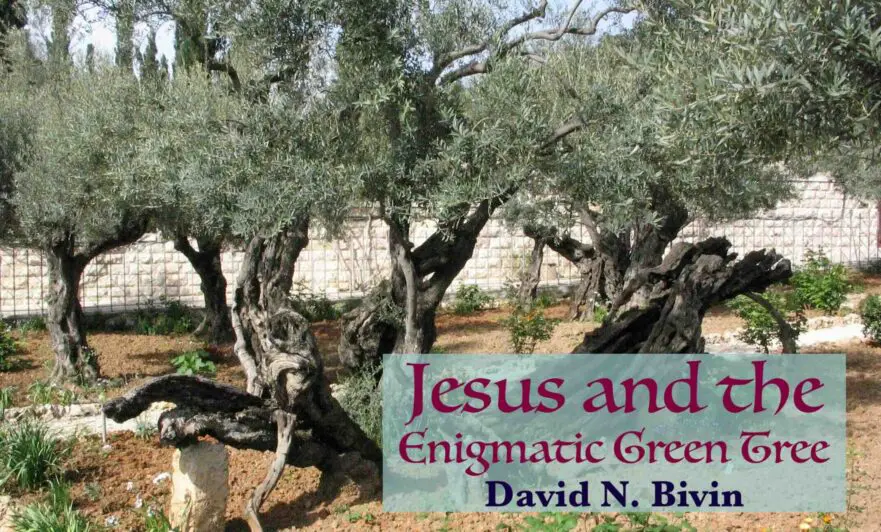

[box]The above image, courtesy of Gary Asperschlager, shows olive trees growing near the Church of All Nations on the Mount of Olives.[/box]
Revised: 19-Apr-13
How did a Jew in Jesus’ time announce that he was the Messiah? One accomplished this by applying to himself words or phrases from Scripture that were interpreted by members of his community to be references to the coming Messiah. Being interpretations rather than direct references, such messianic allusions are extremely subtle, and easily missed by modern readers of ancient Jewish literature. Claimants certainly did not reveal themselves by simply declaring, “I am the Messiah,”[1] as we moderns might expect. Rather, ancient messianic pretenders, such as, for instance, Bar Kochva, informed contemporaries of their messianic identity by referring to themselves with titles acknowledged to refer to one or more of the exalted figures described in Scripture.[2] 

Jesus made bold messianic claims when he spoke. To thoroughly understand these claims, however, we must get into a time machine and travel back in time to a completely different culture, the Jewish culture of first-century Israel. We must acculturate ourselves to the way teachers and disciples in the time of Jesus communicated through allusions to Scripture.

Members of Jewish society in Jesus’ day maintained a high degree of biblical literacy. Consequently, rabbinic teachers and their disciples frequently communicated by using a word or phrase extracted from a passage of Scripture. For example, John the Baptist sent his disciples to Jesus to ask the question: “Are you ‘the Coming One [ὁ ἐρχόμενος (ho erchomenos = הבא]’?” (Matt 11:3 = Luke 7:19), an allusion to Zechariah 9:9 and Malachi 3:1. Jesus responded, “Go tell John…,” etc., an answer that alluded to passages from chapters 29, 35, 42 and 61 of Isaiah.

Paid Content

Premium Members and Friends of JP must be signed in to view this content.

If you are not a Premium Member or Friend, please consider registering. Prices start at $5/month if paid annually, with other options for monthly and quarterly and more: Sign Up For Premium

Amazingly, despite his extreme weakness and physical pain, Jesus had the presence of mind to show concern for those around him: he warned the wailing women by giving a prophecy containing a subtle allusion to the book of Ezekiel. In his words to the women, Jesus spoke with rabbinic sophistication, couching his words in Hebraic parallelism and employing a fortiori reasoning. In addition, he also may have been making a bold messianic claim, applying to himself the title “the Green Tree.”


Notes
  1. Even today a Jew who believes he is the Messiah never says, “I am the Messiah,” but rather, a messianic pretender refers to himself using words or phrases from scripture texts that have been interpreted messianically.[]
  2. See my “‘Prophet’ as a Messianic Title.”[]

Comments 2

  1. Clifton Payne

    Excellent article with the sources to substantiate what Jesus meant by the phrase “green tree.” This article exemplifies the necessity of understanding the linguistic, historical and cultural background of the Bible to be able to understand the scriptures with greater depth and clarity.

  2. Bivin makes an excellent argument for the messianic title, “The Green Tree.” And, although, many scholars have missed this allusion to Yeshua’s claim as the Son of Man or the Messiah, Bivin’s insights into the Hebraims of the New Testament gives him the upper -hand.

Leave a Reply

  • David N. Bivin

    David N. Bivin
    Facebook

    David N. Bivin is founder and editor emeritus of Jerusalem Perspective. A native of Cleveland, Oklahoma, U.S.A., Bivin has lived in Israel since 1963, when he came to Jerusalem on a Rotary Foundation Fellowship to do postgraduate work at the Hebrew University. He studied at the…
    [Read more about author]

  • JP Login

  • JP Content

  • Suggested Reading

  • Articles, blogs, and other content published by Jerusalem Perspective, LLC express the views of their respective authors, and do not necessarily reflect those of JP or other contributors to the site.

    Copyright 1987 - 2026
    © Jerusalem Perspective, LLC
    All Rights Reserved

    Ways to Help:

    DONATIONS: All donations will be used to increase the services available on JerusalemPerspective.com. Donations do not grant donors JP premium content access.