
How to cite this article: Joshua N. Tilton, David N. Bivin, and Lauren S. Asperschlager, “Open Invitation,” The Life of Yeshua: A Suggested Reconstruction (Jerusalem Perspective, 2026) [https://www.jerusalemperspective.com/36671/].
Luke 14:12-14[1]
וַיֹּאמֶר כְּשֶׁתַּעֲשֶׂה מִשְׁתֶּה אַל תִּקְרָא לָעֲשִׁירִים שֶׁמָּא יִקְרָאוּךָ וְיִהְיֶה לְךָ לִגְמוּל אֶלָּא כְּשֶׁתַּעֲשֶׂה סְעוּדָה קְרָא לְדַלִּים לְגִידְּמִים לְחִיגְּרִים וּלְסוּמִים אַשְׁרֶיךָ שֶׁאֵין לָהֶם לְשַׁלֵּם לְךָ [וּ]גְמוּלְךָ יְשֻׁלַּם לְךָ בִּתְחִיַּיתָם שֶׁלְּהַצַּדִּיקִים
Yeshua added, “When you throw a banquet, do not invite the rich, for in that case they will invite you and that will be your reward. Rather, when you host a supper, invite people who are poor or unable to use their hands or who are lame or blind. For in that way you will be blessed, because they have nothing with which to repay you. So your reward will be paid to you at the resurrection of the righteous.”[2]
| Table of Contents |
|
3. Conjectured Stages of Transmission 5. Comment 8. Conclusion |
Reconstruction
To view the reconstructed text of Open Invitation click on the link below:
| “Banquet in the Kingdom of Heaven” complex |
| Man With Edema ・ Open Invitation ・ Great Banquet parable ・ Closed Door ・ Coming From All Directions ・ First and Last ・ Waiting Maidens parable |
Story Placement
Open Invitation (Luke 14:12-14) is a pericope unique to Luke’s Gospel. It occurs as part of a discourse Jesus delivered at a banquet that was held on the Sabbath in the home of a prominent Pharisee (Luke 14:1-6 [Man With Edema]). Open Invitation is addressed to the host. It follows a saying, Places of Honor (Luke 14:7-11), addressed to the guests. Open Invitation is followed by the Great Banquet parable (Luke 14:15-24), in which the host follows the advice Jesus gives in Open Invitation by inviting the poor, the maimed, the lame and the blind to his banquet.
We believe that while Places of Honor was secondarily inserted into its present context,[3] the link between Man With Edema, Open Invitation, and Great Banquet may be original. The healing of the man with dangerous swelling prior to the banquet could have sparked conversation at the banquet about social responsibility toward vulnerable members of society. When those at the feast balked at Jesus’ radical view of social responsibility, he illustrated his teaching with the Great Banquet parable.
We suspect that Man With Edema, Open Invitation, and Great Banquet are only a fragment of a longer teaching discourse that was broken up in the stages of transmission. The Great Banquet parable, which concludes with the host’s declaration that none of the original guests will get a taste of his feast, may have been applied to Jesus’ audience with Closed Door (Luke 13:25-27; cf. Matt. 7:22-23), where Jesus warns them that once the host rises and shuts the door, they will beg for admittance, but he will refuse them. This warning might then have been followed by Coming From All Directions, in which Jesus predicts that at the final redemption people from all over the place will come to feast with Abraham, Isaac and Jacob, but that those in his audience will find themselves excluded in the darkness. Jesus’ vision of the righteous feasting with the patriarchs in the world to come in Coming From All Directions fits well with Jesus’ promise in Open Invitation that those who correct social injustices through the practice of almsgiving and acts of benevolence will receive their reward at the resurrection of the just. First and Last, which in Luke follows Coming From All Directions, might have underscored Jesus’ point by predicting a surprising reversal of the social order at the final redemption. Many who enjoyed power and privilege in this world will find themselves marginalized in the world to come, while many who were oppressed and exploited will be elevated to prominence. The Waiting Maidens parable may have rounded off this discourse by recapitulating Jesus’ argument. Now is the time to prepare for the final judgment. If, like the sensible maidens who provided themselves with oil for their torches, Jesus’ listeners will provide themselves with good deeds, they will be admitted to the eschatological feast. But if, like the foolish maidens who neglected to bring oil, Jesus’ listeners ignore their social responsibilities, they will find themselves on the outside looking in at the glorious celebration of God’s redeeming power in the world to come.
This pericope arrangement we have entitled the “Banquet in the Kingdom of Heaven” complex. Since none of these pericopae refer to the presence of the disciples, it may be that this discourse was delivered prior to the time when Jesus began calling and training disciples. For this reason we have placed the “Banquet in the Kingdom of Heaven” complex in the Teaching and Healing in Yehudah section of the LOY Map. In any case, the sayings in this context were not addressed to disciples but to a slightly skeptical audience. Full-time disciples were in no position to invite poor, maimed, lame or blind guests to a feast, since they had already sold their homes and possessions and distributed their resources to the poor in order to follow Jesus as he traveled from place to place proclaiming the good news of the Kingdom of Heaven.
.

.
Click here to view the Map of the Conjectured Hebrew Life of Yeshua.
.
.
Conjectured Stages of Transmission
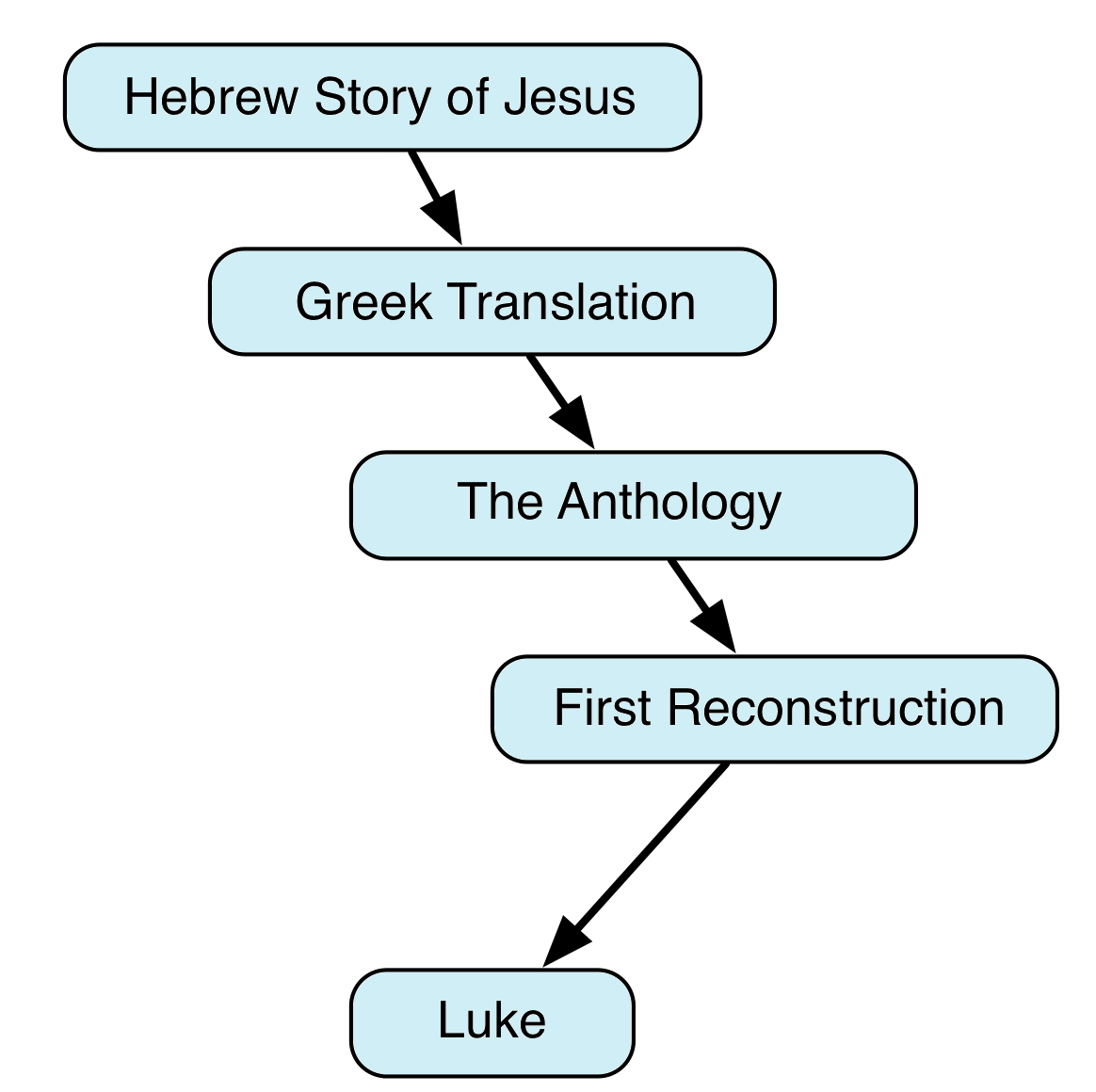
According to Robert Lindsey, the author of Luke mainly relied on two sources, the Anthology (Anth.) and the First Reconstruction (FR), when composing his Gospel. The Anthology was characterized by Hebraic translation Greek, and its contents were arranged according to genre and topic. The First Reconstruction, on the other hand, was characterized by stylistically improved Greek, and the First Reconstructor attempted to impose a more linear, sequential (if not entirely chronological) account from the fragments he found in Anth. From which of these two sources did the author of Luke take his version of Open Invitation? One clue comes from Lindsey’s observation that the author of Luke tended to copy material from his sources in blocks rather than skipping between sources from one pericope to the next. Since on other grounds we identified FR as Luke’s source for Man With Edema and Places of Honor, there is a good chance that the author of Luke copied Open Invitation from FR, too. This conclusion is corroborated by the reappearance in Open Invitation of redactional vocabulary—namely, ὁ κεκληκώς (ho keklēkōs, “the one inviting”)—the First Reconstructor inserted into Places of Honor (see below, Comment to L1). Further corroboration comes from the way the introductory notice (L1), which is expressed in un-Hebraic language, imposes a sense of linear and sequential progression on the pericope. Both un-Hebraic wording and linear progression are markers of FR redaction. We have therefore attributed Luke’s version of Open Invitation to FR.
Crucial Issues
- Does Jesus really prohibit socializing with family and friends?
Comment
L1 ἔλεγεν δὲ καὶ τῷ κεκληκότι αὐτόν (Luke 14:12). Whereas most scholars attribute the wording in L1 to the author of Luke,[4] we attribute it to the First Reconstructor. We are, however, agreed that the introductory phrase is redactional. The use of the imperfect tense (ἔλεγεν [elegen, “he was saying”]) is more likely to be a stylistic improvement than a reflection of Anth.’s wording. The entire phrase resists retroversion to Hebrew.[5] Moreover, the introductory phrase repeats the term ὁ κεκληκώς (ho keklēkōs, “the one calling”), which the First Reconstructor had introduced into the previous pericope, Places of Honor (L14; cf. ὁ σὲ καὶ αὐτὸν καλέσας [ho se kai avton kalesas, “the one calling you and him”] in L7, κεκλημένος ὑπ’ αὐτοῦ [keklēmenos hūp avtou, “one being called by him”] in L6, and πρὸς τοὺς κεκλημένους [pros tous keklēmenous, “to the ones being called”] in L1, all of which we found to be FR redaction). As we note in Places of Honor, Comment to L7, “the one calling” is not a normal way Hebrew would refer to the host of a banquet, a fact that casts doubt on whether Open Invitation’s introductory phrase was translated into Greek from a Hebrew source. It is more likely that the First Reconstructor composed this introductory phrase, as indicated by the FR vocabulary.
καὶ εἶπεν (GR). Anth.’s version of Open Invitation, upon which FR’s version was based, probably had a simple introduction like καὶ εἶπεν (kai eipen, “and he said”). The First Reconstructor improved the Greek style by changing the aorist verb to the imperfect tense and adding a description explaining to whom Jesus’ words were addressed.
וַיֹּאמֶר (HR). On reconstructing εἰπεῖν (eipein, “to say”) with אָמַר (’āmar, “say”), see Widow’s Son in Nain, Comment to L12.
L2 ὅταν ποιῇς δεῖπνον (GR). From GR we have excluded the words ἄριστον (ariston, “early meal”) and ἤ (ē, “or”), but have otherwise adopted Luke’s wording for our reconstruction of Anth. The noun ἄριστον only occurs in one other verse in all of Luke’s writings (Luke 11:38),[6] and that verse, like Luke 14:12, derives from FR (Woes Against Scribes and Pharisees). In Woes Against Scribes and Pharisees we also find the cognate verb ἀριστᾶν (aristan, “to eat the early meal”; Luke 11:37). It is the only instance of this verb in all of Luke-Acts.[7] It seems, therefore, that references to an “early meal” are characteristic of FR redaction.
כְּשֶׁתַּעֲשֶׂה מִשְׁתֶּה (HR). On reconstructing ὅταν (hotan, “when”) with -כְּשֶׁ (keshe-, “when that,” “as that”), see Lord’s Prayer, Comment to L9.
On reconstructing ποιεῖν (poiein, “to do”) with עָשָׂה (‘āsāh, “do”), see Rich Man Declines the Kingdom of Heaven, Comment to L8.
On reconstructing δεῖπνον (deipnon, “meal,” “banquet”) with מִשְׁתֶּה (mishteh, “banquet”), see Yohanan the Immerser’s Execution, Comment to L35.
L3-6 μὴ κάλει τοὺς πλουσίους (GR). In L3-6 we find several indications of Greek redaction. The first is the use of the verb φωνεῖν (fōnein, “to give voice,” “to make a sound”) in the sense of “to invite.” Although this usage of φωνεῖν is rare,[8] it cannot be regarded as especially Hebraic since the verb for “invite,” קָרָא (qārā’, “call”), is generally rendered in LXX as καλεῖν (kalein, “to call”). Indeed, we have reason to suspect that καλεῖν was the verb in Anth., which the First Reconstructor replaced with φωνεῖν. The verb ἀντικαλέσωσίν (antikalesōsin, “they might invite in return”) in L7 seems to presuppose that κάλει (kalei, “Invite!”) originally belonged here in L3. Moreover, we have found the First Reconstructor responsible for the presence of φωνεῖν elsewhere in Luke’s Gospel.[9]
Another sign of redaction in L3-6 is the list of personal relations (friends, brothers, relatives, neighbors), all of which appear to be modified by the adjective πλούσιος (plousios, “rich,” “wealthy”).[10] This list of relations is strikingly similar to the list found in Luke’s version of Betrayal of Friends (parents, brothers, relatives, friends [Luke 21:16]), a pericope the author of Luke copied from FR. This list of four relations balances those who should not be invited (L3-6) with the list of four unfortunates who should be invited (the poor, the maimed, the lame, the blind [L10]),[11] but it tends to dilute the force of the prohibition, even though the original intention of adding the list of personal relations may have been to intensify it (i.e., do not invite the wealthy, not even your wealthy friends, your wealthy brothers, your wealthy relatives, or your wealthy neighbors). Eliminating the list of personal relations from L3-6 does no harm to the saying’s intention but only brings out its intention more clearly, and the greater ease with which the simplified prohibition reverts to Hebrew argues in its favor.
Although the addition of four personal relations creates numerical balance with the list of four classes of unfortunates, there remains a grammatical asymmetry between the two lists. The list of personal relations consists of four nouns all modified by the single adjective “rich,” while the list of unfortunates consists of four adjectives (“poor, maimed, lame, blind”). Eliminating the four nouns from the first list removes this grammatical asymmetry and shows that the original form of the saying took greater interest in the diverse plights of the unfortunate than in the wealthy, who are viewed as an undifferentiated mass.
אַל תִּקְרָא לָעֲשִׁירִים (HR). On reconstructing καλεῖν (kalein, “to call,” “to invite”) with קָרָא (qārā’, “call,” “invite”), see Call of Levi, Comment to L65.
In LXX πλούσιος (plousios, “rich,” “wealthy”) usually occurs as the translation of עָשִׁיר (‘āshir, “rich,” “wealthy”).[12] Likewise, the LXX translators usually rendered עָשִׁיר as πλούσιος.[13]
L7 μήποτε ἀντικαλέσωσίν σε (GR). Apart from καὶ αὐτοί (kai avtoi, “also they”), which could be the product of Lukan or FR redaction,[14] we have accepted Luke’s wording in L7 for GR.
שֶׁמָּא יִקְרָאוּךָ (HR). On reconstructing μήποτε (mēpote, “lest”) with שֶׁמָּא (shemā’, “lest”), see Tower Builder and King Going to War, Comment to L5-6.
The verb ἀντικαλεῖν (antikalein, “to invite in return”) does not occur in LXX, but its absence there poses no obstacle to reconstructing it with קָרָא (qārā’, “call,” “invite”). By using the compound verb, the Greek translator captured the sense in which the verb was used.
L8 καὶ γένηταί σοι εἰς ἀνταπόδομα (GR). The noun ἀνταπόδομα (antapodoma, “repayment”), occurring only this once in all of Luke-Acts,[15] can hardly be considered Lukan. Nevertheless, it is possible that Luke’s wording in L8 has undergone some slight redaction at the hand of the First Reconstructor, whose καὶ γένηται ἀνταπόδομά σοι (kai genētai antapodoma soi, “and it might become a repayment for you”) could represent a stylistic improvement upon a more Hebraic καὶ γένηταί σοι εἰς ἀνταπόδομα (kai genētai soi eis antapodoma, “and it might become for you for a repayment”) in Anth. This supposition is reflected in GR.
וְיִהְיֶה לְךָ לִגְמוּל (HR). On reconstructing γίνεσθαι (ginesthai, “to be”) with הָיָה (hāyāh, “be”), see Widow’s Son in Nain, Comment to L1.
In LXX the noun ἀνταπόδομα (antapodoma, “repayment”) most often occurs as the translation of גְּמוּל (gemūl, “reward,” “compensation”).[16] Most instances of גְּמוּל the LXX translators rendered as ἀνταπόδομα.[17]
The reference to “repayment” or “reward” in L8 provides the first clue that Jesus’ saying is a midrash on a verse in Proverbs, which reads:
מַלְוֵה יי חוֹנֵן דָּל וּגְמֻלוֹ יְשַׁלֶּם לוֹ
He lends to the Lord who is generous to the poor, and his reward [וּגְמֻלוֹ] he will pay to him. (Prov. 19:17)
This verse, which suggests that giving to the poor puts God himself in one’s debt, became an important justification for the practice of almsgiving in the Second Temple period and beyond. Its influence appears in a Hebrew manuscript of Ben Sira:
תן לו ⟨לאל⟩ [כ]מתנתו לך [[ ]] בטוב עין ובהשגת יד מלוה ייי נותן לאביון ומי בעל גמולות כי אם הוא כי אלוה תשלומות הוא ושבעתים ישיב לך
Give to him [to God] according to his gifts to you…with a good eye and an outstretched hand. He lends to the Lord who gives to the destitute. And who is a payer of rewards but him? For he is a God of repayments and he will return it to you sevenfold. (Sir. 35:12-13 [MS B])
Ben Sira paraphrased Prov. 19:17 in his exhortation to almsgiving, but the verse was also used as a justification for almsgiving in Jewish apologetics:
שאל פלסופוס אחד את רבן גמליאל אמר לו כת′ בתורתכם נתן תתן לו ולא ירע לב’ בת’ לו וכי יש לך אדם שהוא מבזבז נכסיו לאחרים ואין לבו רע עליו שמא יצטרך לבריות אמר לו אם בא אדם ללוות ממך מלוהו את אמר לו לאו אם הביא לך את המשכון מלוהו את אמר לו הין אם הביא לך ערב שאינו כראוי מלוהו את אמר לו לאו אם הביא לך ערב ראש המדינה מלוהו את אמר לו הין אמר לו והלא דברים קל וחומר אם כשערבו בשר ודם מלוהו את קל וחומר כשערבו מי שאמר והיה העולם וה″א מלוה ה′ חונן דל וגמולו ישלם לו
A certain philosopher asked Rabban Gamliel and said to him, “It is written in your Torah, You must surely give to him, and your heart must not be evil toward him in your giving [Deut. 15:10], but is there really a person who distributes his possessions to others and his heart is not evil toward them, lest he end up relying on them?” He said to him, “If a person came to borrow from you, would you lend?” He said to him, “No.” “If he brought you collateral, would you lend?” He said to him, “Yes.” “If he brought you a guarantor who is not worthy, would you lend?” He said to him, “No.” “If he brought you as guarantor the head of the province, would you lend?” He said to him, “Yes.” He said to him, “Is this not a matter of kal vahomer? If when a mortal acts as guarantor you would lend, how much more so when the One who spoke and the world came into being acts as guarantor?” And he said, He lends to the Lord who is generous to the poor, and he will pay him his reward [Prov. 19:17]. (Midrash Tannaim 15:10 [ed. Hoffmann, 84])
In his defense of the Jewish practice of almsgiving Rabban Gamliel argued that it makes economic sense to give to the poor. What is given in alms is like a loan that God himself guarantees. Backed with such security an almsgiver need not give grudgingly to those in need. Other ancient Jewish commentaries on Prov. 19:17 are even more daring. They compare God not merely to a guarantor but to a debtor:
א″ר יוחנן מאי דכתיב מלוה ה′ חונן דל אלמלא מקרא כתוב אי אפשר לאומרו כביכול עבד לוה לאיש מלוה
Rabbi Yohanan said, “What is the meaning of the verse, He lends to the Lord who is generous to the poor [Prov. 19:17]? If the verse had not been written, it would be impossible to say it, as it were, the debtor [i.e., God—DNB and JNT] is a slave to the man who lends [Prov. 22:7].” (b. Bab. Bat. 10a)
In other words, Rabbi Yohanan is hinting that God cannot escape his obligation to reward almsgiving. Giving alms to the poor places God in one’s debt, and in the final judgment when all accounts are settled, the person who has given alms can present his bill of indebtedness to God for repayment.
It is not at all surprising that, in his startling and subversive advice to invite the poor to dine at one’s banquet, Jesus would appeal to Prov. 19:17 for justification, since other ancient Jewish sages appealed to the same verse to justify and encourage almsgiving. Jesus sought to convince his audience that inviting the wealthy to a banquet comes with its own empty reward, for one can always expect an invitation in return. But inviting the poor to a banquet, though it seems a losing proposition, is actually to one’s advantage because when guests are unable to return one’s hospitality, it is God who must repay one’s generosity. Much like Ben Sira’s paraphrase, Jesus’ advice parallels Prov. 19:17:
|
Prov. 19:17 |
Luke 14:13-14 |
|
He lends to the Lord who is generous to the poor, |
When you make a banquet, invite the poor… |
|
and his reward he will pay to him. |
…it will be repaid to you at the resurrection of the righteous. |
Jesus’ advice, however, is far more radical than Ben Sira’s or that of the other ancient Jewish sages we have mentioned. For whereas almsgiving, by maintaining distance between the giver and the recipient, allows the social hierarchy to remain intact, Jesus demands social integration between the disparate classes. It was not enough, in Jesus’ view, to give to the poor while keeping them at arm’s length. One must embrace the poor and honor them as one’s social and religious equals by inviting them into one’s home and interacting with them on a personal and intimate level. Such a radical demand from Jesus would require a robust justification to convince his surprised and skeptical audience. Jesus—like so many other ancient Jewish sages who understood its radical potential—found that justification in Prov. 19:17, which promises that God will repay those who give to the poor because generosity to the poor is like making a loan to God. Making a loan to God is not only absolutely secure from default, it must be done joyfully and extravagantly. Who would dare make a miserly loan to God? Such a loan is not a risk but an honor, so the poor recipients of one’s generosity should be treated accordingly.
The skepticism of Jesus’ audience and Jesus’ radical approach to aiding the poor may be symptomatic of the differing emphases the Pharisees and the first-century Jewish pietists known as the ḥasidim placed on Torah study and good deeds. Whereas the Pharisees emphasized Torah study as the greatest mitzvah that leads to the performance of the other commandments, the ḥasidim, with whom Jesus appears to have shared much in common, emphasized deeds that promoted social welfare.
The different emphases Jesus and the Pharisees placed on good deeds versus Torah study manifested in their diverging approaches to table etiquette. Whereas Jesus, in Open Invitation, saw mealtimes as opportunities to practice good deeds, the rabbinic heirs to the Pharisees regarded mealtimes as opportunities for study:
ר′ שִׁמְעוֹן אוֹמֵ′ שְׁלֹשָׁה שֶׁאָכְלוּ עַל שׁוּלְחָן אֶחָד וְלֹא
ולאאָמְרוּ עָלָיו דִּבְרֵי תוֹרָה הֲרֵי אֵילּוּ כְאֹכְלֵי זִבְחֵיּ מֵתִים שנ′ כִּי כָל שׁוּלְחָנוֹת מָלְאוּ קִיא צוֹאָה בְלִי מָקוֹם׃ אֲבָל שְׁלֹשָׁ′ שֶׁאָכְלוּ על שׁוּלְחָן אֶחָד וְאָמְרוּ עָלָיו דִּבְרֵי תוֹרָה כְאִילּוּ אָכְלוּ מִשֻּׁלְחָנוֹ שֶׁלְהַקָּ′בָּ′הֻ′ שנ′ וַיְדַבֵּר אֵלַיִ זֶה הַשֻּׁלְחָן אֲשֶׁר לִפְנֵי יָייRabbi Shimon [ben Yohai] said, “Three who ate at one table but did not say over it words of the Torah—behold! These are like those who eat sacrifices of the dead, as it is written, For all tables are full of vomit and filth without the Omnipresent One [Isa. 28:8]. But three who ate at one table and did say over it words of the Torah, it is as if they ate from the table of the Holy One, blessed be he, as it is written, And he spoke to me, ‘This is the table that is before the Lord’ [Ezek. 41:22].” (m. Avot 3:3)
The competing claims of Torah study and the performance of good deeds is also manifest in the following rabbinic commentary on Prov. 19:17:
ד″א מלוה ה′ חונן דל אמ′ הב″ה הלויני צדקה בעולם הזה ואני אשלם לך לעולם הבא. ד″א מלוה ה′ ח′ ד′ אמ′ הב″ה הלויני תורה בעולם הזה ואני אשלם לך לעולם הבא. א″ר ישמאל כך הוא דרכה של תורה אם פת במלח תאכלו ועל הארץ תישן וחיי צער תחיה ותורה אתה למד אשריך וטוב לך. אשריך בעולם הזה, וטוב לך לעולם הבא. ואל תתאוב לשולחנן של מלכים ששולחנך גדול משולחנן וכתרך גדול מכתרם ונאמן הוא בעל מלאכתך לשלם לך פעולתך בשלום, וגמולו ישלם לו
Another interpretation. He lends to the Lord who is generous to the poor [Prov. 19:17]. Said the Holy One, blessed be he, “Lend me alms in this world, and I will repay you in the world to come.” Another interpretation. He lends to the Lord who is generous to the poor [Prov. 19:17]. Said the Holy One, blessed be he, “Lend me Torah in this world, and I will repay you in the world to come.” Rabbi Yishmael said, “This is the way of the Torah: if a bit of bread with salt you will eat, and on the ground you will sleep, and a life of hardship you will live, and Torah you will study, then blessed are you and good to you [Ps. 128:2]. Blessed are you in this world, and good to you for the world to come. And do not envy the table of kings, for your table is greater than their table and your crown is greater than their crown, and the master of your labor is faithful to repay your deeds with compensation,[18] and his reward he will repay him [Prov. 19:17].” (Midrash Mishle 19 [ed. Visotzky, 137])
The first interpretation of Prov. 19:17 in the quotation above elevates the importance of almsgiving, while the second interpretation, which by its length and complexity is shown to be the more important of the two, elevates the importance of Torah study.
Despite their differing emphases, Jesus was probably not at complete odds with his Pharisaic audience. Nevertheless, his audience probably regarded Jesus’ radical approach to social welfare as impractically idealistic.
But in its own way the Pharisaic-rabbinic emphasis on Torah study was also idealistic. According to Rabbi Yishmael, one should be willing to impoverish oneself for the sake of studying Torah. The imperishable rewards of Torah study far exceed the perishable wealth of mortal kings. For Jesus, alleviating social inequities (tzedakah) was sufficient grounds for impoverishing oneself. It was through such acts of loving service that God was establishing his better reign over Israel, humankind and the whole of creation. God’s better reign, the Kingdom of Heaven, was needed because the world had become subjected to evil and destructive forces. If human greed and indifference could contribute to the ills of this world, then, with God’s help, human compassion could overcome them.
It may be surprising to discover that a dim awareness that Open Invitation is based on Prov. 19:17 seems to have persisted among Christians well into the patristic period. How else does one explain John Chrysostom’s (mid-fourth to early fifth cent. C.E.) surprising references to making God one’s debtor in his discussion of Luke 14:12-14?
Ἄκουσον γὰρ τοῦ Χριστοῦ λέγοντος ἐν τῷ Εὐαγγελίῳ⋅ Μὴ καλέσῃς τοὺς φίλους σου, μηδὲ τοὺς γεἰτονάς σου, ἐὰν ποιήσῃς δοχὴν, ἀλλὰ τοὺς χωλοὺς, τοὺς ἀναπήρους⋅ εἰκότως⋅ πολὺς γάρ ὁ ὑπὲρ τούτων μισθός…. Καὶ γὰρ ὁ φίλους καλῶν, οὐδὲν μέγα ἐποίησεν⋅ απέλαβε γὰρ ἐνταῦθα τὸν μισθόν⋅ ὁ δὲ ἀνάπηρον καλῶν καὶ πένητα, ἔχει τὸν Θεὸν ὀφειλέτην. Μὴ τοίνυν ἀσχάλλωμεν, ὅταν μὴ ἐνταῦθα ἀπολάβωμεν, ἀλλ᾽ ὅταν ἐνταῦθα ἀπολάβωμεν⋅ ἐκεῖ γὰρ οὐκέτι ἀποληψόμεθα. Ὁμοίως, ἂν ἄνθρωπος ἀποδῷ, Θεὸς οὐκ ἀποδίδωσιν⋅ ἃν οὕτος μὴ ἀποδῷ, τότε ἀποδώσει Θεός. Μὴ τοίνυν ἐκείνους ζητῶμεν εὐεργετεῖν τοὺς ἀνταποδοῦναι ἡμῖν δυναμένους, μηδὲ ἐπὶ τοιαὐταις αὐτοὺς ἐλπίσιν εὐεργετῶμεν⋅ ψυχρὰ αὔτη ἡ διάνοια. Τὸν φίλον ἂν καλέσῃς, μέχρι τῆς ἑσπέρας ἡ χάρις⋅ διὰ τοῦτο τῶν καταβαλλομένων ταχύτερον ἣ τῶν καιρῶν δαπανᾶται φιλία⋅ τὸν μέντοι πένητα καὶ ἀνάπηρον ἂν καλέσῃς, οὐδέποτε ἀπολεῖται ἡ χάρις⋅ τὸν γὰρ πάντοτε μνημονεύοντα Θεὸν, καὶ οὐδέποτε ἐπιλανθανόμενον, ἔχεις αὐτὸν ὀφειλἐτην.
For listen to Christ saying in the Gospel, “Do not invite your friends or your neighbors, if you make a feast, but the lame, the maimed.” With reason: For great is the wage for these…. For the one inviting friends, has done no great thing: for he received his wage here. But the one inviting the maimed and the poor has God for a debtor. So let us not grieve when we are not repaid here [in this life], but [let us grieve] when we are repaid here, for we will not be repaid anything more there [in the hereafter]. Likewise, if a human being repays, God does not repay, but if a human being does not repay, then God will repay. So let us not seek out for our generosity those who have it in their power to repay us, or bestow our generosity upon them with such an expectation: this were a cold thought. If you invite a friend the gratitude lasts till evening, and therefore the friendship is spent more quickly than the expenses [for the invitation] are paid. But if you invite the poor and the maimed the gratitude will never perish, for you will have God, who remembers all, and who never forgets, as your debtor. (John Chrysostom, Homilies on Colossians, Homily 1)[19]
This homily twice claims that those who invite the poor to their banquets will make God their debtor. The basis of this claim appears to be awareness that Jesus’ advice rests upon Prov. 19:17. Either John Chrysostom or the tradition upon which he drew recognized that Jesus’ promise that those who invite the poor will be repaid at the resurrection was a paraphrase of the second half of Prov. 19:17 (“and his reward he will repay to him”). Recognition of this fact permitted John Chrysostom or the tradition he tapped into to draw the inference that those who invite the poor to their banquets will have God as their debtor (“He lends to the Lord who is generous to the poor”). Its awareness that Jesus’ counsel to invite the poor is based on Prov. 19:17 explains why this fourth-century C.E. homily, with its exhortation not to grieve when giving to the poor, sounds so similar to Rabban Gamliel’s late first-century C.E. apologetics explaining why one need not have an evil heart toward those to whom one gives alms. One cannot grieve, but can rather give cheerfully and generously, because in doing so one makes God one’s debtor, who is obliged to reward the good deed of almsgiving at the final judgment.
L9 ἀλλ’ ὅταν ποιῇς δοχὴν (GR). We have accepted all of Luke’s wording in L9 for GR, but slightly modified the word order to conform to Hebrew syntax by placing δοχήν (dochēn, “a feast”) after ποιῇς (poiēs, “you might make”). This order is also attested in some ancient MSS. It is possible, however, that the word order δοχὴν ποιῇς is original and that it was the Greek translator of the Hebrew Life of Yeshua who deviated slightly from Hebrew word order (cf. Esth. 1:3).
Jeremias regarded the noun δοχή (dochē, “feast,” “banquet”) as a marker of Lukan redaction, since it occurs in the Gospel of Luke but not in the Gospels of Mark or Matthew.[20] However, even in Luke δοχή only occurs twice and never appears in Acts,[21] so it seems more probable that δοχή came from Luke’s source. Since δοχή is not at all difficult to revert to Hebrew, we have accepted Luke’s vocabulary for GR.
According to Wolter, the combination of ποιεῖν + δοχή is not found in secular Greek literature, but is only attested in LXX and the Gospel of Luke.[22] This fact led Wolter to the conclusion that in using ποιεῖν + δοχή the author of Luke purposely imitated LXX. We think a better explanation of the confinement of ποιεῖν + δοχή to LXX and Luke’s Gospel is that both are based on Hebrew sources. In other words, ποιεῖν + δοχή is not a Septuagintism, it is an Hebraism.
אֶלָּא כְּשֶׁתַּעֲשֶׂה סְעוּדָה (HR). On reconstructing ἀλλά (alla, “but,” “rather”) with אֶלָּא (’elā’, “rather”), see Call of Levi, Comment to L61.
On reconstructing ὅταν (hotan, “when”) with -כְּשֶׁ (keshe-, “when that,” “as that”), see above, Comment to L2.
On reconstructing ποιεῖν (poiein, “to do”) with עָשָׂה (‘āsāh, “do”), see above, Comment to L2.
In Call of Levi, L23, we reconstructed δοχή (dochē, “entertainment,” “meal”) with מִשְׁתֶּה (mishteh, “banquet”), but there δοχή occurred in prose, where we prefer reconstructing in a biblicizing style of Hebrew. Here the situation is different. Not only does δοχή appear in direct speech, but it is used in parallel with and as an approximate synonym for δεῖπνον (deipnon, “banquet”), which we have already reconstructed with מִשְׁתֶּה (mishteh, “banquet”). Supposing that the different terms for “meal” in Greek reflect different terms for “meal” in the underlying Hebrew source, we must find a different reconstruction for δοχή (dochē, “meal”). Fortunately, a suitable Mishnaic equivalent is readily available. The noun סְעוּדָה (se‘ūdāh, “meal,” “supper,” “feast”), while not attested in the Hebrew Scriptures or DSS, appears frequently in the Mishnah. There is no reason to doubt its currency in the first century. As a Mishnaic synonym for סְעוּדָה ,מִשְׁתֶּה is a good option for HR.
It is possible that the variation between “banquet” and “meal” is not without purpose. Perhaps “banquet” was used to signify a more extravagant and exclusive affair, such as wealthy personages would be expected to attend. A “supper,” by contrast, could signify either a grand feast or a modest repast, which anyone might attend. Thus, “supper” might have been intended as a more inclusive term. Using a more inclusive term in L9 would have broadened the application of Jesus’ teaching. Only the wealthy could regularly hold extravagant banquets, but even those whose resources were more limited could invite people into their homes for a supper.
Examples of עָשָׂה סְעוּדָה ( ‘āsāh se‘ūdāh, “make a supper”) are common in rabbinic sources, for instance:
רבי יהושע בן קרחה אומר משל למלך שעשה סעודה והזמין את האורחים והיה אוהבו מיסב ביניהם
Rabbi Yehoshua ben Korhah said, “A parable. [It may be compared] to a king who made a supper [שֶׁעָשָׂה סְעוּדָה], and he invited the guests, and his friend was reclining among them….” (Sifre Deut. §53 [ed. Finkelstein, 121])
Another example of עָשָׂה סְעוּדָה occurs in a story about an extraordinary act of generosity, albeit not quite the kind of generosity Jesus recommends in Open Invitation:
לא יהא אדם קפדן בתוך סעודה. ומעשה בהילל הזקן שעשה סעודה לאדם אחד, ובא עני ועמד על פתחו, אמר לאשתו, אשה אני צריך להכניס, ואין לי פרנסה כלום. נטלה אשתו של הילל כל הסעודה ההיא, ונתנה לו, ואחר כך לשה עיסה אחרת, ובשלה אילפס אחר, ובאת והניחה לפניהם. אמר לה, בתי, מפני מה לא הבאת לנו מיד, סחה לו כל אותו המעשה, אמר לה, בתי, אף אני לא דנתי אותך לכף חובה, אלא לכף זכות, שכל המעשים שעשית לא עשית אלא לשם שמים
Let not a person be ill-tempered at supper. And an anecdote [is told] concerning Hillel the elder, who made a supper [שֶׁעָשָׂה סְעוּדָה] for a certain man. And a poor man came and stood at his door. He [i.e., the poor man] said to his wife, “Woman, I need to usher in [the Sabbath? a bride?], but I have no provender at all!” So Hillel’s wife took all that feast and gave it to him. After that, she kneaded another measure of flour and boiled another pot of stew, and she came and set it before them [i.e., Hillel and his guest]. He said to her, “My daughter, why did you not bring it to us immediately?” She told him all that had happened, and he said to her, “My daughter, I, too, do not judge you according to the measure of debt but according to the measure of merit, for all the deeds that you did were done only for the sake of Heaven.” (Masechtot Derech Eretz: Pirqe Ben Azzai 4:2 [ed. Higger, 200-201])
This story not only exemplifies the high value ancient Jewish sages placed on hospitality and generosity, it also affords another example of the Jewish principle that what one does for the poor is accredited as having been done for God. According to Hillel, what his wife did for the poor man was done “for the sake of Heaven.”
The story about Hillel’s wife also gives us a glimpse into the androcentric mindset that prevailed in the ancient world. Hillel is said to have “made the supper,” when actually it was his wife who made all the food preparations while Hillel entertained his guest. Likewise, when Jesus advised those who “make a supper” to invite the poor, he was addressing hosts who presided over the banquet, not the wives, daughters or slaves of the hosts who actually prepared the meal.
L10 κάλει πτωχούς ἀναπείρους χωλούς τυφλούς (GR). Since Luke’s wording in L10 reverts easily to Hebrew, we have accepted it without alteration for GR.
קְרָא לְדַלִּים לְגִידְּמִים לְחִיגְּרִים וּלְסוּמִים (HR). On reconstructing καλεῖν (kalein, “to call”) with קָרָא (qārā’, “call”), see above, Comment to L3-6.
Jesus’ reference to the “poor” at the head of the list of those who should be invited to a feast is the second major clue that his advice in Open Invitation is a midrash on Prov. 19:17. The addition of other classes of unfortunate persons (those whose bodies are severely injured or impaired) merely demonstrates that “poor” is to be understood in an inclusive rather than a restrictive manner. Most people with such disabilities would have been poor in any case, since their limitations would have made it nearly impossible to earn a living. In LXX the adjective πτωχός (ptōchos, “poor”) occurs as the translation of a variety of Hebrew terms including עָנִי (‘āni, “deprived,” “afflicted”), אֶבְיוֹן (’evyōn, “needy,” “poor”) and דַּל (dal, “weak,” “poor”).[23] The likelihood that Jesus’ saying is based on Prov. 19:17 favors דַּל for HR.[24] The LXX translators more often rendered דַּל as πτωχός than as any other alternative.[25] The adjectives דַּל (“poor”) and עָשִׁיר (“wealthy”; cf. L6) occur as a contrasting pair several times in the Hebrew Scriptures.[26]
In LXX the adjective ἀνάπηρος (anapēros), var. ἀνάπειρος (anapeiros, “maimed”),[27] is rare and does not occur in books included in MT, so finding an equivalent poses something of a challenge. Mishnaic Hebrew possesses the adjective גִּידֵּם (gidēm, “one whose hand or fingers are cut off,” “maimed”), which seems a good possibility.
For the remaining adjectives in L10 we have likewise selected Mishnaic Hebrew equivalents, although Biblical Hebrew equivalents would be equally justifiable. Thus, we have reconstructed χωλός (chōlos, “limping,” “lame”) with חִיגֵּר (ḥigēr, “limping,” “lame”),[28] although the biblical פִּסֵּחַ (pisēaḥ, “limping,” “lame”) is another possibility.[29] Similarly, we have reconstructed τυφλός (tūflos, “blind”) with סוּמָא (sūmā’, “blind”), although the biblical עִוֵּר (‘ivēr, “blind”) remains a valid option.[30] The adjectives גִּידֵּם (“maimed in the hand”), חִיגֵּר (“lame”) and סוּמָא (“blind”) appear together in the following mishnah:
הָיָה אֶחָד מֵהֶן גִּידֵּם אוֹ חִיגֵּר אוֹ אִילֵּם אוֹ סוֹמֵא אוֹ חֵרֵשׁ אֵינוּ נֶעֱשָׂה בֵן סוֹרֵר וּמוֹרֶה
If one of them [i.e., his parents—JNT and DNB] was maimed in the hand [גִּידֵּם] or lame [חִיגֵּר] or mute or blind [סוֹמֵא] or deaf, he does not qualify as a stubborn and rebellious son [Deut. 21:18-21]. (m. Sanh. 8:4)
L11 μακάριος ἔσῃ (GR). From GR we have omitted Luke’s conjunction καί (kai, “and”), which appears to have been added in order to tighten the logical connections in Jesus’ argument. Otherwise, we have accepted Luke’s wording in L11 for GR.
אַשְׁרֶיךָ (HR). On reconstructing μακάριος (makarios, “blessed”) with אַשְׁרֵי (’ashrē, “blessednesses of,” i.e., “blessed”), see Blessedness of the Twelve, Comment to L3.
In Hebrew אַשְׁרֵי is an exclamation that describes a person’s state in the present. Hence, אַשְׁרֶיךָ (ashrechā) means “You are blessed now!” Consequently, Jesus’ saying envisions both present and future rewards. On account of inviting the poor, one will experience God’s blessing now and will receive a reward at the final judgment. We witnessed the same dynamic in the quotation from Midrash Mishle on Prov. 19:17:
אשריך וטוב לך. אשריך בעולם הזה, וטוב לך לעולם הבא. ואל תתאוב לשולחנן של מלכים ששולחנך גדול משולחנן וכתרך גדול מכתרם ונאמן הוא בעל מלאכתך לשלם לך פעולתך בשלום, וגמולו ישלם לו
Blessed are you, and good to you [Ps. 128:2]. Blessed are you in this world, and good to you for the world to come. And do not envy the table of kings, for your table is greater than their table, and your crown [i.e., the crown of Torah ⟨cf. m. Avot 4:13⟩—JNT and DNB] is greater than their crown [i.e., the crown of earthly kingship—JNT and DNB], and the master of your labor is faithful to repay your deeds with compensation, and his reward he will repay him [Prov. 19:17]. (Midrash Mishle 19 [ed. Visotzky, 137])
The Greek translation of אַשְׁרֶיךָ (“Blessed are you!”) as μακάριος ἔσῃ (makarios esē, “you will be blessed”) is not really a distortion of the saying’s original meaning. For even in the Greek text the meaning is “you will be blessed as soon as you host the poor at supper,” not “you will be blessed at the resurrection of the righteous.”[31] The Greek’s future tense is logical rather than temporal.
Exclamations of אַשְׁרֵי (“How blessed…!”) are linked to Prov. 19:17 not only in Jesus’ saying and in Midrash Mishle, but also in other ancient Jewish sources:
דל, שנידלדל מנכסיו, למה הוא דומה, למלך בשר ודם שגזר על בנו, שלא יכנס לתוך סעודתו, והמלך יודע בבנו שהוא רעב וצמא, ואמר, אשרי מי שיכניס את בני בתוך ביתו, ויתן לו פת לחם ויאכל וישתה, וכל מה שיש לי שלו הוא, שנאמר מלוה ה′ חונן דל וגו′
A poor man who is deprived of his possessions, to what is he like? To a king of flesh and blood who decreed against his son that he should not enter during his supper. But the king, knowing that his son was hungry and thirsty, said, “Blessed [אַשְׁרֵי] is the one who will bring my son into his house and give him a piece of bread that he may eat and drink! For all that I have is his.” As it is said, He lends to the Lord who is generous to the poor [and he will pay him his reward] [Prov. 19:17]. (Eliyahu Zuta §5 [ed. Friedmann, 181])
דבר אחר אשרי משכיל אל דל. זהו שאמר הכתוב מלוה ה′ חונן דל
Another interpretation. Blessed is the one who is mindful of the poor [in the day of evil the Lord will deliver him] [Ps. 41:2]. This is what is meant by the verse, He lends to the Lord who is generous to the poor [and he will pay him his reward] [Prov. 19:17]. (Midrash Tehillim 41:2 [ed. Buber, 259])
L12 ὅτι οὐκ ἔχουσιν ἀνταποδοῦναί σοι (GR). Some scholars regard ἔχειν [without object] + infinitive in the sense of “to be able to do” as a mark of Lukan redaction,[32] and indeed this usage does occur a number of times in Luke’s Gospel (Luke 7:42; 12:4; 14:14). However, this usage does not occur anywhere in Acts, although the same usage, and nearly the same vocabulary, also occur in Matthew’s Unforgiving Slave parable:
μὴ ἔχοντος δὲ αὐτοῦ ἀποδοῦναι ἐκέλευσεν αὐτὸν ὁ κύριος πραθῆναι
But not having [that with which] to repay, the lord ordered him to be sold…. (Matt. 18:25)
Moreover, this usage of ἔχειν [without object] + infinitive reverts easily to Hebrew (see below) and may even be regarded as an Hebraism. It therefore appears more likely that ἔχειν [without object] + infinitive in the sense of “to be able to do” in Luke and Matthew reflects their Hebraic-Greek sources rather than Greek redaction. The confinement of the verb ἀνταποδιδόναι (antapodidonai, “to give back,” “to repay”) to this one verse in the entire Lukan corpus also argues against Lukan redaction.[33] We have, accordingly, accepted Luke’s wording without alteration for GR.
שֶׁאֵין לָהֶם לְשַׁלֵּם לְךָ (HR). On reconstructing ὅτι (hoti, “that”) with -שֶׁ (she-, “that”), see Lost Sheep and Lost Coin, Comment to L31.
Instances of אַשְׁרֵי (“How blessed…!”) followed by a -שֶׁ clause giving the reason for the blessedness occur in early rabbinic texts. The first example we cite describes the water-drawing ceremony during the feast of Sukkot as it was celebrated in the Temple in the Second Temple period:
חסידים ואנשי מעשה היו מרקדין לפניהן באבוקות ואומרי′ לפניהם דברי תושבחות, מה היו אומרין, אשרי מי שלא חטא וכל מי שחטא ימחל. ויש מהן או′ אשרי ילדותי שלא בייש את זקניתי, אילו אנשי מעשה. ויש מהן שהיו אומ′ אשריך זקנתי שתכפרי אל ילדותי, אילו בעלי תשובה
The ḥasidim and men of deeds[34] would dance before them with flaming torches and would recite before them words of praise. What did they say? “Blessed is the one who has not sinned, but all who have sinned he will cancel their debt [i.e., forgive their sin—DNB and JNT].”[35] And there were some of them who would say, “Blessed [אַשְׁרֵי] is my youth, because [-שֶׁ] it has not put my old age to shame”—these were the men of deeds. And there were some of them who would say, “Blessed are you [אַשְׁרֶיךָ], my old age, because [-שֶׁ] you atone for my youth”—these were the practitioners of repentance. (t. Suk. 4:2; Vienna MS)
A second example of אַשְׁרֶיךָ followed by an explanatory -שֶׁ clause is found on the lips of the first-century C.E. sage Rabban Yohanan ben Zakkai, who declared:
אשריך אברהם אבינו שאלעזר בן ערך יצא מחלציך
Blessed are you [אַשְׁרֶיךָ], Abraham our father, because [-שֶׁ] Elazar ben Arach came forth from your loins! (t. Hag. 2:1; cf. Mechilta de-Rabbi Ishamel, Pisḥa chpt. 16 [ed. Lauterbach, 1:90]; Mechilta de-Rabbi Shimon ben Yohai to Exod. 20:1 [ed. Melamed, 159])
A similar blessing was pronounced over Rabbi Akiva in the second century C.E.:
אשריך אברהם אבינו שיצא מחלציך עקיבא
Blessed are you [אַשְׁרֶיךָ], Abraham our father, because [-שֶׁ] Akiva came forth from your loins! (Sifre Num. §70 [ed. Horovitz, 70])
Another example comes from early in the second century C.E.:
אמר ר′ ישמעאל אשריך בן דמה שיצאת בשלום ולא פירצת גזירן של חכמים
Rabbi Yishmael said, “Blessed are you [אַשְׁרֶיךָ], Ben Damah, because [-שֶׁ] you went out [i.e., died—JNT and DNB] in peace and did not burst through the decree of the sages.”[36] (t. Hul. 2:23 [ed. Zuckermandel, 503])
These examples show that our reconstruction is not at all unusual for the style of Hebrew that was spoken in the time of Jesus and shortly thereafter.
On reconstructing οὐκ ἔχειν (ouk echein, “not to have”) with -אֵין לְ (’ēn le-, “there is not to”), see Friend in Need simile, Comment to L8.
In LXX the verb ἀνταποδιδόναι (antapodidonai, “to give back,” “to repay”) usually occurs as the translation either of הֵשִׁיב (hēshiv, “return”) or, slightly more often, of שִׁלֵּם (shilēm, “pay”).[37] We also find that ἀνταποδιδόναι was one of the most common renderings of שִׁלֵּם in LXX.[38] The likelihood of dependence on Prov. 19:17 recommends the adoption of שִׁלֵּם for HR.
L13 [καὶ] ἀνταποδοθήσεταί σοι (GR). We have accepted all of Luke’s wording in L13 for GR except for the γάρ (gar, “for”), which, like the καί (kai, “and”) in L11, the First Reconstructor probably added in order to tighten up the logical connections between the statements in (what is now) Luke 14:13-14. Possibly FR’s γάρ replaced a simple καί (kai, “and”) in Anth., for which reason we have placed καί within brackets. We also considered placing the phrase ἀνταπόδομά σου (antapodoma sou, “your repayment”) within brackets following the καί at the beginning of L13, since these words might have been expected both because of the similar wording in L8 and on account of the likelihood that Jesus’ saying was based on Prov. 19:17. However, we have refrained from doing so. Although the First Reconstructor might have omitted these words had they occurred in Anth. for the sake of eliminating redundancy (“your repayment will be repaid to you” also sounds needlessly repetitive in English), the Greek translator of the Hebrew Life of Yeshua might also have preferred not to produce a redundant translation. Nevertheless, the verb ἀνταποδοθήσεται (antapodothēsetai, “it will be repaid”) lacks a subject. Usually this verb is identified as a divine passive (i.e., God is the subject of the verb),[39] but it is more natural to suppose that what will be repaid is the generosity that is given to the poor, in view of which ἀνταπόδομά σου (“your repayment”) may be the unstated subject of the verb.
וּ]גְמוּלְךָ יְשֻׁלַּם לְךָ] (HR). Our reconstruction paraphrases an excerpt of Prov. 19:17:
|
Prov. 19:17 |
HR |
|
וּגְמֻלוֹ יְשַׁלֶּם לוֹ |
[וּ]גְמוּלְךָ יְשֻׁלַּם לְךָ |
|
…and his reward / he will pay / to him. |
…[and] your reward / will be paid / to you. |
The differences between our reconstruction and the quotation from Proverbs are 1) the bracketing of “and”; 2) the pronominal suffix attached to the noun changing from the third to the second person; 3) the voice of the verb changing from active to passive; 4) changing the indirect object from the third to the second person. Changing from the third to the second person was for the purpose of applying the proverb to Jesus’ specific audience. Changing the verb from the active to the passive voice was necessary because the subject of the verb had changed. The proverb mentions lending to the Lord, so it is the Lord who pays the reward, but Jesus’ instruction does not focus on who pays the reward but on the reward itself: the reward for inviting various groups to dine. The reward for inviting the wealthy to a banquet is repaid when they send an invitation in return, but the reward for inviting the poor to a supper will be repaid at the resurrection of the righteous. The change in focus may partly be explained by the ancient Jewish tendency to avoid mentioning God directly.[40]
We have placed the “and” within brackets because, depending on its presence or absence, the statement could be read in two different ways. With the “and” the statement can be understood as “Blessed are you” in this world “because they cannot repay you” in this world, and, therefore, you have a good deed to your credit. “And your reward” in the world to come “will be repaid to you at the resurrection of the righteous.” Without the “and” the statement can be understood as “Blessed are you, since your reward will be paid at the resurrection of the righteous, the recipients of your generosity being unable to repay you at the present time.” The difference in meaning is slight.
On reconstructing ἀνταποδιδόναι (antapodidonai, “to give back,” “to repay”) with שִׁלֵּם (shilēm, “pay”), see above, Comment to L12. Because here ἀνταποδιδόναι occurs in the passive voice we have reconstructed using the passive pu‘al stem.
L14 ἐν τῇ ἀναστάσει τῶν δικαίων (GR). As scholars have noted, the author of Luke probably adopted the reference to the resurrection of the righteous from his source, since the author of Luke himself believed in a joint resurrection of the righteous and the wicked (Acts 24:15), and is therefore unlikely to have invented the phrase “in the resurrection of the righteous,” which is not found anywhere else in the New Testament.[41] Scholars have also noted that the use of ἐν (en, “in”) as a time marker is unusual in Luke, and therefore is likely to have come from a pre-synoptic source.[42] This usage is, however, highly Hebraic. Since this phrase is not easily attributed to Lukan redaction and since it reverts to Hebrew with relative ease, we have adopted Luke’s wording in L14 for GR.
בִּתְחִיַּיתָם שֶׁלְּהַצַּדִּיקִים (HR). In LXX the noun ἀνάστασις (anastasis, “standing up,” “rising up”) is rare, and the few Hebrew equivalents there are unhelpful because the reference is not to resurrection. The term תְּחִיָּיה (teḥiyāh, “revival,” “quickening”) does not occur in MT or DSS. The earliest attestation of תְּחִיָּיה is in rabbinic sources, although there is no reason to doubt that it was already current in the first century.
An example of בַּתְּחִיָּיה (bateḥiyāh, “in the resurrection”) in the sense of “at the resurrection” occurs in the following statement:
כל גוי שיאמר אין אלוה שני אני אחיים בתחיית המתים
Every Gentile who says, “There is no second god,” I will resurrect him at the resurrection [בִּתְחִיַּית] of the dead. (Midrash Tannaim 32:39 [ed. Hoffmann, 202])
Typically in rabbinic sources we find references to the general resurrection of the dead (תְּחִיַּית הַמֵּתִים [teḥiyat hamētim]) rather than references to the resurrection of individuals or certain classes of people. The phrase תְּחִיַּית הַצַּדִּיקִים (teḥiyat hatzadiqim, “the resurrection of the righteous”)[43] is never found. We do, however, find a reference to the resurrection of an individual:
שומר פיו ולשונו שומר מצרות נפשו. אמ′ ר′ ישמעאל מלמד שמיתתו של אדם ותחייתו [של אדם] אינה נתונה אלא בלשונו.
The one guarding his mouth and his tongue guards his soul from troubles [Prov. 21:23]. Rabbi Yishmael said, “It teaches that a person’s death and a person’s resurrection [וּתְחִיַּיתוֹ שֶׁל אָדָם] is not given except by [the conduct of] his tongue.” (Midrash Mishle §21 [end] [ed. Visotzky, 150 ⟨variant reading⟩])
We have used this example as the template for our reconstruction.
On reconstructing δίκαιος (dikaios, “righteous”) with צַדִּיק (tzadiq, “righteous”), see Call of Levi, Comment to L66.
Similar to Jesus’ statement that the reward for inviting the poor to supper will be paid at the resurrection, rabbinic sources date the repayment to the world to come:
אמ′ הב″ה הלויני צדקה בעולם הזה ואני אשלם לך לעולם הבא
Said the Holy One, blessed be he, “Lend me alms in this world, and I will repay you in the world to come.” (Midrash Mishle 19 [ed. Visotzky, 137])
The timing of the repayment in Jesus’ saying (“at the resurrection of the righteous”) and in this rabbinic source (“in the world to come”) is functionally the same.
Open Invitation answers when the good deed of inviting the poor to supper will be repaid, but it does not answer how it will be repaid. Our literary reconstruction, in which Open Invitation appears in the same narrative-sayings complex as Coming From All Directions, suggests that the repayment will be in kind. Those who invite the poor, the maimed, the lame and the blind to share their table in this world will be invited to join the table of Abraham, Isaac and Jacob in the world to come.
Redaction Analysis
Luke’s Version[44]
| Open Invitation | |||
| Luke | Anthology | ||
| Total Words: |
61 | Total Words: |
40 [41] |
| Total Words Identical to Anth.: |
36 | Total Words Taken Over in Luke: |
36 |
| % Identical to Anth.: |
59.02 | % of Anth. in Luke: |
90.00 [87.80] |
| Click here for details. | |||
There is little evidence that the author of Luke subjected Open Invitation to much redaction. There was little need for him to do so, since the First Reconstructor had done most of the redactional work of improving Anth.’s translation Greek style and integrating the pericope into its present context already. The First Reconstructor’s most important change to Anth.’s wording was in L3-6, where he inserted a list of personal relations who are not to be invited to banquets. This list of four items (friends, brothers, relatives, neighbors) counterbalances the list of four unfortunates (people who are poor, maimed, lame, or blind) who should receive invitations. The other changes the First Reconstructor made to the pericope were mainly stylistic and did not significantly affect its meaning.
Results of This Research
1. Does Jesus really prohibit socializing with family and friends? No. The prohibition must not be stripped from its context. As the saying stands in Luke, there is no heavenly reward for entertaining wealthy friends, family members, or neighbors, but socializing with such persons is not forbidden outright.[45] We suspect that prior to the First Reconstructor’s redactional activity the saying made no reference to friends and family but only to the rich. The question was then, whose interests should one serve? Should one cater to the rich and powerful, or should one minister to the poor and forgotten? Jesus strongly believed that one’s resources should be put into the service of the latter. The goal of Jesus’ instruction was really to promote inclusion where exclusion was the norm. One could continue to exclude the poor and the disabled from enjoying the benefits the rich already enjoy, or one could include the poor and disabled in sharing the blessings one has received from God.
Conclusion
In Open Invitation Jesus speaks of the reward (Hebrew: גְּמוּל [gemūl]) that is given for acts of benevolence to those in need (Hebrew: גְּמִילוּת חֲסָדִים [gemilūt ḥasādim]). Our study has shown the value of reverting Jesus’ words to Hebrew, for in doing so we have discovered that his saying was likely based on Prov. 19:17, which states that the one who is generous to the poor lends to God, who will pay him his reward. Jesus’ statement that the one who invites the poor to supper will be repaid at the resurrection echoes this verse. The ancient Jewish sages used Prov. 19:17 both parenetically to encourage almsgiving and apologetically to defend this practice before uncomprehending Gentiles. Jesus used this verse to justify his radical concept of social justice (tzedaqah), which, by including all and excluding none, undermined existing inequities and envisioned a happier and brighter world.

 Click here to return to The Life of Yeshua: A Suggested Reconstruction main page.
_______________________________________________________
Click here to return to The Life of Yeshua: A Suggested Reconstruction main page.
_______________________________________________________
Notes
- For abbreviations and bibliographical references, see “Introduction to ‘The Life of Yeshua: A Suggested Reconstruction.’” ↩
- This translation is a dynamic rendition of our reconstruction of the conjectured Hebrew source that stands behind the Greek of the Synoptic Gospels. It is not a translation of the Greek text of a canonical source. ↩
- On our reasons for supposing that the First Reconstructor inserted Places of Honor between Man With Edema and Open Invitation, see Places of Honor, under the subheading “Story Placement.” An additional reason for the First Reconstructor’s insertion of Places of Honor ahead of Open Invitation may be that he recognized that both sayings were based on verses from Proverbs. Places of Honor is based on Prov. 25:6-7, a fact the First Reconstructor acknowledged by referring to Jesus’ saying as a παραβολή (parabolē, “parable,” “proverb”). See Places of Honor, Comment to L1. Open Invitation, as we will demonstrate in due course, was based on Prov. 19:17. Awareness that both sayings were based on verses from Proverbs may have encouraged the First Reconstructor to place them together. ↩
- Cf., e.g., Jeremias, Sprache, 238; Nolland, Luke, 2:750; Bovon, 2:352. ↩
- For instance, Delitzsch, in his Hebrew translation of the New Testament, rendered ἔλεγεν δὲ καὶ τῷ κεκληκότι αὐτόν (elegen de kai tō keklēkoti avton, “but he was saying also to the one calling him”) as וְגַם אֶל־הָאִישׁ אֲשֶׁר קָרָא לוֹ אָמַר (vegam ’el hā’ish ’asher qārā’ lō ’āmar, “and also to the man who called to him he said”). Notice how much Delitzsch had to rearrange the word order and how he found it necessary to supply words (“man,” “who”) to express what he found in the Greek text. The difficulty with which the introductory phrase reverts to Hebrew indicates that it was not translated into Greek from a Hebrew source. ↩
- See Moulton-Geden, 106. ↩
- Ibid. ↩
- See Plummer, Luke, 358; Bovon, 2:356. ↩
- See Four Soils parable, L60. ↩
- Pace Plummer, Luke, 358. Examples of a series of nouns modified by a single adjective occur in Prov. 25:14, 18. ↩
- See Marshall, 584. ↩
- See Hatch-Redpath, 2:1150. ↩
- See Dos Santos, 163. ↩
- On the author of Luke’s redactional use of καί in the sense of “also,” see Sign-Seeking Generation, Comment to L42-43. ↩
- See Moulton-Geden, 78. ↩
- See Hatch-Redpath, 1:109. ↩
- See Dos Santos, 38. ↩
- Visotzky translated ונאמן הוא בעל מלאכתך לשלם לך פעולתך בשלום as “He who hired your labor may be relied upon to pay you the wages of your work in full.” See Burton L. Visotzky, trans., The Midrash on Proverbs (New Haven: Yale University Press, 1992), 88. But the parallel in m. Avot 6:4, which reads, ונאמן הוא בעל מלאכתך שישלם לך שכר פעולתך (“and faithful is the master of your labor, who will pay you the wage of your deeds”), suggests that בשלום should not be translated “in full” but “with compensation” (בְּשִׁלּוּם [beshilūm), parallel to שָׂכָר (sāchār, “wage”). ↩
- Text according to Migne, Patrologiae Graeca, 62:303-304. Translation adapted from Nicene and Post-Nicene Fathers, 13:260. ↩
- See Jeremias, Sprache, 238. ↩
- See Moulton-Geden, 229. ↩
- Wolter, 2:216. ↩
- See Hatch-Redpath, 2:1239-1240. ↩
- Bar-Asher noted that in the Mishnah the usual term for a poor person is עָנִי, but that the rabbinic sages would sometimes use דַּל in order to allude to scriptural verses. See Moshe Bar-Asher, “Lexicon: Rabbinic Hebrew,” in Encyclopedia of Hebrew Language and Linguistics (4 vols.; ed. Geoffrey Khan; Leiden: Brill, 2013), 2:532-535, esp. 533-534. Thus, supposing that Jesus used דַּל in Open Invitation, this would have been a clear signal that he was alluding to Scripture. ↩
- See Dos Santos, 43. ↩
- We find דַּל and עָשִׁיר as contrasting pairs in Exod. 30:15; Prov. 10:15; 22:16; 28:11; Ruth 3:10. ↩
- See Plummer, Luke, 359 n. 1. ↩
- Proof that the adjective חִיגֵּר was current in the first century is afforded by DSS (1QM VII, 4; 4Q266 [4QDa] 8 I, 8). However, in both these instances חִיגֵּר appears together with פִּסֵּחַ, so some kind of distinction was evidently made between the two terms. ↩
- On reconstructing χωλός (chōlos, “limping,” “lame”) with פִּסֵּחַ (pisēaḥ, “limping,” “lame”), see Yohanan the Immerser’s Question, Comment to L39. ↩
- On reconstructing τυφλός (tūflos, “blind”) with עִוֵּר (‘ivēr, “blind”), see Yohanan the Immerser’s Question, Comment to L30. ↩
- See Bovon, 2:358. ↩
- See Jeremias, Sprache, 239; Bovon, 2:352. ↩
- See Moulton-Geden, 78. ↩
- According to Shmuel Safrai, no distinction is to be made between the ḥasidim and men of deeds. “Men of deeds” was simply an additional epithet by which the ḥasidim were known. See Shmuel Safrai, “Teaching of Pietists in Mishnaic Literature,” Journal of Jewish Studies 16 (1965): 15-33, esp. 16 n. 11. ↩
- On the mixing of metaphors of sin forgiveness and debt cancellation, see Lord’s Prayer, Comment to L19. ↩
- This is a polemical statement aimed against early Christian Jews who healed in Jesus’ name. Rabbi Yishmael preferred that his nephew, Ben Damah, die from a snake bite rather than receive such healing. ↩
- See Hatch-Redpath, 1:108-109. ↩
- See Dos Santos, 210. ↩
- See Jeremias, Sprache, 239; Bovon, 2:352. ↩
- On this ancient Jewish tendency to avoid mentioning God directly, see David N. Bivin, “Jesus and the Oral Torah: The Unutterable Name of God.” ↩
- See Conzelmann, 110; Jeremias, Sprache, 239. ↩
- See Bovon, 2:352. Cf. Jeremias, Sprache, 239. ↩
- Cf. Delitzsch’s translation of ἐν τῇ ἀναστάσει τῶν δικαίων (en tē anastasei tōn dikaiōn, “in the resurrection of the righteous”) in Luke 14:14 as בִּתְחִיַּת הַצַּדִּיקִים (bitḥiyat hatzadiqim, “in the resurrection of the righteous”). ↩
-
Open Invitation
Luke’s Version
Anthology’s Wording (Reconstructed)
ἔλεγεν δὲ καὶ τῷ κεκληκότι αὐτόν ὅταν ποιῇς ἄριστον ἢ δεῖπνον μὴ φώνει τοὺς φίλους σου μηδὲ τοὺς ἀδελφούς σου μηδὲ τοὺς συγγενεῖς σου μὴ γείτονας πλουσίους μήποτε καὶ αὐτοὶ ἀντικαλέσωσίν σε καὶ γένηται ἀνταπόδομά σοι ἀλλ’ ὅταν δοχὴν ποιῇς κάλει πτωχούς ἀναπείρους χωλούς τυφλούς καὶ μακάριος ἔσῃ ὅτι οὐκ ἔχουσιν ἀνταποδοῦναί σοι ἀνταποδοθήσεται γάρ σοι ἐν τῇ ἀναστάσει τῶν δικαίων
καὶ εἶπεν ὅταν ποιῇς δεῖπνον μὴ κάλει τοὺς πλουσίους μήποτε ἀντικαλέσωσίν σε καὶ γένηται σοι εἰς ἀνταπόδομα ἀλλ’ ὅταν ποιῇς δοχὴν κάλει πτωχούς ἀναπείρους χωλούς τυφλούς μακάριος ἔσῃ ὅτι οὐκ ἔχουσιν ἀνταποδοῦναί σοι [καὶ] ἀνταποδοθήσεται σοι ἐν τῇ ἀναστάσει τῶν δικαίων
Total Words:
61
Total Words:
40 [41]
Total Words Identical to Anth.:
36
Total Words Taken Over in Luke:
36
Percentage Identical to Anth.:
59.02%
Percentage of Anth. Represented in Luke:
90.00 [87.80]%
↩
- Cf. Plummer, Luke, 358; Marshall, 583. ↩