How to cite this article:
Joshua N. Tilton, David N. Bivin, and Lauren S. Asperschlager, “Places of Honor,” The Life of Yeshua: A Suggested Reconstruction (Jerusalem Perspective, 2026) [https://www.jerusalemperspective.com/35967/].
Matt. 23:12; Luke 14:7-11; 18:14b[1]
וַיֹּאמֶר לָהֶם כְּשֶׁיִּקְרְאוּ לְךָ לְבֵית הַמִּשְׁתֶּה אַל תֵּשֵׁב בַּמָּקוֹם הָרִאשׁוֹן שֶׁמָּא יָבֹא בַּעַל הַבַּיִת וְיֹאמַר לְךָ [רֵד לְמָטָּן] תֵּן לַזֶּה מְקוֹמְךָ וְאָז בְּבֹשֶׁת פָּנִים תַּתְחִיל לִתְפּוֹשׂ אֶת הַמָּקוֹם הָאַחֲרוֹן אֶלָּא כְּשֶׁיִּקְרְאוּ לְךָ לֵךְ שֵׁב בַּמָּקוֹם הָאַחֲרוֹן וּכְשֶׁיָּבֹא בַּעַל הַבַּיִת יֹאמַר לְךָ אוֹהֲבִי עֲלֵה לְמַעְלָן וְאָז תִּהְיֶה לְךָ חִיבָּה לִפְנֵי כָּל הַמְּסוּבִּין אֶצְלְךָ שֶׁכָּל הַמַּגְבִּיהַּ עַצְמוֹ מַשְׁפִּילִים אוֹתוֹ וְכָל הַמַּשְׁפִּיל עַצְמוֹ מַגְבִּיהִים אוֹתוֹ
And Yeshua said to them, “When you are invited to a banquet, do not sit in the place of honor lest the host come and say to you, ‘Move down from there! Give this fellow your place!’ For then, with deep embarrassment, you would have to occupy the least honored place. Rather, when you are invited, go and sit in the least honored place, and when the host comes, he might say to you, ‘My friend, move up from there!’ For then you will be honored in the presence of all those dining with you. For everyone who exalts himself is humbled, but everyone who humbles himself is exalted.”[2]
| Table of Contents |
|
3. Conjectured Stages of Transmission 5. Comment 8. Conclusion |
Reconstruction
To view the reconstructed text of Places of Honor click on the link below:
| “Showing Proper Humility” complex |
| Warning About Leavened Bread ・ Making a Show ・ Places of Honor |
Story Placement
Places of Honor (Luke 14:7-11) is a pericope unique to the Gospel of Luke, apart from the proverb that comes at its conclusion. This proverb—“Everyone who exalts himself will be humbled, and everyone who humbles himself will be exalted”—also occurs at the end of the Pharisee and Toll Collector parable (Luke 18:14b), another pericope unique to Luke, and in the preamble to Matthew’s Woes Against Scribes and Pharisees (Matt. 23:12). The first question that confronts us with respect to story placement, therefore, is whether the concluding proverb in Luke 14:11 originally belonged with Places of Honor or whether this proverb was appended to Places of Honor either by the evangelist or a pre-synoptic editor.
Although many scholars have assumed that Places of Honor did not originally include the concluding proverb,[3] there is strong evidence to support our supposition that the connection is original. Rabbinic literature preserves a striking parallel to Jesus’ saying:
ר′ יהושע דסיכני בש′ ר′ לוי פתח קריה כי טוב אמר לך עלה הנה מהשפילך לפני נדיב אשר ראו עיניך. ר′ עקיבה מתני לה בש′ ר′ שמעון בן עזאי רחק ממקומך שנים ושלשה מקומות ושב. רד שיאמרו לך עלה ואל תעלה שיאמרו לך רד. מוטב שיאמרו לך עלה עלה ואל יאמרו לך רד רד. וכן היה הלל אומר השפלתי היא הגבהתי, הגבהתי היא השפלתי. מה טעם המגביהי לשבת המשפילי לראות
Rabbi Yehoshua of Sichnin in the name of Rabbi Levi began the reading with For it is better that he say to you, “Come up here!” than that he humiliate you before a noble when your eyes see [Prov. 25:7]. Rabbi Akiva repeated in the name of Rabbi Shimon ben Azzai, “Distance yourself from your place two or three places and sit. Descend, that they will say to you, ‘Go up!’ and do not ascend, that they will say to you, ‘Go down!’ It is better that they say to you, ‘Go up! Go up!’ but do not let them say to you, ‘Go down! Go down!’” And thus Hillel used to say, “My humiliation is my exaltation. My exaltation is my humiliation.” What is the proof? The one who exalts to sit, the one who humbles to see [Ps. 113:5-6]. (Lev. Rab. 1:5 [ed. Margulies, 1:16-17])
Just as Places of Honor includes instructions about taking one’s seat at a banquet followed by a proverb about exalting and humbling oneself, so this rabbinic midrash includes instructions about taking one’s seat at a banquet followed by Hillel’s dictum about his humiliation and exaltation. This pattern of instruction + proverb is unlikely to be coincidental. It is also unlikely that this pericope in Luke influenced the rabbinic midrash.[4] Rather, it appears that both Places of Honor and the rabbinic midrash follow a long-established Jewish pattern of parenesis that coupled advice regarding seating arrangements with a proverbial saying capable of wider application about disgrace and honor.[5] Thus, in view of the important parallel in Lev. Rab. 1:5, we regard the concluding proverb in Luke 14:11 to be an original and integral part of Places of Honor.[6]
Nevertheless, the position of Places of Honor within Luke’s Gospel appears to be artificial. In Luke Places of Honor occurs at the head of a series of remarks Jesus makes at a dinner in the home of a Pharisee after having silenced the legal experts with a halakhic defense of healing on the Sabbath. But Places of Honor has nothing to do with healing or Sabbath observance or caring for disadvantaged members of society. Rather, as its title suggests, Places of Honor has to do with seating arrangements. Jesus recommends not taking the best seat at a wedding banquet because that seat might be reserved for another, and to be made to vacate the prime spot in front of the other guests would be cause for embarrassment. Instead, one should take the worst seat because then the host might do him the honor of calling him up to a more prominent position. To tie this saying in to its Lukan context, an editor gave a description of Jesus’ observing how the guests in the home of the Pharisee who had invited Jesus sought out for themselves the best places (Luke 14:7). But this description, which does not easily revert to Hebrew and appears to have been composed at the Greek stage of transmission, is merely drawn from Jesus’ saying. Thus, Places of Honor lacks a firm anchor in its Lukan surroundings.
Some scholars have doubted whether Places of Honor is an authentic saying of Jesus, but the rabbinic parallel we have already discussed inclines us to the view that it is. Assuming, therefore, that Places of Honor is authentic, in what context might the saying have originally belonged? An important clue to its original context is the use of the term πρωτοκλισία (prōtoklisia, “first couch”) in Luke 14:8, which apart from Places of Honor occurs in only one other pericope in the synoptic tradition. In Making a Show, Jesus criticizes the scribes who, among other things, love the “first seats” at banquets (Matt. 23:6; Mark 12:39; Luke 20:46). Jesus’ teaching in Places of Honor contrasts sharply with the behavior he condemns in Making a Show, so the two pericopae complement one another nicely. We suspect that these two pericopae not only formed a unit in the Hebrew Life of Yeshua, they continued to be joined together even in the Anthology (Anth.), the non-Markan source common to Luke and Matthew according to Robert Lindsey’s hypothesis. The author of Matthew betrays some awareness that Making a Show and Places of Honor once belonged together. To form what he regarded as an appropriate preamble to Woes Against Scribes and Pharisees, the author of Matthew blended various sayings in Matt. 23:1-7 including Moses’ Seat (Matt. 23:2-3a, 5a) and Making a Show (Matt. 23:5b-7). In so doing, the author of Matthew followed the same basic procedure he had used to compose the introductions to the other major discourses.[7] Following the verses borrowed from Making a Show the author of Matthew inserted Forbidden Titles (Matt. 23:8-10), which appears to be the author of Matthew’s substitute for Places of Honor, since at the end of Forbidden Titles the author of Matthew includes two sayings (Matt. 23:11, 12), the last of which is the concluding proverb from Places of Honor. Evidently, for the author of Matthew, the condemnation of certain “rabbinic” titles was a more pressing concern than Jesus’ advice about seating arrangements at wedding parties.[8] In any case, the Matthean evidence supports our view that in Anth. Places of Honor followed Making a Show.
Since we believe Places of Honor may once have formed the continuation of Making a Show, we have included these two pericopae together with Warning About Leavened Bread in a complex we have entitled “Showing Proper Humility.” For an overview of the entire “Showing Proper Humility” complex, click here.
.

.
Click here to view the Map of the Conjectured Hebrew Life of Yeshua.
.
.
Conjectured Stages of Transmission
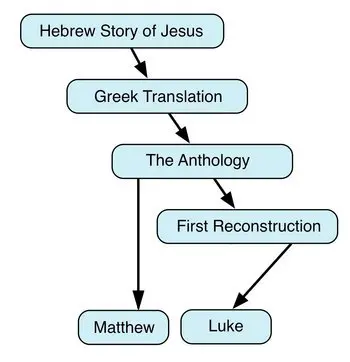
According to Lindsey, the author of Luke relied primarily on two written sources when composing his Gospel. The first of these sources was the Anthology (Anth.), which was characterized by Hebraic Greek due to its direct descent from the Greek translation of the Hebrew Life of Yeshua. Like the author of Luke, the authors of Mark and Matthew had access to this source. Luke’s second source was the First Reconstruction (FR), a stylistically improved epitome of Anth. that attempted to place the sayings and deeds of Jesus in a narrative framework. Of the three evangelists only the author of Luke had access to FR.
Determining the source from which the author of Luke took Places of Honor is surprisingly difficult. On the one hand, Places of Honor follows a pericope—Man with Edema—we have traced to FR, and since the author of Luke tended to take over his source material in blocks, the proximity of Places of Honor to Man with Edema in Luke supports its derivation from FR. In addition, parts of Places of Honor are resistant to Hebrew retroversion, which may also be an indication of this pericope’s origin in FR. On the other hand, Places of Honor does not include much in the way of vocabulary distinctive to FR, which leaves open the possibility that the pericope’s resistance to Hebrew retroversion is due to Lukan rather than FR editorial activity. Moreover, on a few occasions we have found that the author of Luke inserted a pericope from one source into a block of material taken over from the other, as happened with the FR version of the Lord’s Prayer, which was inserted into a section of Anth. material on prayer.[9] So despite his tendency to take over his sources in blocks rather than alternating between his sources from one pericope to the next, the author of Luke could have taken Places of Honor from Anth. and inserted it into FR surroundings.
On balance, however, we think it is more likely that Luke’s version of Places of Honor stems from FR. In Narrow Gate we observed the First Reconstructor creating a segue for Jesus’ saying by borrowing vocabulary and concepts from the saying itself (see Narrow Gate, Comment to L6). The use of the same strategy to introduce Places of Honor points to FR as Luke’s source for this pericope.
From the point of view of Lindsey’s hypothesis, the Anthology is by definition the source of Matthew’s version of the proverb that comes at the end of Places of Honor (Matt. 23:12). This is not to say, however, that Matthew’s version is automatically to be preferred, since the author of Matthew was fully capable of adapting and otherwise editing the wording of his sources. Scholars who adhere to the Two-source Hypothesis are divided between those who attribute the proverb about exaltation and humiliation to “Q”[10] and those who regard it as a stray saying picked up from oral tradition.[11]
Versions of the proverb Jesus quotes at the end of Places of Honor are found elsewhere in the New Testament and in rabbinic sources, as the following sample shows:
ταπεινώθητε ἐνώπιον τοῦ κυρίου καὶ ὑψώσει ὑμᾶς
Be humbled before the Lord, and he will exalt you. (James 4:10; cf. 1 Pet. 5:6)
רבי יוסי אומר רד למעלה עלה למטה אם השפיל אדם עצמו למטה מגביהין אותו למעלה ואם הגביה את עצמו למעלה משפילין אותו למטה
Rabbi Yose says, “Descend upward! Ascend downward! If a person humbles himself below, they will exalt him above. And if he exalts himself above, they will humble him below.” (Avot de-Rabbi Natan, Version B §22 [ed. Schechter, 46])
שכל המשפיל עצמו הקב″ה מגביהו וכל המגביה עצמו הקב″ה משפילו כל המחזר על הגדולה גדולה בורחת ממנו וכל הבורח מן הגדולה גדולה מחזרת אחריו וכל הדוחק את השעה שעה דוחקתו וכל הנדחה מפני שעה שעה עומדת לו
…that everyone who humbles himself the Holy One, blessed be he, exalts him, and everyone who exalts himself the Holy One, blessed be he, humbles him. Everyone who seeks greatness greatness flees from him, and everyone who flees from greatness greatness seeks after him. And all who force the hour the hour forces him, and all who yield before the hour the hour stops for him. (b. Eruv. 13b)
ואם השפלת עצמך, הקדוש ברוך הוא מגביהך
And if you humble yourself, the Holy One, blessed be he, will exalt you. (Masechet Derech Eretz 7:36 [ed. Higger, 146])
כל המשפיל עצמו מגביהין אותו
Everyone who humbles himself they exalt him. (Masechet Derech Eretz Zeira §4 [Masechtot Zeirot, ed. Higger, 91])
The antiquity of this proverb is proved by Hillel’s adaptation of the proverb and by its presence in the Epistle of James.[12] Some versions of the proverb are explicit that it is God who decides the humiliation or exaltation each person ultimately receives (James 4:10; b. Eruv. 13b; Masechet Derech Eretz 7:36), while other versions more generally state the rule or principle that pridefulness leads to embarrassment, but humility leads to honor (Luke 14:11 [Jesus]; Lev. Rab. 1:5 [Hillel]; Avot de-Rabbi Natan, Version B §22 [Rabbi Yose]). Since it is unlikely that God’s direct involvement in distributing honors would have been eliminated from the proverb had it originally been present, and since laying down generally applicable truths is more appropriate to the genre of proverbial sayings, the versions that state the general principle that those who exalt themselves are humbled, etc., are probably closer to the proverb’s original meaning. In our view, it is preferable to regard Hillel’s dictum—“My humiliation is my exaltation. My exaltation is my humiliation”—as a highly personalized adaptation of the proverb than to view the less egocentric versions of the proverb as debased forms of Hillel’s dictum. Rabbi Yose’s version of the proverb—“If a person humbles himself below, they will exalt him above. And if he exalts himself above, they will humble him below”—has the greatest potential for being understood in several different ways,[13] and may, therefore, come closest to the proverb’s original formulation, since something like it would have been capable of giving rise to all the other versions.
Crucial Issues
- Is the advice given in Places of Honor unworthy of Jesus?
Comment
L1 καὶ εἶπεν (GR). Most of Luke 14:7 can be attributed to the editorial work of the First Reconstructor,[14] who, however, likely expanded a simple transitional statement[15] such as “and he said to them” into the more detailed description we now read in Luke. If in L1 Anth. read καὶ εἶπεν (kai eipen, “and he said”), then Luke’s ἔλεγεν δέ (elegen de, “but he was saying”), with the verb in the imperfect tense and a more refined Greek conjunction, reflects the First Reconstructor’s stylistic polishing of Anth.’s translation Greek.
The double use of the preposition πρός (pros, “to,” “toward”) in Luke 14:7 (L1, L3) provides evidence of editorial activity. Everything sandwiched between the repeated preposition is designed to integrate Places of Honor into its current context and may be regarded as FR redaction. Some of the vocabulary and all of the content of the description bookended by the two instances of πρός are drawn from the saying itself. For instance, the use of a participial form of the verb καλεῖν (kalein, “to call”) for referring to the “guests” (literally, “ones who had been called”) draws from the vocabulary of Jesus’ saying about how to behave when one is “called” (i.e., invited) to a wedding feast (L4, L11). The use of καλεῖν in Luke 14:7 also helps to bind Places of Honor more closely to Open Invitation and the Great Banquet parable, both of which feature καλεῖν as a key term.[16] Further instances of themes and vocabulary in Luke 14:7 that are drawn from the saying proper will be discussed in Comment to L2.
The characterization in Luke 14:7 of Jesus’ saying in Places of Honor as a παραβολή (parabolē, “parable”) has puzzled scholars, since Jesus’ words about seating arrangements are not given as an analogy for understanding some other situation or concept but as straightforward advice.[17] Thus, Places of Honor does not conform to the standard definition of a parable. To resolve this difficulty some scholars have suggested that the reference to a parable in Luke 14:7 was intended as an introduction not only to Places of Honor (Luke 14:7-11) but also to Open Invitation (Luke 14:12-14) and the Great Banquet parable (Luke 14:16-24), the latter of which is a true parable.[18] But this solution falters on two grounds. 1) Had the author of Luke 14:7 wished to designate each of these sayings as parables, he ought to have written, τὰς παραβολὰς ταύτας (tas parabolas tavtas, “these parables”) rather than παραβολήν (parabolēn, “a parable”). 2) The wording of Luke 14:7 is clear that the (singular) parable was told in response to Jesus’ observation of the guests’ behavior. Since only Places of Honor addresses the guests (cf. Luke 14:12, which makes clear that the audience of the subsequent sayings is the host rather than the guests) and their behavior, “parable” too must be limited to Places of Honor and cannot include the subsequent sayings.
Other scholars have supposed that although the saying does not have the form of a parable, the author of Luke wanted Places of Honor to be understood as a parable so that his readers would apply the secular advice given in Places of Honor to their spiritual lives.[19] This suggestion, however, probably has more to do with scholars’ embarrassment by what they regard as a “secular” saying in the teachings of Jesus than the verse’s actual intention.
We suspect the First Reconstructor referred to Jesus’ saying as a παραβολή because he was aware of its relationship to the verses in Proverbs that read:
אַל־תִּתְהַדַּר לִפְנֵי־מֶלֶךְ וּבִמְקוֹם גְּדֹלִים אַל־תַּעֲמֹד׃ כִּי טוֹב אֲמָר־לְךָ עֲלֵה הֵנָּה מֵהַשְׁפִּילְךָ לִפְנֵי נָדִיב וגו′
Do not flatter yourself before a king, and in the place of the great do not stand. For it is better that it is said to you, “Ascend hither!” than for you to be humiliated before a noble…. (Prov. 25:6-7)[20]
Although the LXX translators used the noun παροιμία (paroimia, “maxim,” “proverb”) to render מָשָׁל (māshāl, “proverb,” “parable”) in the title of the book of Proverbs (Παροιμίαι Σαλωμῶντος υἱοῦ Δαυιδ [Paroimiai Salōmōntos huiou David, “Maxims of Solomon son of David”] = מִשְׁלֵי שְׁלֹמֹה בֶן־דָּוִד [mishlē shelomoh ven dāvid, “The Proverbs of Solomon son of David”]; Prov. 1:1), Greek authors sometimes referred to the individual proverbs of Solomon by the term παραβολή (cf., e.g., 3 Kgdms. 5:12; Jos., Ant. 8:44). The First Reconstructor, therefore, could easily have referred to Jesus’ saying as a παραβολή because he knew it to be based on one of Solomon’s proverbs.
וַיֹּאמֶר (HR). On reconstructing εἰπεῖν (eipein, “to say”) with אָמַר (’āmar, “say”), see Widow’s Son in Nain, Comment to L12.
L2 ἐπέχων πῶς τὰς πρωτοκλισίας ἐξελέγοντο (Luke 14:7). In order to introduce Jesus’ advice about choosing one’s seat at a wedding banquet the First Reconstructor describes Jesus’ observing (ἐπέχων [epechōn, “directing [his attention]”) the other guests doing the very thing the saying advises against. The basic meaning of the verb ἐπέχειν (epechein) is “to have hold upon” or “to take hold upon” something. The verb can also be used in the sense of “to hold towards” or “to direct towards” something. Here the implied but unstated object of the verb is τὴν διάνοιαν αὐτοῦ (tēn dianoian avtou, “his thought”) or τὸν νοῦν αὐτοῦ (ton noun avtou, “his mind”) or the like.[21] It is not surprising that this usage of ἐπέχειν does not occur in the parts of LXX translated from Hebrew,[22] since Hebrew cannot express the concept of fixing one’s attention with a single verb. This usage of ἐπέχειν does not occur elsewhere either in Luke’s Gospel or in the rest of the synoptic tradition.[23] And since this usage of ἐπέχειν occurs only once in Acts (Acts 3:5), it cannot be regarded as especially Lukan. Hence our conclusion that the description of Jesus’ fixing his attention stems from FR.[24]
The reference to the guests’ selection of τὰς πρωτοκλισίας (tas prōtoklisias, “the first couches”) borrows vocabulary directly from Jesus’ saying (L5), in which he instructs his audience μὴ κατακλιθῇς εἰς τὴν πρωτοκλισίαν (mē kataklithēs eis tēn prōtoklisian, “do not recline in the first couch”; Luke 14:8). Within the synoptic tradition, the term πρωτοκλισία (prōtoklisia, “first couch”), which refers to the Greco-Roman custom of reclining on couches at mealtime, occurs only here and in Making a Show, where Jesus criticizes the scribes who love the “first couches” at banquets. Flusser believed the author of Luke tendentiously inserted references to “first couches” into Places of Honor in order to turn Jesus’ advice about seating arrangements into a polemic against the Pharisees.[25] But for several reasons Flusser’s suggestion is unlikely to be correct. First, in Luke’s Gospel Jesus’ condemnation of the scribes for loving the “first couches” at banquets (Luke 20:46) does not occur until long after the references to “first couches” in Places of Honor (Luke 14:7, 8), so nothing in Luke has prepared readers of the Gospel to associate “first couches” with the Pharisees. Without such preparation, the mere use of the term “first couches” does not effectively weaponize the saying into a polemic against the Pharisees. Second, when in Luke’s Gospel Jesus does criticize a certain group for loving the “first couches” at banquets, it is the scribes, not the Pharisees, who are the target of Jesus’ criticism. So the mere use of the term “first seats” is not particularly apt for turning Places of Honor into a polemic against the Pharisees. Third, some term for “best seat” or “place of honor” must have been present in L5 in order for Jesus’ saying to make sense, and πρωτοκλισία meets that requirement admirably. Not only does πρωτοκλισία possess the required meaning, but it is a term that is known to have been used elsewhere in the synoptic tradition. Fourth, the use of πρωτοκλισία (“first couch”) in the redactional portion of Luke 14:7 is best explained as having been drawn from Luke 14:8, which implies that the First Reconstructor already found πρωτοκλισία there in his source (Anth.).
Nevertheless, Flusser’s observation that πρωτοκλισία occurs in only two sayings of Jesus, Places of Honor and Making a Show, remains important. We regard this shared terminology as a clue that originally these two pericopae belonged together. First, Jesus criticized the scribes for, inter alia, loving the “first couches” at banquets, then Jesus advised his audience to act differently by not appropriating the “first couch” for oneself.
L3 πρὸς αὐτούς (GR). As we noted above in Comment to L1, the repetition of the preposition πρός (pros, “to”; L1, L3) marks the boundary between which the First Reconstructor inserted his additional wording. At the second πρός the First Reconstructor begins once more to follow his source (Anth.).
Negative Scenario (L4-10)
L4 ὅταν καλέσουσίν σοι εἰς γάμους (GR). Luke’s phrasing in L4 does not revert easily to Hebrew. The use of the passive subjunctive verb κληθῇς (klēthēs, “you might be called”) with the prepositional phrase ὑπό τινος (hūpo tinos, “by someone”) looks like FR’s stylistic polishing of something more Hebraic in Anth. The use of ὑπό τινος after a passive verb is, moreover, confined to Luke’s Gospel in the synoptic tradition, occurring in Luke’s versions of Herodes Wonders About Yeshua (Luke 9:7, 8) and Places of Honor (Luke 14:8). Although we have yet to determine Luke’s source for Herodes Wonders About Yeshua, derivation from FR seems likely since it occurs between the FR versions of Sending the Twelve and Return of the Twelve. Therefore, all instances of ὑπό τινος following a passive verb may be due to FR redaction. Since ὑπό τινος following a passive verb does not occur in Acts, this usage is probably a reflection of Luke’s source (FR) rather than the product of Lukan redactional activity. Perhaps behind FR’s stylistically refined phrase κληθῇς ὑπό τινος (“you might be called by someone”) there stood in Anth. a more Hebraic phrase like καλέσουσίν σοι (kalesousin soi, “they will call you”). Hebrew often used third-person plural verbs in an impersonal sense to avoid the passive voice (i.e., “when they will call you” instead of “when you might be called”).[26] This supposition is reflected in GR.
כְּשֶׁיִּקְרְאוּ לְךָ לְבֵית הַמִּשְׁתֶּה (HR). On reconstructing ὅταν (hotan, “when”) with -כְּשֶׁ (keshe-, “when that,” “as that”), see Lord’s Prayer, Comment to L9.
On reconstructing καλεῖν (kalein, “to call”) with קָרָא (qārā’, “call”), see Call of Levi, Comment to L65. Both the Greek and the Hebrew verbs are used here in the sense of “invite.”
On reconstructing γάμος (gamos, “wedding,” “wedding feast”) with בֵּית מִשְׁתֶּה (bēt mishteh, “house of a banquet,” “banqueting hall,” “wedding feast”), see Waiting Maidens, Comment to L29.
L5 μὴ καθίσῃς εἰς τὴν πρωτοκλισίαν (GR). We have accepted nearly all of Luke’s wording in L5 for GR, the only exception being the verb κατακλίνειν (kataklinein, “to recline”), a verb that is peculiar to Luke in the synoptic tradition.[27] We suspect either the First Reconstructor or the author of Luke of supplying this rather elegant compound verb[28] as a substitute for a simpler and more common verb like καθίζειν (kathizein, “to sit”). The use of the term πρωτοκλισία (prōtoklisia, “first couch”) here in L5, which we have traced back to Anth. (see above, Comment to L2), would have provided ample impetus for either writer to have made this substitution, since a couch was a place for reclining on one’s side rather than sitting upright. The reference to the other guests as συνανακείμενοι (sūnanakeimenoi, “fellow recliners”) in L18 (Luke 14:10) may also have contributed to this substitution. Nevertheless, the important rabbinic parallel to Places of Honor we discussed in the Story Placement section above refers to sitting using the verb יָשַׁב (yāshav, “sit”) rather than to reclining, which would be expressed with the verb הֵסֵב (hēsēv, “recline”):
ר′ עקיבה מתני לה בש′ ר′ שמעון בן עזאי רחק ממקומך שנים ושלשה מקומות ושב. רד שיאמרו לך עלה ואל תעלה שיאמרו לך רד
Rabbi Akiva repeated in the name of Rabbi Shimon ben Azzai, “Distance yourself from your place two or three places and sit [וְשֵׁב]. Descend, that they will say to you, ‘Go up!’ and do not ascend, that they will say to you, ‘Go down!’” (Lev. Rab. 1:5 [ed. Margulies, 1:16-17]; cf. Avot de-Rabbi Natan, Version A, §25 [ed. Schechter, 81])
We think it is likely, given the striking similarities between Ben Azzai’s saying and Places of Honor, that Jesus’ saying originally referred to sitting rather than reclining, too.
אַל תֵּשֵׁב בַּמָּקוֹם הָרִאשׁוֹן (HR). On reconstructing καθίζειν (kathizein, “to sit”) with יָשַׁב (yāshav, “sit”), see Widow’s Son in Nain, Comment to L16. The imperative אַל תֵּשֵׁב (’al tēshēv, “do not sit”) in our reconstruction parallels the imperative אַל תַּעֲלֵה (’al ta‘alēh, “do not ascend”) in Ben Azzai’s saying.
Hebrew lacks a single term corresponding to πρωτοκλισία (prōtoklisia, “first couch”). Nevertheless, because of the evidence for the presence of πρωτοκλισία in Anth.’s versions of Making a Show and Places of Honor, we believe the Greek translator of the Hebrew Life of Yeshua must have used πρωτοκλισία to translate something in his Hebrew text. Since the noun πρωτοκλισία does not occur in LXX, the Greek translation of the Hebrew Scriptures gives no clue as to what that something might be. In Making a Show πρωτοκλισία is paired with πρωτοκαθεδρία (protokathedria, “first chair”). But neither term is attested in the ancient sources apart from the Gospels or writings based upon them,[29] so it is conceivable that the Greek translator of Jesus’ words coined them. Or, perhaps more plausibly, the Greek translator used a colloquial term that did not find its way into more literary sources.[30] How, then, can we hope to reconstruct them?
One clue is that in Places of Honor πρωτοκλισία (“first couch”) is contrasted with τόπος ἔσχατος (topos eschatos, “last place”), a phrase that is much easier to revert to Hebrew.[31] If τόπος ἔσχατος corresponds to מָקוֹם אָחֲרוֹן (māqōm ’āḥarōn, “last place”), then perhaps πρωτοκλισία corresponds to מָקוֹם רִאשׁוֹן (māqōm ri’shōn, “first place”). Ben Azzai’s parallel saying, where the word מָקוֹם (māqōm, “place”) plays a prominent role, supports this supposition:
רחק ממקומך שנים ושלשה מקומות ושב
Distance yourself from your place [מִמְּקוֹמְךָ] two or three places [מְקוֹמוֹת] and sit. (Lev. Rab. 1:5 [ed. Margulies, 1:16])
Our reconstruction can also be compared to the regulations governing seating arrangements in the sectarian Rule of the Community:
הזה הסרך למושב הרבים איש בתכונו הכוהנים ישבו לרשונה והזקנים בשנית ושאר כול העם ישבו איש בתכונו
And this is the rule for the seating of the many: each is by rank. The priests must sit at the first [לָרִשׁוֹנָה], the elders in the second, and the remainder of all the people must sit each by his rank. (1QS VI, 8-9)
We suspect that whereas the Hebrew version of Making a Show referred to prime seating locations, for whatever reason the Greek translator of Jesus’ saying chose vocabulary that specified preferred furniture (viz., chairs, couches). Having used πρωτοκλισία (“first couch”) in Making a Show to translate מָקוֹם רִאשׁוֹן (“first place”),[32] the Greek translator continued using πρωτοκλισία to translate מָקוֹם רִאשׁוֹן in Places of Honor, even though this translation produced a certain asymmetry between πρωτοκλισία (“first couch”) and τόπος ἔσχατος (“last place”).
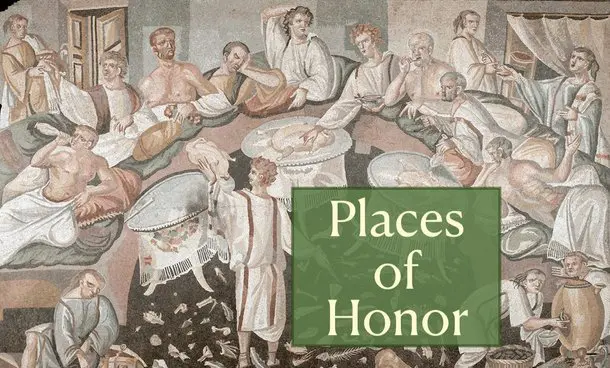
The preferred seating at an ancient banquet was that which was closest to the host. In a Greco-Roman triclinium the host’s place would have been at the top left of the Π-shaped arrangement. The most honored place was to the host’s right, or the upper end of the left leg of the Π-shaped arrangement.[33]
L6 μήποτε ἐντιμότερός σου ᾖ κεκλημένος ὑπ’ αὐτοῦ (Luke 14:8). Luke’s description of “one more worthy than you” who “might be invited by him” is difficult to revert to Hebrew and bears the markings of FR redaction. The comparative adjective ἐντιμότερος (entimoteros, “more honored,” “more valued”) does not occur elsewhere in the synoptic tradition, but the sole instance of ἔντιμος (entimos, “honored,” “valued”) in the Synoptic Gospels occurs in Luke’s version of Centurion’s Slave (Luke 7:2),[34] which comes from FR. The participle κεκλημένος (keklēmenos, “invited”) is the same as occurred in the redactional portion of L1 to refer to the guests. “By him” (ὑπ’ αὐτοῦ [hūp avtou]), meanwhile, echoes the redactional ὑπό τινος (hūpo tinos, “by someone”) in L4. These facts lead us to suspect the First Reconstructor of having added this description to Jesus’ saying. This supposition gains support from Ben Azzai’s parallel saying (“Descend, that they will say to you, ‘Go up!’ and do not ascend, that they will say to you, ‘Go down!’” [Lev. Rab. 1:5]), which does not make reference to a more important guest. The host’s words in L8 (“Give a place to this one!”), which imply the presence of a more important guest, may have been the genesis of FR’s redactional insertions in L6 and L7.
μήποτε (GR). We regard μήποτε (mēpote, “lest”) as the only word in L6 that can be traced back to Anth.
שֶׁמָּא (HR). On reconstructing μήποτε (mēpote, “lest”) with שֶׁמָּא (shemā’, “lest”), see Tower Builder and King Going to War, Comment to L5-6.
L7 ἐλθὼν ὁ οἰκοδεσπότης ἐρεῖ σοι (GR). Luke’s version of Places of Honor refers to the host as ὁ σὲ καὶ αὐτὸν καλέσας (ho se kai avton kalesas, “the one calling you and him [i.e., the more valued guest]”). Since we regard the explicit references to a more honored guest as FR insertions, this cannot be how Anth.’s version of the saying referred to the host. While it is possible that Anth. simply referred to the host as ὁ καλέσας σὲ (ho kalesas se, “the one calling you”)—note the more Hebraic word order—we have found that participial forms of καλεῖν (kalein, “to call”) to refer to the guests (L1, L6) are FR contributions, so it is probable that participial forms of καλεῖν that refer to the host are redactional, too. Also, it is hard to imagine the host being referred to as הַקֹּרֵא לְךָ (haqorē’ lechā, “the one calling you”) in the Hebrew form of Jesus’ saying,[35] since this is not the usual way in Hebrew to refer to a host. The expected Hebrew term for “host” is בַּעַל בַּיִת (ba‘al bayit, lit., “master/owner of a house”),[36] which might be rendered into Greek as οἰκοδεσπότης (oikodespotēs, “house master,” “householder”). If the First Reconstructor read οἰκοδεσπότης in Anth., he might have wished to change this to ὁ σὲ…καλέσας (ho se…kalesas, “the one calling you”) in L7 and ὁ κεκληκώς σε (ho keklēkōs se, “the one calling you”) in L14 because unlike בַּעַל בַּיִת, οἰκοδεσπότης does not normally mean “host”[37] and would have seemed out of place. This explains our departures from Luke’s wording in GR.
יָבֹא בַּעַל הַבַּיִת וְיֹאמַר לְךָ (HR). On reconstructing ἔρχεσθαι (erchesthai, “to come”) with בָּא (bā’, “come”), see Demands of Discipleship, Comment to L8.
On reconstructing οἰκοδεσπότης (oikodespotēs, “house master,” “householder”) with בַּעַל בַּיִת (ba‘al bayit, “master/owner of a house,” “householder,” “landlord,” “host”), see Closed Door, Comment to L2.
On reconstructing ἐρεῖν (erein, “to say”→εἰπεῖν [eipein, “to say”]), see above, Comment to L1.
L8 [κατάβηθι κατώτερον] δὸς τούτῳ τόπον (GR). We have accepted all of Luke’s wording in L8, which reverts easily to Hebrew, for GR.[38] As we noted above in Comment to L6, it was probably Anth.’s oblique reference to another guest implied by τούτῳ (toutō, “to this one”) that prompted the First Reconstructor to add the direct references to a more honored guest in L6 and L7. In addition to accepting Luke’s wording, however, we have also included within brackets the imperative phrase κατάβηθι κατώτερον (katabēthi katōteron, “Descend lower!”), which corresponds to the host’s words άνάβηθι ἀνώτερον (anabēthi anōteron, “Ascend higher!”) in L16. Not only does the inclusion of κατάβηθι κατώτερον lend the saying greater symmetry between L8 and L16, it also enhances the parallelism between the Proverbs-based scenario and the concluding proverb:
|
Scenario |
Proverb |
|
Do not sit in the first place |
Everyone who exalts himself |
|
lest the host comes and says to you, “Descend lower!”…. |
will be humbled, |
|
Sit in the last place |
and everyone who humbles himself |
|
and the host will come and say to you, “Friend, ascend higher!” |
will be exalted. |
Moreover, the imperative “Descend!” features prominently in rabbinic parallels to Jesus’ saying:
רד שיאמרו לך עלה ואל תעלה שיאמרו לך רד. מוטב שיאמרו לך עלה עלה ואל יאמרו לך רד רד
Descend [רֵד], that they will say to you, “Go up!” and do not ascend, that they will say to you, “Go down!” It is better that they say to you, “Go up! Go up!” but do not let them say to you, “Go down! Go down! [רֵד רֵד].” (Lev. Rab. 1:5 [ed. Margulies, 1:16-17])
רבי יוסי אומר רד למעלה עלה למטה אם השפיל אדם עצמו למטה מגביהין אותו למעלה ואם הגביה את עצמו למעלה משפילין אותו למטה
Rabbi Yose says, “Descend [רֵד] upward! Ascend downward! If a person humbles himself below, they will exalt him above. And if he exalts himself above, they will humble him below.” (Avot de-Rabbi Natan, Version B §22 [ed. Schechter, 46])
הִלֵּל אוֹמֵר הַשְׁפָּלָתִי זוֹ הַגְבָּהָתִי וְהַגְבָּהָתִי זוֹ הַשְׁפָּלָתִי מוּטָב לָאָדָם שֶׁיֹּאמְרוּ לוֹ עֲלֵה לְמָעְלָן וְלֹא יֹאמְרוּ לוֹ רֵד לְמָטָּן
Hillel says, “My humiliation, this is my exaltation. And my exaltation, this is my humiliation. It is better for a person that they will say to him, ‘Go up higher!’ and not say to him, ‘Go down lower [רֵד לְמָטָּן]!’” (Exod. Rab. 45:5 [ed. Merkin, 6:171])
These rabbinic parallels support our hypothesis that prior to the First Reconstructor’s redaction Places of Honor included the host’s giving the command, “Descend lower!” (i.e., “Move down!”). Nevertheless, our hypothesis remains speculative, and to indicate this uncertainty we have enclosed “Descend lower!” in GR and HR within brackets.
[רֵד לְמָטָּן] תֵּן לַזֶּה מְקוֹמְךָ (HR). On reconstructing καταβαίνειν (katabainein, “to descend”) with יָרַד (yārad, “descend”), see Lesson of Lot’s Wife, Comment to L5.
The adverb κατώτερος (katōteros, “lower”) does not occur in LXX, but the rabbinic parallels cited in the foregoing paragraphs supply us with a ready equivalent. The phrase רֵד לְמָטָּן (rēd lemāṭān, “Descend lower!”) in Hillel’s saying (Exod. Rab. 45:5) and the paradoxical עֲלֵה לְמַטָּה (‘alēh lemaṭāh, “Ascend downward!”) in Rabbi Yose’s saying (Avot de-Rabbi Natan, Version B §22) indicate that either לְמַטָּה (lemaṭāh, “lower,” “downward”) or its variant לְמָטָּן (lemāṭān, “lower,” “downward”) is a solid choice for HR. We have preferred לְמָטָּן because, according to Segal, this form is especially common in sources from the land of Israel.[39]
On reconstructing διδόναι (didonai, “to give”) with נָתַן (nātan, “give”), see Widow’s Son in Nain, Comment to L18.
On reconstructing τόπος (topos, “place”) with מָקוֹם (māqōm, “place”), see Lord’s Prayer, Comment to L2. To מָקוֹם we have attached the second-person singular possessive suffix ךָ- (-chā, “your”). Although the Greek text lacks an equivalent pronoun, a possessive form would be expected in Hebrew, and Greek translators of Hebrew texts often omitted equivalents to pronominal suffixes in their translations.
L9 καὶ τότε μετὰ αἰσχύνης προσώπου ἄρξῃ (GR). With a slight adjustment of the word order to make it more Hebraic, we have accepted Luke’s wording in L9 for GR.[40] However, we have attached the word προσώπου (prosōpou, “of face”) to the prepositional phrase μετὰ αἰσχύνης (meta aischūnēs, “with shame”) on the suspicion that the First Reconstructor would have eliminated such a Hebraism had he encountered it in Anth.
וְאָז בְּבֹשֶׁת פָּנִים תַּתְחִיל (HR). In LXX most instances of τότε (tote, “then”) occur as the translation of אָז (’āz, “then”).[41] Likewise, the LXX translators rendered most instances of אָז as τότε,[42] and since אָז continued to be used in Mishnaic Hebrew, the style of Hebrew in which we prefer to reconstruct direct speech, אָז is a sound choice for HR.
In LXX αἰσχύνη (aischūnē, “shame,” “dishonor”) occurs as the translation of several Hebrew terms, but none so often as בּשֶׁת (boshet, “shame,” “disgrace”).[43] We also find that the LXX translators usually rendered בּשֶׁת as αἰσχύνη.[44] The phrase μετὰ αἰσχύνης (meta aischūnēs, “with shame”) occurs only once in an LXX book corresponding to MT (2 Chr. 32:21), and there it is supplemented by προσώπου (prosōpou, “of face”) and translates the Hebrew idiom בְּבֹשֶׁת פָּנִים (bevoshet pānim, “with shame of face,” i.e., “shamefacedly”). The idiom בְּבשֶׁת פָּנִים also occurs in Ezra 9:7, where it is rendered ἐν αἰσχύνῃ προσώπου (en aischūnē prosōpou, “in shame of face”; 2 Esd. 9:7). Similarly, the phrase בּשֶׁת הַפָּנִים (boshet hapānim, “the shame of face,” i.e., “the shamefacedness”) occurs twice in MT (Dan. 9:7, 8), and both times LXX renders it as ἡ αἰσχύνη τοῦ προσώπου (hē aischūnē tou prosōpou, “the shame of the face”). Although we cannot be certain that this Hebrew idiom occurred in Jesus’ saying, the persistence of this idiom in post-Biblical Hebrew makes this a real possibility.
Below we cite a few examples of בּשֶׁת פָּנִים from rabbinic sources:
ואעשה אותך לגוי גדול וגו′ אמר רבי אלעזר אמר משה לפני הקדוש ב″ה רבונו של עולם…יש בי בושת פנים מאבותי עכשיו יאמרו ראו פרנס שהעמיד עליהם בקש גדולה לעצמו ולא בקש עליהם רחמים
And I will make you a great nation [Exod. 32:10] etc. Rabbi Eleazar said, “Moses said before the Holy One, blessed be he, ‘Master of the universe…I have shamefacedness [בּוֹשֶׁת פָּנִים] before my ancestors. Now they will say, “See the manager that he set over them! He sought greatness for himself, but he did not seek mercy for them.”’” (b. Ber. 32a)
ומפני מה לא מנו את אחז…רב יוסף אמר מפני שהיה לו בשת פנים מישעיהו
And why was Ahaz not counted [among the Israelites with no share in the world to come]?…Rav Yoseph said, “Because he had shamefacedness [בּשֶׁת פָּנִים] before Isaiah….” (b. Sanh. 104a)
In LXX πρόσωπον (prosōpon, “face”) usually occurs as the translation of פָּנִים (pānim, “face”).[45] Likewise, the LXX translators rendered most instances of פָּנִים as πρόσωπον.[46]
On reconstructing ἄρχειν (archein, “to begin”) with הִתְחִיל (hitḥil, “begin”), see Tower Builder and King Going to War, Comment to L8.
L10 κατέχειν τὸν τόπον τὸν ἔσχατον (GR). Once more we have accepted Luke’s wording for GR but slightly altered the ordering to reflect Hebrew syntax. We have also added the definite article to the adjective ἔσχατος (eschatos, “last”) in accordance with Hebrew usage. Probably the First Reconstructor was responsible for making these changes to Anth.’s wording. It is true that in the Four Soils interpretation, L71, we attributed κατέχειν (katechein, “to hold firm,” “to seize,” “to occupy”) to FR. There, however, the sense of κατέχειν was “to hold firm” in reference to God’s word. Here, κατέχειν is used differently, with the meaning “to seize” or “to occupy” a place. Since this usage of κατέχειν reverts easily to Hebrew, we do not regard it as necessarily stemming from FR.[47]
לִתְפּוֹשׂ אֶת הַמָּקוֹם הָאַחֲרוֹן (HR). In LXX the verb κατέχειν (katechein, “to hold firm,” “to seize,” “to occupy”) occurs as the translation of a variety of Hebrew verbs, the most common among them being אָחַז (’āḥaz, “grasp,” “seize”).[48] On one occasion, however, κατέχειν occurs as the translation of תָּפַשׂ (tāfas, “take,” “hold,” “seize,” “occupy”):
כִּרְתוּ זוֹרֵעַ מִבָּבֶל וְתֹפֵשׂ מַגָּל בְּעֵת קָצִיר
Cut off the sower from Babylon and the one taking [וְתֹפֵשׂ; LXX: κατέχοντα] the sickle in the time of harvest…. (Jer. 50:16 [LXX: Jer. 27:16])
We regard תָּפַשׂ as a better option for HR because its semantic range is closer to that of κατέχειν than אָחַז and is capable of the meaning “occupy” a place, as the following example demonstrates:
משל למלך שהיו לו בנים הרבה משהגדילו הלך כל אחד ואחד תפש את מקומו קטן שבהם היה אביו אוהבו אוכל ושותה עמו נשען עליו ויוצא נשען עליו ונכנס
A parable. [The matter may be compared] to a king who had many sons. When they grew up, each one went and occupied his place [תָּפַשׂ אֶת מְקוֹמוֹ]. The smallest of them was his father’s favorite. He ate and drank with him, and leaned on him when he went out, and leaned on him when he entered. (Sifre Deut. §352 [ed. Finkelstein, 413])
On reconstructing τόπος (topos, “place”) with מָקוֹם (māqōm, “place”), see above, Comment to L8.
On reconstructing ἔσχατος (eschatos, “last”) with אַחֲרוֹן (’aḥarōn, “last”), see First and Last, Comment to L3.
Positive Scenario (L11-18)
L11 ἀλλ’ ὅταν καλέσουσίν σοι (GR). As in L4, we suspect that in L11 the First Reconstructor substituted the passive κληθῇς (klēthēs, “you might be called”) for Anth.’s Hebraic impersonal plural καλέσουσίν σοι (kalesousin soi, “they will call you”). Such a substitution would be an example of FR’s stylistic polishing of Anth.’s translation Greek.
It is possible that in L11 the First Reconstructor omitted εἰς γάμους (eis gamous, “to a wedding feast”; cf. L4), but it is just as likely that from the beginning the positive scenario was given in briefer form than the negative scenario.
אֶלָּא כְּשֶׁיִּקְרְאוּ לְךָ (HR). On reconstructing ἀλλά (alla, “but,” “rather”) with אֶלָּא (’elā’, “rather”), see Call of Levi, Comment to L61.
On reconstructing ὅταν (hotan, “when”) with -כְּשֶׁ (keshe-, “when that,” “as that”), see above, Comment to L4.
On reconstructing καλεῖν (kalein, “to call”) with קָרָא (qārā’, “call”), see above, Comment to L4.
L12 πορευθεὶς κάθισον (GR). As in L5, we suspect the First Reconstructor replaced a verb in Anth. for “sit” with a verb for “recline.” An imperative for “sit” occurs in Ben Azzai’s parallel to Places of Honor (Lev. Rab. 1:5).
לֵךְ שֵׁב (HR). It was not uncommon for the LXX translators to render successive imperatives in the Hebrew text with participle + imperative, as we see in the following examples:
קוּם הִתְהַלֵּךְ בָּאָרֶץ לְאָרְכָּהּ וּלְרָחְבָּהּ כִּי לְךָ אֶתְּנֶנָּה׃
Arise! Walk about in the land to its length and its breadth, for to you I will give it. (Gen. 13:17)
ἀναστὰς διόδευσον τὴν γῆν εἴς τε τὸ μῆκος αὐτῆς καὶ εἰς τὸ πλάτος, ὅτι σοὶ δώσω αὐτήν
Arising, traverse the land to its length and its breadth, because to you I will give it. (Gen. 13:17)
קוּם קַח אֶת־אִשְׁתְּךָ וְאֶת־שְׁתֵּי בְנֹתֶיךָ
Arise! Take your wife and your two daughters…. (Gen. 19:15)
Ἀναστὰς λαβὲ τὴν γυναῖκά σου καὶ τὰς δύο θυγατέρας σου
Arising, take your wife and your two daughters…. (Gen. 19:15)
וְעַתָּה לְכוּ עִבְדוּ וְתֶבֶן לֹא־יִנָּתֵן לָכֶם
And now, go! Work! But straw will not be given to you. (Exod. 5:18)
νῦν οὖν πορευθέντες ἐργάζεσθε· τὸ γὰρ ἄχυρον οὐ δοθήσεται ὑμῖν
Now, therefore, going, work! For the straw will not be given to you. (Exod. 5:18)
לְכוּ זִבְחוּ לֵאלֹהֵיכֶם בָּאָרֶץ
Go! Sacrifice to your God in the land! (Exod. 8:21)
Ἐλθόντες θύσατε τῷ θεῷ ὑμῶν ἐν τῇ γῇ
Going, sacrifice to your God in the land! (Exod. 8:21)
Based on examples such as these, we feel fully justified in reconstructing Luke’s participle + imperative with the double Hebrew imperative לֵךְ שֵׁב (lēch shēv, “Go! Sit!”).
On reconstructing πορεύεσθαι (porevesthai, “to go”) with הָלַךְ (hālach, “walk,” “go”), see Widow’s Son in Nain, Comment to L2.
On reconstructing καθίζειν (kathizein, “to sit”) with יָשַׁב (yāshav, “sit”), see above, Comment to L5.
L13 εἰς τὸν τόπον τὸν ἔσχατον (GR). On our minor adjustments to Luke’s wording, see above, Comment to L10.
בַּמָּקוֹם הָאַחֲרוֹן (HR). On reconstructing τόπος (topos, “place”) with מָקוֹם (māqōm, “place”) and on reconstructing ἔσχατος (eschatos, “last”) with אַחֲרוֹן (’aḥarōn, “last”), see above, Comment to L10.
L14-15 ἵνα ὅταν ἔλθῃ ὁ οἰκοδεσπότης ἐρεῖ σοι (GR). We might suspect that ἵνα ὅταν ἔλθῃ (hina hotan elthē, “so that when he might come”), which differs from ἐλθών (elthōn, “coming”) in the negative scenario (L7), is due to the editorial intervention of FR. However, this appears not to be the case, because it is unlikely that the First Reconstructor would have inserted the ἵνα (hina, “so that”) of a purpose clause without also ensuring that the verb of the purpose clause (“he will say”) was put into the subjunctive mood. This grammatical error is more likely to have been committed by the Greek translator of the Hebrew Life of Yeshua than the First Reconstructor, who was typically keen to improve upon his source’s Greek style.[49] In the present case, the subjunctive mood of ἔλθῃ (elthē, “he might come”) likely distracted the First Reconstructor from noticing this grammatical error. Thus, the only emendation we have made to Luke’s wording in L14 is to change ὁ κεκληκώς σε (ho keklēkōs se, “the one calling you”) to ὁ οἰκοδεσπότης (ho oikodespotēs, “the householder”). On our reasons for doing so, see above, Comment to L7.
On reconstructing ὅταν (hotan, “when”) with -כְּשֶׁ (keshe-, “when that,” “as that”), see above, Comment to L4.
On reconstructing ἔρχεσθαι (erchesthai, “to come”) with בָּא (bā’, “come”), see above, Comment to L7.
On reconstructing οἰκοδεσπότης (oikodespotēs, “house master,” “householder”) with בַּעַל בַּיִת (ba‘al bayit, “master/owner of a house,” “householder,” “landlord,” “host”), see above, Comment to L7.
On reconstructing ἐρεῖν (erein, “to say”→εἰπεῖν [eipein, “to say”]), see above, Comment to L7.
L16 φίλε ἀνάβηθι ἀνώτερον (GR). We suspect that Luke’s double compound verb προσαναβαίνειν (prosanabainein, “to ascend toward”) is a stylistic improvement the First Reconstructor made in order to indicate that the host’s order to move higher up was also a move closer to the host. If so, the First Reconstructor may have been influenced by the LXX translation of Prov. 25:7, the verse upon which he knew Jesus’ saying to have been based (see above, Comment to L1), since LXX interpreted the command עֲלֵה הֵנָּה (‘alēh hēnāh, “Ascend hither!”) as ἀνάβαινε πρός με (anabaine pros me, “Come up to me!”). Given our suspicion, we have replaced Luke’s προσαναβαίνειν with the less colorful ἀναβαίνειν (anabainein, “to ascend”). Otherwise, we have accepted Luke’s wording in L16 for GR.
אוֹהֲבִי עֲלֵה לְמַעְלָן (HR). On reconstructing φίλος (filos, “friend”) with אוֹהֵב (’ōhēv, “loved one,” “friend”), see Lost Sheep and Lost Coin, Comment to L27-28.
On reconstructing ἀναβαίνειν (anabainein, “to ascend”) with עָלָה (‘ālāh, “ascend”), see Yeshua’s Immersion, Comment to L24.
“Ascend!” echoes the phrase כִּי טוֹב אֲמָר לְךָ עֲלֵה הֵנָּה (ki ṭōv ’amār lechā ‘alēh hēnāh, “because it is better that it be said to you, ‘Ascend hither!’…”; Prov. 25:7). The imperative עֲלֵה (‘alēh, “Ascend!”) also features prominently in Ben Azzai’s parallel to Jesus’ saying:
רד שיאמרו לך עלה ואל תעלה שיאמרו לך רד. מוטב שיאמרו לך עלה עלה ואל יאמרו לך רד רד
Descend, that they will say to you, “Go up! [עֲלֵה]” and do not ascend, that they will say to you, “Go down!” It is better that they say to you, “Go up! [עֲלֵה] Go up! [עֲלֵה],” but do not let them say to you, “Go down! Go down!” (Lev. Rab. 1:5 [ed. Margulies, 1:16-17])
The same imperative features prominently in Rabbi Yose’s related paradox:
רבי יוסי אומר רד למעלה עלה למטה אם השפיל אדם עצמו למטה מגביהין אותו למעלה ואם הגביה את עצמו למעלה משפילין אותו למטה
Rabbi Yose says, “Descend upward! Ascend [עֲלֵה] downward! If a person humbles himself below, they will exalt him above. And if he exalts himself above, they will humble him below.” (Avot de-Rabbi Natan, Version B §22 [ed. Schechter, 46])
In LXX the adjective ἀνώτερος (anōteros, “higher”) occurs only 4xx (2 Esd. 13:25; Tob. 8:3; Ezek. 41:7 [2xx]).[50] The two instances in Ezek. 41:7 occur as the translation of לְמַעְלָה (lema‘lāh, “higher,” “upward”). For HR we have adopted the variant form לְמַעְלָן (lema‘lān, “higher,” “upward”), which occurs in Hillel’s parallel to Jesus’ saying:
הִלֵּל אוֹמֵר הַשְׁפָּלָתִי זוֹ הַגְבָּהָתִי וְהַגְבָּהָתִי זוֹ הַשְׁפָּלָתִי מוּטָב לָאָדָם שֶׁיֹּאמְרוּ לוֹ עֲלֵה לְמָעְלָן וְלֹא יֹאמְרוּ לוֹ רֵד לְמָטָּן
Hillel says, “My humiliation, this is my exaltation. And my exaltation, this is my humiliation. It is better for a person that they will say to him, ‘Go up higher’ [עֲלֵה לְמָעְלָן], and not say to him, ‘Go down lower.’” (Exod. Rab. 45:5 [ed. Merkin, 6:171])
L17 καὶ τότε ἔσται σοι δόξα (GR). As we noted above in Comment to L9, τότε (tote, “then”) is not typical of the author of Luke’s style and likely comes from a source. Neither is ascribing δόξα (doxa, “glory”) to an individual in a purely secular sense a feature of Lukan redaction. The phrase ἔσται σοι δόξα (estai soi doxa, “will be to you glory”) looks like a Hebraism. Lacking a verb for “to have,” Hebrew expresses possession with a “to be” verb plus the “to” preposition (-לְ [le-]) plus a pronominal suffix plus the possessed object (e.g., תִּהְיֶה לְךָ חִיבָּה [tihyeh lechā ḥibāh, “will be to you honor”). Greek might more naturally express this as ἕξεις δόξαν (hexeis doxan, “you will have glory”).[51] Thus, it appears all of Luke’s wording in L17, which reverts easily to Hebrew, comes, via FR, from Anth. We have, however, added the conjunction καί (kai, “and”) before τότε in conformity with Luke’s wording in L9. The First Reconstructor or the author of Luke himself could easily have omitted the conjunction as superfluous.
וְאָז תִּהְיֶה לְךָ חִיבָּה (HR). On reconstructing τότε (tote, “then”) with אָז (’āz, “then”), see above, Comment to L9.
On reconstructing εἶναι (einai, “to be”) with הָיָה (hāyāh, “be”), see Call of Levi, Comment to L30.
Elsewhere we have reconstructed δόξα (doxa, “glory”) with כָּבוֹד (kāvōd, “glory”),[52] but in the present context “glory” seems too grand a term. An alternative available in Mishnaic Hebrew is חִיבָּה (ḥibāh, “esteem,” “honor”), which has the correct connotation for a banquet setting. Since the noun חִיבָּה does not occur in MT, we are not able to cite LXX in support of our reconstruction.
L18 ἐνώπιον πάντων τῶν συνανακειμένων σοι (GR). The phrase ἐνώπιον πάντων (enōpion pantōn, “before all”) reverts easily to Hebrew, and so there is no obstacle to adopting it for GR. The reference to the guests by the term συνανακειμένος (sūnanakeimenos, “fellow recliner”) is more open to doubt, since it is a participial form of a double compound verb and since we have found other references in Places of Honor to “reclining” to be the product of FR redaction. Here, however, we are inclined to trace the phrase τῶν συνανακειμένων σοι (tōn sūnanakeimenōn soi, “of the ones reclining with you”) back to Anth. for two reasons. First, earlier in the pericope the First Reconstructor redactionally referred to guests as κεκλημένοι (keklēmenoi, “called ones”), so it would be strange for him to begin referring to guests by a different term at the end of the positive scenario unless he was taking over the new term from Anth. Second, there are other places in the Gospels where συνανακειμένος and ἀνακειμένος are the terms used for “guest,” and in the majority of these cases neither FR nor Lukan influence are a factor. Indeed, we have traced συνανακειμένος to Anth. in Yohanan the Immerser’s Execution (L43, L68), a Markan-Matthean pericope, so it is unnecessary to attribute συνανακειμένος to FR in Places of Honor. Thus, having closely scrutinized Luke’s wording in L18, we have cautiously adopted all of it for GR.
לִפְנֵי כָּל הַמְּסוּבִּין אֶצְלְךָ (HR). On reconstructing ἐνώπιον (enōpion, “before,” “in front of”) with לִפְנֵי (lifnē, “in the presence of,” “in front of,” “before”), see Lost Sheep and Lost Coin, Comment to L58.
On reconstructing πᾶς (pas, “all,” “every”) with כָּל (kol, “all,” “every”), see Demands of Discipleship, Comment to L32.
On reconstructing συνανακειμένος (sūnanakeimenos, “fellow recliner”) with מְסוּבֶּה (mesūbeh, “person reclining,” “guest”), see Yohanan the Immerser’s Execution, Comment to L43.
The reference to the guests as “fellow recliners” may seem out of place in this saying, which has thus far referred to “sitting” (L5, L12) rather than “reclining.” However, these terms need not be regarded as mutually exclusive, as we see in the example below:
מה עשה המלך, עשה סעודה והושיב אותו האיש בראשן שלמסובין
What did the king do? He prepared a meal, and he seated [וְהוֹשִׁיב] that man at the head of the guests [שֶׁלְּמְסוּבִּין]. (Lev. Rab. 27:8 [ed. Margulies, 2:640-641])
In this rabbinic parable הוֹשִׁיב (hōshiv, “he seated”) is used in the same context as מְסוּבִּין (mesūbin, “ones reclining,” “guests”) in a manner not dissimilar to our reconstruction. Note also the similarity between מָקוֹם רִאשׁוֹן (māqōm ri’shōn, “first place”) in our reconstruction (L5) and בְּרֹאשָׁן שֶׁלְּמְסוּבִּין (bero’shān shelemesūbin).
Concluding Proverb: Humiliation and Exaltation (L19-23)
L19-23 There are three versions of the proverb that concludes Places of Honor in the Synoptic Gospels. Luke has a nearly identical version to that which appears at the end of Places of Honor (Luke 14:11) at the conclusion of the Pharisee and Toll Collector parable (Luke 18:14b), and Matthew has a slightly different version in the preamble to the Woes Against Scribes and Pharisees (Matt. 23:12). In the Story Placement section above we discussed our reasons for believing that Luke 14:11 is an original part of Places of Honor.
L19 ὅτι πᾶς ὁ ὑψῶν (GR). The only differences between the Lukan and Matthean versions of the proverb are the conjunctions and Matthew’s use of ὅστις (hostis, “whoever”) plus future verb versus Luke’s πᾶς ὁ (pas ho, “everyone”) plus participle (L19, L22). While some scholars assume with varying degrees of confidence that Matthew’s wording must be more original,[53] the rabbinic parallels, with their -כָּל הַ (kol ha-, “everyone”) plus participle constructions, prove conclusively that it is Luke’s Gospel that preserves the more original wording:
שכל המשפיל עצמו הקב″ה מגביהו וכל המגביה עצמו הקב″ה משפילו
…that everyone who [-שֶׁכָּל הַ] humbles himself the Holy One, blessed be he, exalts him, and everyone who [-וְכָל הַ] exalts himself the Holy One, blessed be he, humbles him. (b. Eruv. 13b)
כל המשפיל עצמו מגביהין אותו
Everyone who [-כָּל הַ] humbles himself they exalt him (Masechet Derech Eretz Zeira §4 [Masechtot Zeirot, ed. Higger, 91])
כל המגביה עצמו על דברי תורה סוף שמשפילין אותו וכל המשפיל עצמו על דברי תורה סוף שמגביהין אותו
Everyone who [-כָּל הַ] exalts himself above the words of the Torah in the end they will humble him. And everyone who [-וְכָל הַ] humbles himself on account of the words of the Torah in the end they will exalt him. (Avot de-Rabbi Natan, Version A, §11 [ed. Schechter, 46])
שֶׁכָּל הַמַּגְבִּיהַּ (HR). On reconstructing ὅτι (hoti, “that,” “because”) with -שֶׁ (she-, “that,” “who,” “because”), see Lost Sheep and Lost Coin, Comment to L31.
On reconstructing πᾶς (pas, “all,” “every”) with כָּל (kol, “all,” “every”), see above, Comment to L18.
In LXX the verb ὑψοῦν (hūpsoun, “to lift up,” “to exalt”) occurs as the translation of several Hebrew verbal roots, among them ג-ב-ה. Although הִגְבִּיהַּ (higbiah, “make elevated,” “exalt”) is not the most common verb to stand behind ὑψοῦν in LXX,[54] the rabbinic parallels to Jesus’ saying show that הִגְבִּיהַּ is the best option for HR.
L20 ἑαυτὸν (GR). Since all three synoptic versions of the proverb agree on the reflexive pronoun ἑαυτόν (heavton, “himself”), GR is not in doubt and no further comment is required.
עַצְמוֹ (HR). On reconstructing ἑαυτοῦ (heavtou, “himself”) with עֶצֶם (‘etzem, “bone,” “self”), see Yeshua’s Discourse on Worry, Comment to L62.
L21 ταπεινωθήσεται (GR). Since all three synoptic versions of the proverb agree in L21 to write ταπεινωθήσεται (tapeinōthēsetai, “he will be humbled”), GR is not in doubt.
Numerous scholars regard the passive verbs ταπεινωθήσεται (tapeinōthēsetai, “he will be humbled”) in L21 and ὑψωθήσεται (hūpsōthēsetai, “he will be exalted”) in L23 as divine passives (i.e., signifying that it is God who accomplishes the action the verb describes).[55] Some do so because they believe this elevates this otherwise secular saying about seating arrangements to the level of a theological truth or a moral lesson. Others read the verbs in Luke 14:11 as divine passives because they divorce this proverb from its context in Places of Honor. And indeed, as we noted above in the Conjectured Stages of Transmission discussion, some versions of the proverb do explicitly attribute the action to God (cf., e.g., James 4:10; b. Eruv. 13b). In other versions, however, the humbling and exalting is not stated as a divine action but as a general principle or universal law. This is especially true of Hillel’s version of the proverb (“My humiliation is my exaltation. My exaltation is my humiliation”; Lev. Rab. 1:5). If, as we believe, the concluding proverb is an original part of Places of Honor, then it is difficult to read ταπεινωθήσεται (“he will be humbled”) and ὑψωθήσεται (“he will be exalted”) as divine passives, since it is the host—not God!—who does the demoting and promoting of his guests.[56] In this regard Jesus’ version of the proverb is like Hillel’s in that it does not overspiritualize its message. Of course, for those holding a worldview according to which there is a divine architect of the universe and a divine sovereign over all nature’s laws, universal truths and general principles have their origin in the God who created the world in which these truths and principles are valid.
מַשְׁפִּילִים אוֹתוֹ (HR). In LXX the verb ταπεινοῦν (tapeinoun, “to humble,” “to humiliate”) occurs as the translation of several Hebrew verbs, among them הִשְׁפִּיל (hishpil, “humble,” “lower”).[57] Although הִשְׁפִּיל is not the most common verb to stand behind ταπεινοῦν in LXX, rabbinic parallels and the presence of הִשְׁפִּיל in Prov. 25:7, the verse upon which Jesus’ saying and the rabbinic parallels are based, prove that הִשְׁפִּיל is the best option for HR.
As in L4 and L11, third-person plural verbs are used with an impersonal subject to express a passive sense.
L22 καὶ πᾶς ὁ ταπεινῶν ἑαυτὸν (GR). The two Lukan versions of the proverb differ with respect to the conjunction. Whereas Luke 14:11 has καί (kai, “and”), the version in Luke 18:14 has δέ (de, “but”). The καί looks more Hebraic, while the δέ is more refined, so we are naturally inclined to accept καί for GR. Happily, Matthew’s version of the proverb, which also has καί, confirms our instinct.[58] As in L19, Matthew has ὅστις + future, and since we found this construction to be redactional in L19, it is likely to be redactional also in L22. Luke 14:11 and Luke 18:14, however, have a slightly different construction in L22 than in L19. Whereas in L19 we found πᾶς ὁ + participle, in L22 πᾶς is omitted. We suspect that the omission of πᾶς is due to FR’s editorial activity, and that the author of Luke simply followed FR’s version of the proverb when he repeated it at the end of the Pharisee and Toll Collector parable. We have therefore included πᾶς in GR.
וְכָל הַמַּשְׁפִּיל עַצְמוֹ (HR). On reconstructing πᾶς (pas, “all,” “every”) with כָּל (kol, “all,” “every”), see above, Comment to L18.
On reconstructing ταπεινοῦν (tapeinoun, “to humble,” “to humiliate”) with הִשְׁפִּיל (hishpil, “humble,” “lower”) see above, Comment to L21.
On reconstructing ἑαυτοῦ (heavtou, “himself”) with עֶצֶם (‘etzem, “bone,” “self”), see above, Comment to L20.
L23 ὑψωθήσεται (GR). Since all three synoptic versions of the proverb agree in L23 to write ὑψωθήσεται (hūpsōthēsetai, “he will be exalted”), there can be little doubt as to GR.
מַגְבִּיהִים אוֹתוֹ (HR). On reconstructing ὑψοῦν (hūpsoun, “to lift up,” “to exalt”) with הִגְבִּיהַּ (higbiah, “make elevated,” “exalt”), see above, Comment to L19.
Redaction Analysis
Luke’s Version[59]
| Places of Honor | |||
| Luke | Anthology | ||
| Total Words: |
93 | Total Words: |
77 [79] |
| Total Words Identical to Anth.: |
61 | Total Words Taken Over in Luke: |
61 |
| % Identical to Anth.: |
65.59 | % of Anth. in Luke: |
79.22 [77.22] |
| Click here for details. | |||
Despite having passed through the First Reconstructor’s stylistic polishing, Luke’s version of Places of Honor is a reasonable approximation of the version contained in Anth. The main differences are 1) the introduction (Luke 14:7), which the First Reconstructor composed in order to acclimate Places of Honor to its new surroundings (L1-3), 2) the use of the passive voice instead of third-person impersonal plurals (L4, L11), 3) explicit reference to a more important guest (L6-7), and 4) referring to the host as “the one calling” instead of “the householder” (L7, L14).
The First Reconstructor also made minor stylistic improvements, such as references to “reclining” rather than “sitting” (L5, L12), omission of unnecessary details (L8) and words (L10, L13, L17, L22), elimination of overt Hebraisms (L9), changes in word order (L9, L10, L13), and the use of more elevated vocabulary (L16).
None of these changes altered the original meaning of the saying in any important way.
Luke’s Doublet (Humiliation and Exaltation [Luke 18:14b])[60]
| Humiliation and Exaltation | |||
| Luke 18:14b | Anthology | ||
| Total Words: |
11 | Total Words: |
12 |
| Total Words Identical to Anth.: |
10 | Total Words Taken Over in Luke: |
10 |
| % Identical to Anth.: |
90.91 | % of Anth. in Luke: |
83.33 |
| Click here for details. | |||
To the end of the Pharisee and Toll Collector parable the author of Luke added a doublet of the humiliation and exaltation proverb that concludes Places of Honor. This version of the proverb is nearly identical to that which occurs in Luke 14:11, which the First Reconstructor barely altered. The few differences between the two Lukan versions of the proverb are probably due to the author of Luke’s editing in Luke 18:14b.
Matthew’s Version[61]
| Humiliation and Exaltation | |||
| Matthew 12:23 | Anthology | ||
| Total Words: |
10 | Total Words: |
12 |
| Total Words Identical to Anth.: |
5 | Total Words Taken Over in Matt.: |
5 |
| % Identical to Anth.: |
50 | % of Anth. in Matt.: |
41.67 |
| Click here for details. | |||
Matthew’s Gospel preserves a version of the humiliation and exaltation proverb, which in Luke concludes Places of Honor. Although the author of Matthew depended on Anth. for this version, the adaptations the author of Matthew made to the proverb have caused Matthew’s version to resemble Anth.’s wording less closely than the FR version preserved in Luke 14:11 and Luke 18:14b.
Results of This Research
1. Is the advice given in Places of Honor unworthy of Jesus? There is considerable embarrassment among scholars regarding the advice given in Places of Honor.[62] It is often regarded as purely secular and utterly self-serving. Even Flusser, who recognized the similarity of Places of Honor to the ancient Jewish sources we have cited above, regarded this saying as “too philistine for Jesus.”[63] However, the type of advice Jesus gives in Places of Honor is characteristic of the Derech Eretz literature that was composed within pietistic circles adjacent to rabbinic Judaism who continued the tradition of the ancient Ḥasidim,[64] with whom Jesus had a particular affinity.[65] The term דֶּרֶךְ אֶרֶץ (derech ’eretz, lit., “way of the land”) often denotes merely “good manners” or “ethics,” but on a deeper level derech eretz signifies the way to the Tree of Life. For the ancient Jewish pietists there was no sharp division between decency and godliness, decorum and holiness, propriety and ethics. There is no reason why Jesus should not have endorsed and repeated ethical instruction on proper behavior at a banquet, especially when the lesson is based on Scripture (Prov. 25:6-7) and the audience was the general public.
Conclusion
In Places of Honor Jesus offers his audience practical advice concerning behavior at a banquet. Rather than flattering oneself by presuming to claim a seat of honor, one should assume the least place, for from there one may always hope for advancement. Jesus’ advice, which draws on Prov. 25:6-7, is similar to the ethical instruction found in ancient Jewish sources, especially the pietistic Derech Eretz literature.
 Click here to return to The Life of Yeshua: A Suggested Reconstruction main page.
_______________________________________________________
Click here to return to The Life of Yeshua: A Suggested Reconstruction main page.
_______________________________________________________
Notes
- For abbreviations and bibliographical references, see “Introduction to ‘The Life of Yeshua: A Suggested Reconstruction.’” ↩
- This translation is a dynamic rendition of our reconstruction of the conjectured Hebrew source that stands behind the Greek of the Synoptic Gospels. It is not a translation of the Greek text of a canonical source. ↩
- Cf., e.g., Bultmann, 103; Bundy, 372 §272; Beare, Earliest, 176 §169; Fitzmyer, 2:1044; Bovon, 2:352; Vermes, Authentic, 158. ↩
- Pace Fitzmyer, 2:1047. For a refutation of Fitzmyer’s view that Luke’s Gospel influenced the midrash in Lev. Rab. 1:5, see Young, JHJP, 249-250. ↩
- See Shmuel Safrai, “The Sayings of Hillel: Their Transmission and Reinterpretation,” in Hillel and Jesus: Comparative Studies of Two Major Religious Leaders (ed. James H. Charlesworth and Loren L. Johns; Minneapolis: Fortress, 1997), 321-334, esp. 329-330. ↩
- See Nolland, Luke, 2:749. Cf. Marshall, 581. ↩
- A prime example of this procedure is found in Matthew’s version of Yeshua Attends to the Crowds. ↩
- Cf. Tomson, If This Be, 276. ↩
- See Lord’s Prayer, under the subheading “Conjectured Stages of Transmission.” ↩
- See John P. Meier, Matthew (Wilmington, Del.: Michael Glazier, 1980), 266; Davies-Allison, 3:279; Fleddermann, 718. ↩
- See Luz, 3:98. ↩
- In view of the sources cited above, we cannot understand Vermes’ statement that although Luke 14:11 “sounds like a proverb…it is not one that is recorded in the extant literature” (Vermes, Authentic, 111). ↩
- Rabbi Yose’s version of the proverb could be understood as “If a person humbles himself lower, he will be exalted higher, and if he exalts himself higher, he will be humbled lower,” or as “If a person humbles himself to a lower position, God will exalt him to a higher position, etc.” or “If a person humbles himself below [i.e., on earth], he will be exalted above [i.e., in heaven], but if he exalts himself above [i.e., in heaven, by, for example, keeping the commandments], he will be humbled below [i.e., on the earth, by, for example, being despised by the Gentiles].” ↩
- Cf. Manson, Sayings, 278; Bundy, 372 §272; Nolland, Luke, 2:749; Bovon, 2:351-352. Pace Plummer, Luke, 356. ↩
- Cf. Manson, Sayings, 278. ↩
- Cf. Bovon, 2:353 n. 17. ↩
- See Bundy, 372 §272; Flusser, Die rabbinischen Gleichnisse und der Gleichniserzähler Jesus (Bern: Peter Lang, 1981), 96. ↩
- See Bovon, 2:353. ↩
- See Plummer, Luke, 356; Creed, 189-190; Manson, Sayings, 278. ↩
- The dependence of Places of Honor on Prov. 25:6-7 has been long noted and is widely recognized. Cf., e.g., Lightfoot, 3:151; Gill, 7:631; Plummer, Luke, 357; Fitzmyer, 2:1047; Nolland, Luke, 2:749; Wolter, 2:213. ↩
- Cf. LSJ, 619-620; Plummer, Luke, 356; Bovon, 2:353 n. 24. ↩
- See Muraoka, Lexicon, 263. ↩
- See Moulton-Geden, 354. ↩
- Cf. Jeremias, Sprache, 237. ↩
- See Flusser, Die rabbinischen Gleichnisse und der Gleichniserzähler Jesus, 94. ↩
- In his Hebrew translation of the New Testament, Delitzsch resorted to writing כִּי יִקְרָא אֹתְךָ אִישׁ (ki yiqrā’ ’otchā ’ish, “when will call you a man”) in Luke 14:8 in order to avoid using the passive voice. ↩
- See Moulton-Geden, 534; Plummer, Luke, 357. ↩
- Cf. Jeremias, Sprache, 237. ↩
- See Moulton-Milligan, 557; McNeile, 331. ↩
- See Wilhelm Michaelis, “πρῶτος, κ.τ.λ.,” TDNT 6:865-882, esp. 870 n. 2. ↩
- Jeremias (Sprache, 237-238) regarded Luke’s τόπος ἔσχατος as pre-Lukan. ↩
- If πρωτοκλισία is the equivalent of מָקוֹם רִאשׁוֹן, then perhaps πρωτοκαθεδρία is the equivalent of מוֹשָׁב רִאשׁוֹן (mōshāv ri’shōn, “first seat”). ↩
- See Blake Leyerle, “Meal Customs in the Greco-Roman World,” in Passover and Easter: Origin and History to Modern Times (ed. Paul F. Bradshaw and Lawrence A. Hoffman; Notre Dame, Ind.: University of Notre Dame Press, 1999), 29-61, esp. 31. ↩
- See Moulton-Geden, 338-339. ↩
- הַקֹּרֵא לְךָ is Delitzsch’s translation of ὁ σὲ…καλέσας in Luke 14:9. ↩
- See Jastrow, 168 (בַּיִת). ↩
- Neither is ὁ καλέσας (“the one calling”) the usual Greek term for “host,” but unlike ὁ οἰκοδεσπότης, ὁ καλέσας would at least be comprehensible, and it fits with the prominent use of καλεῖν in this pericope (Places of Honor) and in the pericopae that follow (Invite Those Who Cannot Repay You, Great Banquet). More usual Greek terms for “host” might include ξενοδόκος (xenodokos, “one who receives strangers,” “host”) and ξένος (xenos, usually “guest,” less frequently “host”; cf. Rom. 16:23; Odyssey 8:208) ↩
- Jeremias (Sprache, 237) judged τόπος in L8 to be “pre-Lukan.” ↩
- See Segal, 136 §295. Note that in Yeshua’s Testing (L72) we reconstructed κάτω (katō, “down”) with לְמַטָּה (lemaṭāh, “downward”). ↩
- Neither τότε (tote, “then”) nor ἄρχειν + infinitive are characteristically Lukan. See Jeremias, Sprache, 237; Randall Buth and Brian Kvasnica, “Critical Notes on the VTS” (JS1, 259-317), esp. 267 (Critical Note 4). ↩
- See Hatch-Redpath, 2:1367-1369. ↩
- See Dos Santos, 5. ↩
- See Trommii, 1:44; Hatch-Redpath, 1:37. ↩
- See Dos Santos, 31. ↩
- See Trommii, 2:367-374; Hatch-Redpath, 2:1223-1230. ↩
- See Dos Santos, 169. ↩
- Jeremias (Sprache, 237), on the other hand, attributed κατέχειν to Lukan redaction. ↩
- See Trommii, 1:871-872; Hatch-Redpath, 2:750-751. ↩
- Cf. Buth and Kvasnica, “Critical Notes on the VTS,” 283 (Critical Note 12), who note that an underlying Hebrew text “might contribute to a translator producing ἵνα with a future” verb because Hebrew does not distinguish between future and subjunctive. Both are expressed with the prefix tense. ↩
- See Hatch-Redpath, 1:112-113. ↩
- Cf., e.g., Wis. 8:10. ↩
- On reconstructing δόξα (doxa, “glory”) with כָּבוֹד (kāvōd, “glory”), see Yeshua’s Discourse on Worry, Comment to L36. ↩
- See Harnack, 29; Cadbury, Style, 136; Fitzmyer, 2:1044; Jeremias, Sprache, 238; Davies-Allison, 3:279; Fleddermann, 719-720. A few scholars (cf., e.g., Gundry, Matt., 459; Luz, 3:98) regard Luke’s wording as more original. ↩
- See Trommii, 2:622-623; Hatch-Redpath, 2:1422. ↩
- Cf., e.g., Jeremias, Theology, 11 n. 3; idem, Sprache, 238; Marshall, 583; Fitzmyer, 2:1047; Catchpole, 264; Nolland, Luke, 2:749; Fleddermann, 721. ↩
- See Wolter, 2:214. ↩
- See Trommii, 2:517-518; Hatch-Redpath, 2:1334-1335. ↩
- Cf. Fleddermann, 720. ↩
-
Places of Honor
Luke’s Version
Anthology’s Wording (Reconstructed)
ἔλεγεν δὲ πρὸς τοὺς κεκλημένους παραβολήν, ἐπέχων πῶς τὰς πρωτοκλισίας ἐξελέγοντο, λέγων πρὸς αὐτούς ὅταν κληθῇς ὑπό τινος εἰς γάμους μὴ κατακλιθῇς εἰς τὴν πρωτοκλισίαν μήποτε ἐντιμότερός σου ᾖ κεκλημένος ὑπ’ αὐτοῦ καὶ ἐλθὼν ὁ σὲ καὶ αὐτὸν καλέσας ἐρεῖ σοι δὸς τούτῳ τόπον καὶ τότε ἄρξῃ μετὰ αἰσχύνης τὸν ἔσχατον τόπον κατέχειν ἀλλ’ ὅταν κληθῇς, πορευθεὶς ἀνάπεσε εἰς τὸν ἔσχατον τόπον ἵνα ὅταν ἔλθῃ ὁ κεκληκώς σε ἐρεῖ σοι φίλε προσανάβηθι ἀνώτερον τότε ἔσται σοι δόξα ἐνώπιον πάντων τῶν συνανακειμένων σοι ὅτι πᾶς ὁ ὑψῶν ἑαυτὸν ταπεινωθήσεται καὶ ὁ ταπεινῶν ἑαυτὸν ὑψωθήσεται
καὶ εἶπεν πρὸς αὐτούς ὅταν καλέσουσιν σοι εἰς γάμους μὴ καθίσῃς εἰς τὴν πρωτοκλισίαν μήποτε ἐλθὼν ὁ οἰκοδεσπότης ἐρεῖ σοι [κατάβηθι κατώτερον] δὸς τούτῳ τόπον καὶ τότε μετὰ αἰσχύνης προσώπου ἄρξῃ κατέχειν τὸν τόπον τὸν ἔσχατον ἀλλ’ ὅταν καλέσουσιν σοι πορευθεὶς κάθισον εἰς τὸν τόπον τὸν ἔσχατον ἵνα ὅταν ἔλθῃ ὁ οἰκοδεσπότης ἐρεῖ σοι φίλε ἀνάβηθι ἀνώτερον καὶ τότε ἔσται σοι δόξα ἐνώπιον πάντων τῶν συνανακειμένων σοι ὅτι πᾶς ὁ ὑψῶν ἑαυτὸν ταπεινωθήσεται καὶ πᾶς ὁ ταπεινῶν ἑαυτὸν ὑψωθήσεται
Total Words:
93
Total Words:
77 [79]
Total Words Identical to Anth.:
61
Total Words Taken Over in Luke:
61
Percentage Identical to Anth.:
65.59%
Percentage of Anth. Represented in Luke:
79.22 [77.22]%
↩
-
Humiliation and Exaltation
Luke 18:14b
Anthology’s Wording (Reconstructed)
ὅτι πᾶς ὁ ὑψῶν ἑαυτὸν ταπεινωθήσεται ὁ δὲ ταπεινῶν ἑαυτὸν ὑψωθήσεται
ὅτι πᾶς ὁ ὑψῶν ἑαυτὸν ταπεινωθήσεται καὶ πᾶς ὁ ταπεινῶν ἑαυτὸν ὑψωθήσεται
Total Words:
11
Total Words:
12
Total Words Identical to Anth.:
10
Total Words Taken Over in Luke:
10
Percentage Identical to Anth.:
90.91%
Percentage of Anth. Represented in Luke:
83.33%
↩
-
Humiliation and Exaltation
Matthew 23:12
Anthology’s Wording (Reconstructed)
ὅστις δὲ ὑψώσει ἑαυτὸν ταπεινωθήσεται καὶ ὅστις ταπεινώσει ἑαυτὸν ὑψωθήσεται
ὅτι πᾶς ὁ ὑψῶν ἑαυτὸν ταπεινωθήσεται καὶ πᾶς ὁ ταπεινῶν ἑαυτὸν ὑψωθήσεται
Total Words:
10
Total Words:
12
Total Words Identical to Anth.:
5
Total Words Taken Over in Matt.:
5
Percentage Identical to Anth.:
50.00%
Percentage of Anth. Represented in Matt.:
41.67%
↩
- Cf., e.g., Bultmann, 104; Bundy, 372 §272; Beare, Earliest, 176 §169. ↩
- See Flusser, Die rabbinischen Gleichnisse und der Gleichniserzähler Jesus, 96. ↩
- Cf. Tomson, If This Be, 224. ↩
- See Shmuel Safrai, “Jesus and the Hasidim,” Jerusalem Perspective 42/43/44 (1994): 3-22 [https://www.jerusalemperspective.com/2685/]. ↩

![David N. Bivin [1939-2026]](https://www.jerusalemperspective.com/wp-content/uploads/userphoto/4.jpg)