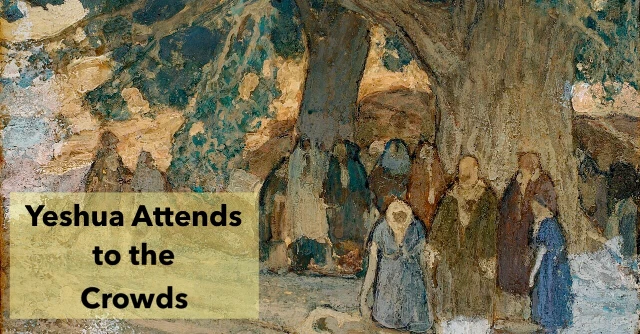
How to cite this article: Joshua N. Tilton, David N. Bivin, and Lauren S. Asperschlager, “Yeshua Attends to the Crowds,” The Life of Yeshua: A Suggested Reconstruction (Jerusalem Perspective, 2026) [https://www.jerusalemperspective.com/34496/].
Matt. 4:23-5:1; 12:15-21; Mark 3:7-12;
Luke 6:17-19[1]
וַיֵּלְכוּ אַחֲרָיו אֻכְלוּסִים גְּדוֹלִים וַיְרַפֵּא אֶת כֻּלָּם
Large crowds followed him, and Yeshua healed them all.[2]
Reconstruction
To view the reconstructed text of Yeshua Attends to the Crowds click on the link below:
Story Placement
Matthew’s Gospel includes two versions of Yeshua Attends to the Crowds (Matt. 4:23-5:1; 12:15-21). The placement of these two versions within Matthew’s Gospel is of great importance for understanding the origins of this pericope. Matthew’s second version of Yeshua Attends to the Crowds (Matt. 12:15-21) agrees with the placement of this pericope in Mark. In Mark Yeshua Attends to the Crowds (Mark 3:7-12) follows a short series of Sabbath controversies consisting of Lord of Shabbat (Mark 2:23-28) and Man’s Contractured Arm (Mark 3:1-6). The same sequence occurs in Matthew: Lord of Shabbat (Matt. 12:1-8)→Man’s Contractured Arm (Matt. 12:9-14)→Yeshua Attends to the Crowds (Matt. 12:15-21). A comparison with Mark’s version, however, reveals that the author of Matthew greatly expanded his second version of Yeshua Attends to the Crowds into a prophecy fulfillment scene so characteristic of Matthew’s Gospel.
Matthew’s first version of Yeshua Attends to the Crowds (Matt. 4:23-5:1) serves as the narrative setting for the Sermon on the Mount. What is so remarkable about Matthew’s placement of the first version of this pericope is that it agrees with the placement of Yeshua Attends to the Crowds in Luke (Luke 6:17-19), for in Luke’s Gospel Yeshua Attends to the Crowds serves as the narrative setting for the Sermon on the Plain, the Lukan parallel to the Sermon on the Mount.[3] The author of Matthew could not have learned this placement of Yeshua Attends to the Crowds from Mark because Mark’s Gospel lacks a parallel to the Sermon on the Plain/Mount. Therefore, the likeliest explanation for this Lukan-Matthean pericope-order agreement is that a version of Yeshua Attends to the Crowds described the narrative setting of Jesus’ great sermon in a pre-synoptic source.
The version of Yeshua Attends to the Crowds in Mark owes its placement to Luke. Although Mark’s Gospel does not include a parallel to the Sermon on the Plain, Mark’s sequence of Man’s Contractured Arm (Mark 3:1-6)→Yeshua Attends to the Crowds (Mark 3:7-12)→Choosing the Twelve (Mark 3:13-19) resembles Luke’s sequence of Man’s Contractured Arm (Luke 6:6-11)→Choosing the Twelve (Luke 6:12-16)→Yeshua Attends to the Crowds (Luke 6:17-19)→Sermon on the Plain. The Lukan-Matthean agreement on the sequence Yeshua Attends to the Crowds→Sermon on the Plain/Mount shows that it is Luke’s sequence that is original and that Mark’s sequence is derivative. This view is buttressed by the fact that Matthew’s sequence of Yeshua Calls His First Disciples→Yeshua Attends to the Crowds→Sermon on the Mount resembles Luke’s sequence of Choosing the Twelve→Yeshua Attends to the Crowds→Sermon on the Plain. The author of Matthew, who folded the list of the twelve apostles into the Sending the Twelve discourse, replaced Choosing the Twelve of the pre-synoptic sequence with Yeshua Calls His First Disciples, which the author of Matthew regarded as a rough equivalent.[4]
|
Matthew |
Matthew |
Mark |
Luke |
|
Man’s Contractured Arm |
Man’s Contractured Arm |
Man’s Contractured Arm |
|
|
Yeshua Calls His First Disciples |
Choosing the Twelve |
||
|
Yeshua Attends to the Crowds |
Yeshua Attends to the Crowds |
Yeshua Attends to the Crowds |
Yeshua Attends to the Crowds |
|
Choosing the Twelve |
|||
|
Sermon on the Mount |
Sermon on the Plain |
||
|
Yeshua, His Mother and Brothers (Part 1) |
|||
|
The Finger of God (Version 2) |
The Finger of God |
Matthew’s duplication of Yeshua Attends to the Crowds reflects the varying placements of this pericope in Matthew’s two sources, the Anthology (Anth.) and Mark. In Anth. Yeshua Attends to the Crowds provided Jesus’ great sermon with a narrative setting, and it seems likely that this narrative setting to Jesus’ great sermon goes all the way back to the Hebrew Life of Yeshua, from which, according to Robert Lindsey’s hypothesis, Anth. and the Synoptic Gospels are descended. But according to Lindsey, the Anthologizer (i.e., the creator of Anth.) reorganized the content of Jesus’ Hebrew biography by genre: teaching materials he grouped into one place, parables he grouped into another section, healing and exorcism accounts he collected in another location, etc. In other words, Anth. did not retain the chronology of the materials it inherited from the Hebrew Life of Yeshua. The question arises, therefore, where in the chronology of Jesus’ Hebrew biography did Jesus’ great sermon, with Yeshua Attends to the Crowds as its narrative setting, occur? Two important clues may yield a provisional answer. As we will discuss below, it does not appear that the disciples were mentioned in the pre-synoptic version of Yeshua Attends to the Crowds. Neither are the disciples mentioned in Centurion’s Slave, which likely followed the close of Jesus’ great sermon in the pre-synoptic source.[5] Both the Lukan and Matthean versions of Centurion’s Slave do, however, locate this story in Capernaum. It therefore seems likely that Jesus delivered his great sermon at an early point in his career when he was active in the Galilee prior to his gathering of disciples. For this reason we have placed our reconstruction of Jesus’ great sermon, which we have entitled the “Torah and the Kingdom of Heaven” complex, within the section of Jesus’ biography we refer to as “Yeshua, the Galilean Miracle-Worker.”
For an overview of the entire “Torah and the Kingdom of Heaven” complex, click here.
.
.
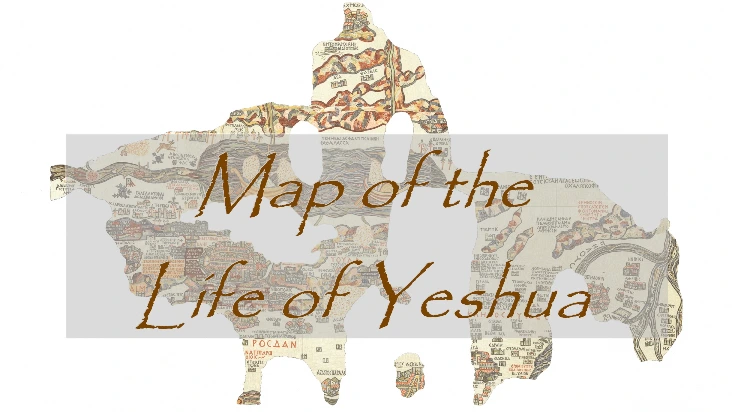
Click here to view the Map of the Conjectured Hebrew Life of Yeshua.
.
.
Conjectured Stages of Transmission
Although the Lukan-Matthean sequence Yeshua Attends to the Crowds→Sermon on the Plain/Mount derives from the Anthology (Anth.), Matthew’s first version of Yeshua Attends to the Crowds bears small resemblance to Luke’s. Lindsey believed that when Double Tradition (DT) pericopae exhibit low levels of verbal identity, the cause was Luke’s reliance on the First Reconstruction (FR), a stylistically polished epitome of Anth.[6] In the present instance we believe Lindsey’s explanation is partially correct. Both internal and external evidence points to FR as the source of Luke’s version of Yeshua Attends to the Crowds. The external evidence for tracing Luke’s version of Yeshua Attends to the Crowds to FR is that in Luke this pericope is both preceded and followed by other pericopae identified as stemming from FR. Since the author of Luke tended to copy his sources in blocks rather than switching between sources from one pericope to the next, the sandwiching of Yeshua Attends to the Crowds between other FR pericopae in Luke points to FR as Luke’s source for Yeshua Attends to the Crowds. As for internal evidence, Luke’s version of Yeshua Attends to the Crowds contains vocabulary (Ἰερουσαλήμ [“Jerusalem” ⟨Hebraic spelling⟩] in L55; ἰᾶσθαι [“to heal,” “to effect a cure”] in L72 and L83) and themes (power going out of Jesus to effect healings in L81-83) we have identified as characteristic of FR.
Nevertheless, an analysis of Matthew’s first version of Yeshua Attends to the Crowds (see the Comment section below) reveals that it represents an elaborate combination of verses from several, mainly Markan, pericopae woven around an Anth. core.[7] Thus the verbal disparity between the Lukan and Matthew’s DT version of Yeshua Attends to the Crowds cannot be put down solely to FR interference. Matthean redaction, aimed at constructing a suitable narrative setting for the Sermon on the Mount, greatly contributed to the differences between the DT versions of Yeshua Attends to the Crowds.
|
Matthew’s Yeshua Attends to the Crowds (Version 1) |
Sources |
|
Matt. 4:23a |
Mark 6:6b |
|
Matt. 4:23b |
Mark 1:39 |
|
Matt. 4:24a |
Mark 1:28 |
|
Matt. 4:24b |
Mark 1:32 |
|
Matt. 4:25a |
Anth.? |
|
Matt. 4:25b |
Mark 3:7 |
|
Matt. 5:1 |
Mark 3:13 |
Mark’s version of Yeshua Attends to the Crowds is a paraphrase of Luke’s. Since Luke’s version is based on FR rather than Anth., Mark’s version of Yeshua Attends to the Crowds is a far cry from the pre-synoptic version in Anth. Many of Mark’s changes to Yeshua Attends to the Crowds were drawn from Healings and Exorcisms, another pericope that describes Jesus’ healing of crowds of people from various ailments and afflictions.
Although the placement of Matthew’s second version of Yeshua Attends to the Crowds agrees with Mark’s, its wording is quite different. The first half of Matt. 12:15 parallels Mark 3:7, and Matt. 12:16 closely tracks Mark 3:12, but the second half of Matt. 12:15 diverges from Mark’s version of Yeshua Attends to the Crowds quite sharply. In place of Mark’s vivid description of how such a mass of people from all over the Holy Land came to Jesus for healing that Jesus ordered the disciples to ready a boat lest he be crushed by the mob, Matthew’s version soberly states that large crowds followed Jesus and he healed them. It is, of course, possible that the author of Matthew simply condensed Mark’s version in order to make space for the prophecy fulfillment section he tacked to the end of the pericope, but the wording of Matt. 12:15b is so different from the Markan parallel and yet reverts so easily to Hebrew that we suspect Matt. 12:15b preserves, more or less exactly, Anth.’s version of the pericope. In other words, we think it likely that the author of Matthew sandwiched the Anth. version of the pericope (= Matt. 12:15b) between the Markan opening (= Matt. 12:15a) and closing (= Matt. 12:16), to which he then added the prophecy fulfillment scene (= Matt. 12:17-21).
|
Matt. 12:15-17 |
Mark 3:7-12 |
|
ὁ δὲ Ἰησοῦς γνοὺς ἀνεχώρησεν ἐκεῖθεν. |
καὶ ὁ Ἰησοῦς μετὰ τῶν μαθητῶν αὐτοῦ ἀνεχώρησεν πρὸς τὴν θάλασσαν, |
|
καὶ ἠκολούθησαν αὐτῷ [ὄχλοι] πολλοί, καὶ ἐθεράπευσεν αὐτοὺς πάντας |
καὶ πολὺ πλῆθος ἀπὸ τῆς Γαλιλαίας [ἠκολούθησεν], καὶ ἀπὸ τῆς Ἰουδαίας καὶ ἀπὸ Ἱεροσολύμων καὶ ἀπὸ τῆς Ἰδουμαίας καὶ πέραν τοῦ Ἰορδάνου καὶ περὶ Τύρον καὶ Σιδῶνα πλῆθος πολὺ ἀκούοντες ὅσα ἐποίει ἦλθον πρὸς αὐτόν. καὶ εἶπεν τοῖς μαθηταῖς αὐτοῦ ἵνα πλοιάριον προσκαρτερῇ αὐτῷ διὰ τὸν ὄχλον ἵνα μὴ θλίβωσιν αὐτόν· πολλοὺς γὰρ ἐθεράπευσεν, ὥστε ἐπιπίπτειν αὐτῷ ἵνα αὐτοῦ ἅψωνται ὅσοι εἶχον μάστιγας. καὶ τὰ πνεύματα τὰ ἀκάθαρτα, ὅταν αὐτὸν ἐθεώρουν, προσέπιπτον αὐτῷ καὶ ἔκραζον λέγοντες ὅτι σὺ εἶ ὁ υἱὸς τοῦ θεοῦ. |
|
καὶ ἐπετίμησεν αὐτοῖς ἵνα μὴ φανερὸν αὐτὸν ποιήσωσιν, ἵνα πληρωθῇ τὸ ῥηθὲν διὰ Ἠσαΐου τοῦ προφήτου λέγοντος…. |
καὶ πολλὰ ἐπετίμα αὐτοῖς ἵνα μὴ αὐτὸν φανερὸν ποιήσωσιν. |
A text-critical issue complicates our assessment of Matt. 12:15b’s relationship to the Markan parallel. Codex Vaticanus includes the verb ἠκολούθησεν (ēkolouthēsen, “he/she/it followed”) in Mark 3:7, but this reading is uncertain and may even be due to assimilation to Matthew, for which reason critical editions place Mark’s ἠκολούθησεν in brackets, and some scholars reject Vaticanus’ reading (and others like it) altogether.[8] If, as we are inclined to believe, ἠκολούθησεν does not belong to the original text of Mark 3:7, then there is almost no verbal agreement between Matt. 12:15b and the Markan parallel. The only other notable agreement is ἐθεράπευσεν (etherapevsen, “he healed”), which is hardly surprising given the subject matter of the pericope.
In addition to the divergence from the Markan parallel and the ease with which Matt. 12:15b reverts to Hebrew, there are two additional reasons for suspecting that Matt. 12:15b reproduces the wording of Anth. First, the statement καὶ ἠκολούθησαν αὐτῷ ὄχλοι πολλοί (kai ēkoloūthēsan avtō ochloi polloi, “and many crowds followed him”) also occurs in Matthew’s DT version of Yeshua Attends to the Crowds, and second, slight variations of the same statement also occur in Matt. 8:1 at the conclusion of the Sermon on the Mount, and in Matt. 19:2 at the conclusion of the fourth of the five major discourses that punctuate Matthew’s Gospel. Thus, “and many crowds followed him” was a stereotyped statement in Matthew, and as we have discovered with other statements of this kind,[9] Matthew’s stereotyped statements were derived from a source, they did not originate as Matthean composition.
Each of the four instances of Matthew’s stereotyped statement that “many crowds followed him” tells us something important about the source from which it was derived. The versions in Matt. 4:25 and Matt. 8:1 associate this statement with the Sermon on the Mount (beginning and end). The version in Matt. 12:15, which adds the information that Jesus healed the crowds, looks like the most complete version of the statement. In its own way the version in Matt. 12:15b also associates this statement with the Sermon on the Mount/Plain because Matthew’s second version of Yeshua Attends to the Crowds, which comes after Man’s Contractured Arm, occupies a similar position as in Luke, where we find Man’s Contractured Arm…Yeshua Attends to the Crowds→Sermon on the Plain. When the version in Matt. 19:2 is placed within its context, it too associates the statement about the crowds’ following Jesus with the Sermon on the Mount because Matt. 19:1-2 strongly resembles Matt. 4:25 at the opening of the Sermon on the Mount:
|
Matt. 4:25 |
Matt. 19:1-2 |
|
καὶ ἠκολούθησαν αὐτῷ ὄχλοι πολλοὶ ἀπὸ τῆς Γαλιλαίας καὶ Δεκαπόλεως καὶ Ἱεροσολύμων καὶ Ἰουδαίας καὶ πέραν τοῦ Ἰορδάνου |
…μετῆρεν ἀπὸ τῆς Γαλιλαίας καὶ ἦλθεν εἰς τὰ ὅρια τῆς Ἰουδαίας πέραν τοῦ Ἰορδάνου καὶ ἠκολούθησαν αὐτῷ ὄχλοι πολλοί, καὶ ἐθεράπευσεν αὐτοὺς ἐκεῖ. |
|
And many crowds followed him from the Galilee and Decapolis and Jerusalem and Judea and beyond the Jordan…. |
…he departed from the Galilee and he came into the mountains of Judea beyond the Jordan and many crowds followed him, and he healed them there. |
In Matt. 19:2 the statement “and many crowds followed him” is accompanied by the further statement “and he healed them,” just as in Matt. 12:15b, where we suspect it is authentic. In Matt. 4:25 the author of Matthew had a clear reason for dropping “and he healed them,” since he had already described Jesus’ healing activities in the previous verse (Matt. 4:24). Likewise, in Matt. 8:1 the author of Matthew had no need to state “and he healed them” because he was about to narrate two specific cases of healing: Man with Scale Disease and Centurion’s Slave. Therefore, only in Matt. 12:15b and Matt. 19:2 did the author of Matthew have opportunity to give the (more or less) full version of the statement he stereotyped from Anth.
Thus, we have recovered the authentic core of Yeshua Attends to the Crowds as it occurred in Anth. And having recovered the core, it is possible to understand how it developed into the forms we now find in Luke and Mark and Matthew.
The First Reconstructor expanded Anth.’s version of Yeshua Attends to the Crowds by filling in several important details: 1) the makeup of the crowds, 2) why they came to Jesus, 3) the types of ailments and afflictions from which they were healed, and 4) the mechanism by which Jesus healed them. FR’s version is represented in Luke, perhaps with a few Lukan touches.
The author of Mark paraphrased Luke’s version of Yeshua Attends to the Crowds with his usual amplifications. Thus, where Luke’s version claimed the crowds came from Judea and Jerusalem and the coasts of Tyre and Sidon (Luke 6:17), the author of Mark added the Galilee, Idumea and Perea to the list (Mark 3:7-8). Likewise, whereas Luke’s version mentioned the exorcism of impure spirits (Luke 6:18), the author of Mark, borrowing from Healings and Exorcisms, describes how when the impure spirits saw Jesus they would shriek, “You are the Son of God!” (Mark 3:11). And whereas Luke’s version states that the crowd sought to touch Jesus because healing power was emanating from him (Luke 6:19), the author of Mark writes that Jesus had to order the disciples to ready a boat lest the crowd crush him because he healed so many that they were falling on him in their attempts to touch him (Mark 3:9-10). All these amplifications are characteristic of the author of Mark’s editorial style.
The author of Matthew had two versions of Yeshua Attends to the Crowds before him, Mark’s and Anth.’s, and both sources informed his two versions in different ways. Matthew’s placement of his first version of Yeshua Attends to the Crowds as the narrative setting for Jesus’ great sermon is indebted to Anth. Embedded deep in the heart of the pericope is Anth.’s statement that many crowds followed Jesus. But the author of Matthew elaborated his first version of Yeshua Attends to the Crowds by drawing in statements from multiple other locations in his sources. Matthew’s second version of Yeshua Attends to the Crowds owes its placement to Mark. The first half of Matt. 12:15 and all of Matt. 12:16 also reflect the beginning and the end of Mark’s pericope (Mark 3:7a, 12). But between the Markan bookends Matthew preserves Anth.’s understated text: “And many crowds followed him, and he healed them all” (Matt. 12:15b). To the conclusion of this combined Markan/Anth. version of Yeshua Attends to the Crowds the author of Matthew attached an announcement of how all this fulfilled Isaiah’s prophecy.
Crucial Issues
- Why does Matthew’s Gospel have two versions of Yeshua Attends to the Crowds?
- Does Matthew’s Isaiah quotation in his second version of Yeshua Attends to the Crowds support the notion that the Gospel of Matthew was originally composed in Hebrew?
- In the pre-synoptic source common to Luke and Matthew did Jesus’ great sermon take place on the mount or on the plain?
- How is Yeshua Attends to the Crowds a fitting narrative setting to Jesus’ great sermon?
Comment
Because the development of the several versions of Yeshua Attends to the Crowds is so complex, the format of this Comment section is different from most other LOY segments. Instead of commenting on the reconstruction document line by line, considering all the versions at once, we will discuss each synoptic version separately. This will enable us to focus on the redactional choices of the First Reconstructor and the evangelists. We will begin, however, by discussing GR, which we have now established is (more or less) represented in Matt. 12:15b, jointly with HR.
Greek and Hebrew Reconstructions
Our justification for GR has been given above in the Conjectured Stages of Transmission discussion.
L50 καὶ ἠκολούθησαν αὐτῷ (GR). The verb ἀκολουθεῖν (akolouthein, “to follow”) is not one of the author of Matthew’s redactional favorites. Of the twenty-five instances of ἀκολουθεῖν in Matthew’s Gospel,[10] most are used with either Markan or Lukan agreement,[11] indicating that in these instances the author of Matthew adopted this verb from his source(s). Of the instances of ἀκολουθεῖν in Matthew’s Gospel that do not have Markan or Lukan support (Matt. 4:25; 8:1, 23; 10:38; 12:15; 19:2, 28), over half occur in the stereotyped phrase καὶ ἠκολούθησαν αὐτῷ ὄχλοι πολλοί (kai ēkolouthēsan avtō ochloi polloi, “and many crowds followed him”; Matt. 4:25; 8:1; 12:15; 19:2), which, we have argued, was borrowed from Anth. Elsewhere we have argued that the instance of ἀκολουθεῖν in Matt. 10:38 is the product of Matthean cross-pollination, in other words, it too reflects the wording of a source.[12] This leaves only the instances of ἀκολουθεῖν in Matt. 8:23 and Matt. 19:28 as candidates of pure Matthean redaction, and since Luke’s parallel to Matt. 19:28 (Luke 22:28) is more difficult to revert to Hebrew than Matthew’s wording, it is likely that ἀκολουθεῖν in Matt. 19:28 is not Matthean but a reflection of Anth. Thus we only find one instance, Matt. 8:23,[13] where the author of Matthew wrote ἀκολουθεῖν where it was not ultimately dependent on a source.
וַיֵּלְכוּ אַחֲרָיו (HR). On reconstructing ἀκολουθεῖν (akolouthein, “to follow”) with הָלַךְ אַחַר (hālach ’aḥar, “walk behind”), see Not Everyone Can Be Yeshua’s Disciple, Comment to L6.
L51 ὄχλοι πολλοί (GR). In the text of Codex Vaticanus the noun ὄχλοι (ochloi, “crowds”) is missing from Matt. 12:15. This omission is probably a scribal error. The author of Matthew, who loved uniformity, is unlikely to have varied his stereotyped phrase καὶ ἠκολούθησαν αὐτῷ ὄχλοι πολλοί (kai ēkolouthēsan avtō ochloi polloi, “and many crowds followed him”; Matt. 4:25; 8:1; 19:2) by omitting ὄχλοι in Matt. 12:15. On the other hand, a scribe who did not realize that the author of Matthew used a stereotyped phrase might have omitted ὄχλοι either from carelessness or as a stylistic improvement.[14]
אֻכְלוּסִים גְּדוֹלִים (HR). On reconstructing ὄχλος (ochlos, “crowd”) with אֻכְלוּס (’uchlūs, “crowd”), see Widow’s Son in Nain, Comment to L3-4.
On reconstructing πολύς (polūs, “much,” “many”) with גָּדוֹל (gādōl, “big”), see Widow’s Son in Nain, Comment to L3-4.
L83 καὶ ἐθεράπευσεν (GR). Although the phrase “and he healed” is separated from “and many crowds followed him” by many lines in the reconstruction document, they are continuous in Matt. 12:15. The two statements “and many crowds followed him” and “and he healed all of them” formed a single sentence in Anth. The author of Matthew faithfully copied καὶ ἐθεράπευσεν (kai etherapevsen, “and he healed”) from Anth., whereas the First Reconstructor paraphrased Anth.’s wording as καὶ ἰᾶτο (kai iato, “and he was curing”).
וַיְרַפֵּא (HR). On reconstructing θεραπεύειν (therapevein, “to give medical treatment,” “to heal”) with רִפֵּא (ripē’, “give medical treatment,” “heal”), see Sending the Twelve: Commissioning, Comment to L22-23.
L84 πάντας αὐτούς (GR). The Lukan-Matthean agreement to write πάντας (pantas, “all”) makes a strong case for the presence of πάντας in Anth. Matthew’s use of the pronoun αὐτούς (avtous, “them”) in L84 is supported by the presence of this pronoun in Matt. 4:24 (L32) and Matt. 19:2, two verses where Anth.’s stereotyped sentence preserved in Matt. 12:15 resurfaces in Matthew’s Gospel. The consistency of αὐτούς in these three related verses (Matt. 4:24; 12:15; 19:2) inclines us toward the view that αὐτούς also occurred in Anth. Perhaps, however, αὐτούς in Anth. came after πάντας (following Hebrew word order) rather than before, as in Matt. 12:15. This possibility is reflected in GR.
אֶת כֻּלָּם (HR). On reconstructing πᾶς (pas, “all,” “every”) with כָּל (kol, “all,” “every”), see Demands of Discipleship, Comment to L32.
Luke’s Yeshua Attends to the Crowds
One of our primary questions facing Luke’s version of Yeshua Attends to the Crowds is whether it is credible that out of Anth.’s simple statement that “Many crowds followed him, and he healed them” the First Reconstructor spun the lively description of Jesus descending the mountain from which he appointed the twelve apostles and meeting on a plain multitudes from all over the Holy Land who came to hear Jesus and to be cured by him, and how everyone tried to touch Jesus because of the healing power emanating from him. We believe such a development is credible, and we will illustrate how this evolution took place in the comments below.
L37-40 καὶ καταβὰς μετ’ αὐτῶν (Luke 6:17). The phrase “and descending with them” in Luke 6:17 links Luke’s version of Yeshua Attends to the Crowds to the preceding pericope, Choosing the Twelve, in which Jesus goes up onto a mountain to pray and summons his disciples in order to appoint twelve of them to be his emissaries to Israel. We do not believe this linkage is original, for as we noted in the Story Placement discussion above, the disciples play no active part either in Yeshua Attends to the Crowds, which provided the narrative setting for Jesus’ great sermon, or in Centurion’s Slave, which followed it. Since according to Lindsey it was the First Reconstructor who attempted to place Anth.’s fragments into a continuous narrative sequence, we suspect that it was he who composed the words καὶ καταβὰς μετ’ αὐτῶν (kai katabas met avtōn, “and descending with them”).
One might suppose αὐτῶν (avtōn, “them”) in L40 refers to the disciples from among whom the apostles were chosen. But καὶ ὄχλος πολὺς μαθητῶν αὐτοῦ (kai ochlos polūs mathētōn avtou, “also a great crowd of his disciples”) rules out this interpretation.[15] The prepositional phrase μετ’ αὐτῶν (met avtōn, “with them”) refers exclusively to the apostles[16] and emphasizes their close relationship to Jesus.[17]
L41 ἔστη ἐπὶ τόπου πεδινοῦ (Luke 6:17). Jesus’ delivery of the Sermon on the Plain standing “on a level place” in Luke weirdly contradicts Matthew’s depiction of Jesus seated on a mountaintop to deliver the Sermon on the Mount. In our view, both descriptions are redactional. In Luke the reference to a τόπος πεδινός (topos pedinos, “level place”) is intended to contrast with the mountain from which Jesus and the disciples descended.[18] Since the descent from the mountain is an FR redactional bridge between Choosing the Twelve and Yeshua Attends to the Crowds, the reference to the “level place” is probably redactional too, and is best attributed to the First Reconstructor. The adjective πεδινός does not occur elsewhere in Luke’s Gospel or Acts.[19]
L42-43 καὶ ὄχλος πολὺς μαθητῶν αὐτοῦ (Luke 6:17). Whereas Anth.’s version of Yeshua Attends to the Crowds referred to “many crowds” (plur.), Luke’s version refers to a single large crowd of Jesus’ disciples plus a great multitude of the people who came to hear Jesus and to be healed by him. The reference to the disciples belongs to FR’s linkage of Yeshua Attends to the Crowds to Choosing the Twelve, so we may safely infer that it was the First Reconstructor who changed Anth.’s plural ὄχλοι πολλοί (ochloi polloi, “many crowds”; L51) into Luke’s singular ὄχλος πολὺς μαθητῶν αὐτοῦ (ochlos polūs mathētōn avtou, “a large crowd of his disciples”). To compensate for this change the First Reconstructor described a “great multitude” (L47) from many places in addition to the “large crowd of his disciples” (L42-43).
L47 καὶ πλῆθος πολὺ (Luke 6:17). The reference in Luke 6:17 to a large group of followers distinct from the large crowd of disciples is probably the work of the First Reconstructor. It is possible, however, that the use of the term πλῆθος (plēthos, “multitude”) is due to Lukan redaction, since this noun occurs with a higher frequency in Luke than in Mark or Matthew and also occurs frequently in Acts.[20] If so, then FR probably read, καὶ ὄχλος πολύς in L47. In support of this possibility we note that in L79 ὁ ὄχλος (ho ochlos, “the crowd”) is used for the group that sought to touch Jesus because of the healing power that was going out of him.[21] Consistency would have required this group of people to be referred to as ὁ πλῆθος (ho plēthos, “the multitude”), since it was the multitude, not the crowd of disciples, who came to Jesus for healing. But it appears the author of Luke forgot to change FR’s ὄχλος in L79 to πλῆθος as he did here in L47. Further evidence that FR read ὄχλος in L47 will be discussed below in Comment to L76-77.
L48 τοῦ λαοῦ (Luke 6:17). We have encountered several instances where the use of the term λαός (laos, “people”) appears to be the product of Lukan—not FR—redaction.[22] Since the phrase τοῦ λαοῦ (tou laou, “of the people”) could be omitted without making the sentence unintelligible, and since we have detected traces of Lukan redaction in L47, it seems probable that τοῦ λαοῦ in L48 came from the author of Luke’s pen.
L54-55 ἀπὸ πάσης τῆς Ἰουδαίας καὶ Ἰερουσαλὴμ (Luke 6:17). Luke’s phrase “from all Judea and Jerusalem” begins to answer the question “Where did they come from?” which is raised by the statement that “many crowds followed him” in Anth.’s version of Yeshua Attends to the Crowds. It was probably the First Reconstructor who supplied this answer. Two reasons support this conclusion. First, the composition of the multitude resembles the description in Bedridden Man of the Pharisees and law teachers οἳ ἦσαν ἐληλυθότες ἐκ πάσης κώμης τῆς Γαλιλαίας καὶ Ἰουδαίας καὶ Ἰερουσαλήμ (“who were coming from every village of the Galilee and Judea and Jerusalem”; Luke 5:17). On the basis of its style and vocabulary we have identified Luke’s version of Bedridden Man as an FR pericope, so the resemblance of the composition of the multitude in Luke 6:17 to the places of the Pharisees’ origin in Luke 5:17 suggests common FR authorship. Second, the use of the Hebraic form Ἰερουσαλήμ (Ierousalēm, “Jerusalem”) is more in accord with FR’s style than the author of Luke’s.
From the distribution of the two forms of the name “Jerusalem”—the Hebraic form Ἰερουσαλήμ (Ierousalēm) and the Hellenized form Ἱεροσόλυμα (Hierosolūma)—in the writings of Luke we find that while the author of Luke was willing to accept the Hebraic Ἰερουσαλήμ from his sources, the Hellenized Ἱεροσόλυμα was his preferred spelling. The Hellenized Ἱεροσόλυμα occurs only 4xx in Luke’s Gospel (Luke 2:22; 13:22; 19:28; 23:7), but is frequent in Acts (22xx).[23] The Hebraic form Ἰερουσαλήμ, meanwhile, predominates in both the Gospel (27xx) and Acts (37xx).[24] These data become even more significant when they are analyzed according to context.
In Luke’s Gospel, where the author of Luke relied on written sources, the Hebraic form Ἰερουσαλήμ occurs both in narration (Luke 2:25, 38, 41, 43, 45; 4:9; 5:17; 6:17; 9:31, 51, 53; 17:11; 19:11; 24:13, 33, 52) and in direct speech (Luke 10:30; 13:4, 33, 34 [2xx]; 18:31; 21:20, 24; 23:28; 24:18, 47), whereas the Hellenized form Ἱεροσόλυμα is confined exclusively to narration (Luke 2:22; 13:22; 19:28; 23:7). The same pattern holds for the first half of Acts (Acts 1:1-15:34), where the Hebraic form Ἰερουσαλήμ occurs both in narration (Acts 1:12 [2xx], 19; 2:5; 4:5; 5:16; 6:7; 8:27; 9:2, 26, 28; 11:2, 22; 12:25; 15:2, 4) and in direct speech (Acts 1:8; 2:14; 4:16; 5:28; 8:26; 9:13, 21; 10:39; 13:27, 31), but the Hellenized form Ἱεροσόλυμα is restricted to narration (Acts 1:4; 8:1, 14, 25; 11:27; 13:13). However, in the second half of Acts (Acts 15:35-28:31), where the personal writing style of the author of Luke-Acts comes to the fore, the situation changes dramatically. The Hebraic form Ἰερουσαλήμ suddenly becomes almost entirely confined to direct speech (Acts 20:22; 21:11, 13; 22:5, 17, 18; 23:11; 24:11),[25] whereas the Hellenized form Ἱεροσόλυμα begins to occur not only in narration (Acts 16:4; 19:21; 20:16; 21:4, 15, 17; 25:1, 7) but also in the direct speech of certain individuals, namely the Roman governor Festus (Acts 25:9, 15, 20, 24), for whom the Hebraic form Ἰερουσαλήμ would hardly have been appropriate, and Paul, when the apostle’s speech was formal and addressed to Hellenized audiences (Agrippa II [Acts 26:4, 10, 20], the Jewish community in Rome [Acts 28:17]).[26]
Thus we find that in the second half of Acts, where the author of Luke-Acts no longer relied on secondhand sources but gave a firsthand account, he refrained from using the Hebraic form Ἰερουσαλήμ except when he was attempting to represent the actual speech of the characters in his narrative. Otherwise, the author of Luke-Acts reverted to his preferred form Ἱεροσόλυμα.
For the purposes of our investigation, the fact that we encounter the Hebraic form Ἰερουσαλήμ in Yeshua Attends to the Crowds tells us that here the author of Luke is reflecting the wording of his source, in this case FR. Had the author of Luke been writing on his own, he would have written Ἱεροσόλυμα in this narrative passage.
L59-60 καὶ τῆς παραλίου Τύρου καὶ Σειδῶνος (Luke 6:17). “And the coast of Tyre and Sidon” concludes FR’s answer to the question “Where did they come from?” which Anth.’s “and many crowds followed him” raises. Having referred in L54-55 to Judea and Jerusalem, which lay to the south, the First Reconstructor here refers to the coast of Tyre and Sidon, which lay to the north. His intention was to indicate that people came from further afield than the Galilee, where Jesus had been operating.
Some scholars suggest that Luke 6:17 depicts multitudes of Gentiles coming to Jesus from the coast of Tyre and Sidon,[27] but this is refuted by Luke’s characterization of the multitude as τοῦ λαοῦ (tou laou, “of the people,” i.e., Israel).[28] The author of Luke, an historian, would have known that masses of Gentile followers of Jesus would have been anachronistic.
It is possible that Luke’s reference here (Luke 6:17) to people coming from Tyre and Sidon, as well as Jesus’ saying that if the miracles that had been performed in Chorazin and Bethsaida had been done in Tyre and Sidon, the Gentiles in those cities would have repented (Luke 10:13-14; cf. Matt. 11:21-22),[29] planted the notion in the author of Mark’s mind that Jesus actually did visit the region of Tyre and Sidon. The author of Mark sets Jesus and a Canaanite Woman on the borders of Tyre (Mark 7:24) and from there he has Jesus return on the improbable route through Sidon to the Sea of Galilee by way of the region of the Decapolis (Mark 7:31).[30]
L61-63 οἳ ἦλθον ἀκοῦσαι αὐτοῦ (Luke 6:18). “Who came to hear him” begins to answer a second question raised by Anth.’s statement “many crowds followed him,” namely “Why?” According to L61-63, they came in order to listen to Jesus. This answer strengthens the connection between Yeshua Attends to the Crowds and the sermon that follows. Since it was the First Reconstructor who was at pains to create a flowing literary narrative out of Anth.’s fragments, it was probably he who contributed this explanation in L61-63.
The First Reconstructor used in L61 a plural pronoun, οἵ (hoi, “who”), and a plural verb, ἦλθον (ēlthon, “they came”), with reference to the singular “multitude” or “crowd” mentioned in L47. Likewise, in L80 the First Reconstructor used a plural verb, ἐζήτουν (ezētoun, “they were seeking”), in connection with the singular ὄχλος (ochlos, “crowd”) in L79. The First Reconstructor thereby treated “crowd/multitude” as a collective noun,[31] singular in form but plural in meaning. Although it was legitimate for him to have done so, we wonder whether this usage betrays the First Reconstructor’s awareness that Anth. spoke of ὄχλοι πολλοί (ochloi polloi, “many crowds [plur.]”; L51).
L72 καὶ ἰαθῆναι (Luke 6:18). Whereas the first part of FR’s answer to “Why did the crowds follow Jesus?” helps connect Yeshua Attends to the Crowds to the sermon that follows by expressing their intention to listen to Jesus’ teachings, the second part of his explanation, “and to be cured,” connects to the second half of Anth.’s statement “And many crowds followed him, and he healed them.” That καὶ ἰαθῆναι (kai iathēnai, “and to be cured”) should be attributed to FR is almost certain, since elsewhere we have found that the use of the verb ἰᾶσθαι (iasthai, “to heal,” “to effect a cure”) is a marker of FR redaction.[32]
L75 ἀπὸ τῶν νόσων αὐτῶν (Luke 6:18). With the words “from their sicknesses” the First Reconstructor begins to answer a question raised by Anth.’s statement “and he healed all of them,” namely “From what?”
The noun νόσος (nosos, “sickness”) occurs only 4xx in Luke’s Gospel (Luke 4:40; 6:18; 7:21; 9:1)[33] and only once in Acts (Acts 19:12), so this term cannot be construed as particularly Lukan. On the other hand, three of Luke’s instances of νόσος (Luke 4:40; 6:18; 9:1) occur in FR pericopae, so νόσος in Luke’s version of Yeshua Attends to the Crowds is best attributed to Luke’s source rather than to Lukan redaction.
L76-77 καὶ οἱ ἐνοχλούμενοι ἀπὸ πνευμάτων ἀκαθάρτων (Luke 6:18). With the phrase “and the ones made ill from impure spirits” the First Reconstructor continues his answer to the question “From what were they healed?” raised by Anth.’s statement “and he healed all of them.”
In LXX the verb ἐνοχλεῖν (enochlein) is relatively rare,[34] but when it does occur it usually does so with the meaning “to be sick” or “to be ill.”[35] Here, however, ἐνοχλεῖν seems to be used as a wordplay on ὄχλος (ochlos, “crowd”), as though the impure spirits were making the crowds sick by crowding into them. Since the wordplay is based on ὄχλος, which we suspect the author of Luke replaced with πλῆθος (see above, Comment to L47), and since the verb ἐνοχλεῖν occurs nowhere else in the Lukan corpus,[36] we attribute Luke’s wording in L76 to FR.
A related verb, ὀχλεῖν (ochlein, “to disturb,” “to crowd”), does, however, occur in Acts in a verse that bears strong resemblance to parts of Yeshua Attends to the Crowds:[37]
|
Luke 6:17-18 |
Acts 5:16 |
|
καὶ πλῆθος πολὺ τοῦ λαοῦ ἀπὸ πάσης τῆς Ἰουδαίας καὶ Ἰερουσαλὴμ καὶ τῆς παραλίου Τύρου καὶ Σιδῶνος, οἳ ἦλθον ἀκοῦσαι αὐτοῦ καὶ ἰαθῆναι ἀπὸ τῶν νόσων αὐτῶν· καὶ οἱ ἐνοχλούμενοι ἀπὸ πνευμάτων ἀκαθάρτων ἐθεραπεύοντο |
συνήρχετο δὲ καὶ τὸ πλῆθος τῶν πέριξ πόλεων Ἰερουσαλὴμ φέροντες ἀσθενεῖς καὶ ὀχλουμένους ὑπὸ πνευμάτων ἀκαθάρτων, οἵτινες ἐθεραπεύοντο ἅπαντες. |
|
…also a great multitude of the people from all Judea and Jerusalem and the coast of Tyre and Sidon, who came to hear him and to be healed from their illnesses. And the ones sickened from impure spirits were being healed. |
But the multitude of the city of Jerusalem’s surroundings also gathered, bearing ill [persons] and ones sickened by impure spirits, who were all being healed. |
It thus appears the author of Luke decided to allude to Yeshua Attends to the Crowds when he described the healing ministry the apostles carried out in the Temple.
L77 πνευμάτων ἀκαθάρτων (Luke 6:18). We are somewhat surprised to find the term “impure spirits” in FR redaction, since neither the author of Luke nor the First Reconstructor seems to have preferred this designation for demons. Nevertheless, “impure spirit” does sometimes occur in an FR pericope if it was prompted by Anth.,[38] so the First Reconstructor’s use of “impure spirits” even without Anth.’s prompting is by no means beyond the realm of possibility.
L78 ἐθεραπεύοντο (Luke 6:18). Although as we stated above in Comment to L72 the First Reconstructor often preferred ἰᾶσθαι (iasthai, “to heal,” “to effect a cure”) to θεραπεύειν (therapevein, “to heal”), the verb θεραπεύειν does occur in FR pericopae,[39] so there is no obstacle to attributing Luke’s wording in L78 to FR. Probably the First Reconstructor wrote θεραπεύειν in L78 for the sake of variation; ἰᾶσθαι occurs in L72 and again in L83.
L79 καὶ πᾶς ὁ ὄχλος (Luke 6:19). As we noted above in Comment to L47, it is surprising to find what Luke had earlier referred to as a πλῆθος (“multitude”) in contradistinction from the ὄχλος (“crowd”) of Jesus’ disciples mentioned here as nothing other than an ὄχλος. Our suspicion is that it was the author of Luke who changed FR’s ὄχλος in L47 to πλῆθος and that he neglected to do so here.
L80 ἐζήτουν ἅπτεσθαι αὐτοῦ (Luke 6:19). On the First Reconstructor’s use of plural verbs with the singular noun “crowd/multitude,” see above, Comment to L61-63.
L81-82 ὅτι δύναμις παρ’ αὐτοῦ ἐξήρχετο (Luke 6:19). The First Reconstructor’s statement that the entire crowd was seeking to touch Jesus “because δύναμις [dūnamis, ‘power’] was going out from him” answers yet another question raised by Anth.’s statement “and he healed them all,” namely “By what mechanism did Jesus heal them?” There were, of course, various options. Jesus might have healed them by word or command. He might have healed them by prayer or by anointing with oil. Jesus might have healed through magic or medicine. But here the First Reconstructor tells us this was not the case. Jesus healed them by touch because power was flowing out of him. The means of healing the First Reconstructor describes is highly personal, since it required a direct connection with Jesus.[40] It also magnifies Jesus’ position, for he serves as a conduit for divine power.
The means of healing here described is also characteristic of FR pericopae. In Luke’s version of Yair’s Daughter and a Woman’s Faith, which we have determined was based on FR, Jesus states, δύναμιν ἐξεληλυθυῖαν ἀπ’ ἐμοῦ (dūnamin exelēlūthūian ap emou, “power was going out from me”; Luke 8:46), which was what alerted him to the fact that someone had been healed. Similarly, in Luke’s version of Bedridden Man, also dependent upon FR, we read, καὶ δύναμις κυρίου ἦν εἰς τὸ ἰᾶσθαι αὐτόν (kai dūnamis kūriou ēn eis to iasthai avton, “and power of the Lord for healing was [with] him”; Luke 5:17).[41] Thus, healing by divine power conducted through Jesus by touch is a redactional motif that originated with the First Reconstructor.
L83 καὶ ἰᾶτο (Luke 6:19). As we noted above in Comment to L72, the verb ἰᾶσθαι (iasthai, “to heal,” “to effect a cure”) is an indicator of FR redaction.
L84 πάντας (Luke 6:19). Luke’s καὶ ἰᾶτο πάντας (kai iato pantas, “and he was curing everyone”) parallels Matthew’s καὶ ἐθεράπευσεν αὐτοὺς πάντας (kai etherapevsen avtous pantas, “and he healed them all”), and it is likely that the former is a paraphrase of the latter, the First Reconstructor rewording Anth.’s statement now preserved in Matthew. The Lukan-Matthean agreement to write πάντας (pantas, “all”) argues in favor of its inclusion in GR and an equivalent in HR.
Mark’s Yeshua Attends to the Crowds
Mark’s version of Yeshua Attends to the Crowds is based on Luke’s but with much dramatization and amplification. Many of Mark’s adaptations are characteristic of Markan editorial style.
L37 καὶ ὁ Ἰησοῦς (Mark 3:7). The author of Mark amplifies Luke’s wording in L37 by the addition of Jesus’ name. Specifying the names of characters is typical of Markan redaction.[42]
L39 [–] (Mark 3:7). Because the author of Mark transposed Luke’s order of Choosing the Twelve→Yeshua Attends to the Crowds (see the Story Placement discussion above), he was unable to depict Jesus as descending from the mountain where the apostles were selected. Thus, an equivalent to Luke’s καταβάς (katabas, “descending”) is omitted in Mark’s version of Yeshua Attends to the Crowds.
L40 μετὰ (Mark 3:7). The author of Mark’s transposition of Luke’s pericope order also affected Mark’s wording in L40. Luke’s αὐτῶν (avtōn, “them”) had lost its original antecedent,[43] so in place of μετ’ αὐτῶν (met avtōn, “with them”) the author of Mark wrote μετά (meta, “with”) in L40 and specified the disciples in L44.
L44 τῶν μαθητῶν αὐτοῦ (Mark 3:7). Whereas Luke refers to “a great crowd of his disciples,” Mark simply refers to “his disciples,” adding the definite article.
L45 ἀνεχώρησεν (Mark 3:7). The verb ἀναχωρεῖν (anachōrein, “to withdraw”) occurs only this once in the Gospel of Mark. While ἀναχωρεῖν never occurs in Luke’s Gospel, it is highly unlikely he would have avoided it if it had occurred in his sources, since the author of Luke-Acts used this verb twice in the second half of Acts (Acts 23:19; 26:31), where his personal preferences are most evident. Thus, Jesus’ dramatic withdrawal from the Pharisees and Herodians who conspired against him can be attributed to Markan redaction.[44]
L46 πρὸς τὴν θάλασσαν (Mark 3:7). Unlike Luke, which has Jesus descending from the mountain upon which he appointed the apostles, Mark has Jesus withdraw to the edge of the “sea,” by which he means the Lake of Gennesar (i.e., the Sea of Galilee). Seaside locations are typical of Markan redaction.[45] In the present case, locating Yeshua Attends to the Crowds at the edge of the “sea” prepares for the Markan parables discourse in Mark 4, which the author of Mark locates παρὰ τὴν θάλασσαν (para tēn thalassan, “beside the sea”; Mark 4:1).[46]
L47 καὶ πολὺ πλῆθος (Mark 3:7). Mark’s wording in L47 is taken from Luke, although the word order is altered slightly. As we noted above in Comment to L47 of Luke’s version, the noun πλῆθος (plēthos, “multitude”) is typical of Lukan composition/redaction, but in Mark πλῆθος is confined to this pericope (here and in L62).[47]
L48 [–] (Mark 3:7). The author of Mark omitted Luke’s qualification of the multitude as being “of the people [of Israel].” Perhaps the author of Mark was willing to hint that the multitude included Gentiles as well as Jews. At any rate, the author of Mark was less careful to avoid anachronism than his Lukan source.
L49 ἀπὸ τῆς Γαλειλαίας (Mark 3:7). The author of Mark expanded the list of places from which the multitude gathered. In Luke the Galilee is not mentioned because it was the First Reconstructor’s intention to communicate that the crowds came from places beyond Jesus’ orbit of activity. Not understanding FR’s intention, the author of Mark enumerated places he thought were missing, beginning with the most obvious, “the Galilee.”
L50 ἠκολούθησεν (Mark 3:7). The verb ἠκολούθησεν (ēkolouthēsen, “they followed”) is present in Codex Vaticanus, which serves as the base text for the reconstruction document, but, as we discussed in the Conjectured Stages of Transmission section above, it is doubtful that this verb belonged to the original text of Mark. Probably ἠκολούθησεν in L50 is a scribal assimilation to the text of Matthew.[48] If ἠκολούθησεν does belong to the original text of Mark, then it preserves an echo of Anth.’s version of Yeshua Attends to the Crowds.
L54 καὶ ἀπὸ τῆς Ἰουδαίας (Mark 3:7). Mark’s wording in L54 is taken over from Luke, the only differences being Mark’s addition of καί (kai, “and”)—made necessary because of Mark’s insertion of “from the Galilee” in L49—at the beginning of the line, and the omission of πάσης (pasēs, “all”).
L55 καὶ ἀπὸ Ἱεροσολύμων (Mark 3:8). Whereas in Luke “all Judea and Jerusalem” form a single unit, the author of Mark separates the two items by inserting ἀπό (apo, “from”) before “Jerusalem.” Also, the author of Mark replaced Luke’s Hebraic form of the name “Jerusalem,” Ἰερουσαλήμ (Ierousalēm), with the Hellenized form Ἱεροσόλυμα (Hierosolūma). The author of Mark’s preference for the Hellenized form of the name probably tells us something about his audience, namely that they were less connected to the Hebrew language than were Luke’s Jewish-Christian sources.
L57 καὶ ἀπὸ τῆς Ἰδουμαίας (Mark 3:8). The author of Mark, wishing to complete the list he inherited from Luke, adds a reference to Idumea, a region to the south of Judea. This is the only reference to Idumea in the synoptic tradition and, indeed, the New Testament.[49] The author of Mark’s geographical awareness suggests that although the Markan community may have been distant from the Hebrew language, it may not have been far removed from the land of Israel. The same impression is given by Mark’s version of the eschatological discourse, in which the disaster that befell Jerusalem was also traumatizing to the Markan community (see Yerushalayim Besieged, under the subheading “Redaction Analysis: Mark’s Version”).
L58 καὶ πέραν τοῦ Ἰορδάνου (Mark 3:8). Whereas Luke’s version of Yeshua Attends to the Crowds mentions only areas to the south and north of the Galilee, Mark’s more comprehensive list also mentions the region to the east “beyond the Jordan.” Luke’s Gospel never mentions a region designated πέραν τοῦ Ἰορδάνου (peran tou Iordanou, “beyond the Jordan”). Mark’s Gospel will mention the region again in Mark 10:1. Matthew’s Gospel knows of no other references to the region “beyond the Jordan” than those he picked up from Mark (Matt. 4:25 ∥ Mark 3:8; Matt. 19:1 ∥ Mark 10:1) and a single reference in a verse quoted from LXX (Matt. 4:15; cf. Isa. 8:23). The absence of πέραν τοῦ Ἰορδάνου in Luke is probably a reflection of its absence in the pre-synoptic sources.
L59-60 καὶ περὶ Τύρον καὶ Σειδῶνα (Mark 3:8). Mark’s περὶ Τύρον καὶ Σειδῶνα (peri Tūron kai Seidōna, “around Tyre and Sidon”) may be less precise than Luke’s καὶ τῆς παραλίου Τύρου καὶ Σειδῶνος (kai tēs paraliou Tūrou kai Seidōnos, “and the coast of Tyre and Sidon”), but the change allowed the author of Mark to introduce these toponyms with a preposition as he had done with all the other locations (ἀπό in L49, L54, L55, L57; πέραν in L58).[50]
L62 πλῆθος πολὺ (Mark 3:8). In L62 the author of Mark reiterates that it was a great multitude that followed Jesus (cf. L47). Repetitions such as this are characteristic of Markan redactional style.[51]
L63-64 ἀκούοντες ὅσα ποιεῖ ἦλθον πρὸς αὐτόν (Mark 3:8). Whereas Luke’s version of Yeshua Attends to the Crowds explains that the multitude came to hear Jesus, Mark’s version explains that the multitude came to Jesus because they heard what he did. Both are reasons why the multitude came, but Luke’s explanation prepares for the sermon that follows. The author of Mark, who omitted the sermon, adapted the explanation to suit these new circumstances.
L65-66 καὶ εἶπεν τοῖς μαθηταῖς αὐτοῦ (Mark 3:9). In Mark’s version of Yeshua Attends to the Crowds Jesus addresses his disciples with instructions. Nothing of the kind occurs in the Lukan parallel, but the instructions prepare Mark’s readers for the seaside scene in Mark 4:1 and also contribute to the amplification of the description in Luke of how the people in the crowd attempted to touch Jesus in order to come into contact with the healing power that was emanating from him.
L67-68 ἵνα πλοιάρια προσκαρτερῇ αὐτῷ (Mark 3:9). Mark’s wording in L65-66, καὶ εἶπεν τοῖς μαθηταῖς αὐτοῦ (kai eipen tois mathētais avtou, “and he said to his disciples”), leads us to expect a direct quotation of Jesus’ speech, but instead Mark provides his readers with a summary of Jesus’ instructions: they are to ready a boat for him, should he wish to put out from shore. In Mark 4:1 he will do so.
To refer to the boat[52] the author of Mark used the term πλοιάριον (ploiarion, “small boat”), the diminutive form of πλοῖον (ploion, “boat”).[53] The use of diminutive forms is characteristic of the author of Mark’s redactional style.[54]
Mark’s choice of verb for “ready” the boat is somewhat unusual: προσκαρτερεῖν (proskarterein, “to persist,” “to persevere,” “to devote oneself,” “to remain in attendance upon”).[55] It is a verb we rather expect to encounter in the writings of Luke (6xx in Acts) or Paul (2xx in Romans; 1x in Colossians) than in Mark (1x).[56]
L69-70 διὰ τὸν ὄχλον ἵνα μὴ θλείβωσιν αὐτόν (Mark 3:9). In L69-70 the author of Mark explains the reason for Jesus’ instruction to ready a boat: the crowds threatened to crush him. One might suppose that the risk came from the mere size of the crowd, but the author of Mark will go on to explain that the risk was due to Jesus’ healings. People were falling upon Jesus in their attempt to touch him. This explanation really only makes sense in light of Luke’s explanation (Luke 6:19) that the people in the crowd sought to touch Jesus because power to heal was emanating from him (L79-82). Mark’s exaggerated depiction of people throwing themselves at Jesus is fanciful, hardly to be taken as “primitive testimony” to the actual events.[57] It is reminiscent of Mark’s fantastic claim in Yeshua, His Mother and Brothers (L4-5) that the crowd was so great it was impossible to eat bread (Mark 3:20).
L71-72 πολλοὺς γὰρ ἐθεράπευσεν (Mark 3:10). In Yeshua Attends to the Crowds the author of Mark stacks explanation upon explanation for Jesus’ instruction to prepare a boat. Jesus gave the instruction 1) because of the crowd, 2) so that they might not crush him, 3) because Jesus healed so many, 4) with the result that they were falling all over him, 5) in order to touch him. The author of Mark fails to mention, because he assumes it from Luke, that the people in the crowd want to touch Jesus because healing power was going out from him. The stacking up of these explanations is similar to the author of Mark’s redactional habit of stacking up prepositional phrases.[58] In L71-72 Mark’s explanation occurs in a γάρ clause. Such explanatory γάρ clauses are also a feature of Markan redaction.[59]
L73 ὥστε ἐπιπείπτειν αὐτῷ (Mark 3:10). The explanation that people were falling upon Jesus, written with ὥστε + infinitive, is also characteristic of Markan redactional style.[60] The verb ἐπιπίπτειν (epipiptein, “to fall upon”), on the other hand, is one we expect to find in the writings of Luke (2xx in Luke; 6xx in Acts) rather than Mark (1x).[61] Had ἐπιπίπτειν occurred in his source for Yeshua Attends to the Crowds, it is unlikely the author of Luke would have rejected it.
L74 ἵνα αὐτοῦ ἅψωνται (Mark 3:10). Mark’s use of the verb ἅπτεσθαι (haptesthai, “to touch”) is picked up from Luke in L80. From Luke the author of Mark also picked up the idea that touching Jesus was effective because it transmitted divine healing power to those who were suffering from various ailments. The author of Mark, with this idea in mind, failed to spell it out for his readers, which leaves them scratching their heads as to why the people in the crowds were pig piling on Jesus. Despite his stacking up of so many explanations in Mark 3:9-10, the author of Mark failed to explain this crucial bit of information.
L75 ὅσοι εἶχον μάστειγας (Mark 3:10). Mark’s phrase ὅσοι εἶχον (hosoi eichon, “as many as were having”) echoes Luke’s statement in Healings and Exorcisms (L3-4) that “as many as were having sick people with various illnesses” brought them to Jesus (Luke 4:40). We find further echoes of Luke’s version of Healings and Exorcisms in Mark’s description of the impure spirits shouting at Jesus that “You are the Son of God!” (L87-88).
Mark’s use of the term μάστιξ (mastix, “whip”) in the sense of “affliction,” “illness”[62] also occurs twice in Yair’s Daughter and a Woman’s Faith (Mark 5:29, 34).[63] The Lukan-Matthean agreements in Yair’s Daughter and a Woman’s Faith against Mark’s use of μάστιξ support the view that this usage is the product of Markan redaction.[64] The author of Luke’s willingness to use μάστιξ in this sense in Yohanan the Immerser’s Question, L28 (Luke 7:21), suggests that he would not have avoided this term had it occurred in his source for Yeshua Attends to the Crowds.
L77 καὶ τὰ πνεύματα τὰ ἀκάθαρτα (Mark 3:11). Rather than describing how people sickened by impure spirits were healed, as in Luke, the author of Mark describes the violent reaction of the impure spirits to encountering Jesus. The term “impure spirits” is picked up from the Lukan parallel, but the depiction of the demonic reaction to Jesus is borrowed from Luke’s version of Healings and Exorcisms (cf. Luke 4:41). There, the demons’ reaction appears to be a recapitulation of the scene in Teaching in Kefar Nahum.
L85 ὅταν αὐτὸν ἐθεώρουν (Mark 3:11). According to the author of Mark, the demons’ reaction to Jesus occurred when they saw him. Note Mark’s un-Hebraic word order and the equally un-Hebraic use of the imperfect tense. Lindsey identified the verb θεωρεῖν (theōrein, “to see”) as a Markan stereotype on account of the failure of Luke and Mark to agree on the use of this verb despite the author of Luke’s willingness to use this verb frequently in his Gospel and in Acts.[65] Had θεωρεῖν occurred in his source for Yeshua Attends to the Crowds, the author of Luke would have had no reason to avoid it. Mark’s wording in L85 bears all the hallmarks of Markan redaction.
L86 προσέπειπταν αὐτῷ (Mark 3:11). The author of Mark’s use of the verb προσπίπτειν (prospiptein, “to fall toward”) in L86 parallels his use of the verb ἐπιπίπτειν (epipiptein, “to fall upon”) in L73.[66] Presumably, the author of Mark means that the demons caused the persons they possessed to fall before Jesus and to shout out, but there are ancient Jewish sources that describe encounters with demons that are not inhabiting possessed individuals,[67] so it is possible that the author of Mark means that there were demons roaming about who, when they saw Jesus, fell down and shouted at him.
L87 καὶ ἔκραζον λέγοντα (Mark 3:11). The author of Mark described the crying and shouting of the impure spirits with language adapted from Luke’s version of Healings and Exorcisms (Luke 4:41).
L88 ὅτι σὺ εἶ ὁ υἱὸς τοῦ θεοῦ (Mark 3:11). Mark’s wording in L88 is identical to the parallel in Luke 4:41. Mark’s fidelity to his source in L88 shows that it is the content of the demons’ speech—their confession of Jesus’ identity as the Son of God—that was most important to him.
L89-90 καὶ πολλὰ ἐπετείμα αὐτοῖς (Mark 3:12). The author of Mark paraphrased Luke’s wording by inserting an adverbial πολλά (polla, “much”), a classic Markan stereotype.[68]
L91-92 ἵνα μὴ αὐτὸν φανερὸν ποιήσωσιν (Mark 3:12). Whereas in Luke 4:41 Jesus rebukes the demons and does not permit them to speak because they know him to be the Messiah, in Mark Jesus rebukes the impure spirits so that they might not make him manifest. Later, in Mark’s version of Herodes Wonders about Yeshua, we learn that the healings and exorcisms the apostles performed during their mission caused Jesus’ name to become manifest (φανερὸν γὰρ ἐγένετο τὸ ὄνομα αὐτοῦ [faneron gar egeneto to onoma avtou]; Mark 6:14). Jesus’ becoming manifest to the public and the relationship of this manifestation to exorcism is thus a Markan redactional motif.[69] The difficulty with which Mark’s wording reverts to Hebrew shows that this explanation was not derived from the Hebraic sources behind the synoptic Gospels.[70]
Matthew’s First Yeshua Attends to the Crowds
The placement of Matthew’s first version of Yeshua Attends to the Crowds ahead of the Sermon on the Mount was dictated by Anth., as we can clearly see from Luke’s parallel placement of Yeshua Attends to the Crowds ahead of the Sermon on the Plain. Nevertheless, in his first version of Yeshua Attends to the Crowds the author of Matthew was not content to replicate Anth.’s wording. Rather, he wove together excerpts from various places in his sources in order to create what he regarded as a sufficiently grand introduction to the first of the major discourses to punctuate his Gospel. In the comments below we will identify those excerpts to understand how the author of Matthew constructed his narrative setting to the Sermon on the Mount.
L1-11 To form Matt. 4:23 the author of Matthew blended two verses he found in Mark (Mark 1:39; 6:6b)[71] and a statement he found in Anth. The first Markan verse (Mark 1:39) is taken from A Deserted Place. This verse is appropriate because it explains how Jesus came to gather such a large following. After a successful day in Capernaum in which Jesus impressed the locals with his “new teaching” in the synagogue and by his exorcism of a disruptive demon (Mark 1:21-28 [Teaching in Kefar Nahum]), healed Simon’s wife’s mother of a fever (Mark 1:29-31 [Shimon’s Mother-in-law]), and then healed numerous persons as evening fell (Mark 1:32-34 [Healings and Exorcisms]), Jesus explains that he cannot remain in just one place, he must visit many places (Mark 1:35-38). The result: καὶ ἦλθεν κηρύσσων εἰς τὰς συναγωγὰς αὐτῶν εἰς ὅλην τὴν Γαλιλαίαν καὶ τὰ δαιμόνια ἐκβάλλων (“and he went, proclaiming in their synagogues in the whole of the Galilee and putting out demons”; Mark 1:39). The second Markan verse (Mark 6:6b) is taken from Sending the Twelve: Commissioning, which is similar: καὶ περιῆγεν τὰς κώμας κύκλῳ διδάσκων (“and he went around the villages teaching”). The Anth. statement the author of Matthew blended with these two Markan verses was also taken from Sending the Twelve: Commissioning (L17-23). This statement read: ἔδωκεν αὐτοῖς ἐξουσίαν ἐπὶ πάντα τὰ δαιμόνια ὥστε ἐκβάλλειν αὐτὰ καὶ θεραπεύειν πᾶσαν νόσον καὶ πᾶσαν μαλακίαν (“and he gave them authority over all the demons in order to put them out and to heal every disease and every sickness”). Although this Anth. statement pertained to the apostles, the author of Matthew correctly understood that Jesus had simply given the apostles the authority to do what he himself had already been doing: healing and exorcising demons. The combination of these three sources accounts for nearly all the wording in Matt. 4:23:
|
Mark 1:39 (A Deserted Place) |
Mark 6:6b (Commissioning) |
Anth. (Commissioning) |
Matt. 4:23 |
|
καὶ ἦλθεν κηρύσσων εἰς τὰς συναγωγὰς αὐτῶν εἰς ὅλην τὴν Γαλιλαίαν καὶ τὰ δαιμόνια ἐκβάλλων |
καὶ περιῆγεν τὰς κώμας κύκλῳ διδάσκων |
ἔδωκεν αὐτοῖς ἐξουσίαν ἐπὶ πάντα τὰ δαιμόνια ὥστε ἐκβάλλειν αὐτὰ καὶ θεραπεύειν πᾶσαν νόσον καὶ πᾶσαν μαλακίαν |
καὶ περιῆγεν ἐν ὅλῃ τῇ Γαλιλαίᾳ διδάσκων ἐν ταῖς συναγωγαῖς αὐτῶν καὶ κηρύσσων τὸ εὐαγγέλιον τῆς βασιλείας καὶ θεραπεύων πᾶσαν νόσον καὶ πᾶσαν μαλακίαν ἐν τῷ λαῷ. |
|
And he went proclaiming in their synagogues in the whole of the Galilee and putting out the demons. |
And he went around the villages teaching. |
…he gave them authority over all the demons in order to put them out and to heal every disease and every sickness. |
And he went about in the whole of the Galilee teaching in their synagogues and proclaiming the gospel of the Kingdom and healing every disease and every sickness in the people. |
|
In the table above blue represents the wording in Matt. 4:23 taken over from Mark 1:39, red represents the wording in Matt. 4:23 taken over from Mark 6:6b, and green represents the wording in Matt. 4:23 taken over from Anth.’s version of Sending the Twelve: Commissioning. Purple represents verbal overlap between Mark 1:39 and Anth.’s version of Sending the Twelve: Commissioning that helped the author of Matthew to associate these sources in his mind. |
The only wording unaccounted for by the combination of these three sources is the content of Jesus’ proclamation, which the author of Matthew identified as “the gospel of the Kingdom,” and the localizing of the diseases and sicknesses “among the people.” The latter detail may be a Matthean addition. It is possible that the author of Matthew’s reference to “the gospel of the Kingdom” has its origin in a statement found elsewhere in Anth. (see below, Comment to L7-8).
Having crafted these excerpts into the opening of his version of Yeshua Attends to the Crowds, the author of Matthew recycled it, repeating the verse almost verbatim as the opening to his version of Sending the Twelve: Commissioning (L1-11).
L1 καὶ περιῆγεν (Matt. 4:23). These words are taken over from Mark 6:6b[72] and repeated in Matt. 9:35.[73] Apart from these two instances of περιάγειν (periagein, “to go around,” “to traverse”), this verb occurs once more in Matthew in one of the woes directed against the Pharisees (Matt. 23:15). In Luke περιάγειν never occurs.[74]
L3 ἐν ὅλῃ τῇ Γαλειλαίᾳ (Matt. 4:23). The location of Jesus’ travels “in the whole of the Galilee” is adapted from Mark 1:39.[75] The author of Matthew preferred the preposition ἐν (en, “in”) to Mark’s εἰς (eis, “into”), which required him to change the case of “whole of the Galilee” from accusative in Mark to dative in Matthew.
L5 διδάσκων (Matt. 4:23). By combining Mark 1:39 with Mark 6:6b the author of Matthew was allowed to describe Jesus as both “teaching” and “proclaiming.” “Teaching” comes from Mark 6:6b.[76]
L6 ἐν ταῖς συναγωγαῖς αὐτῶν (Matt. 4:23). Elsewhere we have noted that dissociative language with respect to the synagogue is typical of Matthean redaction.[77] Here we discover that the Matthean stereotype “your/their synagogues” has its origin in Mark 1:39.[78]
L7-8 καὶ κηρύσσων τὸ εὐαγγέλιον τῆς βασιλείας (Matt. 4:23). “Proclaiming” in Matt. 4:23 is picked up from Mark 1:39,[79] but the content of Jesus’ proclamation, which the author of Matthew identifies as “the gospel of the Kingdom,” appears at first glance to be a Matthean addition. However, a verse in Luke loosely parallels Matthew’s description of Jesus’ itinerary and closely parallels Matthew’s description of Jesus’ proclamation:
Καὶ ἐγένετο ἐν τῷ καθεξῆς καὶ αὐτὸς διώδευεν κατὰ πόλιν καὶ κώμην κηρύσσων καὶ εὐαγγελιζόμενος τὴν βασιλείαν τοῦ θεοῦ καὶ οἱ δώδεκα σὺν αὐτῷ
And it happened in the sequence of events, and he went through both city and village proclaiming and evangelizing the Kingdom of God, and the twelve were with him…. (Luke 8:1)
Luke’s verse appears to have been edited by a Greek redactor (FR?). Nevertheless, the Lukan-Matthean agreements between Luke 8:1 and Matt. 4:23 are strong enough for us to suspect that the author of Matthew was acquainted with Anth.’s version of Luke’s parallel. Luke’s parallel, moreover, refers to Jesus “evangelizing [i.e., announcing] the Kingdom of God,” which is more Hebraic than Matthew’s “gospel of the Kingdom.” Luke’s wording can be reconstructed as מְבַשֵּׂר אֶת מַלְכוּת שָׁמַיִם (mevasēr ’et malchūt shāmayim, “announcing the Kingdom of Heaven”), whereas בְּשׂוֹֹרַת הַמַּלְכוּת (besōrat hamalchūt, “the message of the kingdom”), the nearest Hebrew equivalent to Matthew’s “gospel of the Kingdom,” lacks parallels in ancient Jewish sources and is devoid of meaning in Hebrew. Matthew’s phrasing in L8 appears to be a conflation of Anth.’s εὐαγγελιζόμενος τὴν βασιλείαν τῶν οὐρανῶν (evangelizomenos tēn basileian tōn ouranōn, “announcing the Kingdom of Heaven”)[80] and Mark’s τὸ εὐαγγέλιον τοῦ θεοῦ (to evangelion tou theou, “the gospel of God”; Mark 1:14).[81]
L9-10 καὶ θεραπεύων πᾶσαν νόσον καὶ πᾶσαν μαλακίαν (Matt. 4:23). The content of Matthew’s wording in L9-10 parallels Anth.’s version of Yeshua Attends to the Crowds (L50-51, L83-84), which stated, “Great crowds followed him, and he healed them.” Its content also parallels Mark’s version of Yeshua Attends to the Crowds, L71-72, which states, πολλοὺς γὰρ ἐθεράπευσεν (pollous gar etherapevsen, “for he healed many”; Mark 3:10). However, the author of Matthew expressed this content in words that diverge from both of his sources for Yeshua Attends to the Crowds. The source of Matthew’s phrasing in L9-10, as we suggested above, comes from Anth.’s version of Sending the Twelve: Commissioning.
The verb θεραπεύειν (therapevein, “to heal”) plus the phrase πᾶσαν νόσον καὶ πᾶσαν μαλακίαν (pasan noson kai pasan malakian, “every disease and every sickness”) occurs three times in Matthew (Matt. 4:23; 9:35; 10:1) but nowhere else in the synoptic tradition.[82] This unique Matthean phrasing might lead one to the conclusion that it is purely the product of Matthean redaction, but Lukan-Matthean agreements in Sending the Twelve: Commissioning (Matt. 10:1 ∥ Luke 9:1) indicate that θεραπεύειν πᾶσαν νόσον καὶ πᾶσαν μαλακίαν in Matt. 10:1 was copied from Anth. The author of Matthew stereotyped this phrase by borrowing it from Anth.’s version of Commissioning to construct an opening to the narrative setting for the Sermon on the Mount (Matt. 4:23) and repeating it in his narrative setting for the Sending the Twelve discourse (Matt. 9:35).
L11 ἐν τῷ λαῷ (Matt. 4:23). The phrase “in the people” may be the only truly Matthean contribution to Matt. 4:23. It is possible, however, that ἐν τῷ λαῷ (en tō laō) rightfully belongs in the Greek reconstruction of Sending the Twelve: Commissioning at the end of the phrase θεραπεύειν πᾶσαν νόσον καὶ πᾶσαν μαλακίαν (“to heal every disease and every sickness”), but that the author of Matthew abbreviated Anth.’s wording in Matt. 10:1.
L12-17 The first half of Matt. 4:24 is based on the concluding verse of Mark’s version of Teaching in Kefar Nahum, which differs in notable ways from the Lukan parallel. The author of Matthew omitted nearly all of Teaching in Kefar Nahum from his Gospel, but compensated for this omission by incorporating excerpts from the Markan version at the beginning (Matt. 4:24a ∥ Mark 1:28) and end (Matt. 7:28b ∥ Mark 1:22) of the Sermon on the Mount.
L12-13 καὶ ἀπῆλθεν ἡ ἀκοὴ αὐτοῦ (Matt. 4:24). Matthew’s “and rumor of him went away” in L12-13 is a paraphrase of Mark’s “and rumor of him went out” (Mark 1:28),[83] the only difference being the preposition affixed to the verb: Matthew used the verb ἀπέρχεσθαι (aperchesthai, “to go away”) in place of Mark’s ἐξέρχεσθαι (exerchesthai, “to go out”).[84] Matthew’s dependence on Mark in L12-13 is clear; Luke’s parallel refers to the going out of ἦχος περὶ αὐτοῦ (ēchos peri avtou, “a report concerning him”; Luke 4:37) rather than ἡ ἀκοὴ αὐτοῦ (hē akoē avtou, “the rumor of him”) found in Mark 1:28 and Matt. 4:24.
L14-15 [–] (Matt. 4:24). While paraphrasing Mark 1:28 the author of Matthew omitted Mark’s adverb εὐθύς (evthūs, “immediately”).[85] This omission shows that the author of Matthew did not need Anth. to prompt him to omit Mark’s stereotypical adverb. Even when working solely from Mark, the author of Matthew was inclined to avoid εὐθύς.
The author of Matthew also eliminated Mark’s second adverb, πανταχοῦ (pantachou, “everywhere”), which he probably deemed both hyperbolic and redundant.[86] Such elimination is characteristic of the author of Matthew’s economizing approach to his sources.

L16-17 εἰς ὅλην τὴν Συρίαν (Matt. 4:24). Matthew’s “into the whole of Syria” is both a paraphrase and an interpretation of Mark’s “into the whole of the surrounding region of the Galilee” (Mark 1:28). Evidently, the author of Matthew thought “the surrounding region of the Galilee” in Mark referred to a broader region around the Galilee.[87] The report that went out to “all Syria” explains how it came to be that crowds from the Galilee, the Decapolis, Judea and Perea flocked to Jesus (Matt. 4:25). Thus, by referring to “Syria” the author of Matthew included Judea and the tetrarchies of Antipas and Phillip,[88] since these were to a degree subsidiary to the province of Syria.[89] Reference to “Syria” also allowed the author of Matthew to include the region in which the Matthean community was probably located.[90]
L21-23 καὶ προσήνεγκαν αὐτῷ πάντας τοὺς κακῶς ἔχοντας (Matt. 4:24). In the second half of Matt. 4:24 the author of Matthew blended the first and final verses from Mark’s version of Healings and Exorcisms (Mark 1:32, 34).[91] The middle verse, Mark 1:33, which refers to the populace of Capernaum gathering at the door of Simon’s mother-in-law’s home, could not be used here, since the author of Matthew did not incorporate his version of Shimon’s Mother-in-law (Matt. 8:14-15) until after the Sermon on the Mount.
L21 καὶ προσήνεγκαν αὐτῷ (Matt. 4:24). In place of Mark’s ἔφερον πρὸς αὐτόν (eferon pros avton, “they were bringing to him”) the author of Matthew wrote, καὶ προσήνεγκαν αὐτῷ (kai prosēnenkan avtō, “and they brought to him”).[92] The change of tense is a minor adjustment, while the substitution of the compound verb προσφέρειν (prosferein, “to bring toward”) for Mark’s simple verb φέρειν (ferein, “to bring”) may hint that the author of Matthew was blending Mark’s version of Healings and Exorcisms with Anth.’s, where this verb likely occurred.[93]
L22 πάντας τοὺς (Matt. 4:24). Matthew’s wording in L22 is taken over directly from Mark 1:32.
L23 κακῶς ἔχοντας (Matt. 4:24). The words κακῶς ἔχοντας (kakōs echontas, “having badly,” i.e., “being ill”) occur in both Mark 1:32 and 1:34 and serve as the author of Matthew’s transition point from one verse to the other.[94]
L24 ποικίλαις νόσοις (Matt. 4:24). The author of Matthew picked up the phrase ποικίλαις νόσοις (poikilais vosois, “with various diseases”) from Mark 1:34 (L34)[95] ,where this phrase follows κακῶς ἔχοντας (“being ill”).[96]
L27-28 καὶ βασάνοις συνεχομένους (Matt. 4:24). “And ones being constrained by torments” is a Matthean addition, but the vocabulary is not characteristically Matthean. Neither the noun βάσανος (basanos, “torment”)[97] nor the verb συνέχειν (sūnechein, “to seize”)[98] occur elsewhere in Matthew’s Gospel.
L29 δαιμονιζομένους (Matt. 4:24). Matthew’s reference to demonized persons in L29 corresponds to the “many demons” mentioned in Mark 1:34 (L35) as well as to the demonized persons mentioned in Mark 1:32 (L29).[99] In Matthew’s Gospel the use of the substantive participle δαιμονιζόμενος (daimonizomenos, “demonized”) became a preferred way of referring to persons afflicted by demons.[100] Here we see this Matthean usage was picked up from Mark and became something of a Matthean stereotype.
L30-31 καὶ σεληνιαζομένους καὶ παραλυτικούς (Matt. 4:24). The references to “lunatics” and “paralytics” in L30-31 are Matthean additions. The verb σεληνιάζεσθαι (selēniazesthai, “to be affected by the moon”) recurs once in Matthew’s version of Boy Delivered from Demon (Matt. 17:15), but is otherwise absent from the synoptic tradition.[101] The adjective παραλυτικός (paralūtikos, “paralyzed”) occurs in Matthew and Mark but not Luke,[102] which uses instead the substantive participle παραλελυμένος (paralelūmenos, “weakened person”).[103] Thus, the details the author of Matthew added in L30-31 are expressed in Matthean vocabulary.
L32 καὶ ἐθεράπευσεν αὐτούς (Matt. 4:24). “And he healed them” corresponds to καὶ ἐθεράπευσεν πολλούς (kai etherapevsen pollous, “and he healed many”) in Mark 1:34[104] and echoes Anth.’s version of Yeshua Attends to the Crowds, which stated, “And many crowds followed him, and he healed them.” The author of Matthew inverted Anth.’s order, writing, “…and he healed them. And many crowds followed him” (Matt. 4:24-25).
L50-51 καὶ ἠκολούθησαν αὐτῷ ὄχλοι πολλοὶ (Matt. 4:25). Matthew’s wording in L50-51, which is so different from the Markan parallels, and which became a stereotyped phrase in Matthew’s Gospel, derives from Anth.’s version of Yeshua Attends to the Crowds, as we have shown above.
L52-58 The remainder of Matt. 4:25 is based on Mark’s version of Yeshua Attends to the Crowds (Mark 3:7-8) with a few changes of detail,[105] which we will note below.
L52 ἀπὸ τῆς Γαλειλαίας (Matt. 4:25). Matthew’s wording in L52 is identical to Mark’s in L49.[106] Both Matthew and Mark agree to mention the Galilee first among the places from which the people in the crowd came.
L53 καὶ Δεκαπόλεως (Matt. 4:25). Matthew’s reference to the Decapolis, the only such reference in Matthew,[107] is a Matthean insertion.[108] Mark’s Gospel refers to the Decapolis in Mark 5:20 (Possessed Man in Girgashite Territory) and 7:31 (following Jesus and a Canaanite Woman), and the author of Matthew transferred the setting of Possessed Man in Girgashite Territory from the area around Gerasa (modern Jerash in Jordan) to the area around Gadara, another city of the Decapolis closer to the Sea of Galilee, so the author of Matthew was well acquainted with the cities of the Decapolis and would have believed readily that Jesus attracted crowds from this region. The author of Matthew may have added the reference to the Decapolis to compensate for his omission of Idumea, which Mark mentions in L57. Whereas the author of Matthew inherited traditions that associated Jesus with the Decapolis, he knew of no such association with Idumea.
Nevertheless, Matthew’s reference to the Decapolis is anachronistic. No ancient source written prior to the Jewish revolt in 66-73 C.E. mentions the Decapolis,[109] and it may be that the league of ten cities was established as a response to the Jewish revolt. Here the author of Matthew refers to an area by the name used in his own time, though not, it seems, in the time of Jesus.
L55-56 καὶ Ἱεροσολύμων καὶ Ἰουδαίας (Matt. 4:25). The author of Matthew reversed Mark’s order of Judea→Jerusalem to Jerusalem→Judea[110] and dropped the preposition ἀπό (apo, “from”) that Mark attached to each of these toponyms. The author of Matthew also dropped the definite article attached to “Judea” in Mark. Despite these minor stylistic changes, Matthew’s dependence on Mark is clear from the Hellenized form of the name “Jerusalem.”
L57 [–] (Matt. 4:25). As we noted above in Comment to L53, the author of Matthew omitted Mark’s reference to Idumea.
L58 καὶ πέραν τοῦ Ἰορδάνου (Matt. 4:25). Matthew’s wording in L58 is taken over directly from Mark 3:8.[111]
L59-60 [–] (Matt. 4:25). For reasons that are not readily apparent, the author of Matthew excluded Mark’s reference to those who came from around Tyre and Sidon.
L62-92 Having already explained the reason the crowd followed Jesus (the rumor of Jesus’ healing activity having been noised about throughout Syria) and having detailed the maladies from which Jesus healed them, it was unnecessary for the author of Matthew to continue copying from Mark’s version of Yeshua Attends to the Crowds, where it is explained that the multitude gathered because they heard what Jesus was doing. And because the author of Matthew was using Yeshua Attends to the Crowds as the narrative setting for the Sermon on the Mount, he had no use for Mark’s description of Jesus’ orders to prepare a boat lest he be crushed by those who were falling all over him in an attempt to touch him. Probably this scene sounded just as eccentric to the author of Matthew as it does to modern readers, which would have provided added incentive to omit this portion of Mark’s Yeshua Attends to the Crowds.
L105-106 ἰδὼν δὲ τοὺς ὄχλους (Matt. 5:1). Having skipped over what remained of Mark’s version of Yeshua Attends to the Crowds, the author of Matthew resumed with the phrase “And seeing the crowds,” a phrase the author of Matthew will repeat in Sending the Twelve: Commissioning (Matt. 9:36).
L107 ἀνέβη εἰς τὸ ὄρος (Matt. 5:1). Jesus’ ascent up the mountain is borrowed from Mark 3:13,[112] the first verse of the pericope that follows Yeshua Attends to the Crowds in Mark (viz., Choosing the Twelve). Thus, Matthew’s mountaintop setting of the Sermon on the Mount is a redactional creation of the author of Matthew. It is not an historical recollection but a typological representation of Jesus as a second, and superior, Moses.[113]
L108-109 καὶ καθίσαντος αὐτοῦ προσῆλθαν οἱ μαθηταὶ αὐτοῦ (Matt. 5:1). Matthew’s depiction of Jesus’ sitting and the disciples’ approach is expressed with an un-Hebraic genitive absolute construction indicative of Matthean redaction.[114] Matthew’s depiction of Jesus’ ascent up the mountain and the disciples’ approach is sometimes understood as limiting the Sermon on the Mount’s audience to the disciples alone. But this interpretation is refuted by the conclusion of the sermon, where Matthew has the crowds marvel at Jesus’ teaching, which implies that they, too, were privy to the Sermon on the Mount.[115]
Having woven together a suitable narrative setting from excerpts taken from various places in his two sources, Mark and Anth., the author of Matthew is now ready to begin the Sermon on Mount.
Matthew’s Second Yeshua Attends to the Crowds
Matthew’s second version of Yeshua Attends to the Crowds owes its placement to Mark. The author of Mark placed Yeshua Attends to the Crowds after Man’s Contractured Arm. In Matt. 12 the author of Matthew does the same.
L37 ὁ δὲ Ἰησοῦς γνοὺς (Matt. 12:15). The author of Matthew strengthened the ties between Man’s Contractured Arm and Yeshua Attends to the Crowds (Version 2) by making Jesus’ awareness of the Pharisees’ plot to destroy him the reason for his withdrawal.[116] Thus, Mark’s καὶ ὁ Ἰησοῦς (kai ho Iēsous, “And Jesus…”; Mark 3:7) becomes ὁ δὲ Ἰησοῦς γνούς (ho de Iēsous gnous, “But Jesus, knowing…”) in Matt. 12:15.
Jesus’ “knowing,” expressed with the participle γνούς (gnous) subordinate to a main verb, appears in Matthew for the first time here and becomes a minor refrain thereafter, recurring in Matt. 16:8; 22:18; 26:10. Only in Matt. 16:8 (Warning About Leavened Bread) does this expression have Markan agreement (Mark 8:17).[117] Evidently, it was this instance in Mark 8:17 that served as the model for Matthew’s stereotyped expression.
L44 [–] (Matt. 12:15). The author of Matthew omits Mark’s reference to Jesus’ disciples, perhaps because they had played no role in Man’s Contractured Arm.
L45 ἀνεχώρησεν (Matt. 12:15). “He withdrew” in Matt. 12:15 is taken over directly from Mark 3:7. The author of Matthew had, in any case, a predilection for the verb ἀναχωρεῖν (anachōrein, “to withdraw”).[118]
L46 ἐκεῖθεν (Matt. 12:15). Instead of depicting a withdrawal to the sea as in Mark, the author of Matthew continued to strengthen the connection to the preceding pericope by writing ἐκεῖθεν (ekeithen, “from there”), i.e., from the synagogue where Jesus healed the man with the “dry” arm. The adverb ἐκεῖθεν is characteristic of Matthean redaction.[119]
L50-51 καὶ ἠκολούθησαν αὐτῷ [ὄχλοι] πολλοί (Matt. 12:15). The “many crowds”[120] Matthew describes in L50-51 are roughly equivalent to Mark’s πολὺ πλῆθος (polū plēthos, “great multitude”; L47), but Matthew’s wording depends here not on Mark but on Anth.
L83-84 καὶ ἐθεράπευσεν αὐτοὺς πάντας (Matt. 12:15). Following Anth., Matthew reads, “and he healed them all.” The author of Matthew, anxious to explain how Jesus’ healings fulfilled prophecy, was not interested in depicting the dramatic scene described in Mark. Hence his preference for Anth.’s more succinct description. The only change the author of Matthew made to Anth.’s wording in L83-84 was a slight alteration of word order.
L89-90 καὶ ἐπετείμησεν αὐτοῖς (Matt. 12:16). Skipping over Mark 3:7a-11, the author of Matthew returned to Mark’s version of Yeshua Attends to the Crowds at the beginning of Mark 3:12, in which Jesus rebukes the demons to prevent them from making him manifest. The author of Matthew dropped Mark’s adverbial πολλά (polla, “much”)—a stylistic improvement— and changed the tense of ἐπιτιμᾶν (epitiman, “to rebuke”) from the imperfect in Mark to the aorist. Despite these minor changes, the effect in Matthew of incorporating Mark’s wording in L89 is bizarre, since Matthew’s second version of Yeshua Attends to the Crowds includes nothing about demons. Thus, in Matt. 12:16 the antecedent of αὐτοῖς (avtois, “them”) is not the demons but the very crowds Jesus healed.[121] Rebuking the crowds seems unwarranted, and a more natural verb in these circumstances might have been ἐμβριμᾶσθαι (embrimasthai, “to admonish”; cf. Matt. 9:30; Mark 1:43). Matthew’s retention of ἐπιτιμᾶν is, therefore, a clear example of a verbal relic and simultaneously an example of the author of Matthew’s editorial sloppiness.[122]
L91-92 ἵνα μὴ φανερὸν αὐτὸν ποιήσωσιν (Matt. 12:16). Matthew’s wording in L91-92 is taken over from Mark 3:12 with a slight variation of word order. Here, too, the transferral of Jesus’ rebuke from the demons to the crowds is somewhat bizarre. The demons threatened to reveal Jesus’ identity (thereby “making him manifest”) because they shouted at him, “You are the Son of God!” (Mark 3:11). In Matthew’s second version of Yeshua Attends to the Crowds the people who were being healed made no such confession, so the danger of their revealing Jesus’ secret identity is minimal. Probably the author of Matthew wanted his readers to understand that Jesus’ rebuke was to prevent the crowds from spreading the news about what he was doing, and that for anyone “with ears to hear” the report of Jesus’ healing activity would lead them to the conclusion that Jesus is the Son of God. If so, then the author of Matthew did not express himself very clearly, mainly on account of his careless handling of Mark’s text. The reason for his carelessness was the author of Matthew’s rush to explain to his readers how Jesus’ healing activity was the fulfillment of prophecy.
L93-104 Beginning in L93 and continuing to the end of the pericope, the author of Matthew makes the claim that Jesus’ healing activity fulfills the prophecy in Isa. 42:1-4. Why the author of Matthew chose this prophecy in particular is perplexing because Isaiah’s words are not apt to the situation.[123] Quoting Isa. 53:4 (“Surely he took up our sicknesses and bore our sufferings”) would have been more appropriate, but the author of Matthew had already quoted this verse in connection with Healings and Exorcisms (Matt. 8:17), which describes a scene similar to that in Yeshua Attends to the Crowds.
Matthew’s quotation of Isa. 42:1-4 is not identical to LXX, and there are a few points at which Matthew’s quotation seems closer to the Hebrew text than the Greek translation. Nevertheless, most of the divergences from LXX can be explained as due to Matthean tendencies and preferences rather than recourse to the Hebrew text of Isaiah. Possibly the author of Matthew was informed by a Jewish-Christian tradition that was familiar with the Hebrew text, but the influence of the Hebrew text remains indirect. On the other hand, there is clear evidence for direct dependence on LXX, for at points Matthew’s quotation agrees with LXX against the Hebrew text of Isaiah. These will be discussed in the comments below.
The degree of Matthew’s fidelity to LXX can be easily measured in the following manner:
|
Matt. 12:18-21 |
Isaiah 42:1-4 |
||
|
ἰδοὺ ὁ παῖς μου ὃν ᾑρέτισα, ὁ ἀγαπητός μου εἰς ὃν εὐδόκησεν ἡ ψυχή μου· θήσω τὸ πνεῦμά μου ἐπ’ αὐτόν, καὶ κρίσιν τοῖς ἔθνεσιν ἀπαγγελεῖ. οὐκ ἐρίσει οὐδὲ κραυγάσει, οὐδὲ ἀκούσει τις ἐν ταῖς πλατείαις τὴν φωνὴν αὐτοῦ. κάλαμον συντετριμμένον οὐ κατεάξει καὶ λίνον τυφόμενον οὐ σβέσει, ἕως ἂν ἐκβάλῃ εἰς νῖκος τὴν κρίσιν. καὶ τῷ ὀνόματι αὐτοῦ ἔθνη ἐλπιοῦσιν. |
Ιακωβ ὁ παῖς μου, ἀντιλήμψομαι αὐτοῦ· Ισραηλ ὁ ἐκλεκτός μου, προσεδέξατο αὐτὸν ἡ ψυχή μου· ἔδωκα τὸ πνεῦμά μου ἐπ̓ αὐτόν, κρίσιν τοῖς ἔθνεσιν ἐξοίσει. οὐ κεκράξεται οὐδὲ ἀνήσει, οὐδὲ ἀκουσθήσεται ἔξω ἡ φωνὴ αὐτοῦ. κάλαμον τεθλασμένον οὐ συντρίψει καὶ λίνον καπνιζόμενον οὐ σβέσει, ἀλλὰ εἰς ἀλήθειαν ἐξοίσει κρίσιν. ἀναλάμψει καὶ οὐ θραυσθήσεται, ἕως ἂν θῇ ἐπὶ τῆς γῆς κρίσιν· καὶ ἐπὶ τῷ ὀνόματι αὐτοῦ ἔθνη ἐλπιοῦσιν. |
||
|
Total Words: |
61 |
Total Words: |
67 |
|
Words Identical to LXX: |
34 |
Words Taken Over in Matt.: |
34 |
|
Percentage of Matt. Identical to LXX: |
55.74% |
Percentage of LXX Represented in Matt.: |
50.75% |
That Matthew’s quotation is only about 50% identical to LXX shows that the author of Matthew felt considerable latitude in citing these verses. Nevertheless, the fact that Matthew’s quotation is slightly more than 50% identical to LXX is far more than we would expect if Matthew’s quotation had been translated directly from the Hebrew text of Isaiah.[124]
L93 ἵνα πληρωθῇ τὸ ῥηθὲν διὰ Ἠσαΐου τοῦ προφήτου λέγοντος (Matt. 12:17). In L93 the author of Matthew employs a typical fulfillment formula of a kind that, while frequent in Matthew’s Gospel, is unknown to the rest of the synoptic tradition.[125] The quotation formula is the product of Matthean redaction.
L94-95 ἰδοὺ ὁ παῖς μου ὃν ᾑρέτισα ὁ ἀγαπητός μου ὃν εὐδόκησεν ἡ ψυχή μου (Matt. 12:18). In L94 Matthew’s quotation diverges from both LXX and MT. Some of Matthew’s divergences from LXX bring his quotation a little closer to the Hebrew text, but at other points Matthew’s quotation strikes out on its own. For the sake of clarity we will quote the Greek and Hebrew text of Isa. 42:1:
הֵן עַבְדִּי אֶתְמָךְ־בּוֹ בְּחִירִי רָצְתָה נַפְשִׁי נָתַתִּי רוּחִי עָלָיו מִשְׁפָּט לַגּוֹיִם יוֹצִיא
Behold my slave, I will support him; my chosen one, my soul accepts him. I have given my spirit upon him; judgment for the Gentiles he will bring forth. (Isa. 42:1)
Ιακωβ ὁ παῖς μου, ἀντιλήμψομαι αὐτοῦ· Ισραηλ ὁ ἐκλεκτός μου, προσεδέξατο αὐτὸν ἡ ψυχή μου· ἔδωκα τὸ πνεῦμά μου ἐπ̓ αὐτόν, κρίσιν τοῖς ἔθνεσιν ἐξοίσει.
Jacob, my slave boy, I will help him; Israel, my chosen one, my soul accepts him. I have given my spirit upon him; judgment with the Gentiles he will execute. (Isa. 42:1)
Matthew’s quotation differs from LXX but resembles MT by opening with ἰδού (idou, “Behold!”), which is equivalent to הֵן (hēn, “Behold!”). Matthew’s quotation also differs from LXX but resembles MT by omitting references to Jacob and Israel. However, Matthew’s quotation goes its own way by conflating “my slave boy” and “my chosen one,” and in designating the servant as “my beloved.” “My soul is pleased” could be understood as a variant translation of “my soul accepts,” but it seems rather that the author of Matthew sought to conform the Isaiah quotation to the words the heavenly voice spoke at Jesus’ immersion and transfiguration: οὗτός ἐστιν ὁ υἱός μου ὁ ἀγαπητός ἐν ᾧ εὐδόκησα (houtos estin ho huios mou ho agapētos en hō evdokēsa, “this is my beloved son in whom I am pleased”; Matt. 3:17; 17:5).[126] This, rather than recourse to the Hebrew text of Isaiah, explains Matthew’s deviation from LXX with regard to ἐυδοκεῖν (evdokein, “to be pleased”).
Matthew’s quotation agrees with LXX in referring to a παῖς (pais, “slave boy”).[127] This agreement is not insignificant, since another, more obvious,[128] option was available. Had the author of Matthew been translating directly from the Hebrew text of Isaiah, we might have expected him to render עַבְדִּי (‘avdi, “my slave”) as ὁ δοῦλος μου (ho doulos mou, “my slave”). Thus, ὁ παῖς μου (ho pais mou, “my slave boy”) in Matthew’s quotation hints at dependence on LXX.[129]
L96 θήσω τὸ πνεῦμά μου ἐπ’ αὐτόν (Matt. 12:18). Matthew’s quotation uses the verb τιθέναι (tithenai, “to set,” “to place”) instead of LXX’s διδόναι (didonai, “to give”). This change distances Matthew’s quotation from the Hebrew text, which has נָתַן (nātan, “give”). Matthew’s verb is better explained as a stylistic improvement to LXX than as an alternate translation of the Hebrew text.
L97 καὶ κρίσιν τοῖς ἔθνεσιν ἀπαγγελεῖ (Matt. 12:18). Matthew’s “he will proclaim judgment to the Gentiles” puts a positive spin on LXX’s “he will execute judgment with the Gentiles.” It is also more dissimilar to the Hebrew text than to LXX.[130] It is possible that Matthew’s wording in L97 was influenced by the idea of Jesus’ proclaiming the Gospel of the Kingdom found in Matthew’s first version of Yeshua Attends to the Crowds (L7-8).
L98 οὐκ ἐρείσει οὐδὲ κραυγάσει (Matt. 12:19). Matthew’s “he will not argue or cry out” departs from both LXX and MT, both of which have “cry out” first followed by verbs for “lift up”: לֹא יִצְעַק וְלֹא יִשָּׂא (lo’ yitz‘aq velo’ yisā’, “he will not cry out, and he will not lift up [his voice]”; Isa. 42:2); οὐ κεκράξεται οὐδὲ ἀνήσει (ou kekraxetai oude anēsei, “he will not cry out or lift up [his voice]”; Isa. 42:2). Matthew’s ἐρείσει (ereisei, “he will argue”) sounds rather like LXX’s ἀνήσει (anēsei, “he will lift up”), which raises the possibility that the author of Matthew misheard or misremembered the LXX text or that the author of Matthew was making some kind of wordplay. At any rate, Matthew’s divergence from LXX has nothing to do with the Hebrew text of Isaiah.[131]
L99 οὐδὲ ἀκούσει τις ἐν ταῖς πλατείαις τὴν φωνὴν αὐτοῦ (Matt. 12:19). Matthew’s “And no one will hear his voice in the streets” differs both from LXX (οὐδὲ ἀκουσθήσεται ἔξω ἡ φωνὴ αὐτοῦ [oude akousthēsetai exō hē fōnē avtou, “and his voice will not be heard outside”]; Isa. 42:2) and from MT (וְלֹא־יַשְׁמִיעַ בַּחוּץ קוֹלוֹ [velo’ yashmia‘ baḥūtz qōlō, “and he will not make his voice heard outside/in the street”]; Isa. 42:2).[132] Matthew’s ἐν ταῖς πλατείαις (en tais plateiais, “in the streets”) could be an alternate translation of בַּחוּץ (baḥūtz) in the Hebrew text of Isa. 42:2, since this phrase could be understood either as “outside” or “in the street.” Here and in L94, where Matthew has “behold,” there is some evidence to suggest that the author of Matthew was influenced by a Jewish-Christian interpretation of Isaiah 42 that was based directly on the Hebrew text.
L100 κάλαμον συντετρειμμένον οὐ κατεάξει (Matt. 12:20). Although in L100 Matthew’s quotation differs from LXX, LXX’s influence upon Matthew’s wording in L100 is clear. Both Matthew and LXX use a passive participle to modify “reed.” This imitates MT, where a passive participle likewise modifies “reed.” The participles Matthew and LXX use differ (Matt: κάλαμον συντετρειμμένον [kalamon sūntetreimmenon, “a crushed reed”]; LXX: κάλαμον τεθλασμένον [kalamon tethlasmenon, “a bruised reed”]), but Matthew’s participle is from the same verb, συντρίβειν (sūntribein, “to crush,” “to shatter”), that LXX uses for the main verb of the clause οὐ συντρίψει (ou sūntripsei, “he will not shatter”; Isa. 42:3).[133] Here again we may have an instance of the author of Matthew’s imperfect recall of the LXX text. He knew the verb συντρίβειν belonged somewhere in L100, but he put it in the wrong place, which required him to write οὐ κατεάξει (ou kateaxei, “he will not break”) in place of LXX’s οὐ συντρίψει (“he will not shatter”). Recourse to the Hebrew text of Isa. 42:3 is not required to explain the differences between Matthew’s quotation and LXX in L100.
L101 καὶ λίνον τυφόμενον οὐ σβέσει (Matt. 12:20). Matthew’s wording in L101 is identical to LXX apart from the participle modifying “wick.” Both Matthew (τυφόμενον [tūfomenon]) and LXX (καπνιζόμενον [kapnizomenon]) use participles that mean “smoking,” which differs from MT’s adjective meaning “dim.” Here, too, we may have an instance of the author of Matthew’s imperfect recall of the LXX text.
L102 ἕως ἂν ἐκβάλῃ εἰς νεῖκος τὴν κρίσιν (Matt. 12:20). For reasons unknown, the author of Matthew skipped over the second half of Isa. 42:3 and the first half of Isa. 42:4. Perhaps this was due to a lapse in memory. Resuming the quotation at Isa. 42:4b, Matthew’s “until he might put judgment out into victory” diverges sharply from both LXX (ἕως ἂν θῇ ἐπὶ τῆς γῆς κρίσιν [heōs an thē epi tēs gēs krisin, “until he might establish judgment on the earth”]; Isa. 42:4) and MT (עַד יָשִׂים בָּאָרֶץ מִשְׁפָּט [‘ad yāsim bā’āretz mishpāṭ, “until he establishes judgment/justice in the land”]; Isa. 42:4).[134]
L103-104 καὶ τῷ ὀνόματι αὐτοῦ ἔθνη ἐλπιοῦσιν (Matt. 12:21). In L103-104 Matthew’s quotation conforms almost exactly to LXX except that Matthew’s quotation omits ἐπί (epi, “upon”) before τῷ ὀνόματι αὐτοῦ (tō onomati avtou, “his name”). This departure from LXX could also be explained as due to a failure of memory.[135] In any case, Matthew’s quotation agrees in substance with LXX, which differs greatly from the Hebrew text, which reads, וּלְתוֹרָתוֹ אִיִּים יְיַחֵילוּ (ūletōrātō ’iyim yeyaḥēlū, “and for his instruction coastlands will wait”; Isa. 42:4).[136] Matthew’s indebtedness here to LXX is clear.[137]
Redaction Analysis
Luke’s Version[138]
| Yeshua Attends to the Crowds | |||
| Luke | Anthology | ||
| Total Words: |
62 | Total Words: |
9 |
| Total Words Identical to Anth.: |
3 | Total Words Taken Over in Luke: |
3 |
| % Identical to Anth.: |
4.84 | % of Anth. in Luke: |
33.33 |
| Click here for details. | |||
The author of Luke copied FR’s version of Yeshua Attends to the Crowds with a high level of fidelity to his source. Changing FR’s second ὄχλος πολύς (“abundant crowds”) to πλῆθος πολὺ τοῦ λαοῦ (“an abundant multitude of the people”) is the only example of Lukan redaction we have identified in this pericope.
The First Reconstructor, on the other hand, extensively edited Anth.’s version of Yeshua Attends to the Crowds. Although Lindsey usually thought of the First Reconstructor as an epitomizer, in this pericope the First Reconstructor greatly expanded Anth.’s version of Yeshua Attends to the Crowds with additional details about who made up the crowds, why they had come, what ailments they suffered, and how Jesus healed them. These additional details amplified Jesus’ reputation and lent interest to an otherwise bland pericope.
The author of Luke inherited the changes the First Reconstructor made to the pericope with the result that Luke’s version of Yeshua Attends to the Crowds bears small resemblance to Anth.’s.
Mark’s Version[139]
| Yeshua Attends to the Crowds | |||
| Mark | Anthology | ||
| Total Words: |
102 | Total Words: |
9 |
| Total Words Identical to Anth.: |
2 | Total Words Taken Over in Mark: |
2 |
| % Identical to Anth.: |
1.96 | % of Anth. in Mark: |
22.22 |
| Click here for details. | |||
As is the case with many other pericopae, the Gospel of Mark contains the longest version of Yeshua Attends to the Crowds, despite its being the shortest Gospel in terms of absolute length. The lengthiness of Mark’s version of Yeshua Attends to the Crowds is due to the author of Mark’s creation of a seaside setting for the pericope, the elaborate description of people falling all over Jesus in their attempts to come into contact with his healing power, and the dramatic confession of the demons, who prostrate themselves and shriek that Jesus is the son of God whenever they see him. The author of Mark’s thorough redaction of Luke’s already highly edited FR version of Yeshua Attends to the Crowds accounts for the minimal verbal agreement with Anth.’s version of the periocope.
Matthew’s Versions[140]
| Yeshua Attends to the Crowds (Version 1) | |||
| Matthew | Anthology | ||
| Total Words: |
91 | Total Words: |
9 |
| Total Words Identical to Anth.: |
8 | Total Words Taken Over in Matt.: |
8 |
| % Identical to Anth.: |
8.79 | % of Anth. in Matt.: |
88.89 |
| Click here for details. | |||
.
| Yeshua Attends to the Crowds (Version 2) | |||
| Matthew | Anthology | ||
| Total Words: |
93 | Total Words: |
9 |
| Total Words Identical to Anth.: |
9 | Total Words Taken Over in Matt.: |
9 |
| % Identical to Anth.: |
9.68 | % of Anth. in Matt.: |
100.00 |
| Click here for details. | |||
In Matthew’s first version of Yeshua Attends to the Crowds the author of Matthew wove together several verses from Mark and Anth. in order to create what he considered to be an appropriate setting for the Sermon on the Mount. Despite his extensive redactional activity, the author of Matthew’s first version accurately preserves the wording, though not the word order, of Anth.’s version of Yeshua Attends to the Crowds. This surprising achievement was possible because the author of Matthew wove his redactional tapestry around Anth.’s simple description of the crowds following Jesus and of Jesus healing them.
Matthew’s second version of Yeshua Attends to the Crowds is similar to the first in that at its core it faithfully preserves Anth.’s version of the pericope (this time, even with Anth.’s word order). Rather than constructing around this Anth. core an elaborate tapestry from other Markan and Anth. verses as he did in his first version of Yeshua Attends to the Crowds, in his second version the author of Matthew sandwiched the Anth. core between the opening and closing of Mark’s version of the pericope. This method allowed the author of Matthew to present a succinct version of the pericope to which he could append a quotation from Isaiah in order to claim that Jesus had fulfilled it. Matthew’s quotation does not conform exactly to the Hebrew text of Isaiah or its LXX translation, but its indebtedness to LXX is clear.
Results of This Research
1. Why does Matthew’s Gospel have two versions of Yeshua Attends to the Crowds? The Gospel of Matthew contains two versions of Yeshua Attends to the Crowds because the author of Matthew liked the pericope order of his two sources, Mark and Anth. These two sources placed Yeshua Attends to the Crowds in different locations—Anth. used it to set the stage for Jesus’ great sermon, whereas Mark used it as the sequel to Man’s Contractured Arm—and rather than choose between the two placements, the author of Matthew accepted them both.
Despite preserving the Anth. and Mark placements of Yeshua Attends to the Crowds, he did not preserve their forms. The author of Matthew adapted his two versions of the pericope for two distinct uses: the first he adapted for setting the stage for the Sermon on the Mount, the second he adapted for introducing a quotation from Isaiah, which he claimed Jesus fulfilled.
2. Does Matthew’s Isaiah quotation in his second version of Yeshua Attends to the Crowds support the notion that the Gospel of Matthew was originally composed in Hebrew? No. If Matthew’s Gospel had been originally composed in Hebrew and subsequently translated into Greek, the quotation from Isaiah in Yeshua Attends to the Crowds (Version 2) would have looked a great deal more like the Hebrew text of Isaiah and a lot less like LXX. It appears the author of Matthew adapted the LXX text to suit his purpose. Perhaps the author of Matthew’s quotation was influenced by a Jewish-Christian tradition that was based on the Hebrew text of Isaiah. This would account for the few places where Matthew’s quotation comes closer to MT than LXX. Overall, however, Matthew’s version either follows LXX or adapts LXX away from the Hebrew text.
3. In the pre-synoptic source common to Luke and Matthew did Jesus’ great sermon take place on the mount or on the plain? Attempts have been made to reconcile the locations of the Sermon on the Mount and the Sermon on the Plain, with some scholars situating the sermon on a level plateau part way up a mountain. But such attempts at harmonizing the Gospels’ differences are unconvincing. Our investigation suggests that Anth.’s version of Yeshua Attends to the Crowds gave no indication where Jesus’ great sermon was delivered. It was the First Reconstructor who, by connecting Yeshua Attends to the Crowds to Choosing the Twelve, introduced the idea that the sermon was delivered on a plain at the base of the mountain upon which Jesus appointed his twelve apostles. Hence, we have the Sermon on the Plain in Luke. The author of Mark reversed Luke’s order of Choosing the Twelve→Yeshua Attends to the Crowds to Yeshua Attends to the Crowds→Choosing the Twelve, with the result that the author of Matthew believed that Jesus healed the crowds before he ascended the mountain to appoint the Twelve. Thus, the mountaintop setting of the Sermon on the Mount in Matthew is due to Markan and Matthean redaction. Neither a plain at the base of a mountain nor a location at a mountain’s summit was the original location of Jesus’ great sermon. The original location of Jesus’ sermon has vanished from the historical record. What has been retained is a recollection that people were attracted to Jesus because of his healings, but Jesus was more interested in imparting his teaching about the Kingdom of Heaven.
4. How is Yeshua Attends to the Crowds a fitting narrative setting to Jesus’ great sermon? The pastor and theologian Dietrich Bonhoeffer made a distinction between the ultimate need of human beings to hear the Gospel and the penultimate human needs that must be met in order for the Gospel to be heard. Those penultimate needs include such things as safety and security, basic nourishment and clothing, basic knowledge and understanding, and basic mental and physical health. Without these penultimate needs having been met, a person is in no fit condition to address his or her ultimate need for the Gospel. Jesus’ attention to the people’s need for healing from physical ailments and mental release from demonic influence was not an end in itself, it was a preparation for meeting their ultimate need for the Gospel message. Nevertheless, attending to the needs of the crowds was indispensable. Had Jesus not shown compassion to the sick and healed their afflictions, they could never have looked beyond their misery to share Jesus’ lofty ethical vision. Nor could they, in their weakness, have exerted the effort to live up to the challenging demands of the Kingdom of Heaven. Jesus’ example of attending to the needs of the crowd before giving them instruction should caution those of us who disdain the social aspect of the Gospel or regard it with suspicion. The Gospel is not merely about lifting people out of ignorance and poverty, it does not consist solely of education and service, but neither can these aspects of the disciples’ calling be neglected. Meeting the penultimate needs of individuals and communities by building a more just and caring society is as much a part of the work of proclaiming the Gospel as Yeshua Attends to the Crowds is an essential part of the “Torah and the Kingdom of Heaven” complex.
Conclusion
Yeshua Attends to the Crowds is a fascinating example of the interplay between redactional activity and the preservation of the pre-synoptic sources. It is also a reminder that caring for the weakest and most defenseless members of society is a necessary preparation for the proclamation of the Gospel.
 Click here to return to The Life of Yeshua: A Suggested Reconstruction main page.
_______________________________________________________
Click here to return to The Life of Yeshua: A Suggested Reconstruction main page.
_______________________________________________________

Notes
- For abbreviations and bibliographical references, see “Introduction to ‘The Life of Yeshua: A Suggested Reconstruction.’” ↩
- This translation is a dynamic rendition of our reconstruction of the conjectured Hebrew source that stands behind the Greek of the Synoptic Gospels. It is not a translation of the Greek text of a canonical source. ↩
- See the introduction to the “Torah and the Kingdom of Heaven” complex. ↩
- The motivation for these changes was probably the author of Matthew’s (mis)conception that Jesus had only twelve disciples. Choosing the Twelve, which describes Jesus’ choosing twelve apostles from a much larger group of disciples, contradicted the author of Matthew’s view, so he replaced it with a narrative that described the calling of the first disciples. ↩
- Both Luke and Matthew agree on the general order Yeshua Attends to the Crowds→Sermon on the Plain/Mount→Sermon’s End→Centurion’s Slave. In Luke, Centurion’s Slave immediately follows Sermon’s End, whereas in Matthew, Man with Scale Disease comes between Sermon’s End and Centurion’s Slave. It is probable that it was the author of Matthew who inserted Man with Scale Disease into this pericope sequence. See Sermon’s End, under the subheading “Story Placement.” ↩
- See LOY Excursus: Criteria for Distinguishing Type 1 from Type 2 Double Tradition Pericopae, under the subheading “Causes of Verbal Disparity in DT Pericopae.” ↩
- Cf. Kilpatrick, 50; Schweizer, 76. ↩
- Cf., e.g., Turner, 21; Taylor, 226; Collins, 211. For a different view, see Metzger, 79-80; Marcus, 1:257. ↩
- Other stereotyped statements in Matthew include variations of “And it happened when Jesus finished these words…” (Matt. 7:28; 11:1; 13:53; 19:1; 26:1)—on which, see the LOY segment Sermon’s End—and “They will be thrown into the darkness. There there will be weeping and gnashing of teeth” (Matt. 8:12; 13:42, 50; 22:13; 24:51; 25:30)—on which, see Coming From All Directions, Comment to L17-20. ↩
- See Moulton-Geden, 33. ↩
- Cf. Lindsey, GCSG, 1:15-16. The table below shows all of the instances of ἀκολουθεῖν in Matthew’s Gospel and the synoptic parallels (if any):
↩Matt. 4:20 TT = Mark 1:18 (cf. Luke 5:[–])
Matt. 4:22 TT = Luke 5:11 (cf. Mark 1:20)
Matt. 4:25 DT/TT (cf. Mark 3:7; Luke 6:17)
Matt. 8:1 U
Matt. 8:10 DT = Luke 7:9
Matt. 8:19 DT = Luke 9:57
Matt. 8:22 DT = Luke 9:59
Matt. 8:23 TT (cf. Mark 4:36; Luke 8:22)
Matt. 9:9 (1st instance) TT = Mark 2:14; Luke 5:27
Matt. 9:9 (2nd instance) TT = Mark 2:14; Luke 5:28
Matt. 9:19 TT ≈ Mark 5:24 (cf. Luke 8:42)
Matt. 9:27 TT = Matt. 20:29 (cf. Mark 10:46; Luke 18:35)
Matt. 10:38 DT (cf. Luke 14:27)
Matt. 12:15 TT/DT (cf. Mark 3:7; Luke 6:17)
Matt. 14:13 TT = Luke 9:11 (cf. Mark 6:33)
Matt. 16:24 TT = Mark 8:34; Luke 9:23
Matt. 19:2 Mk-Mt (cf. Mark 10:1)
Matt. 19:21 TT = Mark 10:21; Luke 18:22
Matt. 19:27 TT = Mark 10:28; Luke 18:28
Matt. 19:28 DT (cf. Luke 22:28)
Matt. 20:29 TT = Matt. 9:27 (cf. Mark 10:46; Luke 18:35)
Matt. 20:34 TT = Mark 10:52; Luke 18:43
Matt. 21:9 TT = Mark 11:9 (cf. Luke 19:37)
Matt. 26:58 TT = Mark 14:54; Luke 22:54
Matt. 27:55 TT = Mark 15:41 (cf. Luke 23:49)
Key: TT = pericope has parallels in all three Synoptic Gospels; DT = Lukan-Matthean pericope; Mk-Mt = Markan-Matthean pericope; U = verse unique to a particular Gospel; [–] = no corresponding word and/or verse - See Demands of Discipleship, Comment to L24-25. ↩
- See Quieting a Storm, Comment to L12. ↩
- Pace Metzger, 31. ↩
- Cf. Plummer, Luke, 176; Marshall, 242. ↩
- Pace Fitzmyer, 1:623; J. Green, 262. ↩
- See Nolland, Luke, 1:275. ↩
- Cf. Plummer, Luke, 175. ↩
- See Moulton-Geden, 786. ↩
- See Moulton-Geden, 814-815. On the author of Luke’s redactional preference for πλῆθος, see Possessed Man in Girgashite Territory, Comment to L123-124. ↩
- Cf. Marshall, 242. ↩
- We have found that the author of Luke redactionally used λαός in Yohanan the Immerser’s Eschatological Discourse, L1 (Luke 3:15); Yohanan the Immerser’s Execution, L2 (Luke 3:18); and Sermon’s End, L6 (Luke 7:1). ↩
- Cf. Moulton-Geden, 473. ↩
- Luke’s usage stands in sharp contrast to that of Mark and Matthew, who vastly prefer the Hellenized Ἱεροσόλυμα (Mark: 10xx; Matt.: 11xx) over the Hebraic Ἰερουσαλήμ (Mark: 0xx; Matt.: 2xx). The Lukan-Matthean agreement in Lament for Yerushalayim (Matt. 23:37 ∥ Luke 13:34) to use the Hebraic form Ἰερουσαλήμ proves that this was the form that occurred in Anth., and therefore the use of the Hebraic form elsewhere in Luke is a better guide to the wording of Anth. than Matthew’s preference for the Hellenized Ἱεροσόλυμα. ↩
- In the second half of Acts there are only three instances of Ἰερουσαλήμ in narration (Acts 21:12, 31; 25:3). The first (Acts 21:12) appears in a verse following direct speech where Ἰερουσαλήμ occurs (Acts 21:11). The second instance of Ἰερουσαλήμ (Acts 21:31) does not record direct speech, but it indirectly reports the content of speech delivered to a military commander. Likewise, the third and final instance of Ἰερουσαλήμ (Acts 25:3), while it does not record direct speech, indirectly reports the content of a request made to the governor Festus. Moreover, the final instance of Ἰερουσαλήμ is in a chapter in which Jerusalem is mentioned by name 7xx (Acts 25:1, 3, 7, 9, 15, 20, 24). One wonders whether Ἰερουσαλήμ was used in Acts 25:3 in part to relieve the monotony of so many repetitions of the name “Jerusalem.” ↩
- When delivering an address in a synagogue (Acts 13:27, 31) or to church leaders (Acts 20:22; 21:13), or when addressing his audience in Hebrew (Acts 22:5, 17, 18), or when addressing a mixed audience of Roman officials and Judean accusers (Acts 24:11), the author of Luke-Acts had Paul use the Hebraic form Ἰερουσαλήμ. Thus, the author of Luke-Acts wished to portray Paul as capable of modulating his style of speech to suit his audience. ↩
- See Fitzmyer, Luke, 1:624; J. Green, 263. ↩
- See Wolter, 1:264. Cf. Marshall, 242 (who equivocates); Nolland, Luke, 1:276; Bovon, 1:213. ↩
- On this saying, see Woes on Three Villages. ↩
- See R. Steven Notley, “Literary and Geographical Contours of ‘The Great Omission’” (Rainey-Notley, 360-362). ↩
- See Wolter, 1:264. Cf. Fitzmyer, 1:624. ↩
- On ἰᾶσθαι (iasthai, “to heal,” “to effect a cure”) as a marker of FR redaction, see Man With Edema, Comment to L12. ↩
- See Moulton-Geden, 669. ↩
- See Hatch-Redpath, 1:476. ↩
- Cf. Muraoka, Lexicon, 240. ↩
- See Moulton-Geden, 338. ↩
- Nolland (Luke, 1:276) missed the parallel to Luke 6:18 in Acts 5:16. ↩
- See, for example, Possessed Man in Girgashite Territory, Comment to L81-85. ↩
- Cf., e.g., instances of θεραπεύειν in Man’s Contractured Arm, L11, and Man With Edema, L10, both FR pericopae. ↩
- Cf. Fitzmyer, 1:624. ↩
- Cf. Fitzmyer, 1:624. ↩
- On the author of Mark’s tendency to add names lacking in Luke, see LOY Excursus: Mark’s Editorial Style, under the subheading “Mark’s Freedom and Creativity: Literary Techniques.” ↩
- The disciples are not mentioned in Man’s Contractured Arm, and Jesus clearly did not withdraw from the synagogue in the company of the Pharisees and the Herodians who were plotting to destroy him. ↩
- The conspiracy between the Pharisees and the Herodians to destroy Jesus was itself a Markan invention. See Man’s Contractured Arm, Comment to L47 and Comment to L51. ↩
- On the Markan tendency to locate stories at the seaside, see Call of Levi, Comment to L3. Cf. Bundy, 183 §92. ↩
- See Taylor, 225. ↩
- Taylor (226-227) drew the wrong inference from these data. He proposed amending the text of Mark, replacing καὶ πολὺ πλῆθος with καὶ πολὺς ὄχλος in L47 because “Elsewhere he [i.e., the author of Mark—JNT and DNB] never uses πλῆθος (Lk (8), Ac (17)), but always ὄχλος.” But if a scribe were to bother to assimilate Mark’s text to the Lukan parallel, wouldn’t he be careful to reproduce Luke’s word order? On the other hand, transposition of Luke’s word order is typical of Markan redaction. ↩
- The change from the third-person plural in Matthew to the third-person singular in Mark is due to Matthew’s reference to “many crowds” (plur.) as opposed to Mark’s “great multitude” (sing.). ↩
- See Moulton-Geden, 471. ↩
- Cf. Gundry, Mark, 1:161. ↩
- See LOY Excursus: Mark’s Editorial Style, under the subheading “Mark’s Freedom and Creativity: Literary Techniques.” Taylor (226-227) opined that πλῆθος πολύ in L62 was not original to the text of Mark but assimilated from the Lukan parallel. But the omission of πλῆθος πολύ from Mark 3:8 in some MSS may be a scribal “improvement” of Mark’s redundancy. See Metzger, 80. ↩
- In Codex Vaticanus we find the plural πλοιάρια (ploiaria, “small boats”) instead of the singular πλοιάριον (ploiarion, “small boat”) as in N-A. If πλοιάρια had been original, then we would have expected to find προσκαρτερῇ αὐτοῖς (proskarterē avtois, “they might prepare for them”) instead of προσκαρτερῇ αὐτῷ (proskarterē avtō, “they might prepare for him”), since Jesus personally had no need for more than one boat. It may be that the scribe who wrote πλοιάρια (“small boats” [plur.]) in Codex Vaticanus was attempting to explain the presence of the ἄλλα πλοῖα (alla ploia, “other boats”) said to be with Jesus in Mark 4:36 (see Quieting a Storm, Comment to L12-13). If so, the scribal change does not really solve the mystery, since the question is not where the boats came from but what became of them in the storm. ↩
- See Taylor, 227. ↩
- See LOY Excursus: Mark’s Editorial Style, under the subheading “Mark’s Freedom and Creativity: Vocabulary.” ↩
- Cf. LSJ, 1515. ↩
- See Moulton-Geden, 865. ↩
- Pace Taylor, 226. ↩
- See LOY Excursus: Mark’s Editorial Style, under the subheading “Mark’s Freedom and Creativity: Grammar.” ↩
- On the use of narrative γάρ clauses as a feature of the author of Mark’s compositional style, see Withered Fig Tree, Comment to L10. ↩
- On ὥστε + infinitive as an indicator of Markan redaction, see Four Soils parable, Comment to L11. ↩
- Cf. Moulton-Geden, 369. ↩
- The underlying assumption is that the disease is a divine punishment or a demonic affliction. Cf. Taylor, 228; Gundry, Mark, 1:162; Marcus, 1:258. ↩
- See Moulton-Geden, 618. ↩
- The sentence containing μάστιξ in Mark 5:29 has no parallel in the Lukan or Matthean versions of Yair’s Daughter and a Woman’s Faith (cf. Matt. 9:21; Luke 8:44). The Lukan (Luke 8:48) and Matthean (Matt. 9:22) parallels to Mark 5:34 are worded very differently from Mark’s text. ↩
- See LOY Excursus: Catalog of Markan Stereotypes and Possible Markan Pick-ups, under the entry for Mark 3:11. ↩
- See Gundry, Mark, 1:158; Marcus, 1:259. ↩
- These include Rabbi Shimon ben Yohai’s encounter with Ben Temalion (b. Meil. 17b) and Hanina ben Dosa’s encounter with Igrat (b. Pes. 112b). ↩
- On πολλά as a Markan stereotype, see LOY Excursus: Catalog of Markan Stereotypes and Possible Markan Pick-ups, under the entry for Mark 1:45. Cf. Marcus, 1:259. ↩
- Cf. Marcus, 1:259. ↩
- Delitzsch rendered Mark’s explanation as לְמַעַן אֲשֶׁר לֹא־תְגַלֶּינָה אוֹתוֹ (lema‘an ’asher lo’ tegalenāh ’ōtō, “in order that not they will reveal him”). However, Delitzsch’s translation is more elegant than Mark’s Greek, and if Delitzsch’s phrase had been written in an underlying source, we would have expected a Greek translator to render it as ἵνα μὴ φανέρωσωσιν αὐτόν (hina mē fanerōsōsin avton, “in order that they might not make him manifest”). ↩
- Cf. Davies-Allison, 1:412. ↩
- See Gundry, Matt., 63. Cf. Luz, 1:166. ↩
- See McNeile, 46; Bundy, 90 §16; Schweizer, 76-77; Davies-Allison, 1:412. ↩
- See Moulton-Geden, 795. ↩
- See Schweizer, 77; Davies-Allison, 1:412; Luz, 1:165. ↩
- See Gundry, Matt., 63. ↩
- See Sending the Twelve: Commissioning, Comment to L6. ↩
- Cf. Gundry, Matt., 63. ↩
- Cf. Gundry, Matt., 63; Davies-Allison, 1:414. ↩
- The phrase ἡ βασιλεία τοῦ θεοῦ (“the kingdom of God”) appears to have been FR’s and the author of Luke’s paraphrase of ἡ βασιλεία τῶν οὐρανῶν. See LOY Excursus: The Kingdom of Heaven in the Life of Yeshua, under the subheading “Which is Correct: ‘Kingdom of Heaven’ or ‘Kingdom of God’?” ↩
- Cf. McNeile, 47; Gundry, Matt., 63. ↩
- See McNeile, 47; Davies-Allison, 1:415. ↩
- Cf. Davies-Allison, 1:416; Luz, 1:165. ↩
- See Gundry, Matt., 64. ↩
- See Gundry, Matt., 64. ↩
- See Gundry, Matt., 64. ↩
- Cf. Nolland, Matt., 183. ↩
- Pace McNeile, 47; Davies-Allison, 1:417; Nolland, Matt., 183. ↩
- See Menahem Stern, “The Province of Judaea” (Safrai-Stern, 1:308-376, esp. 311-314). ↩
- On the Matthean community’s location in Syria, see Huub van de Sandt, “The Didache and its Relevance for Understanding the Gospel of Matthew,” under the subheading “2.1. The Nature of the Agreements between Didache and Matthew.” Cf. Schweizer, 78; Beare, Matt., 122. ↩
- See Luz, 1:165. ↩
- Cf. Gundry, Matt., 64; Davies-Allison, 1:417. ↩
- See Healings and Exorcisms, Comment to L5. Cf. Davies-Allison, 1:417. The author of Matthew’s redactional preference for προσφέρειν is revealed in the higher frequency of this verb in Matthew (15xx) compared to Mark (3xx) and Luke (4xx). Moreover, the verb appears in verses that are likely to be redactional (e.g., Matt. 2:11; 9:32; 12:22). In Matt. 9:2, as here in Matt. 4:24, προσφέρειν is Matthew’s substitute for φέρειν (cf. Mark 2:3 ∥ Luke 5:18). ↩
- Cf. Davies-Allison, 1:417. ↩
- Cf. Davies-Allison, 1:417. ↩
- Cf. Hawkins, 172. ↩
- Elsewhere in the synoptic tradition βάσανος appears only in the Rich Man and Lazar parable (Luke 16:23, 28). See Moulton-Geden, 141. ↩
- See Moulton-Geden, 922. ↩
- Cf. Gundry, Matt., 64. ↩
- On the use of the substantive δαιμονιζόμενος as a marker of Matthean redaction, see Possessed Man in Girgashite Territory, Comment to L10. ↩
- See Moulton-Geden, 890; Davies-Allison, 1:418. ↩
- Cf. Moulton-Geden, 759. ↩
- See McNeile, 48. ↩
- Cf. Gundry, Matt., 64; Davies-Allison, 1:418. ↩
- Cf. Gundry, Matt., 64; Luz, 1:165. ↩
- Cf. Gundry, Matt., 65. ↩
- See Moulton-Geden, 187. ↩
- Cf. Gundry, Matt., 65. ↩
- See Rainey-Notley, 362. On the post-70 C.E. dating of Mark and Matthew, see LOY Excursus: The Dates of the Synoptic Gospels. ↩
- Cf. Gundry, Matt., 65. ↩
- Cf. Gundry, Matt., 65. ↩
- Cf. Gundry, Matt., 65; Davies-Allison, 1:421; Luz, 1:182. ↩
- Cf. McNeile, 49; Gundry, Matt., 65. ↩
- Cf. Gundry, Matt., 66. On genitives absolute in the Gospel of Matthew as indicative of redactional activity, see LOY Excursus: The Genitive Absolute in the Synoptic Gospels, under the subheading “The Genitive Absolute in Matthew.” ↩
- Cf. Davies-Allison, 1:421-422; Luz, 1:182. ↩
- Cf. Bundy, 184 §92; Taylor, 255; Nolland, Matt., 491; Luz, 2:190. ↩
- The table below shows all the instances in Matthew of γνούς (gnous) subordinate to a main verb to explain the motive for Jesus’ action. It also shows the synoptic parallels to Matthew’s usage:
↩Matt. 12:15 TT (cf. Mark 3:7; Luke 6:17)
Matt. 16:8 TT = Mark 8:17 (cf. Luke 12:1)
Matt. 22:18 TT (cf. Mark 12:15; Luke 20:23)
Matt. 26:10 Mk-Mt (cf. Mark 14:6)
Key: TT = pericope has parallels in all three Synoptic Gospels; Mk-Mt = Markan-Matthean pericope - On ἀναχωρεῖν as a marker of Matthean redaction, see Jesus and a Canaanite Woman, Comment to L1. ↩
- Cf. Gundry, Matt., 228; Nolland, Matt., 491. On ἐκεῖθεν as a Matthean redactional term, see Sending the Twelve: Conduct in Town, Comment to L135. ↩
- The absence of ὄχλοι before πολλοί in Vaticanus’ text of Matt. 12:15 is probably due to scribal error. ↩
- Cf. McNeile, 172; Bundy, 184 §92; Gundry, Matt., 228; Luz, 2:190. ↩
- For other instances of the author of Matthew’s editorial sloppiness, see Woes on Three Villages, Comment to L24. ↩
- Cf. Nolland, Matt., 492; Luz, 2:191. ↩
- Pace Davies-Allison, 2:322. Gundry (Matt., 229) exaggerated when he claimed that “Matthew diverges from the LXX most of the time in the quotation.” In fact, more than half the time Matthew agrees with LXX, and even the divergences often betray LXX influence. ↩
- On these Matthean fulfillment formulae, see A Voice Crying, Comment to L40. ↩
- Cf. McNeile, 172; Schweizer, 281; Gundry, Use, 112; idem, Matt., 229; Davies-Allison, 2:323-324; Luz, 2:192. ↩
- Cf. Gundry, Use, 111; idem, Matt., 229. ↩
- Pace Davies-Allison, 2:324. ↩
- Cf. Luz, 2:191. Pace Nolland, Matt., 492 n. 41. ↩
- Cf. Gundry, Use, 113. ↩
- Pace Davies-Allison, 2:325. ↩
- We cannot corroborate the view of Davies and Allison that in L99 “Matthew is much closer to the Hebrew” than LXX (Davies-Allison, 2:326). ↩
- Cf. Luz, 2:191. ↩
- Cf. Gundry, Use, 114. ↩
- The omission of ἐπί hardly “demonstrates independence from the LXX,” as Gundry (Use, 115) claimed. ↩
- Cf. Gundry, Use, 115. ↩
- Matthew’s reliance on LXX is the obvious inference to be drawn from the near perfect verbal agreement. Gundry’s (Use, 115) supposition that Matthew and LXX represent “lost variants in the Hebrew text” fails the test of Occam’s razor. ↩
-
Yeshua Attends to the Crowds
Luke’s Version
Anthology’s Wording (Reconstructed)
καὶ καταβὰς μετ’ αὐτῶν ἔστη ἐπὶ τόπου πεδινοῦ, καὶ ὄχλος πολὺς μαθητῶν αὐτοῦ, καὶ πλῆθος πολὺ τοῦ λαοῦ ἀπὸ πάσης τῆς Ἰουδαίας καὶ Ἰερουσαλὴμ καὶ τῆς παραλίου Τύρου καὶ Σιδῶνος, οἳ ἦλθον ἀκοῦσαι αὐτοῦ καὶ ἰαθῆναι ἀπὸ τῶν νόσων αὐτῶν· καὶ οἱ ἐνοχλούμενοι ἀπὸ πνευμάτων ἀκαθάρτων ἐθεραπεύοντο καὶ πᾶς ὁ ὄχλος ἐζήτουν ἅπτεσθαι αὐτοῦ, ὅτι δύναμις παρ’ αὐτοῦ ἐξήρχετο καὶ ἰᾶτο πάντας.
καὶ ἠκολούθησαν αὐτῷ ὄχλοι πολλοί, καὶ ἐθεράπευσεν πάντας αὐτοὺς
Total Words:
62
Total Words:
9
Total Words Identical to Anth.:
3
Total Words Taken Over in Luke:
3
Percentage Identical to Anth.:
4.84%
Percentage of Anth. Represented in Luke:
33.33%
↩
-
Yeshua Attends to the Crowds
Mark’s Version
Anthology’s Wording (Reconstructed)
καὶ ὁ Ἰησοῦς μετὰ τῶν μαθητῶν αὐτοῦ ἀνεχώρησεν πρὸς τὴν θάλασσαν καὶ πολὺ πλῆθος ἀπὸ τῆς Γαλειλαίας ἠκολούθηεν καὶ ἀπὸ τῆς Ἰουδαίας καὶ ἀπὸ Ἱεροσολύμων καὶ ἀπὸ τῆς Ἰδουμαίας καὶ πέραν τοῦ Ἰορδάνου καὶ περὶ Τύρον καὶ Σιδῶνα πλῆθος πολὺ ἀκούοντες ὅσα ἐποίει ἦλθον πρὸς αὐτόν καὶ εἶπεν τοῖς μαθηταῖς αὐτοῦ ἵνα πλοιάριον προσκαρτερῇ αὐτῷ διὰ τὸν ὄχλον ἵνα μὴ θλείβωσιν αὐτόν πολλοὺς γὰρ ἐθεράπευσεν ὥστε ἐπιπίπτειν αὐτῷ ἵνα αὐτοῦ ἅψωνται ὅσοι εἶχον μάστειγας καὶ τὰ πνεύματα τὰ ἀκάθαρτα ὅταν αὐτὸν ἐθεώρουν προσέπειπτον αὐτῷ καὶ ἔκραζον λέγοντες ὅτι σὺ εἶ ὁ υἱὸς τοῦ θεοῦ καὶ πολλὰ ἐπετείμα αὐτοῖς ἵνα μὴ αὐτὸν φανερὸν ποιήσωσιν
καὶ ἠκολούθησαν αὐτῷ ὄχλοι πολλοί, καὶ ἐθεράπευσεν πάντας αὐτοὺς
Total Words:
103
Total Words:
9
Total Words Identical to Anth.:
2
Total Words Taken Over in Mark:
2
Percentage Identical to Anth.:
1.94%
Percentage of Anth. Represented in Mark:
22.22%
↩
-
Yeshua Attends to the Crowds
Matthew’s First Version
Anthology’s Wording (Reconstructed)
καὶ περιῆγεν ἐν ὅλῃ τῇ Γαλιλαίᾳ διδάσκων ἐν ταῖς συναγωγαῖς αὐτῶν καὶ κηρύσσων τὸ εὐαγγέλιον τῆς βασιλείας καὶ θεραπεύων πᾶσαν νόσον καὶ πᾶσαν μαλακίαν ἐν τῷ λαῷ. καὶ ἀπῆλθεν ἡ ἀκοὴ αὐτοῦ εἰς ὅλην τὴν Συρίαν· καὶ προσήνεγκαν αὐτῷ πάντας τοὺς κακῶς ἔχοντας ποικίλαις νόσοις καὶ βασάνοις συνεχομένους [καὶ] δαιμονιζομένους καὶ σεληνιαζομένους καὶ παραλυτικούς, καὶ ἐθεράπευσεν αὐτούς. καὶ ἠκολούθησαν αὐτῷ ὄχλοι πολλοὶ ἀπὸ τῆς Γαλιλαίας καὶ Δεκαπόλεως καὶ Ἱεροσολύμων καὶ Ἰουδαίας καὶ πέραν τοῦ Ἰορδάνου. ἰδὼν δὲ τοὺς ὄχλους ἀνέβη εἰς τὸ ὄρος, καὶ καθίσαντος αὐτοῦ προσῆλθαν αὐτῷ οἱ μαθηταὶ αὐτοῦ
καὶ ἠκολούθησαν αὐτῷ ὄχλοι πολλοί, καὶ ἐθεράπευσεν πάντας αὐτοὺς
Total Words:
91
Total Words:
9
Total Words Identical to Anth.:
8
Total Words Taken Over in Matt.:
8
Percentage Identical to Anth.:
8.79%
Percentage of Anth. Represented in Matt.:
88.89%
.
Yeshua Attends to the Crowds
Matthew’s Second Version
Anthology’s Wording (Reconstructed)
ὁ δὲ Ἰησοῦς γνοὺς ἀνεχώρησεν ἐκεῖθεν. καὶ ἠκολούθησαν αὐτῷ ὄχλοι πολλοί, καὶ ἐθεράπευσεν αὐτοὺς πάντας καὶ ἐπετίμησεν αὐτοῖς ἵνα μὴ φανερὸν αὐτὸν ποιήσωσιν, ἵνα πληρωθῇ τὸ ῥηθὲν διὰ Ἠσαΐου τοῦ προφήτου λέγοντος· ἰδοὺ ὁ παῖς μου ὃν ᾑρέτισα, ὁ ἀγαπητός μου εἰς ὃν εὐδόκησεν ἡ ψυχή μου·θήσω τὸ πνεῦμά μου ἐπ’ αὐτόν, καὶ κρίσιν τοῖς ἔθνεσιν ἀπαγγελεῖ. οὐκ ἐρίσει οὐδὲ κραυγάσει, οὐδὲ ἀκούσει τις ἐν ταῖς πλατείαις τὴν φωνὴν αὐτοῦ. κάλαμον συντετριμμένον οὐ κατεάξει καὶ λίνον τυφόμενον οὐ σβέσει, ἕως ἂν ἐκβάλῃ εἰς νῖκος τὴν κρίσιν. καὶ τῷ ὀνόματι αὐτοῦ ἔθνη ἐλπιοῦσιν.
καὶ ἠκολούθησαν αὐτῷ ὄχλοι πολλοί, καὶ ἐθεράπευσεν πάντας αὐτοὺς
Total Words:
93
Total Words:
9
Total Words Identical to Anth.:
9
Total Words Taken Over in Matt.:
9
Percentage Identical to Anth.:
9.68%
Percentage of Anth. Represented in Matt.:
100.00%
↩