How to cite this article: Joshua N. Tilton and David N. Bivin, “Be Ready for the Son of Man,” The Life of Yeshua: A Suggested Reconstruction (Jerusalem Perspective, 2024) [https://www.jerusalemperspective.com/29093/].
(Matt. 24:42; Mark 13:32-37; Luke 21:34-36)[1]
| Table of Contents |
|
1. Text 3. Conjectured Stages of Transmission 5a. Luke’s Version 5b. FR’s Version 5c. Mark’s Version 7. Conclusion |
Text
To view the text of Be Ready for the Son of Man click on the link below:
Story Placement
In Luke’s Gospel Be Ready for the Son of Man forms the concluding pericope of Jesus’ eschatological discourse. There it draws an ethical lesson from Jesus’ prophecy of destruction and redemption, namely that in view of the troubling events to come, the disciples ought to remain in a sober state of mind and pray for deliverance, because the events described in the prophecy will come upon all the inhabitants of the earth.
In Mark’s Gospel Be Ready for the Son of Man occupies the same position as in Luke except that it is introduced by a disclaimer—Day and Hour Unknown (Mark 13:32)—that if, perhaps, all the events described in the prophecy do not come to pass within the generation whom Jesus addressed (cf. Mark 13:30 ∥ Luke 21:32), readers of Mark’s Gospel are not to worry, since no one apart from the Father knows the day or the hour of the Son of Man’s return.[2] If anything, this Markan disclaimer only serves to heighten the urgency of the ethical message of Be Ready for the Son of Man. For if even Jesus could not predict when the Son of Man would come to gather his elect, then it behooves everyone to remain on high alert, for the Son of Man might arrive at any time.
Mark’s version of Be Ready for the Son of Man also differs from Luke’s in that, unlike Luke, Mark includes a comparison of the disciples’ situation to a man who entrusts his household to his servants and commands the porter to stay awake until his return from a long journey. The comparison soon blurs into direct appeal, however, when Mark has Jesus address the disciples with the words “you do not know when the lord of the house comes” (Mark 13:35). The comparison, therefore, intrudes into what is otherwise a direct ethical appeal to Jesus’ audience. It appears as if the comparison surfaces from some other saying of Jesus that is otherwise submerged beneath the ethical instruction of Be Ready for the Son of Man.
Matthew’s version of Be Ready for the Son of Man does not form the conclusion to the Matthean eschatological discourse, but it does come at an important juncture in which the discourse shifts from prediction to ethical instruction.[3] From here the themes of wakefulness and preparedness (in the form of putting Jesus’ teachings into action) dominate the concluding section of the Matthean discourse.
Similar to how the author of Mark inserted Day and Hour Unknown into his version of the eschatological discourse at the opening of Be Ready for the Son of Man, the author of Matthew inserted his versions of Days of the Son of Man (Matt. 24:37-39) and Indiscriminate Catastrophe (Matt. 24:40-41) between Day and Hour Unknown (Matt. 24:36) and Be Ready for the Son of Man (Matt. 24:42). The author of Matthew intended these inserted pericopae to serve as illustrations of people’s ignorance of the Son of Man’s coming (just as people in Noah’s time were unaware of their great peril, so will the people who witness the Son of Man’s coming be caught by surprise)[4] and how they will be caught unawares (two people will be together in a field: one will be taken, the other left, etc.).[5] Nevertheless, these illustrations are shaky grounds for the conclusion (οὖν) that Jesus’ audience must stay awake, since neither the people of Noah’s day nor the men in the field nor the women at the mill were said to have fallen asleep.[6]
Also, similar to Mark’s addition of the comparison to a man enjoining his gatekeeper to stay awake and watch for his return, the author of Matthew inserted two sayings following Be Ready for the Son of Man that involve persons having to stay awake, either in order to guard the house against a thief (Unexpected Thief) or to be prepared for the return of an absent householder (Faithful or Faithless Slave). While their similarity to Mark’s illustration is obvious, neither Unexpected Thief nor Faithful or Faithless Slave are found in Mark; they are found in Luke, however, though not in Luke’s version of the eschatological discourse.[7] Because these two pericopae take the place of Mark’s comparison, Matthew’s Gospel retains only a truncated version of Be Ready for the Son of Man (Matt. 24:42).[8]
Following Unexpected Thief and Faithful or Faithless Slave the author of Matthew added the Waiting Maidens parable (Matt. 25:1-12), which continues the theme of falling asleep while waiting expectantly for someone to arrive. To this parable the author of Matthew added an exhortation (Matt. 25:13) that reiterates the message from Be Ready for the Son of Man (“Stay awake, therefore, because you do not know the day or the hour”).[9] As we will discuss in the Conjectured Stages of Transmission section below, these Matthean insertions reveal how complex is the transmission history of Be Ready for the Son of Man.
Conjectured Stages of Transmission
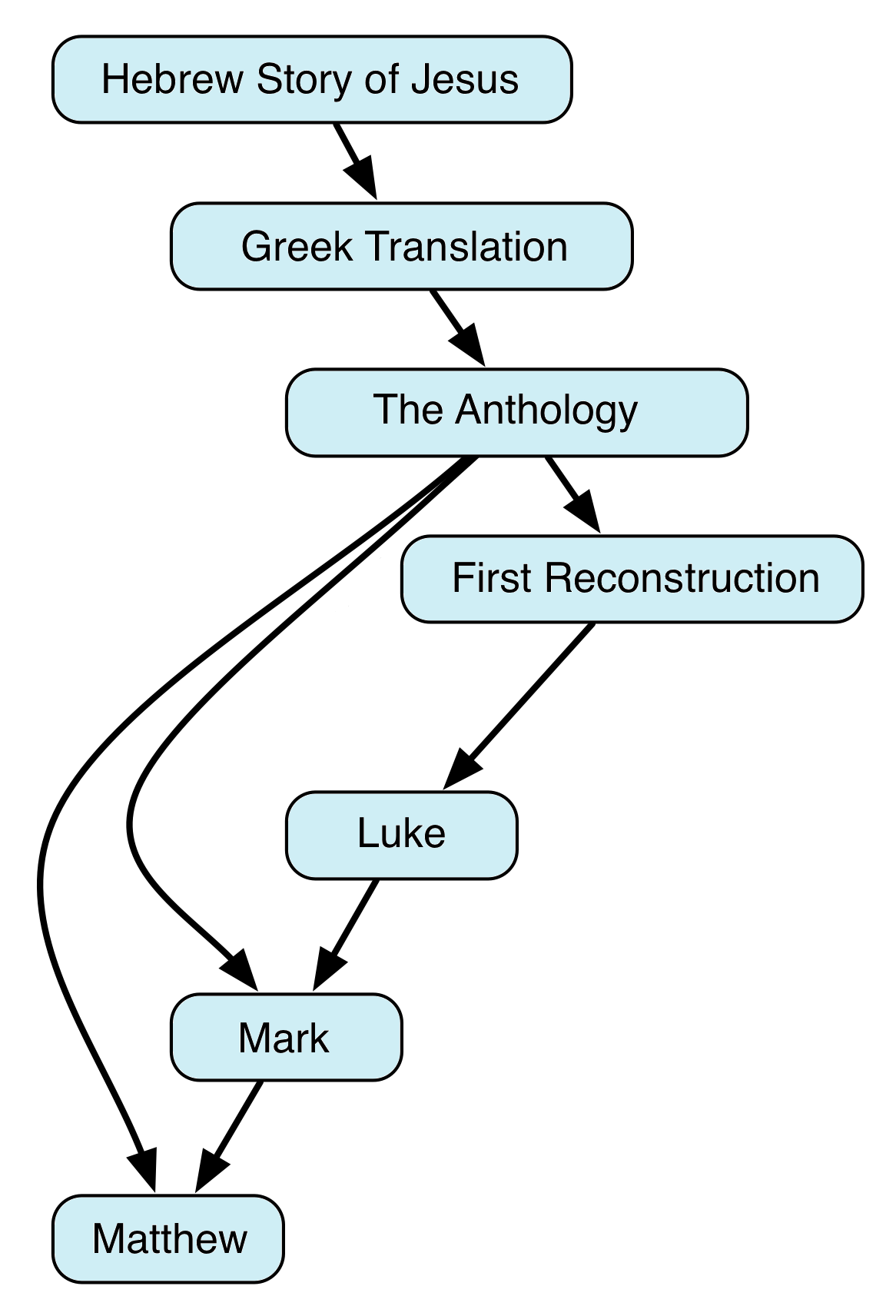
Throughout his version of the eschatological discourse the author of Luke relied on the First Reconstruction (FR),[10] and since the author of Luke was not in the habit of switching back and forth between his sources from one pericope to the next, our presupposition is that Luke’s version of Be Ready for the Son of Man was also based on FR.[11] We will supply confirmation of our presupposition presently. First, however, we must note that FR’s eschatological discourse was based on an earlier prophecy of destruction and redemption preserved in the Anthology (Anth.). Into this prophecy the First Reconstructor inserted additional sayings he collected from elsewhere in Anth. which, to his mind, filled in and updated the prophecy for his readers.
Many of the sayings the First Reconstructor inserted into his version of the eschatological discourse belonged, in Anth., to a single cluster that related to the dual themes of the disciples’ future mission (and the difficulties they would face in carrying it out) and their eventual vindication at the Son of Man’s coming. The First Reconstructor inserted sayings from this Anth. cluster into his expanded version of the eschatological discourse because it supplemented Jesus’ prophecy of destruction and redemption, which pertained to all the Jewish people, with instructions and promises for the future that were specific to Jesus’ followers. The addition of these sayings to the original core of the prophecy made FR’s eschatological discourse more relevant to his readers.
It is possible to reconstruct the Anth. cluster of sayings the First Reconstructor inserted into the eschatological discourse by first using the evidence of Lukan Doublets and then adding evidence of non-Markan Matthean parallels to FR’s inserted pericopae that are located outside Matthew’s version of the eschatological discourse. Two of these inserted sayings have clear parallels in the twelfth chapter of Luke: Luke 21:12-15 (Testifying Before Authorities) has a parallel in Luke 12:11-12, and Luke 21:18 (Hair of Your Head) is paralleled in Luke 12:4-7. On their own these Lukan Doublets are sufficient to show that neither Testifying Before Authorities nor Hair of Your Head originally belonged to Jesus’ prophecy of destruction and redemption, since the presence of doublets in Luke is due to the author of Luke’s use of two sources, Anth. and FR. Thus, the versions of the doublets in Luke 12 are the origin of the FR versions in Luke 21. The mutual proximity of these two doublets, both sayings being located in the twelfth chapter of Luke, draws our attention to the fact that the Matthean parallels to these two doublets are also located close to one another, both being found in Matthew chapter 10: Luke 12:4-7 (Hair of Your Head) is paralleled in Matt. 10:28-31, and Luke 12:11-12 (Testifying before Authorities) is paralleled in Matt. 10:17-20. Moreover, in the tenth chapter of Matthew we find additional parallels to sayings in Luke 21: Luke 21:16-17 (Betrayal of Friends) is paralleled in Matt. 10:21-22a; Luke 21:19 (Steadfastness) is paralleled in Matt. 10:22b; Luke 21:32 (Completion) is paralleled in Matt. 10:23. Therefore, all these pericopae—Hair of Your Head, Testifying Before Authorities, Betrayal of Friends, Steadfastness and Completion—likely belonged to a single cluster in Anth.:
|
Pericope |
Matthew |
Luke |
FR’s Prophecy |
|
Hair of Your Head |
Matt. 10:28-31 |
Luke 12:4-7 |
Luke 21:18 |
|
Testifying Before Authorities |
Matt. 10:17-20 |
Luke 12:11-12 |
Luke 21:12-15 |
|
Betrayal of Friends |
Matt. 10:21-22a |
Luke 21:16-17 |
|
|
Steadfastness |
Matt. 10:22b |
Luke 21:19 |
|
|
Completion |
Matt. 10:23 |
Luke 21:32 |
What is more, we may add to our reconstruction of the Anth. cluster pericopae that, while lacking parallels in Luke 21, occur both in Luke 12 and Matthew 10. These include: Nothing Hidden (Matt. 10:26-27 ∥ Luke 12:2-3), Acknowledgement of the Son of Man (Matt. 10:32-33 ∥ Luke 12:8-9) and Division (Matt. 10:34-36 ∥ Luke 12:51-53).
|
Pericope |
Matthew |
Luke |
FR’s Prophecy |
|
Nothing Hidden |
Matt. 10:26-27 |
Luke 12:2-3 |
|
|
Hair of Your Head |
Matt. 10:28-31 |
Luke 12:4-7 |
Luke 21:18 |
|
Acknowledgement of the Son of Man |
Matt. 10:32-33 |
Luke 12:8-9 |
|
|
Testifying Before Authorities |
Matt. 10:17-20 |
Luke 12:11-12 |
Luke 21:12-15 |
|
Betrayal of Friends |
Matt. 10:21-22a |
Luke 21:16-17 |
|
|
Steadfastness |
Matt. 10:22b |
Luke 21:19 |
|
|
Completion |
Matt. 10:23 |
Luke 21:32 |
|
|
Division |
Matt. 10:34-36 |
Luke 12:51-53 |
We may further conjecture that pericopae in the twelfth chapter of Luke that, while lacking doublets in Luke 21 and parallels in Matthew 10, relate to the dual themes of the disciples’ future mission and their accountability to the Son of Man also belonged to this Anth. cluster. These include: Speaking Against the Son of Man (Luke 12:10); Faithful or Faithless Slave (Part One) (Luke 12:35-38); Unexpected Thief (Luke 12:39-40); Faithful or Faithless Slave (Part Two) (Luke 12:41-46); and perhaps also Proportionality (Luke 12:47-48) and Immersion of Fire (Luke 12:49-50).[12]
|
Pericope |
Matthew |
Luke |
FR’s Prophecy |
|
Nothing Hidden |
Matt. 10:26-27 |
Luke 12:2-3 |
|
|
Hair of Your Head |
Matt. 10:28-31 |
Luke 12:4-7 |
Luke 21:18 |
|
Acknowledgement of the Son of Man |
Matt. 10:32-33 |
Luke 12:8-9 |
|
|
Speaking Against the Son of Man |
Luke 12:10 |
||
|
Testifying Before Authorities |
Matt. 10:17-20 |
Luke 12:11-12 |
Luke 21:12-15 |
|
Betrayal of Friends |
Matt. 10:21-22a |
Luke 21:16-17 |
|
|
Steadfastness |
Matt. 10:22b |
Luke 21:19 |
|
|
Completion |
Matt. 10:23 |
Luke 21:32 |
|
|
Faithful or Faithless Slave (Part One) |
(cf. Matt. 25:1-13) |
Luke 12:35-38 |
Luke 21:34-36 |
|
Unexpected Thief |
Matt. 24:43-44 |
Luke 12:39-40 |
|
|
Faithful or Faithless Slave (Part Two) |
Matt. 24:45-51 |
Luke 12:41-46 |
|
|
Proportionality [?] |
Luke 12:47-48 |
||
|
Immersion of Fire [?] |
Luke 12:49-50 |
||
|
Division |
Matt. 10:34-36 |
Luke 12:51-53 |
|
|
The pericopae included in this reconstruction of the Anth. cluster on the disciples’ mission and their vindication by the Son of Man are shown in one of four colors depending on our certainty of their belonging. They are (from strongest to weakest): 1) pericopae occurring both in Luke 12 and in Matthew 10 and paralleled in Luke 21 (purple); 2) pericopae occurring either in Luke 12 or in Matthew 10 and paralleled in Luke 21 (pink); 3) pericopae occurring in both Luke 12 and Matthew 10 but not in Luke 21 (blue); 4) pericopae occurring either in Luke 12 or in Matthew 10, and, while not paralleled in Luke 21, relating to the themes of the disciples’ future mission and/or the Son of Man (grey). |
|||
And here it is that we find confirmation that Luke’s version of Be Ready for the Son of Man stems from FR, for, while not quite qualifying as a doublet, Be Ready for the Son of Man reads like a paraphrased summary of Faithful or Faithless Slave and Unexpected Thief (Luke 12:35-46). Thus, Be Ready for the Son of Man warns against drunkenness and urges wakefulness in order to be ready for the Son of Man, a warning that recalls the drunkenness of the slave while his master tarried in Faithful or Faithless Slave (Luke 12:45), and an exhortation that echoes the call for preparedness in Unexpected Thief (Luke 12:40) as well as the benediction for wakefulness in Faithful or Faithless Slave (Luke 12:38). So it appears the First Reconstructor based Be Ready for the Son of Man on sayings—Faithful or Faithless Slave and Unexpected Thief—that came from the same Anth. cluster as so many of the other sayings he inserted into his version of the eschatological discourse.
The discovery that Luke’s version of Be Ready for the Son of Man is FR’s summary of Faithful or Faithless Slave and Unexpected Thief explains how the author of Mark came to insert the comparison about the man entrusting his household to his slaves and enjoining the porter to stay awake to his version of Be Ready for the Son of Man: the author of Mark, working from Luke and Anth., realized that Be Ready for the Son of Man was a condensed version of Faithful or Faithless Slave and Unexpected Thief.[13] He therefore added a summary of his own, not of the ethical lesson but of the illustrations from which the lesson was drawn. His realization was not only based on the similarity of the themes and vocabulary; the author of Mark could see that much of the Anth. cluster which included these two pericopae was paralleled in Luke’s eschatological discourse, and he could further see that Be Ready for the Son of Man in Luke 21 occupied the space which in the Anth. cluster was occupied by Faithful or Faithless Slave and Unexpected Thief.
The author of Mark’s realization that Be Ready for the Son of Man is merely a summary of Faithful or Faithless Slave and Unexpected Thief also accounts for the formulation of the final sentence in Mark’s version of the eschatological discourse: “What I say to you I say to everyone: Stay awake!” (Mark 13:37). This statement corresponds to the question Peter asks in Luke’s version of Faithful or Faithless Slave (Part Two): “Lord, do you tell this parable to us or to everyone?” (Luke 12:41), a question that remains unanswered in Luke.
The discovery that Be Ready for the Son of Man is merely FR’s summary of Faithful or Faithless Slave and Unexpected Thief, which came from the same cluster of sayings in Anth. as other pericopae the First Reconstructor worked into the eschatological discourse, also explains much of the author of Matthew’s redactional activity in his version of the eschatological discourse. It was because he could see that in Anth. Faithful or Faithless Slave and Unexpected Thief occupied the same position as Mark’s version of Be Ready for the Son of Man that the author of Matthew recognized that Be Ready for the Son of Man in Mark was merely a summary of these two pericopae.[14] Therefore, preferring Anth.’s unabridged versions to Mark’s abridged adaptation, the author of Matthew placed Unexpected Thief and Faithful or Faithless Slave immediately following his highly abbreviated version of Mark’s Be Ready for the Son of Man.[15] This is why Matthew’s versions of Unexpected Thief and Faithful or Faithless Slave occur in chapter 24 and not in chapter 10 along with the other pericopae from the Anth. cluster.
Moreover, Anth.’s exhortation to keep one’s lamps burning (Luke 12:35) and waiting for a lord to return from a wedding feast (Luke 12:36) in Faithful or Faithless Slave (Part One), along with Mark’s reference to a lord’s coming at midnight (Mark 13:35) in Be Ready for the Son of Man, which was itself inspired by Anth.’s reference to a lord’s returning in the second or third watch of the night (Luke 12:38) in Faithful or Faithless Slave (Part One), reminded the author of Matthew of the Waiting Maidens parable, which refers to lighting torches to welcome a groom, who is addressed as “Lord!” and who comes at midnight.[16] Therefore, although he could not find a way to work Faithful or Faithless Slave (Part One) into his version of the eschatological discourse,[17] he did insert Waiting Maidens parable (Matt. 25:1-13) following Be Ready for the Son of Man (Matt. 24:42), Unexpected Thief (Matt. 24:43-44) and Faithful or Faithless Slave (Part Two) (Matt. 24:45-51).
To summarize our findings thus far: The First Reconstructor composed Be Ready for the Son of Man on the basis of Faithful or Faithless Slave (Parts One and Two) and Unexpected Thief as a parenetic conclusion to his expanded version of Jesus’ prophecy of destruction and redemption, which he adapted from Anth. The author of Luke transcribed FR’s prophecy, including Be Ready for the Son of Man, with relatively little change. The author of Mark, following his usual practice, paraphrased and amplified Luke’s version of the eschatological discourse. In Be Ready for the Son of Man the author of Mark realized that the pericope was based on Faithful or Faithless Slave and Unexpected Thief, so he drew on these pericopae in the process of rewriting Luke’s version of Be Ready for the Son of Man. The author of Mark’s revisions of Be Ready for the Son of Man in the light of Faithful or Faithless Slave and Unexpected Thief and his ability to compare Mark’s eschatological discourse with the Anth. cluster whose contours we outlined above made it clear to the author of Matthew that Mark’s version of Be Ready for the Son of Man was a summary of these two pericopae. The author of Matthew, therefore, adopted only a small portion of Mark’s Be Ready for the Son of Man, because he preferred to incorporate directly from Anth. versions of Faithful or Faithless Slave and Unexpected Thief into his version of the eschatological discourse.
However, a few further remarks regarding the transmission history of Luke’s version of Be Ready for the Son of Man are necessary. First, in addition to drawing upon imagery and vocabulary from Faithful or Faithless Slave and Unexpected Thief, Luke’s version of Be Ready for the Son of Man may allude to the following passage from Isaiah:[18]
פַּחַד וָפַחַת וָפָח עָלֶיךָ יוֹשֵׁב הָאָרֶץ׃ וְהָיָה הַנָּס מִקּוֹל הַפַּחַד יִפֹּל אֶל־הַפַּחַת וְהָעוֹלֶה מִתּוֹךְ הַפַּחַת יִלָּכֵד בַּפָּח כִּי־אֲרֻבּוֹת מִמָּרוֹם נִפְתָּחוּ וַיִּרְעֲשׁוּ מוֹסְדֵי אָרֶץ׃ רֹעָה הִתְרֹעֲעָה הָאָרֶץ פּוֹר הִתְפּוֹרְרָה אֶרֶץ מוֹט הִתְמוֹטְטָה אָרֶץ׃ נוֹעַ תָּנוּעַ אֶרֶץ כַּשִּׁכּוֹר וְהִתְנוֹדְדָה כַּמְּלוּנָה וְכָבַד עָלֶיהָ פִּשְׁעָהּ וְנָפְלָה וְלֹא־תֹסִיף קוּם׃
Terror! And pit! And snare! They are upon you, O inhabitant of the earth. And it will be that the one who escapes from the sound of terror will fall into a pit, and the one who comes up from the pit will be caught in a snare, because the windows from on high were opened, and the foundations of the earth tremble. The earth is utterly broken, the earth is utterly split open, the earth is utterly shaken. The earth utterly staggers like a drunkard and totters like a hut, and its transgression weighs upon it, and it falls and will not rise again. (Isa. 24:17-20)
φόβος καὶ βόθυνος καὶ παγὶς ἐφ̓ ὑμᾶς τοὺς ἐνοικοῦντας ἐπὶ τῆς γῆς· καὶ ἔσται ὁ φεύγων τὸν φόβον ἐμπεσεῖται εἰς τὸν βόθυνον, ὁ δὲ ἐκβαίνων ἐκ τοῦ βοθύνου ἁλώσεται ὑπὸ τῆς παγίδος, ὅτι θυρίδες ἐκ τοῦ οὐρανοῦ ἠνεῴχθησαν, καὶ σεισθήσεται τὰ θεμέλια τῆς γῆς. ταραχῇ ταραχθήσεται ἡ γῆ, καὶ ἀπορίᾳ ἀπορηθήσεται ἡ γῆ· ἔκλινεν καὶ σεισθήσεται ὡς ὀπωροφυλάκιον ἡ γῆ ὡς ὁ μεθύων καὶ κραιπαλῶν καὶ πεσεῖται καὶ οὐ μὴ δύνηται ἀναστῆναι, κατίσχυσεν γὰρ ἐπ̓ αὐτῆς ἡ ἀνομία.
Fear! And pit! And snare! They are upon you, the inhabitants upon the earth. And it will be that the one fleeing the fear will fall into the pit. But the one climbing out of the pit will be caught by the snare, because the windows from heaven were opened and the foundations of the earth were shaken. By trouble the earth is troubled, and by perplexity the earth is confused. Tipped over and shaken like a guard hut is the earth, like a drunkard and a hungover person it also falls and is not able to rise. For lawlessness overcomes it. (Isa. 24:17-20)
Common to the Luke and Isaiah passages are the term παγίς (pagis, “snare”) and the verb κατισχύειν (katischūein, “to prevail”). Also shared are the images of drunkenness and hangover, expressed in nominal (Luke: κραιπάλη [kraipalē, “hangover”]; μέθη [methē, “drunkenness”]) or verbal forms (Isaiah: μεθύειν [methūein, “to get drunk”]; κραιπαλᾶν [kraipalan, “to be hung over”]), and the warning that catastrophe is coming upon all the inhabitants of the earth (Luke: ἐπεισελεύσεται γὰρ ἐπὶ πάντας τοὺς καθημένους ἐπὶ πρόσωπον πάσης τῆς γῆς [“For it will come upon all the ones dwelling upon the face of the whole earth”]; Isaiah: ἐφ̓ ὑμᾶς τοὺς ἐνοικοῦντας ἐπὶ τῆς γῆς [“[They are] upon you, O inhabitants on the earth”]). The two passages also share cognates for the verb “to flee” (Luke: ἐκφυγεῖν [ekfūgein, “to flee from”]; Isaiah: ὁ φεύγων [ho fevgōn, “the one fleeing”]).
Because the probable allusion to this Isaiah passage appears intrusive in the context of Be Ready for the Son of Man, and for additional reasons we will discuss in the Redaction Analysis: Luke’s Version section below, we suspect that the author of Luke added the allusive elements to FR’s version of Be Ready for the Son of Man.
There are also striking similarities between Luke’s version of Be Ready for the Son of Man and a passage in 1 Thessalonians that discusses the final judgment:
περὶ δὲ τῶν χρόνων καὶ τῶν καιρῶν, ἀδελφοί, οὐ χρείαν ἔχετε ὑμῖν γράφεσθαι, αὐτοὶ γὰρ ἀκριβῶς οἴδατε ὅτι ἡμέρα κυρίου ὡς κλέπτης ἐν νυκτὶ οὕτως ἔρχεται. ὅταν λέγωσιν· εἰρήνη καὶ ἀσφάλεια, τότε αἰφνίδιος αὐτοῖς ἐφίσταται ὄλεθρος ὥσπερ ἡ ὠδὶν τῇ ἐν γαστρὶ ἐχούσῃ, καὶ οὐ μὴ ἐκφύγωσιν ὑμεῖς δέ, ἀδελφοί, οὐκ ἐστὲ ἐν σκότει, ἵνα ἡ ἡμέρα ὑμᾶς ὡς κλέπτης καταλάβῃ πάντες γὰρ ὑμεῖς υἱοὶ φωτός ἐστε καὶ υἱοὶ ἡμέρας. οὐκ ἐσμὲν νυκτὸς οὐδὲ σκότους· ἄρα οὖν μὴ καθεύδωμεν ὡς οἱ λοιποὶ ἀλλὰ γρηγορῶμεν καὶ νήφωμεν. οἱ γὰρ καθεύδοντες νυκτὸς καθεύδουσιν καὶ οἱ μεθυσκόμενοι νυκτὸς μεθύουσιν· ἡμεῖς δὲ ἡμέρας ὄντες νήφωμεν ἐνδυσάμενοι θώρακα πίστεως καὶ ἀγάπης καὶ περικεφαλαίαν ἐλπίδα σωτηρίας· ὅτι οὐκ ἔθετο ἡμᾶς ὁ θεὸς εἰς ὀργὴν ἀλλ’ εἰς περιποίησιν σωτηρίας διὰ τοῦ κυρίου ἡμῶν Ἰησοῦ Χριστοῦ τοῦ ἀποθανόντος ὑπὲρ ἡμῶν, ἵνα εἴτε γρηγορῶμεν εἴτε καθεύδωμεν ἅμα σὺν αὐτῷ ζήσωμεν
5:1 But concerning the times and the seasons, brothers, you have no need to be written to. 5:2 For know accurately that the Day of the Lord—like a thief in the night, that is how it comes. 5:3 When they say, “Peace!” and “Security!” then sudden ruin will come upon them like the birthing pains of a woman in labor, and they will not escape. 5:4 But you, brothers, are not in darkness, that the day should capture you like a thief. 5:5 For you all are sons of light and sons of day. We are not of the night or of darkness. 5:6 So, therefore, let us not sleep like the rest, but let us be awake and sober. 5:7 For the ones that sleep sleep at night and the ones that get drunk get drunk at night. 5:8 But we, being of the day, will be awake, wearing a breastplate of faithfulness and love and a helm of hope of salvation. 5:9 Because God has not appointed us for wrath but for attainment of salvation through our Lord Jesus Christ, 5:10 who died for us so that whether we are awake or we are asleep we together might live with him. (1 Thess. 5:1-10)
The similarities between this fascinating passage and Luke’s version of Be Ready for the Son of Man are numerous.[19] Both refer to chronology (Luke: ἡ ἡμέρα ἐκείνη [hē hēmera ekeinē, “that day”]; 1 Thess.: ἡμέρα κυρίου [hēmera kūriou, “day of the Lord”]; Luke: ἐν παντὶ καιρῷ [en panti kairō, “in every season”]; 1 Thess.: περὶ…τῶν χρόνων καὶ τῶν καιρῶν [peri…tōn chronōn kai tōn kairōn, “concerning…the times and the seasons”]); both use a simile (Luke: ὡς παγίς [hōs pagis, “like a snare”]; 1 Thess.: ὥσπερ ἡ ὠδὶν τῇ ἐν γαστρί [hōsper hē ōdin tē en gastri, “like birthing pains of a pregnant woman”]) and the adjective αἰφνίδιος (aifnidios, “sudden”) to describe the crisis and the verb ἐφιστάναι (efistanai, “to stand over,” “to impend”) to describe its coming; both are preoccupied with the need for wakefulness (Luke: ἀγρυπνεῖτε [agrūpneite, “Be sleepless!”]; 1 Thess.: γρηγορῶμεν [grēgorōmen, “Let us stay awake!”]) and sobriety (Luke: μήποτε βαρηθῶσιν ὑμῶν αἱ καρδίαι ἐν κραιπάλῃ καὶ μέθῃ [“lest your hearts be weighed down in hangover and drunkenness”]; 1 Thess.: νήφωμεν [“Let us be sober!”]); and both stress that none but the faithful will escape the coming crisis (Luke: δεόμενοι ἵνα κατισχύσητε ἐκφυγεῖν [“praying that you might be able to escape”]; 1 Thess.: οὐ μὴ ἐκφύγωσιν [“they will not escape”]).
There are also important differences between the two passages. Unlike Be Ready for the Son of Man, the Thessalonians passage is infused with an Essene-style dualism between the Sons of Light and the Sons of Darkness (1 Thess. 5:5),[20] a dualism considered to be divinely ordained (1 Thess. 5:9). And whereas Be Ready for the Son of Man uses the pacific imagery of a prayer vigil when urging wakefulness, the Thessalonians passage employs the militant imagery (like that of the Essenes’ War Scroll) of an armored man keeping watch (1 Thess. 5:8). Also, surprisingly, it is the Thessalonians passage that uses the image of a thief in the night despite Be Ready for the Son of Man being a summary of Faithful or Faithless Slave and Unexpected Thief.
The common subject matter and the shared vocabulary notwithstanding, it is not clear that there is direct dependence between Luke’s version of Be Ready for the Son of Man and the Thessalonians passage.[21] It could be that both passages reflect early Christian notions and terminology concerning a central tenet of the new faith: the belief that the Son of Man was coming soon.
Crucial Issues
- Did the author of Luke edit FR’s version of Be Ready for the Son of Man?
- Did the author of Mark edit Luke’s version of Be Ready for the Son of Man in light of Faithful or Faithless Slave and Unexpected Thief?
Redaction Analysis
Because we regard Be Ready for the Son of Man as a redactional creation of the First Reconstructor, we have not produced a Greek or Hebrew reconstruction of this pericope. The pericopae upon which FR’s version of Be Ready for the Son of Man was based—Faithful or Faithless Slave and Unexpected Thief—will, however, be reconstructed in due course. In the comments below we will focus on how the First Reconstructor used his source (Anth.) and his literary ingenuity to compose Be Ready for the Son of Man. The comments will also focus on how each of the synoptic evangelists adapted this pericope according to their respective needs and intentions. To facilitate this analysis in the comments below, we will discuss each version successively, rather than discussing each of the versions together as we typically do in the commentary to LOY segments.
Luke’s Version
As we discussed in the Conjectured Stages of Transmission section above, we regard Luke’s version of Be Ready for the Son of Man as being based on FR’s. Nevertheless, it appears that the author of Luke did not leave FR’s version of Be Ready for the Son of Man unaltered. The author of Luke adapted FR’s version to include an allusion to Isa. 24:17-20. This allusion was likely inspired by the reference to drunkenness in the Isaiah passage, a theme that also occurred in FR’s version of Be Ready for the Son of Man, and the similarity of the Isaiah passage, which describes the shaking of the earth to its foundations, to the cosmic upheavals foretold in Son of Man’s Coming (Luke 21:25-27).
Despite the author of Luke’s redactional activity, we are still able to discern evidence of the First Reconstructor’s reliance on Faithful or Faithless Slave and Unexpected Thief for his version of Be Ready for the Son of Man. What we do not find in Luke’s version of Be Ready for the Son of Man is influence from Mark. Mark’s version of Be Ready for the Son of Man does not warn against the heart being weighed down, it does not mention drunkenness or the cares of life, it does not compare the suddenness of “that day” to a snare, nor does it refer to the possibility of escaping the hardships described in Jesus’ prophecy by means of ardent prayer. Nearly all of these themes and admonitions, however, can either be drawn from Faithful or Faithless Slave and Unexpected Thief or have parallels in other FR pericopae.
L1-2 προσέχετε δὲ ἑαυτοῖς (Luke 21:34). Luke’s version of Be Ready for the Son of Man opens with the imperative προσέχετε…ἑαυτοῖς (prosechete…heavtois, “Be careful of yourselves”), an imperative that also opens Luke’s version of Reproof (Luke 17:3), which, on other grounds, we have traced to FR.[22] These account for two of the three instances of προσέχετε ἑαυτοῖς in Luke. The remaining instance of προσέχετε ἑαυτοῖς in Luke occurs in Warning About Leavened Bread (Luke 12:1),[23] which may also derive from FR, since it is associated with other FR pericopae (Woes Against Scribes and Pharisees [Luke 11:37-48, 52-54] and Innocent Blood [Luke 11:49-51]).[24] Therefore, although some scholars have characterized προσέχετε ἑαυτοῖς as Lukan,[25] we are comfortable attributing this expression in Be Ready for the Son of Man to the First Reconstructor.[26]
L3-4 μήποτε βαρηθῶσιν ὑμῶν αἱ καρδίαι (Luke 21:34). Some interpreters have pointed to the Passover narrative in Exodus as the source of Luke’s warning “lest your hearts be weighed down,” since there we are told that βεβάρηται ἡ καρδία Φαραω τοῦ μὴ ἐξαποστεῖλαι τὸν λαόν (“The heart of Pharaoh is weighed down so as not to send out the people”; Exod. 7:14; cf. Exod. 8:11; 9:7), a statement that uses the same verb, βαρεῖσθαι (bareisthai, “to be weighed down”), that occurs in Luke 21:34. However, an allusion to the hardening of Pharaoh’s heart is not particularly apt, since his hardening had nothing to do with drunkenness, and the effect of the weighing down of the heart Luke 21:34 warns against—moral lethargy—is unlike the effect of the hardening of Pharaoh’s heart—stubborn rebelliousness against God.[27] Moreover, an allusion to the Passover narrative is unnecessary, since, as some scholars have noted, “to be heavy with wine” was an idiomatic Greek expression.[28]
Rather than looking to Pharaoh’s heart as the source of the First Reconstructor’s warning, we need look no further than Anth.’s version of Faithful or Faithless Slave (Part Two), where the faithless slave’s wickedness, which eventually leads to drunkenness, begins in his heart (Matt. 24:48 ∥ Luke 12:45). Luke’s un-Hebraic word order in L3-4, with ὑμῶν (hūmōn, “your”) before αἱ καρδίαι (hai kardiai, “the hearts”), is yet another indication that this phrase is due to the First Reconstructor’s redactional activity.
Below, in Redaction Analysis: Mark’s Version of Be Ready for the Son of Man, we will note numerous points of contact between this pericope and Mark’s version of Gat Shemanim (Mark 14:32-42). We believe the author of Mark added allusions to Be Ready for the Son of Man to his version of Gat Shemanim in order to demonstrate how the disciples failed to heed Jesus’ warnings in the eschatological discourse to keep awake. The author of Mark’s intention was probably to heighten the urgency of these warnings, for if the disciples could have failed to keep watch at a critical moment when Jesus was with them, how much more might later believers fail to remain vigilant for the coming of the Son of Man? Here we note that Mark’s version of Gat Shemanim contains a compound form of the verb βαρεῖσθαι:
καὶ πάλιν ἐλθὼν εὗρεν αὐτοὺς καθεύδοντας, ἦσαν γὰρ αὐτῶν οἱ ὀφθαλμοὶ καταβαρυνόμενοι
And coming again, he found them sleeping, for their eyes were weighed down [καταβαρυνόμενοι]…. (Mark 14:40)
It would be characteristic of the author of Mark’s editorial style that, when alluding to Be Ready for the Son of Man in his version of Gat Shemanim, he alluded to Luke’s version rather than his own.[29]
L5 ἐν κραιπάλῃ καὶ μέθῃ (Luke 21:34). The First Reconstructor picked up the motif of drunkenness from Faithful or Faithless Slave (Part Two) (Matt. 24:49 ∥ Luke 12:45). There the drunkenness of the faithless slave is literal. Here, too, literal drunkenness may be intended, but moral lethargy is also in view.[30]
It is difficult for us to decide whether FR’s version of Be Ready for the Son of Man referred to κραιπάλη (kraipalē, “hangover”)[31] in addition to μέθη (methē, “drunkenness”) and that the inclusion of κραιπάλη is partly what inspired the author of Luke to insert the allusion to Isa. 24:17-20, or whether the author of Luke added the reference to κραιπάλη in order to allude to Isa. 24:17-20.[32] Perhaps the former scenario is more likely, since there must have been something in FR’s version of Be Ready for the Son of Man that reminded the author of Luke of the Isaiah passage. In any case, the association of drunkenness with hangover must have been fairly common.[33] Moreover, the placement of the effect (κραιπάλη) ahead of the cause (μέθη) in Luke 21:34 is opposite that of Isa. 24:20. If κραιπάλη had not already been present in FR, wouldn’t the author of Luke have added it in LXX’s more logical order?
Since the noun μέθη (methē, “drunkenness”) occurs nowhere else in Luke, and since the sole instance of the cognate verb, μεθύσκειν (methūskein, “to get drunk”), in Luke occurs in Faithful or Faithless Slave (Part Two) (Matt. 24:49 ∥ Luke 12:45), FR’s reference to “drunkenness” was one of the clues that aided the author of Mark in identifying Be Ready for the Son of Man as a summary of Faithful or Faithless Slave and Unexpected Thief.
L6 καὶ μερίμναις βιωτικαῖς (Luke 21:34). The phrase μερίμναις βιωτικαῖς (merimnais biōtikais, “by anxieties of [mundane] life”) is highly reminiscent of the phrase ἡδονῶν τοῦ βίου (hēdonōn tou biou, “pleasures of [mundane] life”; Luke 8:14), which the First Reconstructor inserted into the Four Soils interpretation.[34] We therefore feel confident in ascribing this phrase in Luke 21:34 to the First Reconstructor. The First Reconstructor warned that everyday concerns and attractions could easily distract from the vigilance requisite for standing unashamed before the Son of Man.
L7-8 καὶ ἐπιστῇ ἐφ’ ὑμᾶς αἰφνίδιος ἡ ἡμέρα ἐκείνη (Luke 21:34). Whereas Unexpected Thief warns that the Son of Man will come unexpectedly, Be Ready for the Son of Man warns that the day of the Son of Man’s coming will come αἰφνίδιος (aifnidios, “suddenly”). A similar shift can be observed in 1 Thess. 5:2-3, where Paul, using nearly identical vocabulary, warns his readers that the day of the Lord—not the Son of Man—will come unexpectedly like a thief in the night, and that sudden (αἰφνίδιος) destruction will come upon the faithless. These subtle shifts probably have to do with context and audience.
The subject matter in both Be Ready for the Son of Man and the Thessalonians passage is related to the eschatological timetable. In his version of the eschatological discourse the First Reconstructor had just asserted that everything contained within Jesus’ prophecy would take place within “this generation” (Luke 21:32). Similarly, Paul opens his discussion by referring to “the times and the seasons” (1 Thess. 5:1). Thus the subject matter accounts for the shift from speaking about the Son of Man himself to the day of the Son of Man’s coming (referred to variously as “that day” [FR] or “the day of the Lord” [Paul]). For the First Reconstructor the shift from referring to the Son of Man himself to referring to “that day” was eased by the statement in Faithful or Faithless Slave (Part One) that ἥξει ὁ κύριος τοῦ δούλου ἐκείνου ἐν ἡμέρᾳ ᾗ οὐ προσδοκᾷ (“the lord of that servant will come on a day he does not expect”; Luke 12:46).
The shift from unexpectedness in Unexpected Thief to suddenness in Be Ready for the Son of Man and the Thessalonians passage may have to do with audience. When Jesus described the Son of Man coming unexpectedly like a thief, he meant that the wicked would be caught by surprise. By contrast, Be Ready for the Son of Man and the Thessalonians passage were addressed to believers who were very much expecting the Son of Man and had been awaiting him for some time. Despite their long wait, the First Reconstructor warned his readers the day would come upon them suddenly, whereas Paul warned his readers that the destruction of the wicked would be sudden.
As we discussed above, the similarities between Luke’s version of Be Ready for the Son of Man and the passage in 1 Thessalonians are probably not due to direct literary dependence but to a common tradition of adapting Jesus’ teaching in Unexpected Thief to the needs of first-century churches. Here we remind readers that we have dated the First Reconstruction as nearly contemporaneous (mid-50s C.E.) with 1 Thessalonians (ca. 50 C.E.).[35]
L9 ὡς παγίς (Luke 21:35). Comparison of Be Ready for the Son of Man with Unexpected Thief and with 1 Thess. 5:1-4 would lead us to expect to find the phrase ὡς κλέπτης (hōs kleptēs, “as a thief”) rather than ὡς παγίς (hōs pagis, “as a snare”). In fact, we suspect FR’s version of Be Ready for the Son of Man did read, ὡς κλέπτης (“as a thief”)[36] and that it was the author of Luke who changed the comparison to ὡς παγίς (“as a snare”) in order to insert the allusion to Isa. 24:17-20.
Supporting our supposition that FR read “as a thief” are the following considerations:
- Be Ready for the Son of Man is FR’s summary of Faithless and Faithful Slave and Unexpected Thief, where there is no mention of a snare but where the unexpectedness of the Son of Man’s coming is compared to the stealing in of a thief.
- As A. B. Bruce observed,[37] the image of a snare is not particularly apposite in Be Ready for the Son of Man, since remaining sleepless (L16) is not an effective means for avoiding entrapment in a snare.
- The entire section of Be Ready for the Son of Man that alludes to Isa. 24:17-20 (L9-16) could easily be omitted if ὡς παγίς (“as a snare”) were replaced by ὡς κλέπτης (“as a thief”).
Thus, the allusion to Isa. 24:17-20 appears to be an intrusive element in Luke’s version of Be Ready for the Son of Man.
One reason for attributing this intrusion to the author of Luke is that the description of the crisis coming upon all those dwelling on the face of the earth (Luke 21:35) sounds similar to the description of the reaction of the earth’s inhabitants to the cosmic upheavals that would herald the Son of Man’s coming:
καὶ ἐπὶ τῆς γῆς συνοχὴ ἐθνῶν ἐν ἀπορίᾳ ἤχους θαλάσσης καὶ σάλου ἀποψυχόντων ἀνθρώπων ἀπὸ φόβου καὶ προσδοκίας τῶν ἐπερχομένων τῇ οἰκουμένῃ
…and on the earth distress of Gentiles in perplexity at the roaring of the sea and its surging; the fainting of people from fear and anticipation of the things coming upon the inhabited world. (Luke 21:25-26)
In Son of Man’s Coming we found that this description was the author of Luke’s editorial addition to the pericope. It stands to reason that these two intrusive passages were inserted by the same redactor, the author of Luke.
It now seems probable that the Lukan insertion in Son of Man’s Coming, L12-20, was already laying the groundwork for the allusion to Isa. 24:17-20 in Be Ready for the Son of Man, for some of the distinctive vocabulary in Luke 21:25-26 also occurs in Isa. 24:17-20. This distinctive vocabulary includes φόβος (fobos, “fear”; Isa. 24:17, 18 ≈ Luke 21:26), ἐπὶ τῆς γῆς (epi tēs gēs, “on the earth”; Isa. 24:17 ≈ Luke 21:25) and ἀπορία (aporia, “perplexity”; Isa. 24:19 ≈ Luke 21:25).
L12-14 ἐπεισελεύσεται γὰρ ἐπὶ πάντας τοὺς καθημένους ἐπὶ πρόσωπον πάσης τῆς γῆς (Luke 21:35). Luke’s description of the crisis coming upon all those who dwell on the face of the earth echoes the description of what will happen ἐπὶ τῆς γῆς (“on the earth”; Luke 21:25) in Son of Man’s Coming, L12, and recalls the dread and anticipation of τῶν ἐπερχομένων τῇ οἰκουμένῃ (“the things coming to the inhabited world”; Luke 21:26) in Son of Man’s Coming, L19-20. Scholars sometimes refer to the phrase πρόσωπον τῆς γῆς (prosōpon tēs gēs, “face of the earth”) as a Septuagintism.[38] Be that as it may, the author of Luke used the expression κατοικεῖν ἐπὶ παντὸς προσώπου τῆς γῆς (katoikein epi pantos prosōpou tēs gēs, “to dwell on all the face of the earth”) in Paul’s address to the Athenians (Acts 17:26). Since the author of Luke could use “on the face of the earth” there, it is reasonable to attribute this expression to him here in Be Ready for the Son of Man.
Note that in Son of Man’s Coming we found the verb ἐπέρχεσθαι (eperchesthai, “to come upon”) to be the product of Lukan redaction.[39] The verb ἐπεισέρχεσθαι (epeiserchesthai, “to come upon”), which occurs here in L12, is a compound form of ἐπέρχεσθαι and is best attributed to the author of Luke.[40]
L16-19 ἀγρυπνεῖτε δὲ ἐν παντὶ καιρῷ δεόμενοι (Luke 21:36). The exhortation in Luke’s version of Be Ready for the Son of Man to remain sleepless, entreating God at all times, is similar to a passage in the Epistle to the Ephesians:
διὰ τοῦτο ἀναλάβετε τὴν πανοπλίαν τοῦ θεοῦ, ἵνα δυνηθῆτε ἀντιστῆναι ἐν τῇ ἡμέρᾳ τῇ πονηρᾷ καὶ ἅπαντα κατεργασάμενοι στῆναι. Eph 6:14 στῆτε οὖν περιζωσάμενοι τὴν ὀσφὺν ὑμῶν ἐν ἀληθείᾳ καὶ ἐνδυσάμενοι τὸν θώρακα τῆς δικαιοσύνης Eph 6:15 καὶ ὑποδησάμενοι τοὺς πόδας ἐν ἑτοιμασίᾳ τοῦ εὐαγγελίου τῆς εἰρήνης, Eph 6:16 ἐν πᾶσιν ἀναλαβόντες τὸν θυρεὸν τῆς πίστεως, ἐν ᾧ δυνήσεσθε πάντα τὰ βέλη τοῦ πονηροῦ [τὰ] πεπυρωμένα σβέσαι· Eph 6:17 καὶ τὴν περικεφαλαίαν τοῦ σωτηρίου δέξασθε καὶ τὴν μάχαιραν τοῦ πνεύματος, ὅ ἐστιν ῥῆμα θεοῦ. Eph 6:18 Διὰ πάσης προσευχῆς καὶ δεήσεως προσευχόμενοι ἐν παντὶ καιρῷ ἐν πνεύματι, καὶ εἰς αὐτὸ ἀγρυπνοῦντες ἐν πάσῃ προσκαρτερήσει καὶ δεήσει περὶ πάντων τῶν ἁγίωνΔιὰ πάσης προσευχῆς καὶ δεήσεως προσευχόμενοι ἐν παντὶ καιρῷ ἐν πνεύματι, καὶ εἰς αὐτὸ ἀγρυπνοῦντες ἐν πάσῃ προσκαρτερήσει καὶ δεήσει περὶ πάντων τῶν ἁγίων
6:13 Therefore, take up the whole armor of God, so that you might be able to withstand in the evil day, and subduing all, might stand. 6:14 So stand, having girded your loins with truth and wearing the breastplate of righteousness, 6:15 having shod your feet with the readiness of the gospel of peace, 6:16 in all things taking up the shield of faith, with which you can extinguish all the flaming darts of the enemy, 6:17 and take the helm of salvation and the sword of the spirit, which is the word of God, 6:18 with every prayer and entreaty, praying at all times in the Spirit. And to that end staying awake with all perseverance, and entreating for all the saints…. (Eph. 6:13-18)
Both Be Ready for the Son of Man and the Ephesians passage urge prayer at all times (ἐν παντὶ καιρῷ) and, using the verb ἀγρυπνεῖν (agrūpnein, “to be sleepless”), staying awake. The similarity of the Ephesians passage to the passage in 1 Thessalonians is also clear: both refer to spiritual armor, singling out inter alia breastplate and helmet. The Ephesians passage, in referring to girding one’s loins, also connects to Faithful or Faithless Slave (Part One), which opens, “Let your loins be girded and your lamps lit” (Luke 12:35; cf. Did. 16:1). These interconnections give the impression that we are tugging on the thread of an intricate web of early Christian teaching on the parousia that developed sayings of Jesus in different directions.[41]
In Be Ready for the Son of Man the command to “be sleepless” echoes the blessing on the faithful servants whose lord finds them awake (γρηγοροῦντας) when he comes (Luke 12:37). In the context of the eschatological discourse ἐν παντὶ καιρῷ (en panti kairō, “in every time”) may refer to every period from the time of Jesus’ disciples until the “times of the Gentiles” are completed (Luke 21:24) and the Son of Man comes.
The verb δεῖσθαι (deisthai, “to beg,” “to entreat”) seems to crop up frequently in pericopae the author of Luke copied from FR (Possessed Man in Girgashite Territory, Boy Delivered from Demon, Be Ready for the Son of Man).[42]
L20 ἵνα κατισχύσητε (Luke 21:36). The verb κατισχύειν (katischūein, “to prevail”), found here in L20, also occurs in Isa. 24:20, which might suggest that the author of Luke was responsible for the use of this verb in Luke 21:36, since we determined that it was the author of Luke who inserted the allusion to Isa. 24:17-20 into the Lukan version of Be Ready for the Son of Man. We think it is more probable, however, that the presence of κατισχύειν in FR’s version of Be Ready for the Son of Man, like that of κραιπάλη (kraipalē, “hangover”) in L5, was partly what inspired the author of Luke to insert the allusion to Isa. 24:17-20 into his version of Be Ready for the Son of Man. Alternatively, FR’s version of Be Ready for the Son of Man may have used the simple verb ἰσχύειν (ischūein, “to be strong”),[43] which the author of Luke changed to κατισχύειν (katischūein, “to prevail”) under the influence of Isa. 24:17. In either case, the author of Luke seems to have thought that he was making more explicit an allusion that was already present in Be Ready for the Son of Man.[44] If so, the author of Luke was mistaken.
L43 ἐκφυγεῖν (Luke 21:36). The verb ἐκφεύγειν (ekfevgein, “to flee away,” “to escape”) in Be Ready for the Son of Man harks back to the warning οἱ ἐν τῇ Ἰουδαίᾳ φευγέτωσαν εἰς τὰ ὄρη (“Let the ones in Judea flee to the hills”; Luke 21:21), which the First Reconstructor inserted into his version of Yerushalayim Besieged (L11-12). Therefore, although ἐκφεύγειν occurs 2xx in Acts (Acts 16:27; 19:16) but nowhere else in the Synoptic Gospels, we are confident in ascribing Luke’s wording in L43 to FR. The allusion back to instructions about how to behave once the siege of Jerusalem begins is an indication that for the First Reconstructor this catastrophe still lay in the future and was regarded as one of the events leading up to the coming of the Son of Man.

The verb ἐκφεύγειν also occurs in the Thessalonians passage (1 Thess. 5:1-3) with which Be Ready for the Son of Man has so much in common. There, however, Paul asserts that the wicked will by no means escape the sudden destruction that is coming upon them, whereas here the First Reconstructor urges prayer that the faithful may indeed escape the catastrophes that lie ahead.
L44 ταῦτα πάντα τὰ μέλλοντα γίνεσθαι (Luke 21:36). While the reference to escape may hark back to the description of the siege of Jerusalem, the phrase ταῦτα πάντα τὰ μέλλοντα γίνεσθαι (tavta panta ta mellonta ginesthai, “all these things that are about to happen”) reaches all the way back to the question that prompted the discourse:
πότε οὖν ταῦτα ἔσται καὶ τί τὸ σημεῖον ὅταν μέλλῃ ταῦτα γίνεσθαι
When, then, will these things be? And what is the sign when these things are about to happen? (Luke 21:7)[45]
Variations of the phrase ταῦτα γίνεσθαι (“these things to happen”) are a refrain that runs throughout the First Reconstructor’s eschatological discourse, appearing in Like Lightning (ταῦτα γενέσθαι πρῶτον [“these things will happen first”]; Luke 21:9), Testifying Before Authorities (πρὸ δὲ τούτων πάντων [“But before all these things”]; Luke 21:12), the Fig Tree parable (ἀρχομένων δὲ τούτων γίνεσθαι [“But when these things are beginning to happen”]; Luke 21:28; ὅταν ἴδητε ταῦτα γινόμενα [“When you see these things happening”]; Luke 21:31) and Completion (οὐ μὴ παρέλθῃ ἡ γενεὰ αὕτη ἕως ἂν πάντα γένηται [“This generation will not pass away until everything happens”]; Luke 21:32). Some of these instances may have occurred in Anth.’s prophecy of destruction and redemption, but the First Reconstructor also used this phrase to splice in his additional material, and used it here to refer to the entire content of the eschatological discourse.[46]
L45-46 καὶ σταθῆναι ἔμπροσθεν τοῦ υἱοῦ τοῦ ἀνθρώπου (Luke 21:36). The reference to the Son of Man comes from Unexpected Thief, which, unlike Faithful or Faithless Slave, mentions the Son of Man explicitly (Matt. 24:44 ∥ Luke 12:40).
“To stand before the Son of Man” probably alludes to the scene described in Acknowledgement of the Son of Man (Matt. 10:32-33; 16:27; Mark 8:38; Luke 9:26; 12:8-9), where Luke’s Anth. version twice uses the adverb ἔμπροσθεν (emprosthen, “in front of,” “before”). It may be that the First Reconstructor did not merely mean that his readers should pray that they may escape the things to happen so that they may stand in the Son of Man’s presence unashamed—although he certainly meant that, too[47] —but that his readers should pray that they may escape the things to happen so that they may survive until the Son of Man comes.[48] Such an interpretation is entirely plausible when we bear in mind that the First Reconstructor was convinced that all the things contained in his version of the eschatological discourse would take place before the generation Jesus originally addressed disappeared (Luke 21:32).
FR’s Version
Having examined Luke’s version of Be Ready for the Son of Man line by line, we are now in a position to offer a reconstruction of Luke’s source (FR), which probably read:
προσέχετε δὲ ἑαυτοῖς μήποτε βαρηθῶσιν ὑμῶν αἱ καρδίαι ἐν κραιπάλῃ καὶ μέθῃ καὶ μερίμναις βιωτικαῖς καὶ ἐπιστῇ ἐφ’ ὑμᾶς αἰφνίδιος ἡ ἡμέρα ἐκείνη ὡς κλέπτης ἀγρυπνεῖτε δὲ ἐν παντὶ καιρῷ δεόμενοι ἵνα [κατ]ισχύσητε ἐκφυγεῖν ταῦτα πάντα τὰ μέλλοντα γίνεσθαι καὶ σταθῆναι ἔμπροσθεν τοῦ υἱοῦ τοῦ ἀνθρώπου
But watch out for yourselves lest your hearts might be weighed down in hangover and drunkenness, and the anxieties of life and that day might come upon you as a thief. But be sleepless in all times, entreating that you might be able to escape all these things that are about to happen and to stand before the Son of Man.
This reconstruction of FR’s version of Be Ready for the Son of Man preserves (and indeed enhances) the connections between this pericope and 1 Thess. 5:1-10. On the other hand, it eliminates the intrusive allusion to Isa. 24:17-20.
If our reconstruction is correct, then we may confirm our observation that the First Reconstructor understood the reference to the Son of Man in Son of Man’s Coming in a manner different from that which Anth. intended. As we discussed in Son of Man’s Coming, under the subheading “Results of this Research,” in Jesus’ prophecy the Son of Man image probably functioned as a corporate image of Israel’s redemption, just as it does in Daniel 7. The First Reconstructor, on the other hand, understood the Son of Man as a personal redeemer figure, doubtless to be identified with the risen Jesus.
Mark’s Version
Above, in Redaction Analysis: Luke’s Version, we demonstrated the lack of dependence of Luke’s version of Be Ready for the Son of Man on Mark’s. By contrast, in the comments below we will note evidence in Mark’s version of Be Ready for the Son of Man that indicates dependence on Faithful or Faithless Slave and Unexpected Thief, two pericopae the author of Mark knew from Luke and Anth.
L8-11 (Mark 13:32). Numerous scholars confidently proclaim the authenticity of what they understand to be Jesus’ admission of ignorance in Mark 13:32 that no one—not the angels in heaven, nor even the Son—knows the timing of the eschaton, except for God the Father. No later Christian writer, they reason, would dare impute such an admission to Jesus if he had not actually said as much.[49] However, we are not confident that Mark 13:32 ought to be read as an admission of ignorance by Jesus.[50] Rather, as on two earlier occasions in the Markan version of the eschatological discourse—the first being “Let the reader understand” in Mark 13:14,[51] the second being “If the Lord had not cut those days short, no flesh would have been saved, but for the sake of the elect, whom he elected, those days were cut short” in Mark 13:20[52] —the statement in Mark 13:32 is best read as an authorial aside. In other words, in Mark 13:32 it is not Jesus who is speaking but the author of Mark, who directly addresses the readers of his Gospel. Reading Mark 13:32 as an authorial aside explains why Jesus is referred to in the third person with a title, “the Son,” that Jesus never uses anywhere else in the Gospel of Mark.[53]
But what of the argument that no Christian writer would ever dare to ascribe ignorance of the divine plan to Jesus? While it is true that reverence for Jesus might cause reticence in this regard, we can easily think of one compelling reason why a later Christian writer might want to ascribe such ignorance to Jesus: if the unfolding of history seemed to have proven Jesus wrong. The author of Mark clearly regarded FR’s version of Completion, which has Jesus claim that everything described in the eschatological discourse would take place before “this generation” passes away, as authentic.[54] But by the time the author of Mark was writing his Gospel in the mid-70s to 80 C.E.,[55] well after the destruction of the Temple, it was becoming increasingly unlikely that no matter how the saying was construed, it would be an unfulfilled prophecy. The author of Mark therefore penned Mark 13:32 (Day and Hour Unknown) as a disclaimer.[56] Readers of Mark’s Gospel should not worry if Jesus’ prediction had not come true. No one apart from God, not even Jesus, knows the time for sure. Even if Jesus was a bit off on the specifics of the timing, Mark’s readers could rest assured that the end would come very soon. Just look at how much of what Jesus’ prophecy predicted had already taken place!
The author of Matthew, on the other hand, did read Day and Hour Unknown in Mark’s eschatological discourse as though it were an actual saying of Jesus and not as an authorial aside. In part, this was because of the lack of clear demarcation in the Markan discourse between Jesus’ speech and the authorial asides. Also, the apparent use of “the Son” as a title in Father and Son (Matt. 11:27 ∥ Luke 10:22) made it credible to the author of Matthew that Jesus could have spoken about himself in this way. And so the author of Matthew also allowed Jesus to refer to himself as “the Son” in the Great Commission (Matt. 28:19). Moreover, the author of Matthew had learned to interpret Completion in a manner that did not require a disclaimer. Rather than understanding γενεά (genea) as meaning “generation,” he understood it as meaning “race.” Thus, for the author of Matthew Jesus was referring to the Jewish people: “This race [i.e., the Jews] will not pass away until all these things happen,” in other words, “Don’t worry. The Jewish people will persist until all the punishment they deserve for killing the Messiah has been meted out to them.” Such an anti-Jewish reinterpretation of a saying of Jesus is typical of the author of Matthew. Since, according to this interpretation, there was no contradiction between Completion (Matt. 24:34) and Day and Hour Unknown (Matt. 24:36), it was possible for the author of Matthew to present both as sayings of Jesus.
L8-9 περὶ δὲ τῆς ἡμέρας ἐκείνης ἢ τῆς ὥρας οὐδεὶς οἶδεν (Mark 13:32). Although the author of Mark penned Day and Hour Unknown, his authorial aside draws on sayings he read in Luke. Mark’s reference to “that day” in L8 echoes Luke’s version of Be Ready for the Son of Man, which warns that “that day” (L8) will come upon you suddenly.[57] The combination of “day” and “hour,” on the other hand, is derived from Faithful or Faithless Slave (Part Two),[58] where we read, “The lord of that servant will come on a day he does not expect and in an hour he does not know” (Luke 12:46 ∥ Matt. 24:50).[59] Did the author of Mark suppose that it was not the servant but the servant’s lord who did not know the timing of his arrival? That would seem to be the presupposition behind Mark’s comparison in L21-24 of Be Ready for the Son of Man. The man who goes away does not appoint a specific time for his servants to expect him, but he asks the porter to stay awake until he arrives back home again. Apparently, neither the journeying lord nor the servants knew when he would return.
Mark’s verb for “to know” is not γιγνώσκειν (gignōskein), the verb found in Faithful or Faithless Slave, but εἰδεῖν (eidein), the verb found in Unexpected Thief, where we read: “If the master of the house had known in what hour the thief comes, he would not have let his house be broken into” (Luke 12:39 ∥ Matt. 24:43).
L10-11 οὐδὲ οἱ ἄγγελοι ἐν οὐρανῷ οὐδὲ ὁ υἱός εἰ μὴ ὁ πατήρ (Mark 13:32). Lindsey believed that Day and Hour Unknown was partly inspired by the following saying of Jesus recorded in Acts:
οὐχ ὑμῶν ἐστιν γνῶναι χρόνους ἢ καιροὺς οὓς ὁ πατὴρ ἔθετο ἐν τῇ ἰδίᾳ ἐξουσίᾳ
It is not yours to know times or seasons[60] which the Father set in his own authority. (Acts 1:7)
There are, indeed, certain similarities between this saying and Day and Hour Unknown. Both have to do with knowledge of the timing of the eschaton, and both refer to God as “the Father.” But whereas Acts 1:7 refers to “times and seasons,” Mark 13:32 refers to “that day or hour,” and whereas in Acts 1:7 Jesus denies that the disciples can gain knowledge of the end time, in Day and Hour Unknown Mark asserts that not even Jesus knows when the end will come. Both of these differences can be explained, as we have already done, as the consequence of Mark’s dependence on Faithful or Faithless Slave and Unexpected Thief. Mark’s reference to God as “the Father” probably comes not from Acts 1:7 but from another Son of Man saying recorded in Luke:
ὃς γὰρ ἂν ἐπαισχυνθῇ με καὶ τοὺς ἐμοὺς λόγους, τοῦτον ὁ υἱὸς τοῦ ἀνθρώπου ἐπαισχυνθήσεται, ὅταν ἔλθῃ ἐν τῇ δόξῃ αὐτοῦ καὶ τοῦ πατρὸς καὶ τῶν ἁγίων ἀγγέλων.
For the one who is ashamed of me and my word, of this one will the Son of Man be ashamed when he comes in the glory of him and of the Father and of the holy angels. (Luke 9:26; cf. Mark 8:38)
This verse is the only instance in Luke where the Son of Man, the Father and the angels are mentioned together. As we noted in Days of the Son of Man, Comment to L1-6, it would be unsurprising if Luke 9:26 had been in the author of Mark’s mind while he composed Day and Hour Unknown, since the following verse, Luke 9:27, is a variant of Luke 21:32 (Completion), which contained the erroneous prediction the author of Mark was attempting to resolve. Here we might add that Luke 9:26 is a variant of Acknowledgement of the Son of Man (Matt. 10:32-33 ∥ Luke 12:8-9), which belonged to the same block of Anth. sayings as Faithful or Faithless Slave and Unexpected Thief, another reason why this saying would have been on the author of Mark’s mind.
Despite ascribing ignorance of the end time to Jesus, which the author of Mark could hardly avoid given the failed prophecy contained in Completion, the author of Mark accords to Jesus an exalted position in the hierarchy of being, placing Jesus above the angels, subordinate only to the heavenly Father. A higher christology is hardly to be found anywhere in the New Testament (cf. John 5:19; 1 Cor. 15:24-28; Phil. 2:5-11).[61]
L16 βλέπετε ἀγρυπνεῖτε (Mark 13:33). The verb βλέπειν (blepein, “to see,” “to look”) is a leitmotif that recurs throughout Mark’s version of the eschatological discourse (Mark 13:2, 5, 9, 23, 33), especially in the imperatival form βλέπετε (blepete, “Look out!”; Mark 13:5, 9, 23, 33).[62] The first instance of βλέπετε in Mark’s discourse (Mark 13:5) was taken over from Luke 21:8, the remaining instances (Mark 13:9, 23, 33) are typical Markan stereotyping.[63] The verb ἀγρυπνεῖν (agrūpnein, “to be sleepless”), on the other hand, comes from Luke’s version of Be Ready for the Son of Man (Luke 21:36).[64]
As we noted above in Redaction Analysis: Luke’s Version, Comment to L16-19, the notion of sleeplessness ultimately derives from the blessing pronounced upon the wakeful slave in Faithful or Faithless Slave (Part One) (Luke 12:37). Luke’s version of Be Ready for the Son of Man urged sleeplessness in order that believers might constantly entreat God that they might be delivered from the catastrophes to come. By contrast, Mark’s version of Be Ready for the Son of Man urges sleeplessness on account of not knowing when the time of the end will be.
L17-18 οὐκ οἴδατε γὰρ πότε ὁ καιρός ἐστιν (Mark 13:33). As in L9, Mark’s use in L17 of the verb εἰδεῖν (eidein) for “know” echoes Unexpected Thief. Mark’s use of the interrogative particle πότε (pote, “when”) echoes the exhortation in Faithful or Faithless Slave (Part One) to be like people expecting their lord πότε ἀναλύσῃ ἐκ τῶν γάμων (pote analūsē ek tōn gamōn, “when he might return from the wedding feast”; Luke 12:36). Mark’s use of the noun καιρός (kairos, “time,” “season”) echoes the exhortation in Luke’s version of Be Ready for the Son of Man to be sleepless ἐν παντὶ καιρῷ (en panti kairō, “in every time”).
Mark’s insistence that “you do not know when the time is” conflicts—or at the very least is in tension—with the Fig Tree parable, which in Mark’s version says, “When you see these things happening, know that it is near, right at the door” (Mark 13:29).
L21 ὡς ἄνθρωπος (Mark 13:34). Mark’s comparison of the disciples’ situation to a person who goes on a journey, entrusts his household to his servants, and commands the porter to stay awake for his return opens with vocabulary that echoes the exhortation in Faithful or Faithless Slave (Part One) to be like people (ὅμοιοι ἀνθρώποις) expecting their lord to return from a wedding feast (Luke 12:36).[65]
Mark’s abrupt use of the conjunction ὡς (hōs, “as,” “like”) may be due in part to ὡς παγίς (hōs pagis, “as a snare”) in Luke’s version of Be Ready for the Son of Man (Luke 21:35), but the author of Mark also used ὡς to introduce comparisons in the Spontaneous Growth parable, L3 (Mark 4:26), and the Mustard Seed parable, L7 (Mark 4:31), so the use of ὡς in Mark 13:34 is consistent with Mark’s style.
Scholars frequently regard Mark’s use of ὡς to introduce parables or parable-style comparisons as “Semitic,”[66] being particularly similar to the introductions to rabbinic parables,[67] an idea especially championed by Joachim Jeremias, who wrote:
The parables of Jesus, like contemporary parables, have two basic forms. We have (1)…[and] (2) the parable beginning with a dative (Aramaic le). Most of the rabbinical parables begin with the words: mašal. le (e.g. a very common form is masal. le mäläkh šä… ‘a parable: like a king, who…’). This usage is an abbreviation of: ’ämšol lekha mašal. lema haddabhar domä? le… (‘I will relate a parable to you. With what shall the matter be compared? It is the case with it as with…’). Hence occasionally, all this may be replaced by the bare dative (le).
…Corresponding to the shortened form beginning with the dative we have [in the parables of Jesus] ὡς, ὥσπερ, or in better Greek, ὁμοιωθήσεται, ὡμοιώθη, ὅμοιός ἐστιν. The equivalent Aramaic le underlies all these five forms.[68]
Nevertheless, Jeremias’ discussion in the paragraphs we have quoted above is fraught with difficulties. The most glaring problem is that Jeremias framed the discussion in terms of Aramaic usage despite the fact that all rabbinic parables are recorded in Hebrew, even when embedded in discussions carried out in Aramaic.[69] Jeremias’ discussion is particularly disingenuous because, as he knew full well, the examples he cited in italics are quotations of Hebrew not Aramaic. So Jeremias’ references to Aramaic are not a mistake or an accident, they are intentionally misleading. Jeremias’ insistence that the background to Jesus’ teachings was Aramaic is symptomatic of a false and outdated anti-Semitic notion that by the time of Jesus Judaism had decayed to such a point that Jews no longer spoke their ancestral language and had no access to their sacred Scriptures except through the (allegedly) dogmatic and casuistic interpretations of the rabbis.[70] Jeremias’ frequent use of the term “late Judaism” elsewhere in his writings to describe Judaism of the Second Temple period is another symptom of the same bigoted attitude.
Problematic, too, albeit more benignly, is Jeremias’ assertion that the preposition -לְ (le–, “to”) is equivalent to ὡς (hōs, “as”). The conjunction ὡς is more nearly equivalent to the preposition -כְּ (ke–, “like,” “as,” “when”) than -לְ, and in a survey of all the instances of ὡς in Genesis we found that ὡς occurs far more often as the translation of -כְּ than of any other Hebrew term or phrase.[71] To simply assert, as Jeremias did, that Mark’s use of ὡς to introduce parables and parable-like illustrations reflects the rabbinic use of -לְ at the opening of parables is entirely unjustified.
L22 ἀπόδημος (Mark 13:34). Mark’s comparison of the disciples’ situation to a man going on a journey, entrusting his household to his slaves and commanding the porter to stay awake for his return, echoes the scenario Luke describes in Faithful or Faithless Slave (Part One) of slaves waiting up for their lord to return home from a wedding feast (Luke 12:36). The author of Mark, however, shifts the perspective from that of the slaves in Luke to that of the master.[72]
Mark’s use of the adjective ἀπόδημος (apodēmos, “journeying,” “traveling,” “touring”), the sole instance in NT,[73] to describe the man recalls the Wicked Tenants parable, which in Luke’s version begins: ἄνθρωπός…ἀπεδήμησεν χρόνους ἱκανούς (“a man…went on a lengthy journey”; Luke 20:9; cf. Mark 12:1). Although the adjective ἀπόδημος seems to imply a relatively lengthy journey, the command the man gives to the porter to be sleepless presupposes a mere overnight’s absence, as in Faithful or Faithless Slave (Part One),[74] for the porter could hardly be expected to stay awake for days and nights on end.
Since the opening of Mark’s comparison (ὡς ἄνθρωπος ἀπόδημος ἀφεὶς τὴν οἰκίαν αὐτοῦ καὶ δοὺς τοῖς δούλοις αὐτοῦ τὴν ἐξουσίαν ἑκάστῳ τὸ ἔργον αὐτοῦ [“As a journeying man who left his house and gave to his servants authority, to each his task…”; Mark 13:34) resembles the opening of Matthew’s version of the Entrusted Funds parable (ὥσπερ γὰρ ἄνθρωπος ἀποδημῶν ἐκάλεσεν τοὺς ἰδίους δούλους καὶ παρέδωκεν αὐτοῖς τὰ ὑπάρχοντα αὐτοῦ [“For as a journeying man who called his own slaves and entrusted to them his property”]; Matt. 25:14), some scholars have suggested that the author of Mark conflated two pre-synoptic parables (Faithful or Faithless Slave [Part One] and the Entrusted Funds parable) to create his comparison.[75] But it is more likely that the author of Matthew reworked the opening of the Entrusted Funds parable, which he inserted into his version of the eschatological discourse, to resemble Mark 13:34, which he omitted.[76]
L23 ἀφεὶς τὴν οἰκίαν αὐτοῦ καὶ δοὺς τοῖς δούλοις αὐτοῦ τὴν ἐξουσίαν ἑκάστῳ τὸ ἔργον αὐτοῦ (Mark 13:34). Mark’s description of the man leaving his house and giving his slaves authority to each do their tasks elaborates upon the description in Faithful or Faithless Slave (Part One) of the slaves awaiting their lord’s return from a wedding feast (Luke 12:36), and echoes the description of the faithful and sensible steward in Faithful or Faithless Slave (Part Two), who is set over the household to give its members their food in the proper time (Luke 12:42 ∥ Matt. 24:45).[77] Since in Mark’s comparison the slaves do not play a functional role and could easily have been omitted,[78] they are best regarded as a verbal relic indicating Mark’s dependence on the Lukan/Anth. versions of Faithful or Faithless Slave.
L24 καὶ τῷ θυρωρῷ ἐνετείλατο ἵνα γρηγορῇ (Mark 13:34). The author of Mark zeroes in on the porter,[79] a character not specifically mentioned in Faithful or Faithless Slave, because of all those in charge of the household the porter or gatekeeper is the most likely to stay awake throughout the night ἵνα ἐλθόντος καὶ κρούσαντος εὐθέως ἀνοίξωσιν αὐτῷ (“so that, when he [i.e., the lord] comes and knocks, immediately they may open to him”; Luke 12:36).
Moreover, it appears the author of Mark focused on the porter in order to correlate the comparison with his earlier statement that when the withered fig tree comes to life, his readers should know that the Son of Man was “at the doors” (Mark 13:29).[80]
L27 γρηγορεῖτε οὖν οὐκ οἴδατε γὰρ (Mark 13:35). With the imperative γρηγορεῖτε (grēgoreite, “Stay awake!”) the author of Mark either slips out of the parable-like comparison into direct appeal to the audience,[81] or he pulls the audience into the world of the parable-like comparison. The grounds in L27 are the same as those in L17: οὐκ οἴδατε (“you do not know”). Therefore, the disciples are to be sleepless (L16) and to stay awake (L27). This ties in neatly with the Markan aside that no one knows (οὐδεὶς οἶδεν) the day or the hour.
L28 πότε ὁ κύριος τῆς οἰκίας ἔρχεται (Mark 13:35). As in L17, the author of Mark uses the particle πότε (pote, “when”),[82] which he picked up from Luke 12:36. The author of Mark creates a pun: the disciples know neither πότε ὁ καιρός ἐστιν (pote ho kairos estin, “when the time is”; L17-18) nor πότε ὁ κύριος…ἔρχεται (pote ho kūrios…erchetai, “when the lord…comes”; L28). By referring to “the lord of the house” the author of Mark slips back into the world of the parable-like comparison, bringing his audience with him. Mark’s use of the present-tense ἔρχεται (erchetai, “comes”) echoes the phrase εἰ ᾔδει…ποίᾳ ὥρᾳ ὁ κλέπτης ἔρχεται (“if he had known…in what hour the thief comes”) in Unexpected Thief (Luke 12:39 ∥ Matt. 24:43).
L32-33 ἢ ὀψὲ ἢ μεσονύκτιον ἢ ἀλεκτοροφωνίας ἢ πρωΐ (Mark 13:35). “Whether at evening or at midnight or at cockcrow or at morning” in Mark 13:35 has no counterpart in Luke’s version of Be Ready for the Son of Man. Rather, the author of Mark paraphrased what he read in Faithful or Faithless Slave (Part One): κἂν ἐν τῇ δευτέρᾳ κἂν ἐν τῇ τρίτῃ φυλακῇ (“whether in the second or whether in the third watch [of the night]”; Luke 12:38).

Numerous scholars have claimed that whereas Luke 12:38 refers to the three watches of the night according to the Jewish reckoning, Mark 13:35 refers to the four Roman watches of the night, but in doing so uses popular terminology.[83] But such an assessment comes from a blended reading of Luke 12:38 and Mark 13:35 that is not methodologically sound. Luke 12:38 does not necessarily imply that there are only three watches of the night, but merely mentions the second and third of what may be four watches. Mark 13:35, on the other hand, does not mention watches at all, and as Martin has shown, “evening,” “midnight,” “cockcrow” and “morning” would not have been recognized as popular names for the Roman watches, which were simply referred to numerically,[84] as in Luke 12:38. Martin rightly argued that Greek and Roman audiences would have understood Mark’s time-markers as “less structured temporal references” rather than “as watches, which divide the night into four equal segments.”[85] However, Martin’s other suggestion, that “evening,” “midnight,” “cockcrow” and “morning” were the local designations for the four night watches in first-century Jerusalem, is less convincing.[86] In support of his suggestion Martin cited the following statement in the Mishnah:
בְּכָל יוֹם תּוֹרְמִים אֶת הַמִּזְבֵּחַ מִקְּרוֹת הַגֶּבֶר אוֹ
שסָמוּךְ לו בֵּין מִלְּפָנָיו וּבֵין מִלְּאַחֲרָיו וּבְיוֹם הַכִּיפּוּרִים מֵחֲצוֹת וּבָרְגָלִים מֵאַשְׁמוֹרֶת הָרִאשׁוֹנָה לֹא הָיְתָהמקְרוֹת הַגֶּבר מַגַּעַת עַד שֶׁהָיְתָה עֲזָרָה מְלֵיאָה מִיִּשְׂרָאֵלEvery day they remove ashes from the altar from [the time of] cockcrow or close to it, whether slightly before it or slightly after it. But on the Day of Atonement [they remove the ashes] from [the hour of] midnight. And on pilgrimage feasts [they remove the ashes] from [the time of] the first watch. The [time of] cockcrow had not arrived before the court was full of Israelites. (m. Yom. 1:8)
But while this passage does refer to “midnight” and “cockcrow,” it does not refer to “evening” or “morning,” as does Mark 13:35, nor does it divide the night into four equal parts. Neither is it clear that by referring to “cockcrow” and “midnight” this passage intended to refer to three-hour-long watches of the night. These designations seem rather to refer to specific points of time, not three-hour stretches, when the removal of ashes might be carried out. This impression is confirmed by the equation of “dawn” and “cockcrow” in parallel traditions concerning the recitation of the evening Shema:
מֵאֵמָּתַיִ קוֹרִין אֶת שְׁמַע בַּעֲרָבִים מִשָּׁעָה שֶׁהַכֹּהֲנִים נִכְנָסִים לֹאכַל בִּתְרוּמָתָן עַד סוֹף הָאַשְׁמוֹרֶת הָרִאשׁוֹנָה דִּבְרֶ אֱלִיעֶזֶר וַחֲכָ′ִ אוֹמְ′ עַד חֲצוֹת רַבָּן גַּמְלִיאֵל אוֹמֵ′ עַד שֶׁיַּעֲלֶה עַמוּד הַשַּׁחַר
From when do they recite the Shema in the evenings? From the time when the priests enter to eat their priestly portions until the end of the first watch—the words of Eliezer. But the sages say, “Until midnight.” Rabban Gamliel says, “Until the [first] ray of dawn comes up.” (m. Ber. 1:1)
שחכמים אומרים קריאת שמע של ערבית עד חצות רבן גמליאל אומר עד קרות הגבר
For the sages say, “The recitation of the evening Shema is until midnight.” Rabban Gamliel says, “Until cockcrow.” (Avot de-Rabbi Natan, Version A, §2 [ed. Schechter, 14])
Just as the coming up of the first ray of sunlight is a moment in time, not a three-hour duration, so cockcrow is a single point between nighttime and morning when roosters start crowing, not a lengthy watch of the night. That watches of the night are not in view in the discussion about when to recite the evening Shema is also confirmed by comparison with the timing for the recitation of the morning Shema:
מֵאֵמָּתַיִ קוֹרִין אֶת שְׁמַע בַּשְּׁחָרִים מִשֶּׁיַכִּירוּ בֵין תְּכֵלֶת לַלָּבָן רְ׳ אֱלִיעֶ׳ֶ אוֹמֵ׳ בֵּין תְּכֶלֶת לַכָּרַתָּן עַד הֶנֶץ הַחַמָּה
From when do they recite the morning Shema? From when they can recognize [the difference] between blue and white—Rabbi Eliezer says, “Between blue and green”—until the sun breaks forth. (m. Ber. 1:2)
Here, too, the time markers are specific points in time, not long durations.
Thus Martin’s suggestion that “evening,” “midnight,” “cockcrow” and “morning” were the local Jerusalem designations for the four nightly watches appears unsound,[87] and we cannot accept his conclusion that “The names of the watches in Mark 13:35 indicate that the pre-Markan tradition of the parable of the Porter…originate[s] in the environs of Jerusalem during the first century C.E.”[88]
Instead of referring to four watches of the night, “evening,” “midnight,” “cockcrow” and “morning” in Mark 13:35 are “less structured temporal references,” which the author of Mark used as a substitute for the reference to the second and third watches of the night in Luke 12:38. The reason for this Markan substitution may be related to the passion narrative, which immediately follows the eschatological discourse in Mark.[89] Evening (Mark 14:17), cockcrow (Mark 14:68, 72) and morning (Mark 15:1) mark significant events in Mark’s passion narrative. Significant events also take place around midnight, although the hour is not explicitly mentioned. At evening Jesus dines with his disciples for the last time, at which time Jesus predicts Judas’ betrayal (Mark 14:18-21), Peter’s denial (Mark 14:30) and the failure of all the disciples (Mark 14:27). At cockcrow Peter denies Jesus (Mark 14:66-72). And in the morning Jesus was delivered to Pilate (Mark 15:1-15), mocked (Mark 15:16-20) and crucified (Mark 15:21-26).

But it is what happens in the middle of the night that best explains why the author of Mark wanted to foreshadow the events of the passion in Jesus’ warning to stay awake in his version of Be Ready for the Son of Man.[90] It is in the middle of the night that the disciples’ lack of fortitude is revealed, when three times, according to Mark, Jesus discovered his disciples sleeping (Mark 14:37, 40, 41)—because their eyes were weighed down (Mark 14:40)—despite Jesus having commanded them to stay awake (Mark 14:34), using the same imperative, γρηγορεῖτε, that occurs in Be Ready for the Son of Man (Mark 13:35).
The author of Mark’s purpose in foreshadowing the disciples’ failure in Be Ready for the Son of Man was to impress the urgency of the command to stay awake upon his readers. If even Jesus’ chosen disciples could fail to stay awake in their moment of trial, then the readers of Mark’s Gospel must be all the more vigilant.[91]
It is characteristic of the author of Mark that the very moment he regarded as most crucial—midnight—was the one he failed to mention by name in his narrative. He wanted his readers to be on the lookout for what might happen in the middle of the night, and he knew that the resonances between Jesus’ command to stay awake lest the lord find you sleeping in Be Ready for the Son of Man and Jesus’ finding his disciples asleep three times in Gethsemane would provide them with the answer.
It is also characteristic of the author of Mark to import allusions to later events into earlier narratives. In rewriting Lukan narratives the author of Mark sometimes alluded to similar stories in Acts so that his readers could see how the life of the church was intertwined with the story of Jesus. Mark’s foreshadowing in Be Ready for the Son of Man of the disciples’ failures in the passion narrative is similar. The author of Mark wanted his readers to see how the story of the disciples’ failures remained relevant to their time and place.
L34 μὴ ἐλθὼν ἐξαίφνης εὕρῃ ὑμᾶς καθεύδοντας (Mark 13:36). Mark’s reference to the lord of the house coming ἐξαίφνης (exaifnēs, “suddenly”) echoes the warning in Luke’s version of Be Ready for the Son of Man (L7-8) that “that day might come upon you αἰφνίδιος (aifnidios, ‘suddenly’)” (Luke 21:34). “He may not find you sleeping,” on the other hand, reflects the blessing pronounced in Luke 12:37, μακάριοι οἱ δοῦλοι ἐκεῖνοι οὓς ἐλθὼν ὁ κύριος εὑρήσει γρηγοροῦντας (“Blessed are those servants whom the Lord, coming [home], will find awake”), and again in Luke 12:38, ἔλθῃ καὶ εὕρῃ οὕτως μακάριοί εἰσιν ἐκεῖνοι (“He might come and find them thus, blessed are these”). In Mark, however, we have a backward reflection. Rather than a blessing pronounced upon those who are found awake, Mark utters a warning not to be found asleep. As we noted in the previous comment, this warning anticipates the scene in Gethsemane where three times Jesus comes to his disciples and finds them sleeping:
καὶ ἔρχεται καὶ εὑρίσκει αὐτοὺς καθεύδοντας
And he comes and he finds them sleeping. (Mark 14:37)
καὶ πάλιν ἐλθὼν εὗρεν αὐτοὺς καθεύδοντας
And again, coming, he found them sleeping. (Mark 14:40)
καὶ ἔρχεται τὸ τρίτον καὶ λέγει αὐτοῖς· καθεύδετε τὸ λοιπὸν καὶ ἀναπαύεσθε
And he comes the third time and says to them, “Are you still sleeping and resting?” (Mark 14:41)
L48-52 ὃ δὲ ὑμῖν λέγω πᾶσιν λέγω γρηγορεῖτε (Mark 13:37). In Mark 13:37 the author of Mark issues a third command to be sleepless (L16) or to stay awake (L27, L52), which corresponds to the three occasions on which Jesus came to the disciples and found them sleeping in the middle of the night in Gethsemane.
The words “But what I say to you I say to everyone” may be construed as an opening up of the eschatological discourse, which in Mark is addressed only to Peter, James, John and Andrew (Mark 13:3), to a general audience.[92] But we cannot fail to observe that this statement appears to respond to Peter’s question in Luke’s version of Faithful or Faithless Slave (Part Two), where Peter asks, “Lord, do you say this parable to us or to everyone?” (Luke 12:41).[93] In Luke Peter’s question apparently goes unanswered, a fact that must have bothered the author of Mark. Thus, to conclude the eschatological discourse the author of Mark composed a fitting reply that closely parallels Peter’s question:[94]
|
Luke 12:41 |
Mark 13:37 |
|
κύριε |
|
|
Lord, |
|
|
πρὸς ἡμᾶς τὴν παραβολὴν ταύτην λέγεις |
ὃ δὲ ὑμῖν λέγω |
|
to / us / the / parable / this / you say |
what / But / to you / I say |
|
ἢ καὶ πρὸς πάντας |
πᾶσιν λέγω |
|
or / also / to / everyone? |
to everyone / I say: |
|
γρηγορεῖτε |
|
|
Stay awake! |
Matthew’s Version
L1-5 We have included Matt. 24:48-49 in L1-5 only to show that Luke’s version of Faithful or Faithless Slave (Part Two) agrees substantially with Anth.’s.
L8-11 Matthew’s version of Day and Hour Unknown (Matt. 24:36) basically agrees with Mark’s, but, as we noted in the Story Placement discussion above, the author of Matthew separated this sentence from the rest of Be Ready for the Son of Man by inserting Days of the Son of Man and Indiscriminate Catastrophe. For a detailed discussion of Matthew’s version of Day and Hour Unknown, see Days of the Son of Man, Comment to L1-6.
L15 By transforming Days of the Son of Man and Indiscriminate Catastrophe into illustrations of the point made in Day and Hour Unknown, the author of Matthew distorted the original meaning of these sayings. Neither Days of the Son of Man nor Indiscriminate Catastrophe was originally intended to describe the parousia. Rather, in Days of the Son of Man Jesus complained that just as the people in the days of Noah and Lot, ignoring calls to repentance, carried on with their daily lives, so people were ignoring Jesus’ calls to repentance. And in Indiscriminate Catastrophe Jesus warned that when judgment came down on Jerusalem and the Jewish people, the innocent would suffer along with the guilty. Whether one died in the fight or survived to endure the aftermath, everyone would be affected by the tragedy. The author of Matthew, however, turned Days of the Son of Man into an illustration of the people’s ignorance of the time of catastrophe, and he turned Indiscriminate Catastrophe into a depiction of people caught unawares.
L16-18 Noticing Mark’s wordplay between “You do not know when the time (kairos) is” (Mark 13:33) and “You do not know when the lord (kūrios) of the house comes” (Mark 13:35), the author of Matthew skipped over the first statement of ignorance (L16-18) and Mark’s parable-like illustration (L21-24) and went straight to Mark’s second statement of ignorance (L27-28).[95] Skipping over Mark’s illustration of the porter allowed the author of Matthew to insert from Anth. Unexpected Thief and Faithful or Faithless Slave (Part Two), upon which Mark’s illustration was based.
L27 γρηγορεῖτε οὖν ὅτι οὐκ οἴδατε (Matt. 24:42). Matthew’s wording in L27 is nearly identical to Mark’s except that the author of Matthew improved upon Mark’s grammar by writing, ὅτι οὐκ οἴδατε (hoti ouk oidate, “because you do not know”) in place of Mark’s οὐκ οἴδατε γάρ (ouk oidate gar, “for you do not know”).[96]
As Beare noted, the warning to stay awake does not follow logically from the illustrations about the people of Noah’s time or the sudden division of pairs working in the field or at the mill, as Matthew’s οὖν (oun, “therefore”) implies.[97] The logical disconnect provides further evidence that the author of Matthew inserted Days of the Son of Man and Indiscriminate Catastrophe from some other location into his version of the eschatological discourse.
L28 ποίᾳ ἡμέρᾳ ὁ κύριος ὑμῶν ἔρχεται (Matt. 24:42). The author of Matthew modified Mark’s wording in L28 in several important ways. In place of Mark’s πότε (pote, “when”) the author of Matthew wrote ποίᾳ ἡμέρᾳ (poia hēmera, “in what day”), paving the way for his insertion of Unexpected Thief, which states, “If the householder had known ποίᾳ ὥρᾳ (poia hōra, “in what hour”; Luke 12:39) / ποίᾳ φυλακῇ (poia fūlakē, “in what watch”; Matt. 24:43) the thief comes….”[98] The substitution of Mark’s “when” with “in what hour” also allowed the author of Matthew to eliminate Mark’s references to evening, midnight, cockcrow and morning in L32-33.[99] The author of Matthew also changed Mark’s ὁ κύριος τῆς οἰκίας (ho kūrios tēs oikias, “the lord of the house”) to ὁ κύριος ὑμῶν (ho kūrios hūmōn, “your lord”),[100] thereby maintaining a clear distinction between the exhortation to stay awake and the illustration (Unexpected Thief) to follow.[101]
L36-46 We have included Matthew’s version of Unexpected Thief in L36-46 of the text document simply in order to show that, following his truncated version of Be Ready for the Son of Man, the author of Matthew inserted Anth.’s version of Unexpected Thief with relatively little redactional intervention.
Results of This Research
1. Did the author of Luke edit FR’s version of Be Ready for the Son of Man? Our investigation suggests that the author of Luke did edit FR’s version of Be Ready for the Son of Man by inserting an allusion to Isa. 24:17-20. This insertion involved changing FR’s “as a thief” to “as a snare” (L9) and included adding a statement about the catastrophe coming upon everyone everywhere on the face of the earth (L12-14). Presumably, it was the reference to hangover and drunkenness in FR’s version of Be Ready for the Son of Man that brought the Isaiah passage to the author of Luke’s mind. Probably the author of Luke thought that by making these changes he was bringing out more clearly the allusion to Isa. 24:17-20. In fact, the allusion was no more than a mirage.
2. Did the author of Mark edit Luke’s version of Be Ready for the Son of Man in light of Faithful or Faithless Slave and Unexpected Thief? We have gathered strong evidence to suggest that the author of Mark did rewrite Be Ready for the Son of Man in light of Faithful or Faithless Slave and Unexpected Thief. Mark’s statement that “no one knows the day or the hour” (Mark 13:32) echoes the statement that the slave’s lord will come “in a day he does not expect and in an hour he does not know” (Luke 12:46). Mark’s comparison involving a person going on a journey (Mark 13:34) echoes the reference to people expecting their lord to return from a wedding feast (Luke 12:36). Mark’s featuring of a porter who is charged to stay awake (Mark 13:34) echoes the slaves who wait in readiness to open the door for their returning lord whenever he knocks at the door (Luke 12:36). Mark’s exhortation to “stay awake because you do not know when the lord of the house comes” echoes the blessing pronounced on the slaves whom their lord finds awake when he comes (Luke 12:37) and also resonates with the statement in Unexpected Thief that if the householder had known in what hour the thief comes, he would not have allowed the house to be burgled (Luke 12:39). Mark’s enumeration of “evening,” “midnight,” “cockcrow” and “morning” elaborate upon the reference to the second and third watches of the night in Luke 12:38, and Jesus’ statement (“What I say to you I say to everyone: Stay awake!”) in Mark 13:37 answers Peter’s unanswered question (“Lord, do you say this parable to us or also to everyone?”) in Luke 12:41. In our estimation these examples provide ample evidence of Mark’s dependence in Be Ready for the Son of Man on the Lukan/Anth. versions of Faithful or Faithless Slave and Unexpected Thief.
Conclusion

Be Ready for the Son of Man is an FR pericope, based on Faithful or Faithless Slave and Unexpected Thief, which the First Reconstructor composed as a paranetic conclusion to his expanded version of Jesus’ prophecy of destruction and redemption. Apart from adding an allusion to Isa. 24:17-20, the author of Luke left FR’s version of Be Ready for the Son of Man more or less intact.
On account of verbal and thematic similarities and his ability to see Anth.’s block of Son of Man-related sayings dealing with the future mission of the disciples, in which Faithful or Faithless Slave and Unexpected Thief occupied the same position as Be Ready for the Son of Man in Luke 21, the author of Mark was able to recognize that Be Ready for the Son of Man was a summary of Faithful or Faithless Slave and Unexpected Thief. He therefore used the Lukan/Anth. versions of Faithful or Faithless Slave and Unexpected Thief to amplify his version of Be Ready for the Son of Man.

Because of these Markan amplifications the author of Matthew was able to see that Mark’s version of Be Ready for the Son of Man was an abbreviated version of Faithful or Faithless Slave and Unexpected Thief. He therefore preserved only a small portion of Mark’s version of Be Ready for the Son of Man in order to insert Unexpected Thief and Faithful or Faithless Slave (Part Two) immediately after it. Because Be Ready for the Son of Man was composed entirely in Greek, we have not included it in the Life of Yeshua or attempted to reconstruct this pericope in Hebrew.
 Click here to return to The Life of Yeshua: A Suggested Reconstruction main page.
_______________________________________________________
Click here to return to The Life of Yeshua: A Suggested Reconstruction main page.
_______________________________________________________
Notes
- For abbreviations and bibliographical references, see “Introduction to ‘The Life of Yeshua: A Suggested Reconstruction.’” ↩
- On the possibility that the author of Mark intended Day and Hour Unknown to be read as an authorial aside, rather than as a word of Jesus, see Redaction Analysis: Mark’s Version. ↩
- Cf. Bundy, 472 §383. Beare was certainly correct to criticize references to Matt. 24:43-25:46 as merely an addendum to the eschatological discourse. See Francis W. Beare, “The Synoptic Apocalypse: Matthean Version,” in Understanding the Sacred Text: Essays in honor of Morton S. Enslin on the Hebrew Bible and Christian Beginnings (ed. John Reumann; Valley Forge, Pa.: Judson Press, 1972), 117-133, esp. 131. Matthew’s version of the eschatological discourse can be divided into three main parts: 1) Condemnation of Israel (Matt. 23:1-39); 2) Apocalyptic Predictions (Matt. 24:1-41); 3) Ethical Instruction in view of the Parousia (Matt. 24:42-25:46). ↩
- See Days of the Son of Man, Comment to L1-6. ↩
- Cf. Nolland, Matt., 994. ↩
- Cf. Beare, “The Synoptic Apocalypse: Matthean Version,” 131. ↩
- Cf. Allen, 261. ↩
- See C. H. Dodd, The Parables of the Kingdom (rev. ed.; New York: Charles Scribner’s Sons, 1961), 130. Cf. Kilpatrick, 89; Bundy, 472 §383; Beare, “The Synoptic Apocalypse: Matthean Version,” 130; Davies-Allison, 3:383. ↩
- Cf. Kilpatrick, 89; Luz, 3:216. ↩
- See our introduction to the “Destruction and Redemption” complex. ↩
- Scholars working from the Two-source Hypothesis, which posits Markan Priority, generally presume that Luke’s version of Be Ready for the Son of Man depends on Mark’s or is Luke’s substitute for Mark’s version. See Manson, Sayings, 335; Bundy, 472 §384; Marshall, 781; Bovon, Luke, 3:124. Cf. Jeremias, Parables, 78 n. 28. ↩
- Neither Proportionality (Luke 12:47-48) nor Immersion of Fire (Luke 12:49-50) occur in Matthew, but they could have belonged to the Anth. cluster under discussion. Proportionality continues the theme of reward and punishment from Faithful or Faithless Slave and could therefore have been included within the cluster. Immersion of Fire, which mentions a judgment Jesus was to bring upon the earth, could have been understood as referring to Jesus’ role as a judge in his capacity as the Son of Man. ↩
- Many scholars theorize some relationship between Mark’s version of Be Ready for the Son of Man and the sayings in Luke 12:35-46. See Bacon, 188; Bultmann, 119; Gundry, Mark, 2:796; Evans, 340-341; France, Mark, 541-542; Marcus, 2:920. See also Richard Bauckham, “Synoptic Parousia Parables and the Apocalypse,” New Testament Studies 23.2 (1976): 162-176, esp. 166. Some scholars suspect that Mark’s version of Be Ready for the Son of Man is also related to the Entrusted Funds parable, since it is similar to the opening of Matthew’s version (Matt. 25:14-30). See Bacon, 188; Bundy, 471-472 §383. However, it is a priori more likely that the author of Matthew modeled the opening of his redacted version of the Entrusted Funds parable on the simile in Mark’s version of Be Ready for the Son of Man, which the author of Matthew omitted, than that Mark reflects a pre-synoptic version of the Talents parable that resembles what we now read in Matthew. ↩
- Cf. Allen, 262; Fitzmyer, 2:985; Nolland, Matt., 994 n. 142. ↩
- Cf. Gundry, Matt., 494; Fitzmyer, 2:984-985; Nolland, Luke, 2:699; Hagner, 2:722; Davies-Allison, 3:383; Luz, 3:216; Nolland, Matt., 994; Culpepper, 482. ↩
- Like us, Bauckham supposed that Luke 12:35-46 already existed as a unit in a pre-synoptic source. See Bauckham, “Synoptic Parousia Parables and the Apocalypse,” 165-166. ↩
- Cf. Luz, 3:216 n. 5. ↩
- Cf. Plummer, Luke, 486; Creed, 259; Manson, Sayings, 335; Metzger, 173; Marshall, 782; Fitzmyer, Luke, 2:1356; Wolter, 2:435. ↩
- Cf. Plummer, Luke, 486; Manson, Sayings, 335; C. H. Dodd, “The ‘Primitive Catechism’ and the Sayings of Jesus,” in his More New Testament Studies (Manchester: Manchester University Press, 1968), 11-29, esp. 20-24. Cf. Bultmann, 119. ↩
- Cf. David Flusser, “The Dead Sea Sect and Pre-Pauline Christianity” (JOC, 23-74), esp. 26-27. ↩
- Cf. Dodd, “The ‘Primitive Catechism’ and the Sayings of Jesus,” 20; Wolter, 2:434. ↩
- See LOY Excursus: Sources of the “Strings of Pearls” in Luke’s Gospel, under the subheading “Matthean Parallels to Lukan ‘String of Pearls’ Sayings Lacking Doublets in Luke.” ↩
- It is likely that Anth.’s version of Warning About Leavened Bread simply read, προσέχετε ἀπὸ τῆς ζύμης τῶν Φαρισαίων (“Beware of the leaven of the Pharisees!”) and that the First Reconstructor inserted ἑαυτοῖς (“of yourselves”) after προσέχετε and that he inserted the explanatory ἥτις ἐστὶν ὑπόκρισις (“which is hypocrisy”) between ἀπὸ τῆς ζύμης (“from the leaven”) and τῶν Φαρισαίων (“of the Pharisees”). This would explain why, in place of Mark’s ὁρᾶτε βλέπετε ἀπὸ τῆς ζύμης τῶν Φαρισαίων (“Watch [out]! Look [out] for the leaven of the Pharisees!”; Mark 8:15), Matthew reads, ὁρᾶτε καὶ προσέχετε ἀπὸ τῆς ζύμης τῶν Φαρισαίων (“Watch [out]! And beware of the leaven of the Pharisees!”; Matt. 16:6). According to his usual practice, the author of Matthew combined the wording of his two sources, Mark and Anth. See JP Staff Writer, “What Is the Leaven of the Pharisees?” Jerusalem Perspective (2023) [https://www.jerusalemperspective.com/26391/]. ↩
- In Luke, Woes Against Scribes and Pharisees and Innocent Blood are presented as critical of the Pharisees. Since Warning About Leavened Bread is also critical of the Pharisees, it could be derived from the same source as the previous pericopae (i.e., FR). Moreover, the author of Luke tended to copy his sources in blocks rather than switch back and forth from one pericope to the next. ↩
- See Creed, 258; Cadbury, Style, 176; Marshall, 782. ↩
- It is possible that the two instances of προσέχετε ἑαυτοῖς in Acts (Acts 5:35; 20:28) are due to FR’s influence on the author of Luke’s writing style. ↩
- Cf. Nolland, Luke, 3:1012. ↩
- See Fitzmyer, 2:1355; Nolland, Luke, 3:1012; Wolter, 2:434. ↩
- For more on Mark’s redactional practices, see LOY Excursus: Mark’s Editorial Style. ↩
- Cf. Marshall, 782; Bovon, 3:122. ↩
- For a refutation of the suggestion that κραιπάλη was a specialized medical term, see Cadbury, Style, 54. ↩
- Cf. Bovon, Luke, 3:122 n. 136; Nolland, Luke, 3:1012. ↩
- In LXX, however, Isa. 24:20 is the only verse to contain both the verbs μεθύειν (methūein, “to get drunk”) and κραιπαλᾶν (kraipalan, “to be hungover”). ↩
- Cf. Bovon, Luke, 3:122; Nolland, Luke, 3:1012; Wolter, 2:435. ↩
- See LOY Excursus: The Dates of the Synoptic Gospels, under the subheading “First Reconstruction.” ↩
- If only 1 Thess. 5:2 were taken into consideration, then we might have expected FR to have included the fuller phrase ὡς κλέπτης ἐν νυκτί (hōs kleptēs en nūkti, “as a thief in the night”), but not only does Luke’s (probably more original) version of Unexpected Thief not specify the nighttime, neither do 1 Thess. 5:4; 2 Pet. 3:10; Rev. 3:3; 16:15, which echo Unexpected Thief, refer to the night. Moreover, “like a thief in the night” clashes with the summons in Luke 21:36 to be sleepless “in all times,” not just in the night. Supposing FR simply had the phrase ὡς κλέπτης rather than ὡς κλέπτης ἐν νυκτί avoids this contradiction. ↩
- See A. B. Bruce, 622. ↩
- See Wolter, 2:436. Cf. A. B. Bruce, 622; Plummer, Luke, 487; Marshall, 783; Nolland, Luke, 3:1013. ↩
- See Son of Man’s Coming, Comment to L19. ↩
- Cf. Marshall, 783. ↩
- Cf. Wolter, 2:436. ↩
- See Possessed Man in Girgashite Territory, Comment to L45. ↩
- Elsewhere we have identified ἰσχύειν, used in the sense of “to be able,” as an indicator of the First Reconstructor’s redactional activity. See Tower Builder and King Going to War similes, Comment to L6. ↩
- Cf. Flusser’s suggestion that in Luke 9:51-53 an editor imported christological concepts into the passage because he mistakenly thought he could detect them already submerged in his source. See David Flusser, “Lukas 9:51-56—Ein Hebräisches Fragment,” in The New Testament Age: Essays in Honor of Bo Reicke (ed. William C. Weinrich; 2 vols.; Macon, Ga.: Mercer, 1984), 1:165-179. For an English translation of this essay on WholeStones.org, click here. ↩
- Cf. Nolland, Luke, 3:1013. ↩
- Cf. Wolter, 2:436. ↩
- Cf. Marshall, 783; Fitzmyer, 2:1356. ↩
- Cf. Nolland, Luke, 3:1013; Wolter, 2:436. ↩
- Cf., e.g., McNeile, 355; Knox, 1:107; Bundy, 470 §380; Taylor, 522; Gundry, Mark, 2:747-748; Meier, Marginal, 2:345; Keener, 590. ↩
- We, in fact, read Mark 13:32 as though the author of Mark intended it to be understood as a saying of Jesus in Days of the Son of Man and in Completion. ↩
- See Yerushalayim Besieged, Comment to L10. ↩
- See Yerushalayim Besieged, Comment to L55 and Comment to L56. ↩
- Cf. Bundy, 470 §380. ↩
- See Completion, under the subheading “Redaction Analysis: Mark’s Versions.” ↩
- On the date we assign to the Gospel of Mark, see LOY Excursus: The Dates of the Synoptic Gospels, under the subheading “Mark.” ↩
- Cf. Lloyd Gaston, No Stone On Another: Studies in the Significance of the Fall of Jerusalem in the Synoptic Gospels (Leiden: Brill, 1970), 39. ↩
- Mark’s phrase περὶ δὲ τῆς ἡμέρας ἐκείνης ἢ τῆς ὥρας (“But concerning that day or hour”) is also reminiscent of the Thessalonians passage, with which Luke’s version of Be Ready for the Son of Man has so much in common. In 1 Thess. 5:1 we encounter the phrase περὶ δὲ τῶν χρόνων καὶ τῶν καιρῶν (“But concerning the times and the seasons”). Lindsey believed that in addition to relying on the Gospel of Luke the author of Mark sometimes worked allusions to Acts and the early Pauline epistles into his Gospel. Might the author of Mark have recognized the affinity between Luke’s version of Be Ready for the Son of Man and 1 Thess. 5:1 and picked up περὶ δέ + time marker from there? ↩
- Pace Gundry, Mark, 2:794. ↩
- Cf. LHNS, 176 §221. ↩
- Cf. 1 Thess. 5:1 (“But concerning the times and the seasons…”). ↩
- Cf. Bacon, 189; Bundy, 470 §380. ↩
- Cf. Plummer, Mark, 306; Taylor, 523; Gundry, Mark, 2:796. ↩
- On the author of Mark’s habit of picking up terms from Luke and repeating them excessively, a practice Lindsey called “Markan stereotyping,” see Robert L. Lindsey, “Introduction to A Hebrew Translation of the Gospel of Mark,” under the subheading “The Markan Stereotypes.” ↩
- The only two instances of ἀγρυπνεῖν in the Synoptic Gospels occur in the Lukan and Markan versions of Be Ready for the Son of Man. See Moulton-Geden, 16. ↩
- See David Flusser, Die rabbinischen Gleichnisse und der Gleichniserzähler Jesus (Bern: Peter Lang, 1981), 93. Cf. Gundry, Mark, 2:796. ↩
- Cf. Plummer, Mark, 307. ↩
- See Bertram Thomas Dean Smith, The Parables of the Synoptic Gospels: A Critical Study (London: Cambridge University Press, 1937), 34; Taylor, 523; Marcus, 2:919. ↩
- Jeremias, Parables, 100-101. ↩
- See Shmuel Safrai, “Spoken Languages in the Time of Jesus,” under the subheading “The New Testament”; idem, “Literary Languages in the Time of Jesus,” under the subheading “Parables”; Notley-Safrai, 6; R. Steven Notley, “Reading Gospel Parables as Jewish Literature,” Journal for the Study of the New Testament 41.1 (2018): 29-43, esp. 32-33. ↩
- See Guido Baltes, “The Origins of the ‘Exclusive Aramaic Model’ in the Nineteenth Century: Methodological Fallacies and Subtle Motives” (JS2, 9-34). ↩
- See Sending the Twelve: “The Harvest Is Plentiful” and “A Flock Among Wolves,” Comment to L50. ↩
- See Gundry, Mark, 2:796. ↩
- See Moulton-Geden, 89. ↩
- Cf. Bultmann, 119; Jeremias, Parables, 54; David Wenham, The Rediscovery of Jesus’ Eschatological Discourse (Sheffield: JSOT Press, 1984), 18, 22. ↩
- Cf. Dodd, The Parables of the Kingdom, 129; Jeremias, Parables, 54; Taylor, 524; Beare, Earliest, 217 §222; Wenham, The Rediscovery of Jesus’ Eschatological Discourse, 23-29. ↩
- Cf. Gundry, Mark, 2:797. ↩
- Cf. Bultmann, 119; Jeremias, Parables, 54; Gundry, Mark, 2:796. There is also similarity between Mark’s ἀφεὶς τὴν οἰκίαν αὐτοῦ (“he left his house”) and οὐκ ἂν ἀφῆκεν διορυχθῆναι τὸν οἶκον αὐτοῦ (“he would not have allowed his house to be broken into”) in Luke’s version of Unexpected Thief (Luke 12:39). ↩
- Cf. Wenham, The Rediscovery of Jesus’ Eschatological Discourse, 18. ↩
- As scholars have noted, Mark’s awkward grammar (subject [ἄνθρωπος ἀπόδημος] + participial clause [ἀφεὶς κ.τ.λ.] + καί + participial clause [δοὺς κ.τ.λ.] + καί + finite verb [ἐνετείλατο]) also focuses attention on the command given to the porter. See A. B. Bruce, 432-433; Gundry, Mark, 2:748-749. ↩
- See Fig Tree parable, Comment to L24. Cf. Gaston, No Stone On Another, 40 n. 2. ↩
- Cf. McNeile, 357; Evans, 341. ↩
- See Plummer, Mark, 307. ↩
- See Gould, 255; Swete, 318; Plummer, Mark, 307; Manson, Sayings, 116; Dodd, The Parables of the Kingdom, 126; Taylor, 524; Gaston, No Stone On Another, 41; Wenham, The Rediscovery of Jesus’ Eschatological Discourse, 20; Mann, 541; Gundry, Mark, 2:797; Evans, 341; France, Mark, 546. For additional references, see Troy W. Martin, “Watch During the Watches (Mark 13:35),” Journal of Biblical Literature 120.4 (2001): 685-701. ↩
- See Swete, 318; Martin, “Watch During the Watches (Mark 13:35),” 685. ↩
- See Martin, “Watch During the Watches (Mark 13:35),” 686. ↩
- See Martin, “Watch During the Watches (Mark 13:35),” 692-696. ↩
- Rather than “evening,” “midnight,” “cockcrow” and “morning” as the Hebrew names of the night watches, we find references to הָאַשְׁמוֹרֶת הָרִאשׁוֹנָה (hā’ashmōret hāri’shōnāh, “the first watch”; m. Ber. 1:1; m. Yom. 1:8), הָאַשְׁמֹרֶת הַתִּיכוֹנָה (hā’ashmoret hatichōnāh, “the middle watch”; Judg. 7:19) and הָאַשְׁמֹרֶת הַבֹּקֶר (hā’ashmoret haboqer, “the watch of the morning”; Exod. 14:24; 1 Sam. 11:11). ↩
- See Martin, “Watch During the Watches (Mark 13:35),” 700. ↩
- See R. H. Lightfoot, The Gospel Message of St. Mark (Oxford: Clarendon, 1950), 53. Cf. Dodd, “The ‘Primitive Catechism’ and the Sayings of Jesus,” 21. ↩
- Pace Gundry, Mark, 2:799. ↩
- Cf. Evans, 341. ↩
- Cf. Evans, 342; France, 546; Collins, 619. See also Gaston, No Stone On Another, 41. ↩
- Cf. Dodd’s puzzlement (The Parables of the Kingdom, 130 n. 1) at the relationship between Mark 13:37 and Luke 12:41. Wenham (The Rediscovery of Jesus’ Eschatological Discourse, 57-62) argued that Luke and Mark drew on a common source, Luke preserving the question and Mark preserving the answer. Cf. Gundry, Mark, 2:797. ↩
- Cf. Plummer, Luke, 331; Swete, 319; McNeile, 358; France, Mark, 546. ↩
- Cf. Flusser, Die rabbinischen Gleichnisse und der Gleichniserzähler Jesus, 114 n. 88. ↩
- Cf. Nolland, Matt., 994. ↩
- See Beare, “The Synoptic Apocalypse: Matthean Version,” 131. Cf. Beare, Matt., 475. ↩
- See Gundry, Matt., 494. ↩
- See Bauckham, “Synoptic Parousia Parables and the Apocalypse,” 169. ↩
- See ibid. ↩
- See Dodd, The Parables of the Kingdom, 130. Cf. Nolland, Matt., 994-995. ↩