

How to cite this article:
David N. Bivin with Joshua N. Tilton, “Shimon’s Mother-in-law,” The Life of Yeshua: A Suggested Reconstruction (Jerusalem Perspective, 2014) [https://www.jerusalemperspective.com/12320/].
Matt. 8:14-15; Mark 1:29-31; Luke 4:38-39[1]
Updated: 18 January 2026[2]
וַיִּכָּנֵס לְבֵית שִׁמְעוֹן וְהִנֵּה חֲמוֹתוֹ שֶׁלְּשִׁמְעוֹן מוּטֶּלֶת בְּמִטָּה שֶׁאֲחָזַתָּה חַמָּה גְּדוֹלָה וַיִּשְׁאָלֻהוּ וַיִּגְעַר בַּחַמָּה וַתַּחְלְצֶהָ וַתָּקָם וַתְּשַׁמְּשֵׁם
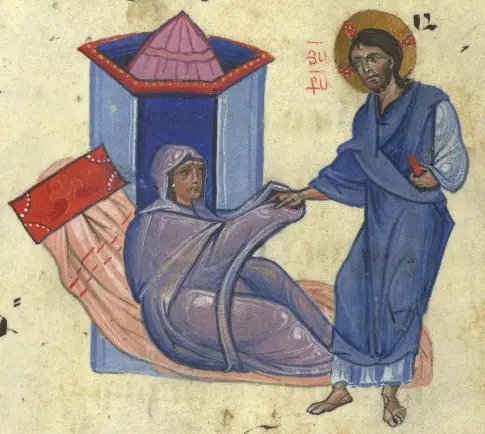
Yeshua entered Shimon’s house. And behold! Shimon’s mother-in-law was lying in bed, because a massive fever had taken hold of her. They asked him, and Yeshua rebuked the fever, and it left her. And Shimon’s mother-in-law got up and waited on them.[3]
| Table of Contents |
|
3. Conjectured Stages of Transmission 5. Comment 8. Conclusion |
Reconstruction
To view the reconstructed text of Shimon’s Mother-in-law click on the link below:
Story Placement
In the Gospels of Luke and Mark we find a common pericope sequence consisting of Teaching in Kefar Nahum→Shimon’s Mother-in-law→Healings and Exorcisms→A Deserted Place, although the two Gospels disagree over whether Yeshua Calls His First Disciples should come after (so Luke) or before (so Mark) this sequence. Matthew’s placement of Shimon’s Mother-in-law is quite different. In Matthew’s Gospel Shimon’s Mother-in-law and Healings and Exorcisms come between Centurion’s Slave at the beginning and Not Everyone Can Be Yeshua’s Disciple, Quieting a Storm and Possessed Man in Girgashite Territory at the other end.
We have demonstrated elsewhere that Matthew’s overall sequence is not historical but a literary attempt to present all these stories as though they took place in the same compressed period of time. Within this literary construction we are able to observe the author of Matthew’s weaving together of the story orders of his two sources, the Gospel of Mark and the Anthology (Anth.).
Mark’s placement of Shimon’s Mother-in-law agrees with Luke’s, but we regard Mark’s placement of Yeshua Calls His First Disciples at the end of the Teaching in Kefar Nahum→Shimon’s Mother-in-law→Healings and Exorcisms→A Deserted Place sequence as a literary improvement over Luke’s placement of Yeshua Calls His First Disciples at the beginning of this sequence. Luke’s sequence does not prepare for Shimon’s Mother-in-law by introducing readers to the character of Simon Peter. Mark’s placement of Yeshua Calls His First Disciples at the head of the sequence, on the other hand, acquaints readers with Peter and a few other disciples, which makes it feel more natural for readers when Jesus abruptly enters Simon’s house. Thus, Luke’s sequence appears to be more original.
Even though Luke’s sequence appears to be more original than Mark’s, this does not prove that the Lukan sequence is any earlier than Luke’s Gospel. It is possible that the author of Luke derived this sequence from his sources, but it is equally possible that the pericope sequence is the evangelist’s own arrangement. How can we decide? One way to decide is to determine which sources the author of Luke used for the pericopae in this sequence. If the evangelist relied on the same source for all these pericopae, then there is a strong likelihood that the author of Luke adopted his source’s sequence. But if in this sequence the evangelist depended on multiple sources, then the pericope arrangement is likely to be Luke’s own.
In another LOY segment we identified Luke’s source for Teaching in Kefar Nahum as Anth. Below we will note certain reasons for identifying the First Reconstruction (FR) as the source behind Luke’s version of Shimon’s Mother-in-law. The shift from Anth. to FR in Luke’s sequence suggests that it was the author of Luke who made Shimon’s Mother-in-law a sequel to Teaching in Kefar Nahum. Therefore, we cannot rely on Luke’s sequence as reflecting a historical chronology. Rather, the author of Luke placed Shimon’s Mother-in-law at a point in his narrative where it seemed best to him.
In our reconstruction of the Hebrew Life of Yeshua we have placed Shimon’s Mother-in-law early on in a section entitled “Yeshua, the Galilean Miracle-Worker.” Events in this section took place before Jesus gathered a following of disciples. Our reasons for placing Shimon’s Mother-in-law in this section are 1) the likelihood that Luke’s placement of Shimon’s Mother-in-law prior to the calling of Jesus’ first disciples reflects the sequence of FR, which in turn could reflect awareness that Shimon’s Mother-in-law took place before Yeshua Calls His First Disciples in Anth., and 2) the reference to the other disciples in Mark’s version of Shimon’s Mother-in-law appears to be a secondary reworking of the story (see below, Comment to L9).
But as for where in the “Yeshua, the Galilean Miracle-Worker” section Shimon’s Mother-in-law should appear in relation to other pericopae, there is very little for us to go on. It is possible that the author of Matthew took the sequence Centurion’s Slave→Shimon’s Mother-in-law from Anth. This would not only explain why these two pericopae are connected in Matthew, but also creates an intriguing juxtaposition. In Centurion’s Slave whether or not Jesus will enter the centurion’s home is a source of narrative tension, but in Shimon’s Mother-in-law Jesus blithely enters Simon’s home. This contrast between the two stories may have been intentional in the Hebrew Life of Yeshua, but it is difficult to know for sure.
.

.
Click here to view the Map of the Conjectured Hebrew Life of Yeshua.
.
.
Conjectured Stages of Transmission

Shimon’s Mother-in-law is a Triple Tradition (TT) pericope. The author of Matthew certainly made use of the version of Shimon’s Mother-in-law he found in Mark, but Matthew’s agreements with Luke’s version against Mark’s suggest that the Matthean evangelist corrected Mark’s version of Shimon’s Mother-in-law on the basis of his second source, the Anthology (Anth.). The author of Mark paraphrased and adapted Luke’s version of Shimon’s Mother-in-law. Luke’s version of Shimon’s Mother-in-law, as we indicated above, probably derives from the First Reconstruction (FR).
Our reasons for attributing Luke’s version of Shimon’s Mother-in-law to FR include the polished Greek style of the pericope (Luke’s version of Shimon’s Mother-in-law includes three instances of participle with conjunction + main verb [L2-5, L17-18, L23-24]), which is atypical for a pericope copied from Anth., and the presence of vocabulary typical of FR (ἀνιστάναι in L2 and L23; παραχρῆμα in L23). In this short pericope these indicators are sufficient to attribute Luke’s version of Shimon’s Mother-in-law to FR.
Crucial Issues
- Did Shimon’s Mother-in-law follow the Capernaum Synagogue incident in the Hebrew Life of Yeshua?
- Did the healing take place before or after Jesus had gathered a following of disciples?
- Where was Simon’s house? Capernaum is not mentioned in the pericope. Is the setting of the story in Capernaum artificial?
- Was Simon’s mother-in-law afflicted only by a fever, or are we to understand that a demon caused the fever?
- Did Shimon’s Mother-in-law take place on the Sabbath? If so, would healing Simon’s mother-in-law have violated the commandments related to Sabbath rest?
- In healing Simon’s mother-in-law, did Jesus touch her?
Comment
L1 καὶ εὐθὺς (Mark 1:29). The author of Mark opened his version of Shimon’s Mother-in-law with his stereotypical expression καὶ εὐθύς (kai evthūs, “and immediately”).[4] The Markan evangelist uses εὐθύς again in L15 (Mark 1:30). Given the Lukan-Matthean agreement against Mark to omit this adverb, it probably did not appear in Anth. Mark’s wording in L1 should be considered a paraphrase of Luke’s introduction to Shimon’s Mother-in-law.
L2 ἀναστὰς δὲ (Luke 4:38). Luke’s version of Shimon’s Mother-in-law opens with a description of Jesus’ rising up from where he had been. The verb Luke’s version uses to express this action, ἀνιστάναι (anistanai, “to arise”), is typical of FR redaction.[5]
Not only does Luke’s version of Shimon’s Mother-in-law open with a verb that is typical of FR redaction, the verbal construction participle with conjunction + main verb (ἀναστὰς δὲ…εἰσῆλθεν [anastas de…eisēlthen, “but rising…he entered”]) is stylistically more refined than the translation Greek we so often find in Anth. Participle with conjunction + main verb constructions do occur in LXX, even with participial forms of ἀνιστάναι, for instance:
ἀναστὰς δὲ Αβρααμ τὸ πρωὶ ἐπέσαξεν τὴν ὄνον αὐτοῦ
But rising early [ἀναστὰς δὲ; MT: וַיַּשְׁכֵּם], Abraham saddled his donkey…. (Gen. 22:3)
ἀναστὰς δὲ Αβρααμ προσεκύνησεν τῷ λαῷ τῆς γῆς
But rising [ἀναστὰς δὲ; MT: וַיָּקָם], Abraham bowed down to the people of the land…. (Gen. 23:7)
ἀναστὰς δὲ Ιακωβ ἔλαβεν τὰς γυναῖκας αὐτοῦ καὶ τὰ παιδία αὐτοῦ
But rising [ἀναστὰς δὲ; MT: וַיָּקָם], Jacob took his wives and his children…. (Gen. 31:17)
ἀναστὰς δὲ Μωυσῆς ἐρρύσατο αὐτὰς
But rising [ἀναστὰς δὲ; MT: וַיָּקָם], Moses rescued them…. (Exod. 2:17)
Nevertheless, the choice of vocabulary and the high concentration of participle with conjunction + main verb in this pericope make it more likely that Luke’s wording in L2 comes from FR than from Anth.[6] We have therefore excluded Luke’s wording in L2 from GR and a Hebrew equivalent to Luke’s wording in L2 from HR.
The First Reconstructor probably added “but rising” at the opening of the pericope to smooth the transition from the preceding pericope (we do not know what pericope that may have been) to Shimon’s Mother-in-law.
L3 ἀπὸ τῆς συναγωγῆς (Luke 4:38). In Luke’s version of Shimon’s Mother-in-law Jesus rises “from the synagogue” and proceeds to Simon’s house. If we are correct that the sequence Teaching in Kefar Nahum→Shimon’s Mother-in-law is the author of Luke’s arrangement, then only the author of Luke would have known that in the preceding pericope Jesus had been in a synagogue. Therefore, it must have been the author of Luke who added the words ἀπὸ τῆς συναγωγῆς (apo tēs sūnagōgēs, “from the synagogue”) in L3 to construct a literary bridge between Teaching in Kefar Nahum and Shimon’s Mother-in-law.[7]
Mark’s ἐκ τῆς συναγωγῆς (ek tēs sūnagōgēs, “from the synagogue”) in L3 is simply an example of the author of Mark’s habit of replacing Luke’s wording with synonymous phrases. Matthew’s omission of Mark’s transition from the synagogue to Simon’s home is certainly due to his decision not to place Shimon’s Mother-in-law in the Markan sequence following Teaching in Kefar Nahum. It may be, however, that the author of Matthew was emboldened to depart from this sequence because he could see that it was not present in Anth.
Although the Lukan-Markan placement of Shimon’s Mother-in-law following Teaching in Kefar Nahum implies that the healing of Simon’s mother-in-law took place on the Sabbath, the lack of any Sabbath controversy in Shimon’s Mother-in-law (viz., whether healing on the Sabbath is permissible) strengthens our supposition that the linking of these two stories is artificial and there is no reason to assume that this story originally took place on the Sabbath.[8]
L4 ἐξελθὼν (Mark 1:29). Since Luke and Matthew agree against Mark’s ἐξελθών (exelthōn, “going out”), it is unlikely that this participle appeared in Anth. More likely, ἐξελθών is the author of Mark’s replacement for Luke’s wording (ἀναστάς, “getting up”) in L2.
L5 εἰσῆλθεν (GR). It is difficult to decide whether Luke’s εἰσῆλθεν (eisēlthen, “he entered”) or Mark’s ἦλθεν (ēlthen, “he came”) or Matthew’s ἐλθών (elthōn, “coming”) is more likely to have come from Anth. Luke’s is a compound verb, which might indicate Greek stylistic polishing, but on the other hand, the verb εἰσέρχεσθαι (eiserchesthai, “to enter”) is common throughout the synoptic tradition. Mark’s simple verb is less polished than Luke’s, and therefore could reflect Anth.’s wording, but it is always hazardous to prefer Mark’s wording to Luke’s without a strong reason for doing so. Matthew’s participle with conjunction + main verb construction (καὶ ἐλθὼν…εἶδεν [kai elthōn…eiden, “and coming…he saw”]) could have come from a Hebraic-Greek source (see above, Comment to L2), but since Matthew simply has a participial form of the same verb Mark uses, ἔρχεσθαι (erchesthai, “to come”), it is more likely that the author of Matthew was paraphrasing Mark’s wording than copying Anth. This impression is only strengthened by Matthew’s addition of Jesus’ name in L6 and the likelihood that by having Jesus notice the sick woman instead of having to be told about her as in Mark and Luke, the author of Matthew was reworking the story in order to heighten Jesus’ profile. We have therefore cautiously accepted Luke’s wording for GR in L5.
וַיִּכָּנֵס (HR). We have chosen to reconstruct the verb εἰσέρχεσθαι (eiserchesthai, “to go into,” “to enter”) with נִכְנַס (nichnas, “enter”), which in MH replaced the BH verb בָּא (bā’) in the sense of “enter.” Reconstructing with וַיִּכָּנֵס (vav-consecutive + MH verb) instead of וַיָּבֹא reflects a mixed biblical/rabbinic style such as we occasionally find in the Dead Sea Scrolls and in rabbinic literature, for example in the story of King Yannai in b. Kid. 66a.[9]
Since נִכְנַס is a Mishnaic Hebrew word that does not occur in the Hebrew Scriptures, we cannot appeal to examples from LXX to support our reconstruction. However, we do find examples of נִכְנַס לְבַיִת (nichnas levayit, “enter a house”) in rabbinic sources (see below, Comment to L7) which are parallel to our reconstruction in Shimon’s Mother-in-law.
L6 ὁ Ἰησοῦς (Matt. 8:14). The presence of Jesus’ name in L6 of Matthew’s version of Shimon’s Mother-in-law is stylistically better than the absence of Jesus’ name in the Lukan and Markan parallels. It therefore seems likely that the author of Matthew added Jesus’ name on his own initiative rather than inserting it on the basis of Anth. Adding Jesus’ name is not only grammatically more clear, it also serves to raise Jesus’ profile in the story, a redactional tendency of the Matthean evangelist.
L7 εἰς τὴν οἰκίαν (GR). All three versions agree to write “into the house” in L7. This phrase reverts easily to Hebrew, and there is no reason to doubt that it occurred in Anth.
לְבֵית (HR). In LXX the noun οἰκία (oikia, “house”) nearly always occurs as the translation of בַּיִת (bayit, “house”).[10] Looking at בַּיִת, we find the LXX translators more often rendered it as οἶκος (oikos, “house”), but οἰκία is their second most frequent translation of בַּיִת.[11] We encounter the phrase נִכְנַס לְבַיִת (nichnas levayit, “enter a house”) several times in the Mishnah.[12]
Where was Simon’s home located? None of the Synoptic Gospels explicitly mention Capernaum in Shimon’s Mother-in-law. The location of Simon’s house in this Galilean village must be inferred from the contexts in which this story appears in these three Gospels. The Lukan-Markan transition from the Capernaum synagogue to Simon’s house certainly implies that Simon’s home was located in Capernaum. And by placing Shimon’s Mother-in-law after Centurion’s Slave, a pericope Matthew says took place in Capernaum (Matt. 8:5), the author of Matthew likewise implies that Peter’s home was in Capernaum.[13] But as we noted in the Story Placement discussion above, neither the Lukan-Markan nor the Matthean pericope sequence appears to be original. The Lukan-Markan sequence is the product of Lukan redaction, and Matthew’s sequence reflects Matthean redaction (although we held open the possibility that Centurion’s Slave was followed by Shimon’s Mother-in-law in Anth.). Another reason to doubt that Simon’s residence was in Capernaum is that this information conflicts with the reference in John 1:44 to Bethsaida as “the city of Andrew and Peter.”[14]
Nevertheless, there are positive reasons for supposing that Capernaum was the village where Simon’s home was located. Something must have motivated the author of Luke to make Shimon’s Mother-in-law the sequel to Teaching in Kefar Nahum, and it is reasonable to conjecture that the evangelist did so because he was heir to a tradition that located Simon’s home in Capernaum. As to the conflicting tradition that Peter was from Bethsaida, Flusser suggested that the apparent contradiction could be reconciled by supposing that while Peter and Andrew hailed from Bethsaida, Peter had taken up residence with his wife in his mother-in-law’s home in Capernaum.[15] Although according to Safrai it was customary for newlyweds to reside with the groom’s family,[16] if Simon’s mother-in-law was a widow and either had no sons of her own or her sons had moved into houses of their own, it seems plausible that Simon could have lived with his wife in the home of his mother-in-law.
One reason we find Flusser’s solution to be attractive is that Jesus typically required his full-time disciples to sell their homes and possessions and to leave their families behind in order to follow him. Indeed, Peter claims to have done just that in Rich Man Declines the Kingdom of Heaven (Matt. 19:27 ∥ Mark 10:28 ∥ Luke 18:28), but it is not clear how he could have done so except by making his wife and mother-in-law homeless. Nothing in the Gospel narratives suggests that Peter’s wife and his mother-in-law traveled with him, but if Peter did not own the home he lived in with his wife and mother-in-law, then he could have fulfilled Jesus’ requirement to sell his goods and leave his family behind without abandoning his wife and mother-in-law to fend for themselves. Of course, supposing that Peter lived with his wife in the home of his mother-in-law does not require that her home be located in Capernaum. It does, however, remove one obstacle to this assumption.
In the end, we are inclined to accept the tradition that Simon made his home in Capernaum, but we freely admit that this tradition is not as strong as it might be.
L8 Σίμωνος (GR). In Shimon’s Mother-in-law, both Luke and Mark refer to the head of the household as Σίμων (Simōn), whereas Matthew refers to him as Πέτρος (Petros, “Peter”). Since Jesus appears to have given Simon the nickname “Peter” (Luke 6:14), perhaps on the occasion of Simon’s confession that Jesus is the Messiah (Matt. 16:18),[17] Matthew’s use of the name “Peter” seems anachronistic, especially if we accept Luke’s pericope order, in which Jesus does not begin to call disciples until after the events reported in this pericope. The reason the author of Matthew used the name “Peter” in Shimon’s Mother-in-law is surely that this is the name by which Jesus’ foremost disciple and apostle was best known to his readers. Also, from a literary point of view, the author of Matthew had already introduced his readers to Simon’s nickname earlier in his Gospel (Matt. 4:18), so it was natural for him to refer to him as Peter from then on.[18] Since Matthew’s use of the name Peter in L8 is a literary improvement and conforms with the evangelist’s redactional preferences, we have accepted the Lukan-Markan Σίμων for GR.[19]
שִׁמְעוֹן (HR). On reconstructing Σίμων with שִׁמְעוֹן (Shim‘ōn), see Choosing the Twelve, Comment to L18.
L9 καὶ Ἀνδρέου μετὰ Ἰακώβου καὶ Ἰωάνου (Mark 1:29). In this pericope Matthew agrees with Luke—against Mark—that the house was the home only of Simon (or Peter) and not also of Andrew.[20] Luke and Matthew also agree against Mark’s mention of James and John.[21] The addition of names is not only typical of Mark’s redactional approach,[22] it is clear that the author of Mark was motivated to add these particular names to his version of Shimon’s Mother-in-law because he had already introduced his readers to these characters by moving Yeshua Calls His First Disciples from its Lukan position after the pericope sequence Teaching in Kefar Nahum→Shimon’s Mother-in-law→Healings and Exorcisms→A Deserted Place to its Markan position immediately prior to this sequence (see our Story Placement discussion above). Mark’s inclusion of these names is clearly redactional, and we have excluded them from GR.
L10 εἶδεν (Matt. 8:14). Davies and Allison noted that in Matthew’s version of Shimon’s Mother-in-law Jesus initiates the healing miracle, which begins with his observation of Peter’s mother-in-law.[23] In the Lukan and Markan accounts, by contrast, it is other members of the household who bring her to Jesus’ attention (L15-16). By making Jesus the initiator of the action the author of Matthew elevates Jesus’ profile in the story, an emphasis that is in keeping with the author of Matthew’s redactional tendencies.
καὶ ἰδοὺ (GR). It is possible, however, that when writing εἶδεν (eiden, “he saw”) the author of Matthew was influenced by something he saw in Anth. That something may have been the highly Hebraic exclamation “And behold!” in which case the author of Matthew changed an address to the reader (“Look at this!”) into an action he attributed to Jesus (“he saw”). Since the First Reconstructor tended to eliminate instances of καὶ ἰδού (kai idou, “and behold!”),[24] it is not surprising that we do not find this phrase in Luke’s version of Shimon’s Mother-in-law.
וְהִנֵּה (HR). On reconstructing ἰδού (idou, “behold!”) with הִנֵּה (hinēh, “behold!”), see Widow’s Son in Nain, Comment to L6.
L11 πενθερὰ (GR). All three evangelists agree to refer to the mother-in-law in L11. We suspect that Luke’s conjunction δέ (de, “but”) is FR’s substitute for Anth.’s καὶ ἰδού (“and behold!”) in L10. Mark’s version adds the definite article ἡ (hē, “the”) to πενθερά (penthera, “mother-in-law”), a stylistic improvement upon Luke’s wording,[25] which resulted in a slight modification of Luke’s word order. Matthew’s version retains Mark’s definite article, but changes the case on account of having Jesus see the sick woman. The author of Matthew omitted the conjunction δέ because of his different sentence structure. Thus, for GR we have only accepted the noun πενθερά.
חֲמוֹתוֹ (HR). Whereas Biblical Hebrew distinguished between חוֹתֵן (ḥōtēn, “the wife’s father”) and חוֹתֶנֶת (ḥōtenet, “the wife’s mother”) on the one hand, and חָם (ḥām, “the husband’s father”) and חָמוֹת (ḥāmōt, “the husband’s mother”) on the other,[26] in Mishnaic Hebrew חָם and חָמוֹת denote the father and mother of either the husband or the wife.[27] For HR we have adopted the late-biblical and mishnaic חָמוֹת (ḥāmōt, “mother-in-law”), which gives our reconstruction a mixed biblical-rabbinic style such as we saw in L5.[28]
The reference to Simon’s mother-in-law implies that he had a wife. The Gospels do not provide us with any further information about her, but we learn from 1 Cor. 9:5 that she accompanied Peter on his journeys, so she was definitely still alive when the events in Shimon’s Mother-in-law took place. The name of Simon’s wife and also that of her mother are lost to history.[29] From the fact that Jesus required his disciples to leave behind family and possessions in order to follow him we may infer that most of his disciples were unmarried. Simon must have married before becoming Jesus’ full-time disciple, and it may be that Jesus only permitted him to become a disciple because his wife would continue to be supported even after Simon had divested himself of his possessions.[30] That the house where Simon’s mother-in-law lived is described as Simon’s residence is a strong indication that Simon was not yet a full-time disciple when the events in this pericope took place.
Unlike modern tropes that typically disparage mothers-in-law, in ancient Jewish literature mothers-in-law are generally spoken of with respect.[31]
L12 τοῦ Σίμωνος (GR). Opposite “the mother-in-law of Simon” in Luke and Mark, Matthew’s version has “the mother-in-law of him (i.e., Peter),” which allows the author of Matthew to avoid using the name “Simon” once more (cf. L8). Since the change from “Simon” to “Peter” in Matthew is redactional, we may presume that in L12 Luke and Mark preserve the wording of the pre-synoptic tradition.
שֶׁלְּשִׁמְעוֹן (HR). On reconstructing Σίμων with שִׁמְעוֹן (Shim‘ōn), see above, Comment to L8. Here we have used the long form of the possessive construct phrase, which is typical of Mishanic Hebrew, but which also occasionally occurs in the Hebrew Scriptures.
L13 κατέκειτο (Mark 1:30). Mark’s imperfect verb κατέκειτο (katekeito, “she was lying”) is opposed by Matthew’s participle βεβλημένην (beblēmenēn, “having been thrown down”) and Luke’s phrase ἦν συνεχομένη (ēn sūnechomenē, “was being seized”). Might we have in L13-14 an example of a Markan pick-up? Noticing Luke’s συνεχομένη, Mark may have recalled the description of a sick man in Acts 28:8: “It happened that the father of Publius lay suffering from feverish attacks and dysentery [πυρετοῖς καὶ δυσεντερίῳ συνεχόμενον κατακεῖσθαι], and Paul visited him and prayed, and putting his hands on him healed him.” Drawing from the similar vocabulary in Acts, Mark might have exchanged Luke’s συνεχομένη for κατέκειτο. If so, Acts 28:8 might have been the inspiration for Mark’s idea that Jesus touched Simon’s mother-in-law in order to heal her, a detail not present in Luke’s version of the story.
Commenting on the mention of laying on of hands in Acts 28:8, Foakes Jackson and Lake wrote: “Luke seems to have had the story of Peter’s mother-in-law in his mind in choosing the vocabulary of this story.”[32] But Foakes Jackson and Lake cannot have had Luke’s version of Shimon’s Mother-in-law in mind, since in Luke Jesus merely rebukes the fever and never touches Simon’s mother-in-law. Rather, Foakes Jackson and Lake, who cited “several cases where a motif in the gospel of Mark is omitted by the parallel in the gospel of Luke only to reappear in Acts,”[33] noted the same phenomena that Lindsey described as “Markan pick-ups,” but accounted for them differently. Whereas Foakes Jackson and Lake assumed Luke’s reliance on Mark, Lindsey proposed that Mark was familiar with Luke-Acts.[34]
βεβλημένη ἐπὶ κλίνης (GR). The author of Matthew is unique in describing Simon’s mother-in-law as “having been thrown down” on account of her illness. There are two other places in Matthew’s Gospel that contain similar descriptions. In Matthew’s version of Centurion’s Slave, L21, the centurion states that his slave is “thrown down in the house” (Matt. 8:6), and in Matthew’s version of Bedridden Man, L18, we read about how people brought to Jesus “a paralytic thrown down on a bed” (Matt. 9:2). There are strong reasons to suspect that Matthew’s description of the slave’s condition in Centurion’s Slave is redactional, having been borrowed from Bedridden Man, but Matthew’s description of the “paralytic” as “thrown on a bed” could derive from Anth., since it so strongly resembles Hebrew descriptions of sick persons “lying” (lit., “thrown”) “in bed.” Here, too, in Shimon’s Mother-in-law it seems likely that the author of Matthew has preserved a Hebraic phrase, or phrase fragment, that was present in Anth. We suspect the First Reconstructor eliminated Anth.’s reference to the mother-in-law’s “having been thrown down” because the wording sounded too harsh for his more refined Greek-speaking audience.
מוּטֶּלֶת בְּמִטָּה (HR). In the preceding paragraph we alluded to the striking correspondence between Matthew’s passive participles βεβλημένος (beblēmenos, “thrown down” [masc.]), found in Bedridden Man, and βεβλημένη (beblēmenē, “thrown down” [fem.]), found here in Shimon’s Mother-in-law, and the Hebrew passive participles מוּטָּל (mūṭāl, “thrown,” “lying” [masc.]) and מוּטֶּלֶת (mūṭelet, “thrown,” “lying” [fem.]) from the root נ‑ט‑ל meaning “to be thrown” or “to lie.”[35] In the Tosefta we read of a sick person who is lying in bed (היה חולה ומוטל במטה; t. Ket. 4:15)[36] and of a sick person who is lying behind a synagogue (חולה שהיה מוטל אחורי בית הכנסת; t. Rosh Hash. 2:7).[37] These examples are sufficient to justify our reconstruction with מוּטֶּלֶת.
On reconstructing the preposition ἐπί (epi, “on,” “upon”) with עַל (‘al, “on,” “upon”), see Widow’s Son in Nain, Comment to L11.
On reconstructing the noun κλίνη (klinē, “bed”) with מִטָּה (miṭāh, “bed”), see Indiscriminate Catastrophe, Comment to L4.
L14 ὅτι συνέσχεν αὐτὴν πυρετὸς μέγας (GR). Whereas Mark and Matthew use a single term to describe the woman’s feverish state, Luke has a clunkier description, which states that Simon’s mother-in-law was “seized with a great fever.” Mark’s wording, which Matthew follows, appears to be a stylistic improvement upon Luke’s more Hebraic description.[38] In Hebrew, fevers are said to “seize” a person.[39] The similarity of Luke’s wording to a known Hebrew idiom mitigates the claim that the verb συνέχειν (sūnechein, “to seize”) is Lukan vocabulary.[40] It may be, however, that Luke’s passive wording reflects FR’s polishing of Anth.’s wording. Thus we have reconstructed Anth. with the active phrase ὅτι συνέσχεν αὐτὴν πυρετὸς μέγας (hoti sūneschen avtēn pūretos megas, “because a great fever seized her”). Using the active voice not only aligns better with Hebrew style, it accords better with Jesus’ rebuke of the fever later in the pericope by allowing it an active role in taking hold of the sick woman.
Some scholars have suggested that πυρετὸς μέγας (“big fever”) is an example of the author of Luke’s use of specialized medical vocabulary.[41] However, according to Weiss, the division of fevers into “small” (σμικρός)[42] and “big” (μέγας) was a popular usage,[43] and Cadbury has shown that the author of Luke did not use specialized medical terminology in his writings.[44] There is no reason why the author of Luke could not have copied the adjective μέγας from his source.
שֶׁאֲחָזַתָּה חַמָּה גְּדוֹלָה (HR). On reconstructing ὅτι (hoti, “that”) with -שֶׁ (she-, “that”), see Lost Sheep and Lost Coin, Comment to L31.
In LXX the verb συνέχειν (sūnechein, “to seize”) occurs as the translation of a wide variety of verbs, and occurs as the translation of אָחַז (’āḥaz, “seize”) only in 3 Kgdms. 6:10.[45] We also find that the LXX translators usually rendered אָחַז with Greek verbs other than συνέχειν.[46] Nevertheless, in rabbinic sources we encounter the verb אָחַז used in combination with חַמָּה (ḥamāh, “fever”) to describe individuals who are sick with fever, a close equivalent to Luke’s συνεχομένη πυρετῷ (sūnechomenē pūretō, “seized by a fever”). For instance:
השוכר את הפועל…שאחזתו חמה
The one who hires a worker…that a fever seized him [שֶׁאֲחָזַתּוּ חַמָּה]…. (t. Bab. Metz. 7:3; Vienna MS)
שמואל אמר אפילו אחזתו החמה שעה אחת ממתינין לו עד שלשים יום
Shmuel said, “Even if the fever seized him [אֲחָזַתּוּ הַחַמָּה] [i.e., an infant—DNB and JNT] for a single hour, they delay for him [i.e., his circumcision—DNB and JNT] until thirty days [have passed—DNB and JNT].” (y. Yev. 8:2 [45b]; cf. y. Shab. 19:5 [90a])
Our Greek and Hebrew reconstructions follow these parallels in using the active voice to describe the fever’s seizing Simon’s mother-in-law.
In LXX the noun πυρετός (pūretos, “fever”) does not occur as the translation of חַמָּה (ḥamāh, “sun,” “fever”), but that is because חַמָּה does not occur in the sense of “fever” in the Hebrew Scriptures. Indeed, πυρετός only occurs once in LXX, at Deut. 28:22, where it occurs as the translation of קַדַּחַת (qadaḥat, “fever”),[47] a term no longer in use in Mishnaic Hebrew.[48] Although we typically prefer to reconstruct narrative in a biblicizing style of Hebrew, it seems unlikely that antiquated terms would have been used in the Hebrew Life of Yeshua for everyday occurrences like having a fever. More likely, colloquial language would have been used in the homely setting of Shimon’s Mother-in-law. We have therefore adopted חַמָּה as the equivalent of πυρετός in HR. The result is a mixed biblical-rabbinic Hebrew style such as we saw in L5 and L11-12 above (see above, Comment to L5). Reconstructing with חַמָּה also yields a pleasing Hebrew wordplay: Simon’s חָמוֹת (ḥāmōt) suffers from a חַמָּה (ḥamāh).
On reconstructing μέγας (megas, “big”) with גָּדוֹל (gādōl, “big”), see Widow’s Son in Nain, Comment to L22.
The phrase חַמָּה גְּדוֹלָה (ḥamāh gedōlāh) occurs in Eliyahu Zuta 8:1 (ed. Friedmann, 185), albeit in the sense of “great vexation” rather than severe fever. But since a hot flash of anger is not so different from a fever, perhaps this example lends some support to our reconstruction.
From a modern perspective, “fever” is an imprecise term describing a symptom rather than the cause of the illness. Some scholars suppose that πυρετός refers to fever caused by malaria.[49] Fever could be a life-threatening condition, which highlights the seriousness of the illness Simon’s mother-in-law suffered.
L15 καὶ εὐθὺς (Mark 1:30). Against Matthew and Luke, Mark’s stereotypical adverb εὐθύς appears twice (here in L15, and in L1) in this very short story. Since the use of εὐθύς is characteristic of Markan redaction, we have excluded this adverb from GR.
L16 ἠρώτησαν αὐτὸν (GR). As we noted above in Comment to L10, Matthew’s version of Shimon’s Mother-in-law omits the intercession on behalf of Simon’s mother-in-law, which allows Jesus to take center stage in Matthew’s version of the pericope. We think it is likely that the intercession goes back to Anth. Mark’s wording, however, simply paraphrases what we find in Luke, but in typically Markan fashion, with its use of the historical present tense.[50] Luke’s “they asked him,” with its impersonal plural[51] and non-Classical usage of the verb ἐρωτᾶν (erōtan, “to ask”),[52] may well trace back to Anth. (via FR), but the prepositional phrase περὶ αὐτῆς (peri avtēs, “concerning her”) was probably supplied by the evangelist to give the intercession greater specificity.[53]
וַיִּשְׁאָלֻהוּ (HR). On reconstructing ἐρωτᾶν (erōtan, “to ask”) with שָׁאַל (shā’al, “ask”), see Tower Builder and King Going to War, Comment to L21.
In 2 Samuel we find an example of שָׁאַל where the request is implied but not stated:
וַיִּשְׁאַל וַיָּשִׂימוּ לוֹ לֶחֶם וַיֹּאכַל
And he [i.e., David—DNB and JNT] asked, and they set out bread for him, and he ate. (2 Sam. 12:20)
The LXX translation of this verse is instructive. Apparently the translators did not like for David’s request to remain unstated, so they made it explicit:
καὶ ᾔτησεν ἄρτον φαγεῖν καὶ παρέθηκαν αὐτῷ ἄρτον καὶ ἔφαγεν
And he asked for bread to eat, and they set bread before him, and he ate. (2 Kgdms. 12:20)
Similarly, as we discussed above, the author of Luke disliked the unstated request in his source and added περὶ αὐτῆς (peri avtēs, “concerning her”) as a remedy.
L17-24 The author of Matthew structured his version of Shimon’s Mother-in-law into two parts, each with three verbs. In the first part, Jesus comes to the house, sees the mother-in-law, and touches her hand. In the second part, the fever leaves, the mother-in-law rises, and she serves Jesus.[54] In this way the author of Matthew eliminated non-essential bystanders from his narrative and focused all his attention on Jesus.
Mark’s “And approaching, he raised her, having taken hold of the hand” (Mark 1:31), with its two aorist participles, is much better Greek than Matthew’s.[55]
L17 καὶ ἐπιστὰς ἐπάνω αὐτῆς (Luke 4:39). We attribute the description of Jesus’ standing over Simon’s mother-in-law to the First Reconstructor, since the preposition ἐπάνω (epanō, “upon”), which never occurs in Acts and is relatively rare in Luke’s Gospel, tends to occur in pericopae the author of Luke copied from FR (Shimon’s Mother-in-law [Luke 4:39], Woes Against Scribes and Pharisees [Luke 11:44]; Entrusted Funds parable [Luke 19:17, 19]). Since we suspect this description is redactional, we have excluded it from GR.
L18 ἐπετίμησεν τῷ πυρετῷ (GR). In Luke’s account, Jesus heals Simon’s mother-in-law by rebuking the fever, not by touch as in the Markan and Matthean versions. In what sense would Jesus have “rebuked” a fever?[56] Some scholars suggest that Jesus’ “rebuke” implies that the fever was caused by a demon.[57] There is some evidence that in antiquity fevers were popularly believed to be caused by demons.[58] But although it is true that ἐπιτιμᾶν (epitiman, “to rebuke”) is used in exorcism contexts in the Synoptic Gospels,[59] the verb is not specific to exorcism.[60] On the contrary, outside the Synoptic Gospels ἐπιτιμᾶν seems not to be used in the context of exorcism.[61] In normal Greek usage, ἐπιτιμᾶν refers to the rebuke of persons,[62] however, in LXX ἐπιτιμᾶν was also used for rebuking inanimate objects.[63]
The non-standard usage of ἐπιτιμᾶν in LXX reflects the way the Hebrew verb גָּעַר (gā‘ar, “rebuke”) can be used to refer to the rebuke of persons as well as animals, abstractions and inanimate objects. For example, in MT גָּעַר can be applied to beasts (Ps. 68:31), the sea (Ps. 106:9; Nah. 1:4) and unspecified pests (Mal. 3:11). In DSS גָּעַר is applied to a stone heart (4Q436 1 I, 10), the evil inclination (4Q436 1 I, 10; cf. 4Q435 1 I, 2) and to life (1QHa XVII, 11). Likewise, in rabbinic literature rebukes are sometimes addressed to non-humans,[64] as in b. Yom. 39b, where Rabban Yohanan ben Zakkai (first cent. C.E.) rebukes the doors of the Temple, and in b. Bab. Metz. 59b, where Rabbi Yehoshua (first cent. C.E.) rebukes the walls of the Beit Midrash. Luke’s record of Jesus’ rebuking a fever, therefore, could simply reflect the use of גָּעַר in an underlying Hebrew text to refer to the rebuke of an inanimate object.[65]
Since the author of Luke was not averse to reporting exorcisms, there is no reason why he would have failed to mention a demon if he believed it to be the cause of the fever from which Simon’s mother-in-law suffered. Neither is there any reason to think he would have suppressed the demonic element had he found it in his source. We are inclined, therefore, to accept Luke’s description of Jesus’ rebuking the fever as stemming from Anth. (via FR) rather than reflecting Greek redaction.
וַיִּגְעַר בַּחַמָּה (HR). In LXX the verb ἐπιτιμᾶν (epitiman, “to rebuke”) almost always occurs as the translation of גָּעַר (gā‘ar, “rebuke”).[66] Likewise, we find that the LXX translators typically rendered גָּעַר as ἐπιτιμᾶν.[67]
On reconstructing πυρετός (pūretos, “fever”) with חַמָּה (ḥamāh, “fever”), see above, Comment to L14.
L19 ἤγειρεν αὐτὴν (Mark 1:31). The Lukan-Matthean agreement against Mark’s ἤγειρεν αὐτήν (ēgeiren avtēn, “he raised her”) in order to describe the woman as getting up on her own (L23) is a strong indication that Mark’s phrase did not occur in Anth. This Markan addition was simply a way for the author of Mark to give greater prominence to Jesus.
L20 κρατήσας τῆς χειρός (Mark 1:31). According to Mark, Jesus lifted the sick woman up by grasping her hand. Mark’s “And approaching, he raised her, having taken hold of the hand” (Mark 1:31; L17-20), with its two aorist participles, is written in much better Greek style than the Lukan or Matthean versions. The author of Matthew picked up on this idea, writing ἥψατο τῆς χειρὸς αὐτῆς (hēpsato tēs cheiros avtēs, “he touched her hand”), although, according to Matthew, after the fever departed, Simon’s mother-in-law got out of bed by herself.[68] In Luke’s version of Shimon’s Mother-in-law, Jesus rebukes the fever without ever touching the sick woman. This is perhaps the most striking difference between the three accounts. Since neither the First Reconstructor nor the author of Luke had a motive for removing a reference to Jesus’ healing by the laying on of hands (cf. Luke 4:40), we regard Mark’s description as a redactional addition to the story.
It may be that it was Luke’s version of Healings and Exorcisms (Luke 4:40), which immediately follows Shimon’s Mother-in-law, that reminded the author of Mark of Jesus’ practice of healing through the laying on of hands. However, Lindsey believed Mark’s phrasing in L20 was picked up from Luke’s version of Yair’s Daughter and a Woman’s Faith, which reads: αὐτὸς δὲ κρατήσας τῆς χειρὸς αὐτῆς (avtos de kratēsas tēs cheiros avtēs, “but he took hold of her hand”; Luke 8:54).[69]

L21 καὶ ἀφῆκεν αὐτήν (GR). All three evangelists agreed to write the same words in L21, and since the phrase καὶ ἀφῆκεν αὐτήν (kai afēken avtēn, “and it left her”) reverts easily to Hebrew, we have accepted these words for GR without modification.
וַתַּחְלְצֶהָ (HR). The Hebrew verb חָלַץ (ḥālatz) can mean “remove” and “take out and expose,” but it can also have the sense “go away” or “withdraw,” which we see in the following example:
בְּצֹאנָם וּבִבְקָרָם יֵלְכוּ לְבַקֵּשׁ אֶת יי וְלֹא יִמְצָאוּ חָלַץ מֵהֶם
With their flocks and herds they shall go to seek the Lord, but they will not find him; he has withdrawn [חָלַץ] from them. (Hosea 5:6; RSV)
The LXX translators did not render חָלַץ as ἀφιέναι (afienai, “to release [a debt],” “to forsake”),[70] but examples from rabbinic literature show that חָלַץ was the verb commonly used in Hebrew to describe recovery from fever.[71] Compare, for instance, the description in Shimon’s Mother-in-law with the story of Rabban Gamliel’s son:
תנו רבנן מעשה שחלה בנו של רבן גמליאל שגר שני תלמידי חכמים אצל רבי חנינא בן דוסא לבקש עליו רחמים כיון שראה אותם עלה לעלייה ובקש עליו רחמים בירידתו אמר להם לכו שחלצתו חמה אמרו לו וכי נביא אתה אמר להן לא נביא אנכי ולא בן נביא אנכי אלא כך מקבלני אם שגורה תפלתי בפי יודע אני שהוא מקובל ואם לאו יודע אני שהוא מטורף ישבו וכתבו וכוונו אותה שעה וכשבאו אצל רבן גמליאל אמר להן העבודה לא חסרתם ולא הותרתם אלא כך היה מעשה באותה שעה חלצתו חמה ושאל לנו מים לשתות
Our rabbis taught [in a baraita]: It happened that the son of Rabban Gamliel was sick. He sent two of the disciples of the sages to Rabbi Hanina ben Dosa to ask [God] for mercy on his behalf. As soon as he saw them he went up to his upper room and asked [God] for mercy on his behalf. When he came down he said to them, “Go! For the fever has left him [שחלצתו חמה].” They said to him, “Are you then a prophet?” He said to them, “I am not a prophet or a prophet’s son, rather this is how I know I am accepted. If the prayer is fluent in my mouth, I know that he is accepted. But if not, I know that he is rejected.” They returned, and they wrote down and noted the time. And when they came to Rabban Gamliel he said to them, “By the [divine] service [in the Temple]! You have not lacked and you have not exceeded, rather it happened thus in that very hour that the fever left him [חלצתו חמה] and he asked for water to drink.” (b. Ber. 34b)[72]
According to a talmudic tradition, healing from a fever is a greater miracle than the deliverance of Hananiah, Mishael and Azariah from the fiery furnace, because the fiery furnace was kindled by human beings, whereas fever is a heavenly fire (b. Ned. 41a). Perhaps this tradition also reflects the seriousness of fever, in that it was comparable to Nebuchadnezzar’s order to execute Hananiah, Mishael and Azariah (Dan. 3:20).
L22 ὁ πυρετός (Mark 1:31). The author of Mark found it necessary to add ὁ πυρετός (ho pūretos, “the fever”) at this point, having omitted the reference to Jesus’ rebuke of the fever in L18. The author of Matthew copied ὁ πυρετός in L22 from Mark.
L23 καὶ ἠγέρθη (GR). The Lukan-Matthean agreement in L23 to describe Simon’s mother-in-law getting up strongly suggests that a description of this kind occurred in Anth. Luke’s wording, παραχρῆμα δὲ ἀναστᾶσα (parachrēma de anastasa, “but straightaway arising”), appears to be the First Reconstructor’s paraphrase of Anth.’s wording, since both the adverb παραχρῆμα (parachrēma, “straightaway”) and the verb ἀνιστάναι (anistanai, “to arise”) are FR redactional terms. The adverb παραχρῆμα occurs 10xx in Luke’s Gospel (Luke 1:64; 4:39; 5:25; 8:44, 47, 55; 13:13; 18:43; 19:11; 22:60) and 6xx in Acts (Acts 3:7; 5:10; 12:23; 13:11; 16:26, 33), with a noticeable drop off in usage in the second half of Acts, where the author of Luke’s personal writing style is most prominent. Most instances of παραχρῆμα in Luke’s Gospel occur in FR pericopae (Luke 4:39 [Shimon’s Mother-in-law]; 5:25 [Bedridden Man]; 8:44 [Yair’s Daughter and a Woman’s Faith], 47 [Yair’s Daughter and a Woman’s Faith], 55 [Yair’s Daughter and a Woman’s Faith]; 18:43 [Man Healed of Blindness ⟨FR?⟩]; 19:11 [Entrusted Funds parable]), so it is probably to the First Reconstructor that the use of παραχρῆμα in L23 should be attributed. As for ἀνιστάναι as a marker of FR redaction, see above, Comment to L2. Matthew’s καὶ ἠγέρθη (kai ēgerthē, “and she rose”), on the other hand, reverts easily to Hebrew and probably reproduces the wording of Anth.
וַתָּקָם (HR). On reconstructing the verb ἐγείρειν (egeirein, “to rise,” “to raise”) with קָם (qām, “to arise”), see Widow’s Son in Nain, Comment to L15.

L24 καὶ διεκόνει αὐτῷ (Matt. 8:15). In his version of Shimon’s Mother-in-law, the author of Matthew consistently eliminated nonessential characters from the scene in order to focus exclusively on Jesus. Not even Peter is said to be present in Matthew’s version of Shimon’s Mother-in-law, although his presence is usually assumed because the healing takes place in his home. In order to avoid introducing characters in the very last phrase of his narrative, the author of Matthew was forced to change αὐτοῖς (avtois, “them”) to αὐτῷ (avtō, “him”).
καὶ διηκόνησεν αὐτοῖς (GR). Although all three evangelists agree to use the same imperfect form διεκόνει (diekonei, “she was serving”), in GR we have adopted the aorist form διηκόνησεν (diēkonēsen, “she served”), since it was not uncommon for both the First Reconstructor and the author of Luke to convert aorists into imperfects. Once Luke’s text had the imperfect form, it was accepted in Mark, and from Mark it was taken over in Matthew.
וַתְּשַׁמְּשֵׁם (HR). For HR we have opted for the Mishnaic Hebrew verb שִׁמֵּשׁ (shimēsh, “serve”),[73] rather than the biblical שֵׁרֵת (shērēt, “serve”), to reconstruct διακονεῖν (diakonein, “to serve”). On reconstructing in a mixed biblical-mishnaic style, see above, Comment to L5.
Redaction Analysis
Luke’s Version[74]
| Shimon’s Mother-in-law | |||
| Luke | Anthology | ||
| Total Words: |
38 | Total Words: |
34 |
| Total Words Identical to Anth.: |
19 | Total Words Taken Over in Luke: |
19 |
| % Identical to Anth.: |
50.00 | % of Anth. in Luke: |
55.88 |
| Click here for details. | |||
The author of Luke made a few stylistic improvements to Shimon’s Mother-in-law. These included adding the phrase “from the synagogue” in L3 to provide a smoother transition from the previous pericope, the addition of “concerning her” in L16 to clarify the intention of the intercessors’ question, and possibly a change of tense from aorist to imperfect in L24. But the First Reconstructor had already made important changes to Anth.’s wording prior to the stage of Lukan redaction. Some of these changes included the use of FR vocabulary (ἀνιστάναι in L2 and L23, ἐπάνω in L17, παραχρῆμα in L23), others included the elimination of Hebraisms (“and behold” in L10, “thrown down in bed” in L13, using the passive voice in L14). None of these changes drastically altered the pericope’s meaning or intention. As a result, Luke’s version of Shimon’s Mother-in-law remains close in form, if not as much in wording, to the original story.
Mark’s Version[75]
| Shimon’s Mother-in-law | |||
| Mark | Anthology | ||
| Total Words: |
44 | Total Words: |
34 |
| Total Words Identical to Anth.: |
13 | Total Words Taken Over in Mark: |
13 |
| % Identical to Anth.: |
29.55 | % of Anth. in Mark: |
38.24 |
| Click here for details. | |||
In Mark’s version of Shimon’s Mother-in-law little of Anth.’s substance remains. Mark’s version retains a few essential terms and phrases such as “into the house of Simon” (L7-8), “mother-in-law of Simon” (L11-12), “fever” (L22, cf. L18), and “she served them” (L24), but most of the content has been paraphrased. Among the more interesting changes the Markan evangelist made to his version of the story are the introduction of Andrew, James and John (L9), whom he had introduced earlier in his Gospel, and Jesus’ raising up of the sick woman by the hand (L18-20). These elements may add “freshness” to the story, but they are unlikely to be original eyewitness recollections of the events. Of particular note are the details that the author of Mark took over from Luke’s version of the story that were not in Anth., like the transition from the synagogue (L3), the phrase “concerning her” (L16), and the imperfect verb in L24.
Matthew’s Version[76]
| Shimon’s Mother-in-law | |||
| Matthew | Anthology | ||
| Total Words: |
30 | Total Words: |
34 |
| Total Words Identical to Anth.: |
10 | Total Words Taken Over in Matt.: |
10 |
| % Identical to Anth.: |
33.33 | % of Anth. in Matt.: |
29.41 |
| Click here for details. | |||
On account of Markan influence and independent redaction, Matthew’s version of Shimon’s Mother-in-law is a far cry from Anth.’s, despite the author of Matthew’s blending of the Markan and Anth. versions of the pericope. With regard to independent redaction, the author of Matthew’s guiding principle was to elevate the role of Jesus. This he accomplished by adding Jesus’ name (L6), having Jesus be the one to notice the mother-in-law (L10), which involved eliminating the intercessors (L16) in the Markan and Anth. versions of the story, and having the healed mother-in-law serve Jesus alone (L24). Another important change the author of Matthew made to the story was to only refer to Simon as “Peter” (L8) or “him” (L12). Two points at which Anth.’s wording emerges through the Markan and Matthean redaction are in L13, where the mother-in-law is described as “having been thrown down” by the fever, and in L23, where Matthew preserves Anth.’s phrase “she rose.” Matthew’s omission of any reference to a transition from a synagogue at the opening of the story (L3) also agrees with our reconstruction of Anth.
Results of This Research
1. Did Shimon’s Mother-in-law follow the Capernaum Synagogue incident in the Hebrew Life of Yeshua? Matthew’s Gospel places Shimon’s Mother-in-law in a different context than it appears in Luke and Mark. This raises the question whether the story opening that transitions from the Capernaum synagogue to Simon’s home in the Lukan and Markan versions of the story reflects the Hebrew Life of Yeshua, or whether it is a secondary bridge created by the author of Luke. By examining Luke’s sources for Teaching in Kefar Nahum and Shimon’s Mother-in-law we determined that the connection is probably Lukan, since the author of Luke depended on different sources for these two stories. Our conclusion that Luke’s sequence is not original has broader repercussions. It means that there is no reason to assume that the events described in Shimon’s Mother-in-law originally took place on the Sabbath, and it also calls into question whether the house where these events took place was located in Capernaum at all.
2. Did the healing take place before or after Jesus had gathered a following of disciples? Disciples are not mentioned in Luke’s version of the story, but were added by the author of Mark, who placed Shimon’s Mother-in-law after Yeshua Calls His First Disciples. The author of Matthew, who agreed with Mark’s placement of Shimon’s Mother-in-law after Yeshua Calls His First Disciples, nevertheless agreed with Luke to omit the disciples from his version of the story. The Lukan-Matthean agreement to omit the disciples suggests to us that the story took place before Jesus had begun to recruit full-time disciples. We are not told how Jesus became acquainted with Simon, but Shimon’s Mother-in-law may help to explain why Simon accepted Jesus’ invitation to join his band of disciples.[77]
3. Where was Simon’s house? Capernaum is not mentioned in the pericope. Is the setting of the story in Capernaum artificial? All three Synoptic Gospels agree in locating Shimon’s Mother-in-law in Capernaum, despite their disagreement as to the placement of this pericope. This may be an indication that the evangelists were in touch with a tradition that located Simon’s home in Capernaum.[78] Although we do not believe Shimon’s Mother-in-law followed Teaching in Kefar Nahum in the Hebrew Life of Yeshua, the Capernaum setting may well be accurate.
4. Was Simon’s mother-in-law afflicted only by a fever, or are we to understand that the fever was caused by a demon? None of the Synoptic Gospels explicitly attribute the fever to a demon. Some commentators have speculated that a demonic cause of the fever ought to be understood from Luke’s version, in which Jesus rebukes the fever. If, as we suppose, ἐπετίμησεν (Luke 4:39; L18) is a translation of גָּעַר, then a demonic explanation for the fever is unnecessary, since גָּעַר was often used for the rebuke of inanimate objects without implying that those objects are subject to demonic forces. Since the Synoptic Gospels do not hesitate to explicitly attribute sicknesses to demons whenever the evangelists believed demons to have been the cause of illness, the failure to mention demons or exorcism in any of the versions of Shimon’s Mother-in-law cautions us against reading a demonic explanation of the fever into the Gospel story.
5. Did this healing take place on the Sabbath? If so, would healing Simon’s mother-in-law have violated the commandments related to Sabbath rest? Since we do not believe Shimon’s Mother-in-law originally took place on the Sabbath, the question of whether healing a woman from a fever would have violated the Sabbath is hypothetical. Healing by speech (as in Luke) is difficult to construe as a violation of the Sabbath (wherein lies the forbidden labor?), but even healing by touch (as in Mark and Matthew) was accepted in Pharisaic-rabbinic halachah in cases where there was a credible threat to a person’s life. Fever could be a serious, life-threatening condition, so infringing the prohibitions of work on the Sabbath to cure a person of fever was certainly defensible. Those who argue that Jesus violated the Sabbath in private when he healed Simon’s mother-in-law, but waited to heal the crowds until after the Sabbath was over because these healings were done in public, attribute a serious ethical lapse to Jesus, the word for which is hypocrisy.
6. In healing Simon’s mother-in-law, did Jesus touch her? We believe the author of Mark introduced the detail of touching Simon’s mother-in-law, having picked it up from Luke’s version of Yair’s Daughter and a Woman’s Faith. Matthew followed Mark in reporting this detail. Luke’s description of Jesus’ rebuke of a fever appears to be authentic.
Conclusion
Shimon’s Mother-in-law, a tender story of Jesus’ compassion upon a sick woman, offers a unique glimpse into the family life of the man who would become Jesus’ foremost disciple.
 Click here to return to The Life of Yeshua: A Suggested Reconstruction main page.
_______________________________________________________
Click here to return to The Life of Yeshua: A Suggested Reconstruction main page.
_______________________________________________________
Notes
- For abbreviations and bibliographical references, see “Introduction to ‘The Life of Yeshua: A Suggested Reconstruction.’” ↩
- David Bivin would like to thank Joshua Tilton, Lauren Asperschlager, Pieter Lechner, Lenore Mullican and Linda Pattillo, who collaborated in producing this commentary on Shimon’s Mother-in-law, and especially Randall Buth for his invaluable help in producing the Hebrew reconstruction of this pericope. ↩
- This translation is a dynamic rendition of our reconstruction of the conjectured Hebrew source that stands behind the Greek of the Synoptic Gospels. It is not a translation of the Greek text of a canonical source. ↩
- Lindsey classified εὐθύς as a “Markan stereotype.” See Robert L. Lindsey, “Introduction to A Hebrew Translation of the Gospel of Mark,” under the subheading “Markan Stereotypes.” ↩
- On ἀνιστάναι (anistanai, “to arise”) as an FR redactional term, see Bedridden Man, Comment to L69. ↩
- Lindsey noted that “Luke much prefers ἀνίστημι (= קָם) to ἐγείρω (= קָם). There is an absence of any Lukan-Matthean agreement on ἀνίστημι without Mark’s agreement (except in Matt. 12:41; Luke 11:32)” (LHNC, to ἀνίστημι). ↩
- J. Green suggested that the movement from a synagogue to a home is meant to prefigure the experience of Paul: “In Acts 18:7-8, only after Paul leaves the synagogue and enters a home is his message received with faith” (J. Green, 225). However, it should be noted that there is no indication that the people who attended the Capernaum synagogue were unreceptive to Jesus’ message. On the contrary, according to Luke, the members of the Capernaum synagogue were amazed at Jesus’ teaching (Luke 4:32) and were so impressed by his authority and power (Luke 4:36) that they spread a positive report about Jesus to those who had not witnessed the incident (Luke 4:37). ↩
- Tomson (If This Be, 154) pointed out that Luke’s Gospel contains five stories that involve healing on the Sabbath: 1) Teaching in Kefar Nahum, 2) Shimon’s Mother-in-law, 3) Man’s Contractured Arm, 4) Daughter of Avraham, and 5) Man With Edema. All the other Sabbath healings in Luke have a clear connection to the Sabbath; either Jesus is teaching in a synagogue (nos. 1 and 4) and/or there is a controversy about whether healing is permitted on the Sabbath (nos. 3, 4, and 5). Only in Shimon’s Mother-in-law must the Sabbath setting be inferred from the broader context outside the pericope. ↩
- On the story of King Yannai in b. Kid. 66a, see David N. Bivin and Joshua N. Tilton, “Introduction to ‘The Life of Yeshua: A Suggested Reconstruction’ Addendum: Linguistic Features of the Baraita in b. Kid. 66a.” ↩
- See Hatch-Redpath, 2:969-970. ↩
- See Dos Santos, 24-25. ↩
- We find the phrase נִכְנַס לְבַיִת in m. Ter. 3:8; m. Bik. 3:2; m. Shab. 13:6; m. Suk. 3:9; m. Betz. 3:5; m. Yev. 15:10; m. Ned. 8:7; m. Bab. Metz. 9:13; m. Ker. 1:7; m. Neg. 13:9, 11, 12. ↩
- The story of the Half Shekel in Matt. 17:24-27 also locates Peter’s home in Capernaum (see France, Matt., 320), but this pericope is unique to Matthew and was composed in an un-Hebraic style and may be the author of Matthew’s own composition. Some of the details in this pericope may be derived from other stories in Matthew’s Gospel. Thus, the location in Capernaum may be influenced by the location of Matthew’s toll station in or near Capernaum, and the location of Peter’s house in Capernaum may have been picked up from Shimon’s Mother-in-law. Hence, we are not confident in relying on the Half Shekel pericope for information on the location of Peter’s house. ↩
- See Fitzmyer, 1:549. ↩
- See Flusser, Jesus, 44. Cf. Fitzmyer, 1:549. ↩
- See Shmuel Safrai, “Home and Family” (Safrai-Stern, 2:753). ↩
- The personal name Πέτρος (always referring to Jesus’ disciple) is found 156xx in the New Testament. On the origin of this nickname, see David N. Bivin, “Jesus’ Petros-petra Wordplay (Matthew 16:18): Is It Greek, Aramaic, or Hebrew?” (JS2, 375-394). An earlier version of this study appeared on JerusalemPerspective.com as “Matthew 16:18: The Petros-petra Wordplay—Greek, Aramaic, or Hebrew?” ↩
- See France, Matt., 320-321; Nolland, Matt., 178-179. ↩
- Based on first-century literary and epigraphic sources, שִׁמְעוֹן-Σίμων was the most common Jewish male’s name of the period. See Rachel Hachlili, “Names and Nicknames of Jews in Second Temple Times,” Eretz-Israel 17 (1984): 188-211 (Hebrew); Tal Ilan, “Names of Hasmoneans in the Second Temple Period,” Eretz-Israel 19 (1987): 238-241 (Hebrew); cf. idem, Lexicon of Jewish Names in Late Antiquity, Part I: Palestine 330 BCE-200 CE (TSAJ 91; Tübingen: Mohr Siebeck, 2002), 226. ↩
- Cf. Flusser, Jesus, 44 n. 14. ↩
- Mark’s addition of “with James and John” forms a stack of prepositional phrases so typical of Markan redaction. On stacked prepositional phrases as typical of Markan redaction, see LOY Excursus: Mark’s Editorial Style, under the subheading “Mark’s Freedom and Creativity”. ↩
- For a description and examples of Mark’s editorial style, see LOY Excursus: Mark’s Editorial Style. ↩
- See Davies-Allison, 2:34. ↩
- On the omission or replacement of ἰδού by the author of Luke and the First Reconstructor before him, see Friend in Need, Comment to L6. ↩
- Nolland (Luke, 1:211) found the omission of the article before πενθερά in Luke’s version of Shimon’s Mother-in-law to be “puzzling.” Cf. Marshall, 194. Luke’s lack of a definite article may preserve a Hebraism reflecting a Hebrew construct phrase. ↩
- BDB, 368, 327. ↩
- Jastrow, 475. ↩
- Strangely, Delitzsch translated πενθερά with חוֹתֶנֶת in Luke 4:38 and Mark 1:30, but with חָמוֹת in Matt. 8:14. ↩
- Flusser lamented the loss of these women’s names, noting that “it is clear from the New Testament that Peter lived in an exemplary marriage.” See David Flusser, “Mary and Israel,” in Jaroslav Pelikan, David Flusser and Justin Lang, Mary: Images of the Mother of Jesus in Jewish and Christian Perspective (Minneapolis: Fortress, 1986), 1-12, esp. 4. ↩
- According to the rabbinic sages, a married disciple needed his wife’s permission to leave home if he intended to study with a sage for more than thirty days (m. Ket. 5:6). See David Bivin, “First-century Discipleship,” under the subheading “Commitment.” ↩
- Cf. Keener, 270. ↩
- See Foakes Jackson-Lake, 4:343. ↩
- Ibid., 4:134. ↩
- See Joshua N. Tilton and David N. Bivin, “LOY Excursus: Catalog of Markan Stereotypes and Possible Markan Pick-ups.” ↩
- See Jastrow, 900. Cf. Hauck, TDNT, 1:527. ↩
- In this case, the sick individual is (or, is believed to be) at the point of death. ↩
- We also read of a person with an abnormal discharge (a zav) who lies across six chairs (זב שהיה מוטל על ששה כסאות; t. Zav. 4:4; Vienna MS), of a child lying on his mother’s lap (עולל מוטל בין ברכי אמו; t. Sot. 6:4), and of an infant lying in a cradle (תינוק מוטל בעריסה; Avot de-Rabbi Natan, Version A, chpt. 16 [ed. Schechter, 63-64]). ↩
- Taylor (179) noted that Mark’s πυρέσσειν (pūressein, “to be feverish”) is a rare verb that does not occur in LXX. ↩
- Marshall (194), however, stated that συνεχομένη “is…the correct term to use for ‘being afflicted’ by illness (Plato, Gorg. 512a; Jos. Ant. 13:398; Mt. 4:24; Acts 28:8).” ↩
- It is true that the verb συνέχειν (sūnechein, “to seize”) appears more often in the writings of Luke (Luke: 6xx; Acts: 3xx) than in the Gospels of Mark (0xx) or Matthew (1x) (see Moulton-Geden, 922), but using συνέχειν in the sense of being “seized” by an illness only occurs in Luke 4:38 and Acts 28:8, so it is difficult to classify this as an especially Lukan usage. ↩
- See Creed, 71; Plummer, Luke, 137; Taylor, 179. ↩
- Σμικρός is the Classical Greek form of Koine’s μικρός. ↩
- Weiss, “πυρέσσω, πυρετός,” TDNT, 6:958. ↩
- See Cadbury, Style, 39-64, especially 45, 51 n. 1, 58 n. 55 for Luke 4:38; Henry J. Cadbury, “Lexical Notes on Luke-Acts. II. Recent Arguments for Medical Language,” Journal of Biblical Literature 45.1-2 (1926): 190-209, esp. 194-195. ↩
- See Hatch-Redpath, 2:1315. ↩
- See Dos Santos, 6. ↩
- Both קַדַּחַת and דַּלֶּקֶת appear in Deut. 28:22. The former is usually understood as “fever,” the latter as “inflammation.” JPS renders Deut. 28:22 as, “The Lord will strike you with consumption, fever [קַדַּחַת], and inflammation [דַּלֶּקֶת]….” ↩
- The noun קַדַּחַת does not appear in the Dead Sea Scrolls, the Hebrew fragments of Ben Sira, or in the Mishnah. קַדַּחַת does appear once in b. Shab. 32b, but only as a citation of Lev. 26:16. The Aramaic cognate קדחתא appears once in b. Betz. 22a. ↩
- Cf. R. K. Harrison, “Fever,” in The Interpreter’s Dictionary of the Bible: An Illustrated Encyclopedia (ed. George A. Buttrick; Nashville: Abingdon, 1962), 2:266. ↩
- On the historical present as an indicator of Markan redaction, see LOY Excursus: Mark’s Editorial Style, under the subheading “Mark’s Freedom and Creativity.” ↩
- According to Luke, Jesus was not accompanied by disciples; he must therefore have been addressed by unidentified members of Simon’s household whom Jesus met after entering Simon’s home. In Mark’s version it is unclear whether we are to understand that Jesus is addressed by Simon’s family or by the disciples. See Taylor, 179. ↩
- In Classical Greek there is a distinction between ἐρωτᾶν (erōtan, “to ask for information”) and αἰτεῖν (aitein, “to make a request”). This distinction is also maintained in LXX. Here Luke uses ἐρωτᾶν in the sense of “to make a request,” contrary to Classical Greek usage. It has been suggested that the failure to maintain the Classical distinction between ἐρωτᾶν and αἰτεῖν in the Gospels reflects the use of a Semitic source, however the blurring of the distinction between these two Greek verbs is also attested in other parts of the New Testament and in first-century papyri and is therefore a feature of Koine Greek. See Jan Joosten, “The Ingredients of New Testament Greek,” Analecta Bruxellensia 10 (2005): 61. Nevertheless, the author of Luke, whose personal writing style was fairly elevated, may have been induced to depart from this Classical Greek usage in Shimon’s Mother-in-law because he relied on sources that were translated from Hebrew. ↩
- On the use of περί + personal pronoun in the sense of “concerning so-and-so” as a marker of Lukan redaction, see Return to the Galil, Comment to L8. ↩
- See Davies-Allison, 2:32. ↩
- Jordash Kiffiak has communicated privately: “Opposite Matthew, Mark has two participles: προσελθὼν and κρατήσας. Luke also has two: ἐπιστὰς and ἀναστᾶσα. True, Matthew uses participles in 8:14. But in two of three instances they are the kind that work better as a potential parallel of something in Hebrew, e.g. נופלת and חולה. The odd one out is ἐλθὼν.” ↩
- On rebuke in Gospel traditions, see Barry Blackburn, Theios Aner and the Markan Miracle Traditions: A Critique of the Theios Aner Concept as an Interpretive Background of the Miracle Traditions Used by Mark (Tübingen: Mohr [Siebeck], 1991), 134-135. ↩
- See JANT, 109. ↩
- Kazen (303) mentions an Aramaic text from Qumran (4Q560 1 I, 4) that seems to list fever (אשא) as a type (or the name) of a demon. Nolland (Luke, 211) cites T. Sol. 18:20, 23, which mention two beings, identified as demons in T. Sol. 18:42, that inflict fevers on human beings. Weiss cites Pliny the Elder (Nat. Hist. 2:16), who mentions a temple in Rome dedicated to the god “Fever” (“πυρέσσω, πυρετός,” TDNT, 6:957). Pliny himself completely dismissed the idea of a fever god. ↩
- Luke uses ἐπιτιμᾶν (epitiman, “to rebuke,” “to reprove”) 3xx in the context of exorcism (Luke 4:35 [Teaching in Kefar Nahum], 41 [Healings and Exorcisms]; 9:42), two of these instances appearing in the pericopae immediately adjacent to Shimon’s Mother-in-law. Matthew uses ἐπιτιμᾶν once in the context of exorcism (Matt. 17:18), and Mark does so twice (Mark 1:25; 3:12). ↩
- For example, Jesus rebukes his disciples (Luke 9:21; Mark 8:33) and the wind and the waves (Matt. 8:26; Mark 4:39; Luke 8:24), the crowd rebukes the blind man who attempts to catch Jesus’ attention (Matt. 20:31; Mark 10:48; Luke 18:39), and Peter even dares to rebuke Jesus (Matt. 16:22; Mark 8:32). ↩
- In Jude 9 we read that the archangel Michael confronted the devil with the words Ἐπιτιμήσαι σοι κύριος (“The Lord rebuke you!”), a clear allusion to Zech. 3:2: יִגְעַר יי בְּךָ הַשָּׂטָן (cf. 1QHa XVII, 11, which may have been influenced by the language of Zech. 3:2). However, it should be noted that a confrontation with the devil/satan is not identical with exorcism. (On the legends concerning the dispute over Moses’ body, including Jude 9, see David Flusser, “Palaea Historica: An Unknown Source of Biblical Legends,” Scripta Hierosolymitana 22 [1971]: 72-74.) In T. Sol. 6:11, King Solomon rebukes Beelzeboul; however, Solomon’s rebuke is not an exorcism (cf. ויגער בליעל in 4Q463 2 I, 3). Testament of Solomon 17:4 states that a certain demon is frightened and rebuked (ἐπιτιμηθείς) by the sign of the cross, but this passage is clearly Christian and therefore likely to have been influenced by the vocabulary of the Gospels. ↩
- In Philo’s works ἐπιτιμᾶν always refers to the rebuke of persons. In Josephus’ writings ἐπιτιμᾶν refers to the censure, punishment or condemnation of persons. However, in Ant. 19:202, Josephus uses ἐπιτιμᾶν in reference to everything the law condemns (ἐπιτιμᾷ) as disgraceful, which might count as a possible exception. ↩
- Cf. Ps. 105[106]:9: “he rebuked [ἐπετίμησεν] the Red Sea, and it became dry.” The noun ἐπιτίμησις (epitimēsis, “rebuke”) translates the Hebrew noun גְּעָרָה (ge‘ārāh, “rebuke”) 4xx where inanimate objects are the recipients of the rebuke: 2 Kgdms. 22:16; Job 26:11; Ps. 17[18]:16; Ps. 103[104]:7. ↩
- There are also numerous examples in rabbinic literature where גָּעַר refers to the rebuke of persons, for example:
↩גיירני על מנת שתלמדני תורה שבכתב גער בו והוציאו בנזיפה
“Make me a proselyte on condition that you teach me the Written Torah [only, and not the Oral Torah—DNB and JNT].” But he [Shammai] scolded and repulsed him in anger. (b. Shab. 31a; Soncino)
- Note that Jesus is also said to have rebuked “wind and raging waves” (Matt. 8:18, 23-27; Mark 4:35-41; Luke 8:22-25).
We do not deny, however, that גָּעַר could be used in exorcism contexts. There are two examples in DSS where גָּעַר is applied to evil spirits. The first is from the War Scroll, which records a prayer that praises God for the overthrow of the dominion of Belial (ממשלת בליעל) saying:
[…ורחי [ח]בלו גערתה ממ[נו
You have chased away [גערתה] from [us] his spirits of [de]struction…. (1QM XIV, 10; cf. 4QMa 8-10 I, 7)
The War Scroll does not describe an exorcism, however it does apply the verb גָּעַר to evil spirits.
The Genesis Apocryphon, on the other hand, does describe an exorcism of an evil spirit. In this text Pharaoh urges Abraham to exorcise an evil spirit:
וכען צלי עלי ועל ביתי ותתגער ממנו רויא דא באישתא וצלית עלוה מגדפא הו וסמכת ידי על [ראי]שה ואתפלי מנה מכתשא ואתגערת [מנה רוחא] באישתא וחי
“But now pray for me and my household so that this evil spirit will be banished [ותתגער] from us.” I prayed that [he might be] cured and laid my hands upon his [hea]d. The plague was removed from him; the evil [spirit] was banished [ואתגערת] from him and he recovered. (1Qap Genar [1Q20] XX, 28-29)
In this Aramaic text a verb from the root ג-ע-ר is used in the context of exorcism.
Notice, however, that the strongest support comes from Aramaic texts that refer to a fever demon (4Q560 1 I, 4) and rebuke (1Qap Genar [1Q20] XX, 28-29) in the context of exorcism, whereas we presume a Hebrew background to the stories about Jesus. ↩
- See Hatch-Redpath, 1:537. ↩
- See Dos Santos, 38. ↩
- See Allen, Matt., 79. ↩
- See LHNC to κρατήσας τῆς χειρός. In a JerusalemPerspective.com forum discussion, Pieter Lechner noted that only Mark includes the detail that Jesus “took him by the hand and raised him up” in the story of the Boy Delivered from Demon (Matt. 17:14-21; Mark 9:14-29; Luke 9:37-43). Matthew and Luke’s agreement against Mark to omit this detail in Boy Delivered from Demon may indicate that the detail is secondary and that Mark tended to proliferate instances of Jesus taking people by the hand in stories of healing. ↩
- See Dos Santos, 64; Hatch-Redpath, 1:183. ↩
- For ancient Jewish and non-Jewish parallels to miraculous healings from fever, see Blackburn, Theios Aner and the Markan Miracle Traditions, 188. ↩
- Cf. the ruling of Shmuel (early second cent. C.E.) that an infant is allowed seven days after his recovery from fever before being circumcised (אמר שמואל חלצתו חמה נותנין לו כל שבעה להברותו; “Shmuel said, ‘When the fever leaves him, they give him a full seven days for his recovery” [b. Shab. 137a]), and Shmuel’s opinion that one should not visit sick persons until after they have recovered from fever (אין מבקרין את החולה אלא למי שחלצתו חמה; “They may not visit a sick person except for one who the fever has left him” [b. Ned. 41a]). ↩
- See Bendavid, 96, lines 5 and 20. Perhaps the most famous rabbinic example of שִׁמֵּשׁ in the sense of “serve” is in the saying of Antigonos of Socho (early second cent. B.C.E.): “Do not be like slaves who serve [הַמְשַׁמְּשִׁים] their master in order to receive a prize…” (m. Avot 1:3). ↩
-
Shimon’s Mother-in-law
Luke’s Version
Anthology’s Wording (Reconstructed)
ἀναστὰς δὲ ἀπὸ τῆς συναγωγῆς εἰσῆλθεν εἰς τὴν οἰκίαν Σίμωνος πενθερὰ δὲ τοῦ Σίμωνος ἦν συνεχομένη πυρετῷ μεγάλῳ καὶ ἠρώτησαν αὐτὸν περὶ αὐτῆς καὶ ἐπιστὰς ἐπάνω αὐτῆς ἐπετείμησεν τῷ πυρετῷ καὶ ἀφῆκεν αὐτήν παραχρῆμα δὲ ἀναστᾶσα διηκόνει αὐτοῖς
καὶ εἰσῆλθεν εἰς τὴν οἰκίαν Σίμωνος καὶ ἰδοὺ πενθερὰ τοῦ Σίμωνος βεβλημένη ἐπὶ κλίνης ὅτι συνέσχεν αὐτὴν πυρετὸς μέγας καὶ ἠρώτησαν αὐτὸν καὶ ἐπετίμησεν τῷ πυρετῷ καὶ ἀφῆκεν αὐτήν καὶ ἠγέρθη καὶ διηκόνησεν αὐτοῖς
Total Words:
38
Total Words:
34
Total Words Identical to Anth.:
19
Total Words Taken Over in Luke:
19
Percentage Identical to Anth.:
50.00%
Percentage of Anth. Represented in Luke:
55.88%
↩
-
Shimon’s Mother-in-law
Mark’s Version
Anthology’s Wording (Reconstructed)
καὶ εὐθὺς ἐκ τῆς συναγωγῆς ἐξελθὼν ἦλθεν εἰς τὴν οἰκίαν Σίμωνος καὶ Ἀνδρέου μετὰ Ἰακώβου καὶ Ἰωάνου ἡ δὲ πενθερὰ Σίμωνος κατέκειτο πυρέσσουσα καὶ εὐθὺς λέγουσιν αὐτῷ περὶ αὐτῆς καὶ προσελθὼν ἤγειρεν αὐτὴν κρατήσας τῆς χειρός καὶ ἀφῆκεν αὐτὴν ὁ πυρετός καὶ διεκόνει αὐτοῖς
καὶ εἰσῆλθεν εἰς τὴν οἰκίαν Σίμωνος καὶ ἰδοὺ πενθερὰ τοῦ Σίμωνος βεβλημένη ἐπὶ κλίνης ὅτι συνέσχεν αὐτὴν πυρετὸς μέγας καὶ ἠρώτησαν αὐτὸν καὶ ἐπετίμησεν τῷ πυρετῷ καὶ ἀφῆκεν αὐτήν καὶ ἠγέρθη καὶ διηκόνησεν αὐτοῖς
Total Words:
44
Total Words:
34
Total Words Identical to Anth.:
13
Total Words Taken Over in Mark:
13
Percentage Identical to Anth.:
29.55%
Percentage of Anth. Represented in Mark:
38.24%
↩
-
Shimon’s Mother-in-law
Matthew’s Version
Anthology’s Wording (Reconstructed)
καὶ ἐλθὼν ὁ Ἰησοῦς εἰς τὴν οἰκίαν Πέτρου εἶδεν τὴν πενθερὰν αὐτοῦ βεβλημένην καὶ πυρέσσουσαν καὶ ἥψατο τῆς χειρὸς αὐτῆς καὶ ἀφῆκεν αὐτὴν ὁ πυρετός καὶ ἠγέρθη καὶ διεκόνει αὐτῷ
καὶ εἰσῆλθεν εἰς τὴν οἰκίαν Σίμωνος καὶ ἰδοὺ πενθερὰ τοῦ Σίμωνος βεβλημένη ἐπὶ κλίνης ὅτι συνέσχεν αὐτὴν πυρετὸς μέγας καὶ ἠρώτησαν αὐτὸν καὶ ἐπετίμησεν τῷ πυρετῷ καὶ ἀφῆκεν αὐτήν καὶ ἠγέρθη καὶ διηκόνησεν αὐτοῖς
Total Words:
30
Total Words:
34
Total Words Identical to Anth.:
10
Total Words Taken Over in Matt.:
10
Percentage Identical to Anth.:
33.33%
Percentage of Anth. Represented in Matt.:
29.41%
↩
- Fitzmyer states that “This miracle on her [Simon’s mother-in-law’s] behalf provides in the Lucan account part of the psychological background for the call of Simon the fisherman” (Fitzmyer, 1:549). ↩
- See the discussion in Davies-Allison, 2:33-34. ↩
![David N. Bivin [1939-2026]](https://www.jerusalemperspective.com/wp-content/uploads/userphoto/4.jpg)

Comments 1
Newly updated reconstruction and commentary!