How to cite this article:
David N. Bivin with Joshua N. Tilton, “Shimon’s Mother-in-law,” The Life of Yeshua: A Suggested Reconstruction (Jerusalem Perspective, 2014) [https://www.jerusalemperspective.com/12320/].
Matt. 8:14-15; Mark 1:29-31; Luke 4:38-39
(Huck 13, 47; Aland 37, 87; Crook 61, 91)[76]
Updated: 1 May 2025[77]
וַיִּכָּנֵס לְבֵית שִׁמְעוֹן וְהִנֵּה חֲמוֹתוֹ שֶׁלְּשִׁמְעוֹן מוּטֶּלֶת בְּמִטָּה שֶׁאֲחָזַתָּה חַמָּה גְּדוֹלָה וַיִּשְׁאָלֻהוּ וַיִּגְעַר בַּחַמָּה וַתַּחְלְצֶהָ וַתָּקָם וַתְּשַׁמְּשֵׁם
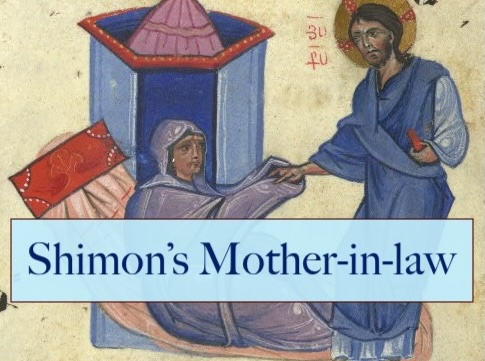
Yeshua entered Shimon’s house. And behold! Shimon’s mother-in-law was lying in bed, because a massive fever had taken hold of her. They asked him, and Yeshua rebuked the fever, and it left her. And Shimon’s mother-in-law got up and waited on them.[78]
| Table of Contents |
|
3. Conjectured Stages of Transmission 5. Comment 8. Conclusion |
Reconstruction
To view the reconstructed text of Shimon’s Mother-in-law click on the link below:
Premium Members and Friends of JP must be signed in to view this content.
If you are not a Premium Member or Friend, please consider registering. Prices start at $5/month if paid annually, with other options for monthly and quarterly and more: Sign Up For Premium
Conclusion
Shimon’s Mother-in-law, a tender story of Jesus’ compassion upon a sick woman, offers a unique glimpse into the family life of the man who would become Jesus’ foremost disciple.

Click here to return to The Life of Yeshua: A Suggested Reconstruction main page.
_______________________________________________________
- [1] Lindsey classified εὐθύς as a “Markan stereotype.” See Robert L. Lindsey, “Introduction to A Hebrew Translation of the Gospel of Mark,” under the subheading “Markan Stereotypes.” ↩
- [2] On ἀνιστάναι (anistanai, “to arise”) as an FR redactional term, see Bedridden Man, Comment to L69. ↩
- [3] Lindsey noted that “Luke much prefers ἀνίστημι (= קָם) to ἐγείρω (= קָם). There is an absence of any Lukan-Matthean agreement on ἀνίστημι without Mark’s agreement (except in Matt. 12:41; Luke 11:32)” (LHNC, to ἀνίστημι). ↩
- [4] J. Green suggested that the movement from a synagogue to a home is meant to prefigure the experience of Paul: “In Acts 18:7-8, only after Paul leaves the synagogue and enters a home is his message received with faith” (J. Green, 225). However, it should be noted that there is no indication that the people who attended the Capernaum synagogue were unreceptive to Jesus’ message. On the contrary, according to Luke, the members of the Capernaum synagogue were amazed at Jesus’ teaching (Luke 4:32) and were so impressed by his authority and power (Luke 4:36) that they spread a positive report about Jesus to those who had not witnessed the incident (Luke 4:37). ↩
- [5] Tomson (If This Be, 154) pointed out that Luke’s Gospel contains five stories that involve healing on the Sabbath: 1) Teaching in Kefar Nahum, 2) Shimon’s Mother-in-law, 3) Man’s Contractured Arm, 4) Daughter of Avraham, and 5) Man With Edema. All the other Sabbath healings in Luke have a clear connection to the Sabbath; either Jesus is teaching in a synagogue (nos. 1 and 4) and/or there is a controversy about whether healing is permitted on the Sabbath (nos. 3, 4, and 5). Only in Shimon’s Mother-in-law must the Sabbath setting be inferred from the broader context outside the pericope. ↩
- [6] On the story of King Yannai in b. Kid. 66a, see David N. Bivin and Joshua N. Tilton, “Introduction to ‘The Life of Yeshua: A Suggested Reconstruction’ Addendum: Linguistic Features of the Baraita in b. Kid. 66a.” ↩
- [7] See Hatch-Redpath, 2:969-970. ↩
- [8] See Dos Santos, 24-25. ↩
- [9] We find the phrase נִכְנַס לְבַיִת in m. Ter. 3:8; m. Bik. 3:2; m. Shab. 13:6; m. Suk. 3:9; m. Betz. 3:5; m. Yev. 15:10; m. Ned. 8:7; m. Bab. Metz. 9:13; m. Ker. 1:7; m. Neg. 13:9, 11, 12. ↩
- [10] The story of the Half Shekel in Matt. 17:24-27 also locates Peter’s home in Capernaum (see France, Matt., 320), but this pericope is unique to Matthew and was composed in an un-Hebraic style and may be the author of Matthew’s own composition. Some of the details in this pericope may be derived from other stories in Matthew’s Gospel. Thus, the location in Capernaum may be influenced by the location of Matthew’s toll station in or near Capernaum, and the location of Peter’s house in Capernaum may have been picked up from Shimon’s Mother-in-law. Hence, we are not confident in relying on the Half Shekel pericope for information on the location of Peter’s house. ↩
- [11] See Fitzmyer, 1:549. ↩
- [12] See Flusser, Jesus, 44. Cf. Fitzmyer, 1:549. ↩
- [13] See Shmuel Safrai, “Home and Family” (Safrai-Stern, 2:753). ↩
- [14] The personal name Πέτρος (always referring to Jesus’ disciple) is found 156xx in the New Testament. On the origin of this nickname, see David N. Bivin, “Jesus’ Petros-petra Wordplay (Matthew 16:18): Is It Greek, Aramaic, or Hebrew?” (JS2, 375-394). An earlier version of this study appeared on JerusalemPerspective.com as “Matthew 16:18: The Petros-petra Wordplay—Greek, Aramaic, or Hebrew?” ↩
- [15] See France, Matt., 320-321; Nolland, Matt., 178-179. ↩
- [16] Based on first-century literary and epigraphic sources, שִׁמְעוֹן-Σίμων was the most common Jewish male’s name of the period. See Rachel Hachlili, “Names and Nicknames of Jews in Second Temple Times,” Eretz-Israel 17 (1984): 188-211 (Hebrew); Tal Ilan, “Names of Hasmoneans in the Second Temple Period,” Eretz-Israel 19 (1987): 238-241 (Hebrew); cf. idem, Lexicon of Jewish Names in Late Antiquity, Part I: Palestine 330 BCE-200 CE (TSAJ 91; Tübingen: Mohr Siebeck, 2002), 226. ↩
- [17] Cf. Flusser, Jesus, 44 n. 14. ↩
- [18] Mark’s addition of “with James and John” forms a stack of prepositional phrases so typical of Markan redaction. On stacked prepositional phrases as typical of Markan redaction, see LOY Excursus: Mark’s Editorial Style, under the subheading “Mark’s Freedom and Creativity”. ↩
- [19] For a description and examples of Mark’s editorial style, see LOY Excursus: Mark’s Editorial Style. ↩
- [20] See Davies-Allison, 2:34. ↩
- [21] On the omission or replacement of ἰδού by the author of Luke and the First Reconstructor before him, see Friend in Need, Comment to L6. ↩
- [22] Nolland (Luke, 1:211) found the omission of the article before πενθερά in Luke’s version of Shimon’s Mother-in-law to be “puzzling.” Cf. Marshall, 194. Luke’s lack of a definite article may preserve a Hebraism reflecting a Hebrew construct phrase. ↩
- [23] BDB, 368, 327. ↩
- [24] Jastrow, 475. ↩
- [25] Strangely, Delitzsch translated πενθερά with חוֹתֶנֶת in Luke 4:38 and Mark 1:30, but with חָמוֹת in Matt. 8:14. ↩
- [26] Flusser lamented the loss of these women’s names, noting that “it is clear from the New Testament that Peter lived in an exemplary marriage.” See David Flusser, “Mary and Israel,” in Jaroslav Pelikan, David Flusser and Justin Lang, Mary: Images of the Mother of Jesus in Jewish and Christian Perspective (Minneapolis: Fortress, 1986), 1-12, esp. 4. ↩
- [27] According to the rabbinic sages, a married disciple needed his wife’s permission to leave home if he intended to study with a sage for more than thirty days (m. Ket. 5:6). See David Bivin, “First-century Discipleship,” under the subheading “Commitment.” ↩
- [28] Cf. Keener, 270. ↩
- [29] See Foakes Jackson-Lake, 4:343. ↩
- [30] Ibid., 4:134. ↩
- [31] See Joshua N. Tilton and David N. Bivin, “LOY Excursus: Catalog of Markan Stereotypes and Possible Markan Pick-ups.” ↩
- [32] See Jastrow, 900. Cf. Hauck, TDNT, 1:527. ↩
- [33] In this case, the sick individual is (or, is believed to be) at the point of death. ↩
- [34] We also read of a person with an abnormal discharge (a zav) who lies across six chairs (זב שהיה מוטל על ששה כסאות; t. Zav. 4:4; Vienna MS), of a child lying on his mother’s lap (עולל מוטל בין ברכי אמו; t. Sot. 6:4), and of an infant lying in a cradle (תינוק מוטל בעריסה; Avot de-Rabbi Natan, Version A, chpt. 16 [ed. Schechter, 63-64]). ↩
- [35] Taylor (179) noted that Mark’s πυρέσσειν (pūressein, “to be feverish”) is a rare verb that does not occur in LXX. ↩
- [36] Marshall (194), however, stated that συνεχομένη “is...the correct term to use for ‘being afflicted’ by illness (Plato, Gorg. 512a; Jos. Ant. 13:398; Mt. 4:24; Acts 28:8).” ↩
- [37] It is true that the verb συνέχειν (sūnechein, “to seize”) appears more often in the writings of Luke (Luke: 6xx; Acts: 3xx) than in the Gospels of Mark (0xx) or Matthew (1x) (see Moulton-Geden, 922), but using συνέχειν in the sense of being “seized” by an illness only occurs in Luke 4:38 and Acts 28:8, so it is difficult to classify this as an especially Lukan usage. ↩
- [38] See Creed, 71; Plummer, Luke, 137; Taylor, 179. ↩
- [39] Σμικρός is the Classical Greek form of Koine’s μικρός. ↩
- [40] Weiss, “πυρέσσω, πυρετός,” TDNT, 6:958. ↩
- [41] See Cadbury, Style, 39-64, especially 45, 51 n. 1, 58 n. 55 for Luke 4:38; Henry J. Cadbury, “Lexical Notes on Luke-Acts. II. Recent Arguments for Medical Language,” Journal of Biblical Literature 45.1-2 (1926): 190-209, esp. 194-195. ↩
- [42] See Hatch-Redpath, 2:1315. ↩
- [43] See Dos Santos, 6. ↩
- [44] Both קַדַּחַת and דַּלֶּקֶת appear in Deut. 28:22. The former is usually understood as “fever,” the latter as “inflammation.” JPS renders Deut. 28:22 as, “The Lord will strike you with consumption, fever [קַדַּחַת], and inflammation [דַּלֶּקֶת]....” ↩
- [45] The noun קַדַּחַת does not appear in the Dead Sea Scrolls, the Hebrew fragments of Ben Sira, or in the Mishnah. קַדַּחַת does appear once in b. Shab. 32b, but only as a citation of Lev. 26:16. The Aramaic cognate קדחתא appears once in b. Betz. 22a. ↩
- [46] Cf. R. K. Harrison, “Fever,” in The Interpreter’s Dictionary of the Bible: An Illustrated Encyclopedia (ed. George A. Buttrick; Nashville: Abingdon, 1962), 2:266. ↩
- [47] On the historical present as an indicator of Markan redaction, see LOY Excursus: Mark’s Editorial Style, under the subheading “Mark’s Freedom and Creativity.” ↩
- [48] According to Luke, Jesus was not accompanied by disciples; he must therefore have been addressed by unidentified members of Simon’s household whom Jesus met after entering Simon’s home. In Mark’s version it is unclear whether we are to understand that Jesus is addressed by Simon’s family or by the disciples. See Taylor, 179. ↩
- [49] In Classical Greek there is a distinction between ἐρωτᾶν (erōtan, “to ask for information”) and αἰτεῖν (aitein, “to make a request”). This distinction is also maintained in LXX. Here Luke uses ἐρωτᾶν in the sense of “to make a request,” contrary to Classical Greek usage. It has been suggested that the failure to maintain the Classical distinction between ἐρωτᾶν and αἰτεῖν in the Gospels reflects the use of a Semitic source, however the blurring of the distinction between these two Greek verbs is also attested in other parts of the New Testament and in first-century papyri and is therefore a feature of Koine Greek. See Jan Joosten, “The Ingredients of New Testament Greek,” Analecta Bruxellensia 10 (2005): 61. Nevertheless, the author of Luke, whose personal writing style was fairly elevated, may have been induced to depart from this Classical Greek usage in Shimon’s Mother-in-law because he relied on sources that were translated from Hebrew. ↩
- [50] On the use of περί + personal pronoun in the sense of “concerning so-and-so” as a marker of Lukan redaction, see Return to the Galil, Comment to L8. ↩
- [51] See Davies-Allison, 2:32. ↩
- [52] Jordash Kiffiak has communicated privately: “Opposite Matthew, Mark has two participles: προσελθὼν and κρατήσας. Luke also has two: ἐπιστὰς and ἀναστᾶσα. True, Matthew uses participles in 8:14. But in two of three instances they are the kind that work better as a potential parallel of something in Hebrew, e.g. נופלת and חולה. The odd one out is ἐλθὼν.” ↩
- [53] On rebuke in Gospel traditions, see Barry Blackburn, Theios Aner and the Markan Miracle Traditions: A Critique of the Theios Aner Concept as an Interpretive Background of the Miracle Traditions Used by Mark (Tübingen: Mohr [Siebeck], 1991), 134-135. ↩
- [54] See JANT, 109. ↩
- [55] Kazen (303) mentions an Aramaic text from Qumran (4Q560 1 I, 4) that seems to list fever (אשא) as a type (or the name) of a demon. Nolland (Luke, 211) cites T. Sol. 18:20, 23, which mention two beings, identified as demons in T. Sol. 18:42, that inflict fevers on human beings. Weiss cites Pliny the Elder (Nat. Hist. 2:16), who mentions a temple in Rome dedicated to the god “Fever” (“πυρέσσω, πυρετός,” TDNT, 6:957). Pliny himself completely dismissed the idea of a fever god. ↩
- [56] Luke uses ἐπιτιμᾶν (epitiman, “to rebuke,” “to reprove”) 3xx in the context of exorcism (Luke 4:35 [Teaching in Kefar Nahum], 41 [Healings and Exorcisms]; 9:42), two of these instances appearing in the pericopae immediately adjacent to Shimon’s Mother-in-law. Matthew uses ἐπιτιμᾶν once in the context of exorcism (Matt. 17:18), and Mark does so twice (Mark 1:25; 3:12). ↩
- [57] For example, Jesus rebukes his disciples (Luke 9:21; Mark 8:33) and the wind and the waves (Matt. 8:26; Mark 4:39; Luke 8:24), the crowd rebukes the blind man who attempts to catch Jesus' attention (Matt. 20:31; Mark 10:48; Luke 18:39), and Peter even dares to rebuke Jesus (Matt. 16:22; Mark 8:32). ↩
- [58] In Jude 9 we read that the archangel Michael confronted the devil with the words Ἐπιτιμήσαι σοι κύριος (“The Lord rebuke you!”), a clear allusion to Zech. 3:2: יִגְעַר יי בְּךָ הַשָּׂטָן (cf. 1QHa XVII, 11, which may have been influenced by the language of Zech. 3:2). However, it should be noted that a confrontation with the devil/satan is not identical with exorcism. (On the legends concerning the dispute over Moses’ body, including Jude 9, see David Flusser, “Palaea Historica: An Unknown Source of Biblical Legends,” Scripta Hierosolymitana 22 [1971]: 72-74.) In T. Sol. 6:11, King Solomon rebukes Beelzeboul; however, Solomon’s rebuke is not an exorcism (cf. ויגער בליעל in 4Q463 2 I, 3). Testament of Solomon 17:4 states that a certain demon is frightened and rebuked (ἐπιτιμηθείς) by the sign of the cross, but this passage is clearly Christian and therefore likely to have been influenced by the vocabulary of the Gospels. ↩
- [59] In Philo’s works ἐπιτιμᾶν always refers to the rebuke of persons. In Josephus’ writings ἐπιτιμᾶν refers to the censure, punishment or condemnation of persons. However, in Ant. 19:202, Josephus uses ἐπιτιμᾶν in reference to everything the law condemns (ἐπιτιμᾷ) as disgraceful, which might count as a possible exception. ↩
- [60] Cf. Ps. 105[106]:9: “he rebuked [ἐπετίμησεν] the Red Sea, and it became dry.” The noun ἐπιτίμησις (epitimēsis, "rebuke") translates the Hebrew noun גְּעָרָה (ge‘ārāh, “rebuke”) 4xx where inanimate objects are the recipients of the rebuke: 2 Kgdms. 22:16; Job 26:11; Ps. 17[18]:16; Ps. 103[104]:7. ↩
- [61] There are also numerous examples in rabbinic literature where גָּעַר refers to the rebuke of persons, for example:
גיירני על מנת שתלמדני תורה שבכתב גער בו והוציאו בנזיפה
“Make me a proselyte on condition that you teach me the Written Torah [only, and not the Oral Torah—DNB and JNT].” But he [Shammai] scolded and repulsed him in anger. (b. Shab. 31a; Soncino)
- [62] Note that Jesus is also said to have rebuked “wind and raging waves” (Matt. 8:18, 23-27; Mark 4:35-41; Luke 8:22-25).
We do not deny, however, that גָּעַר could be used in exorcism contexts. There are two examples in DSS where גָּעַר is applied to evil spirits. The first is from the War Scroll, which records a prayer that praises God for the overthrow of the dominion of Belial (ממשלת בליעל) saying:
[...ורחי [ח]בלו גערתה ממ[נו
You have chased away [גערתה] from [us] his spirits of [de]struction.... (1QM XIV, 10; cf. 4QMa 8-10 I, 7)
The War Scroll does not describe an exorcism, however it does apply the verb גָּעַר to evil spirits.
The Genesis Apocryphon, on the other hand, does describe an exorcism of an evil spirit. In this text Pharaoh urges Abraham to exorcise an evil spirit:
וכען צלי עלי ועל ביתי ותתגער ממנו רויא דא באישתא וצלית עלוה מגדפא הו וסמכת ידי על [ראי]שה ואתפלי מנה מכתשא ואתגערת [מנה רוחא] באישתא וחי
“But now pray for me and my household so that this evil spirit will be banished [ותתגער] from us.” I prayed that [he might be] cured and laid my hands upon his [hea]d. The plague was removed from him; the evil [spirit] was banished [ואתגערת] from him and he recovered. (1Qap Genar [1Q20] XX, 28-29)
In this Aramaic text a verb from the root ג-ע-ר is used in the context of exorcism.
Notice, however, that the strongest support comes from Aramaic texts that refer to a fever demon (4Q560 1 I, 4) and rebuke (1Qap Genar [1Q20] XX, 28-29) in the context of exorcism, whereas we presume a Hebrew background to the stories about Jesus. ↩
- [63] See Hatch-Redpath, 1:537. ↩
- [64] See Dos Santos, 38. ↩
- [65] See Allen, Matt., 79. ↩
- [66] See LHNC to κρατήσας τῆς χειρός. In a JerusalemPerspective.com forum discussion, Pieter Lechner noted that only Mark includes the detail that Jesus “took him by the hand and raised him up” in the story of the Boy Delivered from Demon (Matt. 17:14-21; Mark 9:14-29; Luke 9:37-43). Matthew and Luke’s agreement against Mark to omit this detail in Boy Delivered from Demon may indicate that the detail is secondary and that Mark tended to proliferate instances of Jesus taking people by the hand in stories of healing. ↩
- [67] See Dos Santos, 64; Hatch-Redpath, 1:183. ↩
- [68] For ancient Jewish and non-Jewish parallels to miraculous healings from fever, see Blackburn, Theios Aner and the Markan Miracle Traditions, 188. ↩
- [69] Cf. the ruling of Shmuel (early second cent. C.E.) that an infant is allowed seven days after his recovery from fever before being circumcised (אמר שמואל חלצתו חמה נותנין לו כל שבעה להברותו; “Shmuel said, ‘When the fever leaves him, they give him a full seven days for his recovery” [b. Shab. 137a]), and Shmuel’s opinion that one should not visit sick persons until after they have recovered from fever (אין מבקרין את החולה אלא למי שחלצתו חמה; “They may not visit a sick person except for one who the fever has left him” [b. Ned. 41a]). ↩
- [70] See Bendavid, 96, lines 5 and 20. Perhaps the most famous rabbinic example of שִׁמֵּשׁ in the sense of “serve” is in the saying of Antigonos of Socho (early second cent. B.C.E.): “Do not be like slaves who serve [הַמְשַׁמְּשִׁים] their master in order to receive a prize..." (m. Avot 1:3). ↩
- [71]
Shimon’s Mother-in-law
Luke’s Version
Anthology’s Wording (Reconstructed)
ἀναστὰς δὲ ἀπὸ τῆς συναγωγῆς εἰσῆλθεν εἰς τὴν οἰκίαν Σίμωνος πενθερὰ δὲ τοῦ Σίμωνος ἦν συνεχομένη πυρετῷ μεγάλῳ καὶ ἠρώτησαν αὐτὸν περὶ αὐτῆς καὶ ἐπιστὰς ἐπάνω αὐτῆς ἐπετείμησεν τῷ πυρετῷ καὶ ἀφῆκεν αὐτήν παραχρῆμα δὲ ἀναστᾶσα διηκόνει αὐτοῖς
καὶ εἰσῆλθεν εἰς τὴν οἰκίαν Σίμωνος καὶ ἰδοὺ πενθερὰ τοῦ Σίμωνος βεβλημένη ἐπὶ κλίνης ὅτι συνέσχεν αὐτὴν πυρετὸς μέγας καὶ ἠρώτησαν αὐτὸν καὶ ἐπετίμησεν τῷ πυρετῷ καὶ ἀφῆκεν αὐτήν καὶ ἠγέρθη καὶ διηκόνησεν αὐτοῖς
Total Words:
38
Total Words:
34
Total Words Identical to Anth.:
19
Total Words Taken Over in Luke:
19
Percentage Identical to Anth.:
50.00%
Percentage of Anth. Represented in Luke:
55.88%
↩
- [72]
Shimon’s Mother-in-law
Mark’s Version
Anthology’s Wording (Reconstructed)
καὶ εὐθὺς ἐκ τῆς συναγωγῆς ἐξελθὼν ἦλθεν εἰς τὴν οἰκίαν Σίμωνος καὶ Ἀνδρέου μετὰ Ἰακώβου καὶ Ἰωάνου ἡ δὲ πενθερὰ Σίμωνος κατέκειτο πυρέσσουσα καὶ εὐθὺς λέγουσιν αὐτῷ περὶ αὐτῆς καὶ προσελθὼν ἤγειρεν αὐτὴν κρατήσας τῆς χειρός καὶ ἀφῆκεν αὐτὴν ὁ πυρετός καὶ διεκόνει αὐτοῖς
καὶ εἰσῆλθεν εἰς τὴν οἰκίαν Σίμωνος καὶ ἰδοὺ πενθερὰ τοῦ Σίμωνος βεβλημένη ἐπὶ κλίνης ὅτι συνέσχεν αὐτὴν πυρετὸς μέγας καὶ ἠρώτησαν αὐτὸν καὶ ἐπετίμησεν τῷ πυρετῷ καὶ ἀφῆκεν αὐτήν καὶ ἠγέρθη καὶ διηκόνησεν αὐτοῖς
Total Words:
44
Total Words:
34
Total Words Identical to Anth.:
13
Total Words Taken Over in Mark:
13
Percentage Identical to Anth.:
29.55%
Percentage of Anth. Represented in Mark:
38.24%
↩
- [73]
Shimon’s Mother-in-law
Matthew’s Version
Anthology’s Wording (Reconstructed)
καὶ ἐλθὼν ὁ Ἰησοῦς εἰς τὴν οἰκίαν Πέτρου εἶδεν τὴν πενθερὰν αὐτοῦ βεβλημένην καὶ πυρέσσουσαν καὶ ἥψατο τῆς χειρὸς αὐτῆς καὶ ἀφῆκεν αὐτὴν ὁ πυρετός καὶ ἠγέρθη καὶ διεκόνει αὐτῷ
καὶ εἰσῆλθεν εἰς τὴν οἰκίαν Σίμωνος καὶ ἰδοὺ πενθερὰ τοῦ Σίμωνος βεβλημένη ἐπὶ κλίνης ὅτι συνέσχεν αὐτὴν πυρετὸς μέγας καὶ ἠρώτησαν αὐτὸν καὶ ἐπετίμησεν τῷ πυρετῷ καὶ ἀφῆκεν αὐτήν καὶ ἠγέρθη καὶ διηκόνησεν αὐτοῖς
Total Words:
30
Total Words:
34
Total Words Identical to Anth.:
10
Total Words Taken Over in Matt.:
10
Percentage Identical to Anth.:
33.33%
Percentage of Anth. Represented in Matt.:
29.41%
↩
- [74] Fitzmyer states that “This miracle on her [Simon’s mother-in-law’s] behalf provides in the Lucan account part of the psychological background for the call of Simon the fisherman” (Fitzmyer, 1:549). ↩
- [75] See the discussion in Davies-Allison, 2:33-34. ↩
- [76] For abbreviations and bibliographical references, see “Introduction to ‘The Life of Yeshua: A Suggested Reconstruction.’” ↩
- [77] David Bivin would like to thank Joshua Tilton, Lauren Asperschlager, Pieter Lechner, Lenore Mullican and Linda Pattillo, who collaborated in producing this commentary on Shimon’s Mother-in-law, and especially Randall Buth for his invaluable help in producing the Hebrew reconstruction of this pericope. ↩
- [78] This translation is a dynamic rendition of our reconstruction of the conjectured Hebrew source that stands behind the Greek of the Synoptic Gospels. It is not a translation of the Greek text of a canonical source. ↩




Comments 1
Newly updated reconstruction and commentary!