How to cite this article: R. Steven Notley, “The Cross and the Jewish People,” Jerusalem Perspective (2003) [https://www.jerusalemperspective.com/6275/].

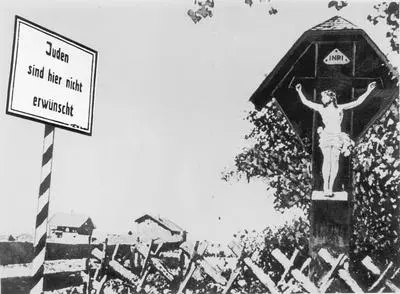
One of the most poignant pictures which exemplify the chasm of historical misunderstanding between Jews and Christians is that found in Yad Vashem, the Holocaust memorial in Jerusalem. It is a photograph of a life-size crucifix that stood outside an unknown German village prior to World War II. In a twist of tragic irony a sign was hung on the cross to warn Jews not to enter the village. It read: “Jews are not welcome here.” Yet, the specter of the lonely figure of Jesus—himself a Jew—hanging on a cross together with such an expression of bigotry and written even by those called by his name, leaves the casual observer struck by the degree of historical distortion which has evolved over two millennia.
The irony is that Jesus was crucified by Pontius Pilate precisely because he was a Jew. Crucifixion was a common form of Roman suppression used against individuals and movements which the empire considered threatening. The Roman prefect Quintilius Varus put down the Jewish insurrection at the time of Herod’s death by crucifying two thousand Jews on the roads leading to Jerusalem (Josephus, Jewish War 2:74-76). Seventy years later, when Titus besieged Jerusalem, many tried to escape because of hunger. All those captured were scourged and crucified. Josephus relates that there were up to 500 a day. In fact, so many Jews were crucified by the Romans during the destruction of Jerusalem that they did not have sufficient space and ran out of crosses (Jewish War 5.446-451).

In light of these historical events, it seems that no symbol better serves to represent Jesus’ identification with the suffering of the Jewish nation. So, how did this unmistakable sign of Jesus’ Jewish identity become a symbol of enmity between his followers and the Jewish people?
The Apostle Paul speaks of the difficulty the Cross posed for both Jews and Greeks in his day:
Has not God made foolish the wisdom of the world? For since, in the wisdom of God, the world did not know God through wisdom, it pleased God through the folly of what we preach to save those who believe. For Jews demand signs and Greeks seek wisdom, but we preach Christ crucified, a stumbling block to Jews and folly to Gentiles, but to those who are called, both Jews and Greeks, Christ the power of God and the wisdom of God. (1 Cor. 1:20-24)
For Greeks, the crucifixion and resurrection of Christ were considered nonsense: “Now when they heard of the resurrection of the dead, some mocked…” (Acts 17:32). Death meant release of the soul from its bondage to a fleshly prison. Why would one want to return to that body through resurrection?
On the other hand, for Jews the provocative notion of the Cross was the suffering of the Messiah (see Luke 24:26; Acts 17:3). Popular notions related to the Messiah were spawned by the hope for a Redeemer, whom God would send to cast off the yoke of Roman oppression and to reestablish the throne of David. The suggestion that the Messiah would die—even more so at the hands of the Romans—was a difficult concept to embrace. It is for this reason that Jesus cautions his followers not to speak openly concerning his future suffering and death.
But Jesus charged and commanded them to tell this to no one, saying, “The Son of man must suffer many things, and be rejected by the elders and chief priests and scribes, and be killed, and on the third day be raised.” (Luke 9:21-22)
The act of crucifixion was considered so barbaric and cruel that Jewish leaders refused to adopt this Roman style of execution. An exception was the Hasmonean ruler Alexander Yannai (103-76 B.C.), who crucified 800 Pharisees in the beginning of the first century B.C.
So unbridled was Alexander’s rage that from brutality he proceeded to impiety. Eight hundred of the prisoners he crucified in the middle of the City, then butchered their wives and children before their eyes; meanwhile, cup in hand as he reclined amidst his concubines, he enjoyed the spectacle. (Josephus, Jewish War 1.93-98)
The Essene author of a commentary on Nahum from the Qumran library, though no supporter of the Pharisees, condemned Alexander’s brutality in his execution of them by crucifixion. Although the author’s allusion does not mention either Alexander or the Pharisees by name, the specific historical event is clear.
[“And chokes prey for its lionesses; and it fills] its caves [with prey] and its dens with victims” (Nahum 2:12). Its interpretation: This concerns the furious young lion (= Alexander) [who executes revenge] on those who seek smooth things(= Pharisees) and hangs men alive…formerly in Israel. Because of a man hanged alive on [the] tree, He proclaims, “Behold I am against [you, says the Lord of Hosts.”] (4QpNah 1:7-8)
The harsh condemnation towards the Jewish leader for crucifying fellow Jews stems from the abject humiliation such a death entailed. Israel’s Sages considered the horror of the execution a desecration of the divine image that each person possesses. Rabbi Meir, a second-century A.D. Sage, sought to explain the reason for Jewish revulsion towards crucifixion through a parable preserved in Tosefta, Sanhedrin 9:7.
R. Meir: It may be compared to two brothers who were twins that looked exactly alike. One was the king over the whole universe and the other became a thief. After a time, the thief was caught. They crucified him upon a cross. Everyone who passed by said: “It looks as if the king has been crucified!” Thus it was written, “Accursed is God [because] of a hanged man (Deut. 21:23).”
The Jewish sources are consistent in their condemnation of crucifixion as a Jewish form of capital punishment. Moreover, because of its use by the Romans to persecute the Jewish people, death on the cross became identified with persecution for faithfulness to the Lord. In an early commentary on Exodus 20:6 in Mechilta de-Rabbi Ishmael, we hear of the various forms of execution and their representation as punishment for different expressions of fidelity to God:
“Of them that love Me and keep My commandments,” refers to those who dwell in the Land of Israel and risk their lives for the sake of the commandments. “Why are you being led out to be decapitated? Because I circumcised my son to be an Israelite.” “Why are you being led out to be burned?” “Because I read the Torah.” “Why are you being led out to be crucified?” “Because I ate the unleavened bread.”
Is it a coincidence that death by crucifixion was executed upon those who were guilty of celebrating the Passover? It was the celebration of God’s act of liberation, when he delivered his people from slavery in Egypt. It was also a time when the Jewish nation renewed their hope and expectation that God would once again redeem the nation. By the way, it is the fervency of these expectations which caused the Romans to reinforce their presence in Jerusalem at Passover. Thus, we find Pontius Pilate—who normally resided in Caesarea—in Jerusalem during the week of Passover when Jesus was crucified.
A final mention of crucifixion is seen in Genesis Rabbah 56:3 and its description of Isaac carrying wood for the sacrifice (cf. Gen. 22:6): “It was like a condemned man who took his cross upon his shoulders.” One wonders whether the complex of ideas and expressions witnessed in Genesis Rabbah concerning crucifixion and “the beloved son,” may have been the source for Jesus’ language concerning his own death. On the Mount of Transfiguration when Jesus speaks with Moses and Elijah about his “departure” (i.e., his death), the heavenly voice calls him “the beloved son” (Matt. 17:5; see also Luke 20:13).
Jesus, however, does not limit the language of the Cross to his own death. He uses it to convey the depth of commitment required for discipleship. Those who follow after Jesus are required to yield totally to the Lord.
If any man would come after me, let him deny himself and take up his cross daily and follow me. For whoever would save his life will lose it; and whoever loses his life for my sake, he will save it. For what does it profit a man if he gains the whole world and loses or forfeits himself? (Luke 9:23-25)
Whoever does not bear his own cross and come after me, cannot be my disciple. (Luke 14:27)
Our brief study once again demonstrates that Jesus’ teachings belong to the world of Israel’s Sages. Even his own death on the Cross was inextricably identified with the suffering of the Jewish people and their hope for redemption. As a Christian, I am unable to undo the centuries of hatred and historical distortion which have driven a wedge between Jesus and the Jewish people. I can only hope that through my own faithful obedience to the Lord, I can rightly reflect Jesus’ love for the Father and his love for the peoples living in the land of Israel today.