Condensed and adapted from the author’s “The Role of the Temple in the Herodian Economy,” Journal of Jewish Studies 38.1 (Spring 1987): 1-37.
And as he came out of the Temple, one of his disciples said to him, “Look, Teacher, what magnificent stones and what magnificent buildings!”
(Mark 13:1)
Herod the Great’s gigantic building projects, both public and private, required enormous financial resources. His riches were so vast that he could spend an incredible fortune not only on buildings in his own domain, but also on showy structures abroad.
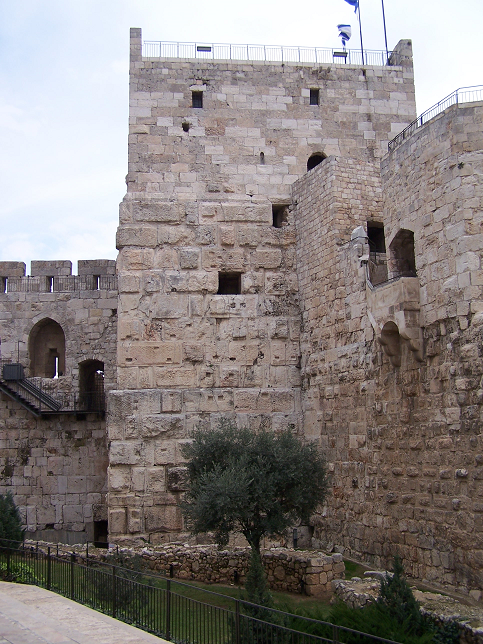
We know of at least twenty of his projects in the land of Israel, the size of which set world records at the time. Among them were the Temple complex, built on a vast artificial esplanade or platform that was the largest of its kind in antiquity;[1] the Royal Portico of the Temple, the longest building then in existence;[2] Herodium, then the largest palace in the world (only Nero built a larger one in Rome, some sixty years after Herod’s death);[3] the harbor of Caesarea, the most technologically advanced harbor in antiquity;[4] the citadels and palace in Jerusalem; the citadel and palaces at Masada; the palace complex at Jericho; the cities of Samaria, Caesarea, Gaba-Hippeon and Antipatris; and the irrigation systems in the Jordan Valley. Josephus tells of dozens of cities abroad that enjoyed Herod’s munificence for luxury buildings and contributions for building a fleet.[5]
Premium Members and Friends of JP must be signed in to view this content.
If you are not a Premium Member or Friend, please consider registering. Prices start at $5/month if paid annually, with other options for monthly and quarterly and more: Sign Up For Premium
Comment from Mendel Nun (Kibbutz Ein Gev, Israel) that was published in the “Readers’ Perspective” column of Jerusalem Perspective 48 (Jul.-Sept. 1995): 7.
I enjoyed reading Magen Broshi’s article, “The Wealth of Herod the Great” (Jerusalem Perspective 37 [Mar.-Apr. 1992]: 3-6); however, Broshi failed to mention one very important product exported from the land of Israel. Pickled fish from the Sea of Galilee, mainly sardines, should have been included in his list of export items. According to Strabo, a first-century Roman geographer and historian, “at the place called Taricheai the lake supplies excellent fish for pickling” (Geographica XVI, 2:45). Apparently, the town of Magdala (called in Greek Taricheai, meaning, the place where fish are salted) on the west coast of the Sea of Galilee was the center of a large sardine pickling industry. Much of the industry’s output was consumed locally, but a considerable amount was exported abroad.
Magen Broshi responds:
The omission of pickled fish in my discussion of exports was intentional. I do not believe that pickled fish from the Sea of Galilee were a significant export for the country. Generally, in this period, more goods were imported than were exported.
Notes
- Cf. J. Simons, Jerusalem in the Old Testament (Leiden, 1952), 346ff. ↩
- The length of the portico was 270 meters. Cf. R. Grafman, “Herod’s Foot and Robinson’s Arch,” Israel Exploration Journal 20 (1970): 60-66; B. Mazar, “The Royal Stoa in the Southern Part of the Temple Mount,” in Recent Archaeology in the Land of Israel, ed. H. Shanks and B. Mazar (Washington, D.C. and Jerusalem, 1985), 141-147. ↩
- E. Netzer, “Greater Herodium,” Qedem 13 (1981): 110. ↩
- A. Raban and R. L. Hohlfelder, “The Ancient Harbors of Caesarea Maritima,” Archaeology 34.2 (1981): 56-60. ↩
- On Herod’s gifts to cities abroad, cf. War 1:422-425; Antiquities 16:146-149. ↩