
How to cite this article: Robert L. Lindsey, “Unlocking the Synoptic Problem: Four Keys for Better Understanding Jesus,” Jerusalem Perspective 49 (1995): 10-17, 38 [https://www.jerusalemperspective.com/2739/].
Over several decades of laboring in the Greek texts of the Synoptic Gospels, I have come to recognize four keys for gaining a correct perspective of Jesus. These four keys, when applied properly to the Synoptic Gospels, help significantly in bringing Jesus and his teachings into focus.
Hebrew Beneath the Greek
 The first key is command of the biblical languages. Note my use of the plural—“languages.” Knowledge of only Greek is not sufficient for studying the Gospels. In 1959 when preparing a Hebrew translation of the Gospel of Mark,[1] I discovered that much of Mark’s text could be translated readily into Hebrew without changing the word order. This attracted my attention since Greek is a language whose meaning is conveyed more through the forms of words than the order of words in a sentence. Hebrew, however, is a language that depends largely on syntax, or the order of words in a sentence, to convey meaning. So, when I saw Greek sentences written with a word order like that of Hebrew,[2] I began asking the question: What has caused Mark’s Greek to assume Hebrew syntax?
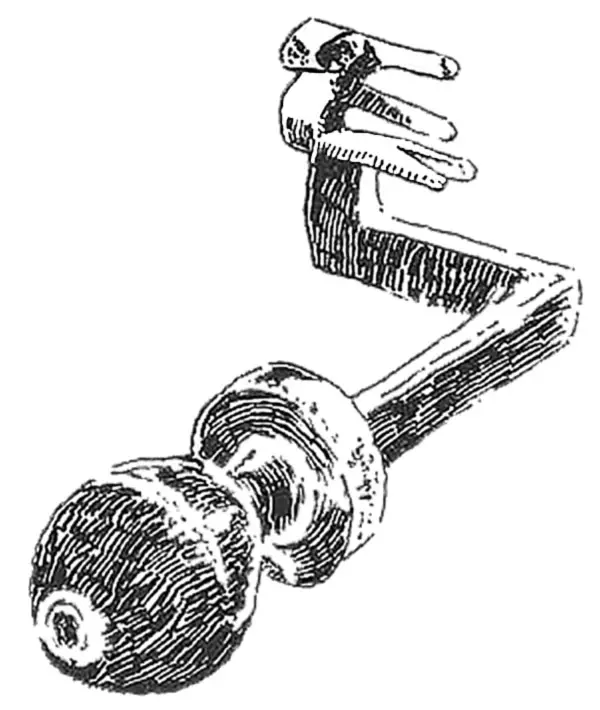
Keys in the time of Jesus were inserted into the keyhole, unlocking the door latch from the inside. Illustration by Helen Twena.
Word order was not the only Hebraism I noticed in Mark and the other two Synoptic Gospels. Hebrew idioms were also plentiful. For example, Jesus frequently talked about the kingdom of heaven. The Greek ἡ βασιλεία τῶν οὐρανῶν (hē basileia tōn ouranōn, “the kingdom of the heavens”) is a slavishly literal rendering of the Hebrew expression מַלְכוּת שָׁמַיִם (mal·CHŪT shā·MA·yim, “kingdom of heavens”). In Hebrew the expression is literally “kingdom of heavens.” The conspicuous plural, “heavens,” is preserved in the Greek τῶν οὐρανῶν (tōn ouranōn, “of the heavens”).[3]
Premium Members and Friends of JP must be signed in to view this content.
If you are not a Premium Member or Friend, please consider registering. Prices start at $5/month if paid annually, with other options for monthly and quarterly and more: Sign Up For Premium

Notes
- For an account of my attempts to translate the Gospel of Mark, see Robert L. Lindsey, A Hebrew Translation of the Gospel of Mark (2nd ed.; Jerusalem: Dugith Publishers, 1973), 9-65; Lindsey, Jesus, Rabbi and Lord: A Lifetime’s Search for the Meaning of Jesus’ Words, 25-27. ↩
- Compare, for example, Luke 4:33: “And rebuked him [the demon] Jesus saying….” The sentence begins with “and” followed by the principal verb, and then the subject—typical Hebrew word order. ↩
- Other examples of Hebrew idioms embedded in the Greek text of the Synoptic Gospels are: “bad eye” (Matt. 6:23); “bind” and “loose” (Matt. 16:19); “cast out your name evil” (Luke 6:22); “lay these sayings in your ears” (Luke 9:44); “set his face to go” (Luke 9:51); “give a ring on his hand” (Luke 15:22); and “lifted up his eyes and saw” (Luke 16:23). See David Bivin and Roy B. Blizzard, Understanding the Difficult Words of Jesus (2nd ed.; Shippensburg, PA: Destiny Image Publishers, 1994), 55-65, 103-109, 115-117, 119-126. ↩
![Robert L. Lindsey [1917-1995]](https://www.jerusalemperspective.com/wp-content/uploads/userphoto/28.jpg)