How to cite this article: Shmuel Safrai, “Did Jesus Wear a Kippah?” Jerusalem Perspective 36 (1992): 11 [https://www.jerusalemperspective.com/2632/].

It is certain that Jesus, a Jew residing in the land of Israel in the first century, did not wear a kippah (skullcap).
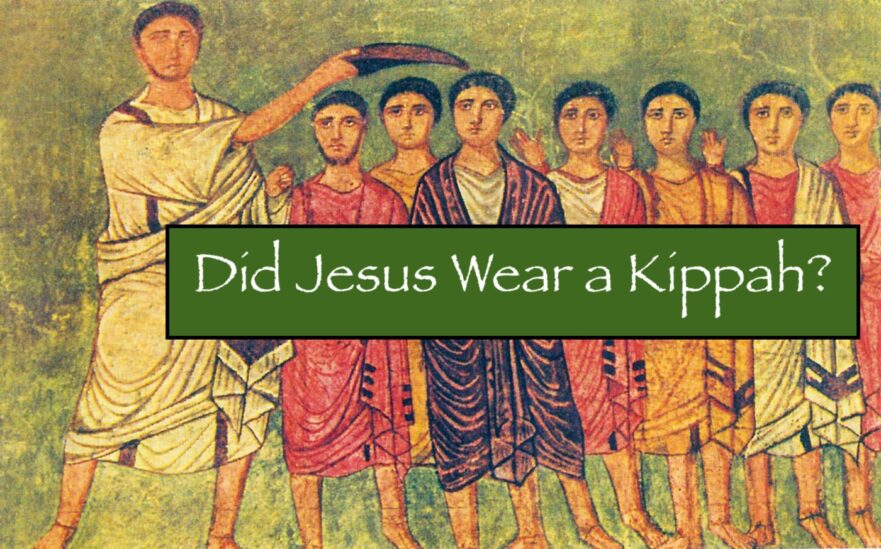
The custom of wearing a kippah arose in Babylonia between the third and fifth centuries C.E. among the non-Jewish residents—Jewish residents of Babylonia had not yet adopted this custom, as the Dura-Europos frescoes show—and passed from there to the Jewish community of Europe.
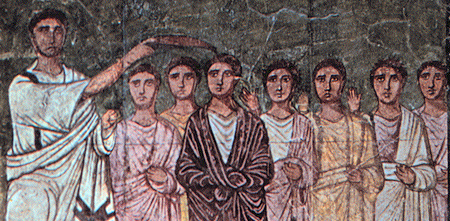
Although priests wore a מִגְבַּעַת (mig⋅BA⋅’at, a turban-like headdress; see Exod. 28:4, 40; Lev. 8:13), other Jews of the Second Temple period did not wear a headcovering. This is confirmed both by the literature and archaeological remains of the period. For instance, the reliefs on the Arch of Titus in Rome, which depict the victory procession in Rome following the conquest of Jerusalem in 70 C.E., show the Jewish captives bareheaded. Likewise, the frescoes of the mid-third century C.E. synagogue excavated at Dura-Europos represent all the Jewish men as bareheaded except for Aaron the priest.
Contemporary Jewish sources verify the picture presented in the New Testament:
Every man who prays or prophesies with his head covered dishonors his head. And every woman who prays or prophesies with her head uncovered dishonors her head—it is just as though her head were shaved…. A man ought not to cover his head, since he is the image and glory of God; but the woman is the glory of man.
(1 Cor. 11:4-7)
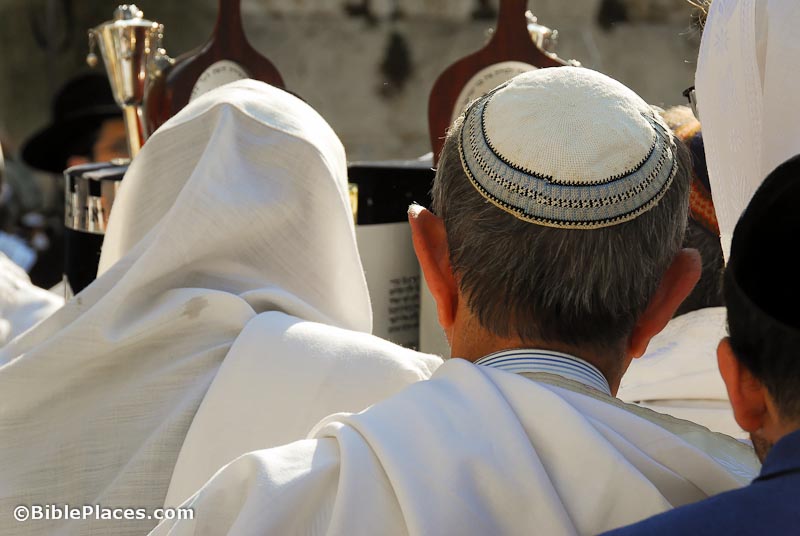
According to the Babylonian Talmud, Nedarim 30b, Jewish children were always bareheaded, men sometimes covered their heads and sometimes did not, while women covered their heads at all times. But it must be remembered that this is a late source (end of fifth century C.E.) and reflects Jewish practice in Babylonia.
According to the Shulhan Arukh, the sixteenth-century code of Jewish law compiled by Rabbi Joseph Karo, one should not walk bareheaded even four cubits (two meters) (Orakh Hayyim 2:6). This ruling is derived from the Babylonian Talmud, Kiddushin 31a, where it is stated that Rav Huna (fourth century C.E.), the son of Rav Yehoshua, would not walk bareheaded four cubits (cf. Babylonian Talmud, Shabbat 118b). However, this is noted as the exceptional practice of a particular sage, not as a practice observed by all males. The practice of covering one’s head in public apparently was not yet wide-spread in Babylonia in the fourth century C.E.
For more on Jesus’ clothing and appearance, check out these JP articles:
◦ Marvin R. Wilson, “The Appearance of Jesus: Hairstyles and Beards in Bible Times”
◦ JP Staff Writer, “Tangled up in Techēlet: Tzitzit (Ritual Tassels) in the Time of Jesus”
To read more New Testament insights from professor Shmuel Safrai on Jerusalem Perspective, click here.
And check out these recent JP articles:
- Mary and Israel
 Mary, the mother of Jesus, must be seen in the context of Jewish suffering.
 - A Jerusalem Perspective on the Magi
 A new collection of articles on Matthew’s narrative of the magi. Available 7 December 2025!
 - The Star of Bethlehem: An Astronomical Perspective
 Can astronomy help us to identify the “star” the magi followed to Bethlehem?
 - The Narrative of the Magi: Some Notes from a Jewish Perspective
 What purpose does Matthew’s choice of the title “magi” serve when he used this term to describe the bearers of the messianic tidings?
 - Wise Men or Stooges: Who Were Matthew’s Magi?
 How to cite this article: Joshua N. Tilton, “Wise Men or Stooges: Who Were Matthew’s Magi?” Jerusalem Perspective (2025) [https://www.jerusalemperspective.com/31038/]. Questions about the magi in Matthew’s Gospel can be answered from a variety of perspectives. Astronomers might attempt to identify the phenomenon the magi observed in the heavens. Historians of religion might attempt to identify …
 - Rethinking the Magi in Matthew and Exodus Rabbah
 A look at the broader backdrop of Jewish tendencies offered by a comparison between traditions in Matthew and Exodus Rabbah.
![Shmuel Safrai [1919-2003]](https://www.jerusalemperspective.com/wp-content/uploads/userphoto/20.jpg)