
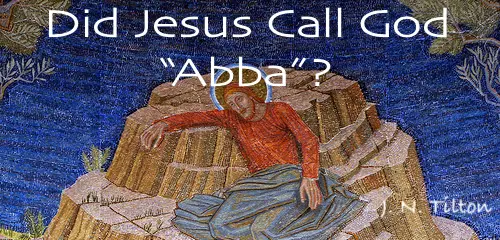
How to cite this article: Joshua N. Tilton, “Did Jesus Call God ‘Abba’?,” Jerusalem Perspective (2016) [https://www.jerusalemperspective.com/16149/].
| “No Jew ever called God abba, yet the evangelists record that Jesus always called God abba, ‘my Father’ (except for the cry from the cross, Mark 15.34).”
—Joachim Jeremias (emphasis original)[1] |
At first glance, the title of this article might seem to pose a preposterous question. “Of course Jesus called God ‘Abba,’” one might exclaim. “It says so in the New Testament!” That “Abba” was Jesus’ favorite term for addressing God is often taken for granted by laypersons and scholars alike. Some scholars have asserted that whenever Jesus addressed God as “Father” in the Gospels, this always goes back to an original “Abba.”[2] Moreover, Jesus’ use of “Abba” in prayer has been cited as evidence that Jesus attained a level of intimacy with God that was not possible within the confines of Second Temple Judaism.[3] It has even been claimed that calling God “Abba” would have been considered offensive, and perhaps blasphemous, to Jesus’ Jewish contemporaries.[4] At other times, scholars have pointed to Jesus’ use of “Abba” as evidence that Jesus spoke Aramaic rather than Hebrew.[5] All of this is a heavy load for one little word to bear, and it is for this reason that it makes sense to re-examine the evidence regarding Jesus’ use of the term “Abba.”
The Evidence for Jesus’ Use of “Abba”
In the past, scholars who defended the notion that Jesus always used the term “Abba” when addressing God as “Father” usually made their case in the following manner: In the first place, scholars claimed that the form אָבִי (’āvi, “my father”), which was the usual way for addressing one’s father in Biblical Hebrew (cf., e.g., Gen. 22:7), had become obsolete by Jesus’ time, having been completely replaced by the form אַבָּא (’abā’, “father”).[6] Thus, if Jesus had wanted to address God as “Father,” either in Hebrew or Aramaic, there was no alternative but to call him “Abba.” In the second place, scholars cited Jesus’ prayer in Gethsemane (where Jesus is reported as saying, “Abba, Father, all things are possible for you” [Mark 14:36]) as proof positive that Jesus did, indeed, call God “Abba.” Finally, these scholars traced the practice of calling out to God as “Abba, Father” among the Greek-speaking non-Jewish believers (Rom. 8:15; Gal. 4:6) back to Jesus. These scholars argued that since “Abba” was a foreign word, the only reason why these non-Jewish Greek-speakers would call God “Abba” was that they did so in imitation of Jesus, whose practice of addressing God in this way had transformed “Abba” into a sacred word.[7]
These arguments would be formidable if they were factual. Upon closer examination, however, we discover that these arguments are at best founded on baseless assumptions, and at worst are wholly erroneous. We will examine these arguments in reverse order, proceeding from the least egregious to the most.
Premium Members and Friends of JP must be signed in to view this content.
If you are not a Premium Member or Friend, please consider registering. Prices start at $5/month if paid annually, with other options for monthly and quarterly and more: Sign Up For Premium
Check out these recent JP articles:
- Review and Reflections Upon: The Aryan Jesus by Susannah Heschel
 Heschel’s detailed examination of German Christian nationalism during the Nazi era can help us to think critically about Christian nationalisms of every flavor in the world today.
 - Love That Costs: Jesus, the Good Samaritan, and the Enemy Next DoorHow to cite this article: Katia Motzeva, “Love That Costs: Jesus, the Good Samaritan, and the Enemy Next Door,” Jerusalem Perspective (2026) [https://www.jerusalemperspective.com/34672/]. Most people think of the parable of the Good Samaritan as a story about a kind man who helped a stranger in need—like someone paying your grocery bill at the store, stopping …
- The Good Tidings of John the Baptist: An Eschatological Priestly Messiah Coming on the Clouds of the SpiritI wish to highlight how John the Baptist’s priestly orientation also led to tension between Jesus and John the Baptist.
- Candy Bars and Jesus: Taking a Risk on Jon GuerraSome songs are wonderful for Sunday morning, but where are the songs that will get you through Monday?
- A Satisfied Mind: Jesus’ Attitude Toward WealthAnd what a challenging, troubling, and unsettling attitude it is!
- Locating Jesus’ Place on the Political-Ideological Spectrum of Second Temple Jewish SocietyWas Jesus on the right, left, or near the center of the political spectrum of first-century Jewish society?




And check out these items from the JP Bookstore:



Notes
- Joachim Jeremias, The Prayers of Jesus (trans. C. Burchard and J. Reumann; London: SCM, 1967), 111. ↩
- See, for instance, Gustaf H. Dalman, The Words of Jesus Considered in the Light of Post-Biblical Jewish Writings and the Aramaic Language: I. Introduction and Fundamental Ideas (trans. D. M. Kay; Edinburgh: T&T Clark, 1902), 191-192; Joachim Jeremias, New Testament Theology: The Proclamation of Jesus (New York: Charles Scribner’s Sons, 1971), 65. ↩
- See Gerhard Kittel, “ἀββᾶ,” in The Theological Dictionary of the New Testament (ed. Gerhard Kittel and Gerhard Friedrich; trans. Geoffrey W. Bromiley; 10 vols.; Grand Rapids: Eerdmans, 1964-1976), 1:6. ↩
- See Jeremias, New Testament Theology, 67. ↩
- For scholars who have argued that Jesus’ use of “Abba” points to an Aramaic original of the Lord’s Prayer, see, for instance, W. D. Davies and Dale C. Allison, Jr., A Critical and Exegetical Commentary on the Gospel According to Saint Matthew (3 vols.; ICC; Edinburgh: T&T Clark, 1988-1997), 1:593; Ulrich Luz, Matthew: Hermeneia—A Critical and Historical Commentary on the Bible (3 vols.; trans. James E. Crouch; Minneapolis: Fortress Press, 2001-2007), 1:311. ↩
- On the supposed obsolescence of אָבִי, see Jeremias, Prayers of Jesus, 22-23, 56. Cf. Dalman, Words of Jesus, 192. ↩
- See Jeremias, Prayers of Jesus, 55; idem, New Testament Theology, 65. ↩


Comments 1
I am studying Abba in preparation for a sermon so thank you for this article. I am very surprised by the amount of debate over this name as I study. I do however agree with this statement from the article: These examples demonstrate that “Abba” was an address that could be used on formal occasions when grave matters (such as giving up one’s own life, as in the case of Isaac) were being discussed. This would certainly be fitting for Jesus using Abba in his prayer in the Garden of Gethsemane.