High Priests of the Roman Period in Rabbinic Sources

Articles Leave a Comment

How and why are High Priests from the end of the Second Temple Period remembered in rabbinic sources?

How to cite this article: Joshua N. Tilton, “High Priests of the Roman Period in Rabbinic Sources,” Jerusalem Perspective (2026) [https://www.jerusalemperspective.com/34556/].

Throughout the period of the Second Temple, the High Priests were powerful and influential figures.[1] Nevertheless, our sources on the individuals who served as High Priests during the Second Temple Period are scant. For the Persian Period we have the names of a few High Priests recorded in the genealogical lists in 1 Chronicles and in Ezra and Nehemiah, and in the late prophetic writings we hear especially of the apocalyptic hopes inspired by Joshua, the first High Priest of the Second Temple. Aside from the biblical record, we also have the Elephantine Papyri and a few coins which attest to later occupants of the high priestly office.[2] For the Greek Period we rely on Ben Sira for information on Shimon ha-Zadik and the books of 1 and 2 Maccabees for the last few High Priests of the Greek Period and the first few High Priests of the Hasmonean Dynasty. But Josephus, who relied on many of these materials for his history of earlier periods, is nearly the exclusive source for the High Priests of the Roman Period, excepting the mention of three High Priests by name in the New Testament,[3] and, of course, the later recollections of the Rabbis.

Since the historical sources for the High Priests of the Roman Period are so few, some historians have attempted to employ the rabbinic traditions for their research. Other scholars object to this practice, arguing that late rabbinic sources cannot be relied upon for reconstructing the history of the Second Temple Period. In this article we will examine some of the rabbinic sources on High Priests from the Roman Period, focusing particularly on those rabbinic traditions which have parallels in Josephus, since for these we have some basis of comparison with which to judge the historical reliability of the rabbinic testimony.[4] After we have analyzed these traditions, we will inquire whether and how these sources ought to be utilized.

Paid Content

Premium Members and Friends of JP must be signed in to view this content.

If you are not a Premium Member or Friend, please consider registering. Prices start at $5/month if paid annually, with other options for monthly and quarterly and more: Sign Up For Premium

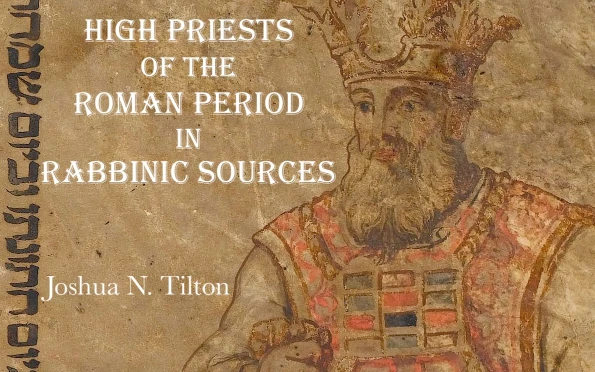
Depiction of a High Priest from a Jewish marriage contract. Image courtesy of Wikimedia Commons.

It is clear from these examples that the Rabbis did not set out to write history at all, let alone a history of the High Priests in the Roman Period. To ignore the rabbinic testimony, however, would be to cut historians off from an important source of historical data. Rather than ignore the rabbinic sources, it is incumbent upon historians to exercise due caution while using them, bearing in mind that the Rabbis were not as interested in accurately preserving the recollections themselves as they were in making clear how they felt about the things they remembered.

Rabbinic Sources on High Priests

Simon the Just: m. Avot 1:2, 3; m. Par. 3:5; t. Naz. 4:7; t. Sot. 13:6-8; b. Men. 109b; b. Yom. 9a; b. Yom. 69a; b. Meg. 11a; b. Ned. 9b; b. Sot. 33a

Mattityahu the High Priest: b. Meg. 11a

Johanan the High Priest: m. Maas. Sh. 5:15 = m. Sot. 9:10; m. Par. 3:5; m. Yad. 4:6; t. Sot. 13:5, 9-10; y. Sot. 9:13; b. Ber. 29a; b. Rosh Hash. 18b; b. Yom. 8b-9a; b. Sot. 47b; b. Sot. 33a

Yannai: b. Kid. 66a

Hanamel the Egyptian: m. Par. 3:5

Joseph b. Elim: t. Yom. 1:4; y. Yom. 1:1 [38d]; b. Yom. 12b-13a

Caiaphas: t. Yev. 1:10

Elionaeus: m. Par. 3:5

Ananias b. Nebedus = Yohanan b. Nar/dbai: b. Ker. 28a; b. Pes. 57a

Ishmael b. Phiabi: m. Sot. 9:15; m. Par. 3:5; t. Par. 3:6; b. Pes. 57a; b. Yom. 9a

Joshua b. Gamala: m. Yev. 6:4; b. Yom. 18a (connected with King Yannai); b. Yeb. 61a; b. Bab. Bat. 21a

——————

Issachar of Kefar Barkai: b. Pes. 57a; b. Ker. 28b

Ishmael b. Elisha: b. Ber. 7a; b. Git. 58a

Simeon/Ishmael b. Kimhit: t. Yom. 3:15[20]; y. Yom. 1:1 [38d]; y. Meg. 1:12 [14a]; y. Hor. 3:2 [16b]; b. Yom. 47a

Pniel the High Priest: b. Git. 58a

Eleazar b. Harsum: (tunic) t. Yom. 1:21-23, y. Yom. 3:6, b. Yom. 35b; y. Taan. 4:5 [69a]; b. Yom. 9a; b. Bab. Bat. 21a


Notes
  1. An earlier version of this article was submitted as a term paper to Dr. Oded Irshai for the course “Can Rabbinic Texts Talk History?” at the Rothberg International School of the Hebrew University of Jerusalem (Spring, 2007). 
  2. For the High Priest Yohanan, probably the grandson of the High Priest of the same name mentioned in Ezra and Nehemiah, see A. Cowley, Aramaic Papyri from the Fifth Century B.C. (Oxford: Clarendon Press, 1923), papyrus no. 30. For Yaddua see Arnold Spaer, “Jaddua the High Priest?” Israel Numismatics Journal 9 (1986/1987): 1-3. For Yohanan III see Dan P. Barag, “Some Notes on a Silver Coin of Johanan the High Priest,” Biblical Archaeologist 48.3 (1985): 166-168, and idem, “A Silver Coin of Yohanan the High Priest and the Coinage of Judea in the Fourth Century B.C.,” Israel Numismatic Journal 9 (1986/1987): 4-21. 
  3. The High Priest Annas, who should be identified with Ananus the son of Sethi, is mentioned in Luke 3:2; John 18:13, 24; Acts 4:6. Joseph Caiaphas is mentioned by name in Matt. 26:3, 57; Luke 3:2; John 11:49; 18:13-14, 28; Acts 4:6. Finally, the High Priest Ananias (Acts 23:2; 24:1) should be identified with Ananias son of Nedebaeus. 
  4. Cf. Shaye J. D. Cohen, “Parallel Historical Tradition in Josephus and Rabbinic Literature,” Proceedings of the 9th World Congress of Jewish Studies Division B vol. 1 (1986): 7-14, esp. 14. 

Leave a Reply

  • Joshua N. Tilton

    Joshua N. Tilton

    Joshua N. Tilton grew up in St. George, a small town on the coast of Maine. For his undergraduate degree he studied at Gordon College in Wenham, Massachusetts, where he earned a B.A. in Biblical and Theological Studies (2002). There he studied Biblical Hebrew and…
    [Read more about author]

  • JP Login


  • Register/Manage Account

  • Articles, blogs, and other content published by Jerusalem Perspective, LLC express the views of their respective authors, and do not necessarily reflect those of JP or other contributors to the site.

    All content on this site was created by real human beings.

    Copyright 1987 - 2026
    © Jerusalem Perspective, LLC
    All Rights Reserved

    Ways to Help:

    DONATIONS: All donations will be used to increase the services available on JerusalemPerspective.com. Donations do not grant donors JP premium content access.