Like Every Sparrow Falling: The Symbolism of Sparrows in a Saying of Jesus

Articles Leave a Comment

The multivalent image of the sparrow in ancient Jewish thought made it a useful vehicle for conveying messages about human and divine relationships.

How to cite this article: Joshua N. Tilton, “Like Every Sparrow Falling: The Symbolism of Sparrows in a Saying of Jesus,” Jerusalem Perspective (2025) [https://www.jerusalemperspective.com/31282/].
Rather listen instead?
JP members can click the link below for an audio version of this essay.[*]
Paid Content

Premium Members and Friends of JP must be signed in to view this content.

If you are not a Premium Member or Friend, please consider registering. Prices start at $5/month if paid annually, with other options for monthly and quarterly and more: Sign Up For Premium

To embolden his disciples in the face of persecution, Jesus assured his audience that while in the marketplace human beings may sell a group of sparrows for a few coins, not one sparrow falls to the ground without God’s knowledge and consent. Yet the mission of the disciples was of even greater interest to God than the small doings of sparrows. God may be aware of every individual sparrow that falls, but every single hair on the head of each and every disciple was numbered.[1] Since the disciples are of far more importance than sparrows, Jesus’ followers can take heart that whatever befalls, they will never be outside God’s attention or care (Matt. 10:28-31 ∥ Luke 12:4-7).[2] But of all God’s creatures to chose from, why did Jesus choose the sparrow for his admonition? And was it to a sparrow specifically that Jesus referred or just to small birds in general? We will address these questions in reverse order.

Paid Content

Premium Members and Friends of JP must be signed in to view this content.

If you are not a Premium Member or Friend, please consider registering. Prices start at $5/month if paid annually, with other options for monthly and quarterly and more: Sign Up For Premium

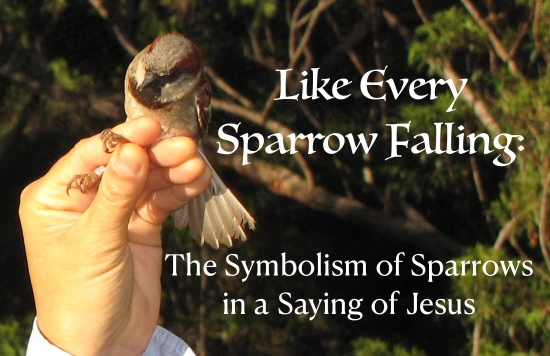
Photograph of a woman holding a House Sparrow in Hawaii. Image courtesy of Wikimedia Commons.
[*] Music in the Audio JP files is excerpted from the Hebrew song Moshe written by Immanuel Zamir in a recording sung by Yaffa Yarkoni obtained from Wikimedia Commons.

Notes
  1. See Michael Wolter, The Gospel According to Luke (2 vols.; trans. Wayne Coppins and Christoph Heilig; Waco, Tex.: Baylor, 2016-2017), 2:136.[]
  2. The differences between the Lukan and Matthean versions of the saying will not detain us here. On the whole, it is the author’s opinion that Matthew’s is the closest to the pre-synoptic version of the saying, with the possible exception of Luke’s “five sparrows for two assarions.” Cf. François Bovon, Luke: Hermeneia—A Critical and Historical Commentary on the Bible (3 vols.; trans. Donald S. Deer; Minneapolis: Fortress, 2002-2013), 2:181.[]

Leave a Reply

  • Joshua N. Tilton

    Joshua N. Tilton

    Joshua N. Tilton grew up in St. George, a small town on the coast of Maine. For his undergraduate degree he studied at Gordon College in Wenham, Massachusetts, where he earned a B.A. in Biblical and Theological Studies (2002). There he studied Biblical Hebrew and…
    [Read more about author]

  • JP Login

  • JP Content

  • Suggested Reading

  • Articles, blogs, and other content published by Jerusalem Perspective, LLC express the views of their respective authors, and do not necessarily reflect those of JP or other contributors to the site.

    Copyright 1987 - 2026
    © Jerusalem Perspective, LLC
    All Rights Reserved

    Ways to Help:

    DONATIONS: All donations will be used to increase the services available on JerusalemPerspective.com. Donations do not grant donors JP premium content access.