Originally Published: 1 July 1989
The parables of Jesus have inspired preachers, poets and believers through the ages. At the same time, the parables have often been a source of considerable controversy and confusion. It is ironic that the simple illustrations used by Jesus have proven so difficult for his followers to understand.
This has happened largely because the parables have been so far removed from their original setting, and interpreters of the Bible with little or no knowledge of the Jewish background to the Gospels have struggled to understand Jesus’ words. The problem began with the very foundation of the Church. The Church fathers, who freely allegorized the parables, had little contact with the world of Jewish learning. Sadly, their oversight has been compounded by almost every following generation of Christians, often with disastrous consequences.
With the arrival of the Enlightenment, some scholars began to look at the parables in their Jewish setting. Yet much of this scholarship, such as that of the influential John Lightfoot, is tainted with anti-Jewish prejudice. This ignorance and prejudice concerning the Judaism of Jesus’ day continues to be perpetuated today in many Bible colleges and seminaries.
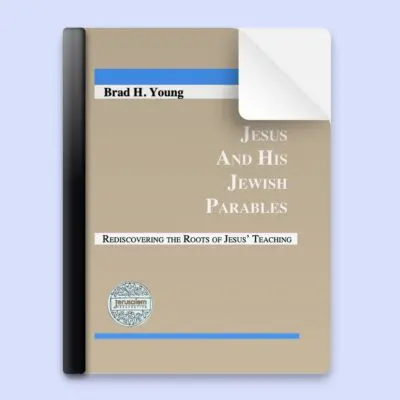
It is against this background that Brad Young has written his Jesus and His Jewish Parables (Mahwah, NJ: Paulist Press, 1989).[1] From the outset he argues that the best way to understand what Jesus was teaching in his parables is to try to hear him as he spoke to his people. The author argues that this can best be done by analyzing the parables of Jesus together with those told by other rabbis of his day.[2]
Contrary to popular opinion, Jesus did not invent the parable form. As Young points out, the genre predated his ministry by some time. Jesus’ parables were not much different in form and structure than those to be found in the Talmud, and many of the parables in the Gospels and rabbinic literature have similar motifs. For example, both Jesus and the rabbis told stories about such things as the wise and the foolish, unfaithful tenants and laborers in a vineyard.
As the reader delves into Jesus and His Jewish Parables, he or she will naturally begin to ask, “Who borrowed from whom?” Young seems quite convinced that the parables of Jesus and the rabbis were developed independently. In Young’s eyes, their parables are distant cousins, both drawing upon the sources of learning that flourished in the days of the Second Temple.
The author warns that too much should not be read into the similarities between the parables of Jesus and those of the sages of Israel. While they use similar language, they often emphasize different points. Each parable must be interpreted in its own context. Even so, Young maintains that without a familiarity with rabbinic parallels, it is difficult to get to the heart of the parables in the Gospels.
Young also disputes the traditional Christian notion that Jesus rejected his brethren in the flesh. His study of Jesus’ parables shows just how close Jesus was to his own people and to the religious thought of his day.
Jesus and His Jewish Parables serves two other important functions. It gives increased exposure to the ideas concerning the teachings of Jesus that have long been advocated by David Flusser and Robert Lindsey. The book also gives an airing to the approach taken by the Jerusalem School of Synoptic Research concerning the synoptic problem.
Brad Young’s Jesus and His Jewish Parables can now be purchased as an eBook (PDF format) from the JP Bookstore:
Notes
- For a second review of Young’s book, see David Flusser’s “Book Review: David Flusser’s Personal Perspective on Brad Young’s Jesus and His Jewish Parables.” ↩
- See Brad Young, “Understanding Parables.” ↩