
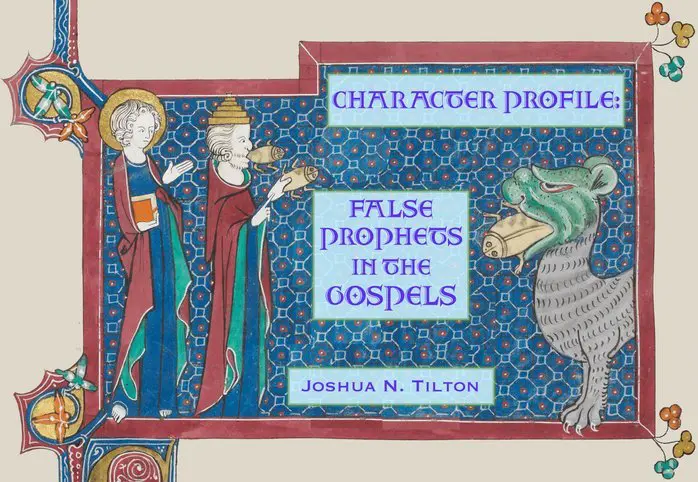
How to cite this article: Joshua N. Tilton, “Character Profile: False Prophets in the Gospels,” Jerusalem Perspective (2026) [https://www.jerusalemperspective.com/36272/].
| Rather listen instead? |
| JP members can play or download an audio version of this essay.[*]
Paid Content
Premium Members and Friends of JP must be signed in to view this content. If you are not a Premium Member or Friend, please consider registering. Prices start at $5/month if paid annually, with other options for monthly and quarterly and more: Sign Up For Premium |
False prophets are mentioned in each of the Synoptic Gospels but not in the Gospel of John. One particular false prophet, Bar-Jesus, also described by the author of Luke-Acts as a Jewish magician, is mentioned in Acts 13:6.[1] Peter’s second epistle warns that just as false prophets deceived the people in the past, so false teachers will mislead the followers of Jesus in the days to come (2 Pet. 2:1). The first epistle of John warns that false prophets have already gone out into the world (1 John 4:1). The Revelation of John prominently figures an eschatological false prophet, spokesperson of the Beast and of the satanic powers that animate him (Rev. 16:13; 19:20; 20:10). Our investigation will be confined to identifying the false prophets mentioned in the Gospels, although this identification may help to elucidate the identity of false prophets mentioned elsewhere in the New Testament and other early Christian sources.
Pseudoprophets
The term for false prophet in the Gospels is ψευδοπροφήτης (psev·do·pro·FĒ·tēs, “pseudoprophet”). In Luke’s Gospel this term occurs only once (Luke 6:26), where false prophets are mentioned in the Sermon on the Plain. In Mark’s Gospel, too, false prophets are mentioned on only one occasion (Mark 13:22), but in the context of Jesus’ eschatological discourse. In Matthew’s Gospel the false prophets feature more prominently, being mentioned explicitly three times (Matt. 7:15; 24:11, 24) and alluded to in Matt. 7:22, and in general being treated far more extensively.
To assume that when the three synoptic evangelists mention the false prophets they all refer to the same individuals or the same types of persons would be a methodological error. Each Gospel writer must first be understood on his own terms before determining whether and how the Gospels’ definitions of a false prophet complement or contradict one another. Our first order of business, therefore, will be to examine the Gospels for information on the false prophets one by one.
Premium Members and Friends of JP must be signed in to view this content.
If you are not a Premium Member or Friend, please consider registering. Prices start at $5/month if paid annually, with other options for monthly and quarterly and more: Sign Up For Premium

Notes
- Philo, too, referred to diviners and fortune tellers by the term “false prophet” (Spec. Leg. 4:51). ↩

Comments 1
Author
Audio JP recording added to False Prophets article. Enjoy!