
In the recordings below, renowned scholar of ancient Israelite priestly literature, Jacob Milgrom, discusses the origin of the concept of repentance within ancient Israelite religion. Milgrom presents the provocative notion that repentance is not a self-evident reaction to sin and guilt; rather, this particular response to God and one’s neighbor had to be invented. Moreover, Milgrom proposes that the invention of repentance came from a segment of ancient Israelite society that one might not have expected. Milgrom contends that repentance was the invention not of the prophetic tradition but of priests who discovered a humane way for sinners to be reconciled with God.
Part 1:
Part 2:
To support his contention that repentance did not always exist, Milgrom argues that not a single instance of repentance can be found in the entire book of Genesis. In Genesis, if a person sinned—Adam and Eve by transgressing a divine prohibition, Cain in the murder of Abel, Jacob’s sons in selling their brother Joseph into slavery, Reuben when he slept with Bilhah, his father’s concubine—no one turned back from their sin, apologized, and asked for forgiveness. They simply shouldered their guilt and bore the consequences of their misdeeds.
The earliest example of repentance Milgrom can identify is in Lev. 5:20-26 (English Bibles: Lev. 6:1-7), which he translates in the following manner:
The Lord spoke to Moses saying, “When a person sins and commits a trespass against the Lord by dealing deceitfully with his fellow in the matter of a deposit or an investment or through robbery or withholds his fellow’s wages or by finding something lost and lying about it, if he swears falsely regarding any of these various things that one may do and sin thereby, when one has the sin and feels guilt and would restore that which he got through robbery or through withholding or the deposit that was entrusted to him or the lost thing that he found or anything else about which he swore falsely, he shall repay the principal amount and add a fifth part to it. He shall pay it to its owner when he feels guilt. Then he shall bring to the priest as his repentance to the Lord a ram without blemish from the flock or the equivalent as an offering of repentance. The priest shall make expiation before the Lord, and he shall be forgiven for whatever he may have done to feel guilt thereby.
The usual punishment for desecrating the Divine Name—in this case, by taking a false oath—is death. But here Scripture describes a way for a person to escape punishment by making restitution to the person he wronged, confessing his sin to God, and offering an ’āshām sacrifice to expiate his guilt. Milgrom regards this as a priestly innovation, which can be summed up in one word: repentance. The priests, in Milgrom’s view, overruled the divine prerogative to punish sin with a series of concrete actions for a person to undo the wrong they committed. That this procedure was included in Scripture suggests that God embraced this priestly innovation, almost as though he was waiting for someone to realize that they could separate themselves from their misdeeds by apologizing and making amends.
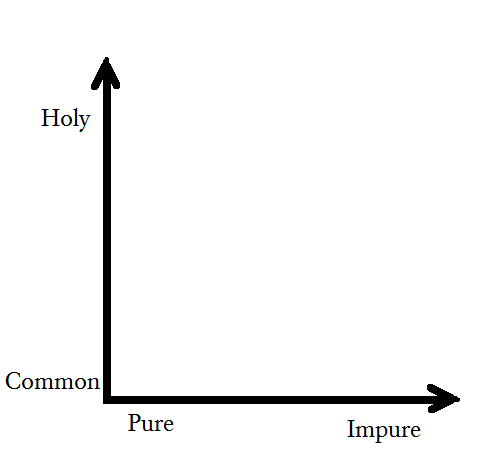
In the course of his lecture Milgrom distinguishes between two types of misdeed: desecration and defilement. Both are transgressions against that which is holy, but they are distinct with regard to severity and kind. Desecration is to lessen the holiness of a person or object by treating it as common or unholy. Defilement is to bring that which is holy into contact with ritual impurity. Both are an affront to God, but defilement carries with it more severe consequences. Desecration shows a lack of carefulness or respect, but defilement of the holy—for instance, by polluting the Sanctuary—shows contempt and disregard for the Divine Presence. (You can read more about the interface between holiness and purity in the JP article “A Goy’s Guide to Ritual Purity.”)
It is interesting to note that the passage in which repentance is first attested involves sin against God and against one’s neighbor. A person’s dishonesty toward his neighbor leads to a break in one’s relationship with God. The triangular relationship between a person, his neighbor, and God is a theme that was to be further developed within Second Temple Judaism, what Flusser referred to as a New Sensitivity, which emphasized that love for God is supremely expressed by one’s love for his fellow man. This sort of theocentric humanism found expression in the teachings of Jesus.
Milgrom’s lecture was delivered at the Narkis Street congregation in Jerusalem as part of the 2008 Lindsey Lectures, which celebrated the legacy of Rev. Dr. Robert Lindsey, who was pastor of the Narkis Street congregation for many years. To open the 2008 Lindsey Lectures, David Bivin described the numerous efforts to carry forward Lindsey’s legacy. Among these are the foundation of the Jerusalem School of Synoptic Research in 1985, the publication of Jerusalem Perspective beginning in 1987, first as a print magazine and later as a website, the re-publication of Lindsey’s book Jesus, Rabbi and Lord in digital format, and the publication of One Foot in Heaven, a biography of Robert Lindsey. David regarded it as his primary calling to keep the memory of his mentor, Robert Lindsey, alive. As we mourn David Bivin mere weeks after his passing, it is comforting to hear David’s voice again, full of vigor and hopeful for the future even as he recounts his many achievements.

One of the efforts David does not mention in his talk is The Life of Yeshua: A Suggested Reconstruction, a project that had not yet begun in 2008 at the time of the lecture. This effort, which occupied the last twelve years of David’s life, systematically applied Robert Lindsey’s synoptic hypothesis to the pericopae in the Synoptic Gospels. With over eighty reconstructions and commentaries published at the time of David’s death and over a dozen additional reconstructions and commentaries at the final stages of preparation, the Life of Yeshua project remains the only attempt to analyze each synoptic pericope from the perspective of Lindsey’s hypothesis.
Jerusalem Perspective is currently endeavoring to secure funding to ensure that this project, which David regarded as his life’s work, will continue. If you would like to contribute a donation to this project, please reach out to us at the following email address: support@jerusalemperspective.com with the subject “Life of Yeshua Funding.”