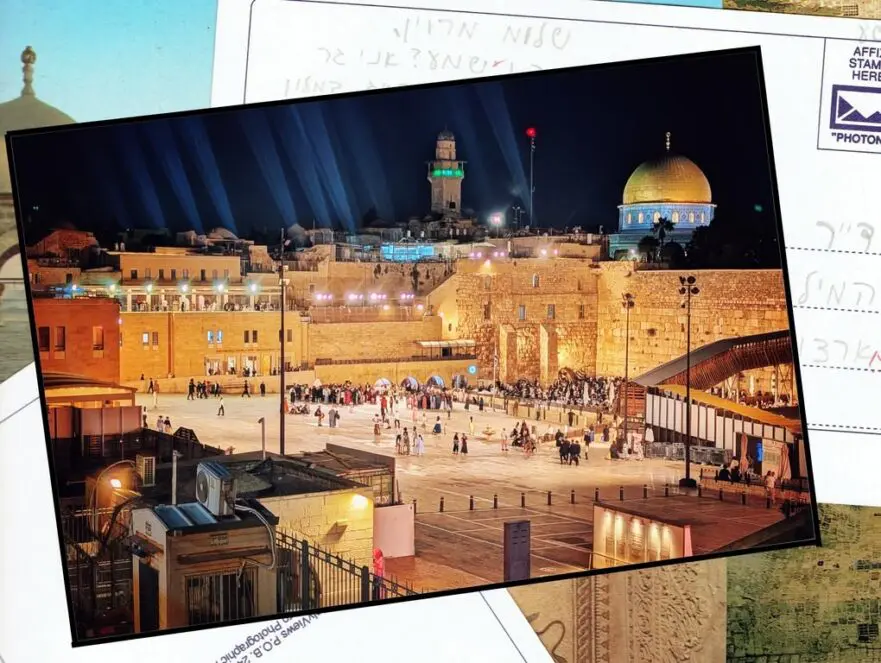
Holy Land Postcard: The Western Wall (הַכּוֹתֶל הַמַּעֲרָבִי)

Blog, Photo Essay Leave a Comment

My first visit to the Western Wall, which happened only days ago, was an exceptionally moving experience.

Rather listen instead?
JP members can play or download an audio version of this essay.[*]
Paid Content

Premium Members and Friends of JP must be signed in to view this content.

If you are not a Premium Member or Friend, please consider registering. Prices start at $5/month if paid annually, with other options for monthly and quarterly and more: Sign Up For Premium

The Western Wall (הַכּוֹתֶל הַמַּעֲרָבִי [ha·KŌ·tel ha·ma·‘a·rā·VI]), or simply the Kotel (הַכּוֹתֶל [ha·KŌ·tel, “the Wall”]), lies at the heart of the Old City of Jerusalem. While often associated with the ancient sanctuary, it is not actually a wall of the Temple building itself. Rather, it is the largest and most famous surviving section of the four monumental retaining walls built by King Herod the Great to support the massive, expanded platform of the Second Temple Mount.

Photo courtesy of Katia Motzeva.

The history of the sacred space spans millennia. The First Temple was constructed by King Solomon in the mid-10th century B.C.E. (ca. 966-957 B.C.E.) and stood for over four centuries before it was destroyed by the Babylonian king Nebuchadnezzar II in 586 B.C.E. Following the famous 538 B.C.E. decree of Persian King Cyrus the Great allowing the Jewish people to return from exile, reconstruction of the Temple began. Under the leadership of the provincial governor Zerubbabel and the High Priest Joshua, the Second Temple was completed and dedicated around 516-515 B.C.E.

Photo courtesy of Katia Motzeva.

Centuries later, around 20-19 B.C.E., Herod the Great began a massive project to double the size of the Temple Mount plaza and completely dismantle and rebuild the Temple sanctuary itself. To avoid interrupting the sacred services, Herod had priests trained as master masons so they could carefully reconstruct the Holy of Holies (Josephus, Ant. 15:390). This grand expansion and renovation outlived its creator; construction was only fully completed around 63-64 C.E.—long after Herod’s death in 4 B.C.E. Tragically, the architectural marvel stood finished for only a few short years before Roman legions under General Titus destroyed the Temple complex in 70 C.E. Because the Western Wall faced the Holy of Holies—the ultimate earthly dwelling place of the Divine presence, entered only once a year on Yom Kippur by the High Priest—this part of the retaining platform became the focal point of Jewish devotion and longing for redemption.

Photo courtesy of Katia Motzeva.

Architecturally, the entire Western Wall stretches 488 meters (approx. 1,600 feet) long, though only a fraction is visible at the main plaza. It consists of 45 structural courses of stone, with 28 layers exposed above ground and another 17 remaining subterranean. While the upper tiers reflect later Byzantine, Umayyad, Mamluk, and Ottoman reconstructions, the subterranean layers still intact date directly to the late Second Temple period. At its peak, the wall towers roughly 32 meters (105 feet) high from bedrock. The Kotel’s modern layout was transformed following the Six-Day War in 1967, when the formerly cramped, narrow alleyway abutting the stones was cleared to create the expansive prayer plaza that welcomes visitors today.

For further reading on the Western Wall, see David N. Bivin, “Pilgrim’s Graffito,” Jerusalem Perspective 22 (1980): 4 [https://www.jerusalemperspective.com/22103/].

Following the cessation of Temple sacrifices in 70 C.E., Jewish worship was transformed as prayer took the place of the daily sacrifices. Dispersed to the four corners of the earth, the Jewish people continued to “offer” their prayers three times a day facing Jerusalem—a practice rooted in Solomon’s dedication prayer for the First Temple (1 Kings 8:22-53; 2 Chronicles 6:12-42). For Christian pilgrims, the Kotel serves as a striking visual confirmation of Jesus’ prophecy that the magnificent stones of the Temple complex would be utterly thrown down (Matt. 24:1-2; Mark 13:1-2; Luke 21:5-6; 19:41-44).

My first visit to the Western Wall, which happened only days ago, was an exceptionally moving experience. Open 24 hours a day, 365 days a year, it welcomes individuals to seek solace and pray at any hour of the day or night. As I approached, I was struck by the sheer magnitude of the site, realizing just how monumental the Temple and its mount must have been. Visitors and worshippers patiently waited in line for their turn to step close to the ancient stones of the Kotel, polished smooth from the centuries and the hands of innumerable pilgrims who have touched them, kissed them, and washed them in hot tears while pouring out their pleas and passionate petitions toward heaven.

Photo courtesy of Katia Motzeva.
[*] Music in the Audio JP files is excerpted from the Hebrew song Moshe written by Immanuel Zamir in a recording sung by Yaffa Yarkoni obtained from Wikimedia Commons.

Leave a Reply

  • Катя Моцева / Katia Motzeva

    Катя Моцева / Katia Motzeva

    Катя Моцева прекарва седемнадесет години в САЩ, където получава бакалавърска степен по библейски езици от университета Уола Уола и две магистърски степени от университета Орал Робъртс – една по библейски езици за напреднали и една по юдейско-християнски изследвания. Тя преподава иврит официално и неофициално от…
    [Read more about author]

  • JP Login


  • Register/Manage Account

  • Articles, blogs, and other content published by Jerusalem Perspective, LLC express the views of their respective authors, and do not necessarily reflect those of JP or other contributors to the site.

    All content on this site was created by real human beings.

    Copyright 1987 - 2026
    © Jerusalem Perspective, LLC
    All Rights Reserved

    Ways to Help:

    DONATIONS: All donations will be used to increase the services available on JerusalemPerspective.com. Donations do not grant donors JP premium content access.