How to cite this article: Joshua N. Tilton, “Did Jesus Raise Jairus’ Daughter from the Dead?” Jerusalem Perspective (2025) [https://www.jerusalemperspective.com/30887/].
| Rather listen instead? |
| JP members can play or download an audio version of this essay.[*]
Paid Content
Premium Members and Friends of JP must be signed in to view this content. If you are not a Premium Member or Friend, please consider registering. Prices start at $5/month if paid annually, with other options for monthly and quarterly and more: Sign Up For Premium |
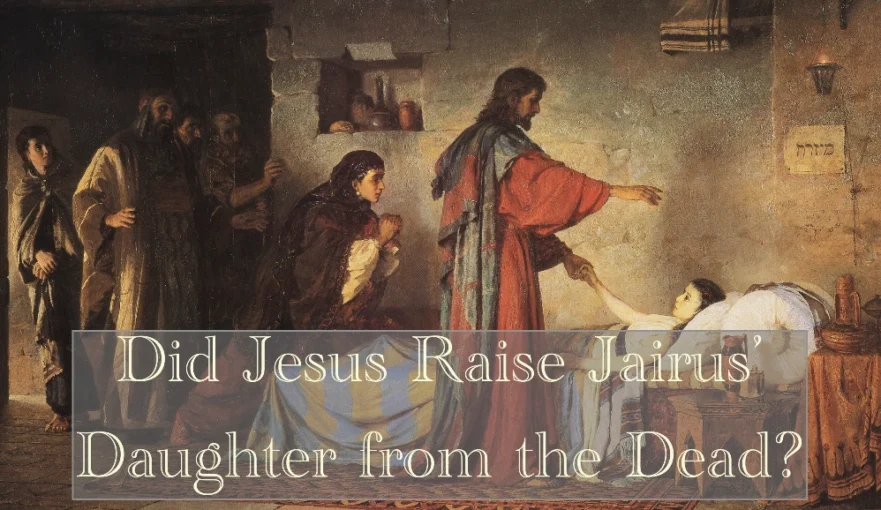
The story of Jairus’ Daughter poses readers with a problem: it is presented as an account of Jesus’ raising someone from the dead, but within the story Jesus himself insists that Jairus’ daughter “did not die, rather she sleeps” (Matt. 9:24 ∥ Mark 5:39 ∥ Luke 8:52). This contradiction requires readers to decide whether Jesus should be taken at his word or whether to prioritize the family’s reports that the girl was dead. The former option runs the risk of robbing Jesus of a spectacular miracle; the latter option risks turning the meaning of Jesus’ words on its head, thereby mocking Jesus to scorn—the very reaction the characters in the story have when Jesus tells them the girl is really just asleep.
Primed for a Miracle
There are several ways in which modern readers of the Gospels are led to suppose that the story of Jairus’ Daughter is an example of Jesus’ raising the dead. The first of these are the headings given to the pericope in various translations of the Bible. The NIV, for instance, labels the pericope as “A Dead Girl and a Sick Woman.” The New Oxford Annotated Bible edition of the RSV names the pericope “Raising the daughter of Jairus.” The HarperCollins Study Bible edition of the NRSV calls it “A Girl Restored to Life and a Woman Healed.” Such titles color a reader’s expectations even before she comes to the story.
Premium Members and Friends of JP must be signed in to view this content.
If you are not a Premium Member or Friend, please consider registering. Prices start at $5/month if paid annually, with other options for monthly and quarterly and more: Sign Up For Premium

Be sure to check out these recent JP articles:
- Bible Versus Scriptures: Part 7—A Neighborly Approach to the Scriptures
 The final part in JP’s series on the nature of the Scriptures.
 - Bible Versus Scriptures: Part 6—Are You Talking to Me?The sixth part in JP’s series on the nature of the Scriptures.
- Bible Versus Scriptures: Part 5—Holiness of the TextThe fifth part in JP’s series on the nature of the Scriptures.
- Bible Versus Scriptures: Part 4—Wherein Lies the Authority?The fourth part in JP’s series on the nature of the Scriptures.
- Love Your Neighbor: The Greatness Behind Mister Rogers’ SongwritingMister Rogers might not make a future New York Times list, but he will always be at the top of the list of my life’s greatest songwriters.
- Bible Versus Scriptures: Part 3—Models of InspirationThe third part in JP’s series on the nature of the Scriptures.