
Revised: 4 June 2015
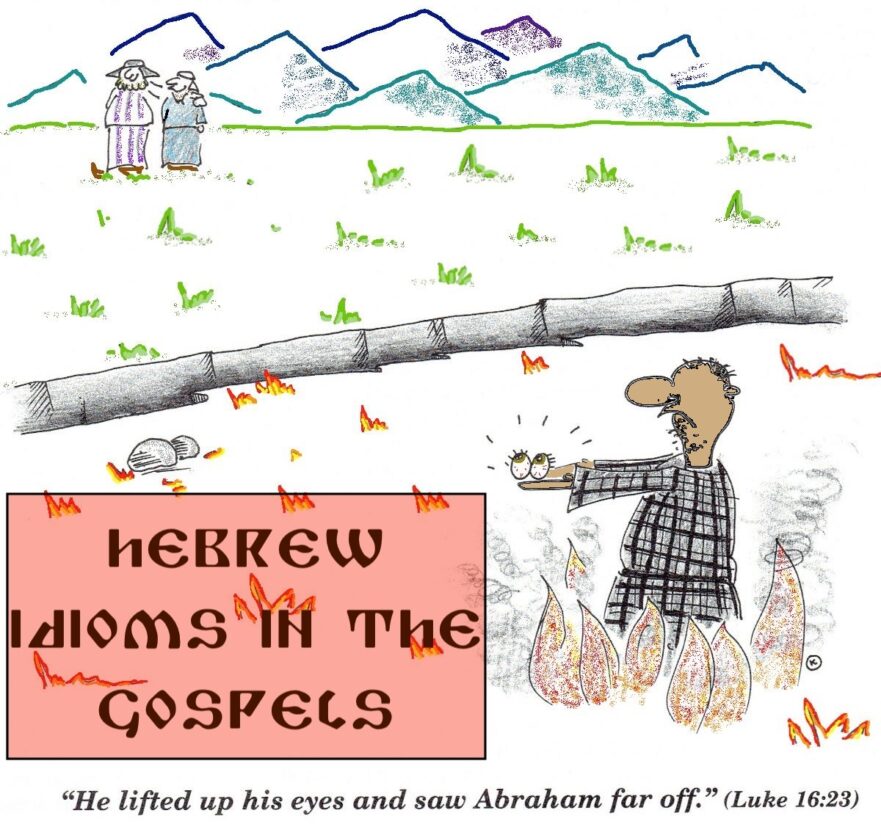
There are many expressions in the Greek texts of Matthew, Mark and Luke that seem to derive from Hebrew idioms. These are phrases that mean something different from the literal meaning of their words. Every language has its own idioms, many of which seem strange when translated literally out of their native setting.
Think of such common English idioms as “hit the ceiling,” “kill time,” “eat one’s heart out,” “lose one’s head,” “be in hot water,” “throw in the towel,” and “kick the bucket.” A non-English speaker who heard these idioms translated literally into his or her language would probably find them amusing. However, if he or she did not suspect that they were literal translations of English idioms and took them at face value, the information the person received would be very misleading.
The Hebrew language has thousands of idioms. Modern Hebrew has fascinating idioms that developed from expressions found in Biblical Hebrew and Rabbinic Hebrew, for example: בְּאַרְבַּע עֵינַיִם (be‘arba enayim), literally, “with four eyes,” means face to face without the presence of a third person, as in, “The two men met with four eyes.” The idiom לֹא דֻּבִּים וְלֹא יַעַר (lo dubim velo ya’ar) is, literally, “[There are] neither bears nor forest,” but means that something is completely false. And the idiom טָמַן אֶת יָדוֹ בַּצַּלַּחַת (taman et yado batsalahat), literally, “buried his hand in the dish,” means that someone idled away his time. A translator faced with putting these idioms into another language such as English must be careful to find an equivalent idiom for each Hebrew expression. If the translator merely translates the idioms word for word, he or she will not end up with English, but Hebrew in English dress.
Premium Members and Friends of JP must be signed in to view this content.
If you are not a Premium Member or Friend, please consider registering. Prices start at $5/month if paid annually, with other options for monthly and quarterly and more: Sign Up For Premium
For more on Gospel idioms, see:





And check out these recent JP articles:
- Bible Versus Scriptures: Part 1—More Different Than You’d Think
 The first part in JP’s series on the nature of the Scriptures.
 - Besorat Ha-Malchut: Jesus’ Gospel of the Kingdom for the Humble of SpiritThe questioning of Jesus by two priests—John the Baptist and Joseph Caiaphas—reveals hidden aspects of Jesus’ high self-awareness.
- “Jerusalem”—A Song I’ve Not Sung in Five YearsI haven’t been able to sing one of my best songs for the past five years. This is the story of why.
- The Holy Study Circle: The Ḥavurah (‘Group’) in Rabbinic Literature and Jesus’ Study CircleThe pattern of activity within Jesus’ group is very similar to the modes of operation known from the ḥavurah of the tannaitic-amoraic period.
- Character Profile: Ennion, First-Century GlassmakerDid Jesus ever drink from a glass made by Ennion when he dined in the home of a wealthy sympathizer?
- Character Profile: False Prophets in the GospelsWho were the false prophets mentioned in the Gospels?




![David N. Bivin [1939-2026]](https://www.jerusalemperspective.com/wp-content/uploads/userphoto/4.jpg)