How to cite this article: JP Staff Writer, “Sidebar: The Temple Warning Inscriptions,” Jerusalem Perspective (2026) [https://www.jerusalemperspective.com/35581/].[1]
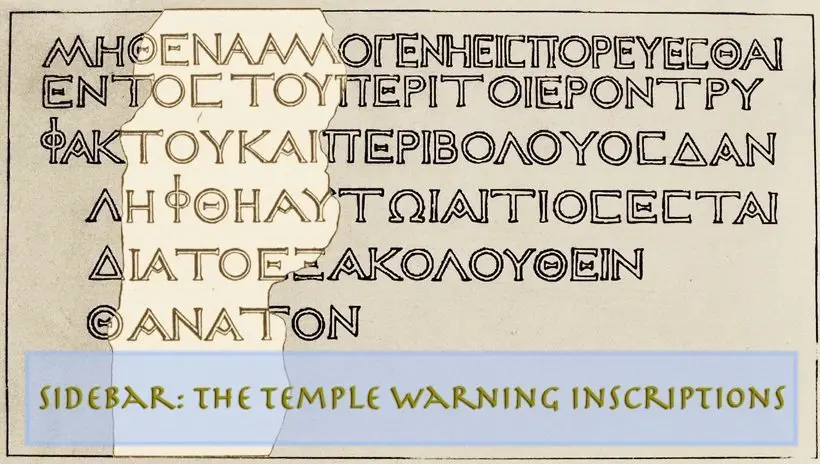
That caution signs were posted in the Temple warning Gentiles not to proceed beyond the τρύφακτος (TRŪ·fak·tos, “balustrade,” “barrier”) or סוֹרֶג (sō·REG, “partition”) that separated the outer courts of the Temple Mount from the inner sacred precincts was never really in doubt. Josephus referred to these warning inscriptions on various occasions, and they are also alluded to in the writings of Philo of Alexandria (Legat. §212) and in rabbinic sources (m. Mid. 2:3).
According to Josephus:
Proceeding…towards the second court of the temple, one found it surrounded by a stone balustrade [δρύφακτος],[2] three cubits high and of exquisite workmanship; in this at regular intervals stood slabs giving warning, some in Greek, others in Latin characters, of the law of purification, to wit that no foreigner [ἀλλόφυλον] was permitted to enter the holy place, for so the second enclosure of the temple was called. (J.W. 5:193-194; Loeb)[3]
Josephus’ description above refers to the prohibition of entry to Gentiles, but it does not state the penalty for trespass. Elsewhere Josephus makes clear that the inscriptions prohibited “the entrance of a foreigner under threat of the penalty of death” (Ant. 15:417; Loeb).
Premium Members and Friends of JP must be signed in to view this content.
If you are not a Premium Member or Friend, please consider registering. Prices start at $5/month if paid annually, with other options for monthly and quarterly and more: Sign Up For Premium
Notes
- This sidebar was originally published in conjunction with Ze’ev Safrai’s, “The So-called ‘Privilegium Paschale’ in Light of Jewish Sources,” Jerusalem Perspective (2026) [https://www.jerusalemperspective.com/35651/]. ↩
- The noun δρύφακτος is a variant spelling of τρύφακτος, which is the spelling found in the text of the Temple warning inscriptions. See Henry George Liddell, Robert Scott, and Henry Stuart Jones, A Greek-English Lexicon (9th ed.; Oxford: Clarendon, 1968), 451. ↩
- Translation according to Flavius Josephus, Works (trans. H. St. J. Thackeray et al.; Loeb Classical Library; 13 vols.; Cambridge, Mass.: Harvard University Press, 1926-1965), 4:59-61. ↩