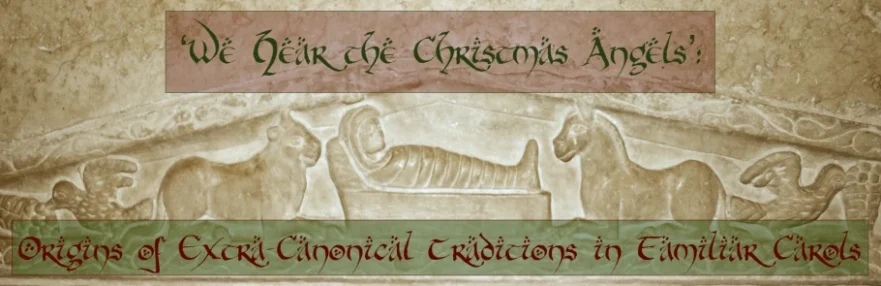
How to cite this article: Joshua N. Tilton, “‘We Hear the Christmas Angels’: Origins of Extra-Canonical Traditions in Familiar Carols,” Jerusalem Perspective (2025) [https://www.jerusalemperspective.com/29924/].
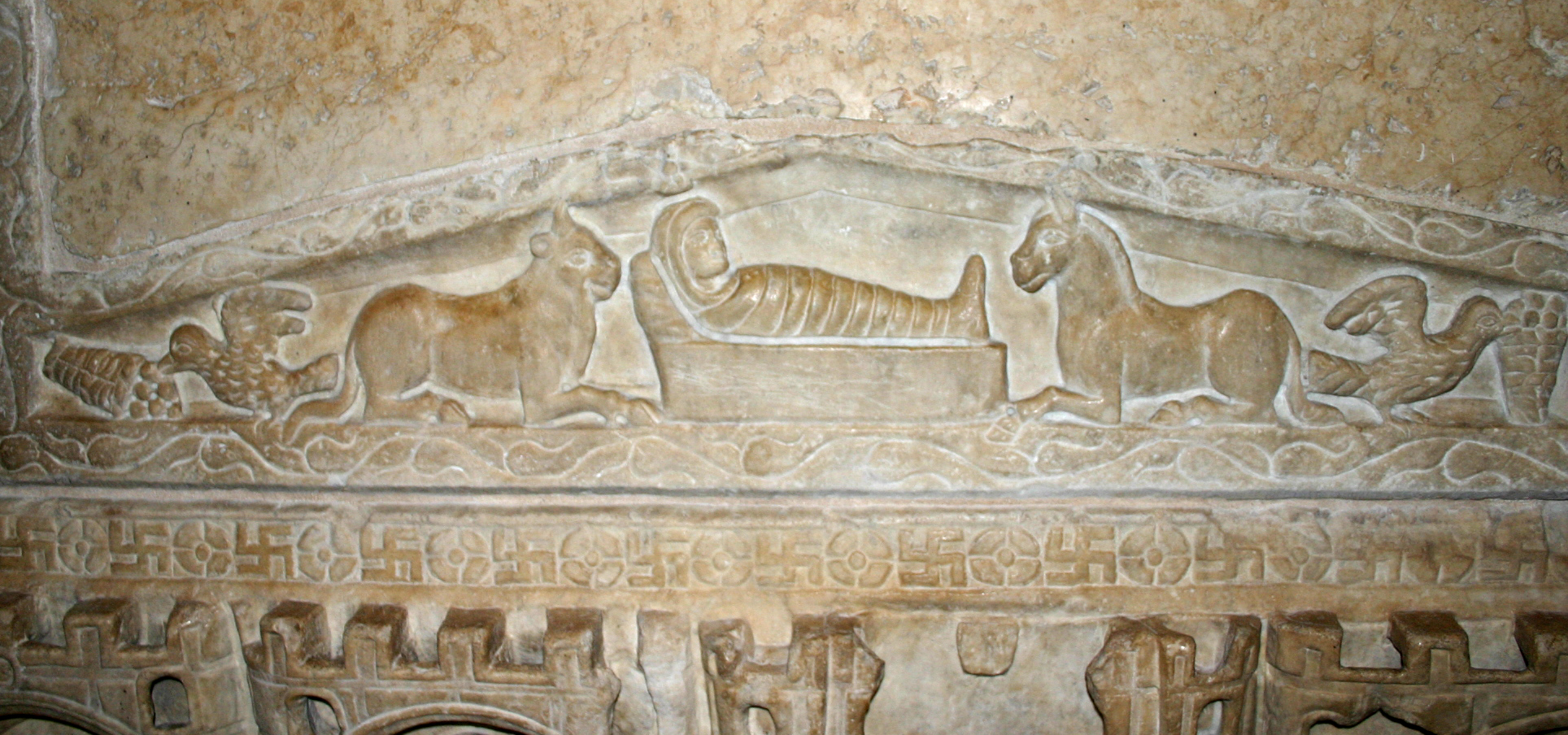
Many of the most familiar and best beloved Christmas carols rehearse the story of Jesus’ birth. Scriptural accounts of the Nativity are found in the Gospels of Matthew and Luke, but some of the most vivid details the old carols describe—the holy light that surrounded the virgin mother and child, the ox and ass at the manger, the three kings kneeling before the Christ-child in the stable—cannot be found in the canonical texts of Scripture. These extra-canonical details are elaborations on the sparse Gospel accounts and pious expansions of the story that, one way or another, magnify the infant Jesus. Some of the expansions familiar from Christmas carols are of relatively recent origin, but many reach far back into antiquity. In this essay we will trace some of these traditions to their earliest attestations. Our inquiry will not proceed from the earliest to the most recent traditions, but will follow the chronological sequence of the infancy narratives. In doing so we hope to gain a deeper appreciation of the extra-canonical traditions that the carols have so deeply embedded in our imaginations.
Of Jesse’s Lineage Coming
(Lo, How a Rose E’er Blooming)
The beautiful carol “Lo, How a Rose E’er Blooming” likens the birth of Jesus to the blossoming of a winter rose. The hymn’s focus is on Mary, the shoot from the stump of Jesse (the forebear of the royal House of David), who bears Jesus, the Christmas rose. However, neither of the Gospel accounts link Jesus to Jesse’s lineage through Mary. Both Matthew’s Gospel and Luke’s connect Jesus to the royal House of David through his human father, Joseph.
Premium Members and Friends of JP must be signed in to view this content.
If you are not a Premium Member or Friend, please consider registering. Prices start at $5/month if paid annually, with other options for monthly and quarterly and more: Sign Up For Premium
Conclusion
Christmas carols contain many details that cannot be found in the canonical accounts of Jesus’ birth. Some of these are recent inventions, but many are deeply rooted in ancient Christian traditions. Some of these traditions developed in order to resolve problems (real or perceived) in the canonical accounts. Thus, a Davidic ancestry was invented for Mary (“Lo, How a Rose”) in order to bind Jesus more securely to a royal lineage, and Joseph’s age was advanced (“The Cherry Tree Carol”) in order to explain why Joseph is never mentioned as being present during Jesus’ adulthood. Other traditions, such as the shepherds’ seeing the star (“The First Noël”), their bringing rustic gifts to the infant Jesus (“In the Bleak Midwinter”), and the presence of the magi at the manger (“As With Gladness Men of Old”), developed from the tendency to harmonize the infancy narratives in Luke and Matthew. Some traditions—the ox and the ass worshipping Jesus at the manger (“Good Christian Men, Rejoice”), the identification of the magi as kings (“We Three Kings”)—emerged from interpreting scriptural prophecies as applying to the nativity, while other traditions—the heavenly light surrounding mother and child (“Silent Night”)— originally had an apologetic purpose. Understanding the origins of these traditions lends us a richer appreciation of the apocryphal details that appear in so many Christmas carols.
The lovely silhouette animation short, “The Star of Bethlehem,” retells the Nativity story with many of the traditional embellishments discussed in this article.
|
This message was brought to you in part by Avtinas Incense™, makers of the incense for the Divine Service since the late Second Temple period with the Avtinas family secret blend of aromatic spices. With Avtinas Incense™ you will make a pleasing offering to the L-rd. To learn more about Avtinas Incense™, and JP’s other first-century sponsors, visit the following link: https://www.jerusalemperspective.com/first-century-sponsors/. These sponsors are, of course, fictional and intended to be in good fun while also being informative about aspects of daily life in the time of Jesus. Purchase of items with our sponsors’ fanciful logos from Jerusalem Perspective’s Dashery store does, however, support the work of JP while also bringing a smile to the buyer’s face. |
- [1] The verse can be construed to mean that Mary was the descendant of David, but it is not the most natural reading and is rendered unlikely in view of Luke 2:4. See Joseph A. Fitzmyer, The Gospel According to Luke (AB 28A and 28B; Garden City, N.Y.: Doubleday, 1981, 1985), 1:344. ↩
- [2] The Latin Gospel of Pseudo-Matthew (seventh century C.E.) “corrected” the text of Luke 2:4 in order to clarify that the journey to Bethlehem was necessary “because Joseph and Mary were from the tribe of Judah and from the house and ancestry of David” (Ps.-Mt. 13:1 [emphasis mine]). Translation according to Bart D. Ehrman and Zlatko Pleše, eds., The Apocryphal Gospels: Texts and Translations (Oxford: Oxford University Press, 2011), 99. ↩
- [3] In his Epistle to the Ephesians Ignatius (late first-early second century C.E.) associates Mary, David, and the Holy Spirit with regard to Jesus’ conception, but without quite stating that Mary herself was a descendant of David: “Jesus the Christ was conceived by Mary according to the plan of God from the seed of David on the one hand, and by the Holy Spirit on the other” (Ign. Eph. 18:2). Perhaps Ignatius intended to imply that Mary was a descendant of David, but it is also possible that this was not his intention. Cf. Ign. Trall. 9:1. ↩
- [4] The designation “star of light” (ἄστρον φωτεινόν [astron fōteinon]), which is familiar from some versions of the carol “We Three Kings,” is an early Christian designation for the Star of Bethlehem. The phrase “star of light” also occurs in Ephrem the Syrian’s Hymns on the Nativity:
Above and below there were two harbingers
for the son: the star of light
shouted out joyfully from above, and John
proclaimed him from below....
Whoever considered Him earthly—
the star of light would convince him
that He was heavenly.... (6:9, 11)Translation according to Kathleen E. McVey, trans., Ephrem the Syrian: Hymns (New York: Paulist, 1989), 112.
With regard to the lyrics of the Christmas carol, there is variation in the refrain: “Star of wonder, star of night” seems to be dominant, but we also find “Star of wonder, star of might” and “Star of wonder, star of light,” which are the preferred lyrics on Hymnary.org (https://hymnary.org/text/we_three_kings_of_orient_are). ↩
- [5] The Hebrew text of Isaiah refers to a נֵצֶר (nētzer, “shoot”), but the Greek translation (LXX) of the Hebrew Scriptures refers to an ἄνθος (anthos, “flower,” “blossom”). It is the Greek translation that allowed for the image of the Christmas rose to be associated with Isaiah 11:1, making possible the composition of "Lo, How a Rose E’er Blooming." ↩
- [6] On the date of the Proto-Gospel of James, see New Testament Apocrypha (2 vols.; ed. Wilhelm Schneemelcher and R. McL. Wilson; Philadelphia: Westminster Press, 1963), 1:372. ↩
- [7] To prove that there was no stain on Mary’s virtue, the unborn Jesus commands a cherry tree to bend its branches toward his mother so that she may pluck its fruit. A similar story appears in the Gospel of Pseudo-Matthew (§20), in which the infant Jesus bids a date palm to bend down its branches so that Mary may pluck its dates. This miracle, however, was not done in order to convince Joseph of Mary’s virginity, and it is said to have taken place after Jesus’ birth. On date palms and other trees mentioned in the Gospels, see Joshua N. Tilton, “‘Look at…all the trees’: Trees in the New Testament Gospels,” Jerusalem Perspective (2024) [https://www.jerusalemperspective.com/28823/]. ↩
- [8] According to the Gospel of Pseudo-Matthew, Joseph not only had sons but also had grandchildren when Mary came into his care (Ps.-Mt. 8:4). ↩
- [9] Cf. Ps.-Mt. 8:2. ↩
- [10] On the status of women in the ancient Jewish world, see Tal Ilan, Jewish Women in Greco-Roman Palestine (Peabody, Mass.: Hendrikson, 1996). On the age of marriage, see esp. 65-69. ↩
- [11] According to the Gospel of Pseudo-Matthew, Mary was fourteen when she came under Joseph’s care (Ps.-Mt. 8:1). ↩
- [12] References to Mary’s donkey occur in later sources as well. Cf. Ps.-Mt. 13:1, 2; Armenian Infancy Gospel 8:1, 5. ↩
- [13] Note that it is only the Gospel of Luke that presupposes a journey to Bethlehem. Matthew’s Gospel seems to assume that Joseph and Mary were permanent residents in Bethlehem and that they did not relocate to Nazareth until after having returned from their asylum in Egypt. ↩
- [14] On the use of the donkey in the ancient Roman world, see Shimon Applebaum, “Animal Husbandry,” in The Roman World (2 vols.; ed. John Wacher; London and New York: Routledge, 1987; repr. 2002), 2:504-526, esp. 513. ↩
- [15] Whereas the Gospels of Matthew and John specifically refer to Jesus' riding on a donkey, which they regard as the fulfillment of Scripture (Zech. 9:9), neither the Gospel of Luke nor the Gospel of Mark refers explicitly to a donkey, but merely mentions a πῶλος (pōlos, “colt”), which could be the offspring of any pack animal. ↩
- [16] Justin Martyr, too, was familiar with the tradition that Jesus was born in a cave (Dial. §78). And this tradition is repeated in later sources. Cf., e.g., Origen, Cels. 1:51; Ps.-Mt. 13:2; Armenian Infancy Gospel 8:6, 9. While not mentioned in popular western carols, the cave tradition is well represented in eastern iconography. At the Church of the Nativity in Bethlehem, the place of Jesus’ birth is located in a grotto (cave). ↩
- [17] Cf. the Armenian Infancy Gospel 8:9. Having a midwife deliver a baby was common enough in the ancient world, but the specification in the Proto-Gospel of James that the woman was a Hebrew midwife suggests that this detail was intended to recall the prominent role of the Hebrew midwives (αἱ μαῖαι τῶν Εβραίων [hai maiai tōn Hebraiōn]) in the story of Moses’ nativity (Exod. 1:15-22). ↩
- [18] See Ehrman-Pleše, 75. ↩
- [19] Translation according to Joseph T. Lienhard, trans., Origen: Homilies on Luke, Fragments on Luke (Washington, D.C.: Catholic University of America Press, 1996), 55. ↩
- [20] Gertrud Schiller, Iconography of Christian Art (2 vols.; trans. Janet Seligman [Ikonographie der christlichen Kunst, 1966-1968]; Greenwich, Conn.: New York Graphic Society, 1971-1972), 1:59-60. ↩
- [21] I owe this observation to Dr. Roger Green, Professor Emeritus of Biblical and Theological Studies at Gordon College in Wenham, Massachusetts. ↩
- [22] See Schiller, Iconography, 1:84. ↩
- [23] The Armenian Infancy Gospel (10:2) mentions the gifts of the shepherds without specifying what those gifts were. ↩
- [24] Tertullian (early third century), on the other hand, mentioned the coming of the magi before Jesus’ circumcision on the eighth day and his presentation in the Temple in a recapitulation of the Nativity story (On the Flesh of Christ §2). ↩
- [25] On the plants that produce frankincense and myrrh and the role these play in the Gospels, see Tilton, “‘Look at…all the trees’: Trees in the New Testament Gospels.” ↩
- [26] See Schiller, Iconography, 1:96; Raymod E. Brown, The Birth of the Messiah: A Commentary on the Infancy Narratives in Matthew and Luke (Garden City, N.Y.: Double Day, 1979), 198. ↩
- [27] See Brown, Birth of the Messiah, 198. ↩
- [28] See G. Delling, “μάγος,” Theological Dictionary of the New Testament (ed. Gerhard Kittel and Gerhard Friedrich; trans. Geoffrey W. Bromiley; 10 vols.; Grand Rapids: Eerdmans, 1964-1976), 4:356-359. ↩
- [29] Ibid., 358; Brown, The Birth of the Messiah, 169. ↩
- [30] See Schiller, Iconography, 1:96. ↩
- [31] See Abraham Terian, trans., The Armenian Gospel of the Infancy (Oxford: Oxford University Press, 2008), xxvi. ↩
- [32] Translation adapted from The Ante-Nicene Fathers (10 vols.; ed. Alexander Roberts, James Donaldson, Allan Menzies; repr. Grand Rapids: Eerdmans, 1980-1986), 1:423.
Hilary of Poitiers (mid-fourth century) repeated this tradition:
...the [Magi’s] offering of gifts...represented their awareness of Christ’s full identity: the gold proclaims him as King, the incense as God, the myrrh as man. And so through the Magi’s veneration [of him], the understanding of every mystery is summed up concerning his death as man, of his resurrection as God, about his judgment as King. (Commentary on Matthew 1:5)
Translation according to D. H. Williams, trans., St. Hilary of Poitiers: Commentary on Matthew (The Fathers of the Church: A New Translation, vol. 125; Washington, D.C.: Catholic University of America Press, 2012), 46. ↩
- [33] To quote a phrase describing The Hitchhiker’s Guide to the Galaxy:
In many of the more relaxed civilizations on the Outer Eastern Rim of the Galaxy, the Hitchhiker's Guide has already supplanted the great Encyclopedia Galactica as the standard repository of all knowledge and wisdom, for though it has many omissions and contains much that is apocryphal, or at least wildly inaccurate, it scores over the older, more pedestrian work in two important respects. First, it is slightly cheaper; and second, it has the words Don't Panic inscribed in large friendly letters on its cover.
Douglas Adams, The Hitchhiker's Guide to the Galaxy (New York: Pocket Books, 1979), 2-3. ↩