
How to cite this article: Dan Cloutier, “Love Your Neighbor: The Greatness Behind Mister Rogers’ Songwriting,” Jerusalem Perspective (2026) [https://www.jerusalemperspective.com/38277/].
On April 27, 2026, The New York Times Magazine published a divisive and often mocked article titled, “The Thirty Greatest Living American Songwriters.”[1] Since all my personal algorithms are geared towards music and songwriting, I learned about the piece that very morning while I was drinking my first cup of morning tea out of my beloved Mister Rogers mug. (For those of you who didn’t grow up in North America, I should probably explain that Fred McFeely Rogers [1928-2003] was a children’s TV show host, author, and ordained Presbyterian minister, whose public television show, Mister Rogers’ Neighborhood, influenced generations of young people in the United States. Fred Rogers was also the person who wrote all the songs for his show. More on his songwriting later….) Mister Rogers’ calming presence, along with different quotes all over the cup, like “I like you just the way you are,” help me reflect on the news each morning.
Anyway, another thing all the algorithms know about me is that I am a person who loves lists. What started with my collecting baseball cards as a kid quickly grew into cataloging things that were important to me. I made lists of my favorite baseball players, like Ricky Henderson, Dwight Evans, and Pedro Martinez. As I grew older this turned into lists of my favorite songs, to my favorite Dylan albums (Time Out of Mind, Highway 61 Revisited, Bringing it All Back Home), the best concerts I’ve ever been to, etc. I even do this with the books of the Bible, which are always changing order in my mind, but the little book of Ruth is always in the top five.
Needless to say, the algorithm worked, and I immediately read about the people The New York Times Magazine felt were worthy to include as the best living songwriters from the United States. I made note of whom I personally felt they overlooked, including Billy Joel, Sufjan Stevens, Tom Waits, Lauren Hill, Eminem, Gillian Welsh, and many other amazing artists, and then went about the rest of my day. My demographic was exactly what The New York Times Magazine was writing for, and even though I had forgotten about the article by nighttime, what I had failed to remember is that we live in the age of rage baiting, provocation, and content, content, content.
Over the next week I saw influencers and musicians of all types hyperfixated on the Times article. All the ensuing hullabaloo left people and fans from all genres of music up in arms about why their favorite bards weren’t included in this list of “greatest.” Countless content creators made their own videos or wrote lists showing what the Times got wrong. In just one example, Rick Beato, a tremendously influential rock music YouTube content creator with over five million subscribers, released a video entitled, “The NYT ‘Greatest Songwriters’ List is an Absolute Disaster.” His headline feels more appropriate for a deadly earthquake or tornado than a list about songwriters, but for reference, this video currently has over 1.2 million views. Content creators know how to get clicks. But the point of that article, and what The New York Times Magazine was also looking to create, was angry discourse. We live in an age where indignation increases engagement, which in turn increases ad revenue. Rage sells, and dehumanizing content is a way for the powerful to gain more power.
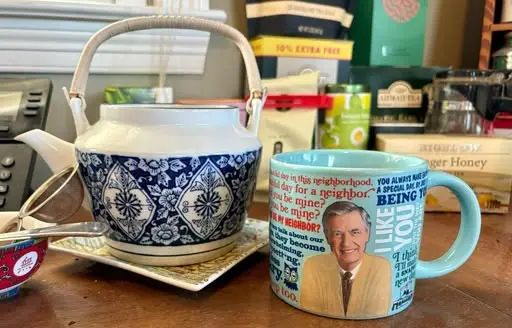
For about two weeks after April 27th, while sipping out of my favorite Mister Rogers mug (the best part about it is that Mister Rogers’ famous sweater even changes color when hot water is added), I would see new videos on YouTube, or new articles in my favorite music blogs chastising The New York Times’ “Thirty Greatest Living American Songwriters” article. Every morning I would stare into the face of Fred Rogers knowing that he’d be so distraught about all the provocation and trolling, especially in the world of music, since music was such an important aspect of his children’s ministry. On his show, art and music were made for the purpose of wonder, not power.
Another part of my daily morning routine, as I drink my tea, is to read the Beatitudes out loud. These sayings are among Jesus’ most famous, but also his most subversive. The powerful, rich, and famous are not the ones who receive God’s blessing in Jesus’ own words. The list from the Times article included record moguls, astronomically famous rich people, including billionaires like Taylor Swift, Jay-Z, and Bruce Springsteen, and generally people in the “in” crowd. Their idea of “greatest” didn’t seem to include the meek, poor of spirit, or the persecuted.
But what does the word “greatest” even mean? Could there be a more subjective word in the English language? I started to wonder if Jesus had anything to say about that, when I was struck by the song “Who is Greatest?” by Jon Guerra, one of my personal favorite current songwriters, and the artist I wrote about in a previous article for Jerusalem Perspective.[2] It always amazes me that well-written song lyrics can so easily stick with me. The song starts:
Who is greatest in the kingdom
The kingdom of heaven
Who would you say?
Not the rich and not the strong
Not the brilliant, but the small
Jon Guerra’s song is largely based on Jesus’ words from Matthew 18:1-5. I didn’t have these verses memorized, so as I sat in front of my computer with my mug of tea, I did a quick Google search and here is what it reads:
Truly I tell you, unless you change and become like little children, you will never enter the kingdom of heaven. Therefore, whoever takes the lowly position of this child is the greatest in the kingdom of heaven. And whoever welcomes one such child in my name welcomes me.
After reading these words, I looked back over the list of thirty songwriters included in The New York Times Magazine, and I saw it decidedly lacked any focus on children or children’s music. The one exception was Dolly Parton, who released her first children’s album at the age of seventy-one. But Dolly is a unique talent, and she might be the only person everyone in the U.S. from all sides can agree on as being great…[3] well, maybe her and Mister Rogers.[4]

As I took my last sip of tea that morning, I looked into the familiar face of the man I had spent hours as a child watching on TV. I thought surely Matthew 18:1-5 must be at the core of everything Fred Rogers taught on television for nearly fifty years. Fred created a show where he could show Jesus’ love without ever speaking Jesus’ name, something that would have been out of place on a public television station. Mister Rogers’ faith in the Kingdom of Heaven was such a core part of the show that you can see it even in the lyrics of the opening song, “Won’t You Be My Neighbor?”:
It’s a beautiful day in the neighborhood
A beautiful day for a neighbor
Would you be mine?
Could you be mine?
It’s a neighborly day in this beauty wood
A neighborly day for a beauty
Would you be mine?
Could you be mine?
I have always wanted to have a neighbor
Just like you
I’ve always wanted to live in a neighborhood with you
Music and Lyrics by Fred M. Rogers. © McFeely-Rogers Foundation.
How clearly this song echoes Jesus’ teaching on the greatest commandment, to “Love your neighbor as yourself”! Jesus wanted his followers’ greatest expression of love for God to be shown through how they treat the people around them—like neighbors. Mister Rogers took this teaching and applied it to his children’s television ministry. The entire premise of his show was that everyone is welcome and everyone is connected by belonging to the same “neighborhood.” Mister Rogers’ Neighborhood created a space, a community, where every child and every viewer belonged. Mister Rogers truly loved his “television neighbors.”
You can also hear in this song echoes from Jesus’ parable of the Good Samaritan (Luke 10:25-37). In the parable, a priest and a Levite, both people of power within society, pass by a broken and robbed man, whose very presence on the roadside cried out to them, “Won’t you please, won’t you please, please won’t you be my neighbor?” The surprise in Jesus’ story is that it was an outsider, a Samaritan, who had the heart to assume “since we’re together we might as well say…won’t you be my neighbor?” and helped the robbed man, proving what it means to be a true neighbor.
Sidebar: Sometimes People Are….by Joshua N. TiltonJust as Dan sometimes sings Mister Rogers’ songs at the respite center where he works, I frequently sing Mister Rogers’ songs to the residents at the nursing home where I work on the weekends as a C.N.A. These songs are familiar to most of the residents, whose children and grandchildren grew up watching Mister Rogers’ Neighborhood on PBS. One of the songs I sing most often is “It’s You I Like,” which speaks about loving a person for who they are (“your skin, your eyes, your feelings”), not they way they look, or how they dress, or the things they own (“it’s not your toys, they’re just beside you”). “I hope that you’ll remember even when you’re feeling blue that it’s you I like, it’s you yourself, it’s you…it’s you I like.” In his article Dan discusses how Jesus’ teachings on the love command find expression in the songs of Mister Rogers. I couldn’t resist adding one more example. One of the interpretations of the love command that is behind Jesus’ teaching is “Love your neighbor because he is like you.” In other words, it becomes possible to love our neighbor when we take a moment to stand in her shoes and realize that as annoying or frustrating or baffling as we might find our neighbor, that person really isn’t so very unlike ourself. This kind of love requires a high level of self-awareness. We need to realize that we have our own flaws and imperfections, our own shortcomings and weaknesses, and that despite these foibles we’re still awesome creatures made in the divine image. One of the songs in which Mister Rogers helped children to gain this self-awareness is “Sometimes People Are Good.” Here are the lyrics of the final verse: Sometimes people are good, An appreciation for human complexity, that none of us are all bad or all good, that we all do things sometimes that we know we shouldn’t, but this doesn’t cancel out our worth or the love God has for us, is part of what lies behind the “New Sensitivity” in ancient Judaism, which gave rise to great thinkers and theologians like Jesus. Jesus was part of an internal revolution within Judaism that prioritized love for God and neighbor over ritual acts, and that adopted a more nuanced view of humanity than the older division between “righteous” and “wicked.” Mister Rogers’ song “Sometimes People Are Good” challenges us to remember that we all do things we don’t approve of and can’t explain. When we realize this about ourselves, it becomes easier to have compassion and empathy for our neighbors, who are also a mixture of bad and good. |
When Mister Rogers wrote, “I have always wanted to have a neighbor just like you,” he meant it, and if you spend any time watching his show, you understand quickly that was true. In 1969, while the U.S. was boiling with racial tensions over equal rights, he famously put his feet in the same swimming pool as the show’s African American police officer. Throughout his show’s history Mister Rogers also always made sure to have guests with different disabilities, and always portrayed them as equals. Outsiders were always welcomed to become insiders in Mister Rogers’ Neighborhood.
Mister Rogers also treated children on his program as fully human, and not as something less. The way Mister Rogers respected children is an outworking of the doctrine that every human being is created in the image of God, a concept that was central to the teachings of Jesus. One of the ways you can most clearly see Mister Rogers’ respect for children is in how he approached music on his show. In my opinion, too many songs written for children are overly simple or boring, but Mister Rogers’ songs are sneakily complicated and full of musical modulation and nuance. Mister Rogers even had the inspired wisdom to hire Johnny Costa, one of the most talented jazz pianists of his generation, to play all the songs live during the show. Every time you’d hear the famous piano intro as Mister Rogers walked into the house and put on his sweater, Johnny Costa would add subtle jazz variations to the melody. No version was ever the same from show to show, and every time the show started the audience was hit with a sense of wonder. This level of complexity is simply not seen in other children’s programming.
Part of my day job is to do music therapy for adults with disabilities, and I can speak from experience that an average Mister Rogers’ song contains well over ten chords, while the normal pop song, folk song, or children’s song might have four to five at the max. Whenever I lead the song “Won’t You Be My Neighbor” to a group at my workplace, I need a chord chart to help me through the various modulations of musical keys that happen, but even with the complexity, everyone in the room knows each and every word. The intricacy of the song turns into one of its greatest strengths. It sets it apart, and makes it more memorable compared to other children’s songs.[5]
Thinking about Mister Rogers’ musical talents, it occurred to me that instead of making an arbitrary list of who are the best living songwriters, I should put together a list of the songwriters who had the biggest impact on my personal life, my faith, and my own craft. I took a sip out of my Mister Rogers tea mug, and as I looked at his kind and familiar face my brain woke to the only obvious choice: Fred Rogers had to be on the list of my personal favorite and most beloved songwriters. It was his songs I used to sing as a child, and in turn it was his songs that I sang to my own children when they were young. Whenever I play any of his songs for the adults with disabilities where I work, the entire room immediately starts singing along. A perfect example is Mister Rogers’ song “You Are Special”:
You are my friend, you are special
You are my friend, you’re special to me
You are the only one like you
Like you, my friend, I like you
In the daytime, in the nighttime
Anytime that you feel’s the right time
For a friendship with me, you see
F-R-I-E-N-D, special
You are my friend, you’re special to me
There’s only one in this wonderful world
You are special
Music and Lyrics by Fred M. Rogers. © McFeely-Rogers Foundation.
I’ve discussed my love for Mister Rogers many times with my friend Joshua, the editor of Jerusalem Perspective, who is also a Mister Rogers fan, and he thinks that just like “Won’t You Be My Neighbor?” the song “You Are Special” is based on the commandment “Love your neighbor as yourself.” He says that the word we normally translate as “neighbor,” רֵעַ (rēa‘), can also mean “friend.” Jesus criticized a false interpretation of the love command—“You have heard it said, ‘Love your friend, and hate your enemy,’ but I say to you, love your enemies…” (Matt. 5:43-44)—but Joshua thinks Mister Rogers applied this meaning of רֵעַ (“neighbor”/”friend”) correctly. In “You Are Special” Mister Rogers was saying: you are my friend/neighbor, and therefore I like you. The fact that you are my friend/neighbor makes you special to me. Not just on an emotional level, but in an ethical sense. Because you, whoever you might be, are my neighbor/friend, I have an obligation to love you and even to like you, to discover what’s special about you and to value the way in which you uniquely reveal God’s image.
Mister Rogers’ songs have brought true good fruit into the world. They are full of love, joy, peace, patience, kindness, goodness, faithfulness, gentleness, and self-control. Speaking of self-control, that brings me to one last song that shows how Mister Rogers’ songwriting was influenced by the teachings of Jesus. On May 1, 1969 Mister Rogers was called to testify in front of a U.S. Senate Committee at the Capitol Building in Washington, D.C., regarding whether Congress should continue funding public broadcasting. There was a real risk the entire endeavor would end if the funds were pulled. Mister Rogers was called to speak, and he used much of his short six-minute speech reciting his timeless song “What Do You Do With the Mad That You Feel?” In a hushed room full of some of the world’s most powerful men, Mister Rogers calmly spoke:
What do you do with the mad that you feel
When you feel so mad you could bite?
When the whole wide world seems oh, so wrong…
And nothing you do seems very right?
What do you do? Do you punch a bag?
Do you pound some clay or some dough?
Do you round up friends for a game of tag?
Or see how fast you go?
It’s great to be able to stop
When you’ve planned a thing that’s wrong,
And be able to do something else instead
And think this song:
I can stop when I want to
Can stop when I wish
I can stop, stop, stop any time.
And what a good feeling to feel like this
And know that the feeling is really mine.
Know that there’s something deep inside
That helps us become what we can.
For a girl can be someday a woman
And a boy can be someday a man.
Music and Lyrics by Fred M. Rogers. © McFeely-Rogers Foundation.
We’ve already seen what a huge influence Jesus’ teaching on the love commandment had on Mister Rogers’ songwriting. He invited everyone to become his neighbor and affirmed that everyone who belongs to the human neighborhood is special. Closely related to Jesus’ teaching on the love commandment, which extends all the way to loving our enemy, is Jesus’ teaching on non-retaliation: “You have heard that it was said, ‘An eye for an eye, and a tooth for a tooth.’ But I say to you, do not retaliate with evil. If someone strikes you on the right cheek, turn to him the other cheek also” (Matt. 5:38-39). Before we can truly learn to love an enemy, we have to learn how not to hate them and how not to act upon that hatred through physical violence. Mister Rogers applied this principle in Jesus’ teaching to his audience of children, asking them the challenging question “How do you cope with your anger?” Just as Jesus instructed his followers to come up with a plan for how to respond to insult and injury (don’t escalate the cycle of violence, but turn the other cheek), Mister Rogers helped his child audience to come up with a plan for how to deal “with the mad that you feel.” What looks like simple advice for children turns out to be a profound application of Jesus’ teaching in the Gospels, and Mister Rogers’ example of applying Jesus’ words to his child audience should challenge us to think more deeply and more creatively about how to put Jesus’ teaching on non-retaliation into practice in our grown-up settings today.
When Mister Rogers finished reciting his lyrics, Senator John Pastore of Rhode Island, who earlier in the hearing sounded entirely skeptical of the public broadcasting budget, broke into a huge smile and said, “I think it’s wonderful, I think it’s wonderful. Looks like you just earned the twenty million dollars.” You can watch it here, along with the 6.8 million people who already have: https://www.youtube.com/watch?v=fKy7ljRr0AA. I can think of nothing more punk rock or cool than that moment. What other songwriter has done something so powerful and subversive at Congress? And all because Mister Rogers intentionally and creatively put Jesus’ words into practice.
An entire book could be written showing all the examples of how Jesus’ teachings are found throughout all of Mister Rogers’ songs and shows. His life is a reminder to all us artists of what’s really important, namely, children, all people, community, and our relationships. Here’s one last quote from Mister Rogers to ponder:
The music is a huge part of my work…. Having written all the music for the neighborhood I feel like that is one of my gifts to children. Here is a way that doesn’t hurt you or anybody else to say who you are and how you feel.
Mister Rogers might not make a future New York Times list, but Mister Rogers will always be at the top of the list of my life’s greatest songwriters. I hope his legacy inspires other people to get into the arts, get on TV, make kind YouTube videos, write songs, and to focus their love and creativity on children. Jesus himself said, “Let the children come to me,” and Mister Rogers’ life and art set an example for all of us to do the same. After all, he was special, and, equally, so are you.
Notes
- See “The Thirty Greatest Living American Songwriters,” The New York Times Magazine (27 April 2026) [https://www.nytimes.com/interactive/2026/magazine/greatest-american-songwriters-alive.html]. ↩
- Dan Cloutier, “Candy Bars and Jesus: Taking a Risk on Jon Guerra,” Jerusalem Perspective (2026) [https://www.jerusalemperspective.com/34528/]. ↩
- See Lulu Garcia-Navarro, “Author Sarah Smarsh Discusses Her New Book On ‘The Great Unifier:’ Dolly Parton,” Weekend Edition Sunday (National Public Radio, 18 Oct. 2020) [https://www.npr.org/2020/10/18/925069851/author-sarah-smarsh-discusses-her-new-book-on-the-great-unifier-dolly-parton]. ↩
- I finished writing this article in early August 2026, and Joshua, JP’s editor, and I were going back and forth with some small changes when Dolly passed away on August 25, 2026. It has been beautiful to see people of all kinds of faiths, backgrounds, and political leanings come together to celebrate her. She was without a doubt an amazing songwriter, but also a tremendous humanitarian, who had given away over half a billion dollars to all kinds of charities. Her Imagination Library alone has donated over 330 million books to children worldwide without resources, and she started this as a tribute to her dad, who never learned to read. What an amazing and generous life she had, and what a blessing to so many children. May her name continue to be a blessing. ↩
- For an insightful discussion of Mister Rogers’ music, check out the YouTube video “Mr. Rogers’ Music Was Way More Intricate Than You Remember” [https://www.youtube.com/watch?v=Z40SZ77CHK0] by Charles Cornell, a musician who teaches millions of people about piano and music theory. ↩