How to cite this article: Dan Cloutier, “‘Jerusalem’—A Song I’ve Not Sung in Five Years,” Jerusalem Perspective (2026) [https://www.jerusalemperspective.com/36933/].
“O Jerusalem” were the last two words my father ever spoke to me. My dad was diagnosed with a rare and aggressive form of lymphoma during the Covid pandemic. I learned of the diagnosis by a phone call from him in the early afternoon of January 6, 2021. He was hopeful, as he had beaten prostate cancer before, but I could tell from his voice that this diagnosis was different and more serious. I took the phone call outside in the frigid Massachusetts winter as I paced around my yard listening to my dad’s bravery in the face of unfavorable odds. I think he said the chance of remission was around 30%. At the end of our conversation I told him I love him and that I’d be there in any way I could be, and then I went inside. I tried to warm back up with a cup of tea, and I opened my computer to find some kind of distraction before teaching my next virtual class. But when I checked the headlines I saw people violently storming the U. S. Capitol Building. I’ll just simply state that in my life, January 6, 2021 was not a good day.
Over the next six months, my dad battled with every ounce of his soul against his disease, and since his treatments meant that his immune system was about as compromised as it could be, my two sisters and I had to watch from a distance. We couldn’t risk getting him sick by our presence. Pandemics can steal so many things from us, one of them being time. By mid summer, we all realized that there was nothing else my dad could do, he had exhausted every last course of action, so we finally were able to gather together again. Covid could still take him out, but the cancer was about to do that anyway. He thought he still had at least a month left, but the moment we started hospice, he immediately slipped away into a dying haze.
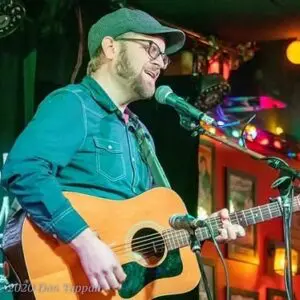
For those last three days I would bring my guitar to his new bedside, now on the first floor in my childhood home’s den, and I would sing his favorite songs for him. I sang “Be Thou My Vision,” “Amazing Grace,” “Great is Thy Faithfulness,” and a few of my own songs that he deeply loved. Near the end, I started to sing my song “Jerusalem,” and when I got to the chorus of “O Jerusalem, O Jerusalem, I love you,” my dad, with closed eyes, sprang back to life for a brief moment, and sang along. “O Jerusalem, O Jerusalem, I love you.” I finished the song with tears in my eyes, and he was back in the fog of death. That was the last direct communication the two of us ever shared, and he was gone a day and a half later.

I wrote my song “Jerusalem” about a year after I had studied abroad for five months in that city in 2001 at Jerusalem University College. I was just reflecting with a friend this week on that season of my life, and how it grew me. My time in Jerusalem is the marking point in my life between childhood and being an adult. I went there as an American kid who only ate pizza and chicken nuggets, who only knew one kind of expression of Christian faith—a modern American evangelical one with full rock bands—and I returned eating hummus and falafel, and longing for chanting monks and incense in my worship.
The summer I wrote “Jerusalem,” I was actually going through a bit of a mental crisis of my own. It was a classic “just graduated from college, dumped by a girlfriend, and not knowing what to do with my life” kind of anxiety and depression. The melody and lyrics of “Jerusalem” rose out of me as a call of desperation. When I picked up my guitar that afternoon, I didn’t intend to write a song about the city, but there was nothing else I could have written at that moment. Fellow songwriters all know the feeling of a piece of art coming out of you with very little effort of your own, like it was actually being spoken by someone else. It simply sprang up like a geyser.
My song starts:
May the ones who love you have safety
May the war inside you forever sleep
O Jerusalem, O Jerusalem
I love you
O Jerusalem, O Jerusalem
Peace within you
There were so many people I met during my stay in the Holy Land who loved the city, but who also showed great personal love to me. In part, I grew from a child into an adult because of all these people and stories.
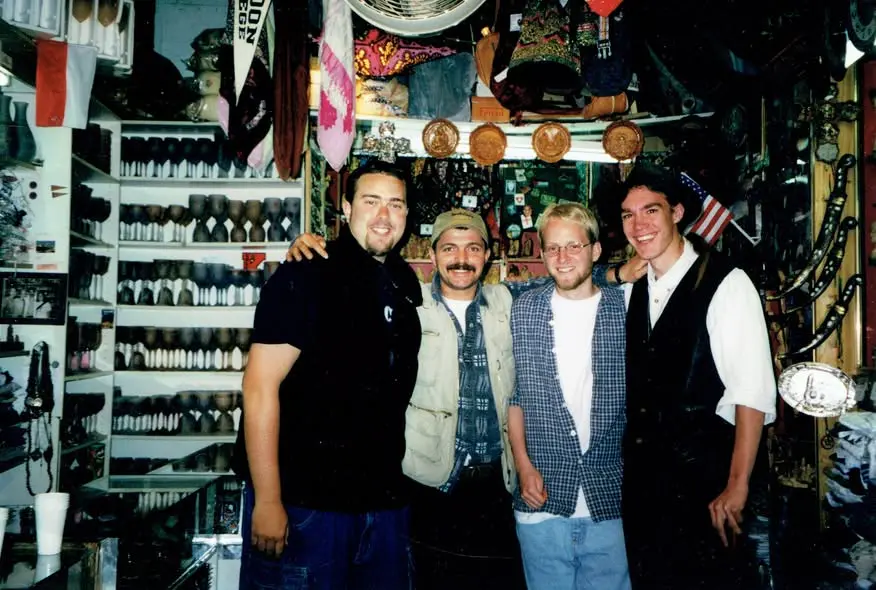
There was my dear Muslim friend, Suleiman, a shopkeeper in the Old City Bazaar (Arab Souk), who took so many of my fellow Christian students under his wing and gifted us with tea and countless hours of conversation. Even twenty-five years later, we are still friends on Facebook, and he never forgets a birthday greeting.
There was the Arab Israeli man who invited a small handful of us over for one of the most delicious dinners of my life at his home to talk about his experiences growing up in the minority in Israel and graciously take all of our (what I’m sure were naive) questions.
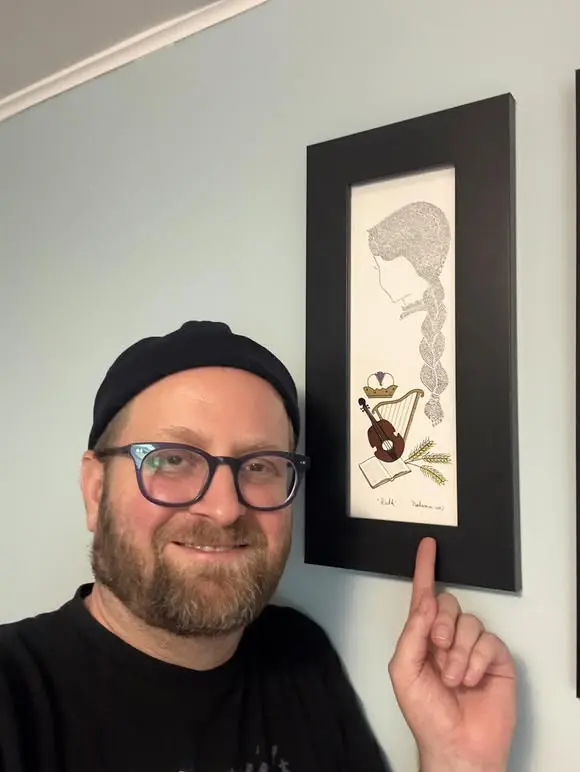
There were also two Jewish shopkeepers, Moshe and Dov, who ran a Zionist bookstore in the Jewish Quarter. Their store had a lovely card that showed the image of Ruth from the Tanakh, or Old Testament, with her image being formed by the written Hebrew text from the book. My grand plan as a twenty-one-year-old was to give that card to the first girl I truly fell for. I would simply write “I love you” on the inside. When I returned to Jerusalem six years later, I went back to that same store, told them the story of how I had just recently given away my Ruth card to the love of my life, and they gifted me, free of cost, a much larger and more expensive print of the same image, which I subsequently went on to use in my proposal to my now beloved wife.
While I was back in the Holy Land visiting two friends who were studying at Hebrew University, and two friends teaching in Beit Jala in the West Bank, I sang “Jerusalem” to a class of Palestinian high school seniors. They patiently sat through my simple folk song, but burst into excitement about their love of American hip-hop. One was a fellow songwriter, and I loved talking shop with him.
I’m telling these stories simply to show that I saw kindness and goodness in both Jew and Muslim alike, in both Israeli and Palestinian alike, in both religious and secular alike. All these people loved Jerusalem, and all these people showed me love too.
The next verse of my song goes:
Sidebar:
|
When I stood in your gates my heart burst into song
But I look at your walls and see bullet holes, what’s going wrong
O Jerusalem, O Jerusalem
I love you
O Jerusalem, O Jerusalem
Peace within you
Lord save us from destruction
Lord save us from destruction
Let us breathe another day
That last line, “Lord save us from destruction,” is the reason I haven’t been able to sing my song ever since that night I last sang it for my father. It was hard enough to sing it in front of my once strong father, who just two years beforehand had ridden a fifty-mile bike ride with me on our family Cape Cod vacation, now destroyed by a cancer that made every moment of life agony. But how was I supposed to sing those words afterwards? Hadn’t I just seen unstoppable destruction?
My song and the lyrics within were largely based on Psalm 122, a Psalm of Ascent that has been sung or recited for millennia by people on pilgrimage to Jerusalem.
May those who love you be secure.
May there be peace within your walls
and security within your citadels.
For the sake of my family and friends,
I will say, “Peace be within you.” (Ps. 122:6-8; NIVUK)[1]
I imagine countless pilgrims also experienced great personal loss, just like I now have. From the first time I sang my song in public, it was immediately the best received song I’d ever written, and that includes people of all different walks of faith, and even those without any religious affiliation. There is something universal about the call for peace, and the desire to stop pointless destruction. Jesus himself wept over the city as he approached it on the way to the cross (Luke 19:41-44).
Many atheist friends would come up to me afterwards, saying how the song moved them as well. The song became my musical calling card, and I played it all the time, but especially whenever tragedy struck the world. I remember singing “Jerusalem” at the open mic I ran the day after the terrorist attack in Paris, where ninety people were slain at the Bataclan music hall watching a band from my own country, the United States. I was in a room full of fellow musicians who were all traumatized by the images on the news of people slain on the floor of a concert venue. Everyone at my open mic joined me singing “Lord save us from destruction” that night.
I remember singing “Jerusalem” whenever I heard about a terror attack in Israel, and I even sang it after the Boston Marathon Bombing, in which I personally knew ten people who, although physically uninjured, were directly across the street from the explosion, and were emotionally and spiritually scarred by all the carnage they witnessed. That was thirteen years ago, and one of my dear friends was only able just last year to be around fireworks again.
Anyone who has spent any real time in Jerusalem knows some place that has been forever changed by violence. The Sbarro pizza joint on King George Street, where I used to eat, was bombed just months after I left, killing 16 and wounding over 130 others. The bar where I had my first ever Murphy’s Irish Stout was attacked shortly afterwards. Only something as stark as a terrorist attack could make me remember, twenty-five years later, such a trivial detail as what kind of beer I drank there.
For twenty years I was able to continue singing “Jerusalem” until I faced my own deeply personal hardship. Maybe I now fear having to be so vulnerable with my art. Maybe I just hold that last interaction with my dad so close to my heart that I don’t want to share it with anyone anymore. I know that when I finally do sing “Jerusalem” again in front of a crowd, or even just in front of one single human, I’m going to break down in tears.
So, when the heinous terrorist attack happened in Israel on October 7, 2023, my singing voice remained silent. I prayed, and got down on my knees for the countless people who were lost, but I just couldn’t sing my song “Jerusalem.” In the subsequent months, when I saw the blown-up buildings in Gaza City, and saw the lines of refugees fleeing for their lives, I still couldn’t sing my song. Even though I knew so many people who are now gone loved Jerusalem, I just couldn’t sing my song.
Writing this article is a way for me to explain why I haven’t shared what is still one of my most requested songs, but it is also a way for me to prepare myself for the time when I’m ready to sing it again. I can feel deep in my bones that my season of healing hibernation is coming to an end.
Today I pray:
Lord save us from destruction!
Save the child forced to be a soldier, the child trapped beneath the rubble, the child who is taught to hate their neighbor!
Lord save us from destruction!
Save us from the horrors of war seen in Gaza, Ukraine, Iran, Syria, Israel, Lebanon, Myanmar, Sudan, the Democratic Republic of the Congo, Haiti, and countless other places!
Lord save us from destruction!
Save us from political violence that has come to my own country, like the savage and hateful rhetoric on social media platforms, the January 6th insurrection, the assassinations of Charlie Kirk and Melissa and Mark Hortman, the murders of George Floyd and Alex Pretti.
Lord save us from destruction!
Save us from terrorism around the world, from the October attack in Israel, to the people lost at the Christmas market attack in Berlin, the attack on Bastille Day in France, the Boston Marathon bombings so close to my own home, to countless other examples of fearful violence perpetrated on innocent civilians!
Lord save us from destruction!
Save us from our own broken minds and bodies that struggle with depression, anxiety, addiction, illness, cancer of all kinds, especially lymphoma!
My song ends with the final refrain:
Glorious hours your hills someday will tell
May your valleys hide the face of hell
O Jerusalem, O Jerusalem
I love you
O Jerusalem, O Jerusalem
Peace within you
What brings me comfort after my dad’s passing is the hope that comes with the idea that this universe is not a mistake, and that there is a God behind it all who loves people, not just those with the most power, or force, or even those that are right. I’m comforted by the hope that there is true redemption for the broken, the abused, the victims of violence and suffering in the promised New Jerusalem. I have no idea what the New Jerusalem will look like, but I do choose to believe that “The Kingdom of God is near” (Luke 21:31).
The famous passage in Revelation 21 has also become much more dear to me after my dad passed:
Then I saw “a new heaven and a new earth,” for the first heaven and the first earth had passed away, and there was no longer any sea. I saw the Holy City, the new Jerusalem, coming down out of heaven from God, prepared as a bride beautifully dressed for her husband. And I heard a loud voice from the throne saying, “Look! God’s dwelling-place is now among the people, and he will dwell with them. They will be his people, and God himself will be with them and be their God. He will wipe every tear from their eyes. There will be no more death or mourning or crying or pain, for the old order of things has passed away.” (Rev. 21:1-4; NIVUK)
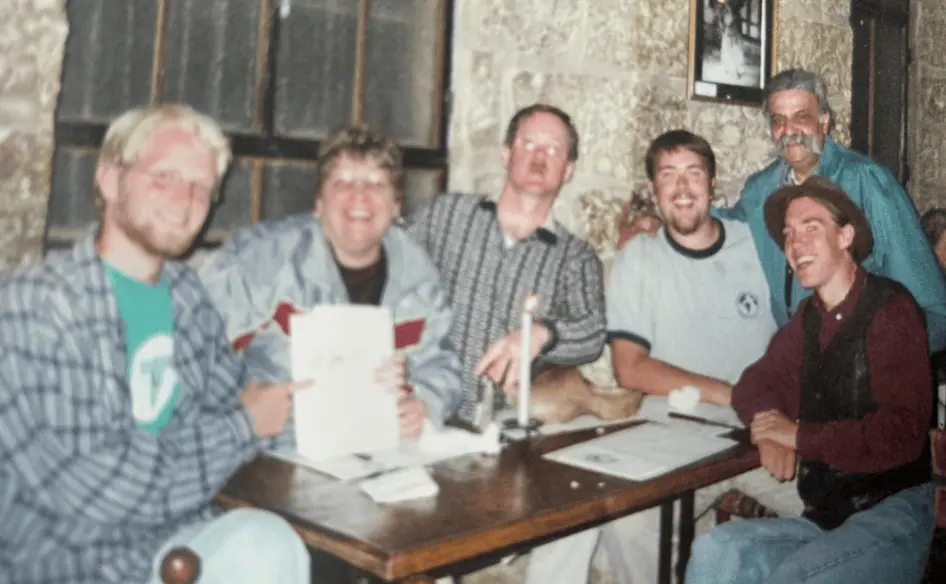
My parents came and visited me for a week while I studied in Jerusalem back in 2001. They arrived tired from the day of travel and overwhelmed by the general chaos of a city that is claimed by all three major monotheistic religions. It was exactly how I felt my first day in Israel, but by then I had been in Jerusalem for about four months. I met my parents and toured them around a place that had begun to feel like home. The narrow streets were no longer chaotic. I had my mom and dad meet my shopkeeper friend, showed them the bookstore where I bought my Ruth card, and took them to pray at the Western Wall. They commented after that first day that they were in disbelief at how much I had grown. And I had. Jerusalem, and all the people who call it home, grew me into the person I am today.
One of the souvenirs I bought for my dad before I returned home myself was two kippahs with the logo of the Boston Red Sox, my hometown baseball team, on top. My dad loved baseball, and I also haven’t really been able to watch my hometown team since he’s been gone, but as I type this article I have the Red Sox on in the background. In fact, the Red Sox just beat our rivals, the New York Yankees, but I still can only watch baseball in small snippets. Grief is part of the human experience, and I can weep for my dad just as Jesus wept over Jerusalem in the midst of his triumphal entry. The hope is that someday every tear will be wiped away.
I’m not quite ready yet to sing “Jerusalem” out loud, but I am willing to share this instrumental version. Often I find that a simple melody can be the most powerful form of prayer, and my fingers won’t shake or crack.
May the ones who love you have safety
May the war inside you forever sleep
Amen.
Readers who wish to hear a 2006 recording of the song with vocals can purchase an mp3 download of Dan’s song for $1.00 from the JP Bookstore. (For Friends of Jerusalem Perspective the download is free.) Proceeds support Dan’s music and Jerusalem Perspective’s mission.
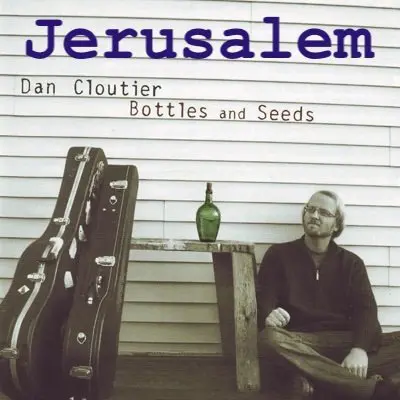
“Jerusalem” by Dan Cloutier
Audio download (mp3 format) of the song “Jerusalem” by Dan Cloutier.

Notes
- Quotation according to the New International Version, UK edition. ↩