

How to cite this article: JP Staff Writer, “Character Profile: Beelzebul,” Jerusalem Perspective (2024) [https://www.jerusalemperspective.com/29561/].
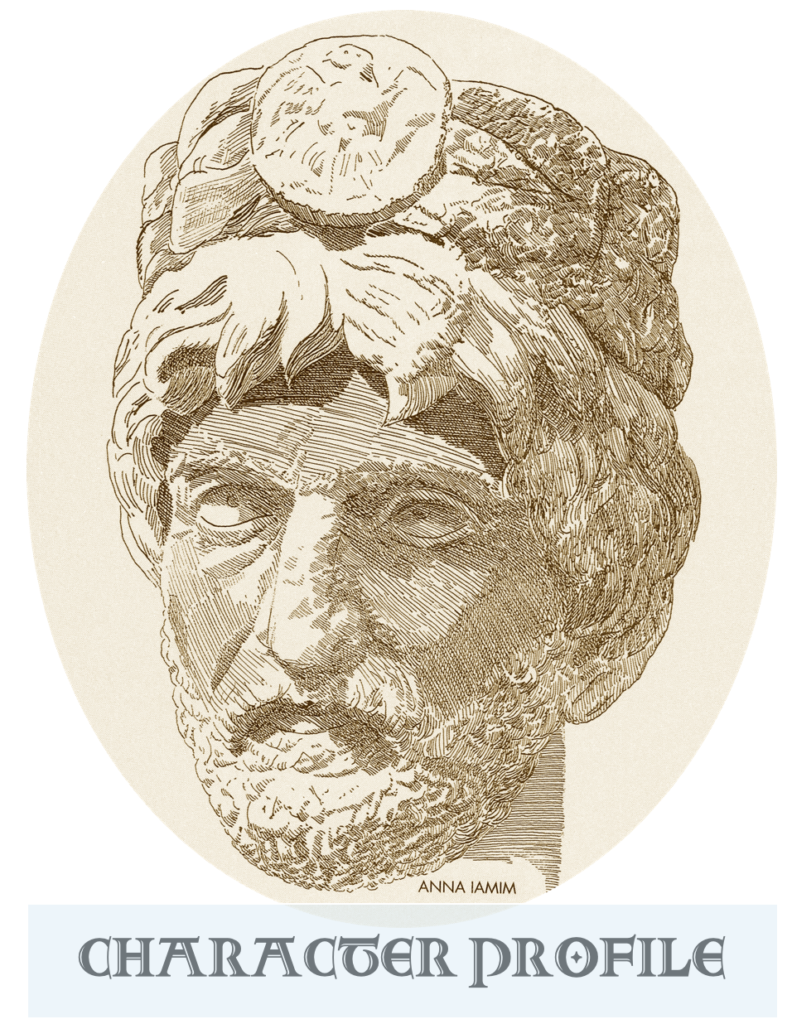
The Synoptic Gospels make reference on a few occasions to a malignant being named Βεελζεβούλ (Be·el·ze·BOUL, “Beelzebul”; Matt. 12:24 ∥ Mark 3:22 ∥ Luke 11:15; Matt. 12:27 ∥ Luke 11:19; Matt. 10:25), who is identified as “the prince of demons.” No being by this name is ever mentioned in any pre-Christian source. Neither is he mentioned in any ancient Jewish source that was untouched by Christian redactors.[1] The Gospels remain the sole source of information regarding the origins and identity of this mysterious and sinister being.
Textual Variants
| Rather listen instead? |
| JP members can play or download an audio version of this essay.[*]
Paid Content
Premium Members and Friends of JP must be signed in to view this content. If you are not a Premium Member or Friend, please consider registering. Prices start at $5/month if paid annually, with other options for monthly and quarterly and more: Sign Up For Premium |
Since the identity of this being is so obscure, it is hardly surprising that there is uncertainty about the meaning and even the form of this being’s name. Whereas the majority of texts, including the early papyrus manuscripts P45 and P75, spell his name as Βεελζεβούλ, two important witnesses, Codex Vaticanus (B) and Codex Sinaiticus (א), omitting the first λ (l), give his name as Βεεζεβούλ. Syriac and Latin versions attest to yet another form, “Beelzebub,” an assimilation to the name spelled Βααλζεβούβ (Baalzeboub) in the text of Aquila’s Greek translation of the Hebrew Scriptures (2nd cent. C.E.).[2] There it serves as a transliteration of the name בַּעַל זְבוּב (ba‘al zevūv, “master of a fly”) known from the Elijah narratives, where “Beelzebub” is identified as the god of the Philistine city Ekron (2 Kgs. 1:2).
Which form of the name is original to the Gospels? Two rules of textual criticism seem to lead to opposite conclusions. One rule is that the most difficult reading (called the lectio difficilior) is most likely to be original, since the tendency of copyists was to make sense of incomprehensible readings. The other rule is that the reading that best explains the other variants is most likely to be original.
Premium Members and Friends of JP must be signed in to view this content.
If you are not a Premium Member or Friend, please consider registering. Prices start at $5/month if paid annually, with other options for monthly and quarterly and more: Sign Up For Premium
If you enjoyed reading this profile, you may also want to check out these recent JP articles:
- Bible Versus Scriptures: Part 3—Models of Inspiration
 The third part in JP’s series on the nature of the Scriptures.
 - Bible Versus Scriptures: Part 2—What Goes into the Canon?The second part in JP’s series on the nature of the Scriptures.
- Bible Versus Scriptures: Part 1—More Different Than You’d ThinkThe first part in JP’s series on the nature of the Scriptures.
- Besorat Ha-Malchut: Jesus’ Gospel of the Kingdom for the Humble of SpiritThe questioning of Jesus by two priests—John the Baptist and Joseph Caiaphas—reveals hidden aspects of Jesus’ high self-awareness.
- “Jerusalem”—A Song I’ve Not Sung in Five YearsI haven’t been able to sing one of my best songs for the past five years. This is the story of why.
- The Holy Study Circle: The Ḥavurah (‘Group’) in Rabbinic Literature and Jesus’ Study CircleThe pattern of activity within Jesus’ group is very similar to the modes of operation known from the ḥavurah of the tannaitic-amoraic period.



Notes
- Beelzeboul is mentioned in the Testament of Solomon, where he is again identified as the price of demons, but this pseudepigraphical work was edited by Christian redactors and was heavily influenced by the Gospels. See François Bovon, Luke: Hermeneia—A Critical and Historical Commentary on the Bible (3 vols.; trans. Donald S. Deer [Evangelium nach Lukas, 1989-2009]; Minneapolis: Fortress, 2002, 2013, 2012), 2:118. ↩
- See Edwin Hatch and Henry A. Redpath, A Concordance to the Septuagint and the Other Greek Versions of the Old Testament (Including the Apocryphal Books) (3 vols.; Oxford: Clarendon, 1897; repr., 2 vols.; Grand Rapids: Baker, 1983), 3:30. Henceforth this work will be cited as Hatch-Redpath. ↩

Comments 2
I would have liked to see what the writer has to say by reading the entire article. But since I am at the level of PEER REVIEW, I won’t spend the money to gain access. Also, I have no idea who the writer is, so there’s no way anyone can know what kind of person is writing this stuff.
The ORIGINAL ‘Smith’s Bible Dictionary’ has a much better article on the meaning and reality of Ba’al-Zevuv. Following through with the other ‘gods’ found in that article, by reading the entries in his dictionary will fill in the blanks. There is a lot of history in the word Ba’al that nobody in the Christian world has any idea about. For example, the word Ba’al was the generic word for god back then, just like the word ‘God’ is the generic word for God in Christianity. So Ba’al had many derivatives, many of which were cultural. And when you look at the history of catastrophe-based ‘myth’, even more layers of meaning can be seen.
Anyway, it’s a shame that JP doesn’t know about the Hebrew Gospels. That might clear up a lot of the confusion inherent in these texts.
Author
Dear ChrisH,
Has the JP staff understood correctly that you have not read this article? How then are you able to compare it either favorably or negatively to any other article on the subject? Your professed ignorance of the content of this article undermines the credibility of your assessment. Please read the article before commenting so that you can form an informed opinion on its quality.